Destination photography moves expensive glass through the world’s wettest logistics: airline transit, taxi rain, boat approaches, monsoon streets and beach spray — all before the first frame — so travel shooters, destination-wedding studios, tourism boards and expedition brands buy waterproof travel programs at unit costs from $3.60 at MOQ 500. This guide covers the destination-shoot category from the travel side: the airport-to-location chain, airline-carryable camera formats, wet-approach builds for islands, boats and monsoon cities, the loadout architecture that separates a working travel kit from a protected one, and the program patterns for the buyers whose calendar is a list of places.
The manufacturer reference is QUANZHOU JUNYUAN BAGS: custom waterproof bag production since 2014, 4,950 m² SGS-verified facility, 7 lines, 149 machines, 137 staff, 200,000 pieces monthly. MOQ 500 per design splittable across the travel-photography family, samples 6–10 working days, bulk 35–50 days, AQL 2.5 inspection, 30/70 T/T, FOB Xiamen, shipping to 100+ countries, with facility claims verified by SGS.
The destination chain: five wet events before the first frame
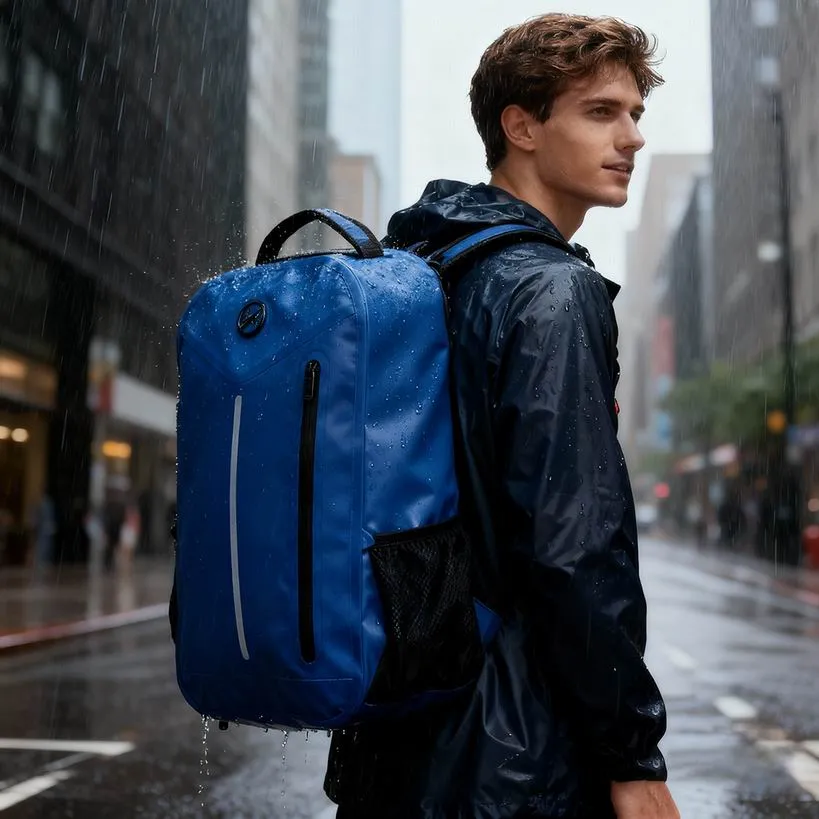
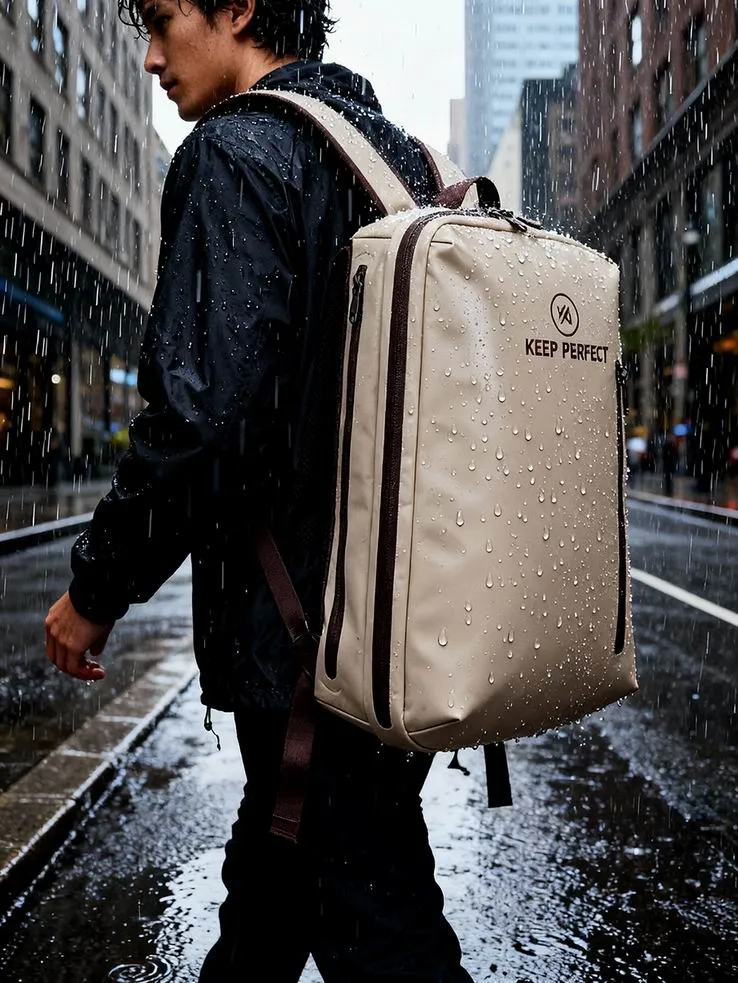
Travel photography bags are engineered against a chain of exposure that starts at the front door and ends at the tripod: the walk to transit in city rain, the airline cabin and its overhead-bin abuse, the carousel and tarmac weather at arrival, the location transfer — boat, jeep, scooter, tuk-tuk — and the approach itself, which on island and coastal destination shoot gear is frequently wet up to the knees. Cabin dimensions are set by airlines rather than by bag designers, so airline-carryable camera formats are drawn against IATA cabin-baggage guidance before the pattern is cut. Each link has a different duty: the transit legs want airline-carryable formats with rain-capable closures, the transfers want abrasion and strap engineering, and the approach wants submersion-class protection for the last hundred meters. The bag that answers all five is a system rather than a product — the shell engineering our camera equipment guide specifies, re-specified for a bag that flies. The protection architecture underneath — suspended dividers, moisture chambers — travels unchanged from the studio build; what changes is everything the airport touches.
The professional’s rule of thumb: protect for the worst link in the chain, not the average. The average destination day is dry; the chain always has one wet link.
The two-bag travel architecture
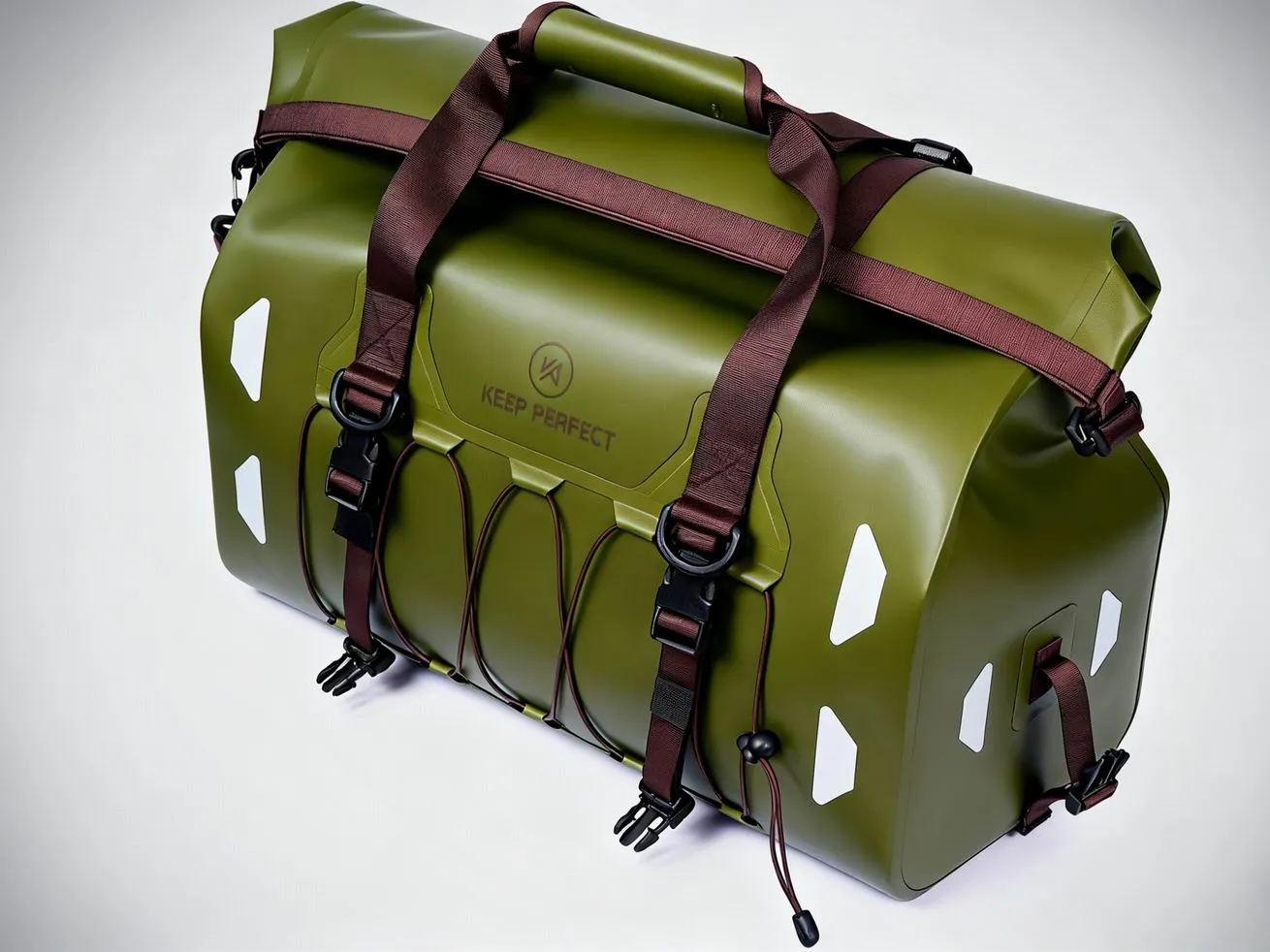
Working shooters do not travel with one bag; they travel with a system, and the system’s shape is remarkably consistent: a carry-on core — bodies, working lenses, laptop, cards — that never leaves the cabin, and a checked or boat-bagged reserve — backup glass, lighting, stands — sealed for the hold. The carry-on core runs the formats our tech protection guide documents for combined electronics: laptop-plus-body suspension, optical windows for transit work, and airline-cabin dimensions engineered into the pattern rather than hoped for. The reserve runs dry-bag duty: welded roll-top builds in the submersion class, the paddling formats our kayaking guide documents, sized to the case the reserve ships in. The interface between the two — what moves where when the weather turns — is the working sling: the fast-access format the lens cases guide extends into the belt-and-sling system a destination day actually runs on.
| System slot | Format | Duty band | Unit cost (500+) |
|---|---|---|---|
| Carry-on core | Airline-dimension camera backpack | Rain-capable transit + cabin abuse | $6.20–$10.40 |
| Working sling | Body-and-two-lens fast-access | Spray, drizzle, run-and-gun | $3.60–$6.80 |
| Reserve dry bag | Roll-top welded 40–60L | Submersion-class hold and boat | $3.80–$7.20 |
| Media wallet | Sealed card-and-drive chamber | All-day body carry | $1.90–$3.40 |
The system splits against one MOQ 500 basis — the per-slot split our MOQ guide documents — and a studio with three shooters outfits the whole roster from one order.
Airline-carryable waterproof engineering
The carry-on build solves a dimensional brief before it solves a weather brief: cabin-liner dimensions, weight discipline (a glass-heavy kit punishes every gram of bag), and open-laptop access at security without unpacking the camera system. The waterproof interpretation keeps the shell capable — laminated 500D faces, storm-flapped zips, a rain cover rated for sustained transit weather — while engineering the airport’s touchpoints: clamshell openings that lie flat on dirty floors without exposing contents, TSA-friendly laptop slots, and grab handles rated for the overhead-bin slam. The cabin-abuse class is real: bins compress, neighboring luggage crushes, and the bag’s frame — the impact architecture our equipment guide names as the second protection system — carries the bin’s load so the glass does not. Weight engineering shows up as laminate selection: modern TPU films deliver the water rating at fabric weights old-school coated nylon could not approach, the materials math our construction methods guide documents.
Wet approaches: islands, boats and monsoon cities
The approach defines adventure photography: the last hundred meters between transport and tripod, which on island shoots is a boat transfer, on coastal work a surf-zone carry, and in the monsoon tropics the street itself. The build pattern is paddling-grade: welded roll-top closures operable with wet hands, submersion-class seams — the rating ladder our IPX rating guide maps — and floating-adjacent behavior: a sealed bag with trapped air rides high for the seconds it needs to after a boat misstep, a fact our marine guide documents for salt-duty hardware that applies to spray-zone glass protection. The monsoon-city variant runs the sustained-rain and humidity engineering of our monsoon travel guide: closure systems that stay sealed through hours of rain and interiors that buffer humidity off the optics, the moisture-chamber discipline the equipment guide specifies.
Island-hopping work adds the multi-leg problem: the bag that protects on leg one must pack down for leg three. Modular systems — a compressible core inside a welded shell — answer it, the packing discipline our travel organizer guide documents for soft systems.
Loadout architecture: what travels where
The destination loadout is a moisture-risk triage: everything that cannot get wet — bodies, drives, cards — lives in sealed chambers; everything that can take spray — stands, modifiers, chargers — travels in splash-band formats; and the day’s working set rides the sling. The architecture follows the two-envelopes doctrine the disaster-response channel uses in our relief operations guide: the inner envelope must survive even if the outer one fails. Practical consequences: the media wallet is sealed even inside the carry-on (cards are the assignment itself, the small-format discipline of our small electronics guide); the reserve dry bag is tested packed, not empty; and a desiccant-and-indicator pair rides every chamber — the humidity defense the equipment guide makes standard. The loadout conversation is the program conversation: patterns are cut to the buyer’s actual kit list, the golden-sample discipline that keeps custom builds honest.
Who buys destination programs
| Buyer type | Typical program | Order shape |
|---|---|---|
| Destination-wedding studios | Roster kits: core + sling + reserve per shooter | 500–1,000 units, season calendars |
| Tourism boards & resorts | Branded shooter kits, media-pool gear | 500–2,000 units, campaign cycles |
| Expedition & adventure brands | Co-branded travel formats for retail | 500–5,000 units, product cycles |
| Workshop leaders & tour operators | Participant kits + staff builds | 500–1,500 units, annual reprints |
Destination-wedding studios order rosters: identical per-shooter systems on one calendar, the per-department split pattern the event channel runs in our event industry guide. Tourism boards and resort brands order media-pool kits — the gear loaned to visiting shooters, branded so every published frame carries the destination’s partner mark, the retail-mirror logic our tourism guide documents. Workshop leaders order participant kits: a branded sling or dry bag as part of the workshop package that survives as gear and as marketing — the retention economics our promotional programs guide quantifies.
Destination program economics at MOQ 500
| Program element | Unit cost adder | Notes |
|---|---|---|
| Airline-dimension pattern + frame | +$1.10–$2.20 | Cabin-fit engineering and bin-abuse frame |
| Roll-top reserve build (vs zip tote) | +$0.80–$1.50 | Submersion-class hold and boat duty |
| Optical window pockets | +$0.30–$0.60 | Transit phone/pass access without opening |
| Sealed media chamber | +$0.40–$0.80 | Cards and drives at the two-envelope standard |
| Brand print/embroidery | +$0.15–$0.35 | Roster identity and workshop branding |
A representative studio roster program lands at $3.60–$10.40 per unit slot at MOQ 500 — the carry-on core at the top of the band, the sling and dry bag in the middle, media wallets at the bottom, all on one golden-sample standard. The arithmetic buyers run next is repair math: one water event on a working body and two lenses exceeds the entire roster order — the same conclusion our equipment guide reaches for the studio side, now applied to the travel chain where the odds are worse.
Sampling against the itinerary
Destination samples validate against the actual chain: the carry-on flies a real itinerary — bin, carousel, taxi — before approval; the dry bag runs a boat transfer packed like a shoot day; the sling works a full location day in delivered weather. The protocol is the golden-sample standard — 6–10 working days per configuration at $60–$150, credited against bulk — with the category’s one decisive test: the packed-float check on the reserve bag, because a dry bag that only seals empty is a prop. Bulk runs 35–50 days at AQL 2.5 with the kit-list patterns frozen at approval, the production chain documented for the full step-by-step.
Remote-location logistics and the packing discipline
Destination work beyond the resort belt adds a logistics layer that changes what a bag must be: locations without support run on what the shooter carried in, and the bag doubles as storage, staging and safe through the whole engagement. The practical pattern: the carry-on core unpacks into working mode and repacks for transit without reconfiguring dividers — patterned once at the golden sample, never re-thought at 4 a.m. before a flight; the reserve bag ships the hold items with the shipping-damage discipline our shipping damage prevention guide documents, because checked glass fails at the seams the carrier can see; and a staged-packing sequence — the method our packing organizers guide formalizes for travel systems — keeps the wet-approach formats accessible rather than buried. Remote weeks also raise the maintenance brief: field-drying discipline for anything that got wet, closure-track cleaning after salt and dust, and the desiccant recharge calendar the equipment guide specifies — performed in a place with no store to replace what fails.
Insurance, liability and the documented build
The working shooter’s insurance policy is quietly the custom bag’s best sales document: gear coverage runs on declared value and risk management, and an underwriter reads "specified waterproof system with sealed media chambers and submersion-class reserve" very differently from "camera bag." Programs for studio rosters increasingly order with the documentation conversation built in: build sheets naming the protection systems, closure ratings from the testing ladder, and batch-coded units mapped to serial-numbered equipment lists — the chain-of-accountability our oil and gas programs use for sample integrity, applied to a studio’s asset register. The liability side matters to the tourism-board and workshop buyers too: a media-pool kit that fails and soaks a visiting shooter’s gear is the brand’s incident, and the branded-bag premium is small against the claim it prevents. The retail-mirror builds in our tourism guide already carry the same logic for guest-facing programs.
The seasonal calendar of destination work
Destination programs order against the season, and the calendar differs by hemisphere and niche: the wedding circuit follows the dry-season windows — the Caribbean winter, the Mediterranean summer, the Southeast Asian November-to-March stretch our monsoon guide maps; the adventure and expedition calendar follows the access windows — rafting seasons, trekking pre-monsoon, polar summers; and the resort and tourism campaign calendar follows the destination’s marketing year, the campaign cycles our tourism guide documents. The production answer is the same at every latitude: bulk lands before the first booking window, reorders run on stored patterns mid-season, and the sample calendar is booked backward from the itinerary — 6–10 working days for samples, 35–50 days for bulk, the full chain in our sampling and bulk production guide. Studios that plan one season ahead pay one freight lane; studios that plan at the last minute pay expedites — the same calendar economics the reorder guide quantifies.
Spec your destination program
- System not product: carry-on core + working sling + reserve dry bag + media wallet on one basis
- Transit brief: airline dimensions, weight discipline, bin-abuse frame, security access
- Approach brief: submersion-class roll-tops for boat, surf and monsoon duty
- Two envelopes: sealed media chambers even inside the carry-on
- Kit-fit: patterns cut to the actual roster kit list, frozen at golden sample
- Calendar: sample before the season’s first itinerary, bulk before the first booking window
Frequently Asked Questions
Q1. What makes a photography bag travel-grade?
A chain answer: airline-carryable dimensions with a bin-abuse frame, rain-capable closures for transit weather, submersion-class reserve formats for boat and surf approaches, and sealed media chambers throughout — engineered for the five wet events between the front door and the first frame.
Q2. What is the MOQ for custom travel photography bags?
MOQ 500 per design, splittable across the travel-photography family — carry-on cores, working slings, reserve dry bags and media wallets mix against one 500-unit basis.
Q3. How much do custom destination shoot bags cost?
Media wallets from $1.90, working slings $3.60–$6.80, reserve dry bags $3.80–$7.20, airline-dimension carry-on cores $6.20–$10.40 at MOQ 500. Airline-pattern engineering adds $1.10–$2.20, optical windows $0.30–$0.60.
Q4. Can a camera backpack meet airline carry-on rules?
Yes — the dimensional brief is engineered into the pattern: cabin-liner dimensions, weight discipline via modern laminate selection, clamshell security access and handles rated for the overhead-bin slam, with the waterproof shell rated for sustained transit rain.
Q5. How do I protect camera gear on boat transfers?
Roll-top welded dry bags in the submersion class, packed-tested before travel and sized to the reserve case — sealed bags with trapped air ride high for the seconds that matter after a misstep, with salt-rated hardware for spray zones.
Q6. What is the two-envelope rule for travel shoots?
The inner envelope — sealed chambers for bodies, cards, drives — must survive even if the outer bag fails. Media wallets stay sealed inside the carry-on, reserve bags are tested packed, and desiccant-indicator pairs ride every chamber.
Q7. Do you make bags for destination wedding photographers?
Yes — roster kits: identical carry-on + sling + reserve + wallet systems per shooter on one production calendar, the per-shooter split a 500-unit order naturally absorbs.
Q8. How do monsoon-city shoots change the spec?
Closure systems rated for hours of sustained rain and humidity-buffering interiors move to the top of the brief — the monsoon-travel engineering our Southeast Asia guide documents, applied to the moisture-chamber standard.
Q9. Can tourism boards order branded shooter kits?
Yes — media-pool programs brand the gear loaned to visiting shooters so every published frame carries the destination mark, the retail-mirror channel our tourism guide documents.
Q10. What about workshop leaders and photo tours?
Participant kits — a branded sling or dry bag in the workshop package — serve as gear and as marketing, reordered annually on stored patterns with the retention economics our promotional guide quantifies.
Q11. How do you test a travel camera bag before a trip?
Fly the carry-on on a real itinerary, run the dry bag through a packed boat transfer, work the sling through a full location day — then the packed-float check on the reserve bag before sign-off. Samples run 6–10 working days at $60–$150 per design, fully credited against the bulk order.
Q12. Are modular systems available for island hopping?
Yes — compressible cores inside welded shells answer the multi-leg problem: full protection on the boat leg, packed-down volume on the transfer legs, the organizer discipline our travel packing guide documents.
Q13. What is the production timeline for destination programs?
35–50 days after golden-sample approval at AQL 2.5 inspection, FOB Xiamen or DDP, timed against the season’s first booking window — the full chain runs from sampling through bulk.
Q14. Can one order outfit a whole studio?
Yes and it usually does: a three-shooter roster takes twelve system slots — three per photographer — well inside a 500-unit order with room for the season’s replacements.
Q15. What fabrics survive salt spray and beach work?
TPU-laminated faces with salt-rated hardware and UV-stable pigments — the marine materials ladder our boating guide documents, at travel weights the construction methods guide makes possible.
Q16. How do we start a destination program?
Send the roster size, the kit lists and the season’s destination profile — the quotation returns in 24–48 hours, samples follow in 6–10 working days patterned to the actual kit.
Q17. Do custom builds help with gear insurance?
They document it: build sheets naming the protection systems, closure ratings from the testing ladder and batch-coded units mapped to serial-numbered equipment lists — the asset-register paperwork underwriters read favorably against a generic "camera bag" line item.
People Also Ask
What bags do travel photographers use?
A system, not a single bag: an airline-carryable core for bodies and laptop, a fast-access sling for the working set, a submersion-class dry bag for the reserve, and a sealed media wallet — the four-slot architecture this guide specs.
Are waterproof camera bags allowed as carry-on?
Custom cores are patterned to cabin-liner dimensions with security-friendly access — the waterproof shell and bin-abuse frame engineered inside the airline envelope.
How do photographers protect gear on boats?
Welded roll-top dry bags rated in the submersion class, packed-tested before travel, with salt-rated hardware for spray zones and floating-adjacent behavior after a misstep.
What does a destination wedding photography kit cost to bag?
From $1.90 for sealed media wallets to $10.40 for carry-on cores at MOQ 500 — a full three-shooter roster fits one 500-unit order with replacement headroom.
Which bag survives monsoon travel shoots?
The monsoon build: closures rated for sustained rain, humidity-buffering chambers and desiccant-indicator pairs — the Southeast Asia engineering applied to camera duty.
How fast can a studio roster program be produced?
Samples in 6–10 working days, bulk in 35–50 days after golden-sample approval — timed backward from the season’s first booked itinerary.