Every buyer’s first question about custom waterproof bags eventually arrives at the same number: the minimum order quantity. MOQ is quoted like a wall — 500 pieces, take it or leave it — but it is not a wall; it is the factory’s cost structure expressed as a single number, and every part of it is explainable, negotiable within its physics, and useful to understand before the first purchase order. Buyers who understand where the number comes from negotiate it intelligently; buyers who do not either overpay for small runs or walk away from factories that were actually the right partner. The quality terms written into that first order — AQL levels, leak-test method, defect classification — should cite published methods from bodies such as ISO rather than a factory’s own description.
This guide explains the machinery behind MOQ for custom waterproof bags: the cost drivers, why 500 pieces is the industry’s honest equilibrium, the levers that genuinely move minimums, the mixed-order structures that stretch a budget, and the first-order strategy that turns a minimum into an advantage. QUANZHOU JUNYUAN BAGS: custom waterproof bag production since 2014, 4,950 m² SGS-verified facility, MOQ 500 pieces per style. We publish our minimum because we can explain it — sampling in 6–10 working days, bulk 35–50 days, FOB Xiamen.
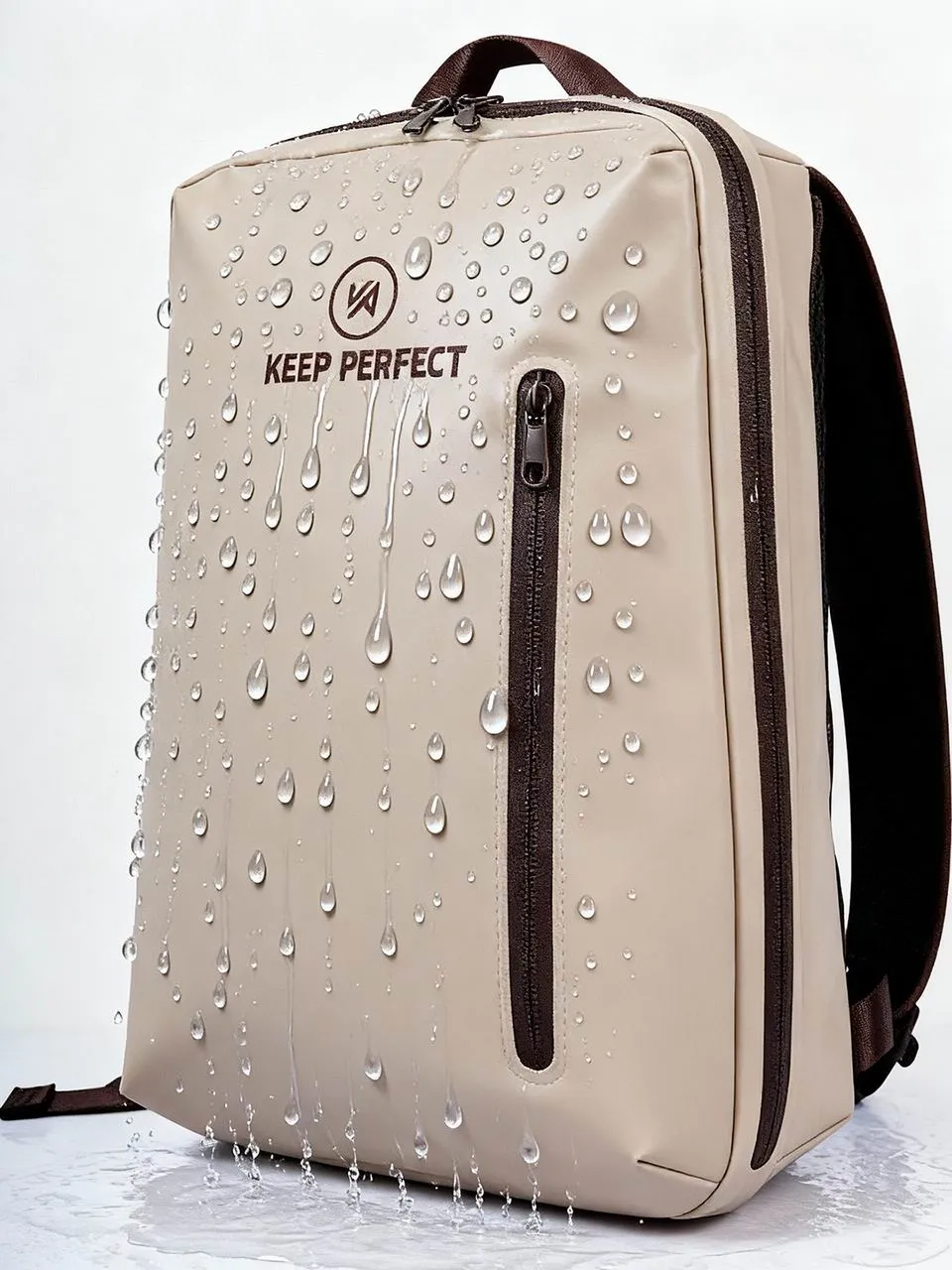
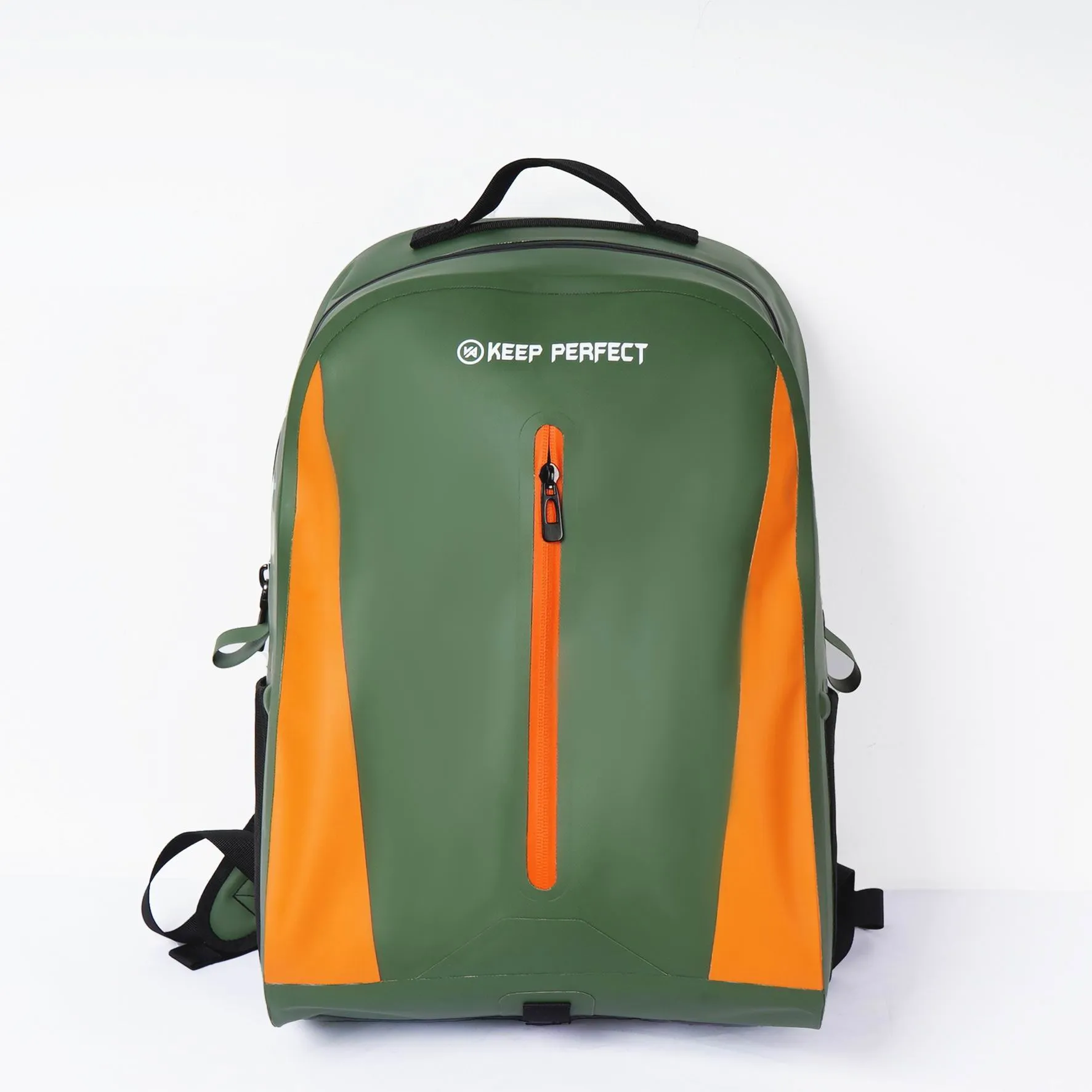

Why factories set minimums: the cost structure in plain view
A custom bag order carries two cost families: fixed costs that exist whether the order is 50 pieces or 5,000, and variable costs that scale with quantity. The fixed family is larger than buyers expect. Pattern engineering and digitizing: one to three days of a pattern-maker’s time. Sampling: materials, line time and shipping for one to three sample rounds. Material procurement: fabric and film suppliers sell by the roll and the kilogram — a custom color or laminate often carries its own upstream minimum of 300-1,000 meters. Line setup: the cutting dies, welding fixtures and workstation layout for a new style take hours to install and minutes to tear down, and the line produces nothing during the changeover. And quality overhead: first-article inspection, test sampling and documentation happen once per order regardless of size.
Spread those fixed costs across quantities and the curve explains everything: at 50 pieces, setup alone can add $3-8 per bag; at 500 pieces, it adds $0.30-0.80; at 5,000, it vanishes into noise. The MOQ is simply the quantity where the fixed-cost surcharge stops distorting the unit price — the point where the buyer pays for bags, not for the changeover. A factory quoting MOQ 500 is not being difficult; it is declining to sell a 50-piece order at a price that would mislead everyone involved, or declining to absorb a loss that makes the relationship start with resentment. The factories worth working with can all walk this arithmetic out loud.
Why 500: the waterproof category’s equilibrium
Different bag categories settle at different minimums, and waterproof bags sit higher than sewn-only categories for process reasons. Welded waterproof construction runs on fixture-based equipment — RF welding dies, hot-air fixtures, taping setups — where each style needs its own tooling and the tooling amortizes over the run. Laminated and coated materials arrive with supplier minimums of their own: a custom TPU laminate in a specific denier and color typically starts at 500-1,000 meters, which converts directly into bag quantities once yield and cutting efficiency are counted. And waterproof production demands per-lot process validation — weld peel tests, leak sampling — whose cost is meaningful below a few hundred units and routine above them.
The arithmetic lands the industry at a common floor: 500 pieces per style is where material minimums, tooling amortization and validation overhead simultaneously stop distorting the price. Some structures bend it downward — a stock fabric in a running color removes the material minimum, a repeat style removes the tooling — and some push it upward: a fully custom laminate with custom hardware and retail packaging stacks three or four independent minimums, each of which must be satisfied before the first bag exists. The buyer’s leverage begins with knowing which of those minimums is actually binding on their project. Our cost breakdown guide itemizes the same structure from the price side.
What is actually negotiable: the five honest levers
MOQ negotiations succeed when they move the physics instead of the number. Five levers genuinely work. Stock materials: choosing a fabric, film and color the factory already runs removes the upstream material minimum, and minimums on stock-material programs routinely drop to 200-300 pieces. Style families: one pattern in three colorways shares tooling and setup across the family, so a 1,500-piece order of one style in three colors often prices like a single 1,500 — while three different styles of 500 each carry three setups. Repeat-order credit: factories discount or waive setup on reorders because the pattern, dies and process documentation already exist, which is why the second order is always cheaper than the first at the same quantity. Component commonality: accepting the factory’s stock buckles, zippers and webbing instead of custom-molded hardware removes the component minimums, which are often the true binding constraint. And schedule flexibility: a program that can wait for a gap in the line’s calendar converts the factory’s downtime into the buyer’s price concession.
The lever that does not work is asking the factory to absorb the loss — "meet my 100-piece budget and the volume will come." Every factory has heard it, and the ones who believed it are no longer quoting. What does work is the same promise structured honestly: a first order at 500 with a written second-order commitment at a target price, so the factory banks the repeat instead of hoping for it. Serious buyers negotiate the program, not the piece count.
Mixed orders and the multi-style stretch
The mixed-order structure is the legitimate answer to the assortment problem: a brand needs four products but cannot place 500 of each. The structure that works splits into tiers. Colorway mixing is nearly free — one style, one material run, multiple colors, with per-color minimums of 100-200 units inside a 500-piece style total. Size mixing is cheap — same style in two or three sizes shares most tooling, with per-size minimums around 100-200. Style mixing within a family is possible — a 20L and 30L dry bag sharing fabric, welding fixtures and hardware can sometimes split a 500-piece family minimum two ways. And cross-style material pooling is the advanced move: three different styles cut from the same custom laminate run, so the 800-meter material minimum serves the whole program instead of one product.
| Mixing tier | What shares | Typical inner minimum | Constraint |
|---|---|---|---|
| Colorways | Everything but dye lot | 100-200 pcs per color | Same fabric run |
| Sizes | Tooling, materials, setup | 100-200 pcs per size | Same pattern family |
| Style family | Fabric, fixtures, hardware | 250 pcs per style | Shared process |
| Material pooling | The custom material run | Program-level 500+ | Cutting plan coordination |
The mixed order’s hidden cost is complexity on the line: every split adds a changeover, a separate bundle ticket, and a separate AQL sample. Honest factories price that complexity as a small per-split surcharge rather than refusing the structure, and honest buyers accept it as the price of assortment. The AQL guide explains how sampling plans handle mixed lots — each style-color cell is its own sampling unit, which is the quality-system mirror of the same complexity.
Below the floor: samples, trial runs and the gray zone
Every MOQ has a documented exception path and an undocumented gray zone, and buyers should walk the documented one. The sample tier is universal: one to five pieces at prototype pricing — two to five times unit cost — whose purpose is design validation, not stock. Our sampling guide covers what to expect round by round. The trial run is the legitimate middle step: 100-200 pieces at a transparent surcharge, offered by factories confident the program will graduate — and the surcharge should be visible in the quote, because a hidden one becomes a pricing fight at the second order. The gray zone is the broker promise of 50 custom pieces at bulk pricing: what it buys is a workshop improvising outside process control, without weld validation or material traceability, and the product that arrives is a liability wearing a waterproof claim.
The line between smart and self-deceiving is the buyer’s purpose. If 100 pieces will validate a market — a crowdfunding run, a regional pilot — pay the trial-run surcharge openly and treat it as research budget. If 100 pieces are all the program will ever order, the honest product is a stock bag with custom branding, which many factories offer at genuinely low minimums because the manufacturing risk was amortized long ago. What never works is asking custom engineering at below-cost quantities: the factory that accepts is telling you something about its order book, not its generosity.
The MOQ arithmetic worked out: a real quote anatomy
Abstract cost talk persuades nobody; a worked quote does. Take a representative custom 25L roll-top dry bag: TPU-laminate 420D stock fabric, one colorway, printed logo, standard buckles. The fixed family for this program: pattern engineering $150-300 (one time), two sample rounds $100-200, cutting die and welding fixture adaptation $200-400, first-article inspection and leak-test protocol setup $100-150. Call the fixed total $550-1,050. The variable family: materials $3.20-4.10 per unit, labor and overhead $2.40-3.00, packaging $0.25-0.60, margin. At 100 pieces the fixed surcharge lands at $5.50-10.50 per bag — doubling the unit economics and producing a quote the buyer calls "too expensive" and the factory calls "a favor." At 500 pieces the same fixed total adds $1.10-2.10; at 2,000 pieces, under $0.55.
Now watch the stock-material lever move the same quote. Swap the stock laminate for a custom color run with a 600-meter supplier minimum: the material commitment alone covers roughly 800-900 bags of fabric, so the program’s true floor is no longer the factory’s 500 but the material’s 800-plus — order 500 and the buyer either warehouses the surplus fabric or pays for it anyway. Swap instead to a fully stock configuration, and the floor relaxes toward 200-300 because nothing upstream needs amortizing. The lesson generalizes: the binding minimum on any quote is the largest upstream commitment in the bill of materials, and the buyer who asks "which component sets my MOQ?" gets a more useful answer than the one who asks "can you do less?"
Inquiry preparation: getting a real MOQ answer in one round
MOQ answers are only as good as the briefs that produce them, and most first inquiries are too vague to quote honestly. "Waterproof backpack, custom logo, what is your MOQ?" cannot be answered with a number — it can only be answered with a range wide enough to be useless, because the minimum depends on decisions the buyer has not yet made. The brief that earns a real answer in one round names: the product type with a reference photo or link, the target materials or at least the duty level (lightweight packable versus heavy-duty welded), the branding method, the quantity ambition across the first year (not just the first order), the destination market, and the timeline.
With that brief, a serious factory returns not one number but the structure: MOQ per style, inner minimums per colorway, which components are stock and which carry upstream minimums, the sample cost and its credit terms against the bulk order, and the price curve at two or three quantity points. That structure is the negotiation surface — everything in it is discussable, and none of it is arbitrary. Our own inquiry response follows exactly this shape: MOQ 500 per style with the component-level explanation, sampling in 6–10 working days credited against bulk, price tiers at 500 / 2,000 / 10,000, and the private label program guide for buyers whose brand, not the product architecture, is the custom element.
First-order strategy: making the minimum work for you
A first order at MOQ is not a burden to minimize; it is the cheapest market research in the product business. Five hundred units is enough stock to sell through real channels and learn real demand: which colorway dies and which sells out, which size the market actually wants, what the reviews teach before the second order commits ten times the capital. The first order also audits the factory end to end — sampling discipline, communication speed, AQL results, packaging execution, shipping accuracy — at the smallest exposure the relationship will ever have. Buyers who treat the first 500 as a paid audition make the second order a confident scaling decision instead of a leap.
Structure the first order to teach the most: one proven style in two or three colorways (colorway data at minimum complexity), stock or near-stock materials (removing the upstream minimum from the risk table), the full packaging spec included (so the packed unit is validated at scale, not improvised later), and the quality terms written — AQL levels, leak-test method, defect classification — so the factory’s performance is measured against a document, not a hope. The lead-time guide completes the program view: sampling 6–10 working days, bulk 35–50 days, and the calendar arithmetic that puts stock in your warehouse the week you planned it. Our own terms sit on the same page: MOQ 500 per style, 200,000 pieces monthly capacity, FOB Xiamen, SGS-verified — our production team documents the full process from first inquiry to loaded container.
Frequently Asked Questions
Q1. What is the typical MOQ for custom waterproof bags?
Five hundred pieces per style is the industry’s honest equilibrium for welded waterproof construction — the point where material minimums, tooling amortization and validation overhead stop distorting unit price. Stock-material programs can drop to 200-300; fully custom laminates can push higher.
Q2. Why do waterproof bag factories set higher MOQs than sewn-bag factories?
Welded construction runs on fixture-based tooling per style, laminated materials arrive with 500-1,000 meter supplier minimums, and waterproof production requires per-lot weld and leak validation. All three costs amortize over quantity, raising the floor.
Q3. Can I negotiate a lower MOQ?
Move the physics, not the number: choose stock materials, split one style into colorways rather than multiple styles, accept stock hardware, offer schedule flexibility, and structure a written second-order commitment. Asking the factory to absorb a loss never works.
Q4. Can I mix colors and sizes inside the 500-piece MOQ?
Yes — colorway mixing typically carries 100-200 piece per-color minimums inside the style total, size mixing similar. Multi-style mixing within a family is sometimes possible with a per-split surcharge for the extra changeovers and sampling.
Q5. What if I only need 100 pieces?
Three honest paths: a trial run at a transparent surcharge (research budget for market validation), a stock bag with custom branding (genuinely low minimums because engineering was amortized long ago), or defer custom until demand justifies the floor.
Q6. Is a 50-piece custom order at bulk pricing ever legitimate?
No — it buys workshop improvisation outside process control: no weld validation, no material traceability, no documentation. The product that arrives is a liability wearing a waterproof claim.
Q7. Why is my second order cheaper than my first at the same quantity?
Repeat-order credit: the pattern, cutting dies, welding fixtures and process documentation already exist, so the fixed-cost family shrinks to materials and line time. This is the structural reason factories reward continuing programs.
Q8. What should a first 500-piece order be designed to learn?
Which colorway and size actually sell, what reviews teach before scaling, and a full factory audit — sampling discipline, AQL results, packaging execution, shipping accuracy — at the smallest exposure the relationship will ever have.
Q9. Does custom packaging have its own MOQ separate from the bag MOQ?
Yes — printed polybags run 5,000-10,000 bags, printed cartons 300-500, retail boxes 1,000-3,000. Component minimums are set by packaging printers and can exceed the bag order; bridge with hangtags and inserts at 1,000-3,000 piece minimums.
Q10. How do material minimums affect my MOQ?
A custom laminate typically starts at 500-1,000 meters, which converts to bag quantity after cutting yield. Choosing a stock fabric removes this minimum entirely — often the single biggest MOQ lever available.
Q11. What terms should be written into a first order at MOQ?
AQL levels and leak-test method, defect classification, packaging spec, delivery window, and the second-order price target if agreed. Performance measured against a document beats performance measured against a hope.
Q12. Does MOQ apply per style or per order?
Per style — tooling, materials and validation are style-specific. A 1,500-piece order of three unrelated styles is three 500-piece programs sharing a container, not one 1,500-piece program.
People Also Ask
What does MOQ mean when ordering custom bags?
Minimum order quantity — the smallest run where the factory’s fixed costs (pattern engineering, tooling, material minimums, validation) stop distorting the unit price. For custom waterproof bags, the honest industry floor is 500 pieces per style.
Why is 500 pieces the standard MOQ for waterproof bags?
Because material supplier minimums (500-1,000 meters of laminate), per-style welding tooling, and per-lot validation overhead all amortize to acceptable levels around that quantity. Below it, buyers pay for changeovers, not bags.
How can I lower the MOQ for my custom bag order?
Choose stock materials and hardware, split one style into colorways instead of multiple styles, offer schedule flexibility, and bring a written repeat-order commitment. These levers move the cost physics that the MOQ expresses.
Can I order samples before committing to the MOQ?
Yes — one to five prototype pieces at two to five times unit cost is universal practice for design validation. Sampling is research, not stock; the production order follows at the full minimum once the sample is approved.
What happens if I order below the MOQ?
Either a transparent trial-run surcharge on 100-200 pieces, a stock-bag-with-branding program at genuinely low minimums, or — if a broker promises custom bulk pricing at 50 pieces — uncontrolled production without validation or traceability.
Do color and size variations count toward the MOQ?
Yes — colorways and sizes within one style share tooling and materials, typically with 100-200 piece inner minimums per variant inside the 500-piece style total. Separate styles carry separate minimums because their setups are separate.