Ask ten suppliers how long a custom waterproof bag order takes and you will hear the same short answer — "35 to 50 days" — which is accurate about bulk production and misleading about everything else. The number a buyer actually lives with runs from the first quotation to stock landing in a warehouse, and it is a chain of seven stages: brief and quotation, sampling and approval, material procurement, tooling and line setup, bulk production, inspection and packing, then freight and customs. Each stage has its own clock, its own dependencies, and its own failure modes. The buyer who plans against the bulk number alone discovers the other six stages the hard way, usually four weeks before a launch date that is no longer reachable.
This guide walks the full chain stage by stage with realistic durations, identifies the delays that actually break schedules in waterproof manufacturing specifically, and gives the reverse-planning method that puts stock in your warehouse on the week you promised your customers. MOQ 500 pieces per style, sampling in 6–10 working days, bulk in 35–50 days, FOB Xiamen: these are the working terms at QUANZHOU JUNYUAN BAGS, custom waterproof bag production since 2014 in a 4,950 m² SGS-verified facility. The calendar below is the one we quote against and the one we are measured on.
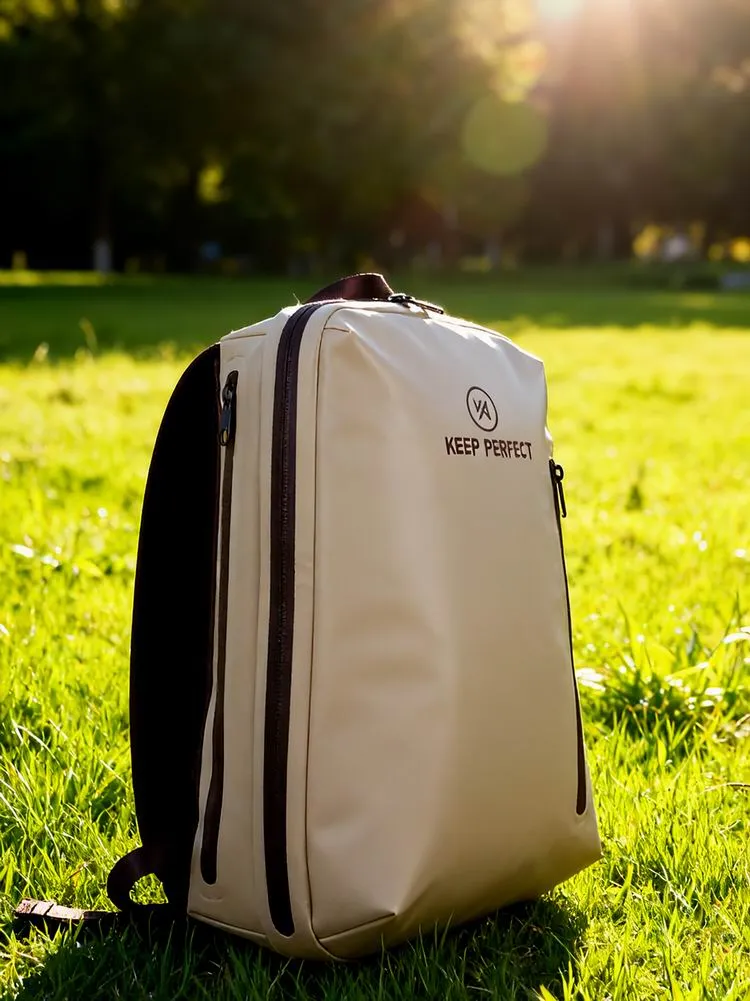
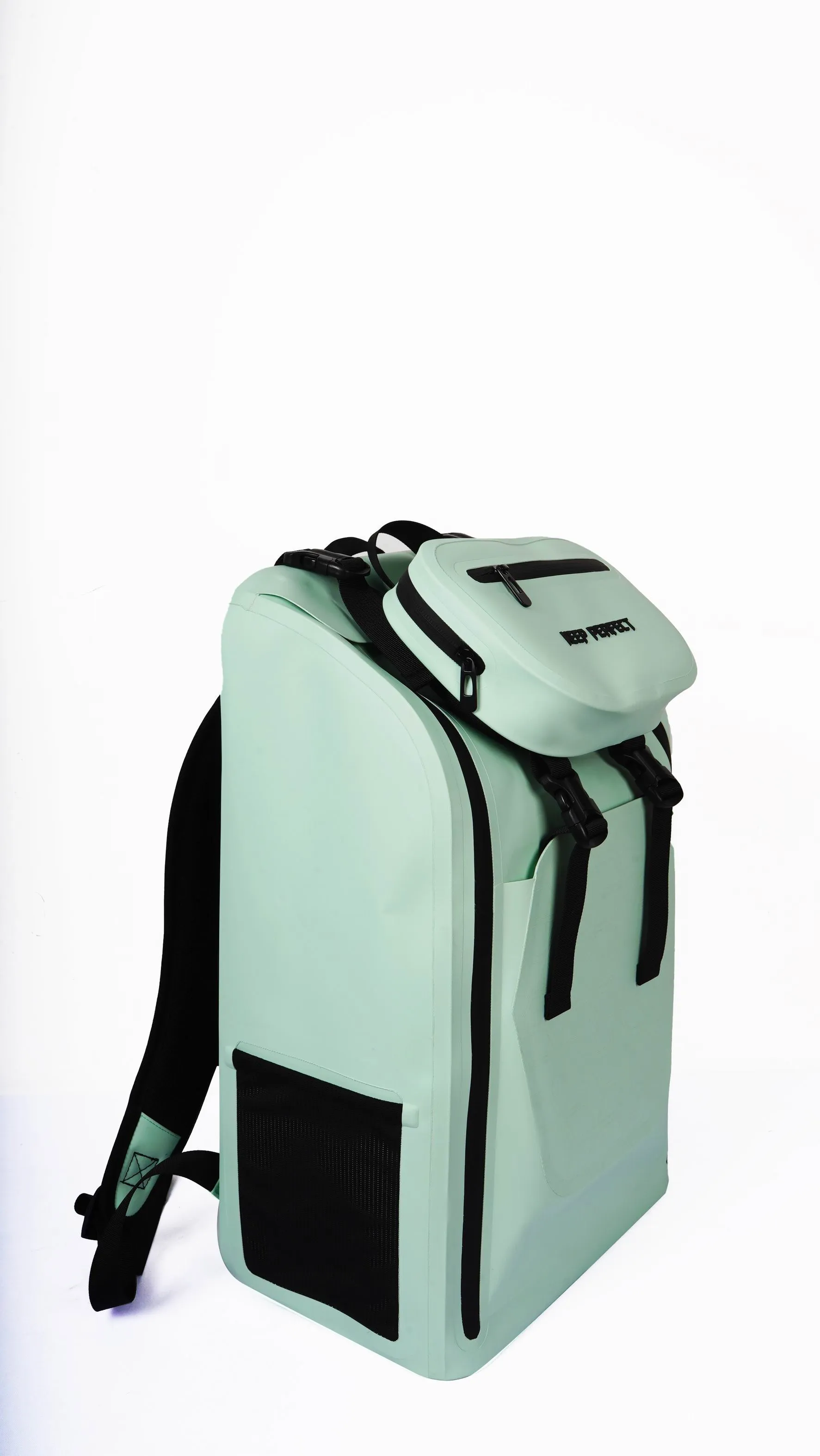
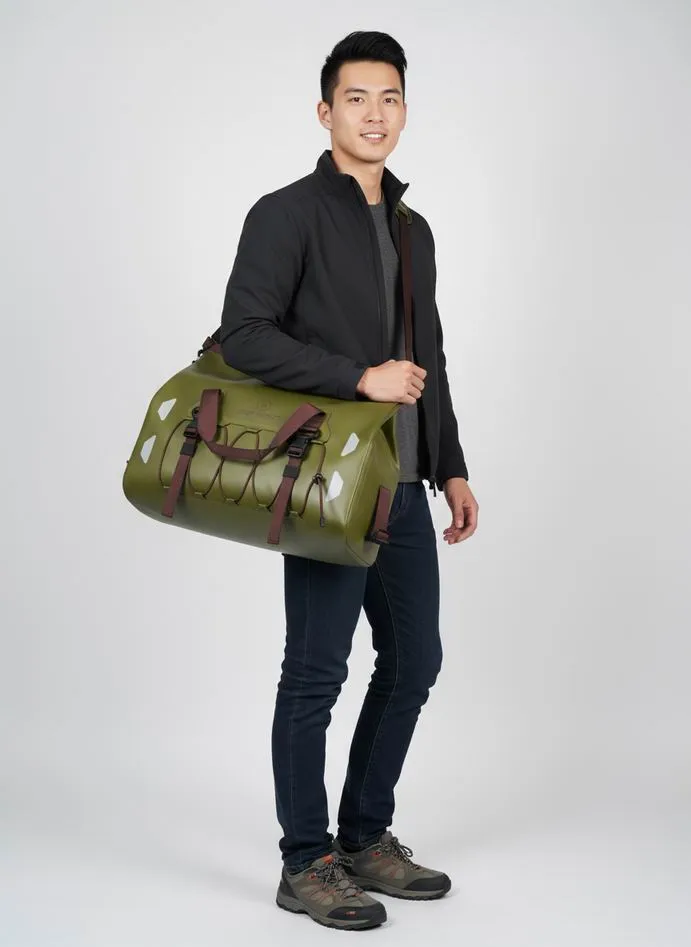
The seven-stage calendar in one picture
The custom waterproof bag lead time that actually matters is the full production timeline, not the manufacturing block alone. A custom waterproof bag program runs through seven gates, and only one of them is "production." Brief and quotation take three to seven days and depend almost entirely on how complete the buyer’s specification is. Sampling and approval take six to ten working days per round, and most programs need one to three rounds. Material procurement runs two to four weeks for stock fabrics and four to eight weeks for custom laminates, and it frequently runs in parallel with sampling rather than after it. Tooling and line setup take five to ten days once the sample is signed. Bulk production is the 35–50 day figure everyone quotes. Inspection and packing add five to ten days. Freight and customs add eighteen to forty-five days by sea, three to seven by air, depending on lane and season.
Add the realistic ranges and the honest total for a first custom program lands at 75–110 days from signed brief to delivered stock, with the spread driven mainly by material choice and freight mode. A repeat order collapses dramatically: materials are already specified, tooling exists, the sample is approved and the process documentation is on file, so the same program reorders in 45–65 days. That gap between first and repeat is the single most useful planning fact in custom importing, and it is why the reorder process guide matters as much as the first-order guide.
Stage one: brief, quotation and design lock (days 1–7)
The clock starts with a specification, and its quality determines the speed of everything downstream. A brief that arrives with a reference image, target dimensions, material direction, branding method, quantity and destination market can be quoted in two to three days. A brief that arrives as "waterproof backpack, custom logo, how much?" triggers a week of clarification emails, and every one of those days is a day the material cannot yet be ordered. The fastest buyers in the industry are not the ones who rush the factory; they are the ones who arrive with decisions already made, or with an explicit openness to the factory’s stock options.
Design lock is the milestone that ends stage one: the point at which dimensions, materials, hardware, branding placement and packaging are all agreed in writing. Everything after design lock is execution; everything before it is negotiation. Our design-file guide and the concept-to-production walkthrough both exist to compress this stage, because the cheapest week to save in a custom program is the first one.
Stage two: sampling rounds and approval (6–10 working days)
Sampling is where waterproof programs differ most from sewn-bag programs. A welded sample requires fixture setup, weld parameter development and leak validation before it is even assembled, so the first physical sample represents real engineering rather than a quick sewn prototype. Six to ten working days is the honest range for a first sample; revisions are faster, typically four to seven days, because the fixture and parameters already exist. Programs that need three rounds should plan twenty-five to thirty working days for sampling alone, and should expect that timeline to be the most variable part of the schedule.
The round count is a choice, not a fate. Buyers who send a complete technical pack — dimensioned drawing, material callout, hardware spec, branding artwork in vector, packaging requirement — routinely approve in one or two rounds. Buyers who iterate on aesthetics through samples routinely need three or four, and pay for it in calendar. Our sampling guide covers what each round should resolve. Branding adds its own sub-loop: the logo method guide explains which decoration processes need their own sample approval before bulk artwork is locked.
Stage three: material procurement — the stage that really sets the clock
If one stage deserves more buyer attention than bulk production, it is material procurement. Stock fabrics held by the factory or its nearby suppliers are available in days; a custom laminate in a specific denier, coating weight and color runs four to eight weeks because the mill must schedule the run, and the run itself is subject to the mill’s own queue. Custom hardware — molded buckles, branded zipper pulls, specialty valves — carries tooling and molding lead times of three to six weeks. Custom packaging sits in the same category: printed cartons and retail boxes are printed to order and queue behind the printer’s existing schedule.
The strategic move is to start procurement in parallel with sampling rather than after approval, which is standard practice for programs with a committed quantity. Ordering the material against a signed brief with an approved sample pending converts a serial eight-week wait into a parallel one that finishes around the time bulk starts. The risk is real — if the design changes materially after approval, the fabric is stranded — but the risk is manageable if the material decision is locked before the sample is built, which is exactly what a competent material selection process achieves. Material choice and lead time are the same decision viewed twice.
Stage four: tooling, patterns and line setup
Waterproof construction is fixture-driven, and fixtures take time. Cutting dies, welding electrodes or hot-air fixtures, taping jigs and assembly templates are prepared per style: five to ten working days from approved sample to a line ready to run. Pattern digitizing and grading run in parallel, along with the process documentation — weld parameter sheets, taping settings, first-article inspection criteria — that turns an approved sample into a repeatable specification. Our HF welding guide explains why fixture work exists at all: the welding window for a given laminate is narrow, and the fixture is what holds every unit inside it.
Setup is also where schedule reality meets factory capacity. A line that is fully booked cannot start your setup on the day the sample is approved; it starts when a slot opens. This is the least-discussed and most consequential variable in custom lead times, and it is why early commitment buys more than money — it buys position in a queue. Serious factories publish honest capacity and honest queue state, and the 200,000-piece monthly figure on our own site is there so buyers can judge whether their program fits the calendar before they commit.
Stage five: bulk production (35–50 days)
Bulk production is the number in every quotation, and it is genuinely the largest single block. The range exists for structural reasons: a simple roll-top dry bag with one material and minimal assembly runs toward the 35-day end, while a multi-panel backpack with welded seams, taped interiors, padded harness, molded back panel, multiple zippers and printed branding runs toward 50 days or beyond. Cutting, welding, taping, assembly, trimming, branding application, hardware installation and final finishing each add line time, and the sequence cannot be compressed by adding workers indefinitely — waterproof assembly is process-limited, not labor-limited.
Quality gates sit inside the production block rather than after it: first-article inspection at line start, in-process weld peel testing at defined intervals, and leak-test sampling per lot. These gates consume time deliberately, and a factory that offers to skip them to save four days is offering to skip the only thing that makes a waterproof claim meaningful. Volume also interacts with duration in a non-obvious way: a 10,000-piece order takes longer than a 500-piece order, but not twenty times longer, because the line reaches steady state and stays there. Our AQL guide documents the sampling structure that runs alongside production.
Stage six: inspection, packing and documentation (5–10 days)
When the last unit leaves the line, the order is not finished. Final inspection against the agreed AQL takes one to three days depending on lot size; any rework discovered in that inspection adds two to five days and re-inspection after it. Packing runs in parallel: individual polybagging, hangtags and inserts, carton packing to the specified count, palletizing and container loading. Retail packaging — printed boxes, header cards, barcode application — adds days and deserves its own line in the plan, which the retail packaging guide covers in detail. Export documentation — packing list, commercial invoice, certificate of origin, any test reports the destination requires — is prepared in the same window.
Third-party inspection is the option that most often surprises the calendar: booking an inspector adds two to four days of scheduling before the inspector even arrives. Buyers who require it should notify the factory at order placement, not at production completion. Our own pre-shipment routine follows the pre-shipment checklist, and buyers are welcome to appoint their own inspector against the same document — a shared checklist is the fastest path through this stage, because there is nothing to argue about when the criteria were written before production started.
Stage seven: freight, customs and the last mile
| Mode | Transit to US/EU | Cost position | Best for |
|---|---|---|---|
| Sea FCL | 28–45 days | Lowest per unit | Planned replenishment, full containers |
| Sea LCL | 32–48 days | Low, plus handling | Smaller first orders sharing a container |
| Air freight | 3–7 days | 4–6x sea | Launch deadlines, high-value compact goods |
| Rail (EU) | 18–25 days | Between sea and air | Europe-bound, non-urgent programs |
| Express courier | 2–5 days | Highest | Samples and emergency top-ups |
Transit time is only part of the last mile: port congestion, customs examination, duty and tax processing, and inland drayage to the final warehouse each add days that no factory controls. A realistic planning allowance is five to ten days on top of published transit for sea freight, and two to three for air. Seasonal peaks matter more than buyers expect — pre-Chinese-New-Year and pre-peak-season bookings tighten vessel space and raise rates, and factory-side schedules tighten in the same window as every other exporter races to ship before the holiday shutdown.
The practical defense is booking space early and shipping against a written Incoterm that makes responsibility unambiguous. Our programs quote FOB Xiamen: the factory’s obligation ends when goods are loaded on board, the buyer’s freight forwarder owns the voyage, and the cost and risk boundary is a single sentence. The full lane-level detail lives in our shipping and logistics guide. Buyers who have never imported should read it before they choose a freight mode, because the mode decision interacts with order quantity and cash cycle in ways that are hard to reverse later.
What actually delays custom waterproof orders: the eight usual causes
| Delay cause | Typical cost | Where it happens | Preventable by |
|---|---|---|---|
| Incomplete brief | 3–10 days | Quotation stage | Technical pack before first email |
| Material not in stock | 14–56 days | Procurement | Locking stock materials or early order |
| Multiple sample rounds | 5–20 days | Sampling | Deciding aesthetics before sampling |
| Late artwork approval | 3–10 days | Branding | Approving vector artwork with the sample |
| Change after approval | 7–25 days | Post-sample | Freezing spec at design lock |
| Inspection failure | 5–15 days | Final QC | Agreed AQL and pre-production sample |
| No vessel space | 7–21 days | Freight | Booking three weeks ahead |
| Holiday shutdown | 10–25 days | Factory calendar | Planning around CNY and golden week |
Six of the eight are buyer-side or shared, and only two are genuinely factory-side. That distribution is the most useful thing a new importer can internalize: the calendar is mostly in the buyer’s hands, and the fastest factories are not the ones that promise the fewest days but the ones that tell you which decisions are blocking the schedule this week. A supplier who says "we are waiting on your artwork" on day four is a supplier managing your program; one who says "no problem, all fine" until week six is managing your expectations.
The two factory-side causes deserve equal scrutiny because they reveal capacity honesty. Inspection failure means the process was not under control, and a good factory catches it in-process rather than at the final gate. Holiday shutdown is predictable and published — Chinese New Year, typically late January to mid-February, closes production for two to three weeks and slows it for a week on either side. Programs that must land in Q1 need to be loaded on a vessel in December, which means the brief should be signed by early October.
Waterproof-specific time sinks buyers do not expect
Three time sinks are unique to waterproof construction and routinely surprise buyers who previously sourced sewn bags. First, weld parameter development: every laminate has a narrow temperature-pressure-dwell window, and finding it for a new material combination takes engineering time before the first good sample exists. Second, seam validation: welded and taped seams require peel testing and leak testing per lot, and the test protocol itself — method, sample size, acceptance criteria — must be agreed before production, not discovered during it. Third, adhesive and tape cure time: some taping and bonding processes require a defined rest period before the unit can be handled, tested or packed, and that period sits in the schedule as real days.
A fourth sink appears only in programs with custom closures: waterproof zippers, valves and proprietary hardware arrive with their own qualification. A zipper that must hold an IPX8 rating is not a drop-in component; it is a tested subsystem, and changing it late reopens validation. Buyers who understand these four sinks stop asking "why is welding slower than sewing?" and start asking "what do you need from me this week so validation can start on time?" — which is the question that actually accelerates a program.
Compressing the calendar: the levers that genuinely work
Five levers shorten a custom waterproof program without degrading it. Stock materials: choosing fabric, film, hardware and colors the factory already runs removes the entire procurement wait, often twenty to forty days. Decision discipline: approving artwork, packaging and branding at sample approval rather than after it removes serial waiting. Parallel procurement: ordering material against a locked spec while the sample is being built overlaps two stages. Air freight on the first order: expediting transit converts a 100-day program into a 70-day one at a cost that is often less than the margin on the launch it protects. And reorder readiness: structuring the first order so the second needs no new tooling, no new material run and no new sample.
The lever that does not work is pressuring production days. Asking a factory to run a 40-day program in 25 days does not create line capacity; it creates overtime on some operations, queue-jumping on others, and quality gates quietly skipped. The rare legitimate exception is a partial air shipment — finish 20% of the lot, fly it, sell through it while the balance sails — which buys calendar without touching process control. Cost interacts with every one of these levers, and the cost breakdown guide prices them from the other side.
Rush orders: when they are worth it and what they cost
Rush programs are legitimate when the value of timing exceeds the premium: a retail launch window, a seasonal category where six weeks of absence costs the whole season, or a replenishment failure that would otherwise leave shelves empty. The premium is real and layered — expedited material procurement, overtime or weekend line time, priority scheduling ahead of other customers, and air freight. A realistic rush premium on a compressed waterproof program runs 15–35% on the manufacturing side before freight, and the freight differential can dwarf it. The correct way to evaluate a rush is to price it against the cost of missing the window, not against the base quotation.
What must never be rushed is validation. Weld peel testing, leak testing and inspection are the product; skipping them to save four days converts a waterproof bag into an untested bag with a waterproof claim, and the failure appears in the customer’s hands rather than the factory’s. The honest version of a rush is a compressed schedule with unchanged quality gates — and any factory willing to publish which days it saved and how is a factory worth keeping.
Planning backwards from a launch date: the reverse calendar
| Milestone | Weeks before launch | What must be true |
|---|---|---|
| Sign brief, lock materials | 16–18 | Spec complete, stock materials chosen |
| First sample shipped | 13–15 | Artwork approved in vector |
| Sample approved | 11–13 | No further design change |
| Bulk production starts | 10–11 | Material in house, tooling ready |
| Production complete | 3–4 | AQL inspection passed |
| Vessel departs | 2–3 | Documents and customs filed |
| Stock in warehouse | 0 | Launch |
Read the table from the bottom up and the shape of a realistic program becomes obvious: a launch date sixteen to eighteen weeks out is the point at which a brief must be signed, and a launch eight weeks out is already a rush. Buyers who internalize this stop treating lead time as a supplier problem and start treating it as a merchandising calendar — which is what it is. Reverse planning also exposes which milestones have slack: sample approval can absorb a week without consequence; material procurement cannot.
The final piece is the contract. Lead time should be written as a defined start and a defined end — "35–50 days from sample approval and deposit, to goods ready for loading" — rather than "about six weeks," because only the defined version is enforceable and only the enforceable version changes factory behavior. Write the Incoterm, the delivery window, the inspection standard and the remedy for late delivery into the same document. Our own terms sit on one page: MOQ 500 per style, sampling 6–10 working days, bulk 35–50 days, FOB Xiamen, SGS-verified facility — and our production team documents the same chain from first inquiry to loaded container. Quality discipline across the chain follows ISO 9001 process principles; the ISO 9001 overview is the reference we work against.
Frequently Asked Questions
Q1. How long does a custom waterproof bag order take in total?
Seventy-five to one hundred and ten days from signed brief to delivered stock for a first program, and forty-five to sixty-five days for a repeat. The bulk production block of 35–50 days is only one of seven stages.
Q2. Why is sampling 6–10 working days longer than for sewn bags?
Welded samples require fixture setup, weld parameter development and leak validation before assembly, so the first physical sample represents real engineering. Revisions run four to seven days because the fixture and parameters already exist.
Q3. Which stage causes the most delay?
Material procurement — stock fabrics are available in days, custom laminates run four to eight weeks and custom molded hardware three to six. Choosing stock materials is the single largest lead-time lever available.
Q4. Can production start before the sample is approved?
Not production, but procurement can: ordering materials against a locked specification while the sample is being built is standard practice for committed programs and removes weeks from the calendar.
Q5. How much time does branding artwork add?
Late artwork approval adds three to ten days because printing plates, embroidery digitizing and heat-transfer films are made to order. Approving vector artwork at sample approval removes it entirely.
Q6. What delays are actually the factory’s fault?
Mainly two: inspection failure, which indicates in-process control broke down, and capacity overbooking, which is why honest factories publish capacity and queue state. Six of the eight common causes are buyer-side or shared.
Q7. How does Chinese New Year affect my schedule?
Production closes for two to three weeks and runs slow for a week either side. Programs that must land in Q1 need to be on a vessel in December, which means signing the brief by early October.
Q8. Is air freight worth it on a first order?
Often yes. It converts a 100-day program into roughly 70 days, and the premium is frequently less than the margin lost by missing a launch or seasonal window. Evaluate it against the cost of delay, not against the base quote.
Q9. Can the 35–50 day production window be compressed?
Pressuring production days does not create line capacity — it creates skipped quality gates. The legitimate compressions are stock materials, parallel procurement, early artwork approval and partial air shipment.
Q10. What is the difference between FOB and other Incoterms for scheduling?
FOB Xiamen ends the factory’s obligation when goods are loaded on board and gives the buyer control of the voyage. It makes the cost and risk boundary a single sentence and keeps freight decisions with the party who owns them.
Q11. How early should I book vessel space?
About three weeks ahead, and earlier in peak season. Pre-peak and pre-New-Year bookings tighten vessel space and raise rates, so late booking is a common cause of seven to twenty-one day slips.
Q12. Should I hire a third-party inspector?
If your program requires it, book at order placement rather than at production completion — inspector scheduling adds two to four days. A shared checklist with the factory is the fastest path through the stage.
Q13. How much longer does a 10,000-piece order take than a 500-piece order?
Longer, but not proportionally: the line reaches steady state and stays there. Cutting, welding and assembly scale with volume; setup, tooling and validation do not.
Q14. Why is my reorder faster than my first order?
Materials are specified, tooling exists, the sample is approved and process documentation is on file. The repeat collapses the procurement, tooling and sampling stages entirely.
Q15. What should be written into the contract about lead time?
A defined start and end — "35–50 days from sample approval and deposit to goods ready for loading" — plus the Incoterm, inspection standard, delivery window and the remedy for late delivery. Only defined terms change behavior.
Q16. Do validation and testing add days I should plan for?
Yes, and they should not be removed. Weld peel testing, leak sampling and first-article inspection consume scheduled days deliberately; they are the difference between a waterproof bag and an untested bag with a waterproof claim.
Q17. How do I know if my launch date is still reachable?
Work the reverse calendar: sixteen to eighteen weeks for a standard program, roughly eight for a rush. If materials are not locked by week sixteen, the honest answer is that the date needs to move or the freight mode needs to change.
People Also Ask
What is the lead time for custom waterproof bags?
Bulk production runs 35–50 days, but the full program from brief to delivered stock runs 75–110 days across seven stages: quotation, sampling, procurement, tooling, production, inspection and freight.
How long does sampling take for a custom waterproof bag?
Six to ten working days for a first welded sample, four to seven for revisions. Programs needing three rounds should plan twenty-five to thirty working days for sampling alone.
Why do custom bag orders take longer than buying stock?
Because materials, tooling, patterns and process validation are made to order. Stock bags amortized that engineering years ago, which is what makes them both faster and cheaper.
What is the fastest way to get custom waterproof bags?
Choose stock materials and hardware, approve artwork with the sample, order materials in parallel with sampling, and fly the goods. That combination compresses a 100-day program toward 70.
How do I plan a product launch around factory lead times?
Work backwards: sign the brief sixteen to eighteen weeks out, approve samples by week thirteen, start bulk by week ten, ship by week two. Launch dates inside eight weeks are rush programs.
Does ordering more units increase lead time?
Somewhat — a 10,000-piece run takes longer than 500 pieces but far less than twenty times as long, because setup and validation are fixed while cutting and assembly scale with volume.