QUANZHOU JUNYUAN COMMERCIAL AND TRADING CO., LTD (trading as QUANZHOU JUNYUAN BAGS) is a vertically integrated soft-goods manufacturer based in Fengze District, Quanzhou, Fujian — the bag-making capital of China. Our founder has been in the bag and outdoor-soft-goods trade since 2004; the current company was incorporated in 2014 to focus exclusively on waterproof and water-resistant custom bags for export. Today our main facility spans 4,950 m², runs 7 production lines staffed by 137 skilled workers operating 149 machines, and turns out up to 200,000 sealed bags per month under an SGS-verified capacity and an ISO 9001:2015 quality system.
Our story: from trading to dedicated waterproof production
Between 2004 and 2014, our founder managed sourcing and QC for trading houses exporting bags to Europe, North America and Australasia. That decade exposed a recurring problem: buyers who wanted a genuinely waterproof bag were routinely sold "water-resistant" stock with taped-but-not-welded seams that failed within one wet season. In 2014 we incorporated the present company and invested in high-frequency (RF) welding lines rather than relying on stitched-and-taped construction. By 2018 we had added TPU lamination and waterproof-zipper assembly, and by 2021 we were running a dedicated decoration cell (screen print, heat-transfer, embroidery, woven labels). The customwaterproofbags.com site is our specialist storefront for the custom, printed and private-label buyer, backed by a production programme that runs from sampling through bulk.
Facility at a glance
| Item | Value |
|---|---|
| Legal entity | Registered in Quanzhou, Fujian (full legal name stated above) |
| Brand / trading name | QUANZHOU JUNYUAN BAGS |
| Founded | 2014 (founder active in bag trade since 2004) |
| SGS-verified production area | 4,950 m² |
| Production lines | 7 lines |
| Machinery | 149 machines (RF welders, hot-air welders, die-cutters, decoration presses) |
| Staff | 137 (cutting, welding, sewing, decoration, QC, packing) |
| Monthly output | 200,000 pcs (SGS-verified) |
| MOQ / sample / bulk | 500 pcs / 6–10 working days / 35–50 days |
| Shipping | DDP to 100+ countries |
| Certifications | BSCI, ISO 9001:2015, CE, CPC, RoHS |
What we make
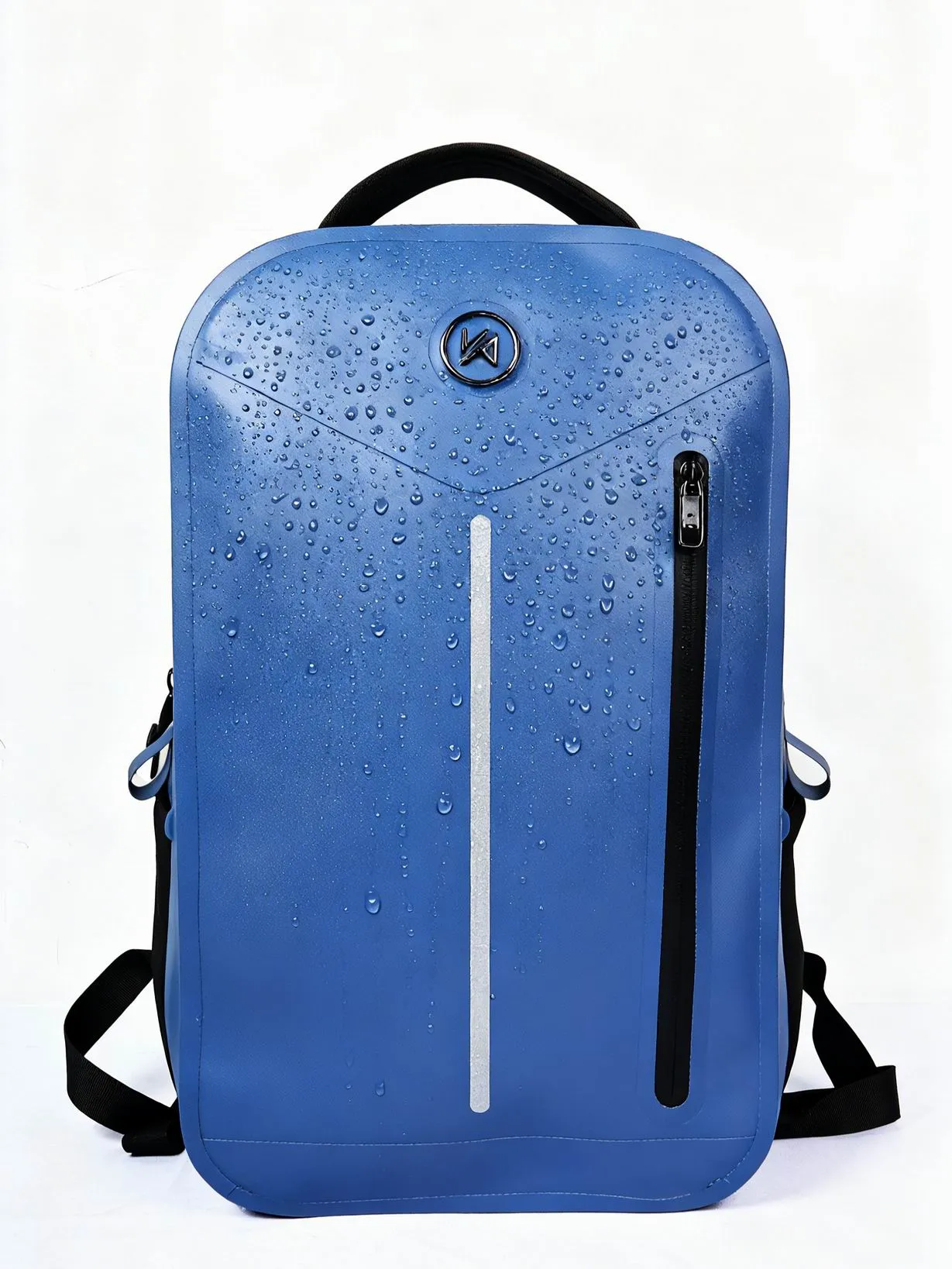
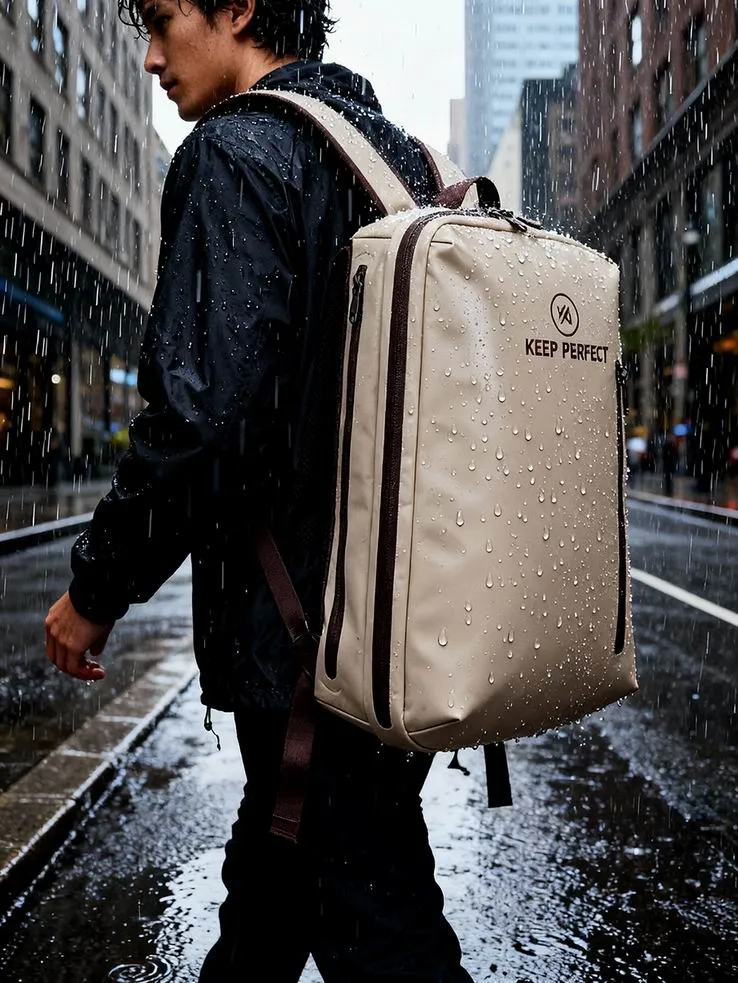
We specialise in sealed, water-resistant soft-goods: roll-top custom waterproof dry bags, waterproof hiking and commuter backpacks, waterproof tote and beach bags, waterproof cooler backpacks, phone pouches, and waterproof duffels. Every unit is built to a defined IP rating — IPX6, IPX7 or IPX8 — rather than a vague "showerproof" claim. Customisation covers fabric colour (Pantone-matched), dimensions, closure type, hardware, pockets, reflectivity and full brand decoration. You can browse the range on the products page.
Certifications and responsible manufacturing
Our social compliance is audited under amfori BSCI, our quality management is certified to ISO 9001:2015, and finished goods carry CE marking, a Children's Product Certificate (CPC) for youth lines and RoHS-compliant materials. For EU-bound orders we supply REACH-testable fabrics through ECHA REACH, and for US consumer lines we can address California Prop 65 on request. Waterproof performance is tested in-house against IEC 60529 and hydrostatic-head methods aligned to ASTM standards.
Who we work with
We serve DTC outdoor brands, international distributors, corporate promotional agencies and contract/industrial buyers. Our order book is deliberately mixed across these four channels, which keeps our lines flexible and our QC battle-tested across small promotional runs and large retail reorders alike. Read real outcomes on the case studies page.
Our philosophy
We do not chase the lowest possible price at the expense of a seam that fails. A waterproof bag is a performance product: if the weld leaks, the brand loses the customer, regardless of how nice the print looks. Every engineering decision — film thickness, weld overlap, closure design, hardware grade — is made to survive the use case you describe. That is why our warranty return rate has held below 1.8% across 2024–2025 shipments.
How we engineer waterproof performance
A bag that merely has a waterproof label will not survive submersion. We engineer three layers of protection: a coated or laminated fabric barrier, welded (not stitched) seams across the water barrier, and a closure that seals under the bag's own internal pressure. Our RF welders fuse PVC and TPU membranes at the molecular level, producing a seam that is as strong as the fabric itself. Where webbing is anchored — shoulder straps, daisy chains, D-rings — we reinforce with a load-spreading patch and over-tape every needle hole so stitching never becomes a leak path. We rate every bag to a defined IP code under IEC 60529: IPX6 for powerful spray, IPX7 for 30 minutes at one metre of submersion, and IPX8 for continuous submersion. We never call a showerproof bag "waterproof" — that distinction is the foundation of our reputation.
Production floor walkthrough
A finished dry bag passes through five zones on our 4,950 m² floor. First, the cutting zone: fabric rolls are unrolled, checked for weight and film thickness, then die-cut or CNC-cut to pattern. Second, the welding zone: panels are joined on RF and hot-air welders with in-line submergence checks every two hours. Third, the assembly zone: straps, buckles, zippers, pockets and handles are attached. Fourth, the decoration zone: screen printing, heat-transfer film, UV printing, embroidery and woven patches are applied in-house. Fifth, the QC and packing zone: AQL 2.5 sampling, polybagging, cartoning and container loading. Because all five zones are under one roof, we control lead time and quality end-to-end instead of coordinating outside vendors.
Quality control system
Our quality system is certified to ISO 9001:2015. QC happens at three gates. At incoming inspection, every fabric roll is checked for width, weight, film thickness and colour under D65 light before cutting. At in-line inspection, welders test a sample seam every two hours and the QC team walks the floor. At final inspection, finished cartons are sampled to AQL 2.5 and we photograph the loaded container. For buyers who want independent oversight, we arrange third-party inspection through SGS, Bureau Veritas or Intertek on request. This discipline is how we hold a sub-2% return rate across thousands of orders.
Logistics and DDP delivery
We ship DDP to over 100 countries. DDP means you pay one landed price and we handle export declaration, ocean or air freight, destination duties, customs clearance and last-mile delivery to your warehouse. There are no surprise duty invoices on arrival. HS classification is prepared under the WCO HS Nomenclature, and we provide the commercial invoice, packing list and certificate of origin as standard. For urgent orders we can consolidate by air or express while keeping bulk production on sea.
Working with us as a first-time buyer
If this is your first custom production order, our team guides you through the paperwork: tech pack, PI, deposit, production schedule, inspection report and shipping documents. We start with a sample (6–10 working days) so you can hold and test the bag before committing to bulk. The first round of sample revisions is free. We accept your reference sample, a competitor link or even a hand sketch — our design team writes the tech pack for you. Read the full process or the MOQ guide before you enquire.
Social and sustainability
Our social compliance is audited under amfori BSCI. For eco-led buyers we offer RPET recycled fabrics that can be certified under the Textile Exchange GRS, and we scope ISO 14001-aligned documentation against ISO 14001 where required. Our facility runs reduced-water fabrication and solar-assisted hot water. Follow our build process and finished goods on our seven social channels linked in the footer.
Milestones
| Year | Milestone |
|---|---|
| 2004 | Founder begins in the bag and soft-goods trade, sourcing for export trading houses. |
| 2014 | Company incorporated in Quanzhou; first RF welding line installed. |
| 2018 | Added TPU lamination and waterproof-zipper assembly; output reaches 80,000 pcs/month. |
| 2021 | In-house decoration cell (print, DTF, embroidery, patches) commissioned. |
| 2023 | Capacity expanded to 200,000 pcs/month; SGS capacity verification completed. |
| 2026 | 7 lines, 149 machines, 137 staff; DDP delivery to 100+ countries. |
Why we are based in Quanzhou
Quanzhou, in Fujian province, is one of China's historic bag-making clusters. Locally we source TPU/PVC film, webbing, buckles and zippers within a short supply radius, which shortens lead times and keeps input cost transparent. That cluster advantage means a fabric change that would take a trading house weeks to source takes us days. It also means our QC team can audit sub-suppliers in person rather than by email. When you buy from us, you are buying into that cluster, not just a single factory building.
Our team
Our 137 staff span cutting, welding, sewing, decoration, QC, packing, logistics and sales engineering. The sales engineer you email on day one is the same person who follows your order through production and signs the pre-shipment report — there is no hand-off to an anonymous customer service queue. Long tenure on the welding and sewing lines means consistent seam quality batch after batch, which is the single biggest driver of our sub-2% return rate.
How we test waterproof performance
We do not rely on supplier datasheets. Every sealed line is tested on the floor. The two most common tests are submergence and hydrostatic head. Submergence: a loaded sample bag is submerged to one metre for 30 minutes (IPX7) or continuously (IPX8) and inspected for seepage along seams and closure. Hydrostatic head: a column of water pressure is applied to a fabric swatch to measure how many millimetres of water it resists before leaking, reported in mm. We also run a roll-over / tumble test for dry bags that will be tossed around on boats. Test methods follow IEC 60529 and physical strength tests align to ASTM; colourfastness references AATCC methods. We share test photos with buyers on request.
Export markets we serve
| Region | Typical buyer | Common product |
|---|---|---|
| North America | DTC outdoor brands, Amazon sellers | Dry bags, phone pouches, coolers |
| Northern Europe / UK | Outdoor retailers, eco brands | RPET backpacks, dry bags |
| Australia / NZ | Beach & boating brands | Totes, roll-top dry bags |
| Middle East | Promotional agencies, events | Printed totes, pouches |
| East Asia | Distributors, bike brands | Commuter backpacks |
What makes a waterproof bag last for years
A sealed bag outlasts a stitched one by a wide margin because there is no thread to rot and no tape to peel. That said, longevity depends on three build choices: film thickness (a 0.5 mm promotional bag will not survive a decade of rafting; a 1.0 mm TPU nylon bag will), hardware grade (acetal buckles outlast plastic under UV and salt), and aftercare (rinsing saltwater off the weld line, drying before storage). We specify the build to the use case so the bag matches your customer's expectations and your warranty window. If a bag does fail under normal use, we track the failure mode and feed it back into the next spec revision — continuous improvement is how return rates stay low.
Why choose a specialist over a general bag factory
Most Chinese bag factories make everything: backpacks, luggage, handbags, cooler bags. We chose to specialise in waterproof sealed soft goods. That focus means our welders are welding TPU/PVC every day, not switching between luggage fabric and dry-bag film; our QC checklist is written for seam integrity, not general stitching; and our sample room keeps waterproof zipper and roll-top tooling ready. A general factory can make you a waterproof bag, but a specialist makes it consistently across 200,000 units a month. That is the difference between a one-off sample and a repeatable retail product.
Contact our production team
Email service@junyuanbags.com or message WhatsApp +86 17750020688. We reply within 24 hours and will turn your reference, sketch or competitor link into a tech pack and a sampling plan. Visit the contact page to start.
Frequently Asked Questions
Q1. When was QUANZHOU JUNYUAN BAGS founded and where are you based?
The present company was incorporated in 2014 to focus exclusively on waterproof and water-resistant custom bags for export; our founder has worked in the bag and outdoor soft-goods trade since 2004. We are based in Fengze District, Quanzhou, Fujian, one of China's historic bag-making clusters. Our SGS-verified facility covers 4,950 m² with 7 production lines, 149 machines and 137 skilled staff across cutting, welding, sewing, decoration, QC and packing.
Q2. How much can your production facility output each month?
Our SGS-verified capacity is up to 200,000 sealed bags per month, produced on 7 lines by 137 staff operating 149 machines including RF welders, hot-air welders, die-cutters and decoration presses. Standard MOQ is 500 pieces per style, samples take 6-10 working days, and bulk production runs 35-50 days after sample approval. Capacity verification was completed with SGS in 2023, and we hold production slots for repeat buyers.
Q3. Which certifications does your facility hold?
Quality management is certified to ISO 9001:2015, social compliance is audited under amfori BSCI, and finished goods carry CE marking, a Children's Product Certificate for youth lines and RoHS-compliant materials. For EU orders we supply REACH-testable fabrics, and for US consumer lines we can address California Prop 65 on request. Waterproof performance is tested in-house to IEC 60529 at IPX6, IPX7 and IPX8 levels.
Q4. Which markets do you export to and what are the trade terms?
We ship to more than 100 countries on DDP terms, covering export declaration, freight, destination duties, customs clearance and last-mile delivery to your warehouse. Our main regions are North America, Northern Europe and the UK, Australia and New Zealand, the Middle East and East Asia. Standard terms are T/T with a 30% deposit and 70% balance before shipment, and FOB Xiamen is also available.
Q5. How do you control quality before a shipment leaves?
QC runs at three gates. Incoming inspection checks every fabric roll for width, weight, film thickness and colour under D65 light. In-line inspection tests a welded sample seam every two hours. Final inspection samples finished cartons to AQL 2.5 and we photograph the loaded container. Third-party inspection through SGS, Bureau Veritas or Intertek can be arranged. This system keeps our return rate below 1.8%.