Tourism is the single largest demand engine for custom waterproof bags: every beach resort, island tour, cruise itinerary and adventure-travel program puts guests next to water with phones, cameras and documents they cannot afford to wet — and the industry has learned that a branded waterproof bag is simultaneously guest equipment, walking advertising and the highest-converting item in destination retail, with unit costs from $2.40 at MOQ 500 and retail realizations of $15–$89. This guide covers the full tourism program: the buyer map (resorts, tour operators, cruise lines, DMCs, national parks), the format family by channel, destination branding that sells, the fleet-and-retail mirror model, compliance for international programs, and the seasonal calendar that decides whether the goods arrive before the guests do.
The manufacturer reference is QUANZHOU JUNYUAN BAGS: custom waterproof bag production since 2014, 4,950 m² SGS-verified facility, 7 lines, 149 machines, 137 staff, 200,000 pieces monthly. MOQ 500 per design splittable across the tourism family, samples 6–10 working days, bulk 35–50 days, AQL 2.5 inspection, 30/70 T/T, FOB Xiamen, shipping to 100+ countries.

Why tourism buys more waterproof bags than any other industry
Tourism buyers ordering custom waterproof bags for tourism programs purchase the destination’s promise in physical form — travel industry waterproof bags are souvenirs with utility, not corporate logo drops. The demand logic is structural. The UN World Tourism Organization counts over a billion international arrivals a year, and the fastest-growing segments — coastal leisure, island destinations, adventure travel, cruising — are precisely the ones where guests spend their days within meters of water. Every one of those guests carries a phone worth ten times the price of the bag that would protect it. The tourism industry discovered the consequence before the bag industry did: a guest with a drowned phone is a one-star review, while a guest whose resort-branded dry bag kept everything dry is a five-star review plus a walking advertisement for the rest of the trip. That is why waterproof bags anchor the merchandise mix of dive shops, island tour desks, cruise gift shops and eco-lodges across every warm-water destination on earth.
The second driver is unique to tourism: the purchase happens at the point of need. Destination retail does not compete with online prices the way hometown retail does — the guest is standing on a dock, the boat leaves in twenty minutes, and the bag in front of them solves the problem right now. That dynamic supports retail realizations of $15–$45 on bags that cost $2.40–$4.90 landed, a margin structure few souvenir categories match.
The buyer map: five channels, five buying logics
| Channel | Buyer | Buying logic | Typical program |
|---|---|---|---|
| Beach resorts & hotels | Retail manager / F&B | Guest amenity + boutique margin | 500–2,000 units/season, tote + pouch mix |
| Tour operators & outfitters | Operations manager | Fleet equipment + dock retail | Fleet bags + retail mirror, 500–3,000 units |
| Cruise lines | Onboard retail / shore excursions | Excursion gear + gift shop | 5,000+ units, multi-port branding |
| DMCs & travel agencies | Program designer | Welcome-kit differentiation | Per-arrival gifting, 500–1,500 units |
| Parks & attractions | Retail / guest services | Rain-day rescue + souvenir | High-turnover pouch + bag mix |
The channels differ in what the bag is for. Resorts treat it as an amenity with a retail upside — the pool-beach tote that carries the property logo home to a dozen countries. Tour operators treat it as working equipment that pays for itself twice — once as fleet gear, once as the retail mirror at the dock. Cruise lines buy at volume for shore-excursion kits. DMCs buy differentiation: the waterproof welcome kit that makes their itinerary feel premium from the arrival hall. Parks and attractions buy the rain-day rescue that converts a washed-out visit into a saved one. A quotation that does not ask which channel you are is quoting a generic bag, not a tourism program.
The tourism format family
| Format | Unit cost (500+) | Retail band | Channel fit |
|---|---|---|---|
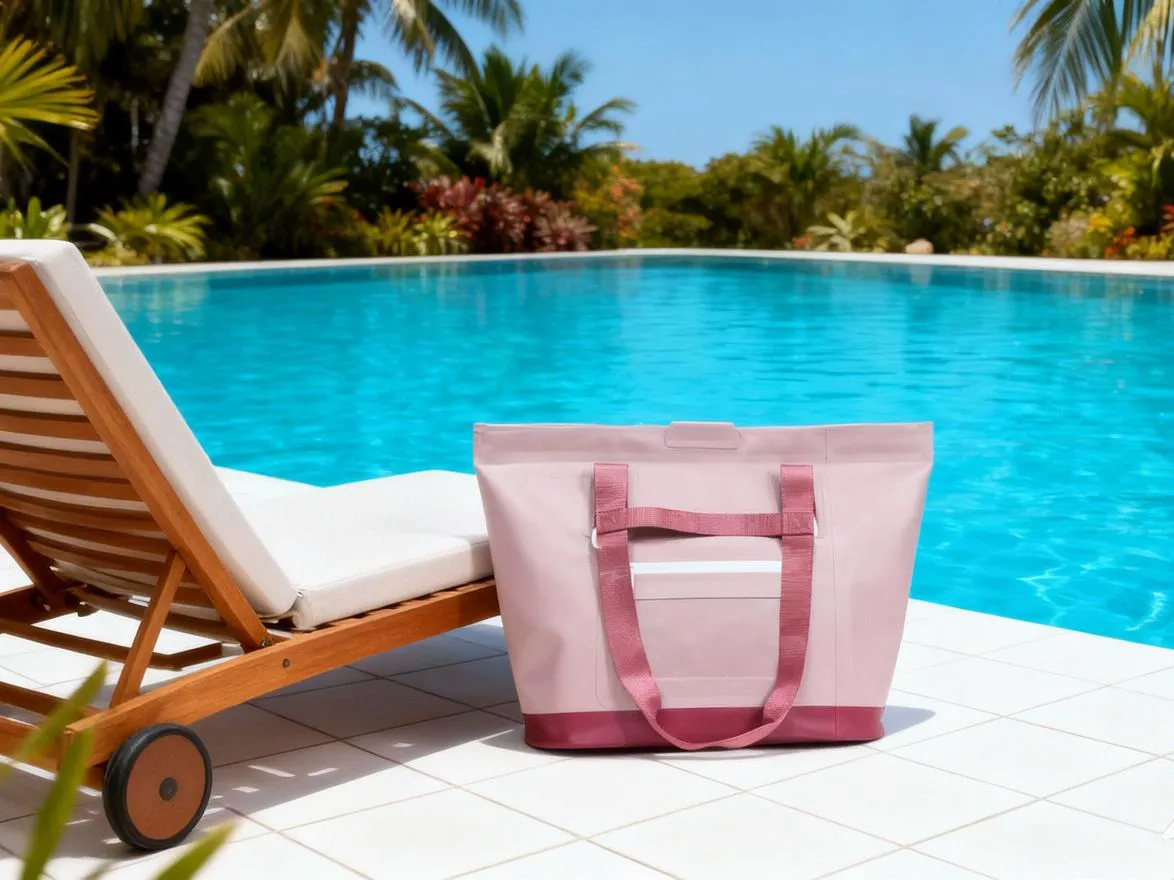
| Beach/pool tote (splash band) | $3.20–$5.40 | $25–$45 | Resort boutique, cruise gift shop |
| Phone pouch (IPX8) | $0.85–$1.60 | $10–$18 | Every channel — the volume impulse SKU |
| Roll-top dry bag 10–20L | $3.40–$4.90 | $25–$45 | Tours, water parks, excursion kits |
| Waist/sling pouch | $2.10–$3.60 | $15–$28 | Theme parks, city tours, festivals |
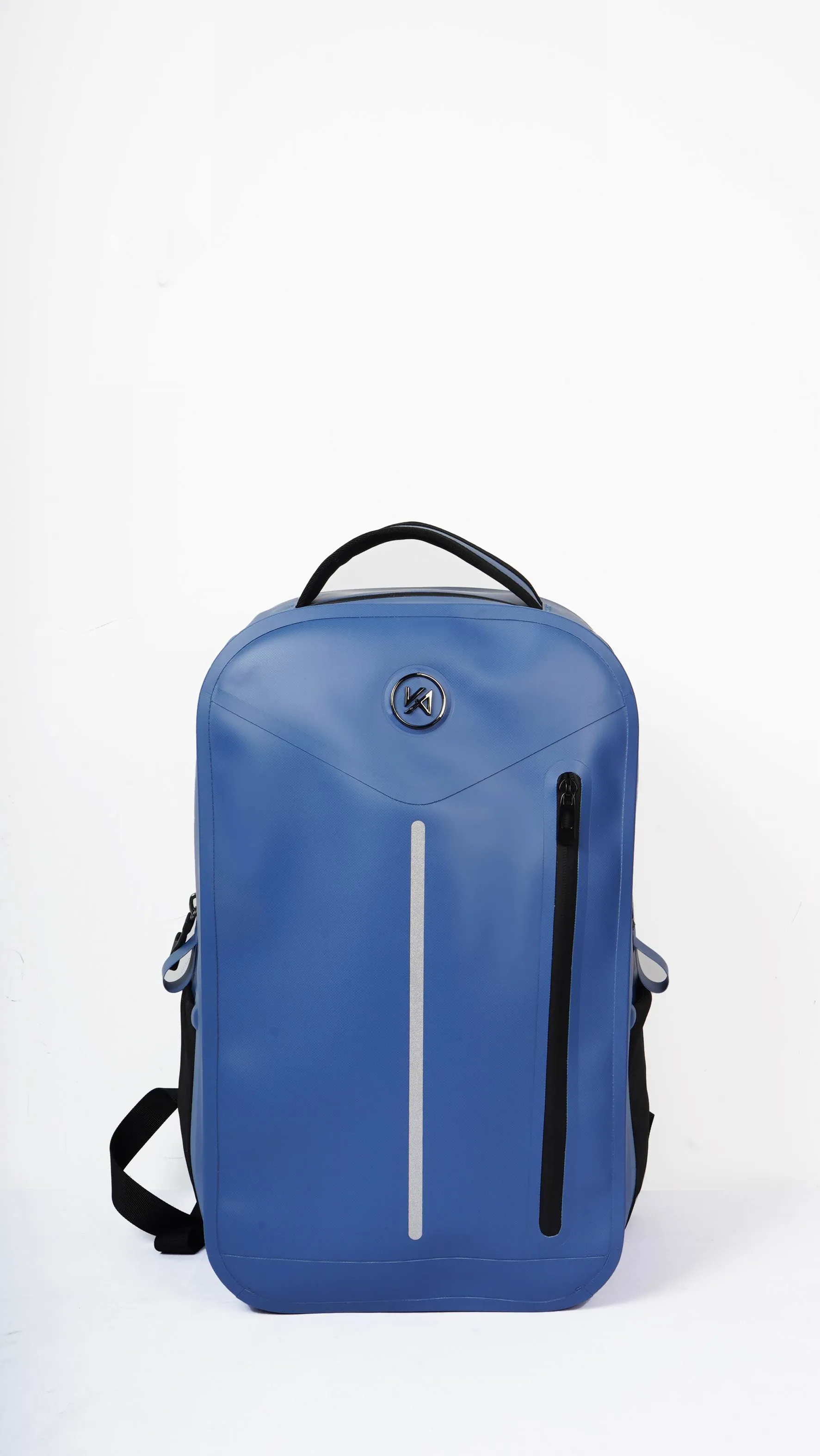
| Travel backpack 20–30L | $5.90–$8.50 | $49–$89 | Adventure travel, premium gift tiers |
| Document/valuables case | $1.90–$2.80 | $12–$22 | Cruise, DMC welcome kits |
The pouch row deserves emphasis: it is the single highest-turnover waterproof SKU in destination retail because it prices as an impulse buy and solves the exact anxiety of the moment. The phone pouch economics and construction — dual-snap closures, 0.18 mm optical TPU touch windows, IPX8 builds — are detailed in our phone pouch guide. The tote row is the resort-boutique margin engine, and its beach-to-boardroom positioning is in our waterproof tote guide.
Destination branding: what actually sells
Destination retail has its own branding grammar, and the winners follow it. The design that sells is the one the guest would have bought as a souvenir anyway — the destination name, the landmark, the local art style — executed on a product they will actually use for years. The failure mode is the corporate-looking bag: a resort logo alone reads as an amenity, while a beautifully rendered island map with the resort mark integrated reads as a souvenir. Practical execution: full-wrap prints for the destination-art builds, Pantone matching at Delta E ≤2 so the boutique range reads as one collection, and multilingual care printing for international guest bases. Method selection with cost bands is in our logo options guide.
A naming nuance that moves conversion: date-stamp or season-stamp a share of the run ("Maldives 2026", "Season 12"). Scarcity and collectability are free margin in destination retail, and the print plate change costs almost nothing at our setup.
The fleet-and-retail mirror: the tour operator model
The tour operator economics are the cleanest in the category, and worth stating plainly because so few operators run them deliberately. Fleet bag: every guest on the island-hopping tour uses a branded dry bag all day — it keeps their phone dry, it identifies the group, and it advertises the company to every other boat at the snorkel stop. Retail mirror: at the take-out dock, the same bag sits in the shop at $30. Guests watched it work for six hours; the sale is a formality. Operators running the model deliberately report the retail mirror repaying the entire fleet cost within a season — after which the fleet equipment is effectively free and the retail line is pure margin. The outfitter version of this model is detailed in our paddling programs guide, and the resort amenity economics in our hospitality guide.
Cruise and multi-port programs
Cruise programs add two layers: volume and geography. Shore-excursion kits run 5,000+ units per season across beach-break and water-activity excursions, and the branding often splits by itinerary — Caribbean, Mediterranean, Alaska each want their own artwork on the same chassis. Our production handles this as one order with split artwork per destination at the MOQ 500-per-design level, one production calendar, consolidated freight to the provisioning port. The excursion formats concentrate in phone pouches, document cases and 10–20L dry bags, with the splash-band beach tote anchoring the gift-shop range. Onboard retail’s own margin logic favors the two-price-point range: the impulse pouch at $12–$15 and the statement tote at $35–$45.
DMC welcome kits and MICE programs
Destination management companies and MICE (meetings, incentives, conferences, events) planners buy waterproof bags as differentiation in a market where every itinerary looks the same on paper. The welcome-kit bag — a destination-branded pouch or small dry bag holding the program, local SIM, and arrival essentials — is the first physical touchpoint of the trip, and it photographs. Incentive-travel programs for corporate groups add the personalization layer: delegate names or team divisions printed per unit with variable data, the same technique our corporate promotional guide covers for brand campaigns. Per-arrival economics work at MOQ 500 because DMC programs aggregate a season’s arrivals into one production run.
Materials for destination duty
Tourism duty is defined by three exposures: UV (the bag lives outdoors at latitude), salt (ocean destinations), and sunscreen-and-sand chemistry (beach reality). The material stack answers all three: UV-stabilized TPU film so the print and polymer survive seasons of equatorial sun — the aging science is in our UV resistance guide; salt-rated hardware and marine-grade construction from our marine programs guide; and smooth film surfaces that rinse clean of sand and lotion. Fabric weights run lighter than expedition duty — 210D–500D laminates for dry bags, heavy canvas-feel laminates for boutique totes — because tourism duty cycles are seasons of daily use rather than years of backcountry abuse. The TPU-versus-PVC decision for tropical retail skews firmly to TPU on hand-feel alone, and the comparison data is in our TPU vs PVC guide.
Compliance for international tourism programs
Tourism programs ship to the world’s most regulated consumer markets by definition — the guests come from everywhere, and the destination’s own import rules apply. The compliance baseline: REACH for EU-bound programs, CPSIA for the US, and the children’s-product threshold whenever the range includes kids’ sizes (family resorts, take note — a kids’ pouch is a children’s product with a certificate trail, and the path is in our compliance testing guide). Cruise-line programs add the line’s own vendor-compliance requirements, which our documentation pack — test reports, factory audits, material declarations — is built to satisfy. The full regulatory map is in our compliance guide.
Tourism program economics at MOQ 500
| Program line | Unit cost (500+) | Retail band | Margin multiple |
|---|---|---|---|
| Phone pouch IPX8 | $0.85–$1.60 | $10–$18 | 8–12× |
| Document case | $1.90–$2.80 | $12–$22 | 6–8× |
| Waist/sling pouch | $2.10–$3.60 | $15–$28 | 6–8× |
| Dry bag 10–20L | $3.40–$4.90 | $25–$45 | 7–9× |
| Beach tote | $3.20–$5.40 | $25–$45 | 7–8× |
| Travel backpack 25L | $5.90–$8.50 | $49–$89 | 8–10× |
The margin multiples are why destination retail anchors its merchandise mix on this category: few souvenir lines return 6–12× landed cost with a multi-year use life that keeps the destination’s brand in circulation. The MOQ 500 splits across the whole family — a resort launch of 200 totes, 200 pouches and 100 dry bags is one order. Full cost mechanics including freight and duty are in the cost breakdown guide.
Sampling: test it where the guests will
Tourism samples prove themselves on location, and the smart buyers test exactly there: the tote through a pool-deck week, the pouch through snorkeling and a sunscreen-covered day, the dry bag on a real excursion with real guests’ kit. Samples run 6–10 working days at $60–$150 per configuration, fees credited against bulk, and the golden sample becomes the AQL 2.5 reference. For multi-property groups we sample the full range at once so the boutique collection is photographed and range-planned before bulk. The full protocol is in our sampling guide.
Common mistakes in tourism bag programs
- Corporate-logo-only design: an amenity look in a souvenir channel — guests buy destinations, not logos
- Fashion-grade film: non-UV-stabilized film chalks and cracks within one equatorial season
- PVC hand-feel in boutique channels: the tote is touched before it is bought; TPU wins the touch test
- Missing the impulse tier: no sub-$2 pouch SKU means no volume line in the range
- Late-season ordering: goods that land after peak season are next year’s inventory at this year’s cost
- Ignoring kids’ compliance: the kids’ pouch is a regulated children’s product — plan the certificate trail
The seasonal calendar that decides everything
Tourism programs live and die by the calendar: the goods must land before the guests do, and the production math rewards whoever starts a season early. Northern-hemisphere summer programs sample in October–November, approve golden samples before the year turns, run bulk in January–February and land goods in March–April — a full month before the season’s first arrivals. Caribbean winter high season and southern-hemisphere summer invert the dates but keep the shape. Mid-season replenishment rides the 30–35 day reorder window for established designs, triggered at the season’s booking peak rather than after the shelves thin. Programs that inquire at season opening learn the expensive arithmetic: air freight that halves the margin, or a boutique that sells out of its best line in week three and cannot restock until week nine.
Spec your tourism program
Bring four facts — your channel (resort, operator, cruise, DMC, park), your destination climate and water exposure, your guest volumes and season dates, and your retail ambition — and the quotation returns in 24–48 hours: format mix per channel, destination-branding plan, compliance stack per destination market, and a costed program at MOQ 500 with free splits. QUANZHOU JUNYUAN BAGS — tourism-grade custom waterproof bags since 2014, 4,950 m² SGS-verified facility, 7 lines, 149 machines, 137 staff, 200,000 pieces monthly, samples 6–10 working days, bulk 35–50 days, AQL 2.5, 30/70 T/T, FOB Xiamen, 100+ countries. The production chain from first inquiry runs from sampling into bulk; the traveler-facing format decisions are in our travel bag features guide, and the complete manufacturing reference is the manufacturing guide.
Frequently Asked Questions
Q1. What waterproof bags do resorts sell in their boutiques?
The anchor mix is a splash-band beach tote at $25–$45 retail, an IPX8 phone pouch at $10–$18 as the volume impulse SKU, and a 10–20L roll-top dry bag at $25–$45 — destination-branded with artwork guests would buy as souvenirs anyway.
Q2. How much do custom waterproof bags for tourism cost?
At MOQ 500: phone pouches $0.85–$1.60, document cases $1.90–$2.80, sling pouches $2.10–$3.60, beach totes $3.20–$5.40, dry bags $3.40–$4.90, travel backpacks $5.90–$8.50. Destination retail realizations run 6–12× landed cost.
Q3. What is the minimum order for resort-branded bags?
MOQ 500 per design, splittable across formats — a resort launch of totes, pouches and dry bags is one order and one production calendar.
Q4. What is the fleet-and-retail mirror model?
Tour operators field branded bags as guest equipment (the fleet) and sell the same bag at the dock shop (the retail mirror). Guests who watched it work all day buy it at take-out — operators report the mirror repaying the fleet cost within a season.
Q5. Can bags be branded with destination artwork?
Yes — full-wrap destination prints, landmark artwork, local-art styles, season-stamped editions, Pantone matching at Delta E ≤2. The design that sells is the souvenir the guest would have bought anyway, on a product they will use for years.
Q6. What bags do cruise lines buy for shore excursions?
Phone pouches, document cases and 10–20L dry bags for excursion kits at 5,000+ units per season, with itinerary-split artwork (Caribbean, Mediterranean, Alaska) on one chassis — plus beach totes for onboard retail.
Q7. Do kids’ waterproof pouches need special certification?
Yes — in the US a kids’ pouch is a CPSIA children’s product requiring third-party testing at a CPSC-accepted lab, a Children’s Product Certificate and tracking labels. Family-resort ranges should plan that trail from the start.
Q8. What materials survive tropical destination duty?
UV-stabilized TPU laminates with salt-rated hardware: the film survives equatorial sun, the hardware survives the ocean, and smooth surfaces rinse clean of sand and sunscreen. 210D–500D for dry bags, heavier laminates for boutique totes.
Q9. How far ahead should a tourism program order?
One full season: sample in autumn for a summer launch, bulk production in winter, goods landed a month before first arrivals. Reorders of established designs ship in 30–35 days mid-season.
Q10. Can DMCs personalize welcome-kit bags per delegate?
Yes — variable-data printing puts delegate names, team divisions or arrival dates on individual units at setup cost, which is why incentive-travel programs use the technique for the arrival moment.
Q11. What sells best in destination retail?
The phone pouch is the highest-turnover SKU (impulse price, immediate need); the destination-art tote is the margin anchor; the dry bag is the excursion kit staple. A two-price-point range — impulse plus statement — outperforms single-format ranges.
Q12. Do you ship to resort islands and cruise provisioning ports?
Yes — 100+ countries served including island destinations via FOB Xiamen sea freight with consolidated port delivery, and cruise-line provisioning schedules accommodated in the production calendar.
Q13. How long do resort retail bags last in UV exposure?
With UV-stabilized film, multiple seasons of equatorial outdoor display and use; fashion-grade film chalks within one season. The film specification is the single decision that determines display life.
Q14. Can one order cover a multi-property hotel group?
Yes — range sampling across properties, shared chassis with property-specific artwork at MOQ 500 per design, consolidated production and split shipping per property.
Q15. What makes a waterproof bag sell as a souvenir?
Destination-first design (name, landmark, local art), a product the guest uses daily (pouch, tote, dry bag), and season-stamping for collectability. Corporate-logo-only bags underperform souvenir-art bags in every destination channel.
Q16. How fast are samples for a tourism range?
6–10 working days per configuration at $60–$150, fees credited against bulk. Multi-property groups sample the whole range at once for range planning and photography.
People Also Ask
What bags should I take on a beach vacation?
A roll-top dry bag for boat and water days, an IPX8 phone pouch for the pool and snorkel, and a splash-resistant tote for the beach — the same three-format mix destination retail stocks, because it answers every water-adjacent moment of the trip.
Are waterproof bags worth buying at resorts?
At the point of need, yes: the boutique premium buys the protection immediately before the excursion. The same formats cost less planned ahead — but a drowned phone costs more than either.
What is the best bag for island hopping tours?
A 10–20L welded roll-top dry bag (IPX7) for the boat day, plus a small deck pouch or phone pouch for access. Zippers are not in the honest answer for spray and swim stops.
How do hotels use branded waterproof bags?
As pool-beach amenities, boutique retail, VIP welcome gifts and excursion equipment — the bag is simultaneously guest equipment, walking advertising and the boutique’s highest-margin line.
What size bag do I need for a day at the beach?
10–20L for a couple’s kit (towels, sunscreen, change of clothes), a phone pouch per swimmer, and a tote for the dry layer. Size to the worst realistic day, not the average one.
Can waterproof bags go in the ocean?
Welded roll-tops and IPX8 pouches are built for exactly that — rinse salt off after use and dry before storage. Splash-band totes handle spray and wet sand but are not for submersion.