Custom waterproof bags are built to your specification — shell material, construction, closure, size, color and branding — at an MOQ of 500 pieces, with samples in 6–10 working days, bulk in 35–50 days, and unit prices of $2.70–$8.50 FOB depending on construction and quantity band. The specification decisions that matter most are four: shell (0.5 mm TPU laminate is the default for serious programs), seams (high-frequency welded for any IPX6+ claim), closure (roll-top for submersion-rated products), and ingress rating (IPX6 for spray, IPX7 for 30-minute 1 m immersion per IEC 60529 ingress protection ratings). Get those four right and everything else — branding, packaging, freight — is execution.
This guide walks the full manufacturing path from first sketch to delivered cartons, with the numbers buyers actually negotiate: material options and cost deltas, construction methods and their failure modes, customization boundaries, testing and certification requirements, and the commercial terms. It reflects production at QUANZHOU JUNYUAN BAGS — a custom waterproof bag specialist since 2014, with a 4,950 m² SGS-verified partner facility, 7 production lines, 149 machines, 137 staff, 200,000 pieces monthly capacity and DDP delivery to 100+ countries under BSCI, ISO 9001:2015, CE, CPC and RoHS.
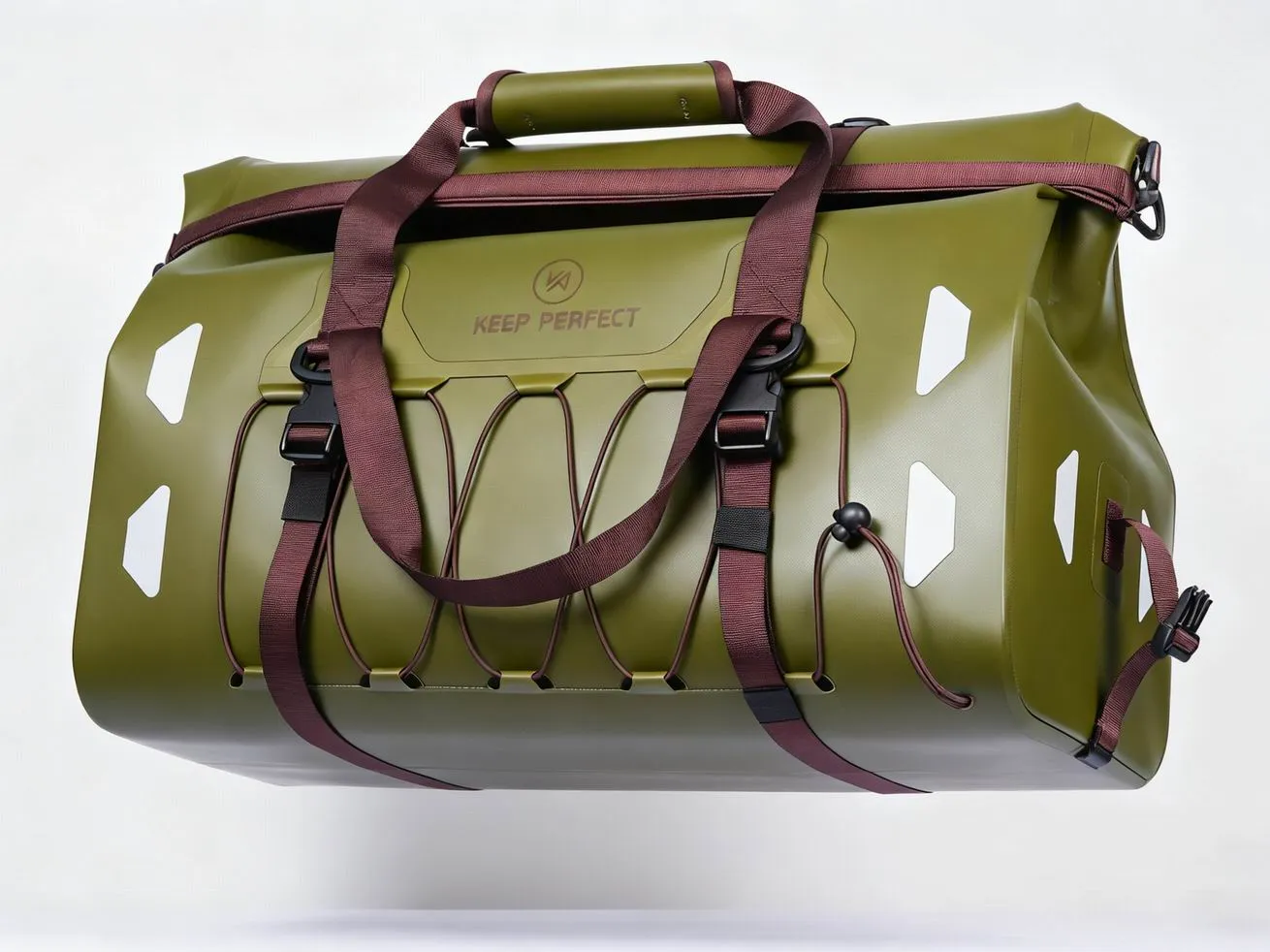
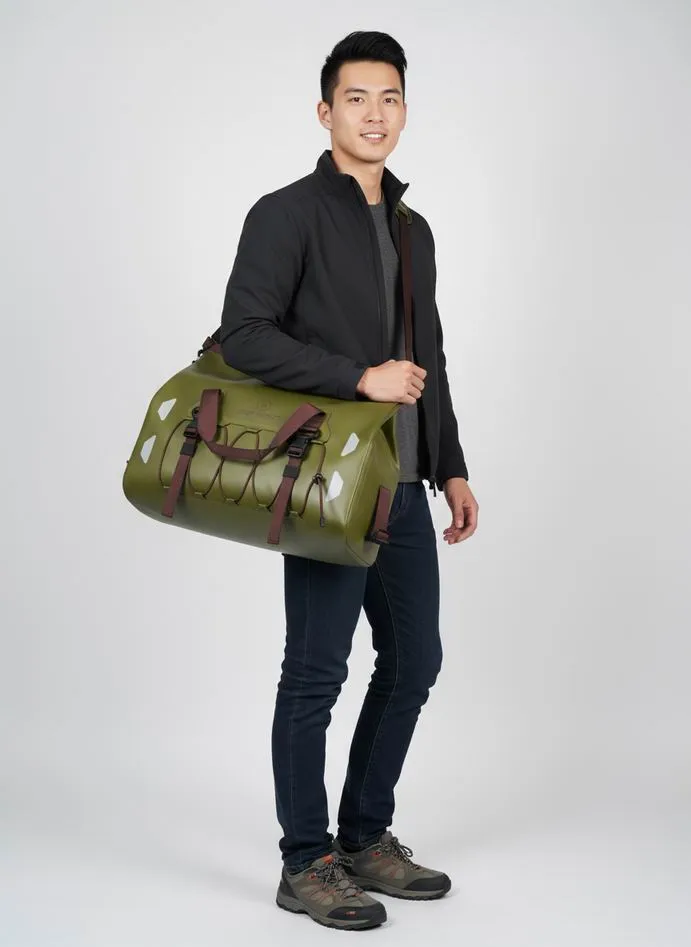
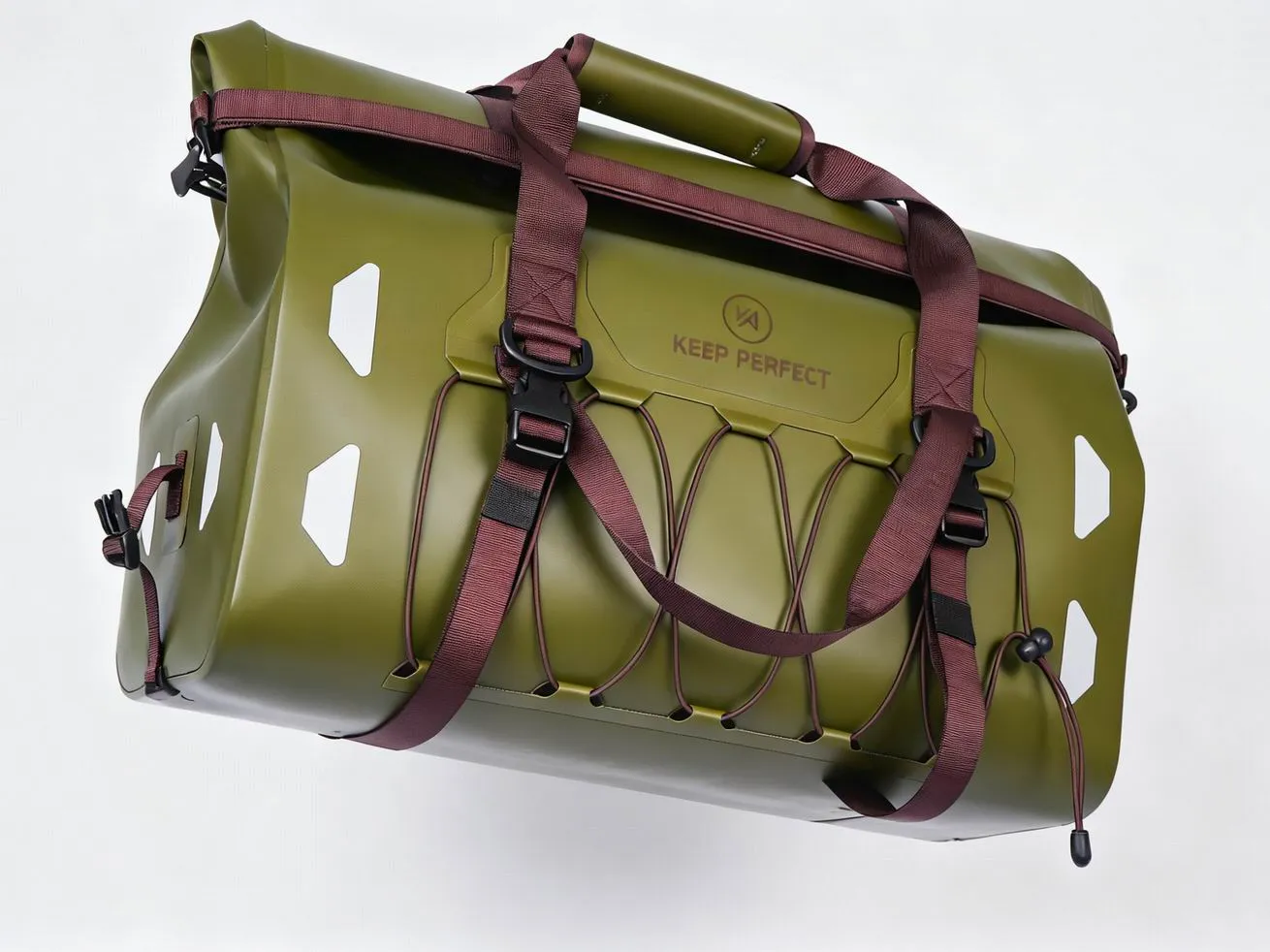
What "custom" actually covers at a waterproof bag factory
Every serious buyer of custom waterproof bags eventually confronts the same six production decisions; this guide walks them in the order a factory actually resolves them. Custom spans six independent dimensions, and a clear brief addresses all six: (1) structure — dimensions, capacity, panel layout; (2) shell — material, weight, color; (3) construction — welded or stitched seams, reinforcement; (4) closure — roll-top, zipper, valve systems; (5) branding — logo method, placement, labels; (6) packaging — polybag, hangtag, retail box, carton marks. You can customize one dimension or all six; cost and MOQ scale with how far you move from proven platform geometry.
The fastest programs stay custom in the dimensions customers see (color, logo, packaging) and standard in the dimensions that carry engineering risk (pattern, seam, closure). That split delivers a genuinely branded product at the 500-piece floor without tooling lead time — and it is why we maintain a library of production-tested platforms across dry bags, backpacks, totes, duffels and pouches as starting points for custom briefs.
Shell materials: TPU laminate, PVC and the alternatives
Shell material is 40–55% of unit cost and determines flexibility, cold-crack behavior, weldability, printability and regulatory profile. The default for premium custom programs is TPU-laminated nylon: a woven face bonded to thermoplastic polyurethane film at 0.35–1.0 mm total thickness, hydrostatic head 5,000–12,000 mm, flexible to –20°C, clean-welding and clean-printing. PVC-coated polyester costs 35–45% less but is stiffer, heavier and increasingly awkward under EU chemical scrutiny — phthalate plasticizers face restrictions detailed in the ECHA REACH regulation.
| Shell option | Weight (g/m²) | Hydrostatic head | Cold flex | Relative cost | Best for |
|---|---|---|---|---|---|
| 500D PVC tarpaulin | 480–560 | 3,000–5,000 mm | –10°C | 1.00× | Budget dry bags, promo |
| 0.5 mm TPU laminate (840D) | 520–620 | 8,000–12,000 mm | –20°C | 1.45–1.6× | Premium custom programs |
| 420D TPU ripstop | 320–400 | 5,000–8,000 mm | –25°C | 1.25–1.35× | Lightweight packs |
| rPET + TPU (GRS) | 540–640 | 7,000–10,000 mm | –18°C | 1.55–1.7× | Sustainability-positioned brands |
| Transparent TPU | 380–450 | Full rating | –15°C | 1.3–1.45× | See-through pouches |
Selection heuristic: match the shell to the promise. A $29.99 retail dry bag carries PVC comfortably; a $49.99 premium program or any sustainability claim needs TPU or rPET. We laminate and stock 20+ film colors, so custom colorways rarely require a mill run at the 500-piece band.
Seam construction: welded beats sewn for anything above IPX4
Seams cause roughly 80% of waterproof failures, so construction method is the credibility decision. High-frequency (HF) welding uses 27.12 MHz RF energy to melt TPU or PVC film at the seam, creating a bond stronger than the parent material — specified at 35 N/5 cm peel strength minimum, 12–16 mm weld width with a redundant second weld line on load-bearing seams. Hot-air taping applies 22–25 mm TPU tape at 480–520°C over stitched seams — appropriate for IPX4–IPX5 rainwear-level products, not submersion. Ultrasonic welding handles lightweight pouches and pocket seams.
The specification line to hold: any product marketed as submersible (IPX7/IPX8) must be HF-welded throughout — a stitched seam with tape is a warranty claim waiting for its first river crossing. Our in-line protocol inspects every weld visually within 30 seconds of formation, and 1-in-20 finished bags per batch passes a 10-minute hydrostatic column test before packing. Buyers comparing factories should ask for weld peel-strength data, not adjectives.
Closure systems: roll-top, waterproof zipper and valves
The closure is the second failure point after seams. Roll-top — three folds plus side-buckle compression — is the IPX6/IPX7 standard: no teeth to fail, self-compressing, and it floats even when overpacked. Waterproof zippers (YKK Aquaseal class) cost $3.50–$6.00 per unit against $0.80 for a standard coil, need a sealed tape bond along the flange, and top out at splash-to-brief-immersion protection in real use. Purge valves ($0.40–$0.90) let compression sacks expel air without ingesting water.
| Closure | Protection level | Unit cost add | Failure mode | Best for |
|---|---|---|---|---|
| Roll-top, triple-fold | IPX6–IPX8 (welded build) | $0.60–$1.10 (buckles, webbing) | User under-folds; strap wear | Dry bags, submersion claims |
| Water-resistant zipper | IPX4–IPX5 | $0.80–$1.50 | Coating wear at the coil | Commuter, tote, quick access |
| Waterproof zipper (Aquaseal) | IPX6–IPX7 brief | $3.50–$6.00 | Slider end-stop leaks | Camera, tech, premium packs |
| Roll-top + purge valve | IPX7 + compressible | +$0.40–$0.90 | Valve gasket aging | Compression sacks, expedition |
Decision rule we give every brand: if the marketing page says "submersible," ship a roll-top; if it says "rainproof commute," a quality water-resistant zipper is the right convenience trade; never put a standard zipper on anything you call waterproof.
Capacity planning and size customization
Capacity anchors the use case: 3–10 L for phone-and-wallet pouches and organizers, 10–20 L for day use, 20–30 L for full-day and overnight (the category anchor), 30–55 L for expedition. Custom dimensions on an existing pattern grade carry no MOQ penalty at the 500-piece band; a fully new pattern adds grading work but stays inside the same commercial structure. Always specify both rolled dimensions and empty weight alongside liters — a 20 L bag at 1,400 g empty is a product customers leave at home.
Weight targets by shell: 650–900 g for a 20 L TPU laminate build, 900–1,200 g in PVC, plus 150–250 g for back panels and straps on carry products. Our pattern library covers the standard bands, and size sets (5/10/20 L or 10/20/30 L families) share one pattern grade and one print setup — the efficient way to look like a full line at 500 pieces.
Color and branding: the visible customization layer
Shell color comes from the film: our stock library of 20+ laminated colors covers most brand palettes at no MOQ penalty, and a 500-piece run splits across two or three colors freely. Truly custom Pantone-matched film requires a mill run of roughly 1,000–2,000 meters — the 3,000-piece conversation. Print colors are matched to Pantone solid-coated at Delta-E ≤1.5 under D65 lighting.
Branding execution: screen print ($0.30–$0.90), heat transfer ($0.60–$1.50), molded patch ($0.60–$1.20 plus $80–$150 mold) or embroidery on panels and patches ($1.50–$3.00, never through film). Placement discipline: upper front panel at 80–120 mm, clear of welds, fold lines and the base. Full method comparison in the logo options guide, color workflow in the Pantone matching guide.
Testing and quality standards that protect your program
A defensible quality system has four gates: incoming material inspection (hydrostatic head per ISO 811, thickness, color), in-line weld checks within 30 seconds of formation, finished-product testing (1-in-20 hydrostatic column per batch; 1-in-200 submersion for IPX7 claims), and final random inspection at AQL 2.5 major / 4.0 minor with a photo-and-data report before balance payment. Our program-wide defect rate runs below 0.8% per AQL report.
Write the test methods into your purchase order — named standards, sample sizes, acceptance criteria — so the QC report is auditable against your spec, not the factory's habit. Third-party verification by SGS inspection services or BV is welcomed on any lot, and buyers running retail programs increasingly require it. Deeper protocol detail: testing standards guide and AQL sampling explained.
Certifications and market compliance
Factory-level credentials: BSCI social audit, ISO 9001:2015 quality management, and product-side CE, CPC and RoHS documentation. Material-level screens: REACH SVHC for the EU, Prop 65 evaluation for California, FDA-relevant documentation for food-contact cooler liners. GRS certification applies when you specify recycled-content shells. We provide reports on request and schedule third-party audits during bulk production.
Compliance is a spec-line item, not an afterthought: tell us your destination markets at quoting and the material selection, labeling and documentation are built into the run. The global certification guide maps requirements by market, and REACH/CPSIA testing covers the chemical screens in detail.
MOQ, pricing and lead time: the commercial frame
The commercial constants: MOQ 500 pieces per design, samples $60–$150 (credited) in 6–10 working days, bulk 35–50 days after golden-sample approval, reorders 25–35 days. Payment 30% T/T deposit, 70% against B/L copy; L/C at sight above $50,000. Unit pricing for a 20 L TPU dry bag: $4.50–$8.50 at 500, $3.80–$7.20 at 1,000–2,999, $3.20–$6.10 at 3,000–4,999, $2.70–$5.20 at 5,000+.
| Stage | Timeline | Cost |
|---|---|---|
| Digital proof | 24 hours | Free |
| Physical sample | 6–10 working days | $60–$150, credited |
| Bulk production | 35–50 days | Per band, 30% deposit |
| Ocean freight (US/EU) | 3–5 weeks | In DDP quote |
| Reorder cycle | 25–35 days | Lower band pricing |
The full negotiation context sits in the MOQ guide and lead-time planning guide.
Shipping: FOB Xiamen, DDP and the paperwork
Two ways to buy freight. FOB Xiamen: we deliver export-cleared to the vessel, your forwarder takes it from there — right for buyers with negotiated freight contracts. DDP: we quote one fixed landed price covering goods, ocean or air freight, destination duty, clearance and last-mile delivery to your warehouse in 100+ countries — right for first-time importers and lean teams. For a 500-piece sea shipment to the US or EU, DDP typically adds 22–32% over FOB, fixed in the proforma invoice.
Waterproof bags classify under HS 4202.92 in the WCO Harmonized System; duty rates vary by market (US roughly 17.6% for most textile-travel-goods lines, EU 9.7% for plastic-sheet bags — verify current rates before pricing). Documentation package: commercial invoice, packing list, B/L, certificate of origin on request, plus any market-specific test reports. Full walkthrough: import and customs guide and international shipping logistics.
The defects that sink programs — and how the spec prevents them
Across the warranty and inspection data we see, five defects generate the overwhelming majority of waterproof bag failures, and every one is preventable at spec stage. Seam weeping: caused by under-specified weld width or skipped hydrostatic sampling — prevented by the 12–16 mm weld spec and 1-in-20 batch testing. Closure leakage: under-folded roll-tops or standard zippers on waterproof claims — prevented by closure discipline and end-user instructions printed on the hangtag. Print peel: wrong ink system or undercure — prevented by ISO 2409 cross-hatch and IPA rub gates. Cold cracking: PVC shells shipped into winter markets — prevented by TPU specification for cold-use products. Hardware embrittlement: recycled-plastic buckles — prevented by acetal (POM) or glass-filled nylon specification.
| Defect | Root cause | Spec-line prevention | QC gate |
|---|---|---|---|
| Seam weeping | Narrow or cold weld | Weld ≥12 mm main / ≥16 mm base | 1-in-20 hydrostatic per batch |
| Closure leakage | Wrong closure for the claim | Roll-top for IPX6+; rated zipper otherwise | Submersion sample 1-in-200 (IPX7) |
| Print peel / fade | Ink-system mismatch, undercure | PU ink on TPU, cure window logged | Cross-hatch + IPA rub per lot |
| Cold cracking | PVC below its flex floor | TPU for markets below –10°C | Cold-flex verification on material |
| Buckle breakage | Recycled-plastic hardware | Acetal / glass-filled nylon only | Break-strength sampling |
The pattern to notice: none of these five is a factory-secret problem — each maps to one line on the spec sheet and one gate on the QC checklist. Programs fail when the spec is silent and the factory fills the gap with the cheapest default. Our defect prevention guide expands each row into full inspection protocol.
How to start your custom waterproof bag project
The starting package is simpler than most buyers expect: a reference product or rough sketch, your target capacity and use case, logo artwork (vector preferred), color preferences and a quantity band. From that we return a digital proof within 24 hours and a firm quotation with the band pricing, and a physical sample follows in 6–10 working days. Bulk starts only after your written golden-sample approval — the arbitration standard for the whole run.
If your program is brand-building rather than one-off purchasing, read the private label playbook alongside this guide, and check capacity and audit documentation. When you are ready, the contact page carries a spec form that captures the six customization dimensions in one pass — the fastest route from brief to proof.
Frequently Asked Questions
Q1. What are custom waterproof bags?
Bags manufactured to your specification — structure, shell material, construction, closure, color and branding — rather than picked from a stock catalog. At our production facility the entry point is MOQ 500 pieces, samples in 6–10 working days, bulk in 35–50 days.
Q2. What is the best material for custom waterproof bags?
0.5 mm TPU-laminated nylon for premium programs: 8,000–12,000 mm hydrostatic head, flexible to –20°C, clean-welding and REACH-friendly. PVC tarpaulin is the 35–45% cheaper budget option; rPET + TPU serves sustainability-positioned brands.
Q3. Welded or stitched seams — which should I choose?
High-frequency welded seams for anything rated IPX6 or above: the bond exceeds parent-material strength at 35 N/5 cm peel. Stitched-and-taped construction is acceptable only for IPX4 splash-level products.
Q4. Roll-top or zipper for a custom waterproof bag?
Roll-top for any submersion claim (IPX6–IPX8) — no teeth to fail and it floats. Water-resistant zippers suit rainproof commuter products; true waterproof zippers cost $3.50–$6.00 and suit camera and tech gear.
Q5. What does IPX7 mean on a custom bag?
Per IEC 60529, the product survives 30 minutes of temporary immersion at 1 meter depth. IPX6 covers sustained powerful spray; IPX8 covers continuous immersion. Claims should map to tested construction — welded seams and roll-top for IPX7.
Q6. What is the MOQ and can I split colors?
500 pieces per design, splittable across two or three shell colors with one shared print setup at no penalty. Custom Pantone-matched film requires a mill run and moves the conversation to 3,000 pieces.
Q7. How much do custom waterproof bags cost?
A 20 L TPU dry bag runs $4.50–$8.50 FOB at 500 pieces, dropping to $3.80–$7.20 at 1,000–2,999, $3.20–$6.10 at 3,000–4,999 and $2.70–$5.20 at 5,000+. Branding adds $0.30–$3.00 by method.
Q8. How long does the full process take?
Digital proof 24 hours, physical sample 6–10 working days, bulk 35–50 days after golden-sample approval, ocean freight 3–5 weeks. Plan 12–16 weeks from brief to warehouse for a first order.
Q9. What customization is possible beyond color and logo?
Dimensions and capacity, panel layout, shell material and weight, closure system, hardware, valves, straps and full packaging — six independent dimensions. Custom geometry on existing patterns carries no MOQ penalty; fully new patterns and molded parts move minimums to 1,000–2,000.
Q10. What quality control backs the production?
Four gates: incoming material testing, in-line weld inspection, 1-in-20 batch hydrostatic testing, and final random inspection at AQL 2.5/4.0 with a report before balance payment. Third-party SGS or BV inspection welcomed.
Q11. What certifications does the factory hold?
BSCI, ISO 9001:2015, CE, CPC, RoHS, with REACH SVHC and Prop 65 screening available, GRS for recycled shells. Operating since 2014: 4,950 m², 7 lines, 149 machines, 137 staff, 200,000 pieces monthly, SGS-verified.
Q12. Do you ship DDP?
Yes — fixed landed price to 100+ countries covering goods, freight, duty, clearance and last-mile. For 500-piece sea shipments to the US or EU, DDP typically adds 22–32% over FOB Xiamen.
Q13. What file do I need to start?
A reference product or sketch, target capacity, logo artwork (vector preferred) and a quantity band. The contact spec form captures all six customization dimensions; we return a digital proof within 24 hours.
Q14. Can I get a sample before committing?
Always — samples are built on the production line with the actual film, hardware and logo method, in 6–10 working days for $60–$150, credited against the bulk order. Bulk never starts without your written golden-sample approval.
Q15. What information should my first inquiry include?
Five things get you a firm quote in one round: the product type and target capacity, intended use and ingress rating (IPX6 or IPX7 for most programs), shell preference (TPU or PVC, or ask us to recommend), your logo artwork and color preferences, and the quantity band with destination country. Photos of reference products help more than long prose. Missing any of these simply means we ask — but the five-point brief turns a week of emails into a 24-hour quotation.
People Also Ask
Are custom dry bags worth it for small brands?
Yes at MOQ 500: the run costs $2,250–$4,250 FOB, lands retail-ready product at 3.5–5× multiples, and validates the brand before heavier tooling investments.
How are waterproof bags manufactured?
Laminate film is CNC- or die-cut, panels are high-frequency welded at 27.12 MHz into a sealed shell, closures and hardware are attached, branding is applied in-line, and each batch passes hydrostatic testing and AQL inspection.
What is the difference between water-resistant and waterproof?
Water-resistant (IPX4–5) sheds rain and splashes; waterproof (IPX6–8) survives sustained spray and rated immersion. The difference is welded seams and rated closures, not marketing language.
How long do waterproof bags last?
A TPU-laminate welded bag lasts 5–10 years in normal outdoor use; PVC stiffens sooner in cold climates. Seam welds outlive the fabric; closures and buckles are the wear items.
Can waterproof bags float?
A properly closed roll-top dry bag traps air and floats — a genuine safety feature for paddle sports. Zippered designs float only if enough air remains inside.
Do waterproof bags need special care?
Very little: rinse salt and sand off after marine use, air-dry before storage, avoid prolonged dashboard heat above 60°C which ages TPU film, and lubricate waterproof zippers with silicone grease a few times per season. Stored dry and unrolled, a welded TPU bag loses almost nothing to time.