Paddling is the purest use case in the waterproof category: every kayaking dry bag will meet the water, most will be submerged at some point, and the format that answers that is the IPX7 welded roll-top — which is why custom kayaking bags are less a design exercise than a specification discipline: capacity mapping, deck and hull mounting, closure discipline, and fleet-grade durability at $2.90–$6.40 per unit at MOQ 500. This guide covers the complete paddling program: the format family from deck pouches to 40L expedition bags, the dry-bag-backpack crossover for portage routes, sizing and rigging for kayaks versus canoes versus SUPs, branding that survives seasons on the water, and the fleet economics for outfitters, rental liveries, schools and paddle-sport brands.
The manufacturer reference is QUANZHOU JUNYUAN BAGS: custom waterproof bag production since 2014, 4,950 m² SGS-verified facility, 7 lines, 149 machines, 137 staff, 200,000 pieces monthly. MOQ 500 per design splittable across the paddling family, samples 6–10 working days, bulk 35–50 days, AQL 2.5 inspection, 30/70 T/T, FOB Xiamen, shipping to 100+ countries.
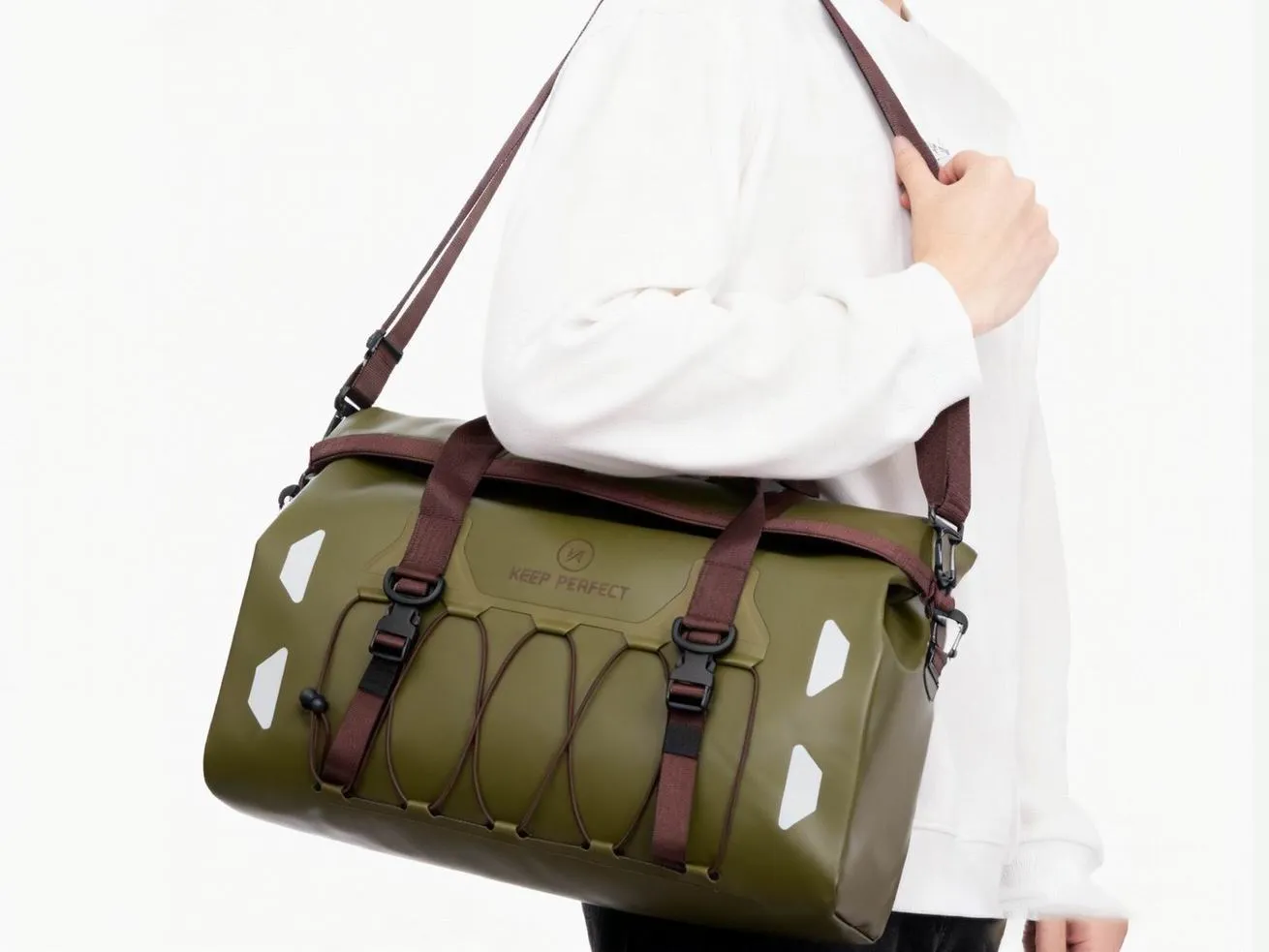
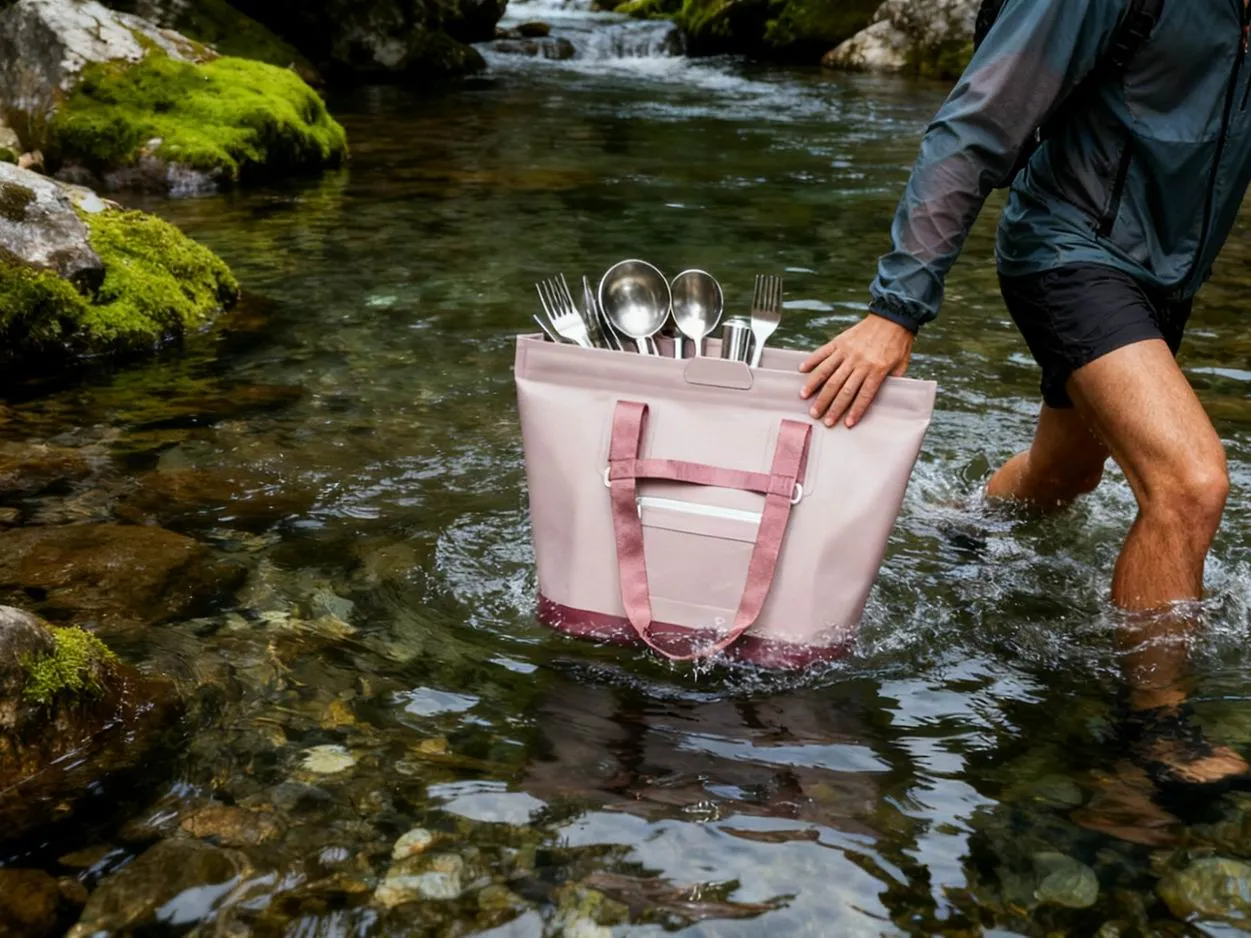
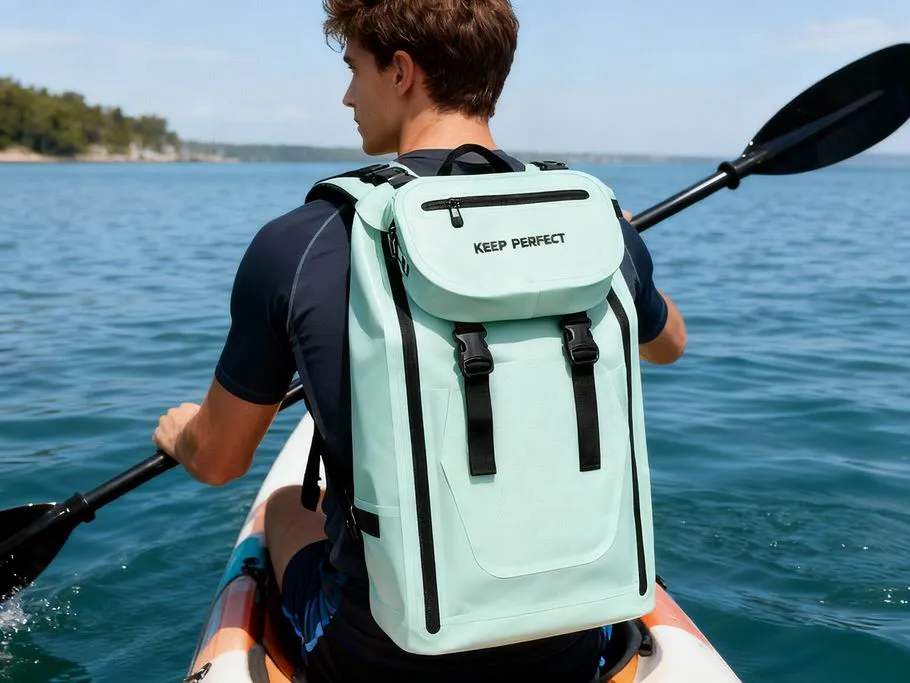
Why paddling sets the standard the whole category measures against
Kayaking and canoeing are where waterproof claims go to be proven or embarrassed: the exposure is total (immersion is a routine event, not an accident), the duty cycle is brutal (outfitter bags meet water daily for entire seasons), and the consequence is immediate (a wet sleeping bag on night two of a river trip is not a warranty claim, it is a customer’s ruined expedition). The construction that survives this is the fully welded roll-top: TPU-laminated fabric, RF-welded seams with no stitching below the waterline, and a three-roll closure with no mechanical seal to fail — the IPX7 architecture, tested to 30 minutes at 1 meter with a dry interior. The rating logic and what each level honestly certifies are in our IPX rating system explainer, and the sealed-closure physics is in the roll-top closure design guide.
One paddling-specific nuance that decides float behavior: a correctly rolled dry bag traps an air column and floats seam-up — which paddling programs treat as a safety feature, because a swamped kayak that sheds floating, visible dry bags is a kayak whose gear is recoverable. Our builds are tested for this on purpose: roll it with air, throw it in the river, watch it ride.
The paddling format family
| Format | Capacity | Rigging | Unit cost (500+) | Program role |
|---|---|---|---|---|
| Deck pouch | 2–8L | Deck lines, quick-clip | $2.40–$3.40 | Camera, snacks, GPS — the day-use layer |
| Stowage dry bag | 10–20L | Hull stow, bulkhead rigging | $3.40–$4.90 | The volume SKU for day programs |
| Expedition dry bag | 20–40L | Hull stow, lashing, portage carry | $3.90–$6.40 | Multi-day and outfitter fleets |
| Dry bag backpack | 20–35L | Carried, lashed, decked | $5.90–$8.50 | Portage routes, bike-to-river, guides |
| Wet/dry separation bag | 15–25L | Hull stow | $4.60–$6.80 | Soggy kit quarantined from dry kit |
The capacities map to real kit: 10L holds a shell layer and lunch, 20L a day’s spare clothing and camera, 40L a multi-day sleeping and shelter system. The full liter-to-kit logic is in our dry bag sizing guide. The dry bag backpack row is the crossover the market increasingly asks for by name — dry-bag sealing in a carryable chassis for the portage between put-in and take-out, covered in detail below.
Kayak versus canoe versus SUP: the rigging differences
The same dry bag family rigs differently across hull types, and the spec adjusts for each. Kayaks stow through hatches into sealed compartments — the bag compresses to fit 20L through an 18 cm hatch rim, so flexibility and smooth welds matter, and deck lines carry the quick-access pouches. Canoes stow open-topped under thwarts and yokes — capacity runs larger (20–40L), lashing points and grab handles do the securing, and abrasion resistance steps up because the bag rides against the hull’s full length. SUPs have no stowage at all — everything rides deck-mounted behind the carry handle, so leash points, compact formats and quick-clip hardware define the build. A quotation that has not asked which hull is being rigged is quoting a generic bag, not a paddling program.
- Kayak spec: compressible 10–20L, smooth low-profile welds for hatch passage, deck-clip pouches
- Canoe spec: 20–40L capacity range, reinforced base, four-point lash capability
- SUP spec: compact leashable formats, quick-clip hardware, high-visibility color options
- Universal: roll-top closure with printed closure discipline, grab handle rated for a swimmer’s grab
The dry bag backpack: the crossover format
The custom dry bag backpack is the fastest-growing format in paddling retail because it answers the whole day: welded IPX7 construction like a dry bag, but with backpack straps, a padded back and often sternum and hip straps like a trekking pack — so the paddle-in, the portage trail and the take-out all run on one bag. The trade versus a pure cylinder is packability (it holds shape rather than rolling flat) and price ($5.90–$8.50 against $3.90–$6.40); the gain is everything that happens out of the boat. For bike-to-river programs, guide fleets and fishing-access routes, it has quietly become the default. The build architecture — where straps anchor on a welded body without breaching the seal — is its own engineering question, covered in our load stress testing guide.
Closure discipline: the two-cent failure and its fix
The data across paddling fleets is consistent and slightly uncomfortable for the industry: the overwhelming majority of "my dry bag leaked" complaints trace to the closure, not the welds — two rolls instead of three, overpacking that prevents a full roll, or grit in the fold. The fix costs two cents: the closure instruction printed on the bag body itself. Our paddling builds print it as standard (roll three full times, buckle, keep the fold clean), and outfitter fleets that adopted printed-discipline bags watched closure complaints collapse. The care side is equally cheap: rinse the fold of silt after river days, store unrolled and dry, and the welds outlast the fabric by seasons. The full maintenance regime is in our warranty-failure analysis work — see the warranty and return-rate guide.
Outfitter and rental fleet programs
The outfitter is the anchor customer of custom kayaking bags, and the fleet economics have a shape worth knowing: a rental livery running 40 kayaks typically fields 80–120 dry bags (2–3 per boat), replaced on a 3–5 season rotation, branded for the dual purpose of fleet identification and dock-shop retail. At MOQ 500 pricing ($3.40–$4.90 for the 10–20L workhorse), the fleet program lands under $2,500 and generates the retail mirror — guests who watched the bag keep their phone dry all day buy one at the take-out shop for $25–$35. The spec details fleets learn to demand: numbered panels for inventory control, grommets for drip-dry hanging, and the UV-stabilized film that survives seasons of deck exposure — the aging science behind that film is in our accelerated aging tests guide.
Schools, clubs and paddling events
Instructional programs and clubs order the same architecture with different accents: club colors and fleet numbering for schools, regatta branding and sponsor panels for events, and the compliance tier that programs for minors require (CPSIA documentation in the US — the children’s-product threshold applies to youth paddling programs, and the certificate path is in our compliance testing guide). Event programs add the variable-data option that works everywhere in this category: race numbers or course names printed per unit at setup, which turns the fleet into the signage. The education-program pattern in our school programs guide applies directly to paddle-sport academies.
Branding that survives the river
Paddling bags photograph in the best possible contexts — clear water, decks, adventure light — and the branding methods that hold up on welded TPU serve that stage: full-wrap prints for the statement builds, screen print for fleet economics, and the high-visibility color options that double as safety features on open water (orange and yellow bags get found; brand-colored bags get photographed). Pantone matching at Delta E ≤2 keeps the fleet, the retail mirror and the staff kit reading as one brand. Method selection with cost bands is in our logo options guide — with the standing note that embroidery never touches film, only fabric upper zones on hybrid builds.
Materials for paddle duty
The paddle-duty stack optimizes for weld integrity and UV survival over trail abrasion: 210D–500D TPU-laminated polyester as the standard (light, flexible, welds cleanly, packs through hatches), with 500D the outfitter-fleet baseline for season-count durability. The material comparison that matters upstream — laminates versus coatings, TPU versus PVC — is in our TPU vs PVC comparison and the lamination techniques guide; the short version for paddling is that TPU laminate is the modern answer and PVC lingers only in legacy fleet stock. UV-stabilized film is the paddling-specific upgrade — a season of deck exposure embrittles standard film — and the testing behind that claim is in our UV resistance guide.
Paddling program economics at MOQ 500
| Program line | Unit cost (500+) | Retail band | Channel |
|---|---|---|---|
| Deck pouch 5L | $2.40–$3.20 | $15–$25 | Dock shop, event, impulse |
| Stowage 10–20L | $3.40–$4.90 | $25–$45 | Fleet workhorse, retail mirror |
| Expedition 20–40L | $3.90–$6.40 | $35–$60 | Outfitters, expedition retail |
| Dry bag backpack 30L | $5.90–$8.50 | $49–$89 | Paddling retail, guides, crossover |
| Wet/dry separation 20L | $4.60–$6.80 | $35–$55 | Lessons, clubs, retail |
The MOQ 500 splits across the whole family: a typical outfitter launch runs 300 stowage bags, 100 deck pouches and 100 dry bag backpacks as one order and one production calendar. Full cost mechanics — freight, duty, the volume steps above 2,000 units — are in the cost breakdown guide.
Sampling: the throw-it-in-the-pool test
Paddling samples prove themselves in water, and the test is the best in any category: roll the sample with a towel inside, clip it shut, and throw it in the pool or the river for an afternoon — then check the towel. While it floats, evaluate the rest: strap anchors on the backpack builds under a loaded carry, the closure through twenty roll cycles, hatch fit for kayak builds, and the weld beads under a hard look for uniformity. Samples run 6–10 working days at $60–$150 per configuration, all fees credited against bulk, and the golden sample becomes the AQL 2.5 reference for production. The full protocol is in our sampling guide.
Common mistakes in paddling bag programs
- Fashion-grade buys: non-UV film chalks out mid-season on deck-exposed fleets
- Zippered "waterproof" bags: zippers weep under sustained immersion — paddling is roll-top territory, full stop
- Wrong-hull rigging: kayak-compressible builds in open canoe stowage waste capacity, and vice versa
- Unprinted closure discipline: the two-cent fix that fleets skip and pay for in complaint volume
- Single-SKU fleets: guests, guides and expeditions need different formats; one size buys complaints
- Missing the retail mirror: the fleet bag guests watched work all day is the dock shop’s best seller
Seasonal calendar for paddle-sport programs
Paddle-sport retail and fleet replacement both run against the season, and the production math rewards whoever starts in autumn: sampling in October–November, golden sample before the year turns, bulk in production by January, goods landed through February — so the fleet refreshes and the dock shop restocks a full month before opening day. Mid-season replenishment rides the 30–35 day reorder window for established designs, with the reorder trigger set at the season’s peak weekend rather than after it. Southern-hemisphere and tropical programs invert the calendar but keep the shape — which is exactly why our production lines run paddling formats year-round, and why the quotation conversation includes the destination season alongside the hull types and quantities. Programs that first inquire in spring learn the expensive version of this arithmetic: air freight that erases the unit economics, or a fleet that opens the season on last year’s tired bags.
Spec your paddling program
Bring four facts — your hull types (kayak, canoe, SUP, mixed), your fleet size and rotation, your water (day flat-water to expedition whitewater), and your retail ambition — and the quotation returns in 24–48 hours: format mix, rigging spec per hull, the UV-stable material stack, and a costed program at MOQ 500 with free splits. QUANZHOU JUNYUAN BAGS — paddling-grade custom dry bags since 2014, 4,950 m² SGS-verified facility, 7 lines, 149 machines, 137 staff, 200,000 pieces monthly, samples 6–10 working days, bulk 35–50 days, AQL 2.5, 30/70 T/T, FOB Xiamen, 100+ countries. The production chain from first inquiry runs from sampling into bulk; the whitewater-specific format decisions are in our whitewater dry bags guide, and the complete manufacturing reference is the manufacturing guide.
Frequently Asked Questions
Q1. What dry bags do kayakers use?
Welded roll-top IPX7 dry bags in 10–20L for stowage through hatches, 2–8L deck pouches for quick access, and 20–40L expedition builds for multi-day kit. The format is the answer: no zipper anywhere, because immersion is routine in the sport.
Q2. How much do custom kayaking dry bags cost?
At MOQ 500: deck pouches $2.40–$3.20, 10–20L stowage bags $3.40–$4.90, 20–40L expedition builds $3.90–$6.40, dry bag backpacks $5.90–$8.50. Fleet pricing for outfitters runs the same schedule with the UV-stable film upgrade.
Q3. What is the minimum order for custom kayaking bags?
MOQ 500 per design, splittable across the paddling family — an outfitter launch of stowage bags, deck pouches and backpack crossovers is one order and one production calendar.
Q4. What size dry bag for kayaking?
10–20L per day-paddler as the stowage standard (fits through a hatch rim), 2–8L on deck for the access layer, 20–40L per person for multi-day trips. The capacity-to-kit mapping is in our sizing guide.
Q5. Are dry bags really waterproof?
Welded roll-tops are: IPX7 certifies 30 minutes at 1 meter with a dry interior, and the closure has no mechanical seal to fail. The depth, duration and method behind that rating are fixed by the IEC 60529 enclosure code. The field complaints trace to two-roll closures — which is why the three-roll instruction prints on the bag.
Q6. Can you backpack with a dry bag?
The dry bag backpack crossover format is built for exactly that: IPX7 welded construction with backpack straps, back padding and a sternum strap, for portage routes, bike-to-river programs and guide carry. $5.90–$8.50 at MOQ 500.
Q7. Do dry bags float?
Correctly rolled with air trapped inside, yes — seam-up and visible, which paddling programs treat as a safety feature: gear from a swamped boat stays findable. Load it sanely; a bag of dive weights does not float.
Q8. How do you attach a dry bag to a kayak?
Deck formats clip to deck lines; hull formats stow through hatches into compartments and lash to bulkhead rigging; canoe formats run larger bags under thwarts with four-point lashing. The spec differs by hull — a quotation should ask which.
Q9. What is the difference between a kayaking dry bag and a regular dry bag?
Paddling-specific builds add hatch-compressible flexibility (kayak), reinforced bases and lash points (canoe), leashable compact formats (SUP), and UV-stabilized film for deck exposure across all — on top of the same welded IPX7 core.
Q10. How long do outfitter dry bags last?
3–5 seasons of daily rental cycles with the care rhythm — rinse the closure of silt, store unrolled and dry — and UV-stable film. Fashion-grade film embrittles on deck within a season; the film is the difference.
Q11. Can I brand dry bags for my outfitter or club?
Yes — full-wrap prints, fleet screen print, high-visibility safety colors, numbered panels for inventory and variable-data race numbers. Pantone matching at Delta E ≤2 across the fleet and retail mirror.
Q12. Do youth paddling programs need special compliance?
In the US, yes: products for children 12 and under run the CPSIA children’s regime — third-party testing at a CPSC-accepted lab, a Children’s Product Certificate and tracking labels. Our youth-program builds run that stack as standard.
Q13. What materials are paddling dry bags made from?
210D–500D TPU-laminated polyester, RF-welded seams, no stitching below the closure line — the 500D baseline for fleets, UV-stabilized film for deck exposure, and TPU rather than PVC throughout.
Q14. How fast can a paddling program be produced?
Samples 6–10 working days, bulk 35–50 days after golden-sample approval, sea freight 4–6 weeks. Season-opening fleets should sample in autumn; reorders of established designs ship in 30–35 days mid-season.
Q15. Can I get samples before committing fleet budget?
Yes — $60–$150 per configuration in 6–10 working days, all fees credited against the bulk order. The paddling sample test is the best in the category: towel in, roll, throw it in the water, check the towel.
Q16. Are dry bags good for SUP?
In compact formats rigged behind the carry handle: 5–15L leashable builds with quick-clip hardware. SUP has no stowage, so everything rides deck — which makes visibility colors and clip speed the spec.
People Also Ask
What dry bag should I get for kayaking?
A welded roll-top in 10–20L for day stowage, plus a small deck pouch for the access layer. Choose IPX7 construction — immersion is routine in the sport, and zippers are not in the honest answer.
Do I need a dry bag for kayaking?
For anything that must stay dry — phone, keys, spare clothing, camera, emergency kit — yes: swamping and rolls are normal events, and the hull itself takes water even when it stays upright.
How big a dry bag for a kayak trip?
10–20L per day-paddler, 20–40L per person for multi-day expeditions, plus a 2–8L deck pouch for the camera and snacks. Size to the kit list of the worst realistic day.
Can you swim with a dry bag?
Snorkeling and short swims with a sealed roll-top on a leash are within design use. It floats seam-up with air trapped — but tow heavy loads rather than swimming against them.
Why do kayakers use dry bags instead of waterproof backpacks?
Because immersion-rated sealing requires the roll-top: zippered backpacks weep under sustained submersion. The crossover formats — dry bag backpacks — deliver the roll-top seal in a carryable chassis.
How do you roll a dry bag properly?
Fill to the line, press out excess air, roll the top three full folds, buckle the clips. Two rolls leak, three hold through immersion — and the instruction prints on every bag we build.