The roll-top closure looks too simple to engineer: press the mouth flat, roll it down, clip the buckle. Yet that simplicity is precisely why it dominates genuine immersion duty from kayaking to expedition logistics — no teeth to jam, no slider to break, no membrane to cut, and a sealing principle that gets stronger as water pressure rises. Behind the simplicity sits a set of design decisions — stay stiffness, mouth width, roll length, fold count, buckle geometry — that separate a roll-top which holds IPX7 for years from one which leaks on its first capsize.
This guide is the engineering deep-dive behind the roll-top entries in our closure systems overview: how the seal actually works, the geometry that governs it, the materials that serve it, and the production and test controls that keep every unit honest. QUANZHOU JUNYUAN BAGS: custom waterproof bag production since 2014, 4,950 m² SGS-verified facility. We build roll-top closures across our dry bag programs — sampling in 6–10 working days, bulk 35–50 days, MOQ 500 — and the details below are the ones we control on the line.
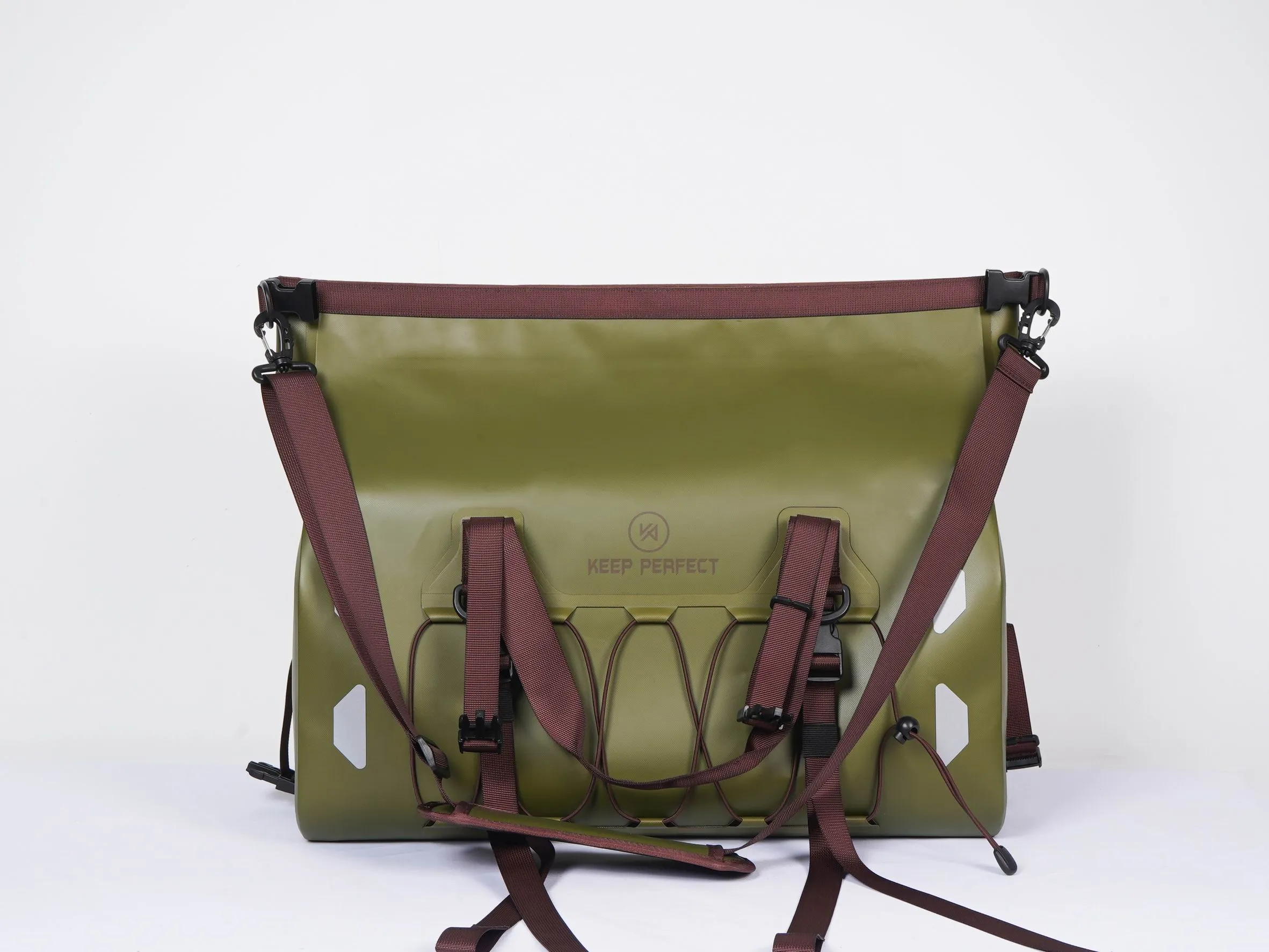
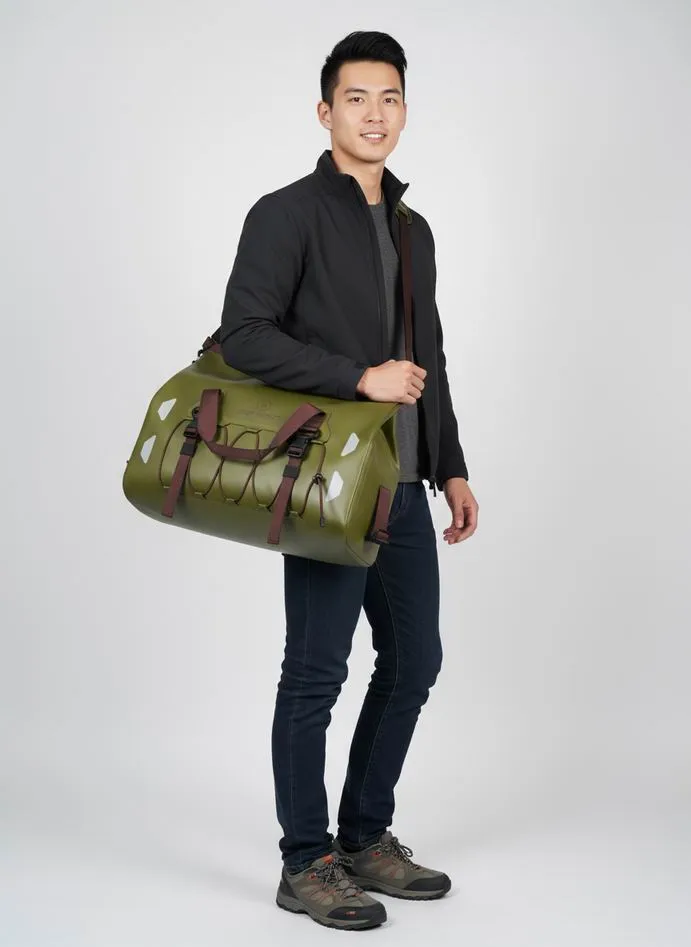

How the seal actually works: path length under pressure
A roll-top does not seal by blockage; it seals by path length. When the two stiffened lips are pressed together and rolled, the interface between them becomes a long, narrow, compressed channel. For water to reach the interior, it must travel along that channel — across the full rolled width, around every turn — against two resisting forces: the contact pressure squeezing the interface closed, and the capillary resistance of a gap measured in microns. Three turns of a well-built roll-top present a water path so long and so constricted that flow stalls before completing the journey. Add external water pressure and the seal improves: hydrostatic load presses the rolled layers harder together, which is why a correctly rolled dry bag can sit on a riverbed.
This mechanism explains every design rule that follows. Seal reliability scales with path length (more turns, wider lips), with contact pressure (stiffer stays, tighter roll tension), and with interface conformity (materials that bed into each other rather than bridge over wrinkles). It also explains the failure modes: anything that shortens the path (under-rolling), reduces pressure (limp stays, loose buckle), or opens a channel (a crease, a trapped strap, an over-stuffed mouth that cannot close flat) converts a pressure vessel into a scoop. The engineering is the disciplined elimination of those three saboteurs.
The stays: stiffness, material and attachment
The stays — the flat stiffeners sewn or welded into each side of the mouth — are the closure’s structural spine. Their job is threefold: hold the mouth open in a clean flat plane so the user can align the lips, transmit roll tension evenly across the full width, and keep the rolled bundle rigid enough that the buckle’s clamp load does not relax. Stay material is a three-way choice. HDPE or PP strip (2-4mm thick, 20-40mm wide) is the industry workhorse: cheap, fatigue-resistant, and stiff enough for bags to 30 liters. Fiberglass or composite batten stock raises stiffness for wide-mouth and expedition bags where a longer unsupported span must stay flat. Aluminum flat bar appears in premium and rescue gear where the stay doubles as a handle anchor — at a cost and weight penalty most consumer bags cannot carry.
Attachment decides whether the stay survives the product. A stay pocket bar-tacked only at the ends lets the stay migrate under repeated rolling until it skews the mouth; the professional construction captures the stay in a welded or stitched channel with a center tack, or welds the stay directly between two fabric plies in TPU-laminate builds — the same weld disciplines in our seam sealing guide. Stay ends are the second failure point: a sharp-cut end works through the fabric in a season of rolls, so ends are radiused and capped, and the pocket is reinforced at both terminations. These are dimes of material that decide years of service life.
Mouth geometry: width, lip length and the fold budget
Mouth width is a genuine trade-off, not a free variable. Wider mouths pack and unpack faster — the entire reason duffel-style dry bags exist — but every added centimeter of width is added unsupported span that the stays must hold flat, and added roll bundle diameter once closed. Past roughly 60-70cm of mouth width, single-piece plastic stays can no longer keep the lips flat under roll tension, and the design must move to stiffer battens or accept a center crease channel that leaks under immersion. This is why expedition dry bags cluster at 40-55cm mouths and why the widest-mouth waterproof bags in the market quietly derate themselves to splash duty.
Lip length — the fabric allowance above the bag body that forms the roll — sets the fold budget. Each turn consumes roughly 2.5-4cm of lip depending on material thickness and stay diameter, so a three-turn minimum with one turn of margin wants 12-16cm of lip; skim that allowance to save fabric and the user cannot complete the specified turns when the bag is fully packed. The fold budget must be verified at maximum rated fill, not empty: a bag stuffed to its stated volume has a shorter effective lip than the same bag on the design table, and closures validated empty fail in the field. Our sampling protocol photographs the roll at rated capacity for exactly this reason.
Materials at the interface: what the lips are made of
The sealing interface is fabric-to-fabric under compression, so the face materials behave as gasket surfaces. TPU-laminated fabrics are the premium interface: the TPU faces are slightly compliant, bedding into each other’s micro-texture under roll pressure, and TPU’s abrasion tolerance survives thousands of rolls without polishing slick. PVC-coated fabrics seal well when new — PVC is tacky and conformable — but cold stiffens them sharply, and a roll-top that must close at minus ten degrees belongs to TPU; the full material comparison sits in our TPU versus PVC guide. PU-coated lightweight nylons, the packable end of the market, seal adequately for rain and splash but their thinner, harder faces conform less, which is part of why ultralight roll-tops honestly derate to IPX6 territory.
Two interface rules override material choice. First, face pairing: the roll closes coating-to-coating, and any contamination between the faces — sand, salt crystals, sunscreen — holds a channel open. Sealing faces should be smooth and wipeable, never brushed or fleece-backed, and the rinse instruction belongs on the product. Second, coating integrity at the fold line: every roll creases the same material in the same place thousands of times, so the lip zone wants the coating family with the best flex-crack endurance in the bag — a specification decision our coatings guide quantifies, and a testing decision our accelerated aging guide verifies with roll-flex cycling.
Buckles, straps and the anti-dog-leg geometry
The buckle does not seal the bag; it preserves the roll the user made. Its placement geometry determines whether roll tension distributes evenly or concentrates into a spiral-ending dog-leg — the crease where most roll-top field leaks actually occur. Two geometries dominate. Side-release buckles on straps that join the two roll ends into a loop (the classic kayak dry bag) pull the bundle into a closed ring: self-centering, forgiving of slightly uneven rolls, and the loop doubles as a carry handle. Single-side buckles that clip each roll end back to the bag body (common on roll-top backpacks) allow top-loading access without a ring, but they pull asymmetrically, and the roll creeps open at the unclipped side unless the straps are angled to wrap tension around the bundle.
| Design variable | Budget option | Mid-range | Premium / expedition |
|---|---|---|---|
| Stay material | PP strip 2-3mm | HDPE 3-4mm | Composite batten / aluminum |
| Stay attachment | End-tacked pocket | Center-tacked channel | Welded between plies |
| Mouth width | <40cm | 40-55cm | 55-70cm with battens |
| Lip allowance | 10-12cm | 12-16cm | 16-20cm (4+ turns) |
| Buckle geometry | Single-side clip | Ring-forming loop | Loop + load-rated hardware |
| Interface material | PVC-coated | TPU-laminate 420D | TPU-laminate 840D+ |
Hardware quality is the quiet differentiator. A side-release buckle on an immersion bag is a load-bearing safety component — it holds the seal closed against the bag’s buoyancy and handling loads — and acetal hardware from a named maker outlasts anonymous regrind plastic by years of UV and cold. Buckle webbing wants low-stretch polyester, bartacked through reinforcement patches that spread load into the body panel; a buckle strap torn out of unreinforced fabric is a warranty claim with a known address. Hardware selection at this level is covered in our hardware guide.
Testing the roll: protocols that prove the seal
Roll-top verification runs on three levels, each catching what the previous one misses. Design validation: the prototype closure is rolled by the printed instruction — exactly three turns, exactly the stated fold direction — and immersed to the claimed rating, then re-tested after five hundred and five thousand roll cycles to prove the seal survives its wear life, and again after the cold soak if any winter duty is claimed, because a closure that seals at twenty degrees and fails at minus five is a regional product wearing a global label. The rating language follows the standards in our IPX7 versus IPX8 guide: depth, duration and preconditioning stated, never an adjective. The immersion codes themselves are defined in IEC 60529, published by the International Electrotechnical Commission, and that edition number is what a defensible test report should cite.
Production verification: sampled units from each run are inflated, closed per instruction, and submerged or vacuum-box tested, with any leak classified critical in the AQL scheme — the leak test exercises the actual closure the customer receives, rolled by the inspector, not a lab idealization. User-instruction verification is the third and most neglected level: the printed roll count, the pictogram, and the mouth-fill marking are tested on actual users, because a closure the market operates wrongly is a design failure wearing a user-error excuse. Brands that skip the third level meet it again in the returns data. Every number those three levels produce should carry a method behind it: the water-resistance and peel test methods quoted on a test report are published by ASTM International, and a result without a named method edition is an opinion rather than a measurement.
Variants and integrations: windows, handles and valves
Once the core seal is engineered, the roll-top becomes a platform for integrations that each carry their own sealing consequences. The viewing window — a clear TPU panel welded into the body so contents are visible — is the most requested variant and the most leak-prone: the window-to-body weld is a material transition that ages differently from the body welds, and window panels scratch into opacity within a season unless specified in abrasion-resistant clear film. The welded carry handle anchored to the stays converts the rolled bundle into luggage; it must be load-rated for the bag’s full weight dynamic, and its anchors belong on the stay structure, never on the unsupported lip fabric, where a heavy load peels the mouth open.
The purge valve integration pairs naturally with roll-tops: a one-way membrane welded into the body lets trapped air escape as the roll forms, so the bag compresses around its contents instead of ballooning — the full valve engineering sits in our valves and air-release guide. Two integration rules apply to every variant. First, every added feature is a new weld line or penetration whose leak risk must enter the test protocol — the window weld and the valve seat go onto the immersion validation list alongside the closure itself. Second, no integration may shorten the fold budget: handles, lash patches and printed panels that invade the lip zone consume the turns the seal depends on, and the lip is defended in the pattern as sealed territory. The pattern-maker’s discipline — closure first, features in the remaining space — is what keeps a feature-rich dry bag honest at its rating.
The roll-top design file: six specification lines
The guide compresses to six specification lines. One: the seal is specified as path length — lip allowance of 12-16cm verified at rated fill, three-turn minimum with margin, fold direction printed on the product. Two: the stays are engineered — material and section sized to mouth width, captured against migration, ends radiused and capped. Three: the interface is gasket-grade — TPU faces for immersion and cold duty, smooth wipeable sealing surfaces, flex-crack endurance specified at the fold zone. Four: the buckle geometry is load-rated — ring-forming loop for immersion duty, reinforcement patches under every strap anchor, named hardware. Five: the tests are layered — immersion at rated depth after roll-cycle preconditioning, cold soak for winter claims, production leak sampling as a critical defect. Six: the instructions are product features — roll count and direction printed at the mouth, fill line marked, rinse care stated. Six lines, executed by a factory building roll-top closures at 200,000 pieces monthly — sampling 6–10 working days, bulk 35–50 days, FOB Xiamen, SGS-verified — documented end to end.
Frequently Asked Questions
Q1. How does a roll-top closure keep water out?
By path length: rolling the stiffened lips three-plus turns creates a long compressed channel that water cannot traverse against contact pressure and capillary resistance. External water pressure actually tightens the seal, which is why rolled dry bags survive riverbeds.
Q2. How many turns should a roll-top be rolled?
Three turns minimum, four for immersion duty — and the lip allowance must be designed so the turns remain possible at full rated capacity. Under-rolling shortens the water path below its safety margin and is the leading field failure.
Q3. What are the stiff strips in a dry bag mouth called?
Stays — flat HDPE, PP, composite or aluminum stiffeners captured in each side of the mouth. They hold the lips flat for alignment, distribute roll tension, and keep the rolled bundle rigid against the buckle’s clamp load.
Q4. Why did my roll-top leak on the river?
Three usual causes: under-rolling (two turns instead of three), over-stuffing (the mouth cannot close flat, leaving an open channel), or a crease/dog-leg at the buckle side. The seal is mechanical and honest — the leak is almost always operational.
Q5. TPU or PVC for a roll-top dry bag?
TPU for immersion and cold duty — its faces stay compliant and conformable at low temperature, and it survives thousands of roll-flex cycles. PVC seals well when new and warm but stiffens sharply in the cold and costs less.
Q6. How wide can a roll-top mouth be?
Single-piece plastic stays hold lips flat to roughly 60-70cm of mouth width. Beyond that the design needs stiffer battens or accepts a leaking center crease — which is why expedition bags cluster at 40-55cm mouths.
Q7. Does the buckle matter for waterproofing?
Indirectly but decisively: the buckle preserves the roll against unwinding, and its placement geometry decides whether roll tension distributes evenly or creeps open at one side. Ring-forming loop geometry is the forgiving, immersion-grade choice.
Q8. Can a roll-top closure wear out?
The closure mechanism itself almost never fails — no teeth, no slider. What wears is the coating at the permanent fold line, which is why lip-zone material is specified for flex-crack endurance, and the stays’ end caps, which is why they are radiused.
Q9. How are roll-tops tested in production?
Sampled units are inflated, rolled per the printed instruction, and submerged or vacuum-box tested; any leak is a critical defect. Design validation adds immersion after five hundred to five thousand roll cycles and cold soaks for winter claims.
Q10. Why store a dry bag unrolled?
A permanent rolled crease fatigues the coating at the fold line and can set a channel into the sealing interface. Storing the bag open and dry preserves both the coating and the stays’ flat alignment.
Q11. What mouth fill line means for sealing?
The fill line marks the maximum contents level at which the specified roll count remains achievable. Over-stuffing past it shortens effective lip length and opens the mouth into a curve that cannot seal — the line is a sealing specification, not a capacity suggestion.
Q12. Roll-top or zipper for genuine submersion?
Roll-top, rolled to instruction. Consumer waterproof zippers rate for spray and brief immersion; only dry-suit-grade zippers rival a roll-top for repeated submersion, at many times the cost and maintenance. The closure overview guide maps the full matrix.
People Also Ask
How do roll-top dry bags seal?
Two stiffened lips pressed flat and rolled three or more turns create a long, compressed, micron-gap channel. Water must traverse the full rolled width against contact pressure and capillary resistance — a path it cannot complete — and external pressure tightens the seal further.
How many times do you roll a dry bag top?
Three turns minimum, four for immersion duty, starting from a flat, unwrinkled mouth. The lip allowance is designed so those turns remain possible at the bag’s rated fill — over-stuffing defeats the fold budget and opens a leak channel.
Why does my dry bag leak at the roll?
Under-rolling, over-stuffing, or a buckle-side dog-leg crease account for nearly all field leaks. Rinse the sealing lips free of sand and salt, close the mouth flat, roll the specified turns, and clip the buckle into its ring.
What is the stiff plastic in a dry bag opening?
Stays — HDPE or PP strips (composite or aluminum in premium builds) captured in the mouth lips. They hold the opening flat for alignment, spread roll tension across the width, and keep the bundle rigid once buckled.
Are roll-top closures better than waterproof zippers?
For immersion, yes — a properly rolled roll-top out-seals consumer waterproof zippers, shrugs off sand, and has no wear parts. Zippers win on access speed for rain-duty bags opened many times daily. The choice maps to exposure, not preference.
Do roll-top closures work in freezing weather?
Material-dependent: TPU-laminate interfaces stay compliant and seal in deep cold, while PVC-coated faces stiffen and resist conforming. Winter-duty roll-tops should be specified in TPU and validated with a cold-soak immersion test.