Accelerated aging tests are the difference between selling a waterproof bag and selling a prediction: instead of waiting three seasons to learn how a material, seam or coating will fail, accelerated aging tests compress years of heat, humidity, UV, flex and freeze-thaw into lab weeks — and the programs that specify them buy their durability knowledge at quotation time, when changing materials costs nothing, instead of at warranty-review time, when it costs the fleet. The discipline is older than the category and routinely misapplied: single-axis tests that miss compounding failures, exposure hours quoted without the retained properties that give them meaning, and marketing "tested" claims with no protocol behind them — so this guide maps the four aging axes a waterproof bag actually dies on, the combined-cycle protocols that catch real failure modes, the retained-property language that turns test hours into service-life predictions, and the specification lines that make aging data a purchase-order requirement rather than a brochure adjective.
QUANZHOU JUNYUAN BAGS is the manufacturer reference for this guide: custom waterproof bag production since 2014, a 4,950 m² SGS-verified facility with 7 lines, 149 machines, 137 staff and 200,000 pieces monthly. Commercial terms are MOQ 500 per design, samples 6–10 working days, bulk 35–50 days, AQL 2.5 inspection, 30/70 T/T, FOB Xiamen, shipping to 100+ countries.
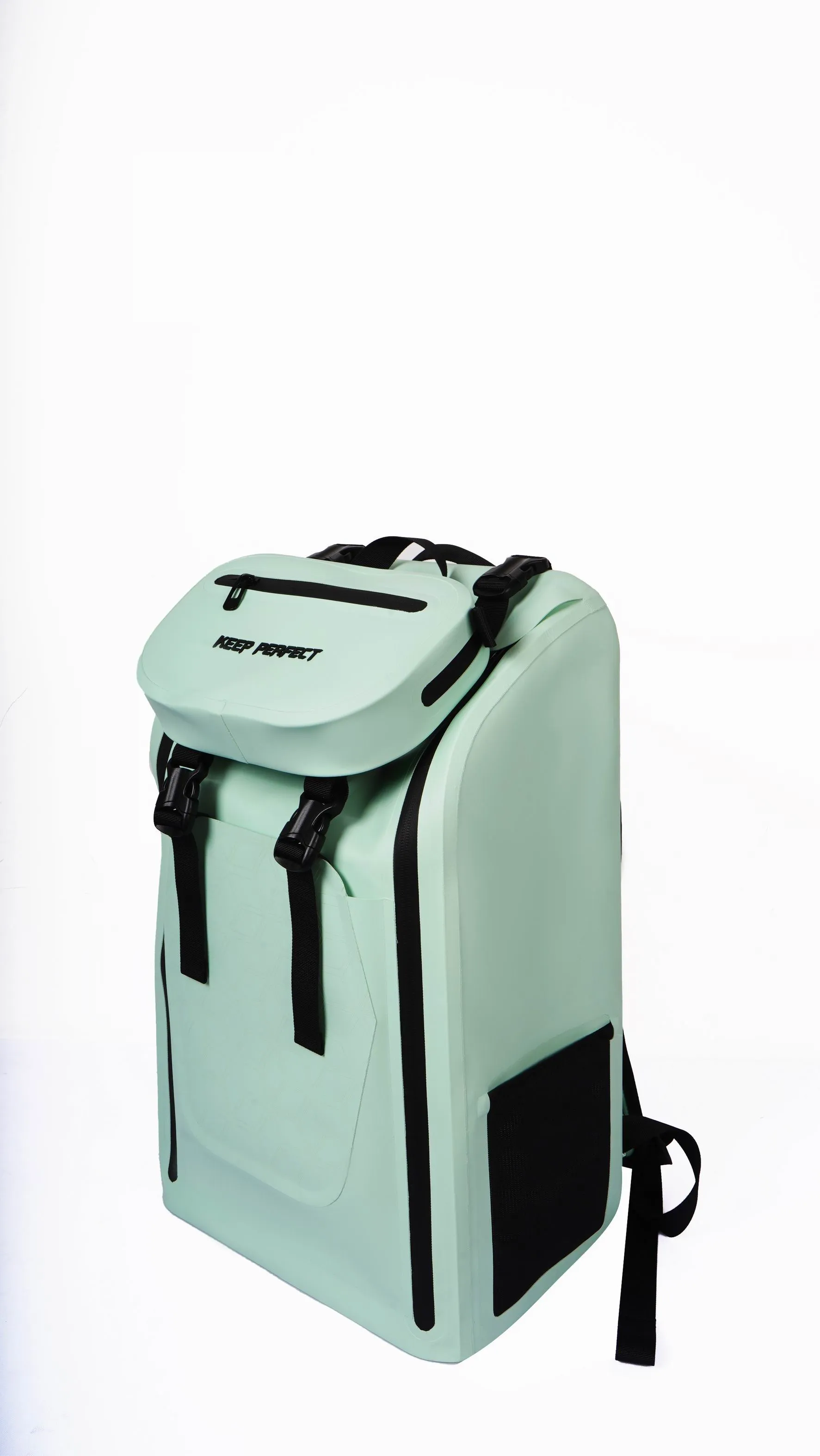


Why aging must be accelerated: the warranty-time problem
Every waterproof bag is sold with an implicit durability promise, and the promise is unverifiable on delivery day — which is the whole problem accelerated aging exists to solve. Day-one testing answers the wrong question: a fresh bag passes hydrostatic head, seam integrity and load tests beautifully, because nothing has attacked it yet; the failures that define service life — embrittled coatings, peeled laminates, stiffened PVC, cracked flex lines — arrive on the degradation clocks our material guides map: plasticizer migration, hydrolysis, photo-oxidation, flex fatigue, the mechanisms the chemical resistance guide and UV resistance guide detail. Learning about those failures from the field means learning from customers — at warranty cost, reputation cost, and a calendar the business cannot compress. Accelerated aging inverts the order: the lab runs the degradation first, the engineering decision follows the aged data, and the field becomes the confirmation rather than the experiment. The economic logic is brutal and simple: a week of combined-cycle testing costs a fraction of one container of failed product, and the programs that skip it are not saving the test budget — they are deferring it to the warranty file, with interest.
The four aging axes a waterproof bag dies on
Accelerated aging protocols are built from four axes, each compressing a real-world degradation mode into a controllable lab exposure. Heat and humidity: elevated temperature and moisture accelerate hydrolysis, plasticizer migration and adhesive aging — the hot-wet clock that governs TPU grades, PVC formulations and laminate bonds, the mechanisms our chemical guide maps; the environmental chamber protocols our environmental testing guide details run this axis. UV: accelerated photo-oxidation in QUV or xenon-arc weathering — the sun clock our UV guide runs — attacking coatings, films, dyes and every exposed polymer simultaneously. Flex and mechanical cycling: repeated folding, rolling and abrasion cycles that convert new-material ratings into aged-material reality — the axis that kills coated flex lines and thins films at creases, measured with the strength instruments our fabric strength testing guide describes. Freeze-thaw and thermal shock: temperature swings that stress coatings, adhesives and welded seams through expansion mismatch — the cold-chain and winter-fleet clock, where a bag that never sees rain can still die of January. Each axis alone is a partial answer; the failure modes that matter in service live at the intersections, which is the entire argument of the next section.
| Aging axis | The real-world clock it compresses | What it kills first |
|---|---|---|
| Heat + humidity | Hydrolysis, plasticizer migration, adhesive aging | Laminate bonds, PVC flexibility, TPU grades |
| UV weathering | Photo-oxidation of coatings, films, dyes | Surface barrier, color, exposed polymers |
| Flex and abrasion cycling | Fold-line fatigue, crease wear, film thinning | Coated flex lines, roll-top zones |
| Freeze-thaw / thermal shock | Expansion-mismatch stress | Coatings, adhesive layers, weld margins |
Combined cycles: why single-axis tests miss the real failures
The central discipline of serious aging work is that field failure is compounding, and single-axis tests systematically miss it. The mechanism is straightforward: each axis degrades the material into a state more vulnerable to the next — UV-embrittled surfaces crack under flex cycles they survived when new; heat-extracted plasticizers leave PVC unable to survive the freeze-thaw it once shrugged off; hydrolyzed adhesive bonds peel under mechanical loads that fresh bonds carried — so a material that passes each axis separately can fail their combination within weeks of field service. The protocols that catch this stack the axes deliberately: age-then-flex, where specimens run UV or heat-humidity exposure first, then mechanical cycling, then property re-measurement; cycle-interleaved exposure, where flex and weathering alternate in the same protocol; and chemistry-stacked cycles, where the service fluids of our chemical guide join the weathering schedule. The evidence language changes accordingly: "passes 1,000 QUV hours" is a single-axis claim; "passes 1,000 QUV hours followed by 10,000 flex cycles with 85% hydrostatic head retained" is an engineering prediction. Buyers reading supplier test claims should count the axes: one axis is screening, two is engineering, and the combined protocols our testing methods guide standardizes are the reference point for what the category considers honest durability evidence.
Protocol design: choosing hours, cycles and acceptance lines
An aging protocol is a designed experiment, and its three design decisions — exposure level, cycle count, acceptance line — deserve the same engineering as the product itself. Exposure level follows the service band: a marine-duty protocol runs harsher UV and salt-stacked conditions than a commuter protocol, because the test should bracket the worst realistic service, not the average; the duty-band arithmetic our material guides apply to selection applies equally to testing. Cycle count follows the service-life target: a program promising three seasons needs aged data that reaches three-season-equivalent exposure, which is where acceleration factors — the ratio between lab hours and field time — enter; the honest handling of acceleration factors is to treat them as estimates validated against field returns, not as conversion tables, because real service is messier than any chamber. The acceptance line is the decision: the retained-property threshold below which the material is rejected — 70% tensile retained, 80% hydrostatic head retained, no delamination visible at 10× — named before testing begins, so the protocol cannot be curved around a failing candidate. Protocol design is also where cost disciplines enter: screening protocols run fast and cheap on many candidates; qualification protocols run long and deep on the finalists; and the two-stage structure keeps the test budget proportional to the decision at stake, the same screening-versus-qualification split our UV and chemical guides use.
Retained-property reporting: the language that makes hours meaningful
Aging data is only as good as its reporting language, and the category’s honest dialect has three rules. Rule one: hours mean nothing without the property — "2,000 hours tested" says only that time passed; "2,000 hours, 85% hydrostatic head retained, no delamination" is information. Rule two: the retained properties must be the ones the product dies of — for a waterproof bag that is head retention at flex lines, seam strength after aging, peel strength of laminate bonds, and tensile retention of the substrate, the battery our fabric strength guide details; a report that measures color but not head is measuring the wrong clock. Rule three: aged and fresh numbers travel together — the delta is the durability statement, and a supplier quoting only aged values without the fresh baseline is hiding the material’s starting point. The buyer’s reading habit: every aging claim decomposes into exposure, property, retention and baseline, and any claim missing one of the four is marketing. Where certification weight is needed, accredited third-party labs run the protocols and issue the reports — the engagement path our third-party labs guide walks — and for in-house data the same four-part language applies, because a test log written in retained-property dialect is the difference between a supplier who tests and a supplier who says they test.
From lab weeks to service years: the prediction model
The translation from accelerated hours to service years is the least exact step in the whole discipline, and honesty about its uncertainty is what separates prediction from prophecy. The mechanisms accelerate unevenly: hydrolysis follows roughly Arrhenius temperature kinetics — doubling per ten degrees as a rule of thumb — so heat-humidity hours map to calendar time with some confidence; photo-oxidation maps by irradiance dose with climate variability attached; flex cycles map by usage intensity, which varies by user more than by material. The professional approach is bracketing, not conversion: run the protocol to bracket the worst realistic service band, set the acceptance line at the retained properties the service band demands, and treat the result as a pass-fail prediction for the band rather than a calendar date — "this material holds the marine band for the program’s three-season target" is a statement testing can support; "this bag lasts 4.2 years" is not. Calibration closes the loop over time: field returns and warranty data from earlier programs calibrate the acceleration factors for the next ones, and suppliers with years of program history carry calibration data new programs can borrow. The buyer’s summary: accelerated aging is a screening and qualification tool of enormous power and bounded precision — programs that use it to choose materials and set acceptance lines get its full value; programs that demand calendar promises from it get numbers with false confidence attached.
What aging testing costs — and what skipping it costs
Aging budgets follow the same two-stage logic as the protocols, and the arithmetic deserves a place in program planning. Screening-stage costs: short combined-cycle protocols on candidate materials, run in-house or at third-party labs, price in the range of a rounding error on any container-scale program — the expense that buys the material shortlist. Qualification-stage costs: the long protocols on finalists — hundreds to thousands of chamber hours, the full retained-property battery, third-party reports where markets demand them — price in the range of a tooling decision, which is exactly what they inform. The other side of the ledger is the skip cost: a container of product that fails its second season costs the goods, the claims handling, the reorder and the account — routinely two orders of magnitude beyond the qualification budget that would have caught it, and that arithmetic ignores the reputation cost that never appears on any invoice. Program-level budgeting guidance: aging protocols belong in the development-phase budget beside sampling and tooling, scheduled alongside the 6–10 working day sample cycles so material decisions close before production commitment; the MOQ-scale economics our MOQ guide documents absorb qualification costs across the run, which at 500 units is exactly the scale where the insurance is cheapest per unit. The cheapest durability knowledge in the category is bought before cutting; everything bought after is a claim.
Aging and the acceptance framework: lot discipline over time
Qualification proves a material can age well; lot discipline proves the shipped lots do — and the aging file stays open for the life of the program. The connection runs through acceptance testing: qualified materials enter production with their aged baselines on file, and periodic lot verification — fresh samples pulled and run through abbreviated aging protocols — catches the material drift that qualification cannot: a resin lot change, a stabilizer package substitution, an adhesive reformulation, each invisible to day-one inspection and each visible to an aging spot-check. The AQL framework our AQL buyers guide documents extends naturally: lot acceptance batteries include the aged spot-checks on the schedule the risk demands — per lot for critical-duty programs, periodically for stable ones. Requalification triggers belong on paper: any material change, any process change, any supplier change reopens the aging file, because qualification belongs to a specific material from a specific source, not to a material name. The discipline closes the category’s oldest gap: the distance between "the sample aged beautifully" and "the tenth production lot failed in month two" is almost always a drift nobody tested — and the programs that run aging as a living protocol rather than a one-time gate are the programs whose year-three performance matches their year-one promise.
The aging-test purchase order: seven lines
The guide compresses to seven specification lines. One: the service band — the climate, chemistry, UV and mechanical duty the product must survive, stated so the protocol brackets it. Two: the service-life target — the seasons the program promises, which sizes the exposure. Three: the protocol — axes, levels and cycle counts, with combined cycles wherever the field stacks axes, referenced to the standards family where one applies. Four: the acceptance line — retained-property thresholds named before testing, on the properties the product dies of. Five: the reporting language — exposure, property, retention and baseline on every claim, third-party reports where certification weight is needed. Six: the lot discipline — periodic aging spot-checks on production lots, with requalification triggers named for material, process and source changes. Seven: the calibration loop — field-return data feeding the next program’s protocol design. Seven lines turn "tested for durability" from an adjective into an engineering file — and the chain that executes it, 200,000 pieces monthly, samples in 6–10 working days, bulk 35–50 days, FOB Xiamen, is documented end to end for buyers who want the factory behind the testing before the first chamber hour.
Frequently Asked Questions
Q1. What are accelerated aging tests?
Laboratory protocols that compress years of service degradation — heat, humidity, UV, flex, freeze-thaw — into weeks of controlled exposure, so durability is measured before production instead of discovered in warranty claims.
Q2. Why do waterproof bags need aging tests?
Because day-one testing answers the wrong question: fresh materials pass everything; the failures that define service life — embrittlement, delamination, flex cracking — arrive on degradation clocks only aging protocols can run ahead of time.
Q3. How do accelerated aging tests work?
Specimens are exposed to intensified versions of real degradation axes — elevated heat-humidity, QUV or xenon weathering, flex cycling, thermal shock — then re-measured for retained properties like hydrostatic head, tensile strength and peel strength.
Q4. What is combined-cycle aging testing?
Protocols that stack axes — age-then-flex, interleaved weathering and cycling, chemistry-stacked exposure — because each axis degrades materials into states more vulnerable to the next, and single-axis tests systematically miss those failures.
Q5. How do lab hours translate to years of use?
By bracketing, not conversion: protocols run to bracket the worst realistic service band with acceptance lines at required retention — mechanisms accelerate unevenly, so honest output is a pass-fail prediction for the service band, calibrated over time by field returns.
Q6. What is retained-property reporting?
The honest test language: exposure, property, retention and baseline on every claim — "2,000 hours QUV, 85% hydrostatic head retained, no delamination" instead of "tested for durability."
Q7. Which properties should aging tests measure?
The ones the product dies of: hydrostatic head at flex lines, seam strength after aging, laminate peel strength, substrate tensile retention — plus color fastness as the aesthetic axis. A report measuring only color measures the wrong clock.
Q8. What is an acceleration factor?
The estimated ratio between lab exposure and field time — hydrolysis roughly doubles per ten degrees, UV maps by irradiance dose, flex by usage intensity. Treat factors as estimates calibrated by field data, not conversion tables.
Q9. How much does aging testing cost?
Screening protocols price as a rounding error on container-scale programs; qualification protocols price like a tooling decision. Skipping them prices as a container of failed product plus claims — routinely two orders of magnitude beyond the test budget.
Q10. Do materials need re-testing between production lots?
Yes — qualification belongs to a specific material from a specific source; lot drift (resin, stabilizer, adhesive changes) is invisible to day-one inspection. Periodic aging spot-checks plus named requalification triggers keep the file alive.
Q11. What standards apply to aging tests?
Weathering standards like the ASTM G154 QUV family, temperature-humidity chamber protocols, flex-cycle methods and the combined protocols the testing methods guide standardizes — referenced by method, hours and retained properties.
Q12. Can aging tests predict exact product lifespan?
No — they bracket service bands with pass-fail predictions. "Holds the marine band for a three-season target" is supportable; "lasts 4.2 years" is false precision. Field-return calibration narrows the bracket over time.
Q13. What is age-then-flex testing?
Specimens run UV or heat-humidity exposure first, then flex cycling, then property re-measurement — catching the compounding failures where aged surfaces crack under mechanical loads they survived when new.
Q14. Who should run aging tests — the factory or a lab?
Both: factories run screening and lot spot-checks in-house; accredited third-party labs run qualification protocols where certification weight is needed. The reporting language is identical either way.
Q15. What triggers requalification of a material?
Any material change, process change or source change — each reopens the aging file because the original qualification no longer describes what is being shipped.
Q16. What goes on an aging-test specification?
Seven lines: service band, service-life target, protocol with combined cycles, acceptance line named in advance, retained-property reporting language, lot spot-check discipline with requalification triggers, and the field-calibration loop.
People Also Ask
What is accelerated aging testing for fabrics?
Compressing years of heat, humidity, UV and flex into weeks of lab exposure, then measuring retained properties — the standard way to predict fabric durability before production.
How do you test the durability of waterproof bags?
Combined-cycle aging protocols — weathering plus flex plus the service chemistry — followed by retained-property measurement of hydrostatic head, seam strength, peel strength and tensile retention.
What does QUV testing simulate?
Sun-and-dew weathering: intense UV exposure cycled with condensation, compressing years of photo-oxidation into hundreds of lab hours under the ASTM G154 family.
How long should a waterproof bag last?
Duty defines the target — promotional one season, premium fleets three-plus — and aging protocols are sized to bracket that target with retention thresholds, turning the promise into testable engineering.
What causes waterproof bags to fail over time?
Four aging axes: heat-humidity (hydrolysis, plasticizer migration), UV (photo-oxidation), flex fatigue at crease lines, and freeze-thaw stress — usually compounded, which is why combined cycles are the honest test.
Is one week of lab aging equal to a year of use?
No fixed ratio exists — acceleration factors vary by mechanism and climate. Serious programs bracket the service band with acceptance lines and calibrate with field returns instead of trusting conversions.