Chemical resistance is the rating waterproof buyers forget until the third warranty claim: a bag can hold out a rainstorm and surrender to sunscreen, diesel or seawater in the same afternoon, because water and chemicals attack polymer materials through different mechanisms entirely — which is why chemical resistant waterproof materials are a specification axis of their own, not a bonus feature of a hydrostatic head number, and why a materials decision that never names its chemical duty band is a decision about half the environment the bag will actually face. This guide explains how oils, solvents and saltwater each attack the TPU films, PVC coatings and laminates that carry a bag’s water barrier, ranks the polymer options honestly, walks the immersion and spot testing that turns marketing claims into ratings, and closes with the two-axis specification — waterproof band plus chemical band — that programs in marine, industrial, oil-and-gas and food-service duty use to buy materials that survive their actual working lives.
The manufacturer reference behind these numbers is QUANZHOU JUNYUAN BAGS — 4,950 m² SGS-verified facility, 7 lines, 149 machines, 137 staff, 200,000 pieces monthly, custom waterproof bag production since 2014. Order terms: MOQ 500 per design, samples 6–10 working days, bulk 35–50 days, AQL 2.5 inspection, 30/70 T/T, FOB Xiamen, and shipping to 100+ countries.


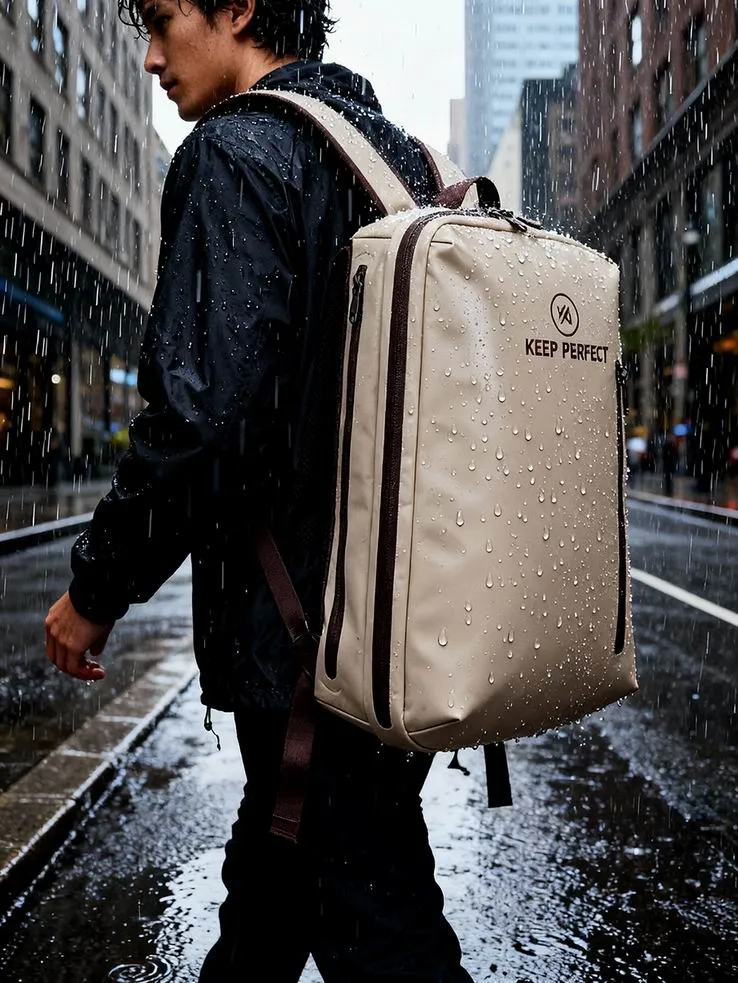
The three chemical fronts: oil, solvent, saltwater
The chemical environment of a working bag sorts into three fronts, and they behave nothing alike. The oil front: hydrocarbons — diesel, gasoline, motor oil, cooking grease, sunscreen — which do not react with polymers so much as dissolve into them, swelling and softening the exact films and coatings that carry the water barrier. The solvent front: alcohols, ketones, acetone-family cleaners and industrial degreasers, which attack faster and more selectively than oils, extracting plasticizers and embrittling materials in hours that oils soften over weeks. The saltwater front: the mildest of the three chemically and the most underrated mechanically — salt does not dissolve the polymer, but it corrodes every metal component, crystals into zippers and seam crevices, and loads the fabric with abrasive residue that accelerates wear on every fold line. A materials decision is a chemical-band decision the moment any of the three fronts is real duty: the marine programs our marine industry guide covers live on the saltwater front, the fuel-and-grease duty of our oil and gas guide lives on the oil front, and the de-icing and cleaning-chemical duty of urban and facilities fleets lives on the solvent front. Waterproof ratings say nothing about any of the three — a fact worth repeating at every specification meeting.
How chemicals attack: the four degradation mechanisms
Under every chemical failure sits one of four mechanisms, and naming the mechanism is how engineers pick the countermeasure. Swelling: hydrocarbons absorb into the polymer matrix, the film gains weight and volume, its tensile strength and barrier integrity fall, and a swelled TPU laminate can pass a rain test on Monday and delaminate by Friday — the classic oil-drip failure on shop floors. Plasticizer extraction: flexible PVC owes its flexibility to plasticizers blended into it, and solvents plus heat leach them out; the coating that arrived supple embrittles, micro-cracks at every flex line, and sheds its waterproofness as it cracks — the failure mode that gives PVC its honest durability caveats, the material trade-offs our TPU versus PVC comparison maps. Hydrolysis: ester-based polymers — including standard polyether TPU in hot-wet conditions — slowly react with water itself at elevated temperature, losing molecular weight and strength over months of tropical humidity and wash cycles; slow, cumulative, and invisible until the film tears at a fold. Surface attack and stress cracking: some chemicals do not penetrate at all but micro-crack the surface under simultaneous mechanical stress — the mechanism behind cracked handles and strap anchors on chemically exposed fleets. The mechanisms compound: UV ages surfaces into states more vulnerable to each one, and the environmental-testing mindset our temperature and humidity testing guide documents is how programs catch compounding before it ships.
| Mechanism | Typical attacker | What the buyer sees | The countermeasure |
|---|---|---|---|
| Swelling | Diesel, oils, sunscreen, grease | Soft, heavy film; late delamination | Aromatic-free TPU; test to the actual fluid |
| Plasticizer extraction | Solvents, cleaners, heat | Brittle, cracking PVC coating | TPU or EVA in solvent duty; capped PVC only for splash |
| Hydrolysis | Hot water, humidity, wash cycles | Film tears at folds after months | Hydrolysis-stable TPU grades for hot-wet duty |
| Stress cracking | Combined chemical plus load | Cracks at strap anchors, folds | Thicker films; relief design at stress points |
The polymer spectrum: what resists what
Ranking materials for chemical duty is a matrix, not a podium, because each polymer wins against different fronts. TPU is the category’s all-rounder: strong against oils, fuels and saltwater, hydrolysis-stable in the right grades, and fully weldable — the reason it anchors premium marine and industrial programs — with its honest weakness at strong solvents, where ketones and acetone-family fluids attack it. PVC resists saltwater and mild chemicals well and costs least, but its plasticizer system makes solvent duty a durability gamble — the exposure-grade decision our TPU-PVC comparison frames. EVA sits between them: good oil and salt behavior, gentle hand, common in lamination layers. PE and PP — the polyolefins — are the solvent champions and the chemical-tank lining of the polymer world, at the cost of stiffness and a narrow processing window, the hot-air-only route our construction guides note. And the substrate matters as much as the surface: a chemical-resistant film laminated to a vulnerable base still fails when the base is attacked through pinholes, which is why laminate construction and film gauge belong in the chemical specification, the gauge arithmetic our TPU film thickness guide supplies.
| Polymer | Oil / fuel | Solvents | Saltwater | Program fit |
|---|---|---|---|---|
| TPU (polyether, film) | Good | Poor vs ketones/acetone | Excellent | Marine, industrial, premium welded builds |
| PVC (plasticized) | Fair–good | Poor: plasticizer extraction | Good | Budget marine and splash duty, not solvent duty |
| EVA | Good | Fair | Good | Lamination layers, soft-hand builds |
| PE / PP | Excellent | Excellent | Excellent | Chemical-heavy niche; stiff, hot-air weld only |
| Silicone-coated nylon | Good | Fair | Excellent | Premium lightweight; the chemistry our silicone material guide covers |
Saltwater is not water: what the coast actually does to bags
Saltwater duty is where the chemical and the mechanical conspire, and buyers who treat a coastal program as "just waterproof" pay for it in zipper and hardware failures. The chemistry is mild: standard TPU, PVC and EVA all shrug off seawater exposure for years, and the water barrier itself is rarely the first casualty. The collateral is not mild. Salt crystals pack into zipper chains and seam crevices, where they hold moisture against metal parts and abrade every slider pass — the failure mode behind zipper protocols our hardware durability testing covers. Hardware corrosion: nickel-plated and cheap zinc components pit and seize in salt air, which is why coastal specifications upgrade to stainless or marine-grade hardware and name the plating on paper. Salt load on fabric: dried salt is abrasive and hygroscopic — it holds damp at the surface layer, feeds mold in storage, and grinds coatings at fold lines; fleets that rinse after every saltwater day measurably outlast fleets that store damp. Sunscreen and oils round out the coastal chemical load: the lotion that protects the crew swells TPU and stains coatings — the oil front arriving through the beach bag, which is why consumer coastal products specify aromatic-free grades that survive their own contents. The coastal specification is therefore four lines: seawater-rated barrier material, marine-grade hardware, a rinse-and-dry care card, and sunscreen-resistance testing on the actual formula the product will sit next to.
Oils and fuels: the swelling problem in practice
Hydrocarbon duty separates the polymer families faster than any other front, because swelling is absorption chemistry: the oil does not break the polymer, it moves into it. The visible arc of an oil-degraded bag: the coating softens and feels tacky, then gains weight and loses snap, then the laminate separates from its backing under flex — three states that can each pass a spray test while heading for structural failure, which is why oil duty needs immersion testing, not rain testing. The program logic follows the fluid. Shop and garage fleets drip motor oil and gear grease at ambient temperature — a duty polyurethanes handle comfortably. Fuel-adjacent duty — diesel handling, outboard maintenance, fuel-dock work — pushes toward aromatic-free TPU or polyolefin layers, because fuel fractions swell standard grades measurably. Kitchen and food-service duty runs cooking oils at temperature, the front our food delivery guide documents, where repeated warm-oil contact plus wash cycles is a hydrolysis-and-swelling double exposure. Two practical rules price into every oil-band program: test against the actual service fluid, because "oil" ranges from salad to diesel and the polymer rankings shuffle between them; and spec the interior separately from the exterior, because the inside of the bag meets the oil daily while the outside meets rain — an interior TPU liner and an exterior weather-grade laminate is often the correct two-material answer at no added seam complexity.
Solvents and the plasticizer question
Solvent duty is the harshest front and the reason "chemical resistant" on a spec sheet needs a named fluid list. The mechanisms are the fast ones: ketones and acetone soften or dissolve vulnerable polymers within hours, and even mild solvent duty — alcohol-based cleaners, industrial degreasers — extracts plasticizers from PVC across a season, embrittling the coating until it cracks at the first fold. The material answers sort cleanly. Polyolefins — PE and PP — shrug off nearly everything in the solvent family and anchor true chemical-duty programs, at their known cost: stiffness and the narrow hot-air-only joining route. Aromatic-free TPUs hold the alcohol-and-cleaner middle ground that most industrial duty actually is, while ceding the ketone end. PVC holds saltwater and oil duty at the best price but concedes solvent duty, and solvent-exposed PVC fleets fail on a schedule a buyer can set a warranty by — the failure our TPU-PVC comparison prices. The specification practice that prevents all of it: name the fluids. A materials line reading "resistant to alcohol-based cleaners and diesel splash, not rated for ketones" is engineering; "chemical resistant" is a tweet. Programs serving cleaning crews, labs, printers or facilities fleets write the fluid list first, then let the matrix pick the polymer, the transparency practice our chemical transparency guide argues should be the industry default.
Testing: immersion, spot tests and the standards behind ratings
Chemical resistance is only as good as the test that rated it, and the serious methods share one idea: expose the actual material to the actual fluid for a defined time and measure what changed. Immersion testing — the backbone standard for rubber and polymer sheeting, ASTM D471 published at astm.org — soaks specimens in the service fluid for a set period at temperature, then measures weight change, volume swelling, tensile loss and surface change; the pass-fail line is a percentage, not an opinion. Spot and wipe testing exposes samples in place, faster and closer to real duty, the method for splash-band programs that never submerge their materials. Combined-cycle testing stacks chemical exposure onto flex and UV to catch the compounding failures that single-axis tests miss — the stacking philosophy our lab-to-field testing guide documents across every degradation axis. For programs needing third-party weight behind a claim, accredited labs run the full protocols and issue the reports our third-party labs guide walks through. The buyer’s screening question for any chemical-resistance claim: "Which fluid, which standard, which lab, and can I see the report?" — four questions that end most marketing conversations and start most qualified ones.
Chemicals meet construction: seams, welds and zippers under attack
A chemical rating is a system rating, and the system includes the seams. Welded seams inherit their materials’ chemistry — a TPU weld resists what TPU resists — but welding adds one chemical-specific gate: contamination. Oils and silicone residues on the weld line cause arcing and cold bonds in RF welding, the failure modes our HF welding guide hunts, which is why chemically-exposed programs enforce surface-cleaning discipline before any weld pass. Seam taping and coatings are adhesives first and barriers second: solvent exposure attacks tape adhesives directly, so a sewn-and-taped bag in solvent duty fails at its tape before its fabric, and the seam-map routing our construction comparison defines sends solvent-duty boundaries to welding on that basis alone. Zippers and hardware carry their own chemistry: corrosive salt fronts pit platings, solvent fronts embrittle some molded sliders, and the chain lubricants buyers love accelerate dust-and-salt packing — the durability stack our zipper testing guide details. The practical specification: a chemical band applies to the whole bag — material, seam route, closure and hardware — and a beautiful TPU chamber behind a vulnerable zipper is a chemical program with a hole in it.
Industry duty: where chemical resistance earns its price
Chemical-resistant specification prices in fast enough that knowing where it earns its keep decides where to spend it. Marine and boat fleets: saltwater front plus fuel plus sunscreen — the full coastal stack, rated on rinse discipline and hardware grade as much as film choice. Oil and gas: the hydrocarbon front at its heaviest, plus de-greasers on the solvent side, the duty profile our oil-and-gas industry guide documents. Food service and delivery: warm oils plus alcohol sanitizers — a gentle-looking front that compounds with wash hydrolysis, the exposure our food-industry guide maps. Facilities and cleaning fleets: daily chemical exposure of the alcohol-and-surfactant middle band, where aromatic-free TPU outlives plasticized PVC by seasons. Construction and utilities: concrete slurries, diesel splash, de-icing salts in winter — the mixed front our construction-crew guide describes, where "solvent-proof" is wasted money but "oil-and-salt tolerant" is not. The cross-industry pattern: most duty is middle-band — splash and wipe, not soak — and most over-specification comes from buying the whole chemical matrix for a splash problem. Match the band, name the fluids, test to them, and the money lands where the failures actually were.
| Duty program | The real chemical front | The specification that holds |
|---|---|---|
| Marine / boating | Salt, fuel splash, sunscreen | Seawater-rated TPU, stainless hardware, rinse protocol |
| Oil and gas | Diesel, grease, degreasers | Aromatic-free TPU or polyolefin layer; welded seams |
| Food delivery | Warm cooking oil, sanitizers | Hydrolysis-stable TPU liner; wash-cycle testing |
| Cleaning / facilities | Alcohol cleaners, surfactants | Aromatic-free TPU; tape-free seam routes |
| Construction / winter | Concrete slurry, diesel, de-icing salt | Oil-tolerant laminate; hardware plating named |
Two ratings, one specification: waterproof band plus chemical band
The discipline this guide closes with is the two-axis specification, because waterproofness and chemical resistance are separable failures that buyers keep collapsing into one word. Axis one, water: the hydrostatic-head band — weather, weather-plus-splash or submersion — priced by the rating arithmetic our hydrostatic head guide sets. Axis two, chemicals: the fluid list, the exposure mode — splash, wipe, immersion — and the service temperature, rated by the testing above. The matrix the two axes make is the purchase order’s materials section: a kayak bag is submersion-band on axis one and seawater-plus-sunscreen on axis two; a cleaning-crew tote is weather-band on axis one and alcohol-wipe on axis two; a fuel-dock duffel is splash-band on axis one and diesel-immersion on axis two. None of the three material decisions is substitutable for another, and every one of them is quotable — a supplier handed both axes can price the correct laminate, seam route and hardware in one pass, 24–48 hours on this factory’s quotation calendar, with samples behind the decision in 6–10 working days and bulk in 35–50, the chain documented. Buyers who specify one axis get one axis — and discover the other in the field.
Aging under chemicals: UV, heat and the compounding curve
Chemical resistance is a day-one property that decays, and the decay curve steepens with every other degradation axis riding it. UV pre-weakens surfaces — photo-oxidized TPU and PVC micro-crack sooner under solvent contact, the UV-stacking our fiber materials guides document across nylon and polyester. Heat accelerates everything: plasticizer extraction, swelling kinetics and hydrolysis all roughly double per ten degrees, so a bag that survives shop-floor solvents at room temperature can fail the same fluid beside a hot engine — the temperature-axis logic our environmental testing guide measures. Mechanical stress cracks chemically-weakened films at load points that carried the same loads clean, which is why chemical-duty patterns add film gauge and relief design at anchors rather than relying on the material’s nominal rating. The engineering response is the aging-mindset our category applies throughout: rate materials new, then rate them again after combined-cycle aging — chemical, flex, UV — and specify from the aged numbers. A specification built on day-one data is a specification for the first month; the fleet lives on the aged curve, and the difference between the two curves is the entire chemical-durability budget.
The chemical-resistance purchase order: eight lines
The guide compresses to eight lines, each traceable to a section above. One: the fluid list — every chemical the product will meet, written by name. Two: exposure mode and duration — splash, wipe, immersion, and the realistic contact time. Three: service temperature range, because chemistry runs on it. Four: barrier material named by family and grade — "aromatic-free polyether TPU," not "waterproof fabric." Five: seam route per the chemical band — welded boundaries for solvent duty, taped seams only in weather-plus-oil duty. Six: hardware and closure spec — plating, slider polymer, corrosion grade. Seven: verification — immersion or spot testing to the actual fluids, combined-cycle aging where duty compounds, third-party reports where the market requires them. Eight: care and serviceability — the rinse protocol, the approved cleaners, the field-repair kit, because a chemical band is maintained, not just purchased. Eight lines is one paragraph of specification work, and it is the difference between a fleet that ages on schedule and a warranty file that reads like a chemistry lab. For programs ready to write those eight lines, the material options, testing protocols and compliance interface — the regulatory edge our REACH and CPSIA compliance guide covers — all resolve in one quotation cycle on a calendar the production guide above documents.
Frequently Asked Questions
Q1. What makes a waterproof material chemical resistant?
A polymer chemistry that absorbs or reacts with the service fluids as little as possible: aromatic-free TPU against oils, polyolefins against solvents, hydrolysis-stable grades against hot-wet exposure. It is rated by immersion testing to the actual fluid, not inferred from the waterproof rating.
Q2. Is TPU chemical resistant?
Against oils, fuels, saltwater and alcohol-based cleaners, strongly — which is why it anchors marine and industrial programs. Against ketones and acetone-family solvents, poorly; that duty routes to polyolefins.
Q3. Is PVC chemical resistant?
To saltwater and many oils, yes; to solvents, no — they extract the plasticizers that keep PVC flexible, embrittling it into cracks. PVC is the value choice for salt and splash duty, not solvent duty.
Q4. Does saltwater damage waterproof bags?
The barrier polymers shrug it off; the collateral does the damage — corroded hardware, salt-packed zippers, abrasive residue on folds. Coastal fleets survive on marine-grade hardware and rinse discipline, not on a different waterproof rating.
Q5. What is the difference between waterproof and chemical resistant?
Two attack modes and two ratings: water presses and wicks through openings; chemicals absorb into, extract from or crack the material itself. A bag can be fully waterproof and chemically defenseless against the wrong fluid.
Q6. What material resists oil and fuel best?
Polyolefins (PE/PP) resist the widest hydrocarbon range; aromatic-free TPU holds oil and diesel duty with better flexibility and full weldability. Standard plasticized PVC holds mild oil splash at the lowest cost.
Q7. How is chemical resistance tested?
Immersion testing per the polymer-sheeting standard family (ASTM D471): soak specimens in the service fluid at temperature, then measure weight, volume, tensile and surface change. Spot and combined-cycle testing approximate splash duty and compounding aging.
Q8. What chemicals destroy waterproof coatings?
The fast killers are ketones and strong solvents on PVC (plasticizer extraction), prolonged hot-oil exposure on standard TPU (swelling), and hot-humid wash cycles on hydrolysis-unstable grades. Naming the fluid names the countermeasure.
Q9. Do cleaning chemicals damage waterproof bags?
Alcohol-based sanitizers and surfactant cleaners fall in the middle band: aromatic-free TPU tolerates them for seasons, plasticized PVC embrittles across one. Cleaning fleets specify the cleaner list with the material, not after it.
Q10. Is sunscreen bad for waterproof bags?
It is an oil-front exposure: sunscreen oils swell standard TPU and stain coatings, so consumer coastal products test against actual sunscreen formulas and often specify aromatic-free grades.
Q11. Does chemical exposure void waterproofness?
Chemically-degraded coatings and films lose barrier integrity as they crack and swell — so yes, unaddressed chemical attack ends the waterproof rating too, which is why the two axes are specified together.
Q12. Which construction is best for chemical duty?
Welded boundaries on solvent duty — tape adhesives are the weak link otherwise; taped seams hold oil-and-weather duty; polyolefin programs take the hot-air-only route. The seam map routes the chemical band per seam class.
Q13. What hardware survives saltwater?
Marine-grade and stainless components with named plating; cheap zinc and nickel pits and seizes in salt air. The hardware spec is part of the chemical specification, not a separate afterthought.
Q14. Can I get a chemical-resistance test report?
Yes: immersion testing to your actual fluids, with third-party lab reports available — ask which fluid, which standard, which lab, and the report follows as part of the qualified quotation.
Q15. Does UV make chemical damage worse?
Yes — photo-oxidized surfaces micro-crack sooner under chemical contact, and heat accelerates every mechanism. Combined-cycle aging tests rate the compounding, not just day-one resistance.
Q16. How do I specify chemical resistance on a purchase order?
Eight lines: fluid list, exposure mode and duration, service temperature, barrier material by family and grade, seam route, hardware spec, verification battery, and the care protocol. The article’s final section writes them out.
People Also Ask
What is chemical resistance in fabrics?
The material’s measured tolerance of named fluids — tested by immersion or spot exposure — separate from its waterproof rating, which only addresses water.
Which waterproof fabric is most chemical resistant?
Polyolefins (PE/PP) resist the widest chemical range; aromatic-free TPU is the flexible, weldable all-rounder for oil, fuel, salt and cleaner duty; PVC concedes solvent exposure.
How does saltwater affect TPU?
Very little chemically — seawater is among TPU’s easiest exposures. The damage on coastal fleets concentrates in hardware corrosion and salt-packed zippers, which is why hardware and rinse discipline carry the coastal spec.
Are waterproof bags oil proof?
Not automatically: oils swell standard films, and diesel and sunscreen soften coatings across weeks. Oil-duty bags specify aromatic-free grades and test against the actual fluid.
What does ASTM D471 test?
Immersion resistance of polymer sheeting: specimens soak in a reference fluid for a defined period at temperature, then report weight, volume, tensile and surface changes as the rating.
Can a bag be waterproof but not chemical resistant?
Entirely, and it is the common failure: a strong water barrier in a polymer the service fluid swells or embrittles. The two ratings are specified, tested and bought on separate axes.