Every waterproof bag on the market is assembled by one of three construction routes — stitched then sealed, welded, or bonded — and the route decision prices the unit, caps its waterproof ceiling and defines how it ages, repairs and dies more than any fabric choice does, which is why a buyer who compares denier numbers while ignoring seam construction is optimizing the 60% of the problem that was never the problem: this guide lays the three routes side by side, shows the physics each one relies on, the cost and durability consequences each one carries, and the seam-by-seam logic serious programs use to route a single bag through all three. The route choice is not a philosophy contest — it is a duty-band calculation, a materials-compatibility check and a unit-economics line that resolves before the first sample is ever cut, and getting it right at the specification stage is the cheapest waterproofing a program will ever buy.
QUANZHOU JUNYUAN BAGS is the manufacturer reference for this guide: custom waterproof bag production since 2014, a 4,950 m² SGS-verified facility with 7 lines, 149 machines, 137 staff and 200,000 pieces monthly. Commercial terms are MOQ 500 per design, samples 6–10 working days, bulk 35–50 days, AQL 2.5 inspection, 30/70 T/T, FOB Xiamen, shipping to 100+ countries.
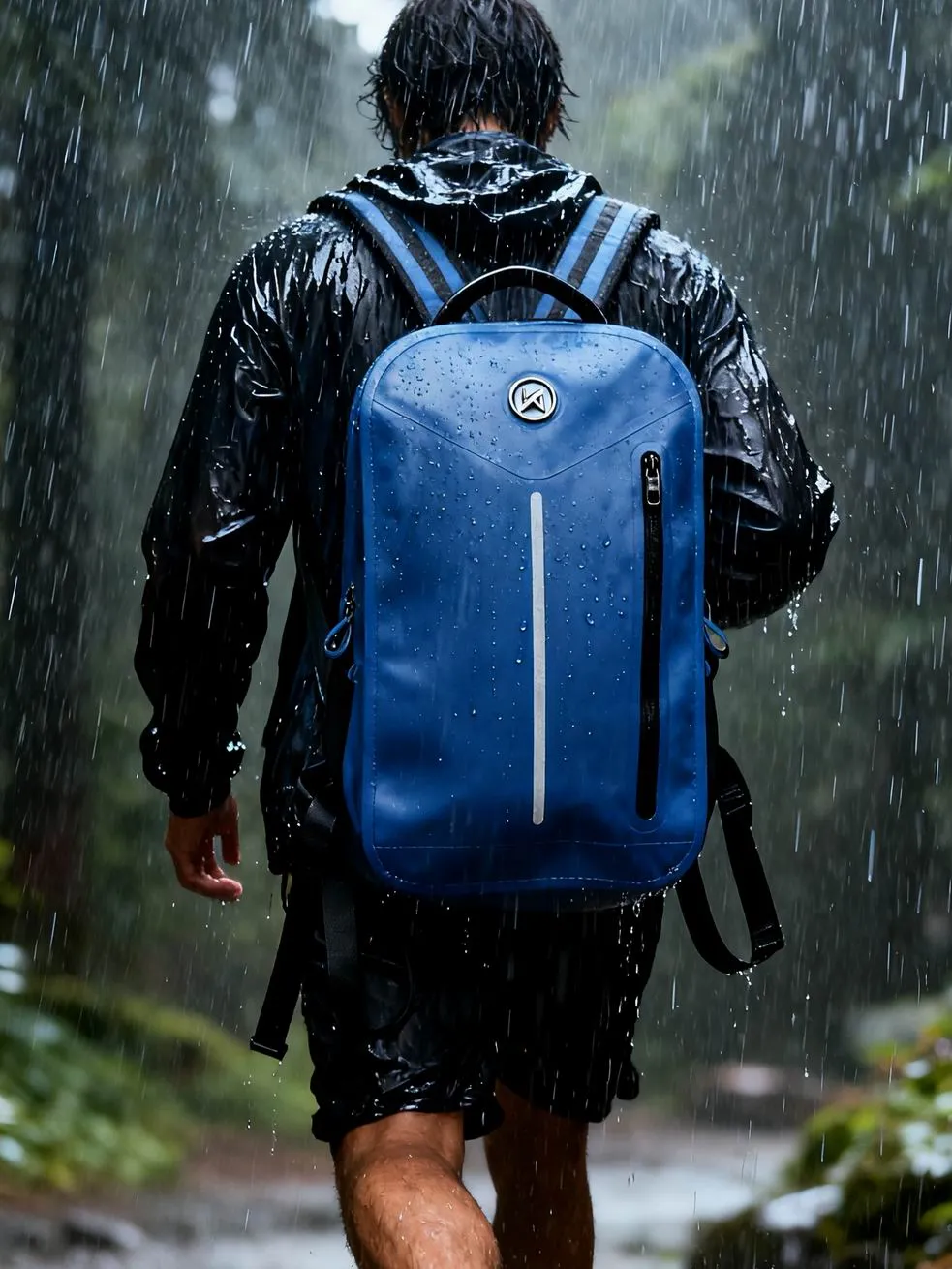
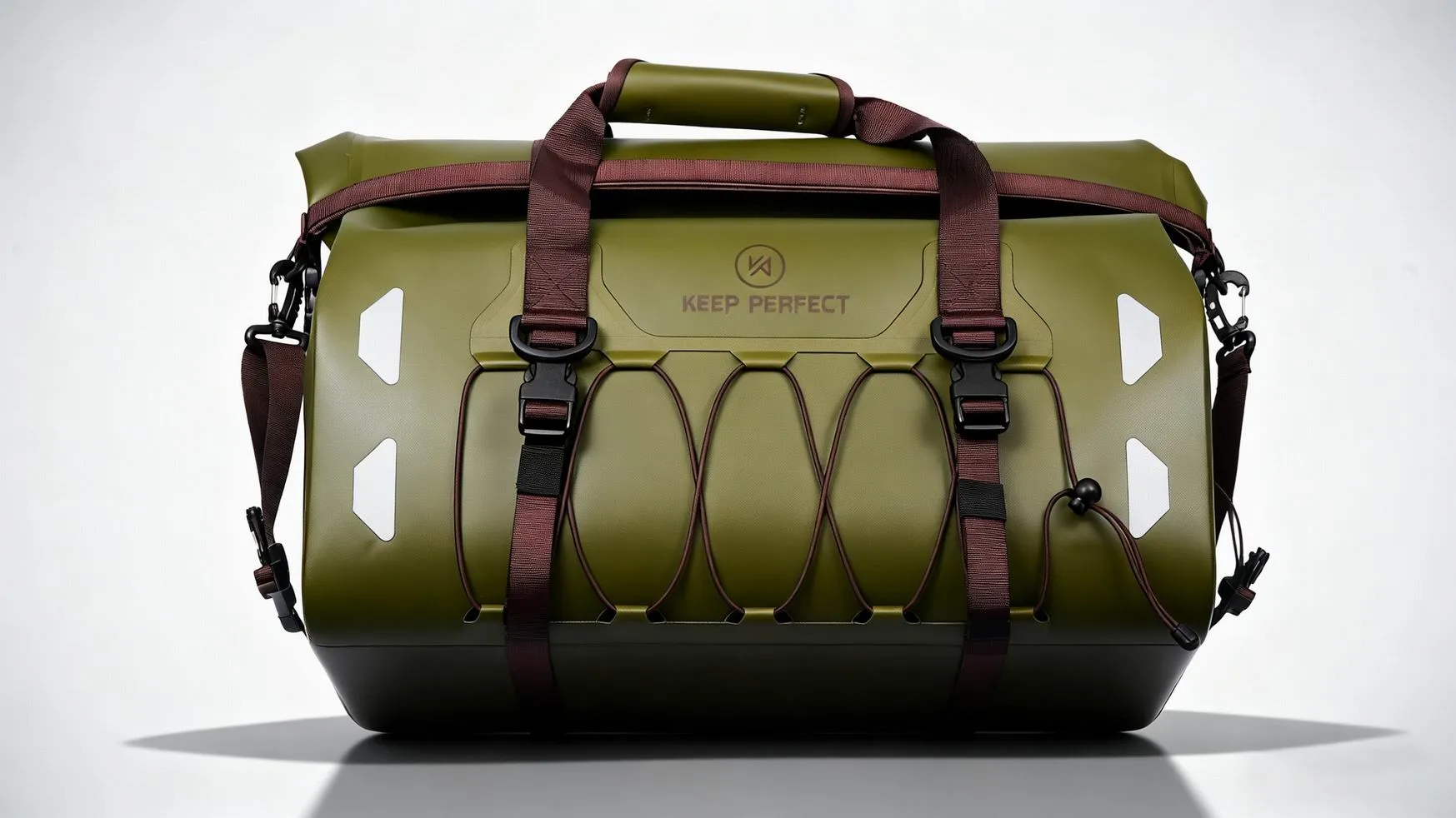
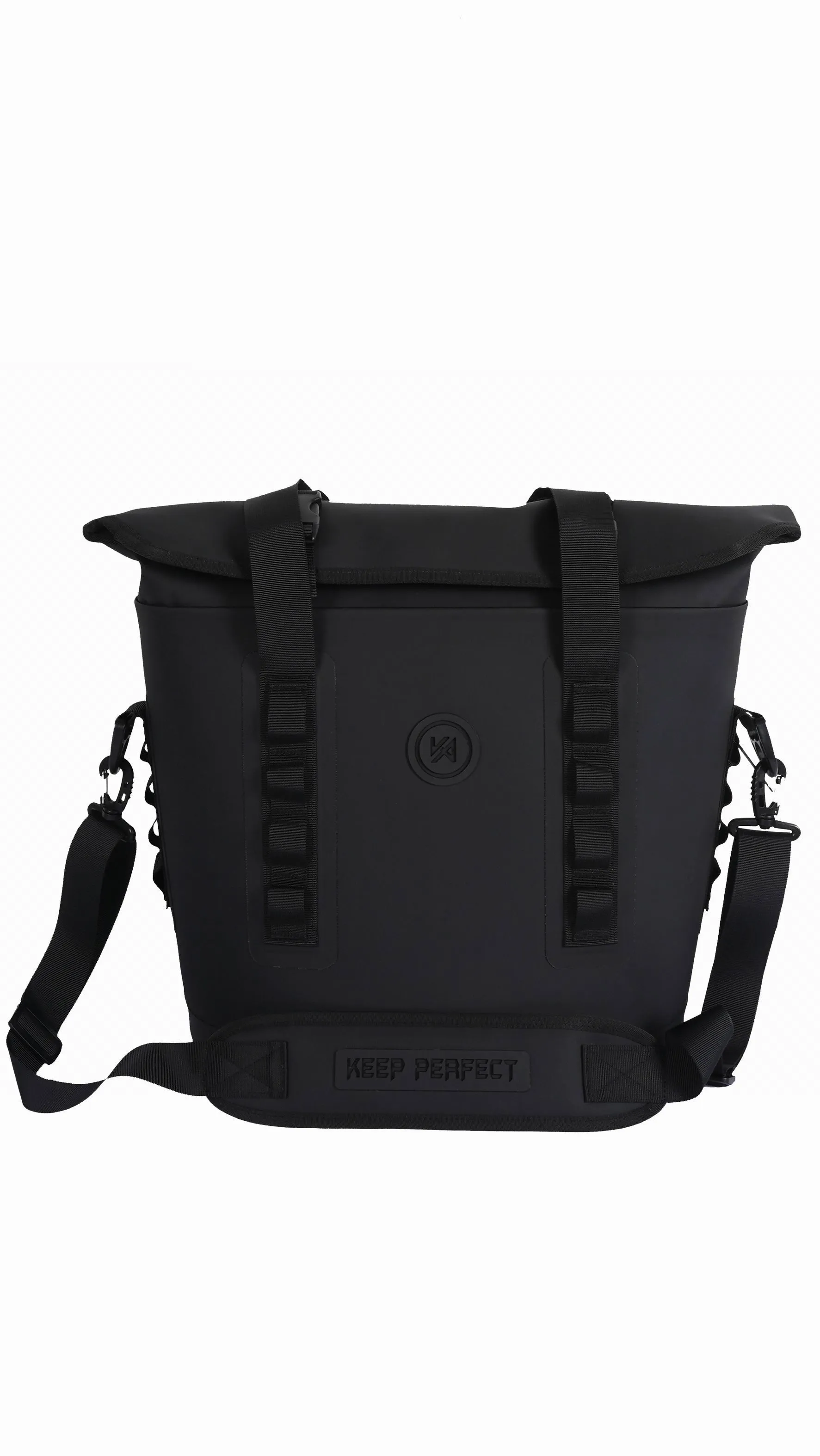
Three routes, one problem: joining fabric without opening a leak
A waterproof bag is a set of panels that must be joined at their edges, and every joining method answers one question: how do I connect these pieces structurally without creating a path for water? The industry’s three answers are older than any of the fabrics they now join. Stitched construction — the oldest route — passes thread through the fabric; the seam is strong, flexible and cheap to produce, but every needle puncture is a designed-in leak channel, so stitched waterproof builds add a sealing step: seam taping or coating, the discipline our seam sealing guide documents. Welded construction fuses the panels into one continuous polymer using heat in one of its industrial forms — radio-frequency, hot-air, ultrasonic or heat-sealing — eliminating the needle entirely, the route family our welding routes comparison maps. Bonded construction joins panels with an adhesive layer — films, tapes or liquid systems activated by heat and pressure — delivering seam lines no thread ever punctured while keeping the flat, quiet hand that welded builds sometimes lose. Three routes, three physics, three cost structures — and the entire rest of this guide is the honest engineering of choosing between them.
Why no single route wins: the constraint each route escapes
If one route were superior on every axis, the other two would be museum pieces. Each survives because it escapes a constraint the others cannot. Stitching escapes the materials trap: thread goes through nearly everything — coated polyesters, laminates, heavy deniers, webbing, foam, hardware flanges — which is why the most complex bags, the ones with straps, padding, frames and twenty panel intersections, are stitched at their structural core no matter what their water boundary is made of. Welding escapes the needle: a fused seam has no holes to seal, which is the only construction that honestly carries sustained submersion, and the reason dry bags, marine builds and the submersion band our waterproof level guide defines are welded without exception. Bonding escapes the bulk: adhesive seams are thin, flat and flexible without any of the seam ridge a fold-and-weld creates, which matters for clean-line product categories and for laminates too delicate to run through a sewing machine at production speed. The practical consequence: serious bags are almost never one route. The boundary is welded, the skeleton is stitched, the laminate edges are bonded — and the specification that names which route carries which seam is the one that survives production.
Stitched construction: structural power at a hydraulic price
The sewing machine is still the most versatile joining tool in the factory, and stitched construction remains the backbone of the category — but its waterproofness is bought, not inherited. Structurally, nothing beats a lockstitch for joining dissimilar materials under load: it handles the webbing anchors, bar-tacks, fold-overs and multi-layer intersections of a real bag, at the highest production speed of any route, on machines every factory already owns. Hydraulically, the needle is the enemy: a stitch line punctures the coating thousands of times per seam, and those holes wick water at pressures a small fraction of the fabric’s rating — the needle-path problem our seam guides open with, and the reason raw stitching is never a waterproof seam. The stitched route therefore always ships with a sealing tier: seam tape fused over the needle path for the weather band, brushed sealant for economy builds, or a design that hides the seam inside a welded boundary. What the buyer gets for accepting that complexity: drape and softness welded builds cannot always match, field repairability no press-dependent route offers, and the lowest tooling cost of any route — a stitched-and-taped program can sample in days with no dies to build, which at the quotation stage is a speed advantage worth pricing. The fabric side of a stitched build follows the same physics as any other: denier governs abrasion life, the rating system our denier guide covers, while the coating or laminate carries the water barrier.
Welded construction: the submersion band’s only honest answer
Welding turns two panels into one continuous piece of polymer, and that single sentence explains everything the route does well and everything it cannot do. With no needle path, no bond line exposed to flex peel and no tape to age, a correctly made weld is the strongest water barrier in the category — the reason the submersion band is welded territory by law of physics rather than by convention. Inside the family, the variants divide by how they make heat: radio-frequency welding generates it inside the material with a 27.12 MHz field, the process our HF deep-dive documents; hot-air welding blows it in from outside along a continuous path, the batch-versus-continuous distinction our welding routes comparison draws; ultrasonic and heat-sealing press materials between a horn and anvil, the precision formats our ultrasonic comparison maps. The constraints are equally clear. Welding only works on thermoplastics — TPU and PVC families weld, PE and PP take only the hot-air route, and coated fabrics weld only where the coating can flow, which is why a welded program’s material list is shorter than a stitched one’s. Tooling is real: dies and fixtures cost money and time, amortizing only across volume — the economics that make MOQ 500 the natural unit for welded programs. And repairs go back to the press: a failed weld is a factory round trip, not a bench job. The buyer’s summary: welded construction is the ceiling of the category’s waterproof performance and the floor of its materials flexibility — buy it when the duty band demands it, which the rating arithmetic of our hydrostatic head guide makes explicit.
| Weld variant | How heat is made | Best format | Watch for |
|---|---|---|---|
| Radio-frequency (HF) | 27.12 MHz dielectric field, internal | Flat panels, 2D geometry, batch press | Arcing on contaminated welds; die cost per program |
| Hot-air | External stream, continuous path | Cylinders, long curves, flexible tooling | Operator speed variance; single-pass consistency |
| Ultrasonic | 20–40 kHz friction at the interface | Thin films, precision seals, seal-and-cut | Thickness window: thick laminates exceed it |
| Heat-sealing (impulse/hot-bar) | Conduction from a heated bar | Straight seams, flanges, films | Slower cycle; seam ridge on heavy builds |
Bonded construction: adhesives and the quiet seam
The third route joins fabric to fabric with an engineered adhesive layer and no stitching at all, and the category under-uses it because buyers rarely ask for it by name. The systems: heat-activated adhesive films laid into the seam and pressed to activation — essentially seam taping promoted from a sealing step to a construction method, the chemistry our seam guide covers; pressure-sensitive adhesive systems for laminates and clean-line builds; and liquid adhesives for assembly steps that need gap-filling, mostly in structural interior work. What bonding buys: seam lines that are thin, flat, quiet and unpunctured — no ridge, no holes, no stitched hand — which is why premium laminate categories, transparent builds and design-led products bond where a weld ridge would ruin the line and a stitch would puncture the film. What bonding costs: slower assembly than sewing, peel-strength ceilings below what thread delivers under point load, and an aging profile that lives or dies on adhesive chemistry — heat-activated films age beautifully, bargain PSA systems peel in a season. The honest seat at the table: bonding is the specialist of the three routes, not the replacement — the route for delicate laminates, for clean-line panels, for interior assembly where its peel ceiling never meets a load it cannot carry. Programs that need its hand and welded builds’ water ceiling split by seam, exactly the hybrid logic below.
The five-axis comparison: rating, strength, speed, cost, repair
Everything above compresses into five axes a buyer can hold in one table — the axes this guide recommends scoring every construction decision on, before any fabric discussion starts.
| Axis | Stitched + sealed | Welded | Bonded |
|---|---|---|---|
| Waterproof ceiling | Weather band with tape; splash tiers below | Submersion band; category ceiling | Weather band, film-dependent |
| Structural strength | Highest on dissimilar joints and point loads | High on aligned panels, weak on tearing loads at the weld edge | Peel-limited; strong in shear on laminates |
| Production speed | Fastest; universal machines | Slower cycles; tooling-gated | Slowest; press-and-cure time |
| Unit cost at volume | Lowest tooling, low per-unit | Higher tooling amortized over volume | Adhesive plus labor; premium niche |
| Field repair | Bench-repairable, strongest repair story | Factory press required | Film patches possible; peel risk |
Read the table as a routing problem, not a ranking: a commuter tote scores highest on stitched-and-taped economics; a kayak dry bag scores highest on welding because its duty band disqualifies the other two; a transparent laminate pouch may score highest on bonding because stitching punctures the very film that makes it transparent. The route follows the program — never the reverse.
Materials decide the route before opinions do
The compatibility matrix is the first gate of any construction decision, because not every fabric honors every route. Welding requires a thermoplastic layer that flows under its heat — TPU and PVC coatings and films weld across the RF and hot-air family, PE and PP accept only hot-air, and fabrics whose coating is too thin or too aged weld unreliably no matter the machine. Stitching requires a fabric that survives needle puncture without fraying — heavier deniers take it best, the durability arithmetic our denier guide and Cordura construction guide detail, while ultralight films shred at the needle and route to welding or bonding. Bonding requires surfaces the adhesive chemistry can wet and hold — laminates and films bond well; heavy textured weaves bond poorly without surface preparation. The polymer base decides the rest: nylon and polyester behave differently under UV, moisture and flex, the comparison our fiber guide makes, and their coating systems decide which sealing and welding routes are even available. A program that picks fabric first and asks about construction second risks selecting a beautiful material that cannot be joined the way its duty band demands; the professional order of operations is duty band, then route, then fabric within the route’s compatibility set.
| Material situation | Available routes | Notes |
|---|---|---|
| TPU laminate or TPU-coated fabric | Weld (RF/hot-air/ultrasonic), stitch+tape, bond | Full route freedom; the category’s premium platform |
| PVC-coated fabric | Weld (RF/hot-air), stitch+seal | Workhorse of welded promotional and marine builds |
| PE / PP sheeting | Hot-air weld only | The single-route edge case; no RF window |
| Ultralight film, transparent TPU | Weld thin-film, bond | Need punctures and shreds both |
| Heavy textured weave, thick coating | Stitch+seal | Weld unreliable on aged or textured coatings |
Hybrid construction: routing seams, not bags
The most important pattern in serious waterproof manufacturing is that professional bags are not one route — they are routed seam by seam, and the best specifications read like a zoning map. The standard hybrid of the category: a welded water boundary wrapped around a stitched skeleton. The body panels and bottom of a dry duffel weld into one continuous chamber; the shoulder straps, handle anchors and padding bar-tack onto the outside of that chamber, where their stitching never crosses the water boundary; the reinforcement patches at each anchor are cut, bonded and edge-taped rather than sewn through the weld. The result is a bag that submersion-tests like a welded box and carries like a stitched one — the reason factory engineers call the hybrid the best of both routes rather than a compromise between them. Interior zoning follows the same logic: floating pockets, dividers and sleeves inside a welded shell are stitched freely, because they never meet water. Double-layer builds formalize the pattern, the construction our double-layer guide documents: a welded inner boundary, a stitched-and-padded outer shell, and a drainage path between them that makes a failure of either layer non-catastrophic. The buyer’s action item: when a supplier presents a construction plan, it should arrive as a seam map with a route named per seam class — body, boundary, anchors, interior — and a quotation that says “welded construction” about a bag with sewn-on straps is describing half the bag.
Construction economics at MOQ 500: how each route prices
At the MOQ 500 scale this factory quotes, the three routes price in three different shapes, and understanding the shapes matters more than comparing any two numbers. Stitched construction is flat-priced: near-zero tooling, universal machines, labor-driven unit cost — a stitched-and-taped program pays almost nothing to start and a modest premium per unit for the sealing pass, which is why weather-band promotional programs route stitched at every budget tier. Welded construction is front-loaded: dies, fixtures and process engineering price into the program start, then amortize across the run — at 500 units the amortization is real but bearable, and it is the reason welded programs quote best when the buyer consolidates formats onto shared tooling, the consolidation logic our MOQ guide explains. Bonded construction is labor-shaped: adhesive placement and press time dominate, so its premium scales with seam count and part complexity rather than with run length. The cross-route honesty for buyers comparing quotes: verify that competing quotations route the same seams the same way, because a stitched-and-taped quote against a welded quote is a comparison of two different products, not two prices for one product — and the seam map, not the unit price, is the first thing to align. Samples close the loop: a construction-decision sample run of both candidate routes, 6–10 working days on this factory’s calendar, prices the decision with evidence instead of opinion, the sampling stage our production team walks end to end.
Quality control: each route fails differently, so each verifies differently
A QC protocol is route-specific or it is theater, because the three routes fail in non-overlapping ways. Stitched programs verify the seal, not the stitch: peel tests on sacrificial taped seams, wick tests at the needle line, and flex-cycled aging spot-checks, the battery our seam sealing guide and the standardized protocols of our seam integrity testing guide define. Welded programs verify the bond: first-weld peel at shift start, the five-defect inspection our HF guide hunts — arcing pinholes, cold welds, over-welds, squeeze-out, cooling voids — and air-pressure or dunk testing of finished chambers, the methods our testing methods guide standardizes. Bonded programs verify the activation: peel-strength sampling from the same adhesive lot, coverage inspection under the film, and thermal-cycle spot-checks that catch under-activated adhesive before it ships. All three routes converge on lot discipline: AQL 2.5 sampling with the route’s battery attached — the acceptance framework our AQL buyers guide documents — because a lot acceptance number without a named test battery is a number, not a specification. The buyer’s one-line check when auditing any supplier: ask to see the QC form for last week’s production; it should show the route’s specific tests, not a generic checklist. Those tests should also be named to a published method: the peel and water-resistance methods the industry cites are maintained by ASTM International, and the method edition is what makes a result reproducible from one supplier to the next.
Service life: how each route ages, fails and comes back
Construction routes write the aging story of a bag long before the fabric does. Stitched-and-sealed builds age at their seals: tape edges lift under abrasion, coatings embrittle under UV, flex lines concentrate wear — but each failure mode has a bench fix, which is why stitched fleets run the longest service lives in the category and why fleet buyers favor the route for anything that must be maintained in the field rather than replaced. Welded builds age at their weld margins: creasing a weld repeatedly work-hardens the polymer at the fold until micro-cracks seed, and a weld that arced invisibly at production fails years early — failures the aging-acceleration mindset our testing guides bring catches at lot stage, not in year three. Bonded builds age at the adhesive: heat cycles and plasticizer migration peel films that were fine on delivery, which is why bonded programs specify adhesive systems by chemistry class, not by price. The repair asymmetry prices into fleet planning: a stitched bag repairs at any bench with needle and sealant; a bonded bag often accepts a film patch; a welded bag’s structural seam wants the factory press. End-of-life, all three routes meet the same recycling question — layered constructions are harder to reclaim than mono-material builds, the material realities our end-of-life guide raises, and a program with sustainability targets should weigh the single-polymer welded build against the multi-material stitched hybrid before the fabric order, not after the press release. The end-of-life question has a public reference point as well: the US Environmental Protection Agency frames it as sustainable materials management, where a single-polymer welded build scores better than a bonded multi-material stack — the same axis this guide routes on.
Routing a real program: the decision sequence
Compressed to its working sequence, the construction decision runs five steps, in order, and skipping a step is how programs end up with the wrong route at the right price. One: fix the duty band — sustained-rain weather duty, brief-splash duty or submersion duty — because the band disqualifies routes before economics get a vote, the band arithmetic our waterproof level guide supplies. Two: list the materials the program needs, and read the compatibility matrix above — a band demanding welding plus a material that cannot weld is a program that changes fabric, not process. Three: zone the seams — boundary, structure, interior — and assign each zone its route; most programs route all three zones, and the seam map is the deliverable. Four: price the routed plan against the alternates at the MOQ 500 scale, with tooling amortization explicit, and let the sample stage arbitrate the last uncertainty: 6–10 working days produces a construction-decision sample per route. Five: write the verification battery into the purchase order per route, so the quotation that wins is the one that promised to prove itself. Programs that run the sequence end with a bag whose seams all carry the route their duty demands — and a supply chain that knows exactly what it quoted.
| Program type | Boundary route | Structural route | The reasoning |
|---|---|---|---|
| Commuter tote, weather duty | Stitched + taped | Stitched | Weather band at lowest cost; full repairability |
| Promotional event bag, splash duty | Stitched + coated seam | Stitched | Economy tier; the splash band needs no weld |
| Kayak dry bag, submersion duty | Welded (RF or hot-air) | Welded + external anchors | Submersion disqualifies every sealed stitch |
| Premium laminate product, clean lines | Bonded film seams | Stitched frame where hidden | Hand and line quality; peel ceiling kept off loads |
| Expedition duffel, mixed duty | Welded chamber + stitched shell | Hybrid, zoned per seam | Submersion boundary with carried-by-hand comfort |
The construction specification: naming routes on paper
The deliverable that survives contact with production is one page, and it names five things. The seam map: every seam class on the bag, zoned as boundary, structure or interior, with its route named — stitched-and-taped, stitched-and-coated, welded by variant, or bonded by adhesive system. The materials list with the route’s compatibility confirmed in writing, so a substitution at bulk stage cannot silently break the route. The sealing and welding parameters: tape system matched to coating, or weld parameters per the process sheets our welding guides supply, attached to the order rather than implied by it. The verification battery: the route-specific QC tests named per seam class, at AQL 2.5, with the first-article inspection before bulk cutting. And the repair provision: what the route’s failures get in the field — sealant kit, film patches or factory service — because a fleet program that cannot state its repair path is outsourcing the decision to whoever holds the broken bag. Orders carrying those five names close the gap between construction as marketing language and construction as engineering; the samples that answer them arrive in 6–10 working days, and the production chain behind them — 200,000 pieces monthly across 7 lines, AQL 2.5, FOB Xiamen — is documented in our production capacity planning guide for buyers who want the whole chain in one page before they route a single seam.
Frequently Asked Questions
Q1. What is the difference between stitched, welded and bonded construction?
Stitched joins fabric with thread and must be sealed afterwards; welded fuses panels into one continuous polymer with heat; bonded joins them with an adhesive layer. Each route carries a different waterproof ceiling, cost shape and repair story.
Q2. Which construction is most waterproof?
Welded, when made correctly: a continuous polymer seam has no needle path to seal and is the only construction that honestly carries sustained submersion. Stitched-and-taped construction carries sustained rain fully at lower cost.
Q3. Can a stitched bag be truly waterproof?
Yes, within its band: seam taping restores a continuous barrier over the needle path, giving full sustained-rain performance. Submersion duty still routes to welding — the band decides, not the marketing.
Q4. What does bonded construction mean on a bag?
The panels are joined with an engineered adhesive — usually a heat-activated film pressed to activation — with no stitching through the seam. It gives thin, flat, unpunctured seam lines, at a peel-strength ceiling below thread.
Q5. Why do dry bags use welded seams?
Because submersion pressure disqualifies every sealed stitch: tape bonds and adhesive lines are risk surfaces under sustained pressure, while a continuous weld has no bond interface to peel. Submersion products are welded by physics, not fashion.
Q6. Is welded construction more expensive than stitched?
Different shape, not simply higher: welding front-loads tooling that amortizes across the run, while stitching runs nearly tooling-free with labor-driven unit cost. At MOQ 500 the comparison must align seam routes first — two quotes routing different seams are two products.
Q7. Which construction is easiest to repair?
Stitched: any bench with needle and sealant restores a tape or coated seam. Bonded seams often accept film patches; welded structural seams generally want the factory press.
Q8. What is a hybrid construction bag?
One bag routed seam by seam: typically a welded water boundary wrapping a stitched structural skeleton, with bonded patches at anchors. The seam map — which route carries which seam — is the specification.
Q9. Do all waterproof fabrics work with all three constructions?
No — compatibility is the first gate. TPU and PVC weld; PE and PP take only hot-air welding; ultralight films shred at the needle and route to welding or bonding; heavy textured weaves weld poorly and route to stitching.
Q10. What is seam taping relative to these routes?
The sealing step that makes the stitched route waterproof: a thermoplastic tape fused over the needle holes. In bonded construction the same film family is promoted from sealing to joining — the chemistry is shared.
Q11. How does construction affect a bag’s lifespan?
Seals age first on stitched builds (bench-repairable), weld margins age at flex creases on welded builds (factory repair), adhesives age under heat cycles on bonded builds. Route-specific aging is why the QC battery differs per route.
Q12. Which construction should a promotional program choose?
Stitched-and-coated or stitched-and-taped: splash and weather duty at the lowest tooling and unit cost, with the MOQ 500 run starting fastest on universal machines.
Q13. Can you weld a bag that has straps and padding?
Yes, as the standard hybrid: the chamber welds as the boundary, and straps, handles and padding bar-tack onto the outside of the chamber so their stitching never crosses the water line.
Q14. How do I verify which construction a supplier actually used?
Ask for the seam map and the QC form: the route’s specific tests (peel and wick for stitched, first-weld peel and dunk tests for welded, adhesive-lot peel for bonded) appear by name on real production paperwork.
Q15. Does bonded construction hold up under load?
In shear on laminates, well; under peel and point loads, below thread. Bonding is routed to seams where its peel ceiling never meets a load it cannot carry — clean-line panels and interior assembly.
Q16. What does a construction decision sample cost in time?
On this factory’s calendar, 6–10 working days per route candidate — the cheapest way to price the route decision with evidence instead of quotation claims.
People Also Ask
What is the most waterproof bag construction?
Welded construction: panels fused into one continuous polymer with no needle path. It is the only route that honestly carries sustained submersion; stitched-and-taped carries the sustained-rain band.
Are welded bags better than stitched?
Better at submersion, not universally better: welding owns the water ceiling but demands thermoplastic materials and tooling, while stitching owns complex structure, drape, speed and field repair. Serious bags route both.
What does fully welded construction mean?
Every seam of the water boundary is fused — typically RF or hot-air — with no stitching crossing the chamber. Straps and anchors attach externally so their stitching stays outside the boundary.
Why do stitched waterproof bags need seam sealing?
Because every needle hole is a leak channel that wicks water below the fabric’s rating; taping or coating re-seals the needle path after sewing.
Is bonded construction waterproof?
Weather-band waterproof with correct films — the adhesive seam is unpunctured and continuous. Under sustained submersion it peels below a weld, so the band routes it.
Which is cheaper, welding or sewing?
Sewing starts cheaper — near-zero tooling. Welding amortizes dies across the run, so the gap narrows with volume and format consolidation; at MOQ 500 both belong on the same quotation, seams aligned.