Ask what happens to a waterproof bag when it wears out and you will usually get an answer about bins and good intentions. The honest answer is shorter and less comfortable: in most markets there is no route that recovers the material at scale, and the reason is not laziness in the waste industry. It is that a waterproof shell is engineered to be inseparable. Lamination, welding, coating, taping and bonded hardware are all chosen because they survive water, flexing and ultraviolet exposure, and any bond that survives ten years of field use also survives every economic attempt to take it apart again.
This guide deals with the disposal end rather than the production end, which is where most sustainability writing on this product category stops. We cover what a waterproof shell is physically made of and why the layer stack resists separation, why mechanical recyclers reject laminated textile even when the base polymer is technically recyclable, what disassembly actually costs in minutes and cents, what chemical and feedstock routes can and cannot accept, where upcycled material genuinely ends up, how to design for disassembly without losing waterproofness, what the real numbers behind brand take-back schemes look like, and what a buyer can put in a product brief to make the thing recoverable. QUANZHOU JUNYUAN BAGS — custom waterproof bag production since 2014, 4,950 m² SGS-verified facility — works to MOQ 500 pieces per style, with sampling in 6–10 working days and bulk in 35–50 days, FOB Xiamen.
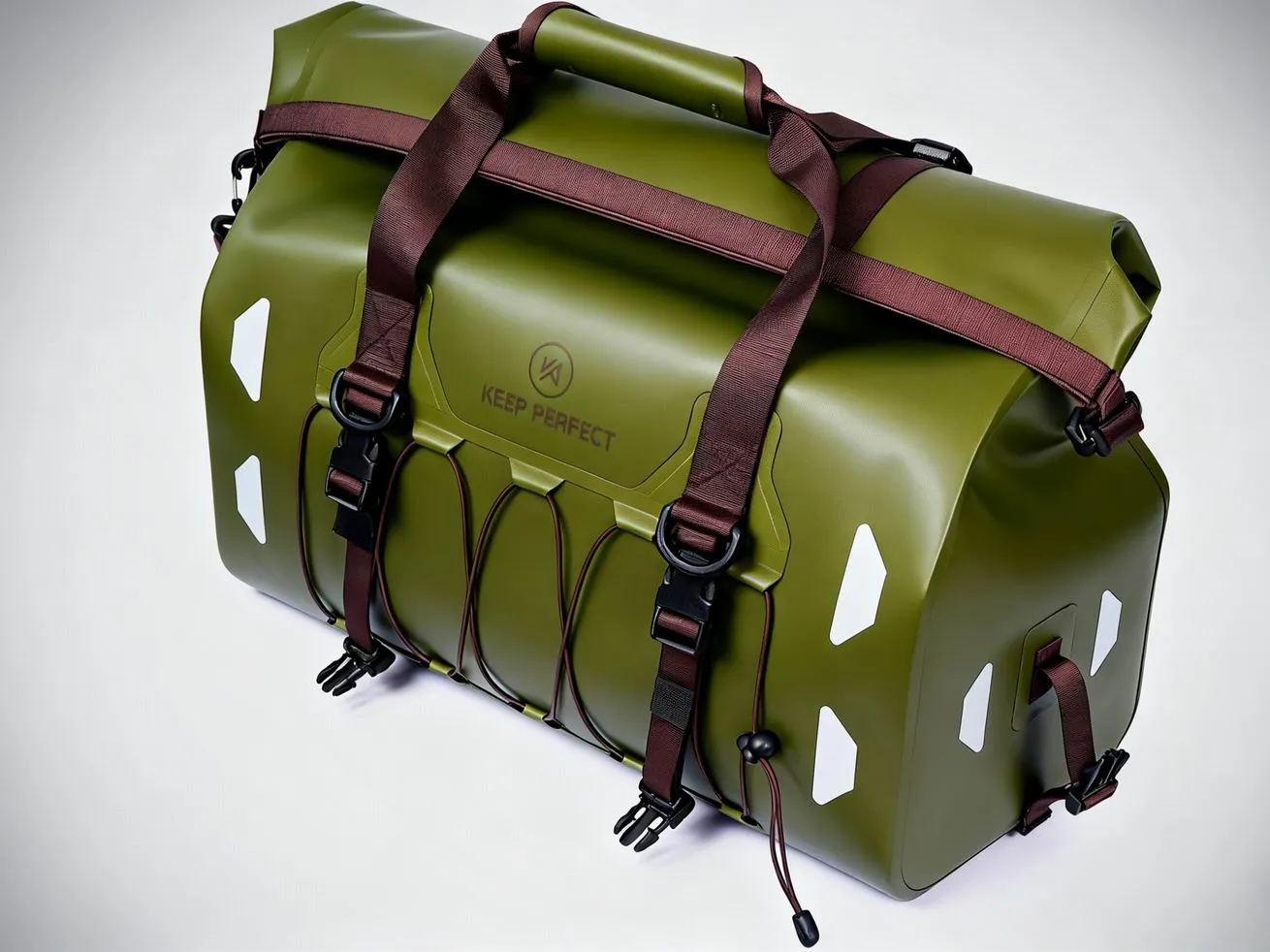
The bag is not recyclable because of how it was designed
Most buyers assume waterproof bag recycling fails because consumers do not bother or councils do not collect. Collection matters, but it is not the binding constraint. The binding constraint is that end-of-life solutions which work on a single-material cotton tote do not transfer to a product whose entire value is a permanent bond between dissimilar materials. A tote is one polymer held together by a thread of the same polymer. A dry bag is a woven face fabric, a film, an adhesive layer, a second film, a welded tape over every seam, nylon webbing, acetal buckles, a coil zipper with a metal slider and a printed logo, all fused into a single object.
That is a design achievement, not a design accident. Waterproofness is achieved by removing the holes that stitching creates and replacing them with continuous film and welded joints. The industry comparison of stitched, welded and bonded construction makes the performance case clearly: welded seams are what let a bag survive submersion. What it does not usually mention is the corollary, which is that a welded seam cannot be unpicked. There is no un-welding operation, and there is no solvent bath that removes a ten-year-old polyurethane lamination from a polyester substrate without destroying both.
The practical consequence is an inverted hierarchy. For most consumer goods the waste hierarchy reads reduce, reuse, recycle, recover, dispose. For waterproof bags the third rung effectively does not exist at commercial scale, so the realistic ladder is: keep using it, repair it, hand it on, recover the material by cutting it into something smaller, and only then energy recovery or landfill. Any claim that skips from collection straight to recycling without describing the separation step is describing a wish rather than a process.
This is worth saying plainly to anyone writing a sustainability page: a product that cannot be separated cannot be recycled, and separation is decided at the design stage. By the time the bag arrives at a sorting facility, every decision that determined its fate was made eighteen months earlier in a material specification and a welding parameter sheet.
What a waterproof shell is actually made of
Before evaluating any recovery route it is worth writing down the actual bill of materials, because most arguments about recyclability in this category happen at the wrong level of detail. People discuss "the bag" as though it were a polymer. It is a stack of eight to twelve distinct materials, and the mass share matters enormously: the two heaviest components determine what a shredded bale behaves like, while the lightest ones determine whether a reprocessor accepts the bale at all.
| Component | Typical material | Approx. mass share | Separable by hand? | What happens to it at end of life |
|---|---|---|---|---|
| Face fabric | Polyester or nylon 210–1000D woven | 35–55% | No, it is laminated | Shredded with everything else; the polymer is not recoverable alone |
| Waterproof film or coating | TPU, PVC or PU | 15–30% | No | Contaminates the base polymer stream; drives most rejection decisions |
| Seam tape | TPU or PU film with adhesive | 3–8% | Only by cutting | Remains bonded to the shell, so it cannot be sorted separately |
| Webbing and straps | Polyester or nylon tape | 6–12% | Yes, if sewn rather than welded | Recoverable as a clean mono-polymer fraction if cut off |
| Hardware | Acetal, aluminium, steel, zinc alloy | 4–10% | Yes, if mechanically attached | Highest value per minute of removal; metal is genuinely recyclable |
| Zipper | Nylon or polyester coil, metal slider | 2–6% | Yes, by cutting the tape | Mixed; the slider is valuable, the coil tape is not |
| Foam padding | EVA or PE foam | 3–10% | Sometimes | Low value; downcycled or rejected |
| Print, label, thread | Inks, PVC or paper labels, polyester thread | 1–3% | No | Small mass, disproportionate effect on reprocessor acceptance |
Two observations follow directly from the table. First, the components that are easy to remove are also the smallest by mass, which is exactly why manual disassembly rarely pays. Second, the component that decides acceptance — the film and any halogenated polymer in it — is also the one nobody can remove. A PVC-coated shell and a TPU-coated shell look identical on a shop floor and behave completely differently in a recycling stream, which is why specification discipline matters more here than in almost any other part of the product.
Why laminated multi-material shells defeat mechanical recycling
Mechanical recycling is grinding, washing, melting and re-extruding. It is the only route operating at meaningful scale for flexible packaging and textiles, and it has three hard requirements: a narrow polymer input, thermal compatibility, and freedom from additives that degrade or contaminate. A laminated waterproof shell fails all three for reasons that are physical rather than organisational.
Thermal incompatibility comes first. Polyester processes around 250–260 °C. Polyamide 6 melts near 220 °C. Thermoplastic polyurethane softens and begins to degrade in the 180–220 °C band depending on hardness and chemistry. Put a polyester shell carrying a quarter of its mass in TPU film through a polyester extrusion line and the TPU fraction does not melt cleanly alongside it: it degrades, gels, discolours and leaves hard particles that ruin the mechanical properties and the surface finish of the whole batch. Reprocessors know this, which is why intake specifications typically demand polymer purity above 98% and treat polyurethane as a contaminant in polyester streams.
PVC is the sharper case. Polyvinyl chloride begins releasing hydrogen chloride well before most processing temperatures and is therefore excluded outright from most polyester and polyolefin streams, with tolerances quoted in the tens or hundreds of parts per million rather than percent. A single PVC-coated bag in a bale of otherwise recyclable polyester is not a dilution problem; it is a rejection problem, and it can cost the reprocessor a full batch. Our comparison of TPU and PVC for waterproof construction is usually read as a performance and compliance question. It is also an end-of-life question.
Sorting cannot save this. Near-infrared spectroscopy, which is what most material recovery facilities use to identify polymers, reads the surface it can see. A TPU-faced laminate presents as TPU regardless of what sits underneath, and a printed or dirty surface degrades the reading further. The result is mis-sorting into a stream that will reject it downstream, or manual sorting out to residual waste — which is the outcome the industry rarely reports.
Disassembly: the economics nobody prices in
The intuitive answer to a bonded multi-material product is to take it apart. In practice, disassembly is where most end-of-life business cases quietly die, because the cost is labour measured in minutes and the revenue is material measured in cents. The exercise is worth doing once with a stopwatch, because the result changes how you read every take-back announcement.
| Component | Removal method | Time per unit | Recovered value | Verdict |
|---|---|---|---|---|
| Buckles and metal hardware | Unclip or cut the webbing | 20–40 seconds | $0.05–0.15 | Worth doing; metal has a real market |
| Webbing and straps | Cut at the bar-tack | 30–60 seconds | $0.01–0.04 | Marginal; only viable if sorted by polymer |
| Zipper assembly | Cut the tape close to the coil | 40–90 seconds | $0.01–0.03 | Negative once labour is counted |
| Foam padding | Tear out of the lining | 60–120 seconds | Near zero | Negative; foam has almost no recovered value |
| Shell panels | Cannot be separated | Not feasible | Negative | The mass is here and the value is not |
| Seam tape | Cannot be separated | Not feasible | Negative | Remains with the shell |
Add the numbers honestly. A mid-sized dry bag needs roughly six to nine minutes of skilled labour to strip to its recoverable fractions. At a fully loaded workshop rate of $4–8 per hour, that is $0.40–1.20 of labour per unit. The recovered material is worth somewhere between $0.10 and $0.30, and it still has to be cleaned, baled and transported, which costs more money. The arithmetic is negative by a factor of three to ten before anyone has paid for the collection of the bag itself.
This is the single most useful fact for evaluating claims. Programmes that genuinely disassemble do so at a loss funded by brand margin, and they are rare. Programmes that do not disassemble are, in material terms, almost always doing one of three things: shredding for low-grade downcycled product, sending to energy recovery, or storing collected goods while a route is developed. None of those are frauds, but only the first is material recovery, and it is the one with the weakest story to tell.
Mechanical recycling: contamination thresholds and what they mean
For the small share of this product category that does enter a mechanical stream, the gate is the reprocessor’s intake specification rather than any national standard. Typical conditions for flexible polyester include polymer purity above 98%, moisture below roughly 0.5%, no halogenated polymer above trace levels, no metal, and limited non-target polymer. Each condition exists because a specific failure mode has cost the industry money, and knowing the failure modes tells you what a bag must be made of to pass.
- Moisture: polyester and polyamide hydrolyse when melted wet, dropping molecular weight and with it tensile strength, so wet bales are rejected or heavily discounted.
- Halogens: hydrogen chloride from degrading PVC corrodes equipment and contaminates the batch, which is why the tolerance is measured in parts per million.
- Adhesives: most laminating adhesives crosslink and char rather than melt, producing black specks that are unacceptable in any visible application.
- Additives: flame retardants, antimicrobial treatments and durable water repellent finishes introduce substances that may be restricted in the target application even when the base polymer is clean.
- Metal: even small fragments damage extruder screens and screws, so hardware must be gone, not merely loose.
Even when the input passes, the output is not the same material. Every melt-processing pass shortens polymer chains, which reduces intrinsic viscosity in polyester and impact strength in polyamide. A waterproof film that entered as a carefully specified 0.15 mm TPU with a defined hardness and hydrolysis resistance emerges as generic flake suitable for strapping, injection-moulded housings, insulation board or fibre. The physical property that made it waterproof — a continuous defect-free film of controlled thickness — is exactly what shredding destroys. Recovery of material is therefore not recovery of function, and any statement implying otherwise should be read carefully.
There is also a numerical loss that rarely appears in claims. Washing, drying and regrinding typically loses eight to fifteen per cent of input mass to moisture, dirt, fines and process residue. Collection, sorting and transport lose more. A programme that collects a thousand kilograms of bags should expect to sell several hundred kilograms of usable flake, not a thousand.
Chemical and feedstock routes: what they can and cannot take
When mechanical recycling cannot accept a stream, the standard answer is to point at chemical recycling. It is worth being precise about what each family actually tolerates, because the gap between pilot capability and commercial intake is wide.
Depolymerisation routes such as glycolysis and methanolysis work on condensation polymers, principally polyester and polyamide, by breaking the chain back to monomers or oligomers and repolymerising. They are genuinely useful for clean, sorted polyester, and genuinely useless for a mixed bag containing polyurethane film, acetal hardware and adhesive. Thermoplastic polyurethane can in principle be glycolysed back to a polyol, but that requires a separated, identified TPU stream and has no meaningful capacity serving consumer soft goods today.
Pyrolysis and gasification tolerate mixed, dirty input, which is why they are often presented as the answer for unrecyclable flexible products. The trade is that they convert polymer into oil, gas or syngas and then back into feedstock, which destroys the value already embodied in the polymer and carries a substantial energy and emissions burden. Feedstock recycling is better than landfill and worse than keeping the polymer intact; treating it as equivalent to recycling is the most common accounting sleight of hand in this space.
Solvent-based dissolution and purification is the most interesting emerging route for mixed textiles because it can separate a target polymer from coatings and dyes at comparatively low temperature. Its constraint is purity: these processes still require a known dominant polymer and controlled input, and they are not licensed to accept welded, hardware-bearing assemblies. For bags, the credible sequence is therefore not a new technology but an old one — remove hardware, cut away trim, and only then consider whether the remaining shell has a route. Some of the broader options are surveyed in our overview of where waterproof material technology is heading after 2026.
Upcycling: where recovered material actually goes
Upcycling in this category means two very different things. In marketing it means a bag made from recovered material. In operations it means taking a returned, defective or end-of-life product and converting it into something of value without melting it. The second definition is where the real activity is, and its economics are dominated by the condition of the incoming unit rather than by the cleverness of the output.
| Route | Input requirement | Typical output | Value relative to virgin material |
|---|---|---|---|
| Cut-and-sew remanufacture | Large intact panels, known polymer, clean | Small pouches, organisers, accessory cases | Highest; displaces a full product |
| Trim and hardware harvesting | Mechanically attached components | Reused buckles, sliders, webbing | High per minute, tiny per unit sold |
| Panel donation to makers | Cosmetically imperfect but serviceable | Community repair and craft supply | Low financial, high brand value |
| Shredding to flake | Sorted single polymer, hardware removed | Injection feedstock, strapping, board | 20–50% of virgin pellet |
| Shredding to fill | Mixed, dirty, any polymer | Acoustic or insulation fill | Near zero, sometimes negative |
| Energy recovery | Anything | Heat, power | Negative in circularity terms |
The circular economy literature frames recovery as a design problem rather than a waste problem, and the framing is correct with one caveat: it assumes the materials can be separated. The Ellen MacArthur Foundation material on circular design is the clearest statement of the principle, and welded textile goods are the case that tests it hardest.
The top row explains why the few credible upcycling programmes in outdoor goods look the way they do. They collect their own returns, sort by stock-keeping unit so the polymer and colour are known, cut the panels that are still sound, and discard the rest. That works because the input is controlled. What does not work is accepting mixed post-consumer bags from the public, because the sorting cost exceeds the output value every time.
For a brand with a custom programme, this points at an achievable and honest offer: repair and resale of returned units, harvesting of hardware from units that cannot be repaired, and remanufacture of intact panels into a smaller accessory sold alongside the main line. None of it requires a recycling miracle and all of it can be quantified, which is more than most claims in this category can say. Packaging is the other half of the same problem, covered separately in our guide to sustainable packaging decisions for bag brands.
Designing for disassembly without losing waterproofness
It is possible to build a waterproof bag that comes apart, and the penalty is smaller than most people assume — provided the decision is made before the tooling exists. The options form a hierarchy from cheapest to most thorough, and each has a specific cost.
- Mechanical hardware attachment: specifying riveted or bolted buckle mounts instead of welded or fully stitched ones keeps metal recoverable in seconds, at a small added component cost and a slightly busier aesthetic.
- Single-polymer webbing and thread: matching the webbing polymer to the shell polymer means the whole soft structure can in principle be processed together, at a modest premium over default nylon tape.
- Reduced layer count: moving from a three-layer laminate to a coated single fabric removes one polymer family from the stack, usually at some cost to abrasion life, which can be partly recovered by choosing a higher-denier base as discussed in our guide to denier and durability.
- Mono-material shell: all-TPU or all-polyolefin construction where the face fabric, film and tape share one polymer family, which is the only configuration a mechanical recycler will seriously consider.
- Removable liner: a drop-in liner rather than a bonded one lets the structural shell and the waterproof element be separated at end of life, at the cost of bulk and a more complex assembly.
The engineering constraint worth respecting is that welded construction is what delivers submersion performance, and the seam is where mono-material designs either succeed or fail. Welding TPU face fabric to TPU film is a well-understood process and can be as strong as a mixed construction; the issue is cost and hand-feel rather than waterproofness. Welding polyethylene to polyethylene is likewise viable. What does not work is assuming a coating is equivalent to a film: a thin acrylic or polyurethane coating on polyester does not weld reliably and is not separable, so it delivers the worst of both.
A useful internal rule is to ask, for each joint in the product, whether it can be reversed in under thirty seconds with a blade or a screwdriver. Every joint that cannot should be between materials that share a polymer family. That one sentence converts an aspiration into a drawing check.
Take-back programmes: the numbers behind the promise
Brand take-back schemes are the most visible end-of-life commitment in this category and the least examined. The pattern is consistent enough to be worth stating as ranges, with the caveat that published figures are self-selected and usually optimistic.
| Metric | Commonly observed range | What drives the number |
|---|---|---|
| Share of units returned within three years | 2–8% | Whether a deposit or prepaid label exists; most schemes have neither |
| Reverse logistics cost per returned unit | $3–9 | Parcel rather than bulk freight; one bag per box is brutally uneconomic |
| Returned units in reusable or repairable condition | 30–60% | Age at return; bags tend to come back late and dirty |
| Share recycled into an equivalent product | Under 5% | Separation capability; almost always the binding limit |
| Share landfilled or incinerated despite collection | 40–70% | No downstream route for mixed laminate in the collecting region |
| Programme survival past three years | Roughly half | Cost per unit versus marketing value; depends on who owns the budget |
Three mechanisms explain most of the gap between announcement and outcome. Service life: a good welded bag lasts five to ten years, by which time the customer has moved house, the brand has changed its line, and the programme has been restructured. Freight: collecting one bag per parcel costs several dollars, which is a large fraction of the product price and cannot be recovered from material value. Downstream: even a perfectly collected bag has nowhere to go if the regional infrastructure cannot separate laminated film.
The design implication is that the highest-return intervention is not collection but durability and repairability, because delaying the disposal event by two years is worth more environmentally than recovering ten per cent of the material badly. Our separate analysis of warranty and return rate analysis shows how quickly small changes in field failure rate change the volume of product entering the waste stream at all.
How to read a recyclability claim without being misled
The vocabulary of this space is loose enough that two honest people can read the same sentence opposite ways. Four distinctions resolve most of it, and each has a testable question attached.
- Recycled content is not recyclability. A bag made from recovered polyester can still be unrecyclable at end of life. Ask what the recovered input was and separately what happens to the finished product.
- Recyclable in principle is not recyclable in practice. The phrase to look for is "where facilities exist", which usually means nowhere in the buyer’s market. Ask which facility, and whether it accepts welded laminate.
- Certification scope is narrow. The Global Recycled Standard certifies recycled content and chain of custody through production; it says nothing about whether the finished bag can be recovered. Our detailed explainer on GRS certification for recycled bags sets out exactly what is and is not covered.
- Percentage claims need a denominator. "Made with fifty per cent recycled material" is meaningful only if it states whether that is of shell mass, of total product mass, and whether it is post-consumer or post-industrial.
Regulators have converged on a similar position, and the underlying priority order is set out in the waste management hierarchy published by the US Environmental Protection Agency, which places source reduction and reuse above recycling and disposal. Guidance in the United States and the United Kingdom both push toward qualifying claims with the basis and the availability of infrastructure, and general environmental claim standards require that claims be specific, verifiable and not misleading. The practical test for a buyer is simple: if the claim does not name the polymer, the process and the facility, it is not a claim about the physical world.
One more signal is worth training yourself to notice. Genuine programmes publish the awkward numbers, including the share that could not be recycled. Programmes that publish only a total tonnage collected are reporting an input, not an outcome, and the difference is the entire question.
What to put in a product brief if you want the bag recoverable
Sustainability intent that never reaches a specification does not affect a product. What works is a short list of measurable requirements attached to the technical pack, written in language a factory can quote against and a quality inspector can check. The following set is achievable within normal custom production economics.
- Name the polymer family for every component over two per cent of product mass, including film, tape, webbing, thread and foam.
- Require that non-metal trim share the shell polymer family, or be removable in under thirty seconds with hand tools.
- Prohibit halogenated polymers in the shell entirely, and require written confirmation rather than a general compliance statement.
- Specify mechanically attached hardware wherever the design allows, and accept the aesthetic consequence.
- Set a minimum service life with a test basis, such as seam peel retention after accelerated ageing as described in our guide to accelerated ageing and durability prediction.
- Require a repair path: which components are available as spares, and for how long after the last production run.
- Ask for a written end-of-life statement per style listing each material and the route the supplier believes applies, then check the routes rather than filing the statement.
- Keep the number of polymers in one product to three or fewer, including the print and label materials.
Each of these costs something, and it is more honest to name the costs than to pretend they are free. Single-polymer trim raises material cost by a few per cent. Mechanical hardware adds assembly time. Higher-denier mono-material faces add weight. What they buy is an option: the possibility that the product has somewhere to go, and the ability to make a specific claim that survives scrutiny. Whether that is worth the premium is a commercial decision, but it should be made with the real numbers in front of you rather than with a brochure.
Where the responsibility actually sits
It is fashionable to distribute blame for this problem evenly between designers, manufacturers, brands and consumers. The distribution is not even. The designer chooses the layer stack. The manufacturer chooses the joining method and the trim. The brand chooses the service life and whether a repair path exists. The consumer chooses how long to keep it and where to put it, which is the smallest of the four levers and the only one most public messaging addresses.
For a buyer commissioning custom product, that means the useful question is not "is this bag recyclable" but "what did we specify that makes it unrecoverable, and which of those decisions were load-bearing". In most designs, one or two of them are load-bearing and the rest were defaults nobody revisited: nylon webbing because it was in stock, a PVC label because it was cheaper, a bonded liner because the sample was built that way. Defaults are where the recoverable margin is.
The remaining honesty is about scale. Even a perfectly designed mono-material bag only realises its end-of-life value if collection and processing exist where the customer lives, and in many markets they do not. Designing for recovery is therefore best understood as buying an option rather than delivering an outcome: it costs a little now, it pays only if infrastructure arrives, and it is nearly impossible to retrofit later. That is a defensible reason to do it, and a bad reason to claim credit for it.
If you want that kind of specification discipline applied to your own styles, start by reviewing Send the drawing with the material stack named and we will tell you which joints we would change first. Minimum order quantity is 500 pieces per style, samples in 6–10 working days, bulk production in 35–50 days, quoted FOB Xiamen.
Frequently Asked Questions
Q1. Why is a waterproof bag harder to recycle than an ordinary bag?
Because waterproofness comes from laminating film to fabric and welding the seams. Those bonds are permanent by design, so the base polymer cannot be separated from the coating, and mechanical recyclers reject mixed laminate even when the base fibre is technically recyclable.
Q2. Can a TPU-laminated polyester bag be mechanically recycled?
Not as a mixed input. Polyester processes near 250 °C while TPU degrades below that, so the coating chars and gels in the melt. Reprocessors typically require above 98% polymer purity, which a laminated shell cannot meet.
Q3. Is PVC worse than TPU at end of life?
Yes, materially. PVC releases hydrogen chloride before normal processing temperatures, so it is excluded from most polyester and polyolefin streams at parts-per-million tolerances rather than a few percent. One PVC-coated unit can cause a whole bale to be rejected.
Q4. How long does it take to disassemble a waterproof bag?
Roughly six to nine minutes of skilled labour per mid-sized unit to remove hardware, webbing and zipper. At normal workshop rates that is several times the value of the material recovered, which is why almost nobody does it commercially.
Q5. What is the most valuable thing to recover from a used bag?
Metal hardware, by a wide margin in value per minute. Buckles and sliders can be unclipped in under a minute and metal has a real market. The shell, which holds most of the mass, holds almost none of the value.
Q6. Does chemical recycling solve this?
Only partly. Depolymerisation needs clean, sorted single-polymer input, which a welded bag is not. Pyrolysis accepts mixed input but destroys the polymer value into fuel or feedstock, so it ranks above landfill and below keeping the material intact.
Q7. What does upcycling actually mean for bags?
In practice it means cutting intact panels from returned or defective units into smaller goods, plus harvesting hardware. It works when the brand controls the input by collecting its own returns and sorting by style, and fails when input arrives mixed from the public.
Q8. What is mono-material construction?
A design in which face fabric, waterproof film, seam tape and trim all belong to one polymer family. It is the only configuration a mechanical recycler will seriously consider, and it typically adds material cost while remaining fully weldable.
Q9. Does GRS certification mean a bag is recyclable?
No. The Global Recycled Standard certifies recycled content and chain of custody through production. It says nothing about whether the finished product can be recovered, and the two are frequently confused in retail copy.
Q10. What percentage of returned bags are actually recycled?
Published programmes usually land below five per cent into an equivalent material stream, with a large share going to energy recovery or landfill despite being collected. Programmes that publish this figure are the ones worth trusting.
Q11. Why do take-back schemes return such low volumes?
Three reasons: good bags last five to ten years so the customer has moved on; collecting one bag per parcel costs several dollars; and even collected bags have no separation route in most regions. Durability beats collection as a lever.
Q12. Is repair a better environmental option than recycling?
Almost always, for this product. Extending service life by two years avoids the full impact of a replacement unit, while recovering ten per cent of the material badly achieves very little. Design for repair before designing for recovery.
Q13. Can a welded seam be made reversible?
No. Welding fuses the polymer, so there is no un-welding operation. The workable alternative is to make sure everything joined by a weld shares one polymer family, and that everything else is mechanically attached.
Q14. How much mass is lost in mechanical recycling?
Typically eight to fifteen per cent through washing, drying and regrinding, before collection and sorting losses. A programme collecting a thousand kilograms should expect to sell several hundred kilograms of usable flake.
Q15. Does a recycled-content bag perform differently?
It can. Reprocessed polymer has shorter chains, so film tensile strength and tear resistance are usually lower, and colour consistency is harder. This is why most constructions blend rather than run at full recycled content, as covered in our recycled TPU guide.
Q16. What should I ask a supplier about end of life?
Ask for a written per-style material declaration naming every polymer over two per cent of mass, plus which components are removable in under thirty seconds. A supplier who can produce that document quickly is usually the one who has thought about it.
Q17. Is designing for recyclability worth the extra cost?
Treat it as buying an option. The premium is real but modest, the benefit only materialises if local collection and processing exist, and it cannot be retrofitted once tooling is cut. That is a reasonable reason to do it and a poor reason to advertise it.
People Also Ask
Why are waterproof bags hard to recycle?
Because waterproofness requires laminated film and welded seams that permanently bond different materials together, and no economic process separates them again.
Can laminated fabric be recycled?
Not by conventional mechanical recycling. Reprocessors need above 98% single-polymer purity, and a laminate is by definition two or more polymers fused.
What is mono-material design?
Building the face fabric, film, tape and trim from one polymer family so the whole product can enter a single recycling stream instead of being rejected as mixed.
Is upcycling better than recycling for old bags?
Usually yes, because cutting intact panels into smaller products preserves more value than shredding, provided the input is clean and sorted by style.
Do brand take-back programmes actually work?
Partly. Return rates are typically two to eight per cent within three years, and a large share of collected units still ends up in energy recovery or landfill.
What is the biggest barrier to bag recycling?
Material separation, not collection. The binding constraint is that the product was designed so its layers cannot be taken apart economically.