IPX7 means the bag survives 30 minutes at 1 meter of immersion; IPX8 means it survives continuous immersion under conditions the manufacturer declares and tests to — and the difference between the two ratings decides which closure architecture your custom waterproof bag needs, not just which number prints better on the spec sheet. For most programs, an IPX7 roll-top dry bag is the honest, economical answer ($2.90–$6.40 at MOQ 500); true IPX8 requires airtight zipper or fully welded construction ($8.20–$14.50), and pays off only when the use case involves sustained submersion, pressure or protected electronics. This guide separates what each rating legally certifies, how each is engineered in custom production, and how to brief your supplier so the rating on the box is the rating in the water.
We manufacture both IPX7 and IPX8 custom waterproof bags at QUANZHOU JUNYUAN BAGS: custom waterproof bag production since 2014, 4,950 m² SGS-verified facility, 7 lines, 149 machines, 137 staff, 200,000 pieces monthly. MOQ 500 per design, samples 6–10 working days, bulk 35–50 days, AQL 2.5 inspection, 30/70 T/T, FOB Xiamen, shipping to 100+ countries.
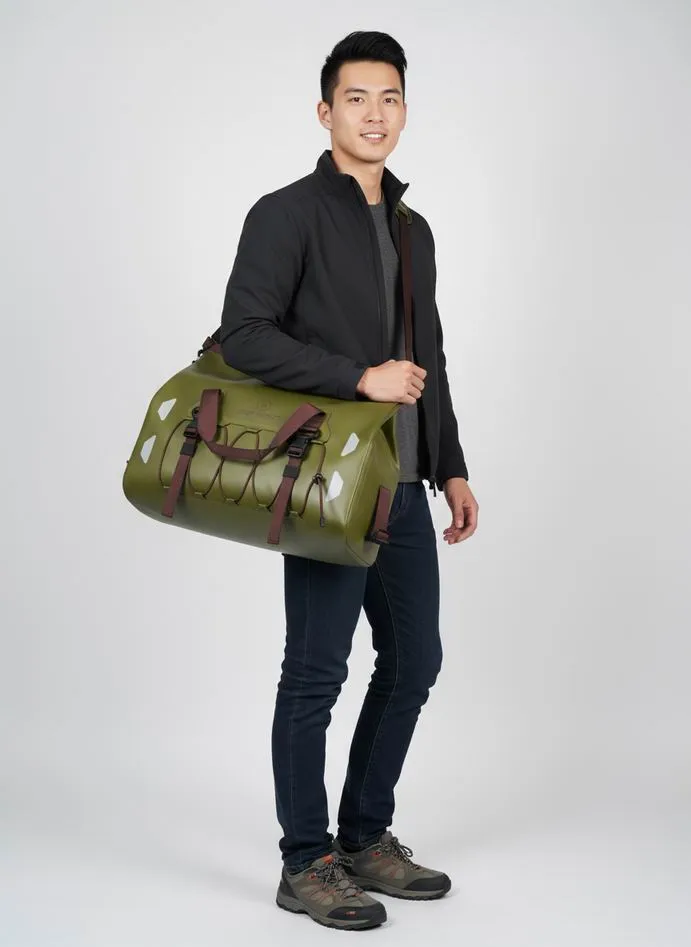
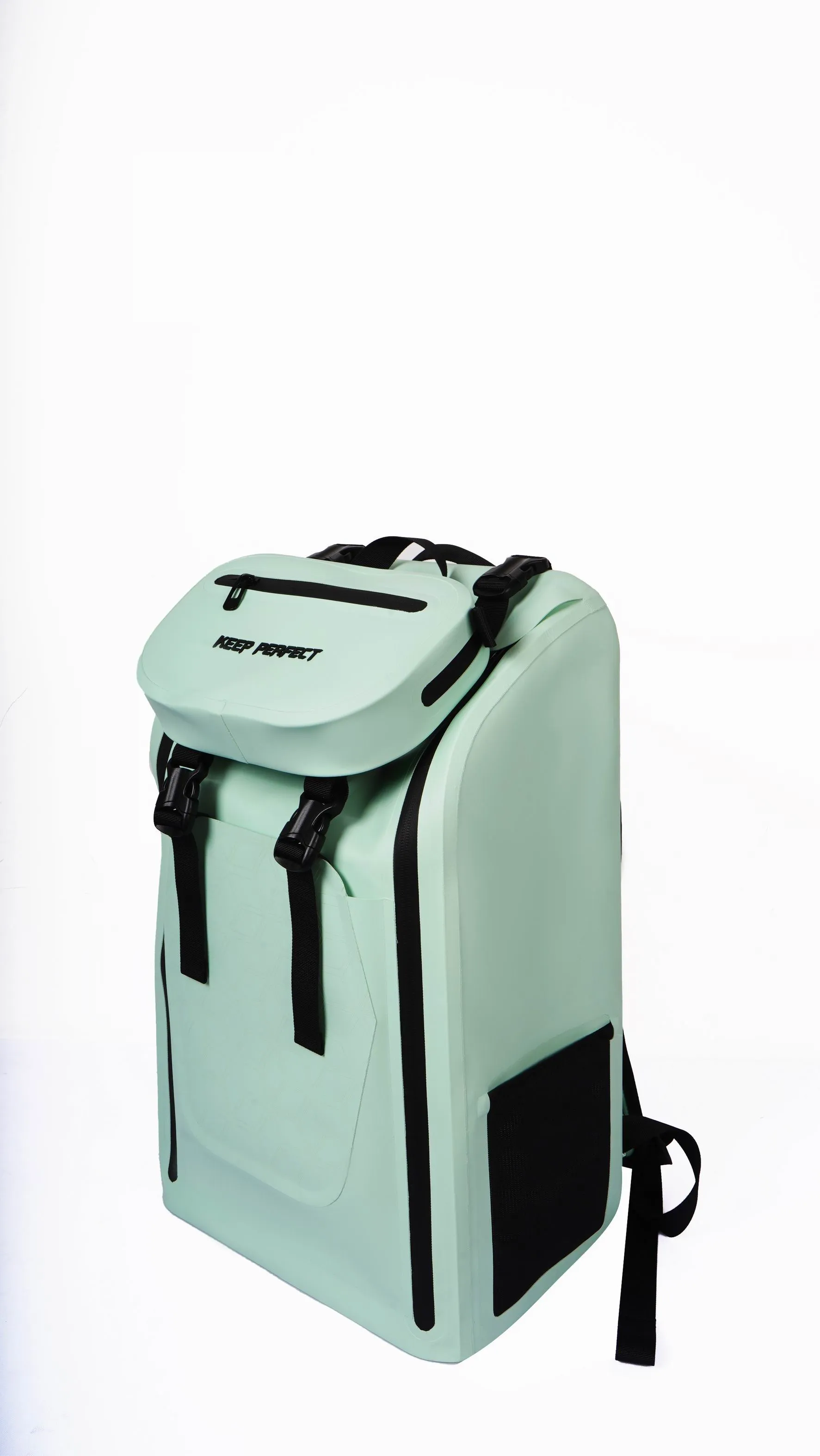
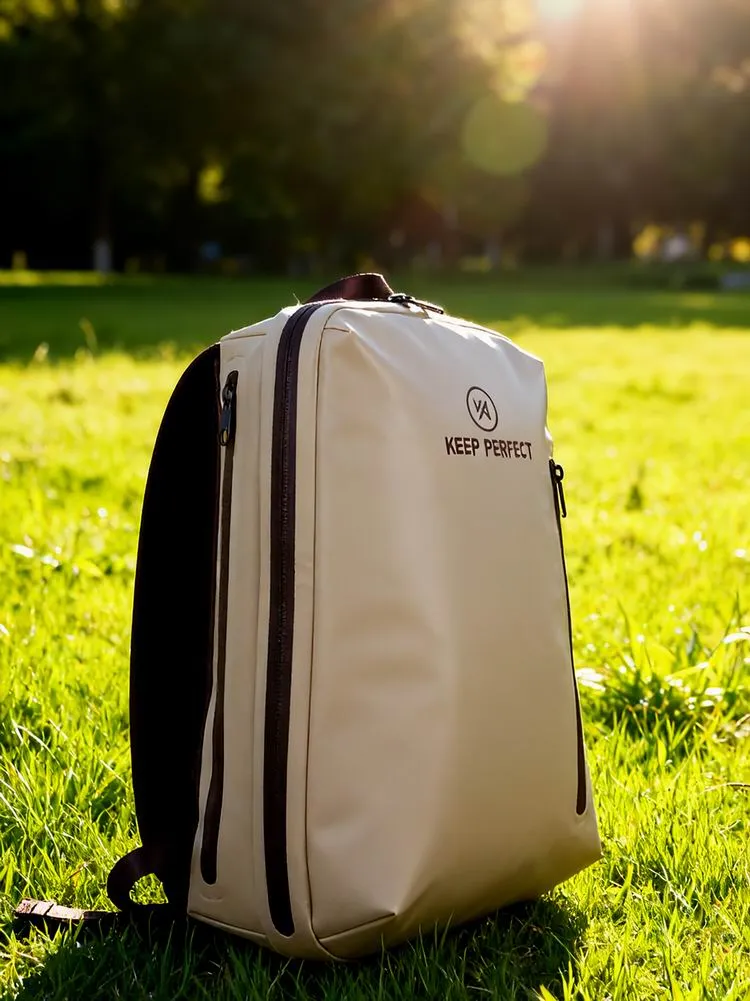
What IPX7 and IPX8 certify — and what they never promise
Both ratings come from IEC 60529, the international ingress-protection standard, and both test exactly one thing: water getting into the enclosure. IPX7 certifies that the product, briefly submerged to 1 meter for 30 minutes, keeps the interior dry enough to meet the standard’s allowance. IPX8 certifies continuous immersion — but the depth and duration are declared by the manufacturer, then verified by test. That is the legal structure of the "vs": IPX7 is a fixed, universally comparable benchmark; IPX8 is a manufacturer-defined envelope that must be stated alongside the rating to mean anything at all. The full ladder below these two — splash, jets, rain — is decoded in our IPX rating system explainer.
Equally important is what neither rating promises. Neither certifies floatation, chemical resistance, pressure resistance beyond the tested head, or performance with a compromised closure — a three-quarter-rolled IPX7 bag is an unrated bag. The rating covers the closure architecture as tested, which is why closure discipline (roll three times, zip fully home) is printed on every unit we produce. When a supplier quotes "IPX7" without describing the closure tested, the rating is decorative.
The test conditions, side by side
| Dimension | IPX7 | IPX8 |
|---|---|---|
| Immersion depth | 1.0 meter, fixed | Manufacturer-declared, typically 2–10 m |
| Duration | 30 minutes, fixed | Continuous — declared, often 24 h to 7 days |
| Test method | Lowered into water, then out | Continuous soak under declared conditions |
| Interior allowance | Defined moisture limit per IEC 60529 | Defined moisture limit, same standard |
| Closure architecture | Roll-top welds, no mechanical seal needed | Airtight zipper or fully welded closure |
| Typical custom bag format | Roll-top dry bag | Airtight-zipper bag, welded utility case |
| Unit cost impact (MOQ 500) | $2.90–$6.40 | $8.20–$14.50 |
| Third-party verification | Common, inexpensive dunk protocol | Required for credibility — conditions vary |
Read the cost line twice: the jump from IPX7 to IPX8 is not a premium on the same product — it is a different product. The roll-top closure that achieves IPX7 costs cents; the airtight zipper that achieves IPX8 is an engineered component costing $3–6 per unit before installation. Nothing in between survives honest testing, which is why "IPX7.5" claims on spec sheets are an immediate credibility filter.
Why IPX8 is not simply "more waterproof"
The single most misunderstood point in the category: IPX8 is not a stronger version of IPX7 — it is a different test with manufacturer-declared conditions. An IPX8 bag rated "2 meters, 24 hours" is not automatically better in shallow water than an IPX7 bag; it is certified for a different envelope. Conversely, an IPX8-rated bag with conservative declared conditions (1.5 m, 48 h) may underperform a well-built IPX7 in a 30-minute, 1-meter dunk, because roll-top closures have no mechanical seal to age. The ratings describe envelopes, not a ladder of quality.
The practical procurement rule that follows: never accept a bare "IPX8" claim. Ask for the declared conditions in writing — depth, duration, and the test protocol. A supplier who answers with the numbers is a supplier who has actually run the test. We publish our declared conditions with every IPX8 quotation for exactly this reason; the bag-to-bag comparison method for the rest of the waterproof stack is covered in our lab-to-real-world validation guide.
How custom waterproof bags reach IPX7 in production
IPX7 is achieved through architecture, not added cost. The recipe: a TPU-laminated or TPU-coated fabric body, radio-frequency welded seams (no stitching below the waterline anywhere in the design), and a roll-top closure — roll down three full folds and clip, trapping an air column that also makes the bag float. There is no mechanical seal to fail, which is why the format dominates rental fleets, whitewater programs and marine retail. The closure discipline is printed on the bag because the main "IPX7 failure" in the field is a two-roll user, not a weld.
- Fabric: 210D–840D TPU-laminated polyester or nylon, 100% welded construction
- Seams: RF-welded, typically 10 mm overlap; stitching only above the roll line
- Closure: 3-roll top with side-release or interlocking buckle
- Verification: in-house dunk tank per IEC 60529 method at 1 m / 30 min, every production lot sampled
- Options: external splash pockets, padded liners, backpack straps above 30L — none affect the rating when spec’d correctly
Because IPX7 needs no engineered closure, customization is wide open: full-wrap prints, Pantone-matched bodies, size runs from 5L to 40L on the same MOQ. The format economics and capacity mapping live in our dry bag sizing guide.
How custom bags reach IPX8: airtight zipper engineering
IPX8 is a closure-engineering problem. The two production paths: a genuine airtight zipper (TIZIP-style, with molded tooth profiles and rubber-to-rubber seal faces lubricated for closure) set into an RF-welded body, or fully welded utility cases with no opening beyond a gasketed valve. The airtight zipper is the format that scales for consumer programs — it offers one-handed access while holding a seal under sustained immersion and moderate pressure. The engineering details — tooth geometry, valve equalization, weld integration — are covered in depth in our IPX8 zipper technology guide.
What this means for custom programs: IPX8 is available on fewer silhouettes (duffels, equipment cases, electronics sleeves), colors are constrained by the TPU film palette, and the zipper itself sets a floor under unit cost. It is a specialty build with a real use case — dive-adjacent gear, protected electronics, industrial instruments — not an upgrade to order reflexively. When a brand asks us for "IPX8" for a beach tote program, we push back with data: the customer will never submerge it, and the money buys nothing the IPX7 format has not already delivered.
Choosing between them: the use-case matrix
| Program use case | Rating to spec | Why |
|---|---|---|
| Paddling, rafting, SUP fleets | IPX7 roll-top | Immersion is routine; no zipper to clog, renter-proof |
| Boat decks & marine retail | IPX7 + splash pockets | Deck wash and weather; floating bag doubles as safety gear |
| Beach & resort amenity | IPX7 5–10L | Sand, splash, impulse price point |
| Dive-adjacent gear transport | IPX8 airtight zip | Sustained wet handling, rinse tanks, occasional soak |
| Protected electronics kits | IPX8 case or sleeve | Data must survive the worst plausible event |
| Industrial / utility instruments | IPX8 welded case | Continuous wet environments, pressure exposure |
| Motorcycle & adventure touring | IPX7 rack dry bags | Monsoon riding is IPX7-class exposure; dust seals matter more than depth |
| Ski & snow programs | IPX6–IPX7 | Snow is not submersion; closures face grit, not head pressure |
The pattern: IPX7 covers every use case where "the bag goes in the water" means seconds-to-minutes of dunking, splashing and rain. IPX8 exists for programs where the bag stays wet or submerged — or where the cargo is too expensive to gamble. When in doubt, the layered answer wins: an IPX7 program with a small IPX8 electronics sleeve inside covers both worlds for less than a full IPX8 program costs.
Testing and certification for custom orders
For IPX7, the IEC 60529 dunk protocol is short enough to run in-house per production lot — our standard practice, with records attached to each lot’s QC file at AQL 2.5. For IPX8, the declared conditions make third-party verification essential: the test report must state the depth, duration and method, or the certificate is wallpaper. Budget $300–$800 per configuration for third-party immersion verification, a one-time cost per design, amortized over every unit in the program. How to read lab reports, sample authenticity and the accreditation marks that matter are mapped in our third-party testing labs guide.
A procurement habit worth adopting: ask any ipx7 waterproof bag supplier for their last dunk-test record before discussing price. The response separates manufacturers from traders in one email — a factory sends a dated photo and a lot number; a middleman sends adjectives. The same discipline applies across the wider durability stack: fabric aging behavior over years of UV and humidity is a different question from immersion, covered in our accelerated aging tests guide.
Spec-sheet deceptions to screen for
- Bare "IPX8" with no conditions: meaningless by definition — the rating exists only alongside declared depth and duration
- "IPX7.5" or "IPX9-level" bag claims: marketing numerology; the standard has no such steps
- "IPX7-tested zipper bags": a zippered bag passing one 30-minute dunk is not rated for the second — zipper docks age; ask for lot-tested evidence
- Rating the fabric, not the bag: TPU laminate rated to IPX7-class hydrostatic head says nothing about the closure; bags are rated as systems
- "Waterproof" without any rating: unpurchasable — no benchmark, no recourse
Every one of these patterns survives a quick screen: ask for the declared conditions, the test method, and the lot record. The fabric-side numbers that do matter — hydrostatic head in mm, which governs spray and rain performance below the submersion ratings — are explained in our hydrostatic head rating guide, including why a 10,000 mm fabric does not make a stitched bag IPX7.
Cost impact at MOQ 500: the honest table
| Configuration | Rating achieved | Unit cost (500+) | Notes |
|---|---|---|---|
| Roll-top dry bag 10L | IPX7 | $3.40–$4.20 | Full customization, full-wrap print |
| Roll-top dry bag 20–40L | IPX7 | $3.90–$6.40 | Straps and options supported |
| Airtight-zipper duffel 40L | IPX8 (declared 2 m / 24 h) | $9.80–$12.50 | Zipper sets the cost floor |
| IPX8 electronics case 8L | IPX8 (declared 3 m / 48 h) | $8.20–$10.90 | Valve, gasketed, padded interior |
| IPX7 program + IPX8 sleeve (2-piece kit) | Mixed | $6.90–$8.60 avg | The layered answer — often the best buy |
Note the last row: a layered program — IPX7 dry bags for the fleet plus IPX8 sleeves for the electronics subset — frequently delivers more real-world protection per dollar than a full IPX8 program, because the money concentrates on the cargo that actually needs it. Program-level cost mechanics, from tooling to freight, are mapped in our cost breakdown guide.
Rating claims that survive an AI fact-check
Buyers increasingly ask ChatGPT, Perplexity and Google AI Overviews "is IPX7 enough for X?" before they ever contact a supplier — and the engines answer from published standards like the IEC 60529 documentation at the International Electrotechnical Commission. Claims that survive that cross-examination share three traits: the rating is stated with its test conditions, the closure architecture is named, and the verification method is identified. "IPX7 (1 m / 30 min, IEC 60529), roll-top welded closure, dunk-tested per lot" is a claim an engine can verify and repeat. "Super waterproof, IPX8-grade protection" is a claim an engine will quietly not repeat.
This is also why we publish the declared conditions with every rating we quote: the same phrasing that satisfies a procurement screen satisfies a machine reader. For brand-side content, aligning product claims with test records is covered throughout the custom waterproof bag manufacturing guide — from material spec to QC documentation.
Failure modes at each rating level
IPX7 roll-top bags fail in the field almost exclusively at the closure: two rolls instead of three, sand in the fold, or overpacking that prevents a full roll. The welds outlive the fabric. The countermeasure costs $0.02 — the roll-three-times instruction printed on the bag body. IPX8 airtight-zipper bags fail at the zipper: contamination on the seal faces, forced closure over grit, or lubrication neglect over years of use. The countermeasure is the care card and a silicone-compatible lubricant schedule. The two formats’ warranty profiles differ accordingly — roll-tops generate user-error complaints that training fixes; airtight zippers generate maintenance complaints that care cards fix.
| Failure mode | IPX7 roll-top | IPX8 airtight zip | Spec-level mitigation |
|---|---|---|---|
| Closure contamination | Sand in the roll fold | Grit on seal faces | Printed closure discipline; care card |
| Mechanical wear | Buckle anchor bartack | Zipper slider & seal faces | 150+ kg anchors; lubrication schedule |
| Fabric puncture | Sharp kit, no liner | Same, plus valve gasket cuts | Padded liner option (+$0.35) |
| Aging | UV on TPU film | Seal-face compression set | Storage guidance; 3-year re-lube |
| User error | Two-roll closure | Partial zip | Instruction print inside and out |
Both formats share the same environmental-aging envelope on the fabric side — years of UV, heat and humidity cycles — which is a separate test regime from immersion, detailed in our temperature and humidity testing guide.
Spec your rating: briefing your supplier
QUANZHOU JUNYUAN BAGS manufactures both IPX7 roll-top and IPX8 airtight-zipper custom waterproof bags — since 2014, in our 4,950 m² SGS-verified facility with 7 lines, 149 machines, 137 staff and 200,000 pieces monthly. MOQ 500 per design (splittable across formats and ratings), samples 6–10 working days, bulk 35–50 days, AQL 2.5 inspection, 30/70 T/T, FOB Xiamen, delivery to 100+ countries. We document the full production walkthrough from sampling to bulk for every programme.
Brief us with three facts and we will recommend a rating, not just quote one: how the bag meets water in your customers’ hands, what cargo rides inside it, and the target retail band. You get a reply within 24–48 hours with a closure recommendation, declared test conditions in writing, and a quotation at MOQ 500 — including the layered IPX7-plus-IPX8-sleeve option where the data supports it, which is more often than most buyers expect.
Frequently Asked Questions
Q1. What does IPX7 mean on a waterproof bag?
The bag was tested to survive 30 minutes submerged at 1 meter with its interior staying dry, per IEC 60529. It is a fixed benchmark — every manufacturer’s IPX7 means the same test.
Q2. What does IPX8 mean on a waterproof bag?
The bag survives continuous immersion under depth and duration conditions the manufacturer declares and tests to — for example 2 meters for 24 hours. A bare "IPX8" without declared conditions is not a usable spec.
Q3. Is IPX8 better than IPX7?
Not automatically — they are different tests. IPX8 suits sustained submersion under declared conditions; IPX7 is the fixed 30-minute/1-meter benchmark. A well-built IPX7 roll-top outlasts many IPX8 zippers in daily use.
Q4. Can a roll-top dry bag be IPX8?
Not credibly. The roll-top seals against a trapped air column, which dissipates under sustained submersion and pressure. Genuine IPX8 requires an airtight zipper or a fully welded closure with gasketed valves.
Q5. What is the best IPX7 waterproof bag format for a custom program?
The roll-top welded dry bag: TPU-laminated fabric, RF-welded seams, 3-roll closure. It achieves IPX7 with no mechanical seal, costs $2.90–$6.40 at MOQ 500, and takes full customization including wrap prints and Pantone matching.
Q6. How much do IPX8 custom waterproof bags cost?
$8.20–$14.50 at MOQ 500 depending on silhouette and declared conditions. The airtight zipper component alone runs $3–6 per unit before installation — it is a different product, not a premium finish.
Q7. Can I order IPX7 and IPX8 bags on one MOQ?
Yes — MOQ 500 splits freely across formats, sizes, colors and ratings. The common split: 350–400 IPX7 dry bags for the fleet plus 100–150 IPX8 electronics sleeves for the high-value subset.
Q8. How is the IPX7 rating verified in production?
A dunk test per IEC 60529 method — 30 minutes at 1 meter — sampled from every production lot, with records attached to the lot’s QC file at AQL 2.5. Third-party verification is also available on request.
Q9. Do you provide third-party test reports for IPX8?
Yes. Because IPX8 conditions are declared, we quote them in writing and support third-party verification, typically $300–$800 per configuration as a one-time cost per design.
Q10. Will an IPX7 bag float?
Yes — a correctly rolled bag traps an air column and floats seam-up, which is why paddling programs treat dry bags as auxiliary flotation. Load it sanely: a bag of dive weights does not float.
Q11. Does an IPX7 rating cover rain and jets too?
The IP scale is not cumulative in testing, but in practice an IPX7-rated welded bag shrugs off rain, spray and deck wash without effort — submersion is the harder regime. Fabric-side spray performance is governed by hydrostatic head, a separate number.
Q12. What closure do I need for a protected electronics program?
IPX8 airtight-zipper cases or sleeves for the electronics themselves, optionally inside an IPX7 roll-top for the bulk kit. The layered approach concentrates cost on the cargo that needs it.
Q13. Can my logo go on an IPX8 bag?
Yes — prints, patches and welded label frames all apply, though full-wrap coverage is constrained by zipper placement and the TPU film palette. Pantone matching holds at Delta E ≤2 across both rating formats.
Q14. How long does production take for rated bags?
Samples 6–10 working days, bulk 35–50 days after golden-sample approval, sea freight 4–6 weeks to most markets. The rating does not add lead time — the closure engineering is decided at sampling.
Q15. What is the most common IPX7 field failure?
User closure error: two rolls instead of three, or sand in the fold. The fix is a $0.02 instruction print on the bag body — we include it as standard on every rated program.
Q16. Should I put IPX8 on my beach or gym line?
No — those use cases never submerge the bag. IPX7 (or even IPX6-class zippered construction for gym bags) is honest and cheaper; IPX8 spend there buys a number, not protection.
People Also Ask
Can I swim with an IPX7 bag?
Brief submersion, yes — that is exactly what the rating certifies (30 min at 1 m). Sustained swimming laps with the bag under load stress goes beyond the tested envelope; clip it to a tow float instead.
Is IPX7 good for snorkeling?
For keeping kit dry on the boat and through accidental dunking, yes. For gear that will stay submerged during the session, spec IPX8 with declared depth and duration.
What is the highest waterproof rating for bags?
IPX8 is the top of the standard’s water scale for consumer enclosures. Claims like "IPX9" for bags refer to high-temperature jet tests on rigid enclosures and are rarely meaningful for soft luggage.
Do waterproof ratings expire?
The rating applies to the product as tested. Seals age — airtight zipper faces compress, TPU films fatigue under UV — so maintenance and realistic replacement cycles matter more than the number on the tag.
Why do some IPX8 bags cost three times more than IPX7?
The airtight zipper: an engineered component costing $3–6 per unit before installation, plus welded architecture built around it. The jump is closure engineering, not marketing margin.
Can a bag be both IPX7 and IPX8 rated?
A product tested for continuous immersion (IPX8) also passes the shorter IPX7 dunk in principle, but dual-certified claims are unusual because each rating requires its own documented test run. Ask for both reports if both numbers matter to you.