A whitewater rafting dry bag does not fail because it leaked at one metre. It fails because it was pinned against a rock with fifty kilograms of dynamic load on its lash points, because the roll lip opened under a pressure wave it was never oriented to resist, or because the shell stiffened at four degrees and cracked on the fold it had survived for three seasons. Still-water immersion certificates measure the easiest load this product will ever see; the loads that actually decide whether the sleeping bag is dry at camp are mechanical, thermal and directional, and none of them appear on an IPX label. Buy to the river class you run most often, not to the deepest number on the hangtag.
This guide covers the difference between static head and what a river actually applies, what each class from III to V demands of construction and hardware, why abrasion against the frame kills more bags than water does, how a bag must be tied in and why bungee alone is not enough, the direction a roll-top should face relative to flow and why it works, air management including buoyancy versus burst behaviour, cold-water polymer behaviour and the seasonal heat cycle, capacity matrices against real frame space, the failure modes rental fleets report, the tests to ask a supplier for beyond submersion, material selection between PVC and TPU laminates, and how a commercial outfitter structures a fleet order. QUANZHOU JUNYUAN BAGS: custom waterproof bag production since 2014, 4,950 m² SGS-verified facility, MOQ 500 pieces per style, sampling in 6–10 working days and bulk in 35–50 days, FOB Xiamen.
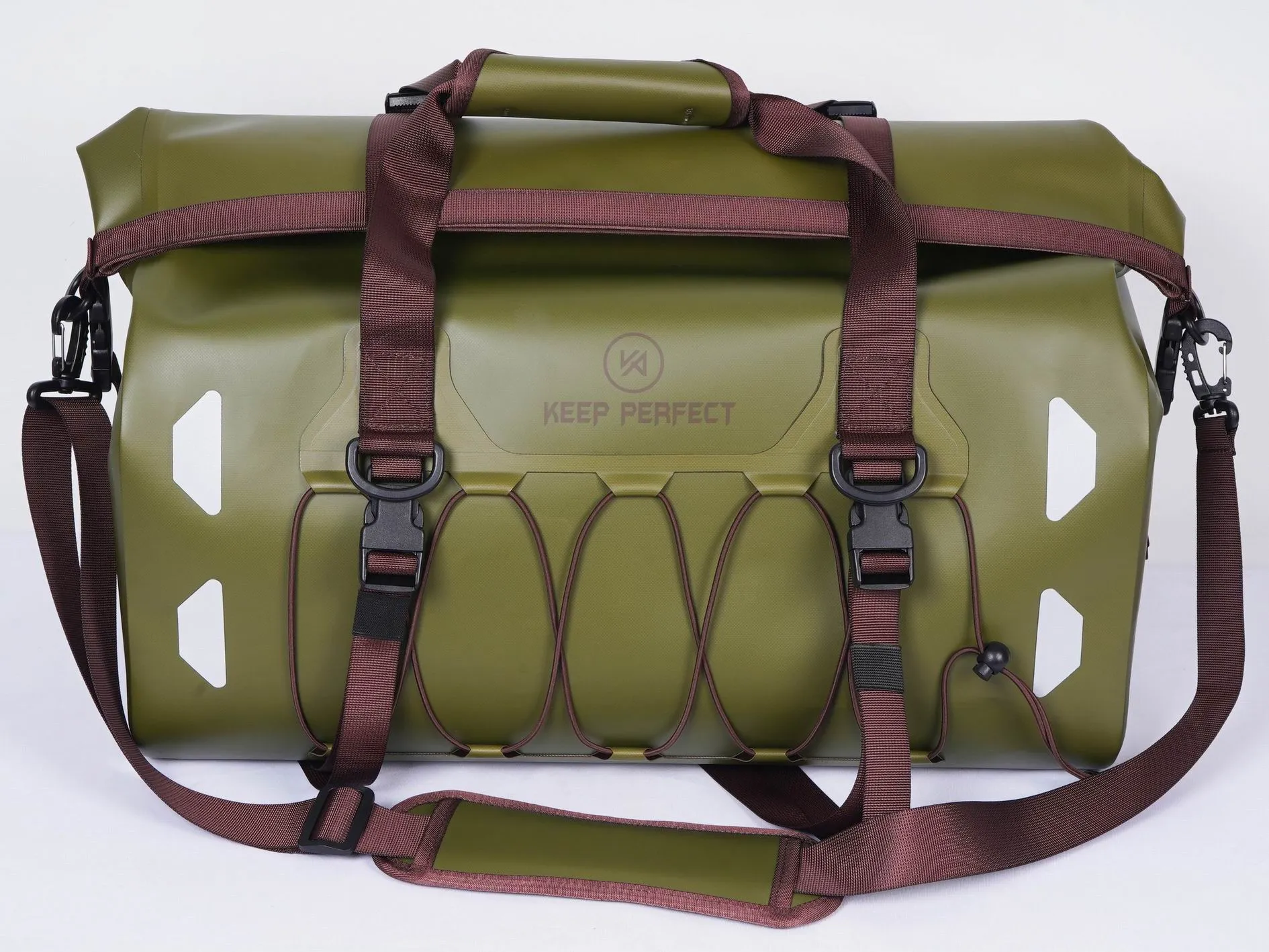
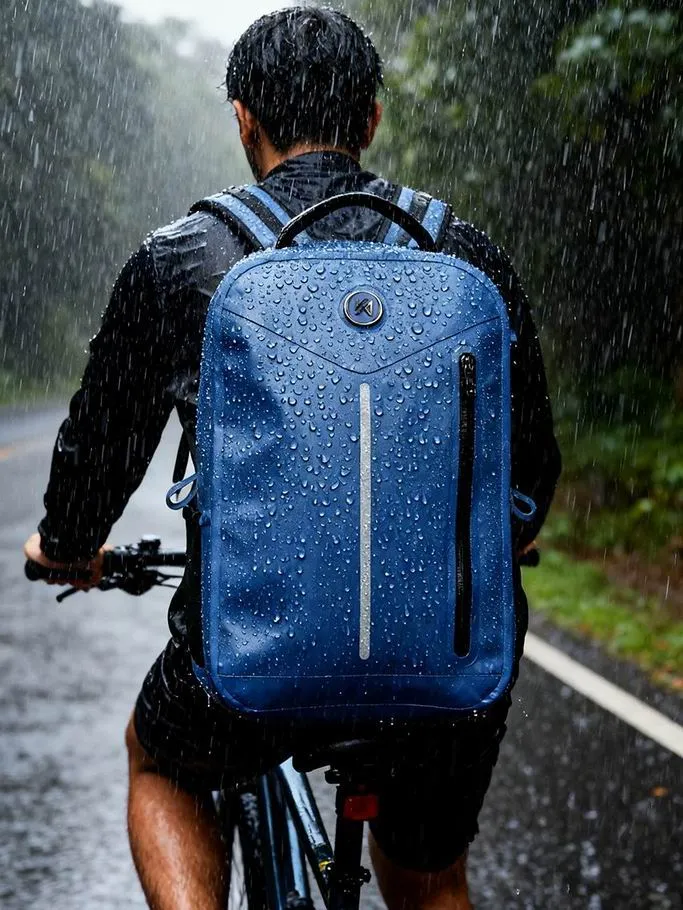
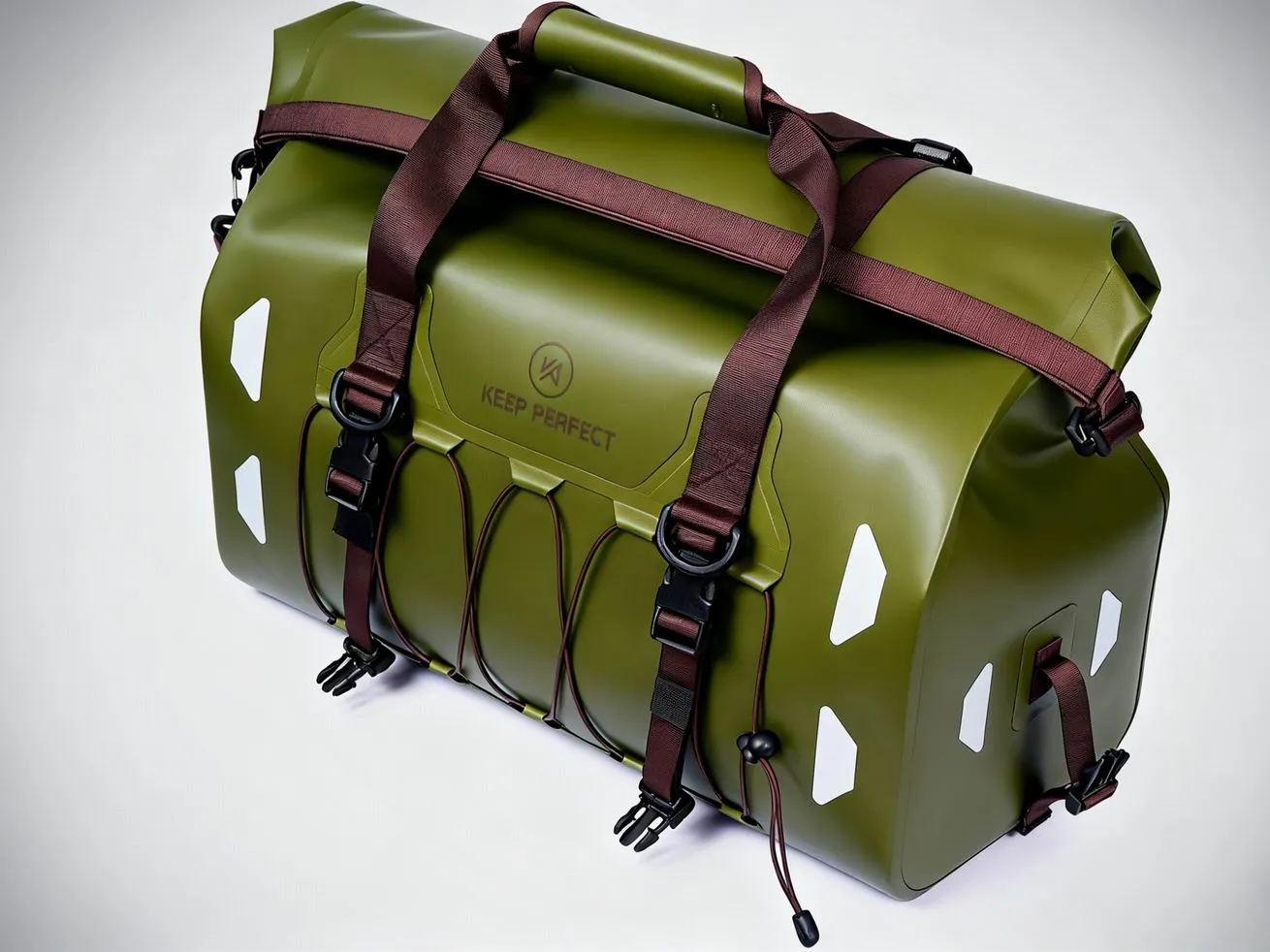
Static head is not what a river applies
Every whitewater rafting dry bags specification conversation starts in the wrong place, because every waterproof river gear marketing sheet leads with a submersion rating. Immersion testing assumes a constant, slowly varying pressure from a static head: thirty minutes at one metre, perhaps two. A river applies something structurally different. In a Class IV hydraulic the surface and the water below it move in opposite directions, a raft drops through its own hole, and a bag lashed to the frame experiences pressure pulses that rise and fall several times per second, sometimes with a genuine negative-pressure phase as the bag is pulled back out. That cycling is what flexes a closure open by a few millimetres at a time until water finds the channel.
There is also a depth question that immersion ratings quietly sidestep. A bag does not need to sink to be forced under. Pinned on the upstream face of a rock with a raft riding over it, or dragged into the trough below a drop while still attached to the boat, it can briefly see the equivalent of two to three metres of head. The load itself is survivable for most welded constructions; what is not survivable is that same load arriving as a shock while the bag is simultaneously being dragged across a bolt head.
The third distinction matters most for design. Immersion is a uniform load, spread across the whole shell, which is the easiest possible case for a welded seam. Rivers deliver point loads: a frame bolt, a rivet, a thwarts edge, a strap buckle pressed into the panel by the bag next to it. A seam that resists uniform pressure beautifully can still peel from a concentrated contact that applies thirty kilograms over twenty square millimetres.
So the honest spec frame goes alphabetically backwards from how the category is sold. Start with the mechanical environment — contact points, lash loads, tumbling, cold — confirm the closure survives the directional part, and only then check that the waterproof rating is adequate. Submersion is a hygiene factor in whitewater. Everything else decides the outcome. Background on how classes are defined is maintained by American Whitewater, whose safety material is the reference most guides work from.
Class III to Class V: what each one demands
River classification is not decoration; it predicts the load spectrum better than any product description will. Commercial operations generally run III to IV with a handful of V sections, and the mixture determines both specification and how many spares to carry. Treating every trip as Class V overbuilds the programme and inflates cost; treating every trip as Class III leaves you short the one day it matters.
| Class | What the water does to gear | Closure and construction response | Redundancy |
|---|---|---|---|
| Class III | Irregular waves to roughly one metre, spray and occasional full dunking of deck gear | Roll-top with three full rolls, welded seams, 420D minimum shell | Single bag acceptable for low-consequence items |
| Class IV | Powerful, holes and recirculation, bags fully submerged and dragged against the frame while loaded | Four rolls minimum, side-locking buckle, reinforced base panel, 500D or laminate with high abrasion face | Double-bag sleeping systems and any item that cannot get wet |
| Class V | Violent, long and demanding routes, high consequence of any loss, large drops | Same as IV plus independent secondary closure or a dry inner liner, hardware rated well above working load | Redundant from the start; assume something will be dropped and plan recovery |
| Continuous multi-day IV to V | Repeated cycles over several days with no drying opportunity between rapids | Material must tolerate wet-on-wet abrasion and not stiffen overnight at altitude | Repair kit carried on the boat, not in the car |
Note what the last row adds. Most boats on most days are fine; it is day four of a Middle Fork style trip when nothing has fully dried since day one that separates constructions. Coated fabrics that survive a single wetting can lose bond strength under sustained immersion combined with flex, particularly when the coating is a PVC formulation with plasticiser that was never qualified for multi-day saturation. The specification questions that predict this are not marketing questions: ask for adhesion after twenty-four and seventy-two hours of immersion with flex, not only dry peel strength.
The contrast with adjacent disciplines is instructive and often missed by brands selling one product into both channels. A sea kayaker optimises for spray and the occasional capsize, where the failure rarely involves sustained contact with something hard. A rafter optimises for being lashed to something rigid and heavy while water moves violently around both. Flatwater paddlesports and whitewater should therefore not share a single shell specification, even where the marketing photography looks interchangeable.
Abrasion against the frame does most of the damage
Ask a river outfitter what kills bags and the answer is rarely "water". It is contact. A bag sitting in the raft’s wells moves constantly — the boat flexes, waves lift and drop it, and the frame tub rotates slightly under load. Multiply that by eighty rapids and ten days and you have a wear machine running at a contact point nobody designed for.
The wear sequence on a coated laminate is predictable and worth knowing because it tells you where to spend money. First the face coating or film loses its surface smoothness and begins to chalk or craze. Then the coating is removed entirely over a small area. Then the base fabric underneath is exposed, which is the real failure, because the woven substrate wicks water by capillary action along its yarns even though the coating elsewhere is intact. Once the substrate is exposed and wet, abrasion accelerates dramatically because wet nylon abrades faster than dry nylon. Detailed mechanisms sit in our review of abrasion testing standards for these materials.
Three interventions work, and they are cheap relative to their effect. A sacrificial wear patch welded over the contact zone rather than stitched through it. A flat base deliberately free of hardware and seams, so the contact face has nothing to catch on. And a conscious decision about where the resting face is: many operations rig bags rotated a quarter turn each morning so the wear distributes around the shell instead of concentrating on one panel.
The remaining killer is hardware contact, specifically bag-on-bag. A buckle on one bag pressed into its neighbour under load behaves like a punch. Simple solutions — recessed buckle housings, or specifying that clips orient inward toward the roll rather than outward toward the neighbouring bag — measurably extend fleet life and cost nothing at quotation stage.
Tie-downs: everything gets attached, and bungee is not enough
An untethered bag in Class IV is lost property within about ninety seconds, and worse, it becomes a hazard for any swimmer downstream. Every item must be secured, which means every bag in the programme needs a designed load path, not a decorative loop. That load path is where most entry-level product fails.
Start with the numbers. A 20 L bag loaded with a sleeping bag and clothing weighs perhaps eight to eleven kilograms. That is static. When a raft drops into a hole, the acceleration a deck-mounted item experiences commonly multiplies that by four to six, so the effective transient load on the anchor point is forty to sixty kilograms — repeatedly, in a direction that changes every cycle. A webbing loop held by twelve stitches into a single layer of 420D can fail well below that, and when it fails you lose both the bag and whatever is downstream of it.
| Anchor design | Typical failure load | Where it belongs | Comment |
|---|---|---|---|
| Stitched loop, single layer, no reinforcement | Often 20 to 35 kg | Nowhere on whitewater | Common on promotional-grade product; adequate for a day pack, inadequate here |
| Webbing loop bar-tacked into doubled fabric | Roughly 60 to 90 kg | Light personal bags, Class III | Acceptable where the item is small and consequence low |
| Welded-on patch with load-spreader, minimum 60 mm engagement | Commonly 120 to 200 kg | All lash points on Class IV to V fleet bags | Load spreads into the panel instead of concentrating at a seam |
| Through-frame strap with cam buckle, bag compressed by the strap | Limited by strap rather than bag | Heavy group gear, kitchen and fire-pan cases | The right answer for anything over about 15 kg |
Two further points save real money. First, use rigid containment rather than elastic for anything heavy: bungee stretches, which lets a loaded bag migrate until it is resting against something it can abrade against or, worse, until it swings outboard on a drop. Cam straps in 25 mm polyester webbing hold position and can be tensioned visibly, which also makes the morning rig check take seconds. Second, keep the straps in the programme rather than buying them separately; hardware selection interacts with closure geometry, and mismatched third-party hardware is a recurring source of field complaints attributed to the bag.
Roll direction: orienting the closure against the flow
This is the single piece of technique most often wrong in the field, and it is a physics problem rather than a habits problem. A roll-top has a direction. Rolled one way the outer layer laps downward over the fold like a shingle, so water running down the outside sheds away. Rolled the other way, the fold presents an upward-facing pocket that collects whatever washes over it and holds it in contact with the seal line for the whole rapid. The closure “works” in the sense that it passes a bucket test, then admits water under a sustained shower.
Orientation on the boat follows the same logic plus one more factor. Water flowing past a moving raft applies pressure to anything protruding. If the rolled lip faces upstream, that pressure acts on the leading edge of the roll and tends to lift it, working against the roll’s own tension. Rotate the closure away from the bow — downstream, or inboard against the frame where the neighbouring structure shields it — and the same flow presses the lap shut. Guides learning rigging for the first time usually have this explained once and never forget it, because the difference shows up immediately in a wet camp.
- Roll away from you and downward so the outer lap sheds water rather than scooping it.
- Four full rolls for Class IV and above; three is a Class III minimum, not a general rule.
- Keep every roll even across the full width — a diagonal roll leaves a channel at the shallow end.
- Leave at least 100 to 150 mm of free neck above the contents; insufficient roll length is the most common field failure.
- Clip through the side tabs so the buckle locks the roll against unwinding, rather than clipping over the top where vibration can loosen it.
- Wipe sand and grit off the closure faces before rolling; a single grain held across the seal line is a leak path.
That last line deserves its own emphasis because it is where technique meets lifespan. Grit embedded between the rolled layers acts as a cutting agent every time the bag flexes, and it abrades the film exactly where the seal depends on being smooth. River sand is quartz; it is harder than every coating used in this category. The full mechanics of seal geometry are set out in our page on roll-top closure design, which covers the failure modes of sheet tension and roll count in more depth.
Air management: buoyancy, burst and the kite effect
Air inside a dry bag is free buoyancy and also stored energy. Both properties are useful and both cause failures. Get this wrong and either your bag bursts at the weld when something heavy lands on it or it behaves like a sail on a windy desert stretch until it tears free of its lash.
The burst case is the one people underestimate. A bag rolled shut with perhaps thirty litres of air inside at ambient pressure becomes considerably stiffer, and its internal pressure rises further when the shell is compressed or warmed. Set that bag on a raft frame in afternoon sun at altitude and internal temperature can climb forty degrees above morning ambient, adding meaningful pressure on top. Then someone kneels on it. The failure is almost always at a weld corner rather than mid-panel, because that is where stress concentrates, and it presents as a split rather than a gradual leak.
The practical rule for fleet bags is to separate two intents. Bags meant to float if they go overboard — personal items, anything containing a camera — should retain roughly twenty to thirty per cent air and should ideally carry a purge valve so trapped air can be expressed before the final roll. Bags lashed permanently to the frame should be compressed: roll the top, then press the air out through the partially open closure before closing the last roll. A compact bag does not migrate, does not catch wind, and occupies less frame space. That distinction, written into a standard operating procedure, removes an entire category of loss.
If you are specifying valves, note the trade-offs rather than assuming a valve is an upgrade: they add a component that can be knocked open, they need a maintenance step in the off-season, and they are another item to stock spares for. Our dedicated discussion of purge and air-release valves covers when they pay for themselves; for rental fleets they usually do, because guests will never reliably express air manually.
Cold water changes the material, not just the passenger
Rivers are cold for most of the season and the water temperature is not incidental to material behaviour. Coated fabrics stiffen as temperature drops, and the effect is not linear or uniform across chemistries. PVC-coated polyester loses noticeable flexibility well above freezing; some formulations become visibly boardy below about five degrees Celsius. Thermoplastic polyurethane laminates generally retain useful flexibility to minus twenty or below, though specific grades vary enough that the datasheet matters more than the generic claim.
Why stiffness matters mechanically: a stiff shell cannot be rolled tightly. The closure the guest forms at six degrees is a looser roll with less line pressure on the seal, and looser rolls leak earlier. Worse, repeated folding of a stiffened film at the same crease line produces crazing, then cracking, then a line of holes along exactly the panel that does the sealing work.
The other half of the cycle is heat, and fleets experience both within one day. A dark bag on a frame in an August afternoon measured at sixty to seventy degrees Celsius is not unusual, and sustained exposure at that range accelerates plasticiser migration in flexible PVC, which is precisely what made the material supple in the first place. So the realistic duty cycle for a river bag is not “cold” or “hot” but alternating, and qualification should reflect that. Our analysis of low- and high-temperature behaviour gives the figures to specify against, including the glass transition ranges worth asking about.
There is also a straightforward colour decision hiding here. Light colours run cooler and hide less dirt; dark colours look better after week two and run hotter. Fleet operators almost always choose mid-tone with high-visibility panels, and then manage appearance by washing rather than by pretending dark hides everything. Our note on colour fastness is relevant for anyone promising a brand colour that has to survive forty river days.
Capacity matrix against real frame space
Volume in litres is easy to print and hard to use. What matters on a raft is how many bags of which shape fit into available frame space, how they share it with the cooler, the fire pan, the water jug and the groover, and how the whole assembly behaves when the boat folds through a wave. Sizing per person is downstream of that.
A practical allocation for a six-day trip with six clients and two guides on a fourteen-foot boat illustrates the arithmetic. Two large group bags of roughly 55 to 70 litres carry kitchen and shared equipment. Each client gets a 20 to 30 litre personal bag plus a small day bag of 8 to 12 litres kept accessible. The crew typically rigs one or two portage-friendly bags that can double as carry bags when the raft is lined or unloaded our vehicles. Everything rides inside the frame perimeter or is strapped down within it, because anything outside that footprint is the first thing lost.
| Role | Recommended volume | Units per trip (8 people, 6 days) | Construction priority |
|---|---|---|---|
| Client personal bag | 20 to 30 L | 6 | Roll-top, welded, resists its own contents compressing it |
| Client day bag | 8 to 12 L | 6 | Shoulder carry, accessible while seated on the tube |
| Group kitchen | 55 to 70 L | 2 | Heavy-duty shell, flat base, two lash points |
| Safety and first aid | 10 L, high-visibility | 1 | Colour-coded, instant identification, never buried |
| Crew personal | 30 to 40 L | 2 | Same as client, different colourway |
| Repair and spares | 5 L | 1 | Contents matter more than the bag |
The commercial insight for a brand building this matrix is that it is a merchandising story as much as a technical one. Six units of one size and two of another amount to one purchase decision rather than eight, and colour-coding by role makes the whole system teachable in ninety seconds at the put-in. The enabling constraint is that the volume tiers should share a platform: same body construction, same closure hardware, different heights. That keeps the sewing and welding setup common across the tier while presenting three distinct price points, and it is far friendlier to a minimum order quantity of 500 pieces per style than three unrelated constructions would be.
Failure modes rental fleets actually report
Fleet operators are the most useful source of failure data in this category because they run high hours, they see every failure mode within two seasons, and they have no emotional attachment to any particular product. Their reported causes cluster tightly, and the ranking is consistent across operations.
| Reported symptom | Underlying mechanism | Detection | Design response |
|---|---|---|---|
| Pinhole leak in the lower third | Puncture or abrasion through the film at a frame contact point | Pressurise and soap-test, or inflate overnight and check for loss | Welded sacrificial patch on the resting face; keep buckles off it |
| Wet contents with no visible hole | Roll too loose, or rolled toward the flow so water pooled in the fold | Bucket test plus a field rig check before every launch | Train roll direction; insist on four rolls; side-locking buckle |
| Split at a weld corner | Burst from internal air pressure plus external impact load | Visible split, usually near a corner radius | Compress before closing; increase corner radius; specify seam peel after aging |
| Buckle cracked, bag opened | Impact fracture of the plastic in cold water | Usually discovered after the bag is already open | Specify a colder-service polymer; carry spare buckles on every boat |
| Seam peel starting at the closure corner | Peel load concentrated where the roll pulls against the top seam | Peel test on retired units; visible lift before failure | Reinforce the top seam line; redistribute load into the panel |
| Whole bag missing | Tether failure or bag never lashed | Theft is rarely the explanation | Welded load-spreader anchor; mandatory guest rig check |
Two aggregate numbers help with planning. A well-specified river bag in commercial service typically delivers two to four seasons before retirement, corresponding broadly to sixty to one hundred and twenty river days, and fleets budget roughly eight to twelve per cent annual replacement against their standing inventory. Below those figures the cause is usually specification rather than luck; above them, it is usually a rigging standard enforced every morning rather than a superior product.
Retired units are worth more than most operations treat them as. Cutting open a dozen retired bags each season and recording where they failed produces a specification loop that no amount of lab testing replaces, and it costs one afternoon. Our wider note on reading return and failure data explains how to turn that into numbers a supplier can act on.
Tests worth asking for beyond submersion
Submersion certification is necessary and nearly useless on its own. The useful tests are the ones that combine loads, because real failure is almost always a combination, and any supplier with genuine experience in this category will recognise the list immediately.
- Submersion followed immediately by agitation: thirty minutes under water with the bag rolled and lightly loaded, then ten minutes of tumbling on a hard surface, then a leak check. Still water followed by nothing is not a test.
- Static anchor pull: apply roughly five times the expected working load to the lash point for sixty seconds and record whether failure occurs in the anchor, the panel, or the strap.
- Abrasion after ultraviolet exposure, not before: condition the shell to the equivalent of a season of sun, then run the abrasion protocol. Fresh material behaves differently from aged material in a way single tests conceal.
- Cold drop: charge the unit at a realistic loading, hold at minus five degrees for four hours, drop one metre onto concrete, inspect welds.
- Seam peel strength dry, after twenty-four hours immersion, and after seventy-two hours immersion with flex. The delta between those three numbers predicts multi-day performance better than any single figure.
Where a third-party report is needed, standard methods published by ISO cover most of these either directly or by adaptation, and independent laboratories referenced in our guide to third-party testing will combine protocols when asked. Combining is the point: any competent factory can pass each test individually, and the combination is what separates construction that survives a season from construction that survives a single afternoon.
PVC or TPU on the river
The choice is less about absolute quality than about where you want your risk. PVC-coated polyester is cheaper, extremely tough against puncture and abrasion, easy to field-repair with solvent cement, and heavier, and it stiffens in cold and slowly loses plasticiser under heat. TPU laminate is lighter, stays flexible across a much wider temperature range, costs more, and repairs less forgivingly in the field.
For a desert operation running warm water and long seasons, heat resistance and UV behaviour move up the list and PVC’s plasticiser migration becomes the governing limit. For spring snowmelt, high country and shoulder seasons, flexibility at low temperature governs and TPU earns its premium quickly. Many experienced fleets run both: coated product for the heavy group gear that never needs tight rolling, laminate for the personal bags where the guest’s own hands form the closure.
Denier and weave then set the mechanical life. Base fabrics in the 420 to 1000 denier range cover the category, and the textile decisions covered in our comparison of TPU against PVC constructions and our note on denier and durability apply directly, with one river-specific amendment: because almost every contact is wet and abrasive, base fabric strength matters more relative to coating hardness than it does in dry-use categories. A weaker base cloth under a harder finish gives up little here and fails earlier.
Finally, think about repairability as an explicit line item rather than an afterthought. Ask which repair method the construction supports, what patch material is needed, whether field repairs require heat or only pressure, and how many seasons the patch itself is expected to last. A bag that cannot be repaired in a camp becomes rubbish on the second puncture, and the most sophisticated laminate in the world does not survive that economics.
How an outfitter structures the fleet order
Here is where the technical specification becomes a commercial one, because the same analysis determines both what gets bought and how it is bought. An outfitter does not want forty different products; they want a small number of tiers that cover every job, share hardware, and can be reordered without a redesign conversation every season.
The pattern that works is a three-step capacity matrix on a single platform: one body construction, one closure family, three heights, and colour-coding that maps to role rather than to decoration. Add one repair SKU per closure hardware type. That structure covers a whole operation with maybe four styles, which matters because each style is a separate 500-piece minimum. Splitting a fleet across nine styles multiplies the minimum commitment nine ways and leaves the operation with nine partial inventories.
Branding then has to be specified for the environment, not for a photograph. A print placed on the panel that rests against the frame will be gone by season’s end regardless of ink quality, because it is being sanded off. Options that last: welded-on badges in a low-abrasion zone, transfer prints protected by a clear film, or embroidery patches applied over a reinforcing panel that is already doubled. Our guide to logo methods and their durability maps which processes survive abrasion and which merely look even at handover.
Spares deserve a line on the purchase order rather than a hope. Buckles, purge valve bodies and any removable strap should be ordered at roughly five to ten per cent of fleet count at the original order, because hardware suppliers change tooling quietly and discovering this in year three means retrofitting every bag. The same logic applies to repair patch material, which is cheapest when ordered with the original production run.
And plan the reorder cycle against the season, not against running out. Guidance on minimum quantities and production slots applies particularly here, because a fleet discovered to be short in May cannot be resupplied in June. The operations that never have this problem order against a fixed calendar, in the autumn, for the following spring.
Writing the purchase specification
All of the above compresses into a specification that fits on one page and can be quoted without a meeting. Ten lines, each of which removes a category of argument later: shell material and denier stated as a standard or a sample reference; seam construction method and required peel strength with the test age stated; closure type, roll count the geometry supports, and buckle polymer with a stated low-temperature service figure; lash anchor design and test load; number and placement of wear patches; colour and any reflectivity; logo method and placement; hardware spare quantities; the repair method the construction supports; and the acceptance tests, including at least one combined protocol rather than submersion alone.
Then ask the supplier to price two versions: one built to your written specification and one built to whatever they consider equivalent. Where the prices differ, that difference is the map of where your assumptions diverge from theirs, and discussing that map is more useful than negotiating either number. A supplier who cannot explain their own substitutions in mechanical terms is pricing a commodity, not engineering a product for Class IV.
Finally, specify how failures will be judged. Agreeing before the order that retired units will be cut open annually and that the findings will be shared changes the character of every subsequent conversation, because both sides then have evidence rather than opinion. It also makes the second-year order better than the first, which is the actual goal of the exercise.
If you are building or refreshing a whitewater programme and want those ten lines answered against your own boats, send us river class, season length, fleet size and current failure history. Minimum order quantity is 500 pieces per style, samples take 6–10 working days, bulk production runs 35–50 days, and quotations are issued FOB Xiamen.
Frequently Asked Questions
Q1. How many rolls should a whitewater dry bag closure have?
Three is the minimum acceptable for Class III and four for Class IV and above. The count matters less than each roll being full width and even, because a diagonal roll leaves a channel at its shallow end regardless of how many times it was folded.
Q2. Which way should a roll-top face on a raft?
Away from the bow. Water flowing past the moving boat presses on anything protruding, and if that pressure acts on the leading edge of the roll it tends to lift the lip and open the seal. Facing downstream or inboard presses the lap shut instead.
Q3. Why did my bag leak with no visible hole?
Most often the roll was too loose or too short, or it was rolled so water pooled in the fold rather than shedding off it. Insufficient free neck height above the contents is the most common cause, because there is simply not enough material left to make four proper rolls.
Q4. Should I leave air in the bag for buoyancy?
It depends on intent. Bags meant to float if lost should keep roughly twenty to thirty per cent air and ideally have a purge valve. Bags lashed to the frame should be compressed, because trapped air makes them shift, catch wind and occasionally burst at a weld corner when something lands on them.
Q5. Is IPX7 enough for whitewater?
It is necessary and not sufficient. Immersion ratings test a constant head in still water. Rivers deliver pressure pulses, point loading against frame hardware and drag while submerged, none of which an immersion certificate addresses.
Q6. What canvas load should a lash point withstand?
Design for the transient, not the static, figure. A twenty litre bag weighing ten kilograms can see four to six times that under acceleration in a drop, so specify anchors tested around one hundred and fifty kilograms rather than around twenty-five.
Q7. Are bungee cords adequate for tying bags down?
For light items, yes. For anything heavy, no, because elastic stretches and lets a loaded bag migrate until it rests against something abrasive or swings outboard. Use twenty-five millimetre cam straps for heavy group gear.
Q8. Do PVC bags really stiffen in cold water?
Many formulations become visibly boardy below about five degrees Celsius. The consequence is practical: a stiffened shell cannot be rolled tightly, so the seal formed at low temperature has less line pressure and leaks earlier.
Q9. How long should a rental fleet bag last?
Two to four seasons in commercial service, broadly sixty to one hundred and twenty river days, with fleets budgeting eight to twelve per cent annual replacement. Falling short of that usually indicates a specification problem rather than bad luck.
Q10. Which failure should I expect first?
In most fleets, abrasion or puncture at a frame contact point, reported as a pinhole leak in the lower third. Water ingress through the closure is second and is usually attributable to technique rather than to the product.
Q11. Is TPU worth the premium for whitewater?
It earns it in cold conditions and anywhere the guest forms the closure with cold hands, because it stays flexible to far lower temperatures. For warm-water operations with heavy group gear that never needs tight rolling, coated product often represents better value.
Q12. Where should the logo go on a river bag?
Anywhere that does not contact the frame. Print placed on the resting panel is abraded off within a season regardless of ink quality. Welded badges or patches applied over an already-reinforced zone survive far longer.
Q13. How do I know whether a seam will survive multi-day immersion?
Ask for peel strength measured dry, after twenty-four hours immersed, and after seventy-two hours immersed with flex. The trend between those three numbers is more informative than any single value, because coatings differ most under sustained saturation.
Q14. What should a safety or first-aid bag look like?
Small, unmistakably colour-coded, always in the same place, and never buried beneath other gear. In an emergency nobody searches; they grab. High-visibility panels beat any labelling system at distance.
Q15. Can I repair these bags in the field?
Coated fabrics generally repair well with solvent cement and patch material. Laminates are more demanding and some need heat as well as pressure. Decide the repair method during specification, because a bag that cannot be patched at camp is finished at its second puncture.
Q16. How many different sizes does a fleet really need?
Usually three tiers on one platform, colour-coded by role. More styles than that multiply minimum order commitments and fragment the spare parts inventory without improving anything operationally.
Q17. When should a seasonal operation place its reorder?
Against a fixed calendar rather than against running short. For a northern-hemisphere season, ordering in the preceding autumn is standard, because a fleet discovered to be short in May cannot realistically be resupplied in June.
People Also Ask
What size dry bag do I need for whitewater rafting?
Twenty to thirty litres for personal gear on a multi-day trip, plus eight to twelve litres for a day bag. Group equipment rides in fifty-five to seventy litre bags shared across the boat.
Are dry bags really waterproof in rapids?
Yes when rolled and oriented correctly, but they are not designed to be held underwater under pressure. Constant or forced submersion can let water in through the closure over time.
How tight should I roll a dry bag?
Tight enough that the layers grip each other, at least three full rolls for Class III and four above that. A roll made loosely allows the layers to shift and open a channel.
Why do rental bags fail so fast?
High hours combined with constant frame contact and closures formed by untrained guests. Abrasion at the resting face and loose rolls account for the majority of retirements.
What is the difference between a dry bag and a waterproof bag?
A dry bag is built to be rolled shut and tolerate temporary immersion. General waterproof bags resist spray and rain but many are not designed to survive prolonged or pressurised submersion.
Should a dry bag float if it falls in the river?
It should be specified to, meaning enough retained air and a shell that does not absorb. Whether it actually floats depends on how much air is trapped when the closure is formed.