The mistake travellers make about a Southeast Asian monsoon is measuring it as rain. It is not primarily a rain problem; it is a drying problem. Between May and October across much of the region, relative humidity sits between 75 and 95 per cent, downpours deliver 30 to 60 millimetres an hour for twenty to ninety minutes, and then the sun comes out and bakes whatever is wet at high ultraviolet load. A bag in that cycle never reaches dryness, and the failure that ends a trip is almost never the downpour — it is mould at the forty-eight hour mark, a coating that hydrolysed in storage, or a zip seized by grit.
So this guide is organised around moisture over time rather than water at a moment. It covers the real intensity of a monsoon downpour, when to choose waterproof and when to choose quick-dry, motorbike and tuk-tuk exposure, mud and grit in closures, the mould clock, hydrolysis of coatings in hot humid storage, drainage and desiccant strategy, airport security with a wet bag, the deliberate soaking of Songkran, a packing plan by itinerary type, and what a brand should specify for monsoon markets. MOQ 500 pieces per style, sampling in 6–10 working days, bulk in 35–50 days, FOB Xiamen: these are the working terms at QUANZHOU JUNYUAN BAGS, custom waterproof bag production since 2014 in a 4,950 m² SGS-verified facility.
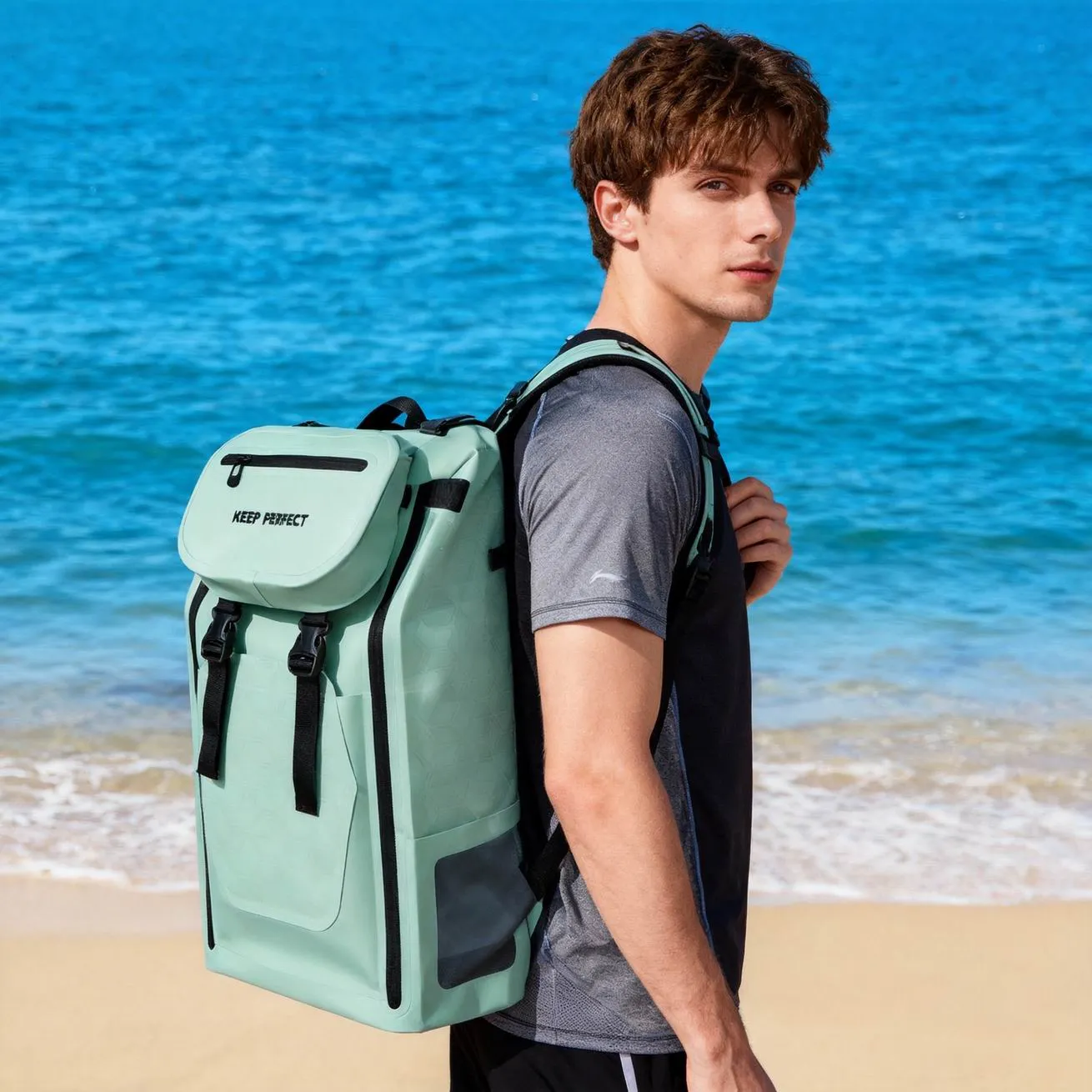
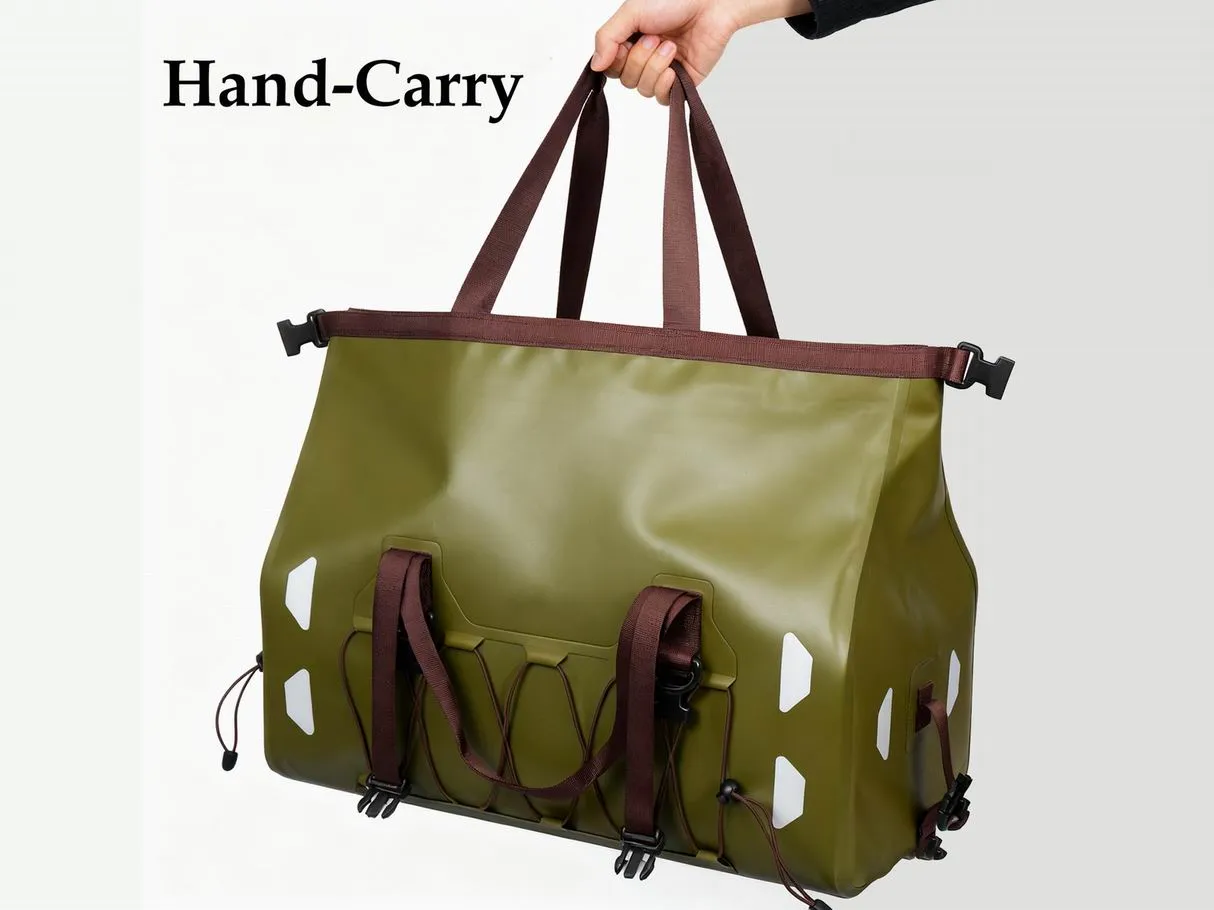
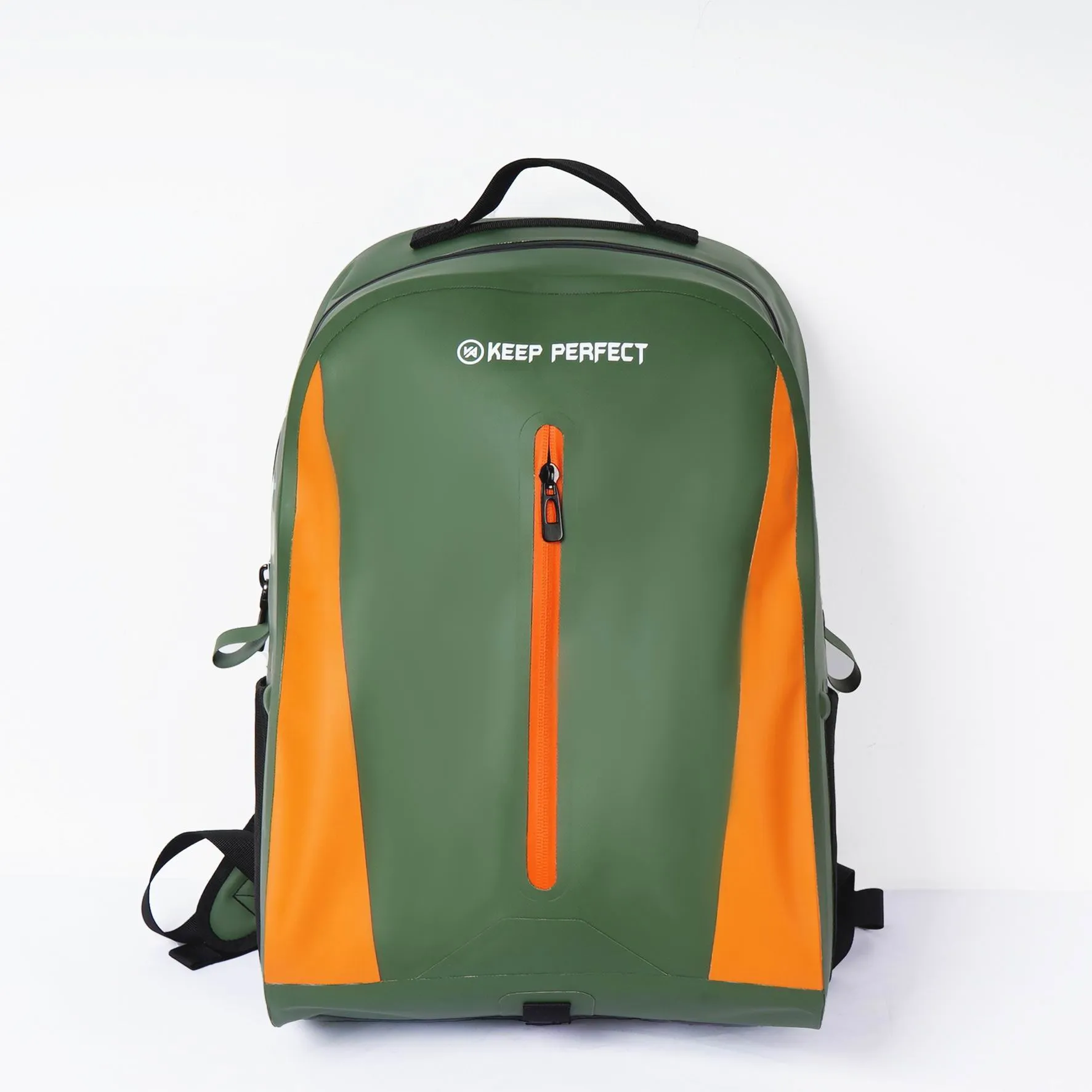
In a monsoon the bag never dries, and that is what destroys gear
Most travellers arrive with a bag selected against a waterproof rating and discover within four days that the rating was answering the wrong question. A monsoon itinerary does not test whether water can get in during an hour of rain; it tests whether the bag can shed water fast enough and dry quickly enough that the next downpour does not start from a wet baseline. Good monsoon travel waterproof bags are specified for drainage, drying speed and mould resistance in that order, and a bag that is fully sealed but slow to dry often performs worse than one that lets water in and out quickly. That is the central inversion of the whole southeast asia rainy season packing problem.
The arithmetic is unforgiving. Fabric that starts a day at 60 per cent moisture content because it never dried overnight has far less capacity to absorb the next event, so it wets through faster, and the interior humidity stays near saturation continuously. Electronics fog, paper softens, and anything organic — cotton, leather, some adhesives — begins to degrade. The bag is not failing at a seam; it is failing as a system that was never designed for a month of permanent dampness.
That reframing has a practical consequence worth stating up front: the most valuable items on a monsoon trip are often not a better bag but a drying habit and a smaller wardrobe of quick-dry clothing. The bag decision follows from the drying plan rather than the other way round.
The real intensity of a Southeast Asian downpour
Travellers from temperate climates systematically underestimate tropical rainfall because their reference frame is wrong. Temperate rain is often two to five millimetres an hour over many hours. A tropical convective downpour is a different physical event: intense, short, warm, and frequently accompanied by wind that drives water horizontally. Classifications and measurement conventions for these events are published by the World Meteorological Organization, and the practical numbers below are what a traveller actually experiences.
| Event | Intensity and duration | What it does to a bag | Response that works |
|---|---|---|---|
| Pre-storm build, darkening | 10 to 20 minutes of rising wind | Nothing yet; the warning to cover up | Put the dry bag on now, not when it starts |
| Convective downpour | 30 to 60 mm per hour, 20 to 90 minutes | DWR exhausts; face fabric wets out in 5 to 15 minutes | Seek cover; a roll-top beats an umbrella in wind |
| Intense cell or squall line | 60 to 100 mm per hour in bursts | Any exposed closure takes water; bags set down fill pockets | Keep the bag on your back; never set it down |
| Post-storm sun | High UV within 30 minutes | Rapid surface drying but sustained UV load on coating | Air the bag open; UV is the coating’s long-term enemy |
| All-day rain, monsoon trough | 10 to 20 mm per hour for 8 to 14 hours | Prolonged wetting; the bag never recovers | Assume saturation; protect only the critical layer |
| Street flooding after heavy rain | Knee-deep standing water in minutes | Immersion of the bag base; contaminated water | Carry the bag high; treat it as contaminated afterwards |
Two rows deserve emphasis. Fabric wets out in five to fifteen minutes in a genuine downpour regardless of the shop finish, because a durable water repellent treatment is a surface property that is overwhelmed by volume and then by abrasion; see our explanation of DWR, PU and silicone coatings. And the post-storm sun is not a favour: it dries the surface while loading the coating with ultraviolet, which over a season is a larger cause of coating failure than the rain itself. Our page on UV resistance in bag materials covers that mechanism.
Flooding adds a contamination dimension that most packing advice ignores. Standing water in an Asian city after a storm is not clean water; it carries road residue and sewage. Anything immersed should be rinsed with fresh water and dried as soon as possible, and the traveller should assume a health dimension as well — the US CDC travel health pages cover the infections associated with floodwater exposure in the region.
Waterproof or quick-dry: choose per item, not per bag
The most useful decision in a monsoon is not which bag to buy but which items deserve a sealed container and which deserve to get wet and dry quickly. Sealing an item that will inevitably become damp is worse than not sealing it, because a sealed damp environment at 30 degrees is exactly where mould establishes. Items that must stay dry get welded protection; items that will get wet anyway get quick-dry treatment and air.
| Item | What actually happens to it | Waterproof or quick-dry | Why |
|---|---|---|---|
| Passport and documents | Softens and becomes unusable | Waterproof, rigid sleeve plus a dry bag | No recovery possible on the road |
| Phone and power bank | Corrosion at ports, fogging under glass | Waterproof pouch with touchscreen operation | A pouch that must be opened will be opened in the rain |
| Camera and lenses | Fungus on glass within weeks | Dry bag with desiccant, opened weekly | Sealing without desiccant traps moisture against the glass |
| Cotton clothing | Stays wet 8 to 12 hours, then smells | Neither — do not bring it | Cotton is the wrong fibre for this climate |
| Quick-dry shirts and underwear | Wet in minutes, dry in one to two hours | Quick-dry, no sealing | Sealing defeats the entire advantage |
| Towel | Never dries; becomes the moisture source | Quick-dry microfibre, wrung and aired | A damp towel sealed in a bag is how mould starts |
| Shoes | Soaked, then must dry overnight | Quick-dry sandals plus one pair of drainable shoes | Sealed wet shoes do not dry; they rot |
| Toiletries and medication | Packaging degrades, tablets spoil | Waterproof, sealed | Silica gel in the same pouch |
The pattern in that table is that only irreplaceable or moisture-sensitive items earn a sealed container, and everything else is optimised for drying speed. This is the opposite of the instinct most travellers arrive with, which is to seal everything. Sealing everything in a monsoon produces a bag that is waterproof and mouldy, which is a worse outcome than a bag that is damp and airing.
For the construction side of that decision, the trade-offs are set out in our guide to choosing the right waterproof level and the rating itself under hydrostatic head explained. The short version is that in this climate the seam construction and the drying behaviour matter more than the fabric number, which is why seam sealing method is a more useful question than the printed rating.
Motorbike, tuk-tuk and songthaew: exposure nobody rates a bag for
The single most underrated water event in Southeast Asia is not the rain itself but the twenty to forty minute ride through it. On the back of a motorbike taxi, or in an open-sided tuk-tuk or songthaew, the traveller is moving at 30 to 60 kilometres per hour through water that is being thrown up by other vehicles, running off road surfaces and driven sideways by the wind of your own motion. The bag on your back or on your lap receives a continuous directional spray at pressure, for far longer than any standing-in-the-rain test.
- Wear the bag on your back rather than carrying it on your lap; a bag on a lap collects water in any front pocket and cannot shed it.
- Put the bag on a plastic liner or a dry bag cover before the ride, not after the first minute of spray.
- Keep the closure facing your back. An outward-facing zip on a moving vehicle is a scoop.
- Assume the ride will be longer than quoted. Twenty minutes of spray wets out more fabric than ten minutes of standing rain.
- Secure loose straps before moving; a dangling strap wicks water into the bag along its whole length by capillary action.
Capillary wicking along a strap is worth understanding because it explains a very common complaint: a bag that was never submerged but whose interior is wet along one edge. Water travels along the webbing and enters at the stitch line where the strap is attached, bypassing the closure entirely. The design response is a strap attachment that is sealed or at least bar-tacked away from the interior, and a habit of tucking straps in before a ride.
For ferry and longtail transfers the exposure changes shape rather than intensity: spray from the bow, deck water, and the wade from the beach to the boat. The same principles apply, and our dedicated page on island hopping and boat tours covers that scenario in more detail.
Mud, grit and the closure that stops working
Monsoon streets produce a fine abrasive slurry of soil, sand and road residue. It gets onto the bag during any wade, any flooded street and any roadside stop, and it finds its way into zip coils and buckle channels where it acts as a grinding compound. A zip that has been operated a few dozen times with grit inside it develops measurable play and begins to weep, and unlike a clean-water leak this one does not stop when the rain does.
- Rinse the closure with fresh water at the end of every day that involved flooding or a wade; it takes thirty seconds.
- Open and close the zip a few times while rinsing, so water actually flushes the coil rather than wetting the outside.
- Prefer a covered or garaged zip on any bag used in this region; an exposed coil is a grit collector.
- Carry a small soft brush. Dried mud inside a slider will not come out with water alone.
- If a slider becomes stiff, stop forcing it. A forced slider permanently damages the coil and cannot be repaired on the road.
This is also the argument for an inner dry bag as the primary protection rather than the outer closure. The outer bag gets grit in its zip and becomes less reliable over the trip; the inner roll-top dry bag is opened less often and rinsed more easily, so it stays reliable throughout. The layered approach is standard in kayaking for the same reason, and the sizing logic is the same as in our dry bag sizing guide.
Mould, mildew and the forty-eight hour clock
Mould is the failure that actually ends monsoon trips, and it runs on a predictable clock. Given a surface film of moisture, an organic substrate such as cotton, dust or skin residue, and temperatures between 25 and 32 degrees, visible mould can appear within twenty-four to forty-eight hours. Odour usually precedes it by about a day, which makes smell the early warning and means that a bag that smells is a bag that is already colonised.
The substrate matters more than people realise. Mould needs something to eat, and a clean welded TPU surface offers far less than a fabric liner holding dust and fibre. That is one reason welded liners outperform fabric ones in this climate even at similar waterproof performance, and it is the practical case for specifying antimicrobial treatment on anything sold into humid markets.
- Air the bag fully open for an hour every day, ideally in moving air rather than in a closed hotel room.
- Never store anything damp overnight in a sealed compartment; if it must be sealed, add fresh silica gel.
- Wipe liners with a mild surfactant every three or four days to remove the film mould feeds on.
- Treat smell as the alarm, not the problem. A bag that smells needs drying and cleaning that day.
- Choose welded liners and quick-dry clothing over cotton; both remove the substrate rather than treating the symptom.
The material-side measures are covered in our pages on antimicrobial treatments and temperature and humidity testing. For the traveller, the single habit that matters most is daily airing, because every other measure is fighting a battle that daily drying would have prevented.
Hydrolysis: why coated bags fail between trips in this climate
Here is a failure mode almost nobody warns travellers about, and it is the one that produces the classic complaint of a bag that was fine last year and is sticky or flaking this year. Polyurethane coatings and some thermoplastic polyurethane films are susceptible to hydrolysis — chemical breakdown by water vapour — and the rate rises steeply with both temperature and humidity. A bag stored for eight months in a non-air-conditioned room at 30 degrees and 85 per cent relative humidity can degrade more than one stored for five years in a temperate climate.
The symptoms are unmistakable once known: a coating that has gone tacky or sticky to the touch, a surface that powders when rubbed, a smell often described as sour or like old plastic, and finally flaking that exposes the base fabric. It is not repairable, because the polymer itself has broken down rather than the surface being dirty. It is also the reason a bag bought cheaply before one long trip and stored afterwards often fails on the second trip.
Two practical conclusions. Store bags dry and cool between trips — airtight storage with desiccant is worth it in this region, and the bag should be genuinely dry before it goes in. And when buying, treat material choice as a durability decision rather than a price decision: some coatings and films are markedly more hydrolysis-resistant than others, which is set out in our comparison of TPU and PVC materials and in the testing discussion under accelerated ageing and durability prediction.
Desiccant, drainage and drying on a wet-season itinerary
Desiccant behaves differently at 85 per cent relative humidity than travellers expect. Silica gel saturates in hours rather than weeks in this climate, and a sachet that has been open in a bag for two days is doing nothing at all. That leads to two rules: use more than the packet suggests by a factor of two or three, and regenerate it rather than trusting it.
- Dry silica sachets on a hot surface or in a low oven for an hour to regenerate them; colour-indicating gel tells you when it is spent.
- Use roughly double the sachet count you would use in a temperate climate, and check them every two days.
- Choose a bag with drainage grommets at the base of external pockets, so water leaves instead of pooling.
- Air the bag in moving air, not in a closed room; a fan turns a twelve hour dry into a two hour dry.
- Wring and air a microfibre towel every evening. It is usually the largest single moisture source in the bag.
- Accept a wet outer shell and protect only the critical layer. Fighting saturation of the outer bag is a losing battle.
Drainage deserves a specific note because it is the cheapest feature that genuinely helps. A pocket with a grommet at its base empties itself; the same pocket without one holds water against the seam for hours and becomes the wick that carries moisture inward. When comparing two otherwise similar bags in this climate, the one with drainable pockets will keep the interior drier over a week than the one with a marginally higher fabric rating.
Ventilation is the companion feature. A ventilated mesh panel lets damp items dry rather than marinate, and combined with a wet-dry separation layout it is the closest thing to a structural answer to a monsoon. Fully sealed construction without either feature is the wrong specification here, however impressive its rating.
Airport security, wet bags and the flight home
The flight home is where a monsoon trip tends to produce its last failure. Bags go onto a conveyor wet, sometimes very wet, and a wet bag in an aircraft hold is a bag in a sealed, cool, humid environment for several hours — after which it is collected and often put straight into a car and then a cupboard. The mould clock starts at the aircraft door.
Practical handling: wring and towel-dry everything the night before, pack damp items in breathable mesh rather than sealed plastic, and if the bag must travel wet, dry it fully within hours of arriving home rather than the next day. At security, a wet bag with wet electronics inside is a common cause of additional screening, so keeping devices in one accessible dry pouch speeds the process and reduces the exposure.
There is also a weight dimension. Wet fabric is heavy: a 40 litre bag that has absorbed a litre of water carries an extra kilogram, and a set of wet towels adds more. On a carrier with a 7 kilogram cabin allowance, drying the bag before the airport can be the difference between compliance and a gate charge.
Songkran and the deliberate soaking
The Thai New Year water festival, and its equivalents across the region, invert the entire problem: the soaking is deliberate, total, and repeated over several days, and everybody participates. No travel bag survives it, and none is meant to. What matters is that the contents that cannot be replaced are never in the bag at all.
- Carry phone, passport and cash in a submersible pouch on the person, rated and tested rather than assumed.
- Leave the main bag at the accommodation. Anything you carry will be soaked within minutes and probably iced.
- If you must carry a camera, use a purpose-built housing or a dry bag with a proven seal; a plastic bag is not a plan.
- Assume water is not clean. Rinse everything afterwards and treat any cut or abrasion seriously afterwards.
- Expect coloured dye in the water in some cities; it stains light-coloured fabric permanently.
The pouch question is worth taking seriously because it is where most people lose a phone. A pouch that must be opened to operate the screen will be opened, in the street, by wet hands, surrounded by people throwing water. Touchscreen operability through the film is therefore the primary specification, ahead of the depth rating; see our overview of waterproof phone and electronics pouches for what to check.
A wet-season packing plan by itinerary type
The right configuration depends on how much of the day is spent outdoors and how often accommodation changes. Three archetypes cover most wet-season itineraries in the region, and the differences between them are mostly about how much drying capacity is assumed.
- City-based with daily laundry: one 30 to 35 litre coated bag, one 8 litre dry bag for documents and devices, one 3 litre phone pouch, and quick-dry clothing for four days rather than ten.
- Island hopping with boat and motorbike transfers: a 40 litre roll-top main bag, a 20 litre dry bag for transfer days, drainable external pockets, and a mesh bag for anything damp.
- Overland with weekly moves and no reliable laundry: two bags — one dry and protected, one wet and hose-able — plus double the clothing count and a laundry day built into the itinerary.
- Motorbike-heavy routes: a bag worn on the back with the closure facing inward, a liner before every ride, and straps tucked in to stop capillary wicking.
- Festival periods: a submersible pouch on the person and nothing else; the main bag stays at the accommodation.
The constant across all five is that the critical layer is protected by a small sealed container rather than by the main bag. That is the single decision that most reliably separates travellers who lose something in a monsoon from travellers who do not, and it holds regardless of what the main bag cost.
What a brand should specify for monsoon markets
Selling into Southeast Asia, or into any market with a pronounced wet season, changes the specification in ways that are not obvious from a temperate-market perspective. The product is not competing on submersion performance; it is competing on whether it still works after six months of permanent dampness. That shifts the priorities towards drainage, welded liners, hydrolysis-resistant coatings and antimicrobial treatment, and away from headline ratings.
- Specify hydrolysis-resistant coatings and films. This is the failure that generates season-two warranty claims and it is a material choice, not a construction one.
- Weld wet-zone liners rather than sewing them, and add antimicrobial treatment; both remove the substrate mould needs.
- Add drainage grommets to external pockets. It is a low-cost feature that measurably improves real-world dryness.
- Choose covered or garaged zips. Grit in an exposed coil is the most common closure failure in this region.
- Test to heat and humidity rather than to water column alone; the relevant method is environmental cycling rather than a static pressure test.
- Educate on drying in the care instructions. A product that fails because it was stored damp generates returns that no design change will fix.
Commercially, wet-season markets reward a small range executed well over a large one: a 20 to 25 litre day piece with drainage, a 40 litre travel piece with a welded wet zone, and a set of 3, 5 and 8 litre dry bags in bright, distinguishable colours. Minimum order quantity is 500 pieces per style, and a three-piece ladder in two or three colourways reaches that comfortably when planned as one programme; see minimum order quantities. Branding in humid markets should be tested for adhesion against the chosen coating, as set out under logo options for waterproof bags, because heat and humidity are exactly the conditions that lift a poorly matched print. If you want these inputs turned into a quotation, send us the capacity ladder, coating preference and target volumes. Sampling takes 6–10 working days, bulk production runs 35–50 days, and quotations are issued FOB Xiamen.
Frequently Asked Questions
Q1. How waterproof does a bag need to be for a Southeast Asian monsoon?
Less than most travellers assume for the main bag, and more than they assume for the critical layer. Drainage, drying speed and mould resistance decide most outcomes; a high rating on a slow-drying bag still ends in mould.
Q2. What is the real rainfall rate in a tropical downpour?
Commonly 30 to 60 millimetres per hour for twenty to ninety minutes, with intense cells reaching 60 to 100 millimetres per hour in bursts. That wets out any shop water-repellent finish within five to fifteen minutes.
Q3. Should I seal everything in dry bags in a monsoon?
No. Seal only what cannot be replaced or is damaged by moisture. Sealing damp quick-dry clothing and towels creates the warm, saturated environment where mould establishes in twenty-four to forty-eight hours.
Q4. How fast does mould grow on damp gear in the tropics?
Visible growth can appear in twenty-four to forty-eight hours at 25 to 32 degrees with a surface moisture film. Odour usually appears about a day earlier, so smell is the early warning signal.
Q5. Why did my waterproof bag go sticky and flaky after a year in storage?
Almost certainly hydrolysis: chemical breakdown of a polyurethane coating accelerated by heat and humidity. It is not dirt and not repairable, and it is common after storage in a non-air-conditioned room in a humid climate.
Q6. How do I protect a bag carried on the back of a motorbike in rain?
Wear it with the closure facing your back, use a liner or cover before the ride starts, and tuck in loose straps. Twenty minutes of road spray at speed wets out more fabric than standing in rain.
Q7. What is capillary wicking along a strap?
Water travelling along webbing and entering at the stitch line where the strap is attached, bypassing the closure entirely. It explains bags that are wet inside along one edge despite never having been submerged.
Q8. How often should I regenerate silica gel in a humid climate?
Every two days, roughly, and use double the sachet count you would use at home. At 85 per cent relative humidity silica saturates in hours rather than weeks.
Q9. Are drainage grommets worth looking for?
Yes. A pocket with a grommet empties itself; the same pocket without one holds water against a seam for hours and wicks inward. It is the cheapest feature that genuinely improves dryness.
Q10. What should I do about a bag that gets soaked on the last day?
Wring and towel-dry everything the night before, use mesh rather than sealed plastic for damp items, and dry the bag fully within hours of arriving home. The mould clock starts at the aircraft door.
Q11. Does a wet bag add much weight at the airport?
Yes. A 40 litre bag holding a litre of absorbed water carries an extra kilogram, which matters on carriers with a 7 kilogram cabin allowance. Dry the bag before the airport.
Q12. How do I keep a phone usable during Songkran?
In a submersible pouch worn on the person that operates the touchscreen through the film. A pouch that has to be opened to be used will be opened in the street by wet hands.
Q13. Is a rain cover useful in a monsoon?
Limited use. It helps on a motorbike or a walk, but wind makes umbrellas useless and a cover does nothing for drainage or drying. Treat it as a supplement to a liner, not as the plan.
Q14. What clothing should I avoid in a wet season?
Cotton. It stays wet for eight to twelve hours at high humidity and then smells. Quick-dry synthetics and merino blends dry in one to two hours and can be washed nightly.
Q15. Should camera gear be sealed in a dry bag?
Sealed with desiccant, and opened weekly in dry air. Sealing without desiccant traps moisture against the glass, which is how lens fungus establishes over a season.
Q16. What should a brand specify first for monsoon markets?
Hydrolysis-resistant coating, welded antimicrobial liners, drainage and covered zips. Those four decide whether the product survives a second season; a higher water-column rating does not.
Q17. How long does it take to develop a custom monsoon-market waterproof bag?
Sampling typically takes 6–10 working days once the specification is agreed, and bulk production runs 35–50 days. Both assume coating and closure decisions are settled before sampling begins.
People Also Ask
How heavy is rain in a Southeast Asian monsoon?
Typically 30 to 60 millimetres per hour for twenty to ninety minutes, with intense cells far higher. It wets out a water-repellent finish within minutes.
Should I seal everything in dry bags in the tropics?
No. Seal only documents, devices and medication. Sealing damp clothing and towels creates the conditions for mould within two days.
How quickly does mould grow on damp gear?
Visible growth in twenty-four to forty-eight hours at tropical temperatures. Odour appears first, so treat a smelly bag as an emergency.
Why did my bag coating go sticky in storage?
Hydrolysis, accelerated by heat and humidity. It is chemical breakdown of the coating, not dirt, and it cannot be repaired.
How do I carry a bag on a motorbike in rain?
Wear it with the closure against your back, fit a liner before the ride, and tuck in straps so water cannot wick along the webbing.
Are drainage holes in pockets worth having?
Yes, they let water leave instead of pooling against a seam. It is the cheapest feature that improves real-world dryness in a wet season.