An island-hopping day is not a wetting event, it is a re-wetting cycle. A boat makes four to six landings, and at each one the bag is splashed, held overhead through surf, set down on a wet deck, and then asked to open cleanly so someone can find a dry shirt. There is never enough time between stops for anything to dry, so the governing property is not how well the bag keeps water out on the first dunking, it is how well it still seals on the fortieth, with wet and gritty hands, in a swell. Most bags sold into this channel are specified against the first dunking and fail on the cycle.
This guide covers the mechanics in the order a day actually runs: why re-wet tolerance is the property that matters and how to test for it, what a wet landing does to a carry system, why boat stowage is a dimensional constraint rather than a volume one, why buoyancy is an advantage here and a hazard elsewhere, how salt spray and tropical sun alternate on an open boat and why that pairing is worse than either alone, why separating wet from dry beats adding capacity, what sand and reef-safe sunscreen do to coatings, how to protect the one item that cannot be replaced, how straps and handles should be built for being passed hand to hand, what an afternoon squall demands, a format matrix for the range, what boat operators report after a season, and how an island-hopping programme is structured commercially. QUANZHOU JUNYUAN BAGS has produced custom waterproof bags since 2014 in a 4,950 m² SGS-verified facility: MOQ 500 pieces per style, sampling in 6–10 working days, bulk in 35–50 days, FOB Xiamen.
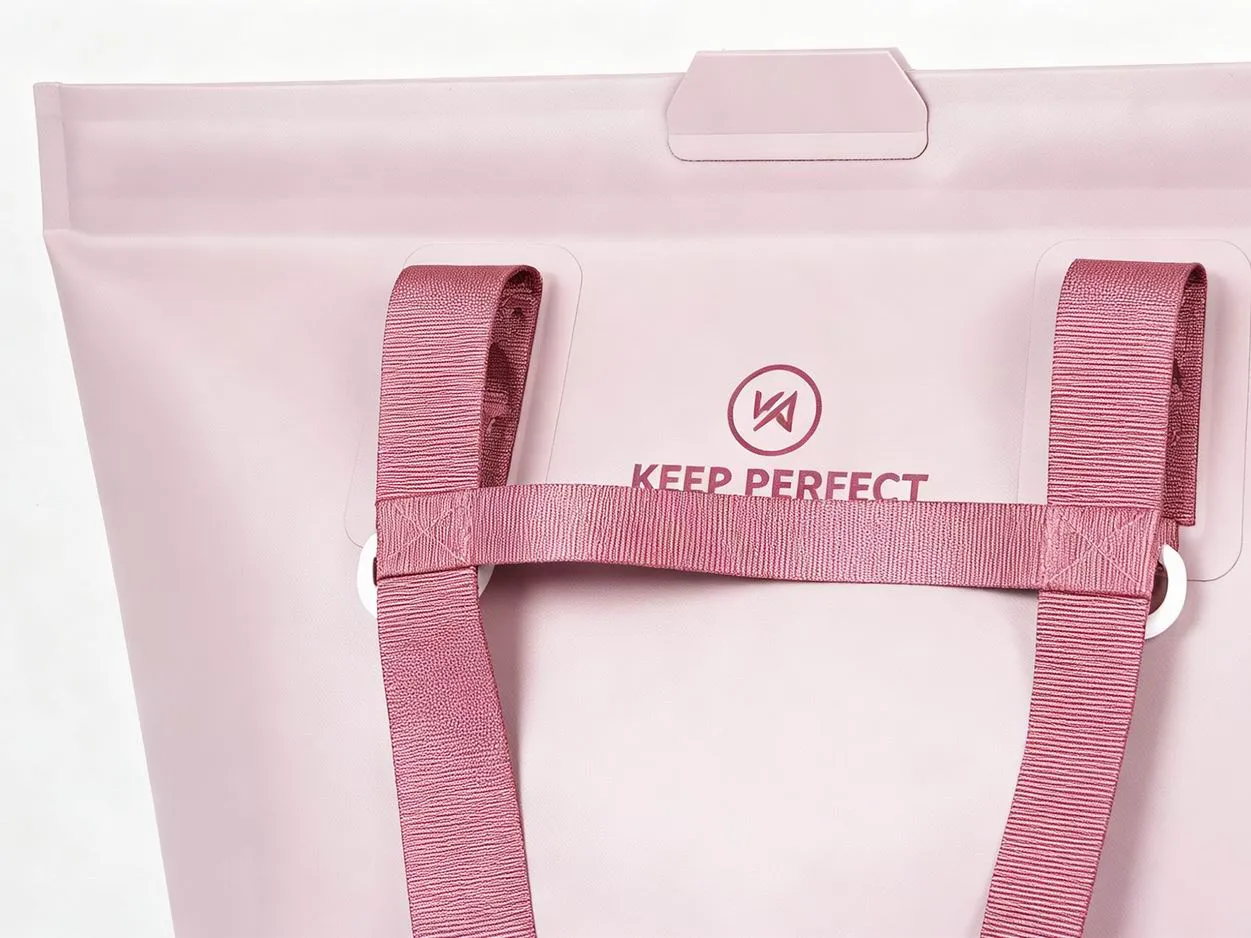
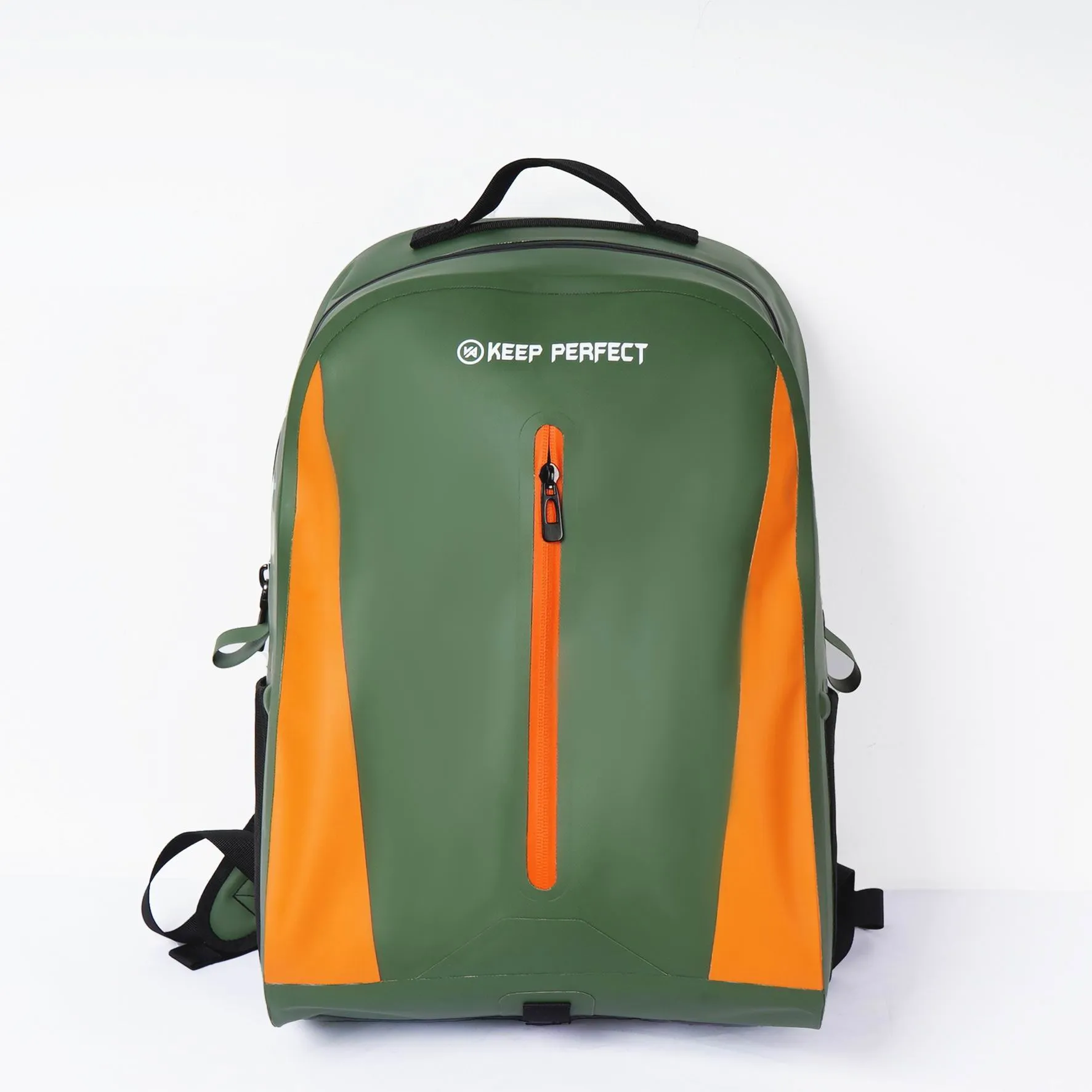
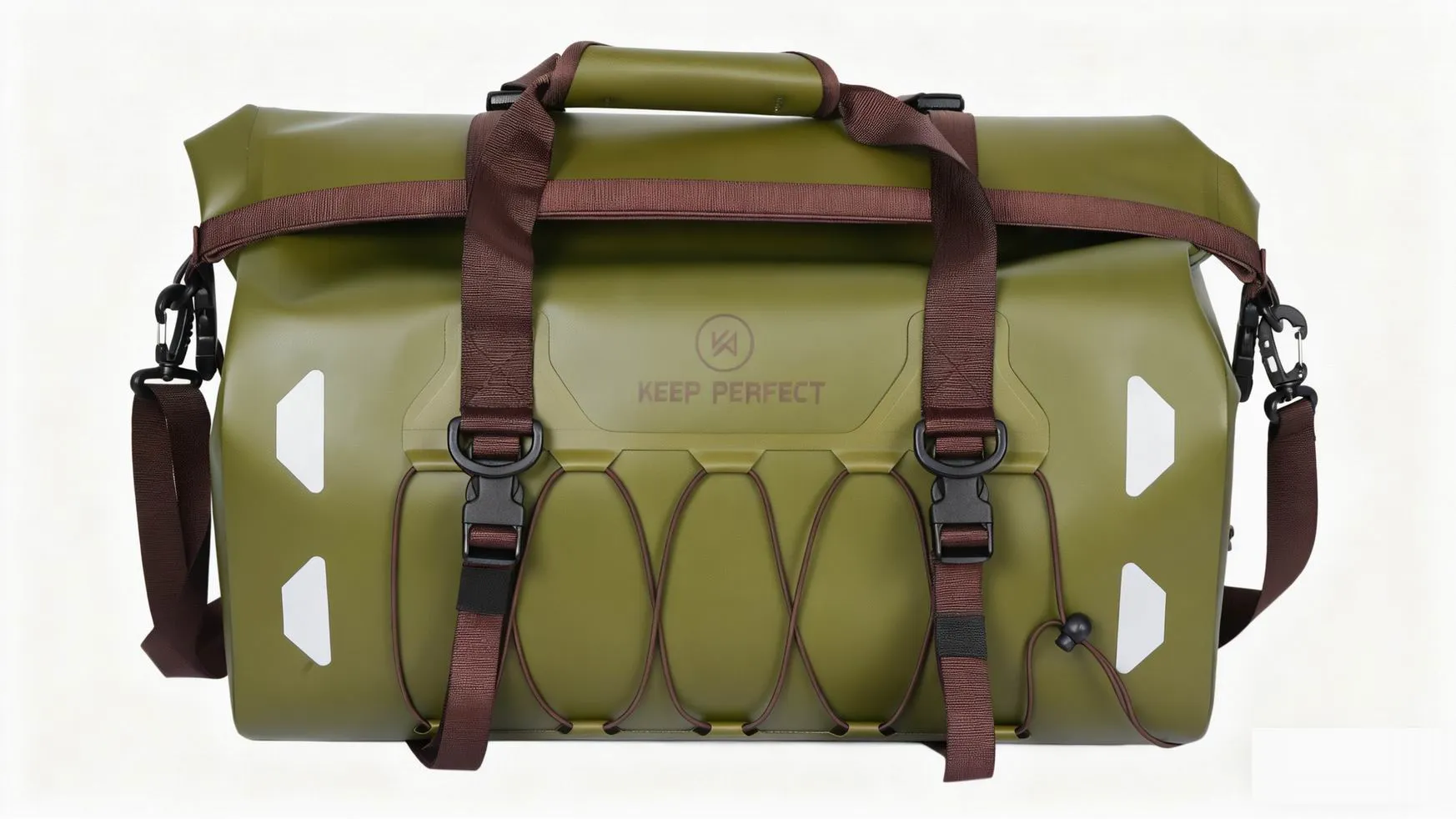
Re-wet tolerance is the property that decides the category
The distinction sounds pedantic and it is the whole subject, and it is the reason island hopping dry bags should be briefed around closure behaviour under contamination rather than around ingress ratings, and why boat tour waterproof bags chosen from a rating table rather than from a season of observation disappoint within weeks. A submersion rating describes what happens when a clean, empty, carefully closed bag goes under water once, for thirty minutes, in a laboratory. A day of island hopping is the opposite on every axis: the bag is full, it is being opened and closed dozens of times, the hands doing it are wet and frequently sandy, the surface it is set down on is wet, and the interval between wettings is measured in minutes. What governs the outcome is therefore not the seal strength on the first closure but the seal strength on the fortieth, under conditions that steadily contaminate it.
This is why island hopping dry bags should be briefed around closure behaviour under contamination rather than around ingress ratings, and why boat tour waterproof bags are frequently mis-specified by buyers who have read a rating table rather than watched a season. Three mechanisms degrade the seal across a day. Grit and salt crystals on the seal faces hold them apart. Water absorbed into the face fabric changes how it folds. And the user, hurrying between stops, rolls fewer times than the design assumes.
The arithmetic is unforgiving. A boat running six landings a day, six days a week, for a six-month season puts a bag through roughly nine hundred wet-dry cycles. A product that loses one per cent of its seal reliability per cycle is finished long before the season is. That is the number worth quoting to a supplier, because it reframes the conversation from ratings to cycle life immediately.
Testing for it is cheap. Take a bag, wet it, roll it shut, open it, lay it on a wet sandy surface, close it again, and repeat forty times, then immerse it. Almost no supplier runs this and it takes under an hour. Our general treatment of closure families is in the article on zipper and roll-top systems; the island-hopping amendment is to weight every row of that comparison by how the closure behaves when it is dirty and the user is in a hurry.
The wet landing: overhead, in surf, with one hand on the boat
The defining physical moment of this category is the landing. The boat comes alongside a beach or a reef shelf, passengers step into water between knee and chest height, and the bag goes overhead because that is the only way to keep it out of the water. Waves arrive on a cycle of a few seconds and they are not all the same height. The bag is above the head, one hand is on the boat or on another person, and the surface underfoot is uneven.
Everything about the carry system follows from that. A shoulder strap that slips off a wet shoulder is not a minor annoyance; it drops the bag into the water at the exact moment the user cannot let go of anything else. A single grab handle at the top is the most useful feature a bag in this channel can have, because it is how the bag is passed from the boat to a person already standing in the water, and that hand-to-hand transfer happens at every single stop.
- A top grab handle sized for a whole hand, positioned so the bag hangs level when lifted.
- A second grab handle at the opposite end, for two-person transfers of loaded bags.
- Shoulder straps with a high-friction contact face, because wet skin and wet webbing are both slippery.
- A sternum strap or stabiliser, since a bag carried overhead in surf swings and unbalances the wearer.
- No dangling webbing, because loose ends catch on cleats, railings and fingers during transfers.
The load case on that top handle is worth specifying numerically rather than leaving to chance. A loaded thirty-litre bag weighs around twelve kilograms, and a hand-to-hand transfer in a swell imposes a dynamic component on top of that, so a rated handle with a stated safety factor and a production pull test is a reasonable requirement rather than an excessive one. Our page on load testing straps and handles explains how to write it so the number means something.
One further detail that separates designs built for this from designs adapted into it: the bag has to be liftable overhead one-handed by someone who is not especially strong. That is a weight and balance requirement as much as a strength one, and it argues against large single-compartment bags in favour of two smaller ones, which are also easier to stow on a boat.
Boat stowage is a dimensional constraint, not a volume one
The second hard constraint is where the bag goes when it is not being carried, and it is the one most often discovered on the first morning of a holiday. Small tour boats have no lockers. Rigid inflatables have sponsons that curve inward, so the usable floor is narrower at the bottom than it looks from above. Open boats have benches with limited clearance beneath, and the floor of any small boat is wet, usually with a mixture of seawater, sand and sunscreen, and occasionally with bilge water.
| Boat type | Where a bag actually goes | What that does to it | Design response |
|---|---|---|---|
| Rigid inflatable or RIB | On the floor between the sponsons, or on a bench | Sits in standing seawater and sand; narrow usable width | Soft body that conforms; welded base; width stated rather than volume |
| Open longtail or outboard boat | On a bench or at the passenger’s feet | Spray from ahead; no shade; bag slides when the boat turns | Flat profile; high-friction base; a tie-down point |
| Catamaran or day cruiser | In an open net area or a wet locker | Constant spray and direct sun for hours | Ultraviolet and salt tested together; no external metal hardware |
| Kayak or small tender | Strapped to a deck or between the legs | Immersed if it capsizes; severe volume limits | Ten to twenty litres maximum; buoyant when closed |
| Ferry or larger tour vessel | In an open rack or on an upper deck | Rain squalls and spray with no cover | Genuine splash protection; drainage rather than sealed base |
Two conclusions follow. First, publish width and height, not just litres, because the aperture the bag has to pass through is the binding constraint on a boat and a customer cannot work it out from a capacity figure. Second, soft bodies win comprehensively over semi-rigid ones: a soft bag conforms to whatever space exists, absorbs being stepped over, and does not crack when it is dropped onto a deck. General sizing reasoning is set out in our capacity selection guide, and the broader boating context sits in our page on bags for boating programmes.
Buoyancy: here you want the bag to float
This is one of the clearest places where this category diverges from adjacent ones, and the divergence is worth stating because it reverses a recommendation. In canyoning, buoyancy is a hazard: a buoyant bag fights the swimmer under a waterfall and pulls at whatever it is attached to. On a boat tour, buoyancy is a benefit, because the most likely serious event is the bag going overboard, and a bag that floats can be retrieved while a bag that sinks is gone.
The requirement is modest and easy to deliver. A closed bag with typical air content should float for long enough to be recovered, which in practice means a few minutes rather than indefinite flotation, and it should float upright enough to be seen. Trapped air does most of the work; the design contribution is simply not defeating it, which means avoiding heavy metal hardware and dense rigid components on a small bag.
The complementary requirement is a tie-down point. On an open boat in a swell, an unsecured bag goes overboard, and it happens most often during the first ten minutes while people are settling. A webbing loop sized for a carabiner or a short line, positioned so the bag can be clipped to a railing or a bench, costs almost nothing and prevents the single most common loss event in this channel.
Retention is worth designing for in the other direction too. A bag that is clipped down needs to be unclipped quickly at every stop, six times a day, so the attachment must be a single-action clip rather than a threaded or laced arrangement. That is the same access-versus-security trade-off covered for closures, applied to the tie-down, and it is routinely specified the wrong way round.
Salt spray and sun, alternating, all day
An open tour boat provides no shade and no fresh water, which produces a specific and fairly brutal ageing regime. Salt aerosol settles on the bag continuously while the boat is moving. Tropical sun then dries it within minutes. Then the next spray wets it again. That alternation runs for six or eight hours a day, and it is considerably more damaging than either exposure alone, for the same reason it is on a sailing yacht: ultraviolet damage opens the surface, and the opened surface admits salt solution deeper than an intact one would.
The result over a season is a shell that chalks and crazes, a closure that stiffens, and hardware that corrodes. The specification response is familiar but worth restating because it is cheap: stabilised face materials, no plated zinc hardware anywhere, and mid-tone rather than dark colours, because surface temperature drives the rate of every mechanism involved. Our page on UV-resistant materials covers the radiation chemistry, and the marine salt behaviour that pairs with it is described in our guide to bags for sailing and yachting.
The practical difference between this and sailing is maintenance. A sailing crew rinses gear at the end of the day because the boat has a fresh-water hose. A tour boat does not, and the passenger certainly does not. So the product has to survive without rinsing, which raises the value of hardware that does not depend on being rinsed and lowers the value of any design that assumes maintenance.
One useful and very cheap product decision follows: print the rinse instruction on the bag. A single line telling the user to rinse the closure with fresh water at the end of the day, in language simple enough to be read while tired, measurably extends the life of closures in this channel. Nobody reads a manual and everybody reads a tag.
Changing at every stop: separation beats capacity
Island-hopping itineraries typically involve swimming or snorkelling at two or three stops, which means the passenger changes clothes two or three times in a day with nowhere private to do it and nowhere dry to put anything. The bag therefore has to hold a wet swimsuit, a damp towel and a set of dry clothes simultaneously, and it has to do that while sitting on a wet deck for several hours.
The correct answer is separation, and the correct order of investment is separation first and capacity second. Adding five litres to a single compartment does nothing for a passenger whose dry shirt is now touching a wet swimsuit. Splitting the same volume into a wet zone and a dry zone solves the actual problem. That is the reasoning behind our article on wet and dry separation, and for this channel the amendment is that the wet zone must drain, because a sealed wet zone holding two litres of seawater is worse than no separation at all.
- A wet zone with a drain path, not merely a separate compartment, so water leaves rather than accumulating.
- A dry zone with the most reliable closure in the range, reserved for clothing and electronics.
- A wipe-clean interior in the wet zone, since seawater plus sunscreen leaves a film textiles hold.
- An external mesh pocket for a water bottle and a damp mask or snorkel, which need air rather than containment.
- A flat profile, so the bag can be laid open on a bench and used as a working surface.
The snorkel and mask point deserves a line because it is the item most often mishandled. A mask and snorkel come out of the water wet and salty, they are awkwardly shaped, and if they go into a closed compartment they contaminate everything else. An external mesh pocket that drains and air-dries handles them perfectly, and it is a feature customers notice immediately because it solves something that annoys them every single trip.
Sand and reef-safe sunscreen
Two chemical and abrasive agents ride along on every island trip, and neither is usually in the brief. Sand behaves here as it does in any beach category: it is largely quartz, it is harder than every coating in the category, and it destroys closures long before it damages panels. Reef-safe sunscreen, now required in a growing number of island destinations, changes the formulation but not the risk.
The mineral filters used in reef-safe formulations are inert, but the emollients and solvents that make any sunscreen spreadable are not, and they extract plasticiser from coatings and films. The failure sequence is the same one seen in surf categories: the surface becomes tacky, the tacky surface captures sand, and the captured sand abrades the softened surface. Within a few weeks of heavy use the interior of a bag that has only ever held dry clothes can be visibly degraded.
The response is separation rather than exotic materials, for the same reason it is everywhere else: keeping sunscreen out of contact with the structure costs less than engineering every surface to tolerate it. One small pocket, isolated, wipe-clean, clearly identified. The underlying chemistry is set out in our review of chemical resistance in waterproof materials, and the sunscreen and reef context is maintained by the NOAA Coral Reef Conservation Program, which is also the right source for understanding why destinations restrict formulations in the first place.
Sand management then reduces to geometry, and the brief is short: minimise upward-facing crevices, make every retaining feature shake-out-able, and put the closure where sandy hands are least likely to touch it. That is the same design logic described for surf and beach bags, applied to a product that is also being carried through water.
The one item that cannot be replaced
Every island-hopping operator has the same story: a passenger loses a phone or a camera to salt water on the first morning and the rest of their holiday is spent trying to recover photographs. It is the highest-consequence event in the category by a wide margin, it is entirely preventable, and it generates reviews that damage operators and brands long after the trip.
The failure is rarely immersion. It is spray: a phone in an outside pocket, or held in a hand during a landing, accumulates salt aerosol and then stops charging, or a camera lens develops a film that degrades every subsequent photograph. So the specification is not the deepest possible submersion rating but a pouch that is genuinely sealed against spray, that can be operated with wet hands, and that is attached to the person rather than left in the bag.
- A phone pouch worn rather than carried, so it survives the landing if the bag does not.
- A wipe-clean interior, because a grain of sand inside the pouch scratches a screen permanently.
- A lens cloth and a rinse instruction for cameras, which is the difference between a ruined trip and a minor inconvenience.
- A sealed small pocket inside the dry zone for a room key, cash and a boat ticket.
- A tether point for the pouch, because anything held in a hand during a landing eventually goes in the water.
Our guide to small electronics cases covers pouch construction and the realistic limits of what they protect, and the destination-photography parallel sits in our article on bags for travel photography. For this channel the operative sentence is that spray is the governing risk, not immersion.
Straps and handles for a day of transfers
A bag on an island tour is picked up and put down perhaps fifty times a day, frequently by someone other than its owner, and usually over water. That is a completely different carry profile from trekking, where a pack is put on once and worn for hours. It rewards simplicity and punishes features.
Backpack straps are the contested decision. They are more comfortable for the walk across an island and worse for everything else: they take time to put on, they dangle and catch during transfers, and a wet back panel against a wet swimsuit is unpleasant. A convertible system that can be carried by a top handle or slung over one shoulder, with backpack straps that stow away, is the pragmatic answer, and the stowage has to be simple enough to use one-handed.
Hardware deserves the same attention it gets in marine categories. Plated zinc alloy fails by dezincification, which is invisible until it is total, and acetal or similar engineering polymer does not corrode at all. Salt crystals also jam buckles, which is why buckle geometry with drainage paths and no blind cavities matters; a side-release buckle that cannot be flushed will eventually not release. Component guidance sits in our note on selecting buckles, straps and fittings, and the waist-bag format that many passengers end up preferring for this reason is covered in our page on waist and sling bags.
Squalls: the moment waterproofing actually matters
For most of an island day, waterproofing is barely tested. Then a tropical squall arrives, usually in the afternoon, and for twenty minutes the bag on an open boat is exposed to driving rain at speed, which is a genuinely severe wetting condition and one that catches out every product designed around splash resistance.
The distinction worth writing into a brief is between splash resistance and driven-rain resistance. A bag that shrugs off spray can leak under twenty minutes of wind-driven rain, because rain driven at thirty knots finds closures and seam ends that splashing never reaches. So the specification should name the standard rather than the adjective, and the sensible target for this channel is resistance to driven rain rather than to immersion.
The other squall consideration is what happens afterwards. A bag that took water in during a squall then sits in a humid boat for the rest of the day with wet contents, so drainage matters as much as exclusion: a bag that lets water in at the top and lets it out at the bottom is a better product in this channel than one that is nearly sealed and holds whatever got in. That is the same argument that produces drain holes in canyon product, arrived at for a different reason.
For adjacent tropical travel context where the same squall logic applies on land, see our guides to tropical packing and to sun and surf essentials. The general framework for choosing how much protection to specify, rather than defaulting to the maximum, is set out in our article on choosing the right waterproof level.
A format matrix for the island channel
Three formats serve the channel well, and a fourth serves the operators rather than the passengers. Each has a different governing requirement, which is the argument against selling one bag in four sizes.
| Format | Volume and shape | Job it does | Governing requirement |
|---|---|---|---|
| Landing bag | 20 to 30 L, flat profile | The day bag: dry clothes, towel, water, sunscreen | Re-wet tolerance; drainage; top grab handle; fits a boat bench |
| Wet zone bag | 10 to 20 L, vented | Swimsuit, mask and snorkel, damp towel | Drainage and air-drying; wipe-clean interior; external mesh |
| Worn valuables pouch | 1 to 3 L, body-worn | Phone, cards, room key, cash | Spray sealing operated with wet hands; wipe-clean interior; tethered |
| Cooler or refreshment bag | 15 to 25 L, insulated | Drinks and snacks for a day in the sun | Ice-melt containment; condensation management; rinse-ability |
| Operator kit bag | 30 to 45 L, heavy duty | First aid, spare masks, safety kit, paperwork | Identifiable by colour; abrasion-tolerant; rated handles; lockable |
The landing bag is the commercial core and the one where re-wet tolerance should be tested hardest. Its volume is bounded from below by what a day requires and from above by what can be carried overhead through surf and stowed on a boat, and in practice that puts it between twenty and thirty litres regardless of how many passengers wish it were larger.
Insulated formats deserve a note because ice melt is a water problem that is usually forgotten. A cooler bag that does not contain meltwater leaks into the boat and into everything else, and the condensation on the outside of an insulated bag in tropical humidity is substantial. Our page on insulated waterproof bags covers the construction, and the island amendment is simply that the bag has to sit on a wet deck for hours without becoming the wettest object on the boat.
What boat operators report after a season
Island tour operators run this product at a utilisation rate no retail customer approaches, and because the bag is visible to every passenger all day, they hear about failures immediately. Their reported pattern is consistent across Southeast Asia, the Caribbean and the Mediterranean.
| Observation | Mechanism | When it appears | Specification change that helps |
|---|---|---|---|
| Closure weeping by mid-season | Seal face contaminated by salt crystals and grit over hundreds of cycles | After roughly three hundred cycles | Higher durometer seal faces; a printed rinse instruction; a stated minimum roll count |
| Buckle will not release | Salt crystals packed into a blind cavity in the hardware | Mid-season, worse without rinsing | Hardware with drainage paths and no blind cavities; polymer rather than plated alloy |
| Shell chalked and crazed | Ultraviolet and salt alternating all day on an unshaded boat | One season in tropical sun | Stabilised face; mid-tone colours; combined cyclic testing rather than separate tests |
| Wet compartment smells and never dries | A sealed wet zone holding seawater with no drain path | Within weeks | Drain openings at the lowest corners; external mesh for masks and snorkels |
| Handle tearing out under a loaded bag | Load path terminating in a panel rather than continuing under the base | Often sudden, at a transfer | Continuous webbing under the base; a stated rating and a production pull test |
| Branding removed from contact faces | Abrasion against a wet, sandy deck | Weeks | Keep decoration above contact zones; prefer welded badges to ink films |
The replacement arithmetic worth budgeting against is roughly one to two seasons for passenger bags in commercial service, with annual replacement of forty to sixty per cent. Operators replacing above that are buying retail product at retail prices and should be buying commercial product instead; the cost per season is usually lower even at a higher unit price.
The operators who get this right do two things. They colour-code bags by role, which makes a first-aid bag findable in seconds and costs nothing. And they rinse bags at the end of the day because the dock has a hose, which is worth knowing when writing the care instruction: if the operator rinses, the specification can assume less; if the passenger takes the bag home unrinsed, it cannot.
Building an island-hopping programme commercially
This channel suits a platform approach unusually well, because the same construction serves passengers, operators and resort retail, and because the merchandising work is done by colour and graphics rather than by construction. Three or four formats at several colourways present a full range while keeping every style comfortably above the 500-piece minimum per style.
The buying calendar is the commercial fact that matters most. Island operations order ahead of a season that is defined by weather rather than by retail, resort retail buys on a tourist calendar, and tour operators replace on a schedule. That predictability is worth more than volume, and it is why a supplier who understands the calendar can plan production rather than chase it. Timing detail is discussed in our note on minimum quantities and production slots, and for northern hemisphere summer seasons the order belongs in the preceding winter.
Branding has one hard constraint in this channel: contact faces are wet sandpaper. Any ink film on a face that touches a boat deck is gone within weeks, and the customer reads that as a defective product rather than as abrasion. Keep decoration above contact zones, prefer welded badges or patches, and treat colour-coding by role as a functional specification where operators are concerned. Our guide to logo methods and durability sets out what survives by process, and the wider channel context sits in our page on bags for tourism and travel programmes.
Finally, the accessory that sells best here is the worn valuables pouch. It is cheap, it solves the problem passengers are most anxious about, and it is the item most likely to be bought as a second purchase. Bundling it with the landing bag raises perceived value well beyond its cost.
If you are specifying an island-hopping range, send us the boat types, landing conditions, formats and any failure history you already have. Minimum order quantity is 500 pieces per style, samples take 6–10 working days, bulk production runs 35–50 days, and quotations are issued FOB Xiamen. Tourism statistics and destination guidance relevant to island itineraries are published by UN Tourism.
Frequently Asked Questions
Q1. What makes an island-hopping bag different from a general dry bag?
Cycle count. A bag is splashed, opened, closed and set down wet at four to six landings a day, for hundreds of cycles a season. What matters is whether it still seals when it is dirty, not whether it sealed when it was new.
Q2. How waterproof does a boat tour bag need to be?
Resistant to driven rain and spray rather than to immersion. A squall on an open boat is the hardest wetting event of the day, and nothing in the itinerary submerges the bag for long.
Q3. What size bag is right for a day of island hopping?
Twenty to thirty litres, with a flat profile. Larger bags cannot be carried overhead through surf or stowed on a boat bench, regardless of how much passengers would like the extra space.
Q4. Should the bag float if it goes overboard?
Yes, and this is the reverse of the recommendation for canyoning. On a boat, the likely serious event is the bag going overboard, and a floating bag can be recovered.
Q5. Why does my dry bag leak after a few weeks of trips?
Almost always contamination of the seal faces by salt crystals and grit, accumulated over hundreds of cycles. Rinse the faces, roll at least four times, and specify harder seal faces that shed particles.
Q6. Is a zip or a roll-top better for island tours?
A roll-top, because it has no moving parts and can be re-rolled when contaminated. Coated zippers jam with salt crystals and the fresh-water soak that clears them is not available on a boat.
Q7. What should I do with a wet swimsuit between stops?
Put it in a draining wet compartment or an external mesh pocket, not in a sealed one. A sealed wet zone holding seawater for hours is worse than no separation at all.
Q8. How do I keep a phone safe during a wet landing?
Carry it on your body in a sealed pouch rather than in the bag. The governing risk is spray, not immersion, and the pouch interior must be wipe-clean because sand inside scratches screens.
Q9. Does reef-safe sunscreen still damage bags?
Yes. The mineral filters are inert but the emollients and solvents are not, and they extract plasticiser from coatings, leaving a tacky surface that captures sand. Give sunscreen its own pocket.
Q10. Why does hardware fail on tour boats?
Salt crystals pack into blind cavities in buckles and plated zinc alloy corrodes internally by dezincification. Specify polymer hardware with drainage paths and no blind cavities.
Q11. Should an island bag be a backpack or a tote?
A convertible one carried by a top grab handle. Backpack straps dangle and catch during hand-to-hand transfers, and a wet back panel against a wet swimsuit is unpleasant.
Q12. How many wet-dry cycles does a season involve?
Roughly nine hundred for a boat running six landings a day, six days a week, over six months. That figure is the right way to brief a supplier, because it reframes durability as cycle life.
Q13. Where should branding go on an island-hopping bag?
Above every contact zone. Boat decks are wet and sandy, so ink films on contact faces are removed within weeks. Prefer welded badges and use colour to code bags by role.
Q14. How long do bags last in commercial island tour service?
One to two seasons, with annual replacement of forty to sixty per cent. Operators replacing faster are usually buying retail product where commercial product would cost less per season.
Q15. What is the most useful single feature to specify?
A top grab handle sized for a whole hand. Bags are passed hand to hand at every landing, often over water, and that transfer is when most losses and most handle failures happen.
Q16. Do I need a cooler bag and will it leak?
Meltwater is a real water problem. Specify containment for ice melt and expect heavy outside condensation in tropical humidity, and check the bag can sit on a wet deck for hours.
Q17. Why does my bag smell after a few trips?
A sealed wet compartment holding seawater with no drain path. Add drainage and air-drying; antimicrobial finishes only suppress growth on the treated surface and do not fix the underlying dampness.
People Also Ask
What bag do I need for island hopping?
A twenty to thirty litre flat bag with a wet compartment that drains, a top grab handle, a reliable closure you can re-seal with wet hands, and a body-worn pouch for your phone.
Will my bag get wet on a boat tour?
Yes, repeatedly. Expect spray while the boat moves and a soaking at every wet landing, with only minutes to dry between stops.
Should a dry bag float on a boat trip?
Yes. If it goes overboard a floating bag can be recovered, which is why light hardware and trapped air matter here.
How do I stop my phone getting ruined on island tours?
Keep it in a sealed pouch worn on your body. Spray is the real risk rather than immersion, and rinse the pouch interior because sand scratches screens.
What size dry bag fits on a small tour boat?
Twenty to thirty litres with a flat profile. Width and height matter more than volume, because boat floors and benches have fixed apertures.
Why does my dry bag stop sealing after a season?
Salt crystals and grit on the seal faces from hundreds of open-and-close cycles. Rinse the faces, roll four times and consider harder seal faces.