A cooler bag has to do three things with water and they are not the same thing: keep meltwater inside the liner, keep external water out of the insulation, and let the meltwater out when the user chooses. Most products in this category solve two of the three. The failure that actually ends a cooler bag is rarely dramatic leakage on day one; it is insulation that quietly absorbed water over a season and lost most of its thermal resistance, a weld that sealed the shell but left a capillary path along the foam, or a drain plug that weeps onto a car seat. Understanding the conflict between thermal and waterproof construction is worth more than any ice retention claim on the hangtag.
This guide works through that conflict layer by layer: why wet foam collapses as an insulator and what that means in kilograms of ice per day, which insulation materials absorb water and which do not, why a weld through a foam sandwich behaves differently from a weld through two films, the food contact compliance that gates the whole category, how much meltwater a realistic load actually generates and where it should go, why the outside of a cold bag gets wet in humid air, how closure choice trades thermal performance against leak integrity, why published retention figures are almost always measured under friendlier conditions than the ones you will use, what a cooler capacity matrix looks like, what breaks when a soft cooler is loaded to fifteen kilograms, and how a brand assembles the range. The production baseline at QUANZHOU JUNYUAN BAGS — custom waterproof bag production since 2014, 4,950 m² SGS-verified facility — is MOQ 500 pieces per style, sampling in 6–10 working days and bulk in 35–50 days, FOB Xiamen.
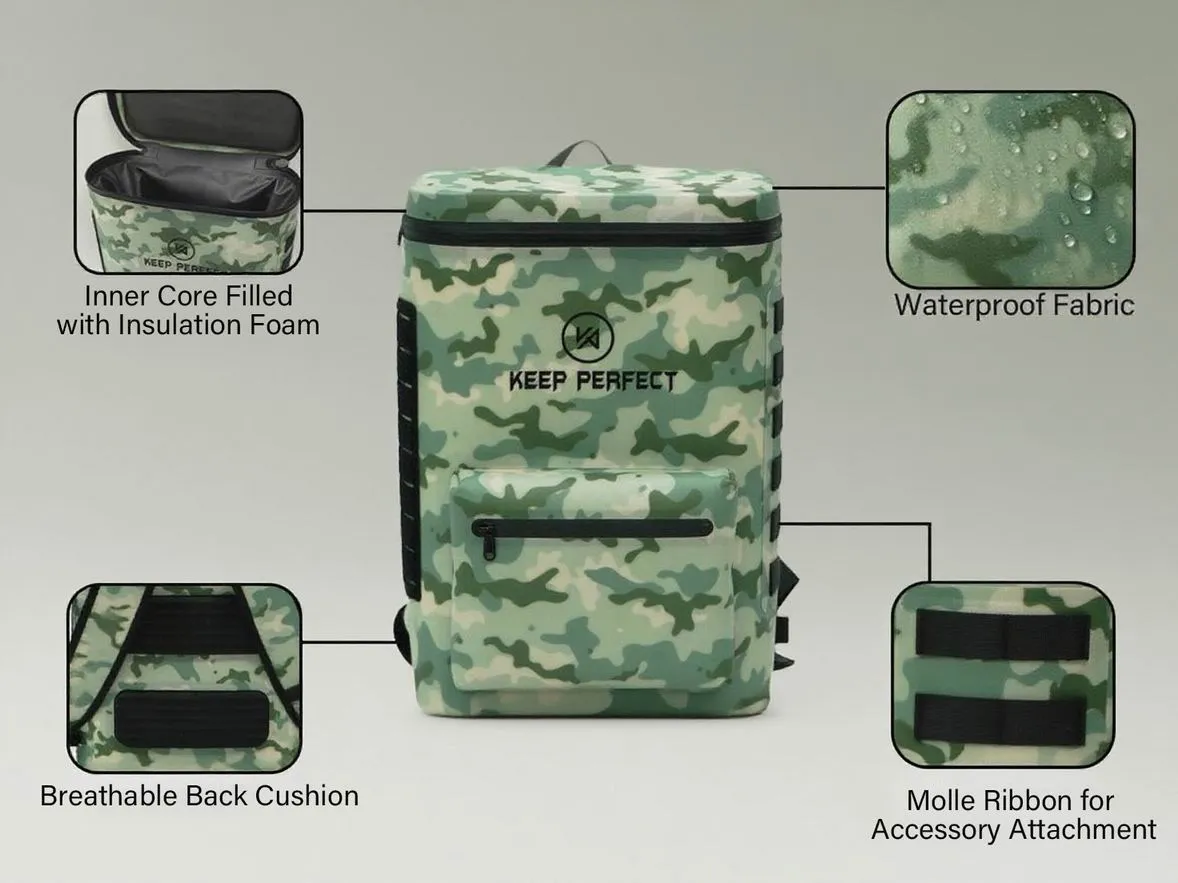
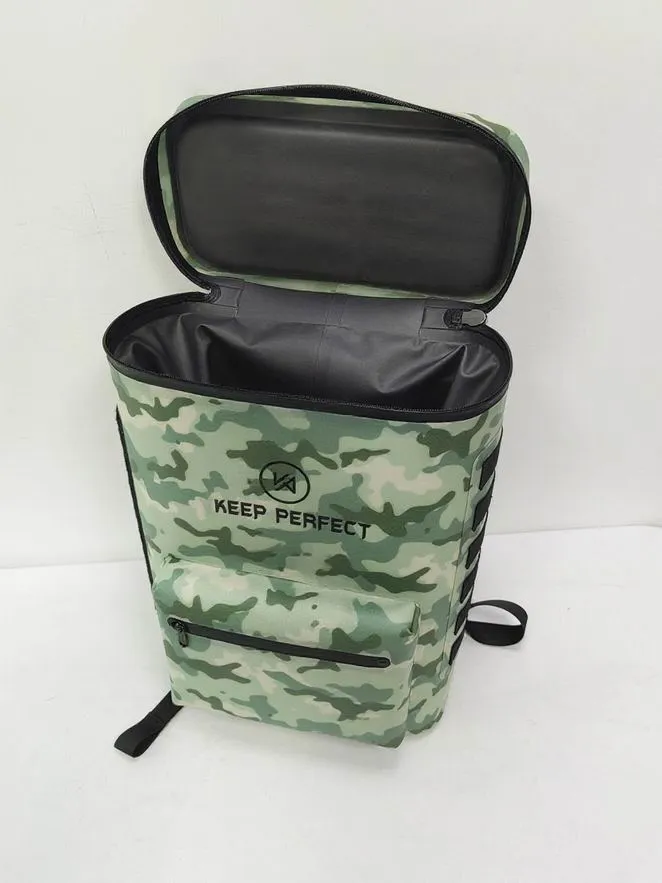
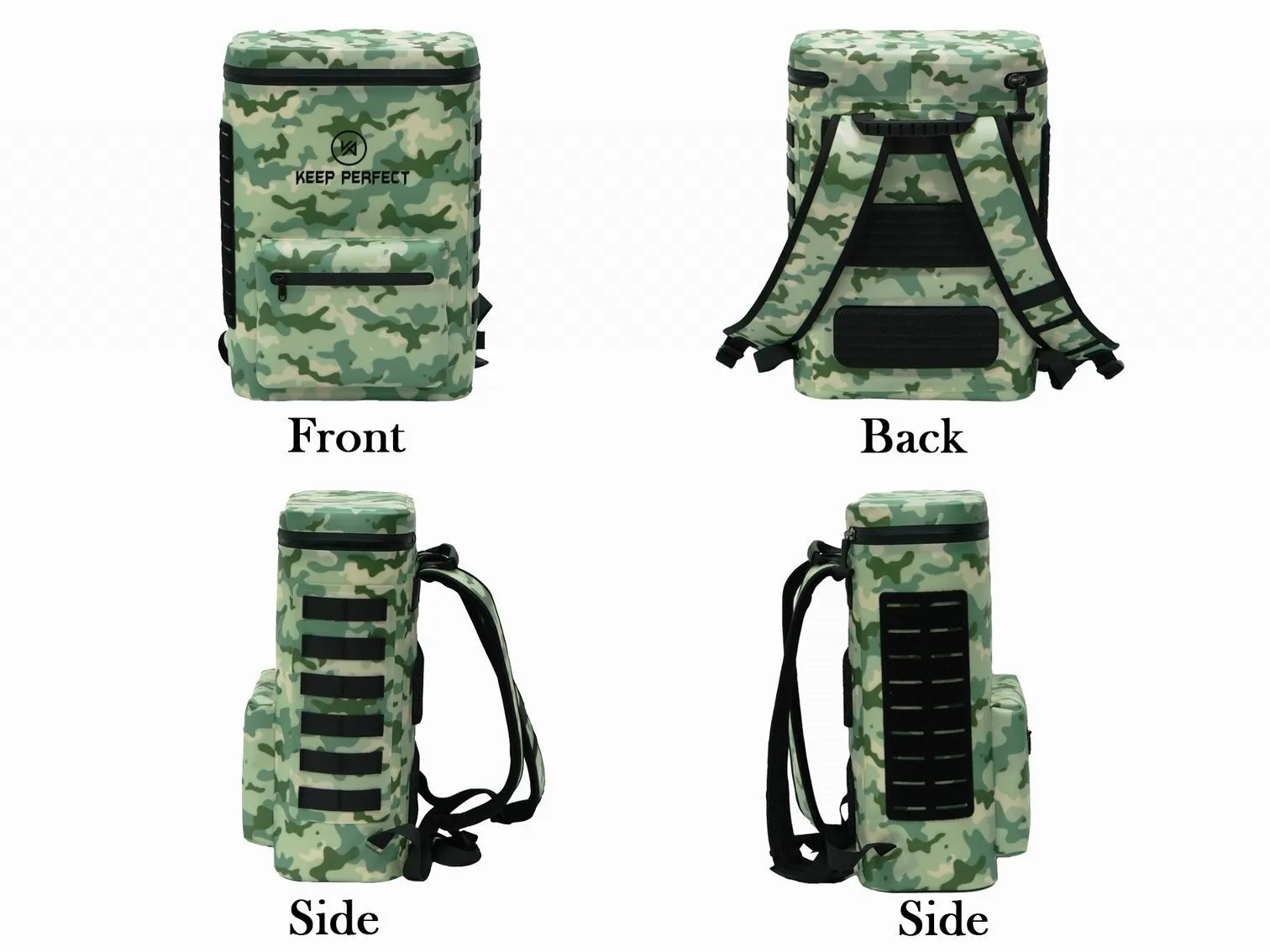
Insulation and waterproofing pull in opposite directions
Thermal performance wants thickness, trapped gas and no metal or stitched path through the wall. Waterproof performance wants a continuous, weldable, impermeable membrane with no holes and, ideally, thin sections that weld predictably. Those two sets of requirements meet in the same five millimetres of wall, and every compromise made there shows up either as a warm bag or a wet one. That is the entire reason waterproof cooler bags are harder to specify than either a dry bag or a soft lunch bag, and why the usual approach of buying a dry bag and adding foam produces disappointing product.
The mechanism that governs the category is simple once stated and invisible until it bites. Insulation works because it traps gas in small cells. If water displaces that gas, thermal conductivity rises by roughly an order of magnitude, because still air conducts at about 0.026 W per metre-kelvin and water conducts at about 0.6. A foam layer that has taken up twenty per cent water by volume has lost a large share of its resistance, and it will not recover without being dried for days. So an insulated leakproof liner is not a comfort detail; it is what keeps the insulation dry for the life of the product.
Two consequences follow and both should be in the brief. The liner must be genuinely impermeable and welded rather than stitched, because stitch holes are how water reaches the foam. And the outer shell must keep rain, spray and wash-down water out of the wall assembly from the outside too, because a cooler used on a boat or a beach gets wet from both directions.
The third consequence is the one designers dislike: the wall must also let water out on purpose. Ice melts, and a twenty-litre cooler carrying eight kilograms of ice eventually contains eight litres of water. A bag that is perfectly sealed becomes a sloshing water tank; a bag that drains needs a closure in its lowest point, and that closure is the single most common leak in the category. Designing for all three simultaneously is the actual engineering problem.
Wet foam is not insulation: doing the arithmetic
It is worth doing the heat-leak calculation once, because it converts marketing into something checkable. Take a mid-size soft cooler of about twenty litres, with a wall area of roughly half a square metre, eight millimetres of closed-cell foam, standing in thirty-two degree air with ice inside at zero. A realistic overall heat transfer coefficient for that construction is in the region of 1.5 to 3 watts per square metre-kelvin.
At 2 W/m²K the heat leak is 2 × 0.5 × 32, which is about 32 watts continuously. Over twenty-four hours that is roughly 2.8 megajoules, and melting ice costs 334 kilojoules per kilogram, so the bag consumes something in the order of eight kilograms of ice per day simply standing still in hot shade. Everything else — opening the lid, warm contents added later, direct sun — adds to that figure. This is why a cooler of that size with eight kilograms of ice lasts a day rather than three, and why the honest specification conversation is about surface area, wall thickness and closure discipline rather than about a claimed hour count.
| Insulation material | Typical thickness in soft coolers | Water absorption behaviour | What it means for the product |
|---|---|---|---|
| Expanded polyethylene (EPE) foam | 6 to 12 mm | Closed cell; very low absorption if the skin is intact, but cut edges wick | The default choice. Requires sealed edges and a liner that keeps meltwater off the cut face |
| Cross-linked PE or EVA foam | 8 to 15 mm | Closed cell, lower absorption, better compression set | Premium option; holds thickness after repeated compression, worth the cost on a flagship SKU |
| Nitrile or PVC foam sheet | 5 to 10 mm | Closed cell but heavier and often plasticised | Good thermal performance, but plasticiser content complicates food contact and odour |
| Open-cell PU sponge | 8 to 20 mm | Absorbs water readily and holds it | Avoid in any cooler that may see meltwater; it is a lining comfort material, not insulation |
| Reflective film plus foam | Film 12 to 50 micron over foam | Depends wholly on the foam beneath it | Helps radiant load in direct sun only; a shiny layer over poor foam still performs poorly |
| Rigid PU board (hard coolers) | 30 to 60 mm | Closed cell and very low absorption | Best per-unit thermal value, but incompatible with a soft, packable product |
The row that surprises buyers is the last column of the first row. EPE is genuinely closed-cell and genuinely cheap, and it still fails in service because the cut edges of the sheet are open cells and will wick meltwater along the wall. Sealing the perimeter of every insulation panel, or specifying a liner that is welded around the foam rather than laid over it, is what turns a cheap foam into a durable one.
Compression set is the other quiet killer and it is a purchasing decision. A foam that recovers fully after being compressed under a loaded strap keeps its thickness and its performance for years; a foam with poor compression set takes a permanent set at the strap line and the base within one season, and the bag gets warmer every month. Asking for a compression set figure rather than a density figure is the quickest way to find out which foam is being quoted. Our note on foam materials used in bag construction covers the property set in more detail.
The weld has to do two incompatible jobs
Welding two films together is a mature, predictable process. Welding a shell to a liner through a compressible foam layer is not, because the foam changes the geometry of the joint while the weld is being made. Under heat and pressure the foam compresses, the two faces move closer together, and the energy that should be forming the bond is partly absorbed in squashing the middle layer. The result is a joint that looks correct and has variable strength along its length.
- Ask how the insulation is terminated at the weld. A foam that runs into the weld line produces variable thickness and variable results.
- Specify a stepped or skived edge, where the foam is thinned or stopped short of the joint so the two films meet at a consistent gap.
- Measure peel strength along the seam rather than at one point; variation along the length is the signature of foam interference.
- Test the seam wet and cold, because a joint that passes at room temperature can behave differently at five degrees.
- Check for capillary paths along the foam after a leak test; cut the sample open and look for moisture beyond the weld.
The choice of welding process matters more here than in a plain dry bag, because the energy has to reach the interface through a variable thickness. Radio frequency welding suits polar materials and gives a consistent bond through thicker stacks, hot-air and heat-sealing are more flexible about material but more sensitive to thickness variation, and ultrasonic welding is fast but unforgiving where the stack thickness changes. The trade-offs are set out in our comparison of radio frequency and hot air welding and in the note on heat sealing versus ultrasonic welding.
A practical validation that costs almost nothing: fill a pre-production sample with warm water, seal it, lay it on absorbent paper for an hour, then cut the corner welds open and look for moisture tracking along the foam. Moisture beyond the weld line means the joint is not the barrier you think it is, and no amount of external taping fixes it. Our overview of seam sealing methods explains where tape helps and where it does not.
Food contact compliance is the gate you cannot skip
A cooler liner is a food contact material, and that changes the sourcing conversation more than any performance question. In the United States the relevant framework is the Food and Drug Administration’s indirect food additive regulations, in the European Union it is the framework regulation together with the plastics regulation and any national provisions such as the German LFGB, and in practice a brand selling internationally needs documentation for all of them. The Food and Drug Administration’s food contact substance programme is the usual starting point for the US side.
What the testing actually measures is migration: how much of the material moves into a food simulant under defined time and temperature conditions. Overall migration limits are commonly expressed as ten milligrams per square decimetre or sixty milligrams per kilogram of simulant, and specific migration limits apply to named substances. A liner that smells strongly when new is often a liner with a migration problem, and odour complaints in this category are frequently compliance complaints wearing a different hat.
| Material commonly used for liners | Compliance posture | Odour and taste behaviour | Practical verdict |
|---|---|---|---|
| TPU film | Generally straightforward with the right grade and documentation | Low odour once cured; grades vary | Best overall balance of weldability, compliance and durability |
| PEVA or EVA film | Widely used and usually clean, but plasticiser and additive packages vary | Can carry a vinyl-like odour when new | Good value; specify the additive package, not just the polymer |
| Flexible PVC film | Increasingly difficult; plasticiser restrictions bite in several markets | Odour is the usual complaint | Avoid unless the market is known and the formulation is documented |
| Aluminium foil laminate | Depends on the adhesive and the printed layer | Neutral if laminated cleanly | Good thermal behaviour; watch the adhesive and any printed layer |
| Coated polyester textile | Compliance depends on the coating, and stitch holes remain a leak path | Usually neutral | Only acceptable if genuinely welded and migration-tested as a system |
Two substance classes deserve explicit mention in any brief. Plasticisers of the phthalate family are restricted in children’s products and in food contact applications across several jurisdictions, and their presence is a formulation question rather than a polymer question. Azo colourants and heavy metals in printed or dyed layers are restricted under REACH and under US consumer product rules, and a printed interior pattern is a real risk surface that brands frequently overlook. The documentary set is described in our guide to REACH and CPSIA compliance testing and in the broader note on regulatory compliance for custom bags, and the textile-specific scheme is covered under OEKO-TEX Standard 100.
One procedural recommendation that saves months: test the liner as a complete assembly, including the weld and any print, rather than as a roll of film. Migration from the finished article can differ from migration from the raw material, and a certificate for the film alone will not satisfy a retailer’s technical file.
Meltwater: the water you generate yourself
Ice turns into water at one litre per kilogram, so a cooler loaded with eight kilograms of ice will eventually hold eight litres of free water. That water has to be managed, and there are only three strategies — retain it, drain it, or absorb it — each with a clear consequence that belongs in the product description rather than in the returns data.
- Retained: a fully welded liner with no drain keeps everything inside and makes the bag genuinely leakproof in a car, but the contents end up swimming and the bag becomes heavy and unstable to carry.
- Drained: a drain plug at the lowest point lets water out on demand, solves the weight problem, and introduces the most common leak in the category if the plug is badly designed.
- Absorbed: a removable absorbent pad or a sacrificial base panel mops up small volumes, which suits lunch-size coolers and daily use far better than large ones.
- Whatever the strategy, the lowest point of the bag must be weldable and flat, because a drain in a curved or folded base will always weep.
- Tether the plug to the bag. An untethered plug is lost within a season and a lost plug converts a good product into a leaking one.
The plug itself deserves specification rather than selection. A threaded plug with a captive silicone gasket, a coarse thread that will not cross-thread when operated with wet hands, and a tether moulded rather than knotted will survive years. A push-in plug with no gasket will weep under the hydrostatic load of a full liner, and it weeps most when the bag is sitting on a car seat, which is exactly when the customer notices.
There is a marketing point hiding in this. Buyers in this category overwhelmingly say their previous bag leaked, and in the majority of cases what leaked was meltwater from a drain or a seam rather than rain coming in. A product that states clearly how it handles meltwater, and that ships with the plug tethered and the base flat, addresses the objection that actually stops the sale.
Sloshing is the secondary issue and it is a fit problem rather than a leak problem. Eight litres of free water moving in a half-full bag changes how it carries and how it sits in a vehicle, which is why large coolers benefit from a divider or from a recommended fill ratio rather than from more weld strength.
Condensation: the outside gets wet too
A cold bag in warm humid air collects water on its outer surface, and this surprises people because they assume the waterproofing should prevent it. It cannot. Condensation is not ingress; it is the air giving up moisture against a surface below its dew point. In thirty degree air at seventy per cent relative humidity the dew point is around twenty-four degrees, so any exterior panel sitting at five degrees will run with water.
The design consequences are specific. The outer shell must be impermeable so condensation sits on the surface rather than soaking into the wall, and it must be smooth so it can be wiped rather than absorbing. A textile outer that wets through is the classic failure: the bag appears to be leaking, the insulation behind it gets damp, and the seat underneath gets soaked. This is one of the few places where a fully coated, wipeable shell is functionally necessary rather than merely premium.
Inside the bag, the same physics produces condensation on the liner and on cold contents when the lid is opened, and that moisture has nowhere to go in a sealed liner. The mitigation is the meltwater strategy plus a liner that can be dried open, and it is the reason welded coolers should always be shipped with a "dry open" instruction rather than a "wipe and close" one. The mechanisms are the same ones discussed in our article on managing condensation in sealed constructions.
For a brand, this is also a packaging and retail problem. A cooler photographed with beads of water on the outside looks like a leak in a customer review photograph, and a customer who cannot tell condensation from failure will write that review. A card explaining the difference costs a few cents and prevents a category of returns that no engineering change can fix.
Closure choice in a thermal product
Closure choice in a cooler is a three-way trade between air exchange, leak integrity and speed of access, and unlike a dry bag the thermal cost of a poor closure is continuous rather than occasional. Warm air entering the bag is not a one-off loss; every exchange carries enthalpy that the ice has to pay for, and a lid that does not seal flat can double the effective heat leak.
| Closure | Thermal behaviour | Leak integrity | Where it belongs |
|---|---|---|---|
| Coated waterproof zip across the top | Good when new; the coil is a continuous thermal bridge and air path | Good against splashes, poor against standing water in the liner | Main opening on lunch and day coolers where access matters |
| Zip under a storm flap with compression | Better; the flap breaks the air path | Good if the flap is genuinely clamped | Mid-size coolers used outdoors |
| Roll-top closure | Excellent air seal, but the fold compresses the insulation locally | Excellent against liquid, provided three or more turns | Large coolers, marine use, anything carried lying down |
| Hinged lid with a gasket and latch | Best thermal performance of the group | Excellent if the gasket is a real seal and not a decorative lip | Premium and semi-rigid formats |
| Hook-and-loop lid closure | Poor; the closure leaks air along its whole length | Poor against liquid | Avoid except as a secondary tidy |
The roll-top row deserves a caution because it is counter-intuitive. Rolling the top of an insulated bag compresses the foam at the fold, and a compressed foam section is a thermal bridge exactly where the warmest air would enter. The answer is to build the fold region with no insulation or with a thinner, non-compressible section, so the roll seals film-to-film rather than squashing a sandwich. It is a small tooling decision and it is the difference between a roll-top cooler that performs and one that does not.
The access question then decides it. A lunch cooler is opened a dozen times a day and needs a zip. A marine cooler is opened twice and needs a roll-top. A family cooler used at a campsite is opened constantly by several people and needs a lid that can be closed one-handed by a child. Matching closure to opening frequency is more predictive of satisfaction than any thermal specification. The sealing mechanics are compared further in our guide to zipper and roll-top closures, and zip construction is covered under submersible zipper technology.
Why published ice retention figures are inflated
Ice retention is a measurement, and like any measurement it can be made generous by choosing the conditions. Nearly every inflated claim in this category comes from one of four levers, and a buyer who knows them can compare two suppliers honestly for the first time.
| Test condition lever | Typical laboratory setting | Typical real setting | Effect on the number |
|---|---|---|---|
| Ambient temperature | 20 to 23 degrees, often indoors | 30 to 35 degrees in sun or a hot vehicle | Roughly doubles the melt rate at the upper end |
| Ice to contents ratio | Two parts ice to one part contents, sometimes all ice | One part ice to two or three parts contents and drinks | Can halve the claimed duration |
| Pre-chilling | Bag and contents pre-chilled overnight | Bag taken from a garage, contents at room temperature | The first hours of melt are spent cooling the contents |
| Opening frequency | Unopened for the full test | Opened four to twelve times a day | Each opening exchanges the full internal air volume |
| Sun exposure | Shade, still air | Direct sun on a dark shell | Radiant load can exceed conducted load several times over |
| Ice form | Block ice or large cubes | Party ice from a bag, already wet | Surface area changes the melt rate materially |
A retention claim is therefore only meaningful when the conditions are printed next to it, and the honest format is a sentence rather than a number: "holds ice for a working day at thirty-two degrees in shade with a one-to-one ice-to-contents ratio and six openings". Any supplier who will not state those conditions is quoting a laboratory convenience rather than a product property.
The specification practice that works is to define your own protocol and make every supplier quote to it. Choose ambient temperature, ice form, ice-to-contents ratio, pre-chill state, opening schedule and sun exposure, and require the result as hours to a defined internal temperature rather than as "ice remaining", which is ambiguous because partial melt is not failure. Consistency of method matters more than severity; a moderate protocol applied to all candidates ranks them correctly, whereas a severe protocol applied to one and a lenient one to another ranks nothing.
Where a published method is needed for a dispute, the standard test methods published by ASTM International include thermal and packaging procedures that can be adapted, and the general discipline of turning laboratory work into field predictions is set out in our piece on validating laboratory results against real use.
A capacity matrix for a cooler range
Cooler volumes are driven by use case and by how long the user is away from a shop, and unlike dry bags the useful dimension is often the internal usable volume after insulation rather than the external litres. A bag with a thick wall can be externally large and internally disappointing, which is a common source of review disappointment and a very easy thing to get right in the brief.
| Format | Usable internal volume | Realistic ice load | Serves | Sourcing note |
|---|---|---|---|---|
| Lunch cooler / single-serve | 4 to 8 L | 0.5 to 1 kg | A working day for one person | Highest volume SKU; the natural entry product and logo carrier |
| Day cooler | 12 to 20 L | 2 to 5 kg | A day out for two to four people | The core SKU; should exist in at least two colourways |
| Weekend cooler | 25 to 40 L | 6 to 12 kg | A long weekend for a family | Needs a drain, a reinforced base and real handle engineering |
| Cooler backpack | 15 to 25 L | 3 to 6 kg | Walk-in sites, beaches, festivals | Harness and back panel decide the reviews as much as the thermal result |
| Bottle and can sleeves | 0.5 to 2 L | No ice, conduction only | Add-on sale | Cheapest SKU; ideal for bundling and for testing a new print |
| Marine or fishing cooler | 30 to 60 L | 10 to 25 kg | Boats, long days offshore | Salt exposure and wash-down drive the shell and hardware specification |
Two structural notes for the range. First, publish usable internal volume rather than external volume, and state the wall thickness next to it; customers compare honestly when given both. Second, treat the backpack format as a load-carrying problem first and a thermal problem second, because a cooler backpack at fifteen kilograms is heavier than most hiking loads and every comfort failure in the harness will be reported as a product failure. Strap and handle engineering for that weight is covered in our guide to load stress testing for straps and handles.
Sequencing the launch is straightforward and worth stating: lunch cooler first, because it sells in volume and validates the print and the liner; day cooler second; backpack and weekend formats once the closure and drain decisions are proven in the field. Launching a sixty-litre marine cooler first is the most expensive way to discover a drain plug problem.
A loaded cooler is a heavy bag: what actually breaks
A twenty-five litre cooler carrying eight kilograms of ice and six kilograms of food and drink weighs about fifteen kilograms, which is heavier than most luggage anybody carries by hand and heavier than a loaded hiking pack. Most cooler bags are engineered as insulated containers and then tested as if they were light bags, which is why the failure patterns are consistent and predictable.
- Handle attachment fails first. A webbing handle sewn to the shell needs a welded reinforcement patch, and the patch needs to be tested at the loaded weight rather than empty.
- The base abrasive-fails next. A loaded cooler is dragged across tailgates, decks and concrete far more often than it is lifted.
- Weld creep appears under sustained load: a seam that holds empty can open slowly under fifteen kilograms over several hours.
- Shoulder straps on cooler backpacks compress the wall where they cross it, creating a thermal bridge and a wear point at the same location.
- Drop performance matters because a full cooler gets set down hard; test filled, not empty, and test at the cold temperature as well.
The thermal consequence of the strap crossing the wall is underrated. Every strap anchor compresses insulation permanently if the foam has poor compression set, and a cooler backpack worn for two seasons develops warm stripes exactly where the harness attaches. Routing the load path outside the insulated volume, or specifying a foam with a stated compression set figure, prevents it.
A sensible pre-production test set for a loaded cooler therefore includes a filled drop test, a filled carry test with the handle anchored to a welded patch, a filled twenty-four hour seam creep check, and a base abrasion test against concrete. None of them are expensive, and together they remove most of the returns in the category. Defect patterns across the industry are catalogued in our article on common defects and how to prevent them.
Cleaning, odour and what grows in a sealed liner
A cooler liner is a warm, dark, occasionally wet enclosure that is regularly contaminated with food residue, and it will grow microbial life unless it is designed to be cleaned. The design answer is boring and decisive: a welded liner with coved corners, no textile layer, no absorbent seam tape inside, and an opening large enough to get a hand and a cloth into.
Odour has two sources and they need different fixes. Surface residue is removed by cleaning and is prevented by a smooth welded liner. Absorbed odour lives in the foam behind the liner and is essentially permanent, which is why a thin or pinholed liner is a product-life problem rather than a hygiene problem. Specifying a liner film thickness that resists puncture from ice and from packaging corners is cheaper than handling the complaints.
Cleaning protocol matters and should be printed on the product: dilute detergent, a soft cloth, thorough rinsing, and drying open in shade. Bleach and solvent cleaners damage films and leave residues that then migrate, and machine washing destroys welds and plugs. Antimicrobial finishes can be added to the liner surface and are discussed in our review of antimicrobial treatments, but they do not substitute for a liner that can be wiped and dried.
One retail detail: ship the bag with the lid open or with a spacer, and include a drying instruction. A welded cooler closed at the factory and shipped through a humid container arrives smelling of its own manufacturing moisture, and that smell is the first thing a customer notices and the last thing they forget.
Building a cooler range commercially
Cooler programmes are attractive because they sell in volume, attach to a season, and bundle well, and they are dangerous because they combine the compliance burden of a food contact product with the durability expectations of an outdoor one. The commercial structure that works keeps the material set narrow and the format count modest.
Decide one liner film, one insulation platform in two thicknesses, one closure family and one drain design, and build the whole matrix from those. A six-product range assembled that way holds every style at a workable minimum order quantity of 500 pieces per style and lets the brand quote a single compliance file rather than six. Our discussion of minimum quantities and production slots covers how that interacts with seasonal planning.
Logo durability on coolers has a specific enemy: condensation and wiping. A print on a panel that is regularly wiped will be abraded by the cloth and by the grit in it, so place branding away from the main wipe zone or use a welded badge. Heat transfer onto a coated shell performs well here and embroidery should be avoided, because it perforates the shell and gives condensation a path into the wall. The comparisons are set out in our guide to logo printing and embroidery options, and the costing implications appear in the cost breakdown for custom bags.
Accessories sell disproportionately well in this category and are cheap to add: a tethered drain plug supplied as a spare, a divider panel, a removable absorbent base pad, an external bottle sleeve and a shoulder strap with a padded sleeve. Bundling two of them raises perceived value more than it raises cost, and for gift and corporate channels it is the difference between one order and a repeat programme.
Finally, decide the test protocol before sampling, not after. The thermal protocol, the leak protocol and the loaded drop protocol should all be written into the enquiry, so that the first sample arrives already measured against criteria the brand can compare. Suppliers respond well to a precise brief, and the alternative is a sampling round spent discovering that two parties meant different things by "leakproof".
If you are building a cooler programme, send the formats, target volumes, compliance markets and thermal protocol. Minimum order quantity is 500 pieces per style, samples take 6–10 working days, bulk production runs 35–50 days, and quotations are issued FOB Xiamen.
Frequently Asked Questions
Q1. Why does my cooler bag stop working after one season even though it never leaked?
Most likely the insulation absorbed water. Wet foam conducts heat roughly twenty times faster than the trapped gas it replaced, so a liner with pinholes or wicking edges silently destroys thermal performance.
Q2. What insulation thickness should a soft cooler have?
Six to twelve millimetres of closed-cell foam for day coolers, and twelve to twenty for weekend and marine formats. Thickness only pays if the foam stays dry and recovers from compression.
Q3. Which liner material is safest for food contact?
TPU and PEVA films are the practical choices, provided the additive package is documented and the finished article is migration-tested. Flexible PVC is increasingly difficult to place in regulated markets.
Q4. What does food contact compliance actually test?
Migration of substances into food simulants under defined time and temperature, with overall migration limits and specific limits for named substances. Test the finished assembly, not just the film roll.
Q5. Why is there water on the outside of my cooler bag?
Condensation. Any surface below the dew point of the surrounding air collects water, and in thirty degree humid air that dew point is around twenty-four degrees. It is not a leak, but it does mean the shell must be wipeable.
Q6. Should a cooler bag have a drain plug?
For anything above about twenty litres, yes, because meltwater volume equals ice volume at one litre per kilogram. Specify a threaded plug with a captive gasket and a moulded tether.
Q7. How much ice does a twenty-litre cooler actually use per day?
In the order of six to nine kilograms per day at thirty-two degrees in shade for a typical wall construction. Openings, sun and warm contents added later all increase that figure.
Q8. Are roll-top closures good for coolers?
They seal well against liquid, but the roll compresses the insulation and creates a thermal bridge. Build the fold region without foam so the roll seals film to film.
Q9. Why do ice retention claims not match what I experience?
Laboratory tests usually assume cooler ambient temperatures, more ice relative to contents, pre-chilling and no openings. A thirty-five degree day with four openings and warm drinks added is a different test entirely.
Q10. Can I put a cooler bag in the washing machine?
No. Machine agitation damages welds and drain plugs, and detergents can strip coatings. Clean with dilute detergent and a cloth, rinse, and dry open in shade.
Q11. Why does my cooler backpack feel warm where the straps attach?
The harness compresses the wall, and foam with poor compression set takes a permanent set. Route the load path outside the insulated volume or specify a foam with a stated compression set figure.
Q12. What breaks first on a loaded cooler?
The handle attachment, then the base from abrasion. Test with the bag filled to its realistic weight, because a fifteen kilogram cooler loaded behaves very differently from an empty one.
Q13. How do I stop odour building up in the liner?
Use a welded liner with coved corners and no textile layer, keep the film thick enough to resist puncture from ice, and dry the bag open after every use. Odour absorbed into foam cannot be removed.
Q14. Is a shiny reflective layer inside the lid worth specifying?
It helps against radiant load in direct sun, which is a real and large load on a dark shell. It does nothing for conducted heat and cannot rescue a thin foam layer.
Q15. Should I specify external or internal volume?
Publish usable internal volume and state the wall thickness beside it. An externally large bag with thick walls is a common source of disappointment and it is easily avoided.
Q16. What logo method survives on a cooler bag?
Heat transfer or a welded badge on a panel away from the main wipe zone. Embroidery perforates the shell and gives condensation a route into the insulation, and print in the wipe zone abrades quickly.
Q17. How should I structure a cooler range to keep minimums workable?
One liner film, one insulation platform in two thicknesses, one closure family and one drain design across the matrix. That covers six formats while holding each style at a 500-piece minimum.
People Also Ask
Are waterproof cooler bags worth it?
Yes, if the liner keeps the insulation dry. Waterlogged foam is the main reason coolers lose performance long before they leak.
How long should ice last in a soft cooler?
A working day at thirty-two degrees in shade with a one-to-one ice-to-contents ratio and a handful of openings. Longer claims usually assume cooler conditions.
Why is my cooler bag wet on the outside?
Condensation on a surface below the dew point. It is not leakage, but the outer shell must be impermeable and wipeable.
Can I machine wash a cooler bag?
No. Hand wash with mild detergent, rinse well and dry open. Machines damage welds and drain plugs.
What liner material is food safe?
TPU and PEVA with documented additive packages, migration-tested as a finished article rather than as raw film.
Should a cooler have a drain plug?
Above about twenty litres, yes. Insist on a threaded plug with a captive gasket and a tether.