Surf and beach gear fails in an order that surprises people who have never designed for it. Water is rarely the cause. Sand arrives first, and beach sand is largely quartz, which sits at seven on the Mohs scale while every coating, film and elastomer in this product category sits far below it. So abrasive wear begins the moment a grain enters a closure, long before anything leaks. Then come the chemicals nobody specifies against: surf wax carries petroleum jelly and paraffin that transfer to linings, and modern sunscreens contain organic filters and solvents that extract plasticiser from coatings and have been documented to attack a surprising range of plastics.
This guide covers the mechanics of grit damage and the three ways it destroys a closure, what surf wax and sunscreen actually do at the polymer level and how to specify against it, why wet wetsuit containment is the defining functional requirement rather than an accessory feature, the particular duty cycle of board bags including nose and tail abrasion and transit heat, why the absence of fresh water at most beaches should change closure choice, the small items that carry disproportionate cost when they fail, what surf schools report after a season, how to select materials for this environment, and how a beach or surf programme is structured commercially. MOQ 500 pieces per style, sampling in 6–10 working days, bulk in 35–50 days, FOB Xiamen: these are the working terms at QUANZHOU JUNYUAN BAGS, custom waterproof bag production since 2014 in a 4,950 m² SGS-verified facility.
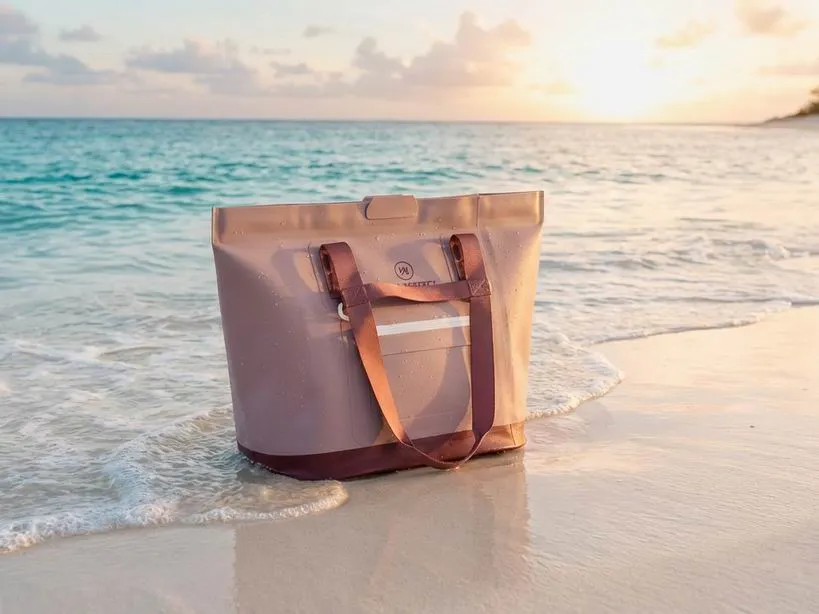
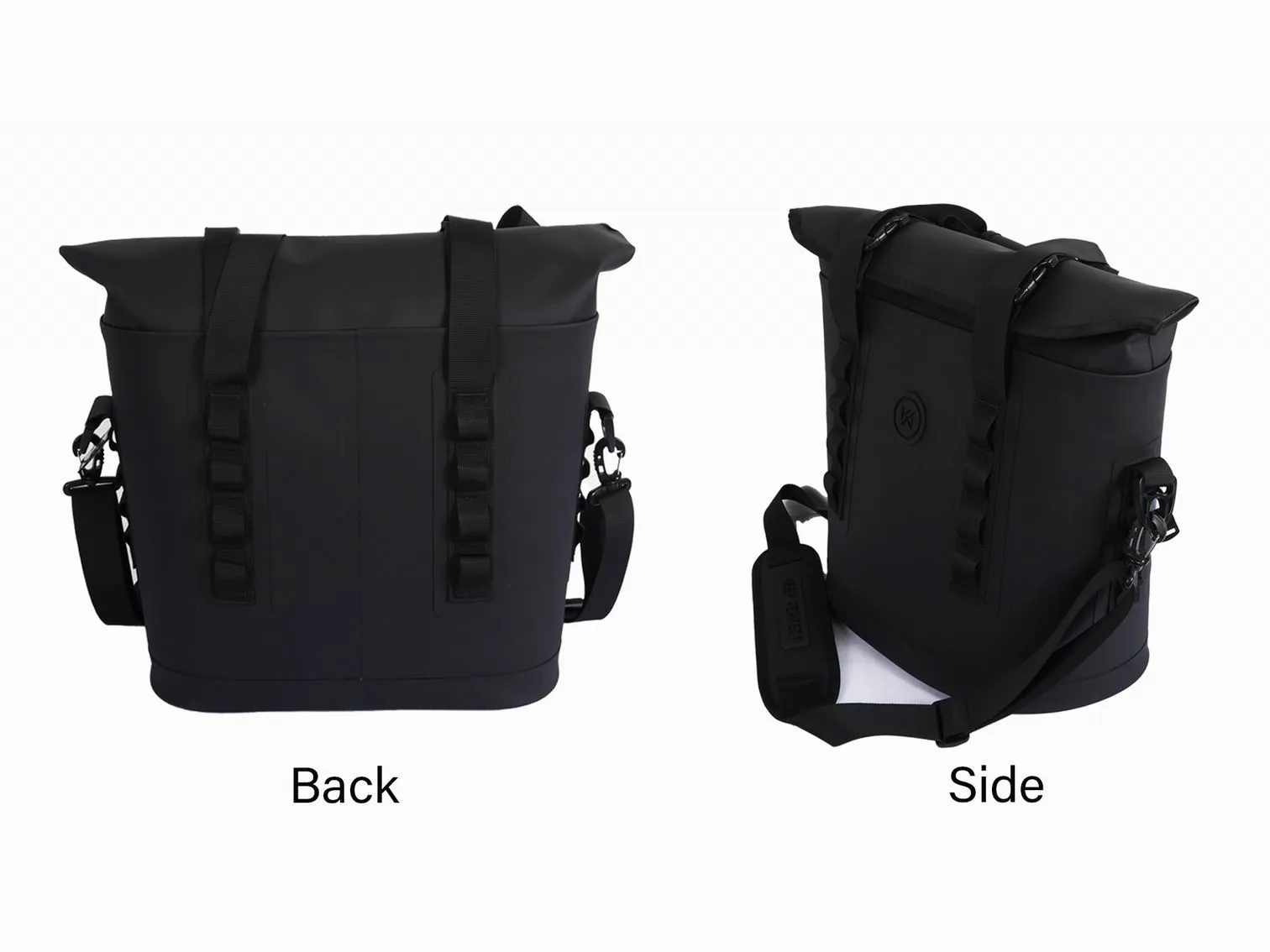
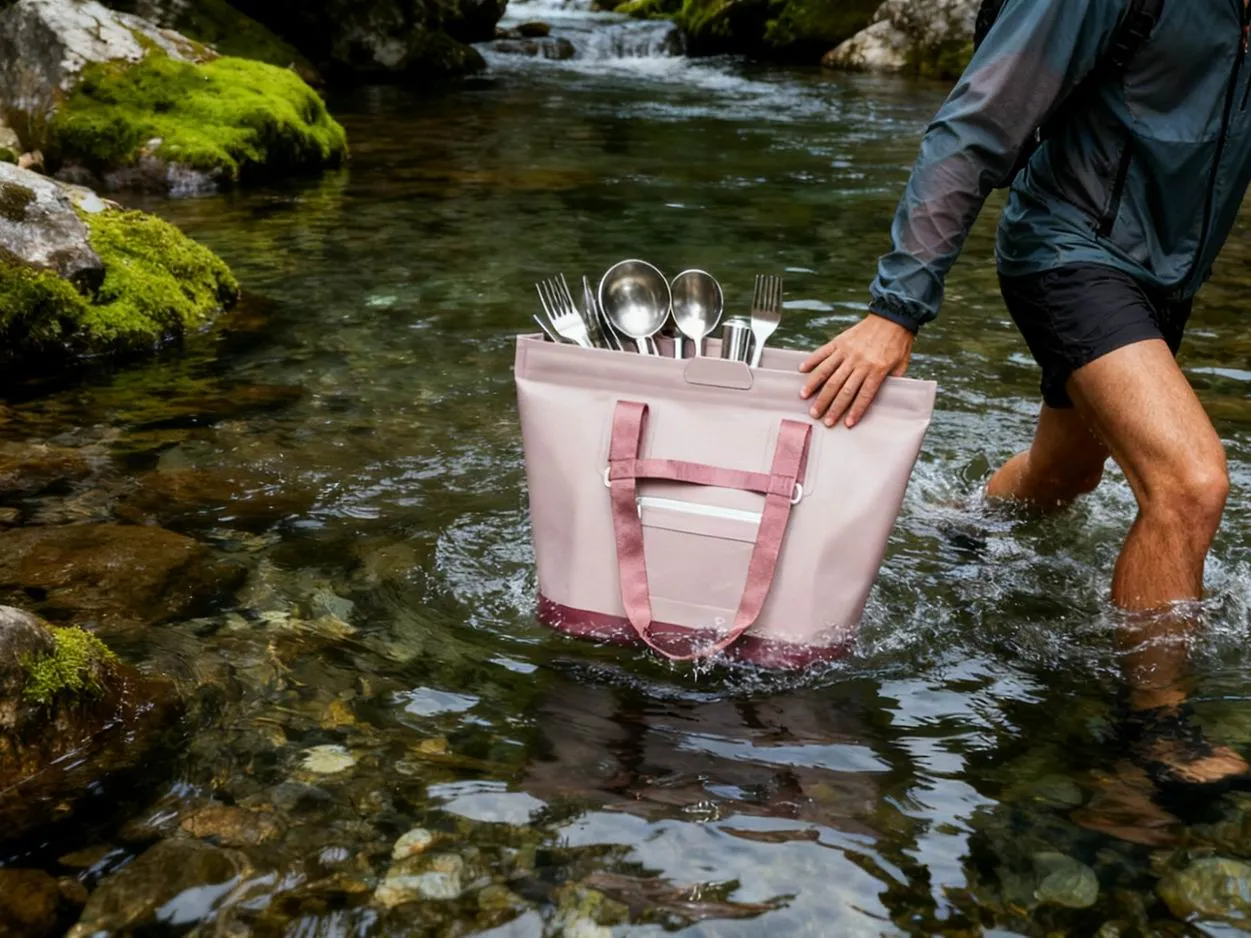
Sand arrives first and it is harder than everything you build with
Start with the hardness numbers, because they explain almost every subsequent decision. Quartz, the dominant mineral in most beach sand, sits at roughly seven on the Mohs scale. Thermoplastic polyurethane, flexible PVC, silicone elastomers, nylon and polyester all sit far below it. Any contact between the two therefore results in the polymer losing material, every time, and the only variables are how much contact occurs and how much load presses them together — which is why the useful way to judge surf waterproof bags has little to do with depth ratings and almost everything to do with beach sand protection.
That matters here in a way it does not in other water sports because of where the contact happens. In paddling or sailing, grit is occasional. On a beach it is ambient: it is in the air, on every surface, in the car, in the wax on the board and on the hands of everyone touching the bag. So any design feature that creates a place for grit to sit and then be rubbed — the inside of a roll line, the tooth spacing of a zipper, the gap around a buckle, the fold of a flap — is a wear machine by default. The constructive consequence of recognising this is that the key property is how little grit the product retains rather than how much water it excludes.
This reordering also explains why some products that test beautifully fail in this environment, because grit resistance is won or lost on geometry: how many crevices exist, whether they face upward and collect, and whether they can be emptied by shaking. A bag with fewer features beats a better bag with more pockets, provided the features removed are the ones nobody used. Surf industry bodies including the International Surfing Association publish nothing on this, and coastal advocacy groups such as the Surfrider Foundation concern themselves with water quality rather than equipment durability, which is itself part of the problem: the failure mechanism has almost no literature, so products are specified against water rather than against grit.
The practical design brief that follows is unusual and worth stating plainly. Minimise crevices. Make every retaining feature either shake-out-able or rinse-able. Put closures where hands covered in sand are least likely to touch them. And accept that dual-purpose features, such as a mat that doubles as a closure flap, beat delicate multi-layer constructions every single time.
Three ways grit destroys a closure
Once a grain is inside a closure, one of three mechanisms runs, and they are worth distinguishing because each has a different remedy and different timing.
| Mechanism | What happens physically | Typical symptom | Effective countermeasure |
|---|---|---|---|
| Cutting | A trapped grain abrades the film or coating each time the closure flexes, eventually wearing through | Slow weeping that worsens over weeks; visible scoring when the roll line is opened | Keep grit out of the seal line by design; specify that faces are wiped before rolling |
| Spacing | A grain sits across the seal line and holds the two surfaces apart by its own diameter | Immediate leak that disappears when re-rolled | Roll faces that can be shaken or wiped clean; avoid reversal of a roll that traps grit |
| Embedding | Grains press into a soft elastomer and stay there permanently, becoming part of the surface | Gradual loss of seal compliance; the closure stops feeling soft | Higher durometer seal materials; avoid tacky surfaces that hold particles |
The third mechanism is the one most often missed because it is invisible. Soft elastomeric seals feel excellent in the hand and are superb at conforming to irregular surfaces, which is why they are used in high-performance closures. They are also excellent at retaining particles that then stay embedded for the life of the product, gradually converting a compliant seal into a rigid, slightly abrasive one. On a dusty, sandy beach this happens within weeks.
There is a subtlety in the recommended countermeasures that deserves spelling out, because it drives a frequently wrong purchasing decision. Higher durometer is not automatically better; it is better at shedding grit and worse at conforming to creases. The correct choice depends on whether the closure is likely to encounter grit at all. A bag designed to be opened only in a car park can use a soft seal happily. One that will be opened on sand should not.
Our general treatment of sheet and roll geometry, including roll count and sheet tension, sits in the article on roll-top reliability. Read it with one amendment for beach duty: assume the faces will not be clean, because assuming otherwise is what produces premature failures.
Surf wax and sunscreen dissolve things
Every surf brand knows that wax transfers from the board to everything else. Far fewer have thought carefully through what that transfer does to a bag’s internal surfaces, and the effect is chemical rather than cosmetic. Surf wax is broadly a mixture of paraffin, petroleum jelly and tackifying resins, sometimes with beeswax. The petroleum jelly fraction is a light hydrocarbon mixture, and light hydrocarbons are exactly the class of substance that swells and extracts the plasticiser out of flexible PVC and attacks certain elastomers.
Sunscreen is the more aggressive actor and the less appreciated one. Many formulations rely on organic ultraviolet filters — oxybenzone, avobenzone, octinoxate and similar — plus emollients and solvents needed to make the product spreadable. Those solvents are effective at dissolving exactly the kinds of organic compounds used in coatings and films. Separately, and more widely documented, insect repellent containing DEET attacks a long list of plastics and elastomers, and any bag that shares a beach bag with a repellent bottle is exposed. The result is surface tackiness, then softening, then loss of coating integrity.
The compounding effect is worth noting because it explains how fast this happens. Wax and sunscreen leave a slightly tacky film on interior surfaces. Tacky films capture sand. Captured sand abrades the softened surface. Within one season, the interior of a bag that has only ever held dry clothes can be visibly degraded, and the buyer will describe it as "poor quality" without anyone identifying solvent attack as the cause.
Specifying against it is achievable and cheap. Choose interior linings with documented resistance to hydrocarbons and solvents rather than the cheapest compatible fabric; this is precisely the reason our review of chemical resistance in waterproof materials exists, and the relevant test data is resistance to oils and solvents rather than to salt. Add a wipe-clean interior rather than a textile one. And add a deliberate isolated pocket for wax, sunscreen and anything else oily, because separation beats resistance: keeping the solvent out of contact with the structure costs less than engineering every surface to tolerate it.
The wet wetsuit defines the product
Ask anyone who surfs regularly what a surf bag is for and the honest answer is nearly always the same: carrying a wet wetsuit afterwards. That one job generates most of the requirements, and it is the reason this category diverges from general outdoor dry bags far more than the marketing suggests.
A wet wetsuit is a genuinely awkward cargo. It weighs several kilograms of retained water, it is covered in salt or organic residue depending on which of the two halves of the year it is, the neoprene surface has a high coefficient of friction and drags against whatever it touches, and it will sit sealed inside something warm for hours. Each of those properties drives a decision: the bag must tolerate sustained internal dampness, the interior must be cleanable, the base must resist dragging, and there must be some way for water to go rather than accumulating.
The most successful product idea in this space is the crossover format: a bag that opens fully flat into a changing mat. It solves the actual sequence of use — stand on the mat to change out of the wetsuit, then tip everything into the bag and close it, keeping sand and water out of the car rather than merely containing them later. It is not a clever marketing feature; it is what the job requires, and it deserves a specification of its own including mat thickness, puncture resistance against shells and stones, and how the mat’s perimeter handles being folded and shaken.
Where a fully mat-convertible construction is impractical, the minimum viable version is a drainable interior with a water-resistant outer boundary. Our discussion of wet and dry separation sets out the construction options, and for this application the relevant conclusion is that the wet compartment must clean out completely. Blind corners and textured linings guarantee odour within a season.
Board bags: a different duty cycle entirely
Board bags are often grouped with surf bags because they are sold to the same customers, and they are engineered almost nothing alike. A board bag is soft protective packaging for a large rigid object, it is dragged rather than carried, and its dominant failure modes have nothing to do with water ingress.
Abrasion concentrates at two places. The nose sees contact whenever the bag is set down or dragged, and the tail sees it whenever the bag is stood upright, which surfers do constantly. Both areas need reinforcement that continues past the immediate contact patch, because the load is not static — it is a dragging contact that propagates. Second, and less often specified, the base sees sustained sliding. Third fabric selection therefore matters more than features, and our general review of abrasion testing standards is the right reference for comparing candidates.
Transit heat is the other serious consideration and it is the one that causes the most expensive failures. A dark board bag left on an airport tarmac or in the back of a truck can reach temperatures that soften the resin-to-fibre bond in a surfboard itself, resulting in delamination that no bag warranty will cover. This is why quality travel board bags incorporate a reflective or insulating layer, and why that layer belongs in the specification rather than being treated as decoration. Anyone selling into warm-market surf retail should know their board bags are protecting the most expensive thing in the transaction.
Finally, transit itself: wheels, drag pads and handles for a two-metre package. Sustained drag loading at a single corner is exactly the load case covered in our article on load testing straps and handles, and it is worth specifying a test load for board bag handles because the failure — a handle releasing at a carousel — is both expensive and reputationally loud.
Heat in cars, on sand and against dark boards
Beach categories run hotter than almost any other. Surf bags live in car boots, sit directly on sand in full sun, and rest against boards whose decks can become hot enough to be uncomfortable to touch. Interior car temperatures in full sun are routinely thirty to forty degrees above ambient, so sixty to seventy degrees Celsius is a normal summer afternoon rather than an extreme.
Three consequences follow. Adhesive-backed components — tapes, transfers, some bonded patches — are at their least reliable at those temperatures, and failures cluster in the first hot season. Flexible PVC loses plasticiser faster at elevated temperature, which is a permanent rather than temporary loss, and once gone the film becomes brittle and cracks at exactly the folds the design relies on. And anything sealed with air inside develops measurable internal pressure, which interacts badly with point loading from other gear stacked on top.
Colour is not a trivial consideration here. A dark bag against a dark board deck in full sun absorbs most of the incident radiation and radiates it back into whatever it holds, while a lighter shell reflects more and runs measurably cooler. This is the same physics that drives differences in ultraviolet ageing, discussed in our page on UV-resistant materials, with the additional twist that the heat effect matters for contents rather than only for durability.
For specification purposes the honest test is a simple one nobody asks for: leave the loaded bag in a vehicle in direct sun for a full afternoon and then inspect every adhesive joint, every print and every seal line. It is a free test that catches a category of problems the laboratory rarely reproduces, and doing it once during sampling prevents an entire season of field complaints.
Closure choice where there is no fresh water
Sailing has rinse facilities and dive centres have tanks. Beaches mostly do not. That absence is the single biggest difference between this environment and the others in this family, and it changes the closure decision in a way general-purpose advice gets wrong.
A coated waterproof zipper used daily in sand will eventually jam, and the standard remedy — soaking it in fresh water — is simply unavailable most of the time. So the practical failure is not the zipper wearing out; it is the zipper jamming on a Tuesday and being forced open. Roll-tops have no moving parts and tolerate grit far better provided the faces are shaken or wiped, but they are slower and require two hands and some attention, which matters less for gear stowed in a car than it does for anything accessed repeatedly.
| Design factor | Coated zipper on the beach | Roll-top on the beach | Magnetic or flap closure |
|---|---|---|---|
| Behaviour with sand present | Grit enters tooth spacing, jams, then tears when forced | Grit across the seal line holds it apart; re-rolling usually fixes it | Copes well but rarely achieves high ingress protection |
| Remedy available on site | Usually none until a shower is found | Shake or wipe the faces, then re-roll | Brush off |
| Access speed with sandy hands | Fast until it jams | Slower, needs care | Fastest |
| Best application here | Small items accessed in a vehicle rather than on sand | Main compartment for wet kit | Outer pockets for non-critical items |
The memorable takeaway for a product team is that closure choice should be made per compartment rather than per range. The main compartment carrying a wet wetsuit is opened after the session, usually near the car, and should be the most forgiving closure available. A small valuables pocket that gets opened in the car can use whatever is fastest. Our broader comparison of zipper and roll-top systems gives the general trade-offs; the beach amendment is to weight maintainability without water heavily.
One component decision reinforces this: hardware should be chosen to be shake-out-able. Designs that trap a grain behind a slider, inside a buckle housing or under a flap fail the environment. Detail-level selection guidance is in our note on buckles, straps and fittings.
Small items, disproportionate cost
Car keys and phones are where beach product earns its reviews. The failure mode is not dramatic; it is a key fob corroded by salt carried into a house for months afterwards, or a phone charging port encrusted with salt and sand. Both are entirely preventable and both generate brand-damaging reviews out of proportion to their cost.
- A dedicated sealed small pocket for keys and cards, positioned so it is never in contact with damp kit.
- A phone pouch with a genuinely wipeable interior, because sand inside the pouch scratches screens.
- A wax and sunscreen pocket isolated from everything else, since separation beats resistance every time.
- A bottle holder that drains rather than one that pools, because condensation plus sand produces slime.
- A lanyard or clip point for keys, since loose keys in a beach bag are effectively lost from the moment they are dropped.
The salt-into-the-house point deserves a paragraph of its own because it is the most underrated failure in the category. Salt does not stop being active when the day ends. Keys, coins, sunglasses and tools carried home from a beach continue corroding for months, and a bag that segregates them from everything damp prevents damage the customer will never attribute to the bag but will absolutely notice.
For electronics specifically, our guide to small electronics cases covers pouch construction and the realistic limits of what they protect against. The beach-specific version of that advice is that sand ingress is the governing risk, not immersion, and any pouch that cannot be cleaned internally will eventually scratch the device it protects.
Beyond the surfboard: other beach sports
Surf is the headline use, but the same product frequently goes to customers doing something else entirely on the same sand, and those disciplines impose additional requirements worth designing for rather than tolerating. Three groups are commercially significant and each asks for something slightly different.
Open water swimming is the one that most often gets badly served, because its essential product is not a bag at all but a tow float: an inflated buoy tethered to the swimmer, which provides visibility, a rest platform and somewhere to keep a key. The specification is dominated by questions that never arise elsewhere — high-visibility colour, an inflation method that stays inflated for a two-hour swim, a tether and waist belt that does not chafe over distance, and a dry compartment that stays dry while being dragged through water at one to two knots. It is also the one product in this family where failure has a safety dimension rather than merely a convenience one.
Windsurfing and kitesurfing introduce equipment that is bulky, awkward and dangerous to damaged gear. Kites themselves must stay dry in storage but are packed sandy, harness lines abrade rather hard, and the volumes are large relative to weight. The dominant requirement is a large, abrasion-tolerant bag with very few internal features, which is close to the opposite of what surf retail tends to stock.
Beach volleyball, beach fitness and general beach day use are the volume channel and the most price-sensitive. Here the requirements are unglamorous and specific: sand management above all, somewhere clean for a phone and keys, insulation for drinks, and a shape that stands up rather than collapsing on soft sand. A slightly stiffer base and a two-level interior does more for this customer than any additional litre of capacity.
The commercial point is that these four groups frequently buy from the same retailer and often from the same surf brand, so a range that addresses them coherently captures considerably more of the basket than one that addresses only surfers. Colourways and graphics carry most of the differentiation, which suits a platform approach where one construction serves several channels.
What surf schools report after a season
Surf schools and beach rental operations run this product harder than any retail customer and replace it on a schedule, which makes their feedback the most predictive data available. The pattern is consistent enough to be useful as a specification checklist.
| Observation | Mechanism | When | Response |
|---|---|---|---|
| Closure that will not seal and weeps slowly | Grain embedded in the seal line holding the surfaces apart | Week two onward | Specify higher durometer seal faces and instruct users to shake before rolling |
| Interior permanently tacky and grubby | Plasticiser extracted by sunscreen and wax solvents, then sand captured by the residue | Two to three months | Solvent-resistant lining plus a dedicated oily-items pocket |
| Odour that persists after washing | Damp closure failure: wet wetsuit sealed warm for hours in a non-draining compartment | Continuous | Drainage plus a design that compels drying open |
| Zip jams then tears | Sand in tooth spacing forced rather than flushed | Toward the end of a busy season | Reserve zips for car-side access; use roll-tops for sand-side access |
| Print rubbed away on the base | Dragging contact against sand acting as an abrasive slurry | Weeks | Move branding off every contact face; use welded badges |
| Handle tear-out on loaded bags | Sustained load approaching twenty kilograms of wet neoprene | Mid-season | Continue the webbing under the base rather than terminating it in a panel |
Lifetime expectations worth planning against are roughly one to three seasons for surf-school product, with annual replacement of thirty to fifty per cent being entirely normal for smaller items. That replacement rate is high enough that price sensitivity dominates the purchase, which creates a specific opportunity: schools will reliably pay more for a bag that demonstrably lasts two seasons instead of one, but only if the difference is quantified for them in cost per season rather than described as durability.
It is also worth noting what schools do that retail customers never do: they hose everything. A construction that cannot be hosed out, inverted and stacked drying will fail in this channel regardless of how good its materials are, and this single requirement should sit near the top of any brief aimed at it.
Materials and coatings for beach duty
Material selection for this environment is less about choosing a premium option and more about matching three specific risks: abrasion from quartz, solvent contact from wax and sunscreen, and sustained elevated temperature. Ranking candidates against those three produces a different answer from ranking them against waterproof performance.
| Candidate | Grit abrasion | Solvent resistance | Heat behaviour | Fits best for |
|---|---|---|---|---|
| PVC-coated polyester, heavy denier | Good, especially with a textured face | Poor; plasticiser extraction is the governing failure | Stiffens and embrittles over successive seasons | Base panels and outer shells with a resistant inner liner |
| TPU laminate | Good, particularly in higher durometer grades | Better than flexible PVC against oils and solvents | Generally stable, though grade dependent | Interiors, linings and any surface touching wax or sunscreen |
| Silicone-coated nylon | Moderate; soft faces retain particles | Moderate | Stable across a wide range | Where low weight dominates and sand exposure is low |
| Mesh and net panels | Excellent, since there is nothing to abrade | Excellent | Stable | Drainage zones, external pockets, shoe and fin storage |
Two combination strategies work better than any single material. First, a tough cheap outer shell protecting a chemically resistant inner liner, which puts each material where its strengths count and costs less than using the premium material throughout. Second, mesh or net in every location where drainage is acceptable, because nothing survives grit better than a surface that is mostly holes.
Base cloth selection then determines how much abrasion reserve exists, and the interaction between denier, weave and coating is explained in our note on denier and durability. The comparison between the two dominant polymer families is set out in our article on TPU versus PVC constructions; read both with the solvent column above in mind rather than with generic durability in mind.
Building a beach and surf range
The commercial structure of this channel is favourable if it is understood properly. Surf retail sells heavily around seasonality, school and rental operations replace on a known calendar, and the crossover into general beach lifestyle retail means a single product can reach several channels. What makes it work is a small number of formats rather than a large number of sizes.
A viable range is three or four items: a convertible changing-mat bag, a general purpose beach tote with a sealed valuables pocket, a small items format for keys and phones, and — for brands with board customers — a protective board bag with the use cases described earlier. Colourways and graphics carry the merchandising work rather than multiple constructions, which keeps each style comfortably above the 500-piece minimum rather than fragmenting volume across six bodies.
Branding needs realistic specification here because abrasion conditions are severe and public. Any print on a dragging face is gone within weeks and the customer will assume the whole product is poor, so keep decoration off contact surfaces entirely and prefer welded badges or patches on reinforced zones. Detailed process guidance sits in our page on logo methods and durability, and it is worth noting for this channel that graphics are the purchase reason far more often than in technical categories.
Two further commercial notes. Accessories sell disproportionately well — adding a changing mat, a key pouch or a wax pocket lifts perceived value well beyond its cost. And colour selection has a technical dimension beyond taste: our discussion of colour fastness matters because salt, sunscreen and sun together fade prints faster than any single exposure test suggests. Ordering discipline is the same as elsewhere and described further in our note on minimum quantities and production slots — for northern hemisphere surf retail, the previous autumn.
Writing the specification
Nine lines cover the environment and remove most of the ambiguity before sampling begins. Each one corresponds to a failure described above, and each is cheap to include and expensive to add later.
- State that grit is the primary abrasive and require the supplier to justify every crevice in the design.
- Require documented resistance to oils and solvents for every interior surface, with the test method named.
- Specify an isolated compartment for wax, sunscreen and repellent rather than relying on material resistance alone.
- Require the wet compartment to hose clean, invert and drain, with no blind corners.
- State maximum sun-exposed surface temperature expected in market and require a hot-load test during sampling.
- Keep closures matched to where they are used: forgiving types for sand-side access, fast types for car-side access.
- Keep all branding off contact faces; specify badge or patch rather than print where contact is possible.
- Require a handle and strap load test at a stated multiple of realistic wet load.
- Ask for one combined ageing test: ultraviolet, then salt, then abrasion, rather than three separate single-condition results.
Then treat the mat-convertible question as the strategic one rather than a feature question. If the brand’s customer is a surfer changing at the car, the whole product is really a changing mat with a bag attached, and everything else follows from that. If the customer is a family going to the beach, the requirement is segregation of wet, oily and clean items, and the product should be specified accordingly. Confusing those two briefs produces products that review adequately and sell poorly.
Finally, remember that in this category the purchase decision is aesthetic and the ownership experience is mechanical. A bag bought for its print will be judged on whether it keeps sand out of a car and whether the key pocket works. Those are engineering decisions made months earlier, which is precisely why specifying against sand and solvents rather than against water produces the products that earn repeat purchase.
For related reading across the family, our notes on general sun and surf essentials and on preparation for a tropical holiday in this packing guide cover adjacent contexts, and the same line of reasoning applies to open water generally as set out in our page on bags for sailing and yachting. If you are building a surf or beach range, send us target markets, formats and any failure history you already have. Minimum order quantity is 500 pieces per style, samples take 6–10 working days, bulk production runs 35–50 days, and quotations are issued FOB Xiamen.
Frequently Asked Questions
Q1. Why does sand damage waterproof bags more than water does?
Because beach sand is mostly quartz at roughly seven on the Mohs scale, far harder than any coating, film or elastomer in the product. Once a grain enters a closure it abrades the softer surface every time the closure flexes.
Q2. How do I stop grit getting into a roll-top seal?
Shake or wipe the faces before rolling, and close the bag somewhere other than directly on sand. Design also matters: higher durometer seal faces shed particles better than very soft ones.
Q3. Is a zip or a roll-top better for the beach?
A roll-top, for anything opened on sand, because it has no moving parts and can be re-rolled to fix a leak. Reserve coated zippers for compartments accessed in a vehicle where fresh water will eventually be available.
Q4. What does sunscreen do to a waterproof bag?
The solvents and organic filters in many formulations extract plasticiser from coatings and films, leaving the surface tacky. That tackiness then captures sand, which abrades the softened surface, so the damage accelerates.
Q5. Why does my bag interior feel sticky after a surf season?
Almost always plasticiser extraction from wax and sunscreen rather than dirt. Specifying a solvent-resistant lining and separating oily items into their own pocket prevents it.
Q6. Should I separate wax from everything else?
Yes. Separation is cheaper and more reliable than trying to make every interior surface solvent resistant. Give wax, sunscreen and repellent one dedicated pocket that can be wiped clean.
Q7. Do board bags need the same specification as surf bags?
No. Board bags are protective packaging: nose and tail abrasion, drag loading and transit heat are governing concerns, while water ingress barely matters. Many include a reflective layer specifically to protect the board’s resin from heat.
Q8. How hot does a bag get in a car at the beach?
Interior temperatures in full sun commonly run thirty to forty degrees above ambient, so sixty to seventy degrees Celsius in summer. That is enough to soften adhesives and accelerate plasticiser loss.
Q9. What causes the smell in a surf bag?
A wet wetsuit sealed warm for hours in a compartment that does not drain. The remedy is drainage and a design that compels drying open, not fragrance or antimicrobial spray.
Q10. How long does surf school equipment last?
Typically one to three seasons, with thirty to fifty per cent annual replacement of smaller items. Schools will pay more for double the life, but only if the comparison is expressed as cost per season.
Q11. Where should branding go on a beach bag?
Anywhere that does not contact the ground. Print on a dragging face is removed within weeks by sand acting as an abrasive slurry, so use welded badges and keep decoration above contact zones.
Q12. Why is my waterproof zipper jamming and what can I do on the spot?
Grit has entered the tooth spacing. Shake it out and brush it rather than forcing the slider, because forcing it tears the coating and permanently destroys the closure.
Q13. Does colour choice affect how the product performs?
Yes. Darker shells absorb more radiation and run hotter, which accelerates every thermal ageing mechanism. In high-insolation markets that is a specification consideration rather than a styling one.
Q14. What is the most valuable small feature to specify?
A sealed pocket for keys and cards, positioned away from damp kit. Salt carried home on keys continues corroding for months, which generates complaints nobody connects back to the bag.
Q15. Is mesh better than solid fabric for parts of a beach bag?
Yes wherever drainage is acceptable. Mesh has almost no surface to abrade and sheds sand completely, which is why it outperforms coated fabrics in every grit-related failure mode.
Q16. Can I make one bag work for both surfers and beach-going families?
Rarely well. Surfers need a changing-mat crossover with wet containment; families need segregation of wet, oily and clean items. Confusing the two briefs produces something adequate rather than something that sells.
Q17. How many styles should a beach range carry?
Three or four formats with several colourways rather than six different constructions. That keeps each style above the minimum order requirement while presenting a full-looking range.
People Also Ask
What is the best waterproof bag for surfing?
One that prioritises grit management over depth ratings: a convertible changing-mat bag with a sealed valuables pocket, a solvent-resistant lining and a closure you can operate with sandy hands.
Does sand ruin waterproof zippers?
Yes. Grains enter the tooth spacing, jam the slider and tear the coating when forced. Use roll-tops on the beach and reserve zippers for items accessed away from sand.
Can sunscreen damage bags?
Yes. Solvents and organic UV filters extract plasticiser from coatings, leaving the surface tacky so it captures sand and abrades faster.
How do I stop my surf bag smelling?
Ensure it drains and dry it open every time. Sealing a wet wetsuit warm for hours is the cause; antimicrobial finishes only mask the symptom.
Do I need a special bag for a wetsuit?
A draining, hose-clean compartment is enough for most people. A bag that opens into a changing mat solves the entire sequence better than a standard holdall.
Why do dark board bags damage boards?
Heat. A dark bag in sun can raise sufficiently high temperatures to soften the resin-to-fibre bond, causing delamination. Reflective layers exist specifically to prevent this.