Events run outdoors on fixed dates: the show happens in whatever weather the sky delivers, so festival operators, production companies, venues and event agencies buy waterproof programs across crew kit, credentials, merchandise and VIP gifting — at unit costs from $1.60 at MOQ 500. This guide covers the full event category: production crew radio and tool bags, credential and wristband management, weatherproof merchandise totes, VIP and sponsor gift builds, backstage and site-office document duty, and the specification decisions that keep a rain-soaked show running like a dry one.
The manufacturer reference is QUANZHOU JUNYUAN BAGS: custom waterproof bag production since 2014, 4,950 m² SGS-verified facility, 7 lines, 149 machines, 137 staff, 200,000 pieces monthly. MOQ 500 per design splittable across the event family, samples 6–10 working days, bulk 35–50 days, AQL 2.5 inspection, 30/70 T/T, FOB Xiamen, shipping to 100+ countries.
Why the event calendar buys waterproof by default
Event waterproof bags answer a scheduling fact no other industry shares: the date is fixed and the weather is not. A tour cannot slide a week, a festival cannot reschedule fifteen thousand ticket holders, and a production schedule cannot stop because a cue binder is drowning. The industry’s exposure is total — crew kit lives in open-air site runs, credentials hang on bodies in the rain, merchandise sells from open tents, and the VIP program hands the brand to its most valuable guests in a bag that must not look like it lost a fight with the sky. The result is a category that buys like touring equipment: specified, branded, reordered on the season calendar, the same procurement logic the live-production side of the music festival business applies in our music festival guide.
The buyer map is equally fixed: production companies buy crew and backstage duty, festival operators buy merchandise and credential formats, venues and agencies buy VIP and sponsor kits, and event-supply distributors buy all of it for resale. Each buyer appears below with its own spec sheet.
The four event program channels
| Channel | Primary formats | Defining duty | Unit cost (500+) |
|---|---|---|---|
| Production crews | Radio bags, tool rolls, cue-sheet cases | Site runs, weather, night load-ins | $3.20–$7.20 |
| Festival merchandise | Branded totes, drawstring packs | Retail presentation in the rain | $1.60–$3.90 |
| Credential & access | Wristband pouches, lanyard wallets, tag cases | Wet-hand scanning, all-shift wear | $0.90–$2.40 |
| VIP & sponsor gifting | Premium totes, welcome kits | Brand presentation, weatherproof luxury | $4.20–$8.90 |
The channels share fabric and factory but answer different briefs: production buys duty (radio-belt compatibility, one-hand closure, night colors), merchandise buys margin (a $2.80 tote that retails at $18 and survives day one), credentials buy scan-rate (clear TPU windows that read through rain), VIP buys the unboxing (the same weatherproofing as the crew build, in a shell that photographs like a gift, the corporate-gift discipline our corporate gifting guide documents at the premium end).
Production crew duty: radios, tools and cue sheets
The production kit fails wet in the most expensive way possible: a dead radio mid-cue. Crew builds specify around the radio first — belt-mount compatibility or harness integration, clear-window fronts that let screens and channel dials read through rain without unholstering, one-hand roll or buckle closure for hands full of cable, and interior battery organization that keeps the shift’s spares dry and countable. Tool rolls add the tiered-pocket discipline of the industrial builds in our industrial work bag guide, scaled to grip and stage hardware; cue-sheet and run-sheet cases carry the show’s paper brain in welded waterproof shells sized to clipboard format. Night load-in duty adds reflective piping — the stage-deck visibility logic our reflective integration guide covers — so a blacked-out crew can see its own kit.
Crew programs run per-department: audio, lighting, video, stage management, each with a department-branded format against one production calendar. A mid-size festival with five departments is a 500-unit program in a single order, which is why the MOQ 500 basis fits the category so cleanly.
Festival merchandise: the tote that survives day one
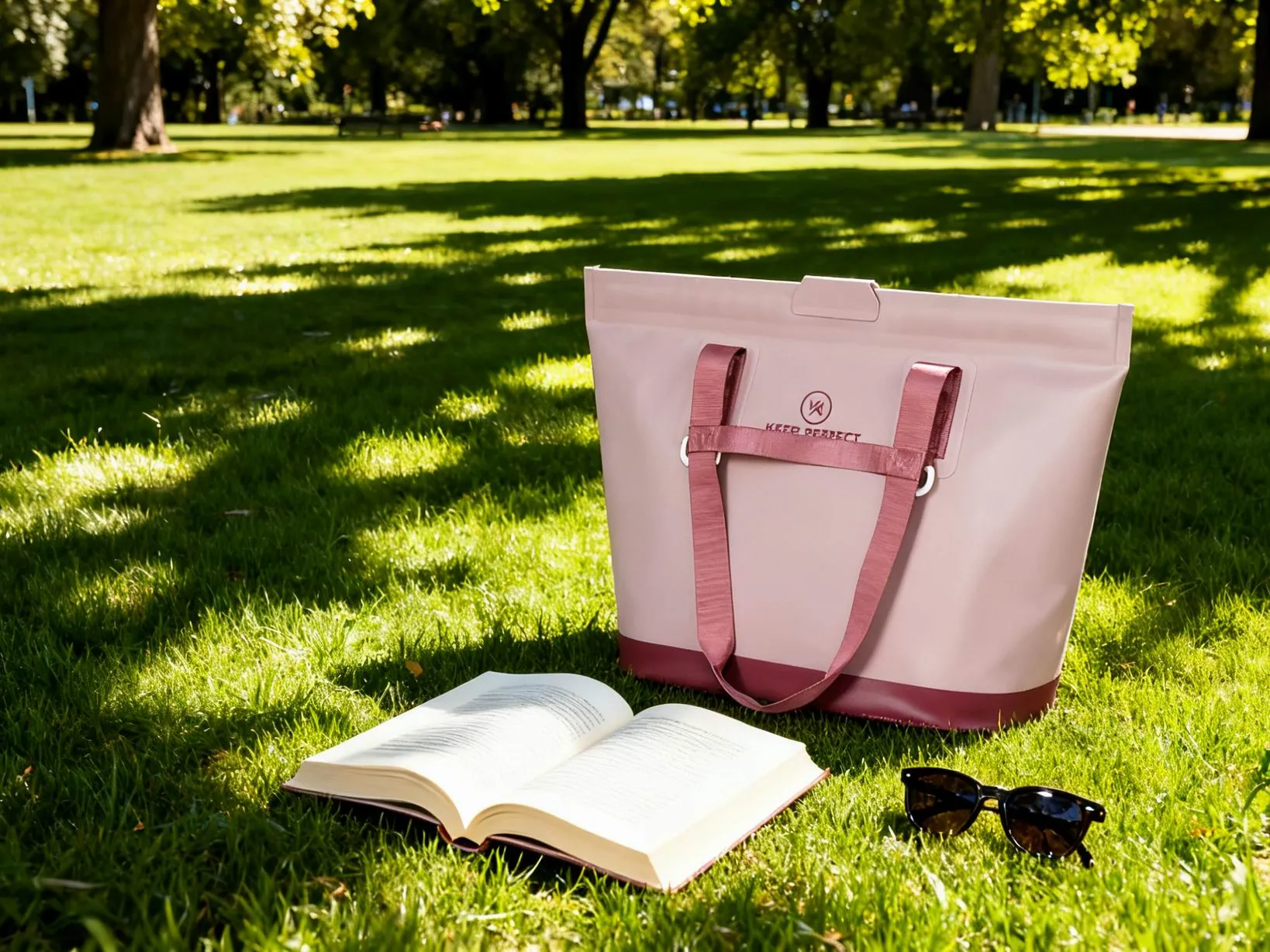
Festival merchandise is impulse revenue with a weather problem: the buyer decides at the tent, the bag carries purchases through the rest of the day, and the brand impression forms in the rain. The merch tote specification is therefore three properties at once — retail-grade presentation (the bag is photographed by thousands of phones), waterproof duty (it carries purchases through rain, spills and mud fields), and honest margin architecture (a $2.10–$3.90 build retailing at $15–$25, the promotional economics our promotional programs guide maps). Waterproof merch totes quietly outperform the cotton giveaway: where the canvas bag becomes a wet liability by afternoon, the welded-seam tote stays functional and keeps selling the brand long after the festival ends.
The format family spans flat-pack totes for high-volume sales, drawstring packs for the youth segment, and premium builds for the merch tent’s top shelf — one artwork system across three formats, split against the same 500-unit basis.
Credential and access management in the wet
Access control runs on small waterproof duty: wristbands, badge pouches, lanyard wallets and tag cases that must scan through rain, survive all-shift wear and stay legible at the gate. The specification is optical first — clear TPU windows with anti-glare finish sized to the scanner’s read zone (the window engineering our phone pouch guide documents for touchscreens applies to badge scanning identically) — then structural: welded perimeters that seal the credential against all-day exposure, breakaway lanyard options for safety compliance, and batch-coded runs that separate crew, media, VIP and artist access visibly at a glance. Credential formats price at $0.90–$2.40 at MOQ 500, the lowest-cost channel in the category and the one that touches every stakeholder on site.
Multi-day festivals add the re-entry duty: a credential that survives three rain days without delaminating is a security budget line, not a stationery line — a soaked credential is a forged credential’s best friend.
VIP and sponsor kits: weatherproof presentation
The VIP kit is the event’s diplomacy: sponsor deliverables, artist welcome packages, premium-holder gift totes. The brief marries the waterproof engineering of crew builds with the unboxing discipline of luxury retail — matte laminated shells with tone-on-tone branding, structured bodies that photograph like hard goods, and interiors tiered to the gift manifest. Weatherproof VIP builds run $4.20–$8.90 at MOQ 500, with the premium materials ladder and branding options our corporate gifting guide details. Sponsor co-branding adds the multi-logo placement conversation: zone layouts that give each sponsor its clean space, the variable-data printing our production lines run for name-personalized kits.
The hospitality crossover is direct: hotel partners, suite programs and resort venues buy the same builds for their own guest duty — the channel logic our hospitality guide documents.
Backstage document duty: the show’s paper brain
Every production runs on paper that must not die: run sheets, stage plots, advance packets, settlement documents, permits. Site offices and backstage desks operate from bins and cases that keep the show’s paperwork legible through load-in weather and lawn-site humidity — A4 and letter waterproof document cases with stiffened shells, zip-welded perimeter protection, and the batch coding that keeps each department’s packet distinct on a shared production table. The document duty parallels the construction permit logic our industrial guide covers: wet paperwork is not an inconvenience at settlement time, it is a dispute. Backstage formats run $2.10–$4.60 and split into event programs at the same 500-unit basis.
Weather engineering for the event calendar
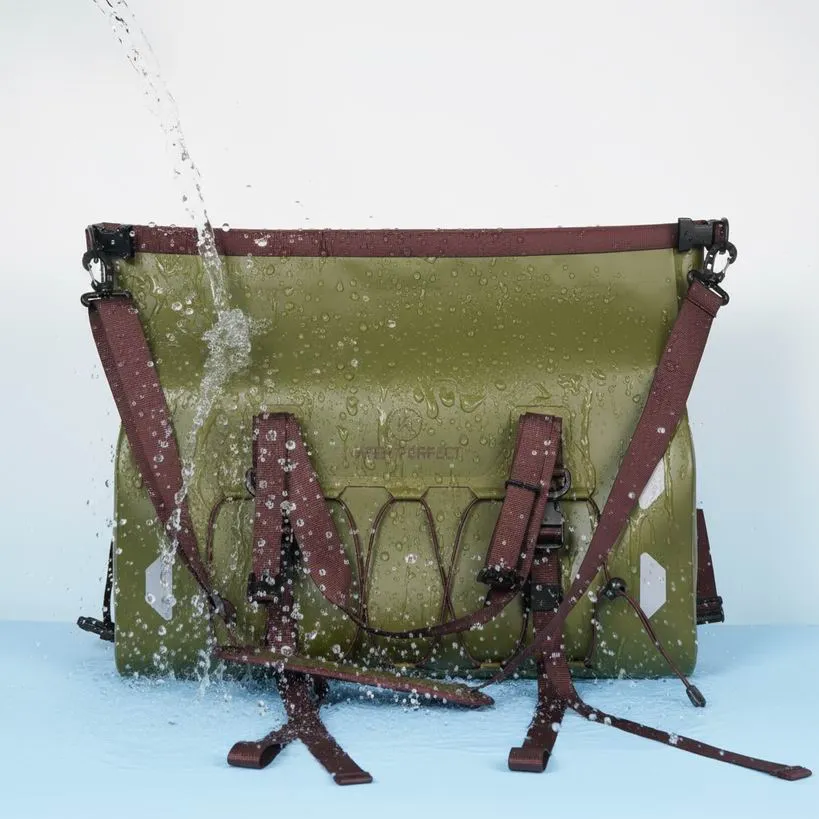
Event builds live in the splash-to-downpour band rather than the submersion band: sustained rain, mud-field abrasion, tent-run spray — the exposure class the IPX ladder maps in our IPX rating guide. The fabric decision follows the channel: merch and credential formats run 210D–420D for hand and cost, crew builds run 500D TPU-laminated for site abuse, VIP shells run premium matte laminates where finish is the spec. UV stability matters more than buyers expect — a merchandise tote on a July festival field takes more UV hours in one weekend than a commuter bag takes in a season, the polymer science our UV resistance guide quantifies. Mud-field abrasion on the base doubles fabric where the bag sets down, the load-path discipline our load stress testing guide applies to every carry format.
- Merch duty: welded seams, retail finish, mud-rated base — presentation that survives day one
- Crew duty: 500D TPU lamination, one-hand closure, night reflective, radio-first interiors
- Credential duty: optical windows, welded perimeter, breakaway options, batch-coded access tiers
- VIP duty: premium laminates, structured bodies, sponsor zone layouts, name-personalized runs
Event program economics at MOQ 500
| Program element | Unit cost adder | Notes |
|---|---|---|
| Full-color merch print, 1–2 sides | +$0.15–$0.30 | The artwork is the retail product |
| Optical scan window (credentials) | +$0.10–$0.20 | Anti-glare TPU sized to scanner read zone |
| Reflective piping (crew builds) | +$0.20–$0.35 | Stage-deck and night load-in visibility |
| Premium matte laminate (VIP) | +$0.80–$1.60 | Photographs like a hard-goods gift |
| Variable-data name printing | +$0.08–$0.15 | Name-personalized VIP and sponsor kits |
A representative festival program lands at $1.60–$3.90 for merchandise formats, $3.20–$7.20 for crew builds and $4.20–$8.90 for VIP kits — one order, one production calendar, one golden-sample standard across all three channels. The MOQ 500 basis is deliberately shaped for this: a single mid-size event mixes all four channels against one 500-unit basis, the split discipline our MOQ guide documents.
Sampling against a show date
Event calendars compress everything: the sample must exist before the print deadline, and the bulk must land before load-in. The protocol is the golden-sample standard — 6–10 working days per configuration at $60–$150 credited against bulk, 35–50 days production at AQL 2.5 — booked backward from the show date with the freight lane confirmed in writing. Event validation is dress-rehearsal validation: run the radio bag through a real show rehearsal, sell the merch tote through a pop-up day, scan a credential a hundred times in the wet. The step-by-step chain from sample approval to bulk readiness is documented.
Who buys: the event buyer map
Production companies order crew formats on tour calendars — one design per department, reprinted by season. Festival operators order merchandise and credentials on the announcement calendar, sized to gate counts and sales forecasts. Venues and corporate-event agencies order VIP and sponsor kits on the client calendar, frequently white-labeled per client event — the white-label path our private label vs white label guide compares. Event-supply distributors buy the full family for resale with tiered pricing across their rental and retail counters. The tourism crossover is constant: destination events route the same duty through the channels our tourism industry guide maps.
The wet-weather show-day checklist
Shows that survive rain do so on preparation, and the waterproof program is half the preparation. The practical list runs: credential windows tested against the actual scanner model, not a generic phone camera; crew radio bags staged at each department head’s position before gates open; merchandise totes pre-stocked under tent cover with a wet-floor protocol for the retail counter; VIP kits moved under cover and handed with the laminated shell facing the guest; backstage document cases sealed before the first forecast drop, not after. Operators who run the checklist discover that the waterproof program is not an expense against the rain day — it is the reason the rain day looks like every other day of the run, and the difference is visible in the settlement sheet.
Sustainability options for event programs
Event brands carry visible sustainability expectations, and the material menu answers them without performance loss: rPET shells from certified ocean-bound feedstock — the full supply chain story in our rPET supply chain guide — recycled liners, and mono-material construction specified for end-of-life recyclability. Festival merchandise is the natural flagship: a reusable waterproof tote replaces the single-use giveaway outright, converting the sustainability story from brochure copy into the product itself. The cost delta is modest — $0.20–$0.50 per unit at volume — and the buyer’s own marketing usually amplifies it far beyond the shelf: a waterproof merch tote with an rPET hangtag gets photographed, posted and kept, which is more than any laminated flyer achieves.
Spec your event program
- Channel mix: crew + merch + credential + VIP against one 500-unit basis
- Duty band: splash-to-downpour banding per channel, mud-rated bases on field formats
- Optical windows: scanner-sized anti-glare TPU on all credential builds
- Brand system: one artwork platform across formats, variable data for VIP names
- Calendar: golden sample before print deadline, bulk before load-in, freight lane in writing
- Reorder: season-calendar reprints on stored patterns, the reorder discipline our sampling guide covers
Frequently Asked Questions
Q1. Why do events need waterproof bags specifically?
Because event dates are fixed and weather is not: crew radios, credentials, cue sheets, merchandise and VIP kits all work outdoors in delivered weather. A dead radio, a soaked credential or a wilted gift tote are show-day failures a specified waterproof program prevents.
Q2. What is the MOQ for custom event waterproof bags?
MOQ 500 per design, splittable across the event family — one order can mix crew radio bags, merchandise totes, credential pouches and VIP kits against the same 500-unit basis.
Q3. How much do event waterproof bags cost?
Credential formats from $0.90, merchandise totes $1.60–$3.90, crew builds $3.20–$7.20, VIP kits $4.20–$8.90 at MOQ 500. Optical windows add $0.10–$0.20, premium VIP laminates $0.80–$1.60, variable-data name printing $0.08–$0.15.
Q4. Can merchandise totes really retail at festival prices?
Yes — a $2.10–$3.90 waterproof tote retails at $15–$25 in the merch tent and outperforms canvas giveaways because it survives the weather day and keeps carrying the brand after the festival. The margin architecture is mapped in our promotional programs guide.
Q5. Do you make waterproof badge and wristband pouches?
Yes — credential wallets, tag cases and wristband pouches with anti-glare optical windows sized to scanner read zones, welded perimeters for all-shift wear, and batch-coded access tiers from crew to artist level.
Q6. How do crew radio bags keep radios dry but usable?
Belt or harness mounts with clear TPU fronts that read screens and dials through rain, one-hand roll or buckle closure, and dry interior battery organization — the radio is specified first and the bag is engineered around it.
Q7. Can VIP kits be personalized per guest?
Yes — variable-data printing runs name-personalized kits within the same production batch, the capability our corporate gifting guide documents for premium programs.
Q8. Are the bags suitable for multi-day festivals?
The builds are rated for multi-day outdoor duty: UV-stable materials for full-sun fields, mud-rated bases, and credential windows rated for three rain days of scanning without delaminating.
Q9. What fabrics are used for event waterproof bags?
210D–420D for merchandise and credential formats, 500D TPU-laminated for crew builds, premium matte laminates for VIP shells — denier follows channel duty, the ladder our IPX rating guide maps.
Q10. How fast can event samples be produced?
6–10 working days per configuration at $60–$150 per design, credited against bulk — booked backward from the print deadline, because the event calendar compresses everything downstream.
Q11. What is the bulk production timeline for an event order?
35–50 days after golden-sample approval at AQL 2.5 inspection, FOB Xiamen or DDP, with the freight lane confirmed in writing before the order is placed.
Q12. Can sponsors co-brand the same bag?
Yes — zone layouts give each sponsor clean logo space on a shared shell, specified at the artwork stage so multi-brand programs print in one pass.
Q13. Do you supply event rental and supply companies?
Yes — distributor programs run the full event family for resale with tiered pricing, batch-coded for inventory across rental and retail counters.
Q14. Can one order cover a whole festival?
Yes and it usually does: a mid-size festival mixes crew, merchandise, credential and VIP formats against one MOQ 500 basis on one production calendar — five production departments alone make a 500-unit program.
Q15. How do the bags handle mud-field conditions?
Doubled base fabric where the bag sets down, TPU-laminated bodies that wipe clean, and sealed-seam construction that keeps mud out of the carry space — field duty the load-path testing in our stress testing guide validates.
Q16. What branding methods work on event bags?
Full-color print for merchandise faces, tone-on-tone for VIP shells, reflective piping for crew visibility and variable-data names for personalized kits — one artwork platform across all formats.
Q17. Can event programs run on sustainable materials?
Yes — rPET shells from certified ocean-bound feedstock, recycled liners and mono-material construction at a $0.20–$0.50 delta, with the reusable merch tote doubling as the sustainability story itself rather than a brochure claim.
Q18. How do we start an event waterproof program?
Send the channel mix, artwork system and show date — the quotation returns in 24–48 hours, samples follow in 6–10 working days, and the golden-sample approval locks the bulk calendar against load-in.
People Also Ask
What are event waterproof bags?
Custom waterproof programs for the live-event industry: crew radio and tool bags, credential and wristband pouches, merchandise totes and VIP gift kits — engineered for fixed-date outdoor duty where delivered weather cannot cancel the show.
How much do custom festival totes cost?
From $1.60 for flat-pack merchandise totes to $8.90 for premium VIP builds at MOQ 500, with full-color printing at +$0.15–$0.30 per unit.
Can waterproof bags be branded for events?
Yes — full-color merchandise faces, sponsor zone layouts, crew department branding and variable-data name personalization all run in one production pass.
Do festivals order waterproof merchandise bags?
Increasingly yes: the waterproof tote outsells and outlives the canvas giveaway, surviving the weather day while it carries purchases and keeps selling the brand afterward.
How do credentials stay dry at outdoor events?
Welded-perimeter pouches with anti-glare optical windows sized to scanner read zones — rated for all-shift wear and multi-day rain without delaminating.
How fast can event bag programs be produced?
Samples in 6–10 working days, bulk in 35–50 days after golden-sample approval — booked backward from the print deadline and load-in date.