Modern business runs on devices that die instantly in water: tablets, drones, test instruments, scanners, laptops and the servers they report to — and every one of them moves, between sites, clients, shows and shifts, through weather that does not care — so IT fleets, field-service operators, drone programs, AV teams and device brands buy waterproof transport programs at unit costs from $2.90 at MOQ 500. This guide covers the electronics-transport category end to end: the failure physics that set the spec, fleet formats for devices in daily rotation, drone and instrument builds, trade-show and event transport, ESD and corrosion considerations that waterproofing must respect, and the program economics that make sealed transport the cheapest line in any device-fleet budget.
The manufacturer reference is QUANZHOU JUNYUAN BAGS: custom waterproof bag production since 2014, 4,950 m² SGS-verified facility, 7 lines, 149 machines, 137 staff, 200,000 pieces monthly. MOQ 500 per design splittable across the electronics family, samples 6–10 working days, bulk 35–50 days, AQL 2.5 inspection, 30/70 T/T, FOB Xiamen, shipping to 100+ countries.


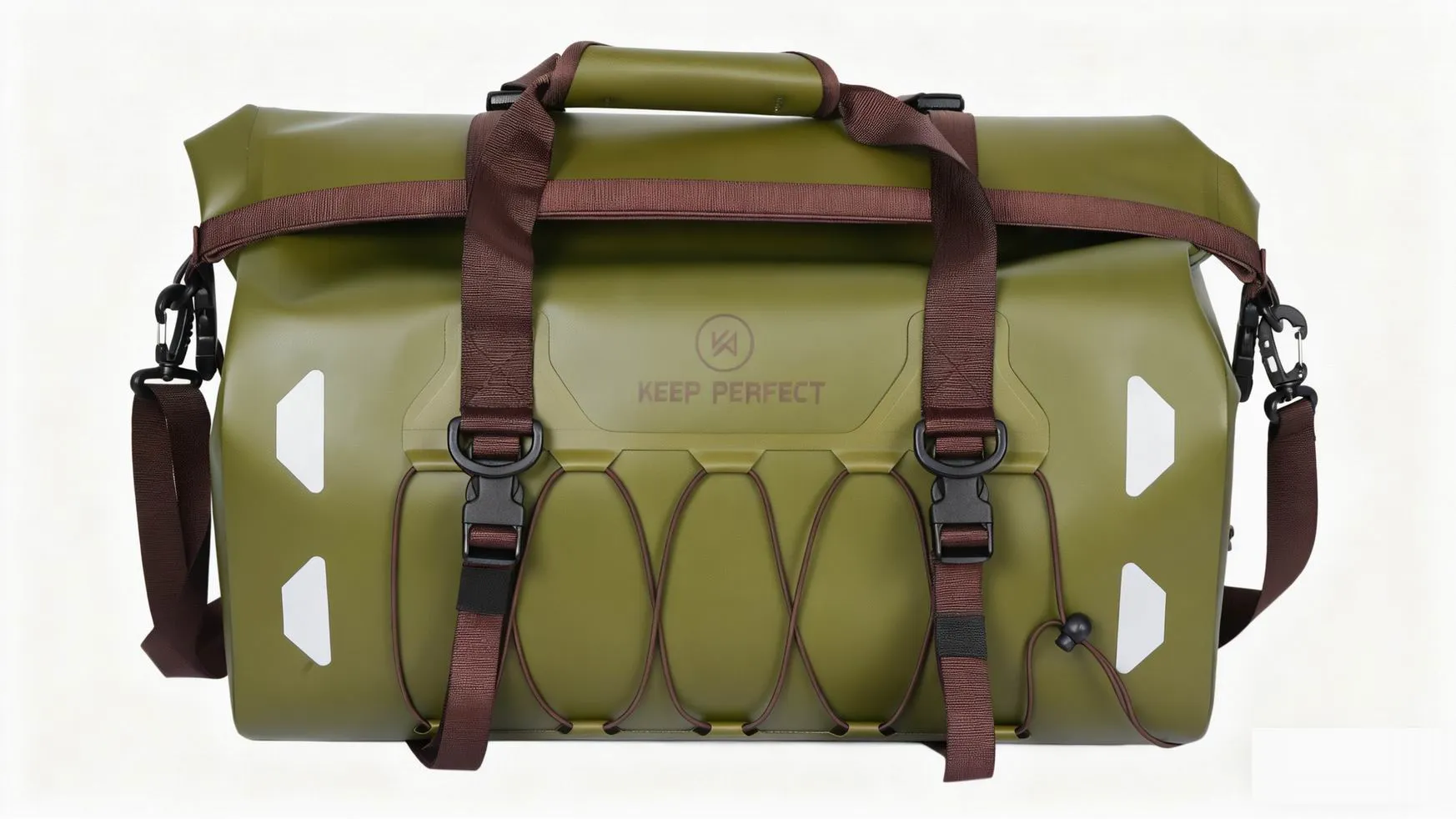
The failure physics: why water and electronics do not negotiate
Waterproof electronics transport starts from a physics fact: water kills electronics instantly and corrosion finishes what immersion starts. A splash across a powered connector can short a board beyond economic repair; a humid storage cycle grows corrosion on contacts that no calibration restores; and the third mechanism — condensation — is the stealth one, hitting devices moved between cold vehicles and warm sites the same way it fogs camera glass, the moisture discipline our photography equipment guide documents at the optics standard. The device protection bags that answer all three mechanisms are layered, not single-shell: a waterproof exterior banded to the exposure class, an impact architecture that keeps the drop from cracking the case the water would enter through, and a sealed interior chamber that buffers humidity and condensation off the boards. The banding language is the same ladder every program in this library speaks — our IPX rating guide — and the layering logic is the dual-protection argument our laptop protection guide makes for the most common device in any fleet.
The five transport channels
| Channel | Typical cargo | Defining duty | Unit cost (500+) |
|---|---|---|---|
| IT & field-service fleets | Tablets, scanners, meters, tools | Daily rotation, vehicle cycles, site weather | $2.90–$6.40 |
| Drone programs | Airframes, controllers, batteries | Wet approaches, prop-safe suspension | $5.90–$11.20 |
| AV & production | Consoles, drives, cabling, IEM kits | Load-in weather, night stages | $3.40–$8.20 |
| Trade-show & demo | Demo kits, signage, sample stock | City weather, booth-to-booth moves | $2.90–$6.80 |
| Data-center & server moves | Drives, blades, patch kit | Zero-tolerance moisture, ESD discipline | $3.80–$9.40 |
The channels share the sealed-chamber core and split on the operational brief: field fleets optimize rotation speed — devices check in and out daily, so closures are rated for cycle counts and interiors are labeled per asset, the batch-coding discipline our industrial programs guide documents for tool fleets. Drone builds carry the hardest corner — the submersion-class shells and prop-safe cradles our equipment guide specifies at the photography end of the same duty. AV and trade-show channels run the event-site logistics our event industry guide maps, at electronics stakes. Data-center moves are the zero-tolerance tier where a sealed chamber is a compliance line, not a preference.
Fleet formats: devices in daily rotation
The fleet build answers a rhythm rather than a journey: the device lives in the case between shifts, checks in and out, rides a vehicle dock, and survives the site. The engineering priorities follow: closure cycle life before closure elegance (a case opened sixty times a day is a machine — the cycle-rating discipline our durability prediction guide quantifies), asset visibility (windows and label slots that let a supervisor audit the fleet without opening every case), and interior geometry that charges-in-case where the fleet standard allows. The tablet-and-scanner formats run the optical-window engineering of our small electronics guide at fleet scale: touch-through operation, scan-through windows, and glove-speed access. Vehicle duty adds the mounting discipline of our two-wheel transport guide — hard-points, quick-release, no projectiles. Fleet programs split per role against one MOQ basis: techs, supervisors, vehicles, the per-department pattern that sizes a 500-unit order from a single mid-market operator.
Drone and instrument transport
Waterproof drone transport and instrument builds share a payload truth: the cargo is both fragile and expensive per liter, and it travels to the worst weather on the itinerary — because that is where the work is. Drone formats run the hard-soft hybrid pattern at flight-glass stakes: welded submersion-class shells, form-cut suspension locking arms and gimbals against transit shock, sealed battery chambers specified to air-transport rules, and field-carry harnesses for the wet approach, the format engineering our destination transport guide documents at the photography duty class. Test instruments — multimeters, environmental sensors, medical-adjacent devices — add calibration stakes: an instrument that takes on moisture is out of tolerance and off the job, the chain-of-integrity argument our medical transport guide makes for clinical devices. Instrument formats run the sealed-chamber standard with desiccant-indicator pairs at $3.40–$9.40, and calibration labs increasingly specify them for loaner fleets — the rental-discipline economics our lens-case channel documents.
Trade-show and demo transport
The demo kit is the company’s product in a bag: it crosses cities, booths and hotel lobbies in every weather a sales calendar meets, and it fails expensively — a dead demo unit is a lost booth day plus a repair cycle. Trade show gear bags answer with the city-transit brief: rolling-friendly formats where the venue walk justifies wheels, splash-band shells for taxi-and-tarmac duty, and interiors that stage the demo — the kit opens to a working presentation rather than a jumble, the staged-packing method our organizer guide formalizes. Branding is functional here, not decorative: the case face is booth furniture before the booth is built, the presentation logic our promotional programs guide values at the highest-visibility tier. Show programs split booth kits, demo stock and collateral formats against one basis and reprint on the show calendar — the seasonal reorder discipline our tourism retail channels document.
ESD, corrosion and the waterproofing trade-offs
Electronics transport has a materials layer that ordinary waterproof programs do not: static and corrosion. Static-discharge protection (ESD) is normally a property of specific lining materials — and it coexists carefully with sealed-chamber construction: the practical spec pairs conductive or dissipative interior surfaces where the device standard requires them with a sealed outer perimeter that keeps humidity off the boards, the materials trade-off specified at the artwork stage rather than discovered at the first field failure. Corrosion defense is the chamber’s own brief: contacts and connectors corrode silently in humid storage, the same slow-failure physics our photography guide documents for optics, and the desiccant-indicator standard answers it identically. The honest engineering note for buyers: a fully sealed chamber trades airflow for moisture control — correct for transport and storage, but devices that run hot inside sealed liners need ventilation paths at the pattern level, specified as ports, not accidental gaps.
- ESD linings: dissipative interior surfaces where device standards demand, sealed perimeter outside them
- Corrosion defense: desiccant-indicator chambers that keep humidity off contacts in storage and transit
- Thermal honesty: ventilation ports engineered for heat-generating devices, never accidental gaps
- Battery rules: transport-rated battery chambers confirmed in writing at the artwork stage
Electronics program economics at MOQ 500
| Program element | Unit cost adder | Notes |
|---|---|---|
| Sealed chamber + desiccant pair | +$0.40–$0.90 | The moisture defense line |
| Optical scan/touch window | +$0.30–$0.60 | Fleet devices used in-case |
| Hard-soft hybrid frame (drones) | +$1.20–$2.40 | Flight-glass protection |
| ESD-dissipative lining | +$0.35–$0.70 | Device-standard compliance |
| Asset labels + batch coding | +$0.10–$0.25 | Fleet audit without opening cases |
A representative fleet program lands at $2.90–$6.40 per unit at MOQ 500 — the sealed chamber, cycle-rated closures, asset visibility and splash-band shell — with drone and server-tier builds above it. The budget line that closes programs is replacement math: a fleet tablet runs $400–$700, and one prevented water event pays for a hundred case-units. IT buyers run the same arithmetic our healthcare programs run for instruments and our oil-and-gas buyers run for samples: the protection is the cheapest component of the cargo it carries.
Sampling against the fleet, not the catalog
Electronics samples validate with the actual devices and the actual rhythm: the fleet case runs a full check-in/check-out week, the drone format ships a real itinerary, the demo kit stages a real booth. The protocol is the golden-sample standard — 6–10 working days per configuration at $60–$150, credited against bulk — with the category’s decisive test borrowed from our photography program: the condensation run, cold device into the warm chamber, inspected for fog at the window. Bulk runs 35–50 days at AQL 2.5 with interiors frozen at approval, and the step-by-step chain is documented. Fleet reorders run on stored patterns at replacement ratios — the calendar our reorder guide quantifies.
Who buys: the electronics buyer map
IT directors and fleet managers order rotation formats on refresh cycles, batch-coded to asset registers — the accountability architecture our logistics buyers use for parcels. Field-service and utilities operators order the site-duty tier, the weather ladder our work-site guide documents. Drone service companies — inspection, mapping, agriculture, the survey duty our farming guide covers — order flight programs. AV integrators and event producers order the load-in channel. Device brands — drone makers, instrument makers, tablet brands selling into rugged markets — order branded transport as accessory lines, the private-label path our white label comparison documents. The buyer map is the category’s growth story: every industry that field-deploys electronics is quietly in this market.
Cold-chain and environmental extremes
Electronics transport meets temperature extremes the same way cargo does: winter fleets ride vehicles that drop below freezing overnight, desert and tropical programs cycle through heat and humidity in one shift, and the device’s own operating envelope — the manufacturer’s storage range printed in every spec sheet — becomes the transport spec’s baseline. The build answers at the materials layer: low-temperature-flexible laminations that do not crack at the cold-end of the range, the freeze-thaw discipline our work-site guide specifies for winter fleets, and heat-stable chambers that do not outgas at the hot end — the interior chemistry that matters most precisely where sealed and warm intersect. Cold-vehicle storage adds the condensation protocol: a device moved from a frozen dock into a heated cab fogs from the inside if the chamber is not sealed — the same physics our destination guide documents for camera glass — and the sealed chamber is the buffer that lets the device acclimate dry. Programs in extreme climates specify the envelope in writing at the artwork stage; the laminate ladder answers, and the durability science our aging guide runs predicts the service life before the fleet learns it.
Insurance and asset-register integration
Electronics fleets are insured assets with serial numbers, and the transport program increasingly shows up in the policy conversation: batch-coded chambers map to asset registers, build sheets document the protection systems, and the replacement-ratio history a sealed-fleet runs reads better than a failure log — the documented-build argument our destination photography guide makes for gear insurance, applied to IT inventories where the asset counts are larger. The operational version of the same discipline: a case that opens to labeled slots is an audit that takes seconds — the supervisor counts by window, the inventory system reads the batch code, and the check-in cycle our fleet section specifies closes without a clipboard. The buyers who integrate the case into the asset system order batch coding and label windows as first-line features, not add-ons; the ones who do not discover the value at the first annual inventory.
The refresh-cycle partnership
Device fleets turn over on two- to four-year refresh cycles, and the transport program that survives refreshes is the one patterned for change: modular interiors that re-pin when the tablet model changes, closures and shells that outlast two device generations, and a stored-pattern reprint that ships new interiors before the new devices arrive. The economics track our reorder guide’s numbers: reprints on stored patterns run a fraction of first-run cost on two-week calendars, and the program that plans the refresh orders once rather than reacting to it. Brand crossovers run the same clock: device makers ship transport accessories per generation, the private-label channel our white label guide documents, and the accessory that outlasts the device it was sold with is the retention product that keeps the brand in the field through the whole cycle.
Spec your electronics program
- Channel first: fleet rotation, flight program, show kit or server tier — the briefs differ
- Layered spec: exposure-band shell + impact frame + sealed chamber, each named in the pattern
- Materials layer: ESD linings where standards demand, thermal ports where devices run hot
- Asset system: windows, label slots, batch coding for audit-without-opening
- Cycle rating: closures specified for the rotation count, not the showroom demo
- Calendar: sample against the real rhythm, bulk at AQL 2.5, reorders on stored patterns
Frequently Asked Questions
Q1. Why do electronics need waterproof transport bags?
Because water kills instantly, corrosion finishes silently and condensation hits every cold-to-warm vehicle move — and every fleet device travels. A sealed chamber is the cheapest component in the cargo it protects: one prevented event pays for a hundred case-units.
Q2. What is the MOQ for custom electronics transport bags?
MOQ 500 per design, splittable across the electronics family — fleet cases, drone formats, demo kits and instrument chambers mix against one 500-unit basis.
Q3. How much do custom waterproof electronics cases cost?
Fleet formats $2.90–$6.40, AV builds $3.40–$8.20, drone transport $5.90–$11.20, server-move tiers $3.80–$9.40 at MOQ 500. Sealed chambers add $0.40–$0.90, optical windows $0.30–$0.60, ESD linings $0.35–$0.70.
Q4. Can tablets be used inside the case?
Yes — optical windows pass touch and scan operation without opening: fleet devices check in and out sealed, scan through rain and charge where the fleet standard allows, with closures rated for daily-rotation cycles.
Q5. How are drones transported in bad weather?
Submersion-class welded shells with prop-safe form-cut suspension, sealed battery chambers to air-transport rules and harness carry for wet approaches — the hard-soft hybrid pattern at flight-glass stakes, from $5.90 at MOQ 500.
Q6. Do waterproof cases protect against drops too?
The layered build does: an impact frame under the waterproof shell keeps the drop from cracking the case the water would enter through — water and shock are separate failure paths, engineered separately, the dual-system argument our laptop guide documents.
Q7. What is ESD lining and when is it needed?
Static-dissipative interior surfaces specified where device standards demand them, paired with a sealed outer perimeter — the coexistence is a materials trade-off engineered at the artwork stage, not improvised after a field failure. Device fleets that move by air are additionally built to IATA carriage rules for lithium cells, and any ingress claim on a sealed case should be traceable to the IEC 60529 enclosure code rather than to a marketing adjective.
Q8. Are waterproof cases suitable for server and data-center moves?
Yes — the zero-tolerance tier: sealed chambers with desiccant-indicator pairs, ESD-discipline linings and asset batch-coding, because a moisture event on drives or blades is a compliance incident, not a repair ticket.
Q9. Can one order cover a whole field fleet?
Yes and it usually does: tech, supervisor and vehicle formats split per role against one MOQ 500 basis, batch-coded to the asset register — a mid-market field operator sizes a complete program from one order.
Q10. What closures survive daily fleet rotation?
Cycle-rated systems specified for the rotation count — the aging science our durability guide quantifies: a case opened sixty times a day is a machine, and its closures are consumables with a rating.
Q11. Do the cases prevent condensation damage?
Sealed chambers buffer the cold-to-warm transition: the device acclimates inside a dry envelope instead of fogging in the open — the same condensation discipline our photography program validates with the fog-at-the-window test.
Q12. Can demo kits open straight to a working presentation?
Yes — staged interiors open to a working booth setup rather than a jumble: the demo kit crosses city weather and stages in one motion, the packing method our organizer guide formalizes.
Q13. Are battery chambers airline-compliant?
Transport-rated battery chambers are specified to the packaging discipline carriers accept, confirmed in writing at the artwork stage — drone and fleet programs ship with the rules documented, not assumed.
Q14. How fast are electronics program samples?
6–10 working days per configuration at $60–$150 per design, credited against bulk — validated against the real devices and the real rhythm: a rotation week, a real itinerary, a staged booth.
Q15. What is the bulk production timeline?
35–50 days after golden-sample approval at AQL 2.5 inspection, FOB Xiamen or DDP, with interiors frozen at the approved sample — the full chain runs from sampling through bulk.
Q16. How do we start an electronics transport program?
Send the device list, the rotation rhythm and the exposure profile — the quotation returns in 24–48 hours, samples follow in 6–10 working days patterned to the actual fleet.
People Also Ask
What is waterproof electronics transport?
A layered protection system — exposure-band waterproof shell, impact frame, sealed humidity chamber — engineered for devices that die instantly in water and corrode silently in damp, moving between sites through weather that does not care.
How much do custom device cases cost?
From $2.90 for fleet formats to $11.20 for drone transport at MOQ 500, with sealed chambers at +$0.40–$0.90 and ESD linings at +$0.35–$0.70.
Can you use a tablet without removing it from the case?
Yes — optical windows pass touch and scan operation, closures are rated for daily check-in/check-out cycles, and asset windows let supervisors audit the fleet without opening a case.
How do drones travel in rain and boats?
Welded submersion-class shells with prop-safe suspension and sealed battery chambers to airline rules — the hard-soft hybrid pattern from $5.90 at MOQ 500.
Do waterproof cases cause overheating?
Only if the thermal layer is skipped: heat-generating devices get engineered ventilation ports at the pattern level — specified paths, never accidental gaps, with the sealed perimeter intact around them.
Are waterproof electronics bags worth it for IT fleets?
One prevented water event on a $400–$700 tablet pays for a hundred case-units — the protection is the cheapest component in the cargo it carries, and the fleet math closes every program.