Logistics is the industry where waterproof performance is measured in network reliability: every wet parcel is a claim, every illegible wet label is a misroute, every soaked freight document is a shipment that stops at the border — so parcel networks, courier fleets, freight forwarders and warehouse operators run specified waterproof programs from hub to doorstep, at unit costs from $1.20 at MOQ 500. This guide covers the full logistics program: the five segments (parcel hubs, last-mile courier fleets, freight documentation, warehouse and dock operations, e-commerce fulfillment), material and durability specifications for industrial duty cycles, branding and hi-vis requirements, and the economics of buying transport gear as network infrastructure rather than consumables.
The manufacturer reference is QUANZHOU JUNYUAN BAGS: custom waterproof bag production since 2014, 4,950 m² SGS-verified facility, 7 lines, 149 machines, 137 staff, 200,000 pieces monthly. MOQ 500 per design splittable across the logistics family, samples 6–10 working days, bulk 35–50 days, AQL 2.5 inspection, 30/70 T/T, FOB Xiamen, shipping to 100+ countries.

Why logistics buys waterproof as network infrastructure
Weather is the logistics industry’s oldest adversary, and logistics waterproof bags are how the industry answers it — from parcel sortation to shipping industry bags that protect documents crossing borders. The logistics industry’s product is reliability, delivered on time intact — and weather is the variable the network cannot schedule around. Every stage has an exposure: parcels meet the yard between trailer and conveyor at the hub, meet the sidewalk at the doorstep, meet the truck bed at the freight dock. The claims math is what converts logistics buyers: a single water-damaged parcel claim (refund, reship, support time, customer trust) typically costs more than the bag that would have protected it, and the bag protects thousands. Freight documentation is the same story at higher stakes: the bill of lading, customs paperwork and dangerous-goods declarations that ride with the shipment stop the shipment if they become illegible — which is why document cases are standard freight equipment, covered in our customs and import guide.
The scale context: global parcel volumes run above 160 billion a year and the last-mile share of logistics cost runs 40–50 percent of total — the segments where weather exposure is highest and margins are thinnest, which is precisely where a sub-$5 protective asset with an 18-month duty life earns its keep.
The five logistics segments and their specifications
| Segment | Formats | Key spec | Unit cost (500+) |
|---|---|---|---|
| Parcel hub operations | Tote liners, sleeve cases, label wallets | Abrasion + rapid handling | $1.20–$4.90 |
| Last-mile courier fleets | Courier backpacks, pannier liners | Rain duty + visibility + 15 kg cycles | $3.40–$8.50 |
| Freight documentation | Document cases, DG-declaration wallets | Immersion-rated document protection | $1.90–$3.60 |
| Warehouse & dock | Tool bags, scanner cases, hi-vis totes | Industrial duty + hi-vis + chemical splash | $2.40–$6.80 |
| E-commerce fulfillment | Branded shipper protectors, return totes | Waterproof + brand presentation | $2.10–$5.40 |
The segments buy on different logics: hubs buy abrasion durability in thousands of handling cycles; couriers buy all-weather duty with safety visibility; freight buys document protection to a standard that survives a storm and a customs officer; warehouses buy industrial spec with hi-vis; e-commerce brands buy the customer’s unboxing moment in rain. A quotation that does not ask which segment is quoting a bag, not a program.
The hub problem: where weather enters the network
The sorting hub is logistics’ weather chokepoint: parcels travel sealed in vehicles, but between trailer, conveyor and outbound load they cross open yards in every season. Networks manage the exposure with protective equipment at the transfer points — waterproof tote liners for open-carton staging, sleeve cases for high-value and high-vulnerability SKUs, and label wallets that keep barcode labels scannable through a downpour (a wet, illegible label is not a damage claim; it is a misroute that costs more than damage). The specification for hub duty is abrasion first: 500D laminated bodies surviving thousands of drag-and-drop cycles, with the construction standards in our construction methods guide. Hub equipment is fleet-issued and tracked like the scanners it carries — the asset-management pattern that keeps a 10,000-parcel hub’s equipment budget on a predictable rotation.
Last-mile fleets: the courier specification
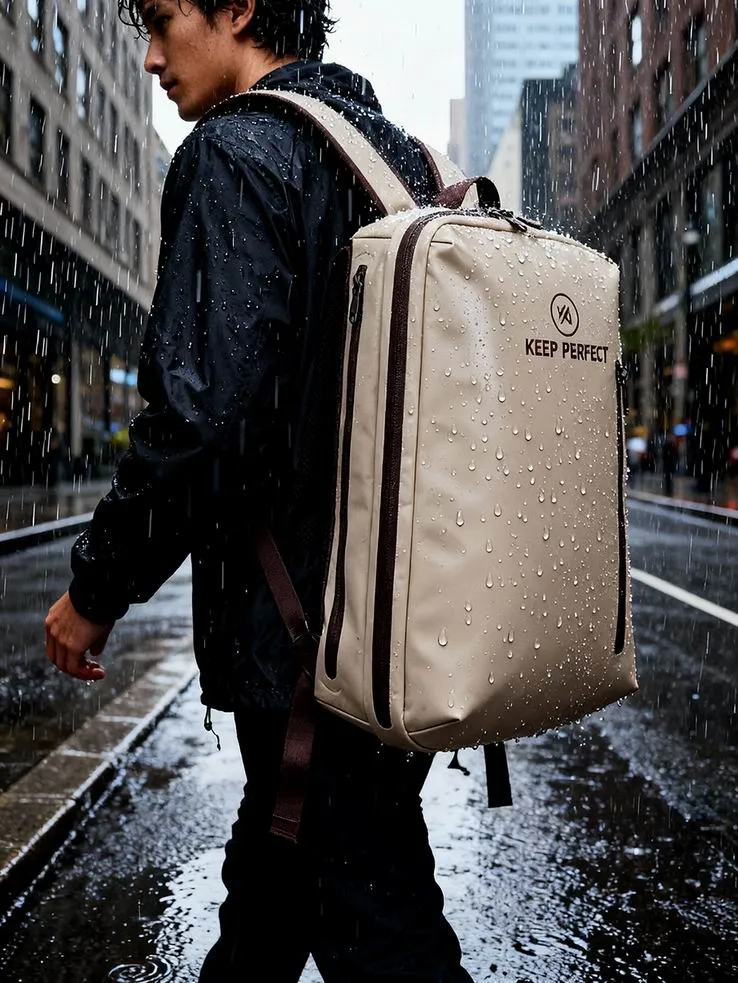
Last-mile couriers — bicycle, scooter, van and on-foot — run the network’s highest weather exposure per item: every delivery ends on a doorstep, every route runs in whatever the sky delivers, and peak season runs straight through winter in the northern markets. The courier build is a synthesis spec: splash-to-jet-band waterproofing (the parcels must arrive dry; couriers are not swimming), 500D shells with reinforced bases for daily 15 kg load cycles, integrated reflective panels for the traffic mix (the safety architecture in our reflective materials guide), and quick-access closures operable one-handed at the door. Courier fleets buy in per-rider issues with seasonal refresh — a 500-courier network is a 500-unit order plus float at exactly our MOQ, on a 12–18 month rotation. The food-delivery cousin of this spec — insulated for temperature — is covered separately in our food delivery guide.
Freight documentation: the paper that stops shipments
International freight runs on paper that must survive the same weather as the cargo: bills of lading, customs declarations, dangerous-goods documents and inspection certificates ride with the shipment from origin to destination. A wet, illegible document is a shipment-stopping event — detention at the border, demurrage on the clock, and a reissuing process measured in days. Freight document cases are specified immersion-rated precisely because the consequences justify it: welded construction, positive-sealing closures, and lanyard attachment points that keep the case with the driver rather than under the truck. Our IPX7 vs IPX8 comparison covers the rating logic for buyers specifying the seal level; document cases run $1.90–$3.60 at MOQ 500 in fleet quantities, and forwarders typically issue per-driver plus per-vehicle sets.
Warehouse and dock operations
Warehouse and dock staff work the network’s industrial environments — outdoor docks, yard transfers, loading in rain — and their equipment spec mirrors the utility-sector build covered in our industrial and utility workers guide: hi-vis colorways as safety equipment, chemical-splash tolerance for the fluids that live on working docks (the material chemistry in our chemical resistance guide), and scanner-and-tablet cases that keep the network’s data devices alive through outdoor duty. The economics of industrial-grade gear versus workwear-grade replacements follow the durability math in our load stress testing guide: fleet-grade components cost 20–30 percent more up front and last three times longer.
E-commerce: waterproof as customer experience
The newest logistics segment buys waterproof as brand protection in the customer’s final moment: the e-commerce brand whose parcel arrives soaked — or arrives dry because the shipper protector worked — has made a brand statement either way. Direct-to-consumer brands in weather-exposed categories (apparel, electronics, paper goods) increasingly specify branded waterproof shipper protectors and return-route totes: the outbound journey protected and branded, the return journey pre-paid for. Return logistics matter as much as outbound in category economics — waterproof return totes fold flat for customer storage and survive the round trip, at $2.10–$5.40 in MOQ-500 quantities. The brand-presentation requirements are the ones our packaging design guide covers, applied to the weather variable.
Durability engineering for fleet duty
Logistics duty cycles are the category’s most quantifiable: a courier bag survives a known number of delivery cycles, a hub liner a known number of handling cycles, a dock case a known shift count — which is why logistics procurement is the most receptive buyer for durability engineering. The stack: 500D laminated shells with reinforced base panels, strap systems engineered for cycled loads (the testing methodology in our load stress testing guide), zippers specified for thousands of cycles rather than fashion-grade counts, and UV-stable materials for outdoor-staged equipment — the aging predictions in our accelerated aging tests guide. Fleet buyers who specify this stack get equipment economics; buyers who substitute retail-grade gear get replacement economics, and the difference compounds across a 500-unit fleet every rotation.
Branding and visibility for logistics fleets
The logistics bag is moving signage: a 500-courier fleet puts branded bags through every neighborhood the network serves, eight hours a day, in the highest-recall context there is — a working delivery professional. Branding that survives the duty: large-format prints readable at 20 meters, Pantone-matched at Delta E ≤2 so the fleet reads as one network, print methods specified for outdoor durability (method economics in our logo options guide), and the reflective integration that makes the brand and the safety requirement the same design element. Contract-logistics programs add co-branding — network and client brands sharing panels, printed per batch with variable data for route territories, the same technique our corporate promotional guide documents for brand campaigns.
Logistics program economics at MOQ 500
| Program line | Unit cost (500+) | Duty cycle | Fleet math |
|---|---|---|---|
| Document case | $1.90–$3.60 | 24–36 months | Per-driver + per-vehicle issue |
| Label wallet | $1.20–$2.10 | 12–18 months | Per-handler issue, hub scale |
| Courier backpack | $3.40–$8.50 | 12–18 months | Per-courier + 10% float |
| Hub tote liner | $2.40–$4.90 | 18–24 months | Hub equipment rotation |
| Scanner/tablet case | $2.40–$6.80 | Device lifecycle | Per-device fleet |
| E-commerce shipper protector | $2.10–$5.40 | Round trip | Season volume |
The MOQ 500 splits across the equipment family: a regional network’s couriers, hubs and vehicles run as one order with tiered designs. Volume programs above 2,000 units step down in cost — the full mechanics are in the cost breakdown guide.
Sampling: the route test
Logistics samples prove themselves on the network: the courier bag through a full route week including a rain day, the document case through a border crossing in weather, the hub liner through a peak-week handling cycle. The evaluation criteria are the duty spec — strap performance at hour eight of a 60-stop day, closure operation with gloved hands, label readability through a wet wallet, base-panel condition after a month of dock duty. Samples run 6–10 working days at $60–$150 per configuration, credited against bulk, with the golden sample becoming the AQL 2.5 reference for fleet production. Networks should sample the full equipment family together, because the SKUs work as a system. The full protocol is in our sampling guide.
Common mistakes in logistics bag programs
- Retail-grade fleet buys: fashion zippers and straps fail inside a duty cycle — replacement economics beat equipment economics
- Ignoring label protection: a wet label is not a damage claim, it is a misroute — the cheapest fix in the network
- Hi-vis as decoration: reflective panels must be engineered for 360-degree visibility, not stuck on as branding
- Document cases at splash spec: freight documents justify immersion-rated protection — detention costs more than the spec upgrade
- No float stock: a courier without a bag is a route that fails — 10% float is the cheapest network insurance
- Forgetting the return leg: e-commerce protection that is one-way leaves half the journey exposed
The network procurement calendar
Logistics programs buy on operational calendars: fleet expansions align with volume growth and market launches, seasonal capacity aligns with peak (the winter peak in mature markets, festival peaks in Asia), and equipment rotations align with fiscal-year budgets. The production math — samples 6–10 working days, bulk 35–50 days, freight 4–6 weeks — means peak-season equipment orders must be placed by mid-summer in mature markets, and fleet launches need sampling underway the moment the expansion is approved. Rotation reorders of established designs ride the 30–35 day window. Networks that plan the calendar buy sea freight and unhurried QC; networks that order late buy air freight and learn what compressed inspection misses. The wholesale-side planning discipline is the same one in our seasonal planning guide.
Cross-border operations: the customs interface
Cross-border logistics adds a regulatory interface where waterproof equipment earns a second kind of keep: customs inspection. Shipments opened at the border are re-secured in whatever weather the inspection yard offers, and the equipment that makes that transition orderly — resealable waterproof wrap formats, document cases that present paperwork dry and legible, and inspection-friendly closures an officer can open and reseal — directly reduces the friction costs of border time. The cross-border program also runs the industry’s strictest documentation expectations: our export documentation pack (material declarations, batch traceability, AQL records) is built for exactly this environment, and the import-side compliance map — duties, documentation, and the paperwork sequence — is in our customs and import guide. Forwarders running multi-lane networks specify one document-case standard across all lanes for exactly this reason: one format, trained once, inspected everywhere.
Spec your logistics program
Bring four facts — your segment (hub, last-mile, freight, warehouse, e-commerce), your fleet scale and rotation cycle, your climate exposure profile, and your brand and visibility standards — and the quotation returns in 24–48 hours: format spec per segment, durability engineering to your duty cycle, and a costed equipment program at MOQ 500 with SKU splits. QUANZHOU JUNYUAN BAGS — logistics-grade custom waterproof bags since 2014, 4,950 m² SGS-verified facility, 7 lines, 149 machines, 137 staff, 200,000 pieces monthly, samples 6–10 working days, bulk 35–50 days, AQL 2.5, 30/70 T/T, FOB Xiamen, 100+ countries. The production chain from first inquiry runs from sampling into bulk; the import-side logistics are in our customs and import guide, and the complete manufacturing reference is the manufacturing guide.
Frequently Asked Questions
Q1. What waterproof bags do couriers use?
Splash-to-jet-band courier backpacks with 500D shells, reinforced bases for daily 15 kg cycles, integrated reflective panels, and one-handed quick-access closures — $3.40–$8.50 at MOQ 500 on 12–18 month rotations.
Q2. How much do custom logistics bags cost?
At MOQ 500: label wallets $1.20–$2.10, document cases $1.90–$3.60, hub tote liners $2.40–$4.90, scanner cases $2.40–$6.80, courier backpacks $3.40–$8.50, e-commerce shipper protectors $2.10–$5.40.
Q3. What is the minimum order for network-branded bags?
MOQ 500 per design, splittable across the equipment family — a regional network’s couriers, hubs and vehicles as one order with tiered designs.
Q4. Why do freight documents need waterproof cases?
A wet bill of lading or customs declaration stops the shipment at the border: detention, demurrage and reissuing measured in days. Document cases run $1.90–$3.60 — less than an hour of detention on most lanes.
Q5. How long do courier fleet bags last?
Properly specified: 12–18 months of daily route duty. The failure points are zippers and straps under load cycling — fleet-grade components cost 20–30 percent more and last roughly three times longer.
Q6. Can logistics bags be hi-vis and branded together?
Yes — integrated reflective panels make safety and branding the same design element: 360-degree night visibility with large-format Pantone-matched brand panels readable at 20 meters.
Q7. What protects parcels at sorting hubs?
Waterproof tote liners for open-yard staging, sleeve cases for high-vulnerability SKUs, and label wallets that keep barcodes scannable through downpours — abrasion-spec 500D construction for thousands of handling cycles.
Q8. Do e-commerce brands need waterproof shipping protection?
Weather-exposed categories do — apparel, electronics, paper goods: a branded shipper protector ($2.10–$5.40) protects the unboxing moment and doubles as return-leg protection for the round trip.
Q9. What is the claims math for waterproof fleet bags?
A single water-damaged parcel claim (refund, reship, support time) typically costs more than the bag that would have protected it — and the bag protects thousands. Fleet bags are insurance priced in cents per delivery.
Q10. Can one order cover couriers, hubs and vehicles?
Yes — courier backpacks, hub liners, document cases and scanner cases as tiered designs on one production calendar, with per-territory variable-data printing for route branding.
Q11. How fast can a fleet expansion be equipped?
Samples 6–10 working days, bulk 35–50 days after golden-sample approval, freight 4–6 weeks. Expansions should start sampling at approval; rotation reorders ship in 30–35 days.
Q12. What materials survive dock and yard duty?
500D laminates with reinforced base panels, chemical-splash tolerance for working-dock fluids, UV-stable films for outdoor-staged equipment, and zippers specified for thousands of cycles.
Q13. Do warehouse scanners need waterproof cases?
Outdoor dock and yard duty says yes: scanner and tablet cases ($2.40–$6.80) keep the network’s data devices alive through loading-rain and yard transfers — the device is worth thirty times the case.
Q14. Can return logistics be waterproofed?
Yes — return totes fold flat for customer storage and survive the round trip, pre-labeled for pickup, protecting reverse-logistics economics the same way outbound protection guards the first impression.
Q15. How do I test a logistics bag sample?
Run it on the network: a full route week for courier bags including a rain day, a border crossing for document cases, a peak-week handling cycle for hub liners. Evaluate straps at hour eight, closures with gloves, bases after dock duty.
Q16. Are logistics bags the same as food delivery bags?
No — food delivery adds food-contact liners and insulation for temperature; parcel logistics optimizes abrasion durability, document protection and label handling. Different specifications, the same MOQ structure and production calendar.
People Also Ask
How do couriers keep packages dry?
Fleet-issued waterproof bags: splash-to-jet-band protection, reinforced bases, and label wallets that keep barcodes scannable — parcel networks treat the bag as network infrastructure, not courier preference.
What happens if a shipping label gets wet?
It misroutes — which costs more than damage: sorting fails, delivery stalls, support time compounds. Label wallets at $1.20–$2.10 are the network’s cheapest reliability fix.
Do delivery drivers need waterproof bags?
Every route runs in whatever the sky delivers, and peak season runs through winter — all-weather bags with hi-vis panels are both equipment and safety gear for couriers on traffic-mixed routes.
What is a waterproof document case for freight?
An immersion-rated case carrying bills of lading, customs declarations and DG documents with the shipment — because wet paperwork is a shipment-stopping event at any border.
Can packages be waterproof without plastic mailers?
Yes — reusable branded shipper protectors and return totes protect the parcel both directions without single-use plastic, with round-trip economics single-use mailers cannot match.
How often do delivery fleets replace bags?
12–18 month rotations with 10% float for new starters and swaps. Specified properly, the replacement cycle is a budget line; underspecified, it is a quarterly surprise.