A ski holiday destroys bags in the transfers and in the boot room, not on the mountain. The bag is checked at an airport, dragged across slush and road salt, stacked under other luggage in a coach hold, and then it lives in a shared boot room where meltwater runs across the floor all day and nothing dries overnight. Meanwhile the traveller cycles it between a heated hotel at twenty-two degrees and a lift queue at minus twelve, six or eight times a day, and expects gloves, goggles and a phone to work every time. That sequence, not the sport, is the specification.
This guide follows the itinerary rather than the equipment: what airline baggage systems do to soft goods and why strap management is a genuine hazard, how road salt and de-icing fluid at the airport attack hardware, how to choose between a soft ski bag and a hard case against weight limits and damage risk, why the boot room is the defining wet environment and how a bag should be built to stand in it, how the boot bag crossover works, what a heated hotel room does to wet kit, how gondolas and resort buses impose a volume ceiling, what hot spring and spa humidity does differently, how hut-to-hut travel changes the drying problem, why altitude sun and sunscreen belong in the brief, a format matrix for a ski holiday range, and how a resort programme is structured commercially. For the sport itself — edges, freeze-thaw closures and boot meltwater on the hill — see our separate article on ski and snowboard bags. QUANZHOU JUNYUAN BAGS has produced custom waterproof bags since 2014 in a 4,950 m² SGS-verified facility: MOQ 500 pieces per style, sampling in 6–10 working days, bulk in 35–50 days, FOB Xiamen.
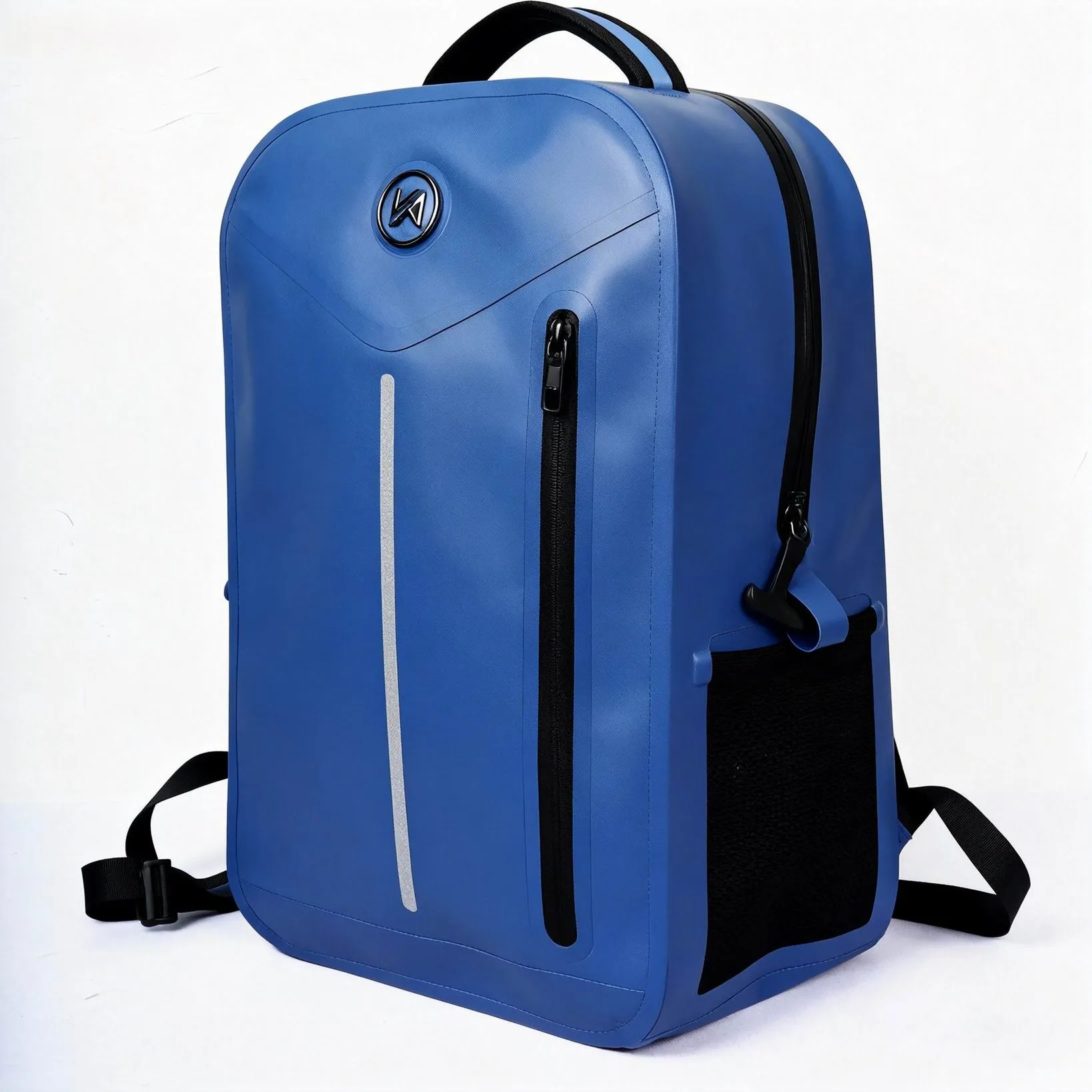
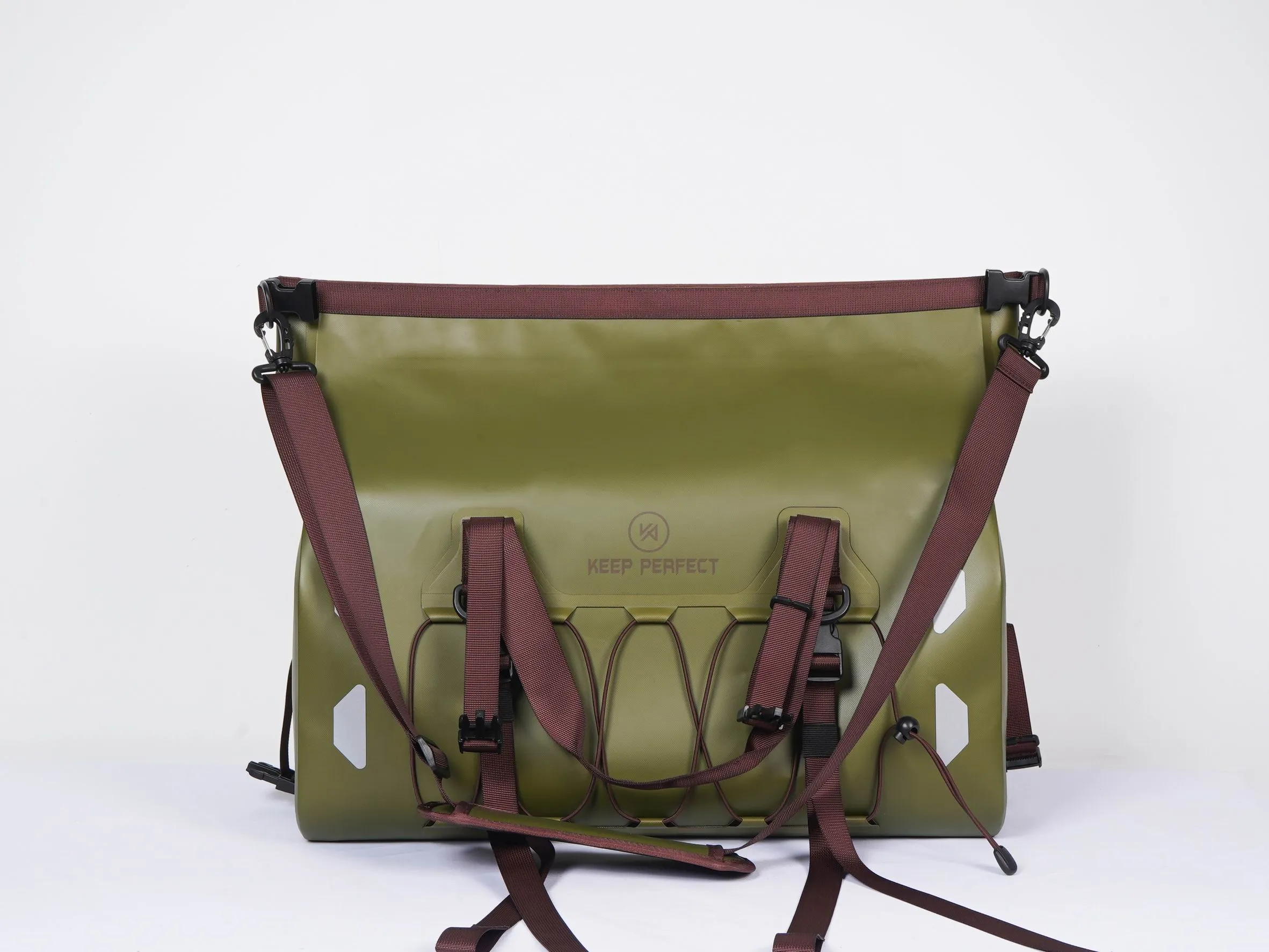
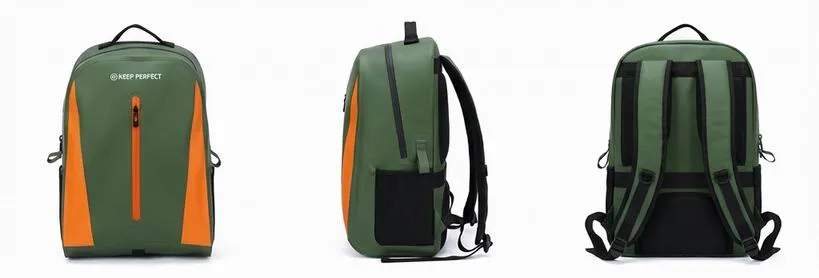
The itinerary is the specification
Buyers in this category consistently brief the wrong environment. They describe snow, cold and a mountain, and they receive a product engineered for those three things, when what ski resort travel bags actually have to survive is a baggage belt, a coach hold and a wet boot room, and that is the frame in which winter holiday waterproof bags should be specified. What actually happens is that the bag spends two hours in an airport baggage system, one hour in a coach hold, six nights standing on a wet boot room floor, and perhaps thirty hours on the mountain, split across a week, most of it in a heated lift queue or a restaurant. The mountain is the least damaging part of the week.
That reordering is exactly how ski resort travel bags should be evaluated, and it is the reason winter holiday waterproof bags fail in a pattern that looks random until the itinerary is mapped: scuffed panels from a conveyor, corroded hardware from road salt, a damp interior from a boot room, and a strap that came off in a baggage belt. None of those are snow problems, and none of them are solved by specifying a warmer or thicker material.
The second structural fact is that a ski holiday has more distinct environments per day than almost any other trip. Flight, transfer, hotel room, boot room, gondola, slope, mountain restaurant, apres venue, spa, back to the hotel. Each is a different temperature, a different humidity and a different wetting regime, and the bag moves between them repeatedly with wet contents inside. Cycling, not extremes, is the load.
The framework for deciding how much protection to specify, rather than defaulting to the maximum, is set out in our article on choosing the right waterproof level. For this channel the answer is usually moderate ingress protection with excellent abrasion resistance and a genuinely welded base, which is a different product from the one most winter catalogues list.
Airline handling: conveyors, weight and the strap that snags
Checked baggage is the single most damaging period in a ski holiday, and the mechanism is not impact so much as it is catching and dragging. Bags are placed on belts, they travel past rollers and junctions, they are stacked, and they are pulled off at the end. A bag with dangling webbing, an unsecured compression strap or a loose handle is a bag waiting to be caught in a mechanism, and a caught bag is either torn or delayed.
| Handling hazard | What happens | How the bag fails | Design response |
|---|---|---|---|
| Dangling strap caught in a belt junction | The strap is pulled while the bag is held, loading one anchor violently | Anchor torn out; panel torn; bag lost from the system | Elastic keepers on every loose end; straps that stow flush |
| Dragging across a rough belt | Abrasion concentrated at the base and one corner | Scuffing, coating thinning, print removed | Abrasion-resistant base; decoration kept off contact faces |
| Stacking under heavier bags | Sustained point load for hours | Crushed contents; deformed structure | A structured base with corner reinforcement; soft body above |
| Exposure to road salt and de-icing fluid | Wet, chemically active residue on the shell and hardware | Corrosion at fittings; stiffening closures; salt staining | Corrosion-resistant hardware; a rinse instruction on the product |
| Weight and oversize limits | Excess charges, or a bag repacked at the airport | Overloaded handles and zips failing at the worst moment | A stated packed weight; handles rated above the allowance |
The practical specification list is short and worth writing literally. Every loose webbing end gets a keeper. Compression straps stow flush rather than hanging. The base is abrasion resistant and the corners reinforced. Handles are rated above the relevant baggage allowance rather than above the realistic packed weight, because bags get repacked at check-in desks. And hardware is corrosion resistant, because airport aprons are salted and de-icing fluid is chemically active.
Two commercial points belong here. Ski and boot bags are frequently oversized items with their own carriage rules and charges, so a product that is four centimetres shorter or a kilogram lighter can be worth real money to the traveller every single trip; that is a selling point worth stating on the packaging. And lockability matters: a lockable main closure is a genuine requirement for checked baggage, and it should use a locking mechanism that survives being handled rather than a decorative one. Our article on bags in airline and aviation contexts covers the wider baggage-system context, and general travel format trade-offs sit in our overview of travel bag formats.
Airport to resort: slush, salt and the coach hold
The transfer leg is underrated. Bags are wheeled or carried from a terminal across a wet, salted apron to a coach, loaded into a hold by a driver working quickly, stacked under forty other bags, and then driven up a mountain road for two hours. Snow and slush melt off bags throughout that journey, so the hold floor is wet and everything at the bottom sits in it.
- Assume the bag will stand in meltwater in the hold, which is the argument for a welded base rather than a stitched one.
- Assume it will be handled with gloves and possibly dropped, so grab handles must be usable with a gloved hand.
- Assume salt and grit will be on the exterior, so the shell should rinse clean and the hardware should resist chloride.
- Assume it will be stacked, so structure at the base matters more than structure in the body.
- Assume the traveller cannot access it during the transfer, so anything needed on arrival travels separately.
The chemical point deserves a paragraph because it is specific to winter travel and almost never in a brief. Road salt and de-icing fluids are chloride-bearing and they are far more concentrated than seawater in the slush at an airport kerb. Hardware that would survive a season of marine use can stain within one winter transfer if it is plated zinc or a low-grade stainless, and closures stiffen when the residue dries in them. Polymer hardware and a rinse instruction solve it cheaply; the underlying corrosion reasoning is the same as that set out in our guide to marine and sailing use.
One small design detail earns disproportionate goodwill: a grab handle at both ends. A ski bag or a large duffel has to be lifted into a hold and pulled out again, often by one person, and a bag with a single handle in the wrong place is a bag that gets dragged. Dragging is what destroys the base, so the second handle is a durability feature rather than a convenience.
Soft ski bag or hard case: the trade is damage versus weight
This is the decision every travelling skier argues about, and the honest answer depends on what is being protected and what the airline charges. A hard case protects the contents best and weighs the most, which matters because ski carriage allowances are usually weight-bounded and a heavy case eats into the allowance that would otherwise carry skis, boots and clothing. A soft bag is lighter, compresses for storage in a resort room, and protects far less.
The damage data worth knowing is that skis are most often damaged by impact and by crushing rather than by anything a hard case uniquely prevents, and the most common real-world damage is a base or edge injury from something heavy sitting on the bag. That argues for internal structure rather than a hard shell: a padded divider, a compression system that holds the skis together so they cannot rub, and a base that resists the bag being dropped on its end. It is a cheaper solution and it weighs less.
Where a hard case genuinely wins is for a traveller checking expensive skis repeatedly, or for anyone whose itinerary involves several flights. Where a soft bag wins is for a once-a-year holiday, for anyone near a weight limit, and for resort storage, because a soft bag compresses into a cupboard and a case does not. Both belong in a range, and the marketing distinction should be drawn on those grounds rather than on protection in the abstract.
Either way, three features should be specified: a closure that can be locked, internal compression that stops the contents moving, and wheels or a shoulder system rated for the loaded weight. Our comparison of duffel and dry bag formats covers the general shape trade-offs, and sizing against both volume and airline dimensions is discussed in our capacity selection guide.
The boot room is the defining wet environment
Every resort has one and it is the same room everywhere: a shared, heated, badly ventilated space with racks, benches, and a floor covered in meltwater from dozens of pairs of boots. Temperatures inside are well above freezing, so snow melts continuously, and the water runs toward the lowest point, which is usually where bags get put down. Boots go back wet, gloves go back wetter, and nothing dries between one day and the next.
| Boot room exposure | What it does | How the bag fails | Design response |
|---|---|---|---|
| Standing meltwater on the floor | Sustained contact at the lowest part of the bag | Wicking along lower seams; damp contents | A welded base with no seam in the lowest twenty millimetres |
| Continuous high humidity | No drying between days; condensation inside the bag | Damp gloves every morning; odour by midweek | Ventilation path; a design that compels opening and drying |
| Wet boots stored inside | Several litres of water sealed in a warm space | Mildew; a bag that never dries; ruined clothing nearby | A separate boot compartment that drains and opens fully |
| Grit, salt and ski wax on the floor | Abrasive and chemically active residue | Base thinning; coating softening | A heavier denier base; solvent-tolerant interior in the boot zone |
| Shared space, bags stacked and knocked | Impacts from other people moving equipment | Scuffing and crushed contents | Structure at the base and corners; identifiable marking |
The construction conclusion is unambiguous: a welded base with no seam in the lowest part of the bag. A stitched-and-taped base seam standing in meltwater for six nights is the most common single failure in this channel, and it presents as damp contents with a shell that looks perfect. It is also one of the cheapest things to fix at design stage and impossible to fix afterwards.
The second conclusion is separation. Boots and gloves must not share a compartment with anything that has to be dry, and ideally they should not share a bag at all. Our article on wet and dry separation sets out the construction options, and the boot-specific format is covered in our note on shoe and boot bags. The resort amendment is that the wet compartment must open fully and dry overnight in a room with no airflow, which rules out blind corners and textured linings.
The boot bag crossover: a mat that becomes a bag
The single most useful product idea in this category is borrowed directly from surf: a boot bag that opens fully flat into a standing mat. The sequence of use explains why. A skier arrives back at the boot room, needs somewhere dry and clean to stand while changing out of boots, and then needs to carry the wet boots away. One product that does both removes the entire problem of standing in meltwater in socks, and it keeps the meltwater off the hotel room floor afterwards.
Specifying it is not complicated but it is specific. The mat face needs to be thick enough to insulate against a cold wet floor and tough enough to resist grit and buckle points underfoot. The perimeter has to survive being folded and shaken repeatedly. The closure has to work when the whole thing is being folded up with wet gloves on, which is the argument for a generous single closure rather than a precise one. And the interior has to wipe clean, because it will contain several litres of meltwater by the end of a week.
- A mat face with enough thickness to insulate from a cold wet floor, not merely a lining.
- A perimeter that tolerates folding, shaking and being stood on at the edges.
- One generous closure operable with thick gloves, rather than a precise one that demands dexterity.
- A wipe-clean, drainable interior with no blind corners.
- A hang loop, because the bag should be hung to dry rather than left on a wet floor.
The parallel with surf product is exact and worth borrowing wholesale: in both cases the bag exists to contain the wet thing the customer has just taken off, and in both cases the winning product is the one that also solves the changing problem. Our article on surf and beach bags describes the same crossover from the warm-water side, and the design lessons transfer almost unchanged.
The hotel room: heat, condensation and the wet corner
Resort accommodation is heated generously and ventilated poorly, which creates a specific and predictable problem. Wet kit comes into a warm room, the room is dry and warm, and everything should dry beautifully — except that the room is small, there is nowhere to hang anything, and the cold outer surface of a bag brought in from outside immediately collects condensation. By the second morning there is usually a wet corner of the room and a bag whose outside is wetter than its contents.
Two design responses help. The first is a hanging system: a bag that can be hung on a door, a rail or a radiator cover dries properly, and one that can only be stood on the floor does not. The second is a ventilation path, which is counter-intuitive in a waterproof product and correct here, because the alternative is a sealed bag holding damp gloves for a week. Our discussion of condensation in sealed constructions covers the mechanism generally.
There is also a small but real fire-safety dimension worth knowing when writing care instructions: resort accommodation frequently prohibits drying equipment on heaters, for good reason, and it is worth saying so on the product rather than leaving a customer to discover a melted liner. The materials question underneath that — how coatings and films behave across a wide temperature range — is covered in our page on thermal properties.
Finally, a mundane and very practical point: resort rooms have carpet, and a bag that has stood in a boot room will wreck it. A bag with a base that can be wiped, or a design that encourages hanging rather than floor-standing, prevents a complaint from the accommodation provider, which is a real cost to resort operators and a real source of friction for anyone running a catered chalet.
Gondolas, buses and the volume ceiling at the resort
On the mountain, the constraint is not weather but size. Gondola cabins have limited floor space and a rack or an external carrier for skis; resort buses are crowded at peak times; and a mountain restaurant at lunch has nowhere to put a bag. A bag that is comfortable to carry for ten minutes becomes a nuisance the moment it has to be held on a lap or stored in an overhead space.
The practical ceiling is around thirty litres for anything carried on the mountain, and considerably less for a bag that will go into a gondola at peak time. That is a smaller number than most travellers expect, and it is worth stating on the product, because the alternative is a customer buying the right bag in the wrong size and then carrying it for a week.
Ski and boot carrying is the other geometry question. A bag with external ski carry loops is useful for the walk from a bus stop to a lift and awkward everywhere else; a bag designed to be worn while carrying skis needs its centre of mass close to the back and no protruding pockets that foul the skis. Those two requirements pull in different directions, and the honest answer is that a resort travel bag should not try to carry skis at all — that is what the ski bag is for.
The related mountain context, where the same volume and harness geometry questions appear in a more technical form, sits in our page on bags for mountaineering. For resort travel the conclusion is simpler: smaller, flatter, and designed to be held rather than worn.
Hot springs, spas and the humid changing room
A growing share of ski holidays include a thermal spa or an onsen, and it is a genuinely distinct environment that catches bags out. These facilities are warm, very humid, and chemically active in a way that fresh water is not: sulphurous and mineral-rich water, chlorinated pools, and changing rooms where the air is saturated. A bag brought into that environment behaves differently from one brought into a cold dry lift queue.
Two things happen. The bag collects condensation heavily on the outside, because it is cooler than the surrounding air, and if it is sealed the moisture stays on the surface and then transfers to contents when the bag is opened. And mineral or chlorinated water that gets onto the bag leaves residue that is more aggressive than snowmelt, particularly on hardware and on printed decoration.
- A bag for spa use should be small, drainable and quick-drying rather than sealed and protective.
- Keep it outside the changing room wherever possible, since the humidity there is the problem rather than the water.
- Expect residue: rinse with fresh water and specify hardware that tolerates chlorinated and mineral water.
- Use mesh or vented panels, because nothing dries in a saturated atmosphere without airflow.
- Keep electronics and documents in a sealed pouch and out of the spa bag entirely.
The chemical side is worth specifying rather than assuming, because chlorine and sulphur compounds attack coatings and metals differently from salt. Our review of chemical resistance in waterproof materials is the right reference, and the ventilation argument is the same one developed in our page on ventilated constructions.
Hut to hut and multi-day: the drying problem compounds
A hut-to-hut or multi-day ski touring itinerary changes the arithmetic entirely, because there is no hotel room and no boot room with heating. Wet gloves, wet socks and a damp base layer are carried for days, in a bag, in cold conditions, and they never dry. By day three the bag weighs more than it did on day one and everything in it is damp.
The design response is ruthless separation and maximum drainage. Every wet item needs to be outside the dry core, the wet zone needs to be fully openable so items can be hung in a hut drying room, and the dry core needs to be genuinely reliable because it holds the sleeping layer. Compression helps here in a way it does not in other contexts, because it reduces the volume the traveller must carry uphill.
Weight matters more than in resort travel, and the temptation is to strip features. The right order is the opposite: keep the separation and the drainage, and strip decoration and organisation instead. A bag that is two hundred grams lighter and holds damp gloves against a dry sleeping layer is a bad trade at any weight.
Our general treatment of multi-day packing systems sits in the article on expedition packing systems, and the compression trade-offs are covered in our note on compression formats. The winter amendment is simply that dampness accumulates rather than resolving, so drainage outranks containment.
Altitude sun and sunscreen belong in the brief
The ultraviolet load at a ski resort is higher than almost anywhere a traveller goes with a bag. Altitude reduces atmospheric filtering, and fresh snow reflects a large majority of incident ultraviolet radiation back upward, so a bag sitting on a mountain restaurant terrace receives radiation from above and below simultaneously. Add sunscreen applied liberally and frequently, and you have the same combined load that beach categories deal with, at a temperature nobody associates with it.
The consequence is that ultraviolet and solvent exposure should be specified together, even though the product is sold as winter equipment. Sunscreen solvents extract plasticiser from coatings and leave a tacky surface that captures grit, exactly as they do in summer categories, and the ultraviolet exposure that accompanies it accelerates everything. A dedicated sunscreen pocket is the cheap fix, and stabilised face materials are the specification fix.
Colour has a second effect here that is worth knowing. A dark bag in strong sun on snow warms substantially, which sounds helpful in winter and is not: it melts the snow it is standing in, and the bag ends up sitting in meltwater it created itself. Mid-tone colours reduce the effect, and a bag that is standing in a puddle of its own making is a familiar and avoidable complaint.
Our page on UV-resistant materials covers the radiation chemistry, and the sunscreen mechanism is set out in our review of chemical resistance. Neither is usually part of a winter brief, and both should be.
A format matrix for a ski holiday range
Five formats cover the week, and the range logic is that three of them are travel products while two are resort products. Confusing those two groups is the most common way a winter range goes wrong.
| Format | Volume and shape | Job it does | Governing requirement |
|---|---|---|---|
| Ski or board travel bag | 180 to 210 cm long, soft or hard | Getting equipment through an airport | Weight against allowance; internal compression; lockable closure; abrasion-resistant base |
| Boot and helmet bag | 30 to 45 L, opens flat | Boots, helmet, goggles, gloves | Opens into a mat; welded base; drainable; operable with gloves |
| Cabin or carry-on bag | 30 to 40 L, soft | Clothing and the things that must not be checked | Compresses for a resort cupboard; lockable; fits overhead bins |
| On-mountain bag | 15 to 25 L, flat | Water, layers, sunscreen, phone on the hill | Small enough for a gondola; glove-friendly closures; sealed pocket for a phone |
| Spa or thermal bag | 10 to 20 L, mesh and vented | Wet kit at a hot spring or pool | Drainage and fast drying; tolerates chlorine and mineral residue |
The boot bag is the commercial standout, because it is the item whose absence people notice most and the one that solves an annoyance they experience every single day of the holiday. A mat-convertible version at a modest price premium outsells a technically superior non-convertible version in almost every resort retail setting, and it is the product most likely to be bought as a replacement after a bad experience.
Commercially, five formats on three or four constructions is ten or twelve SKUs with every style above the 500-piece minimum per style. That structure also suits the two buying channels in this market, resort retail and pre-season catalogue, because both buy sets rather than singles. Planning detail is in our note on minimum quantities and production slots, and for a northern hemisphere winter the order belongs in the preceding spring.
Building a ski resort programme commercially
The ski travel channel has a structure worth understanding before quoting it. Much of the volume is pre-season and catalogue-driven, resort retail is concentrated and seasonal, and there are three institutional buyers — ski schools, chalet and hotel operators, and corporate incentive travel — who buy in bulk on a known calendar. Each wants something slightly different, and a single platform can serve all three.
Ski schools and rental operations want durability and identification: bags that survive being stacked wet every night for a season, with clear marking so equipment goes back to the right place. Hotels and chalet operators want something that protects their carpets and their boot rooms, which is a genuinely different brief and an easy sale once it is framed that way. Corporate and incentive buyers want branding and presentation, where logo durability and packaging matter more than technical performance. Our pages on hospitality programmes and corporate gifting cover those two channels.
Branding in this channel has a specific failure mode: prints and transfers on a bag that stands in meltwater, gets stacked in a coach hold and is dragged across an airport apron are removed within weeks, and the customer reads that as a defective product. Keep decoration above contact zones, prefer welded badges, and specify adhesives rated for the temperature range the bag will see, because a resort apron in the sun is warmer than most people assume. Our guide to logo methods and durability covers the process choices.
Two closing commercial notes. Sets sell better in this channel than almost any other, because a ski holiday genuinely requires three different bags and the buyer knows it. And repairability matters: a spare buckle and a slider in the pack cost pennies, and a traveller who fixes a bag at a resort rather than replacing it becomes a customer for life.
If you are specifying a ski resort range, send us the itineraries, airline allowances you need to meet, formats and any failure history you already have. Minimum order quantity is 500 pieces per style, samples take 6–10 working days, bulk production runs 35–50 days, and quotations are issued FOB Xiamen. Airline baggage rules and industry carriage guidance are published by IATA, and international competition and resort context by the International Ski and Snowboard Federation.
Frequently Asked Questions
Q1. How is a ski holiday bag different from a ski sports bag?
The sports bag is specified for the slope: edges, freeze-thaw closures and carrying equipment. The travel bag is specified for airports, coach holds and boot rooms, where abrasion, salt and standing meltwater do the damage.
Q2. Should I choose a soft ski bag or a hard case?
A hard case protects best and eats your weight allowance. A soft bag with internal compression protects adequately, weighs less and compresses for resort storage. Choose hard for frequent travel with expensive skis.
Q3. Why do travel bags get damaged at airports?
Mostly by catching and dragging rather than impact. Dangling straps snag in belt junctions, and bags are dragged across rough surfaces, so stow every loose end and specify an abrasion-resistant base.
Q4. What is the most important construction detail for this channel?
A welded base with no seam in the lowest part of the bag. Boot room floors run with meltwater, and a stitched base seam standing in it for six nights is the commonest failure in the category.
Q5. How do I stop wet boots ruining everything else?
Give them a separate compartment that opens fully and drains, or a dedicated boot bag. Never share a compartment between wet boots and anything that has to be dry.
Q6. Why is my bag damp inside at a ski resort?
Either wicking through a base seam standing in meltwater, or condensation from moving between a heated room and cold outdoor air. Welded bases and ventilation address the two causes respectively.
Q7. Does road salt damage winter travel bags?
Yes. Airport slush carries road salt and de-icing fluid at higher concentration than seawater, which corrodes plated hardware and stiffens closures. Use polymer hardware and rinse the bag.
Q8. How big should a bag be for the mountain?
Around fifteen to twenty-five litres. Gondolas, resort buses and mountain restaurants all impose a space limit well below what people expect, and anything larger becomes a nuisance by lunchtime.
Q9. Should I take a bag into a thermal spa or onsen?
Only a small, vented, quick-drying one. The humidity is the problem rather than the water, and chlorine and mineral residue are harder on coatings and hardware than snowmelt.
Q10. Why does sunscreen matter in a winter specification?
Altitude ultraviolet is intense and snow reflects most of it, so bags get a summer radiation load in winter. Sunscreen solvents also attack coatings, so a dedicated pocket and stabilised materials both belong in the brief.
Q11. How should bags be dried in a resort room?
Hung, not stood on the floor, and never on a heater, which most resorts prohibit for fire safety. A hang loop and a ventilation path are the design features that make this possible.
Q12. What should a hut-to-hut bag prioritise?
Separation and drainage above all, because dampness accumulates over days rather than resolving. Keep the sleeping layer in a genuinely reliable dry core and strip decoration before you strip drainage.
Q13. How long should handles last on a ski travel bag?
They should be rated above the airline allowance rather than above the realistic packed weight, because bags are repacked at check-in desks and then lifted by one person at the other end.
Q14. Where should branding go on a winter travel bag?
Above contact zones. Airport aprons, coach holds and boot room floors remove prints within weeks, so prefer welded badges and specify adhesives rated for the temperature range.
Q15. Why does my dark bag end up in a puddle?
A dark shell in strong sun on snow absorbs enough heat to melt the snow it is standing in. Mid-tone colours reduce the effect, and it is a specification choice rather than a styling one.
Q16. How many formats does a ski holiday need?
Five: a ski or board travel bag, a boot bag, a cabin bag, an on-mountain bag and a spa bag. Three of those are travel products and two are resort products, and the distinction matters.
Q17. What is the best selling single item in resort retail?
A mat-convertible boot bag. It solves an annoyance the customer experiences every day of the holiday, and it outsells technically superior non-convertible versions almost everywhere.
People Also Ask
What bags do I need for a ski holiday?
A ski or board travel bag with internal compression, a mat-convertible boot bag, a soft cabin bag, a small on-mountain bag under twenty-five litres and a vented spa bag.
Is a hard or soft ski bag better?
Hard protects more and weighs more. Soft with internal compression suits most holidays, compresses for resort storage and leaves more of your weight allowance for equipment.
How do I stop my ski bag smelling and staying damp?
Separate wet boots into a draining compartment that opens fully, hang the bag rather than standing it on a wet floor, and never dry gear on a room heater.
Why did my bag rip at the airport?
Usually a dangling strap caught in a belt junction. Stow every loose webbing end with elastic keepers and keep compression straps flush.
What size bag can I take on a gondola?
Fifteen to twenty-five litres. Cabins are crowded at peak times and mountain restaurants have almost no storage, so smaller is genuinely better.
Do I need a waterproof bag for a ski resort?
Moderately waterproof with a welded base rather than fully submersible. Standing meltwater, airport slush and condensation are the real exposures, not immersion.