Waterproof duffels and custom waterproof dry bags solve different problems: the duffel wins on carry comfort, organization and access (IPX4–IPX6, $6.40–$9.80), while the roll-top dry bag wins on absolute immersion protection and price (IPX7, $2.90–$6.40) — and most serious programs end up running both. Choosing wrong is expensive: a duffel sold to rafters generates swampings and returns; a dry bag sold to gym commuters generates "cannot find anything" complaints. This guide puts the two formats side by side with real specs, real prices and the use-case matrix that tells you which one your program needs — or how to split the MOQ 500 across both.
We manufacture both formats — and the hybrid designs between them — at QUANZHOU JUNYUAN BAGS: custom waterproof bag production since 2014, 4,950 m² SGS-verified facility, 7 lines, 149 machines, 137 staff, 200,000 pieces monthly. MOQ 500 per design (splittable across formats), samples 6–10 working days, bulk 35–50 days, AQL 2.5 inspection, 30/70 T/T, FOB Xiamen, shipping to 100+ countries.
The structural difference in one paragraph
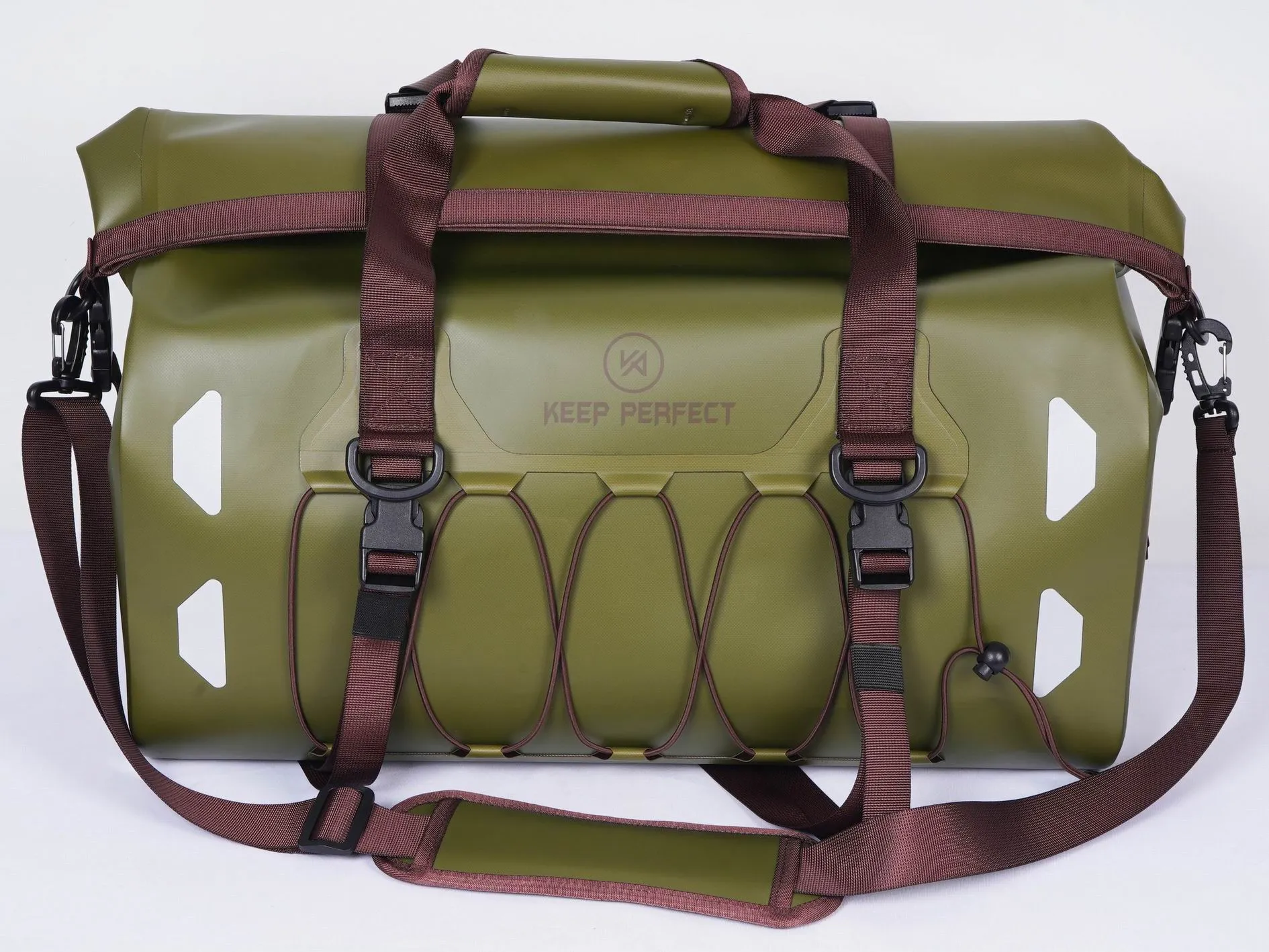
Choosing between custom waterproof dry bags and waterproof duffel bags is the first fork in every water-program brief, and the wrong turn is expensive. A custom waterproof dry bag is a welded TPU-laminated tube closed by rolling the top three times and clipping — no zipper anywhere in the design, which is exactly why it survives immersion: there is no mechanical closure to fail. A waterproof duffel is a structured bag with a wide zippered opening (usually a #8–#10 AquaGuard water-resistant zipper), shaped compartments, grab handles and often backpack straps — built for carrying and organizing, with water resistance that stops at rain and splash. The roll-top trades access for integrity; the duffel trades integrity for access. Every other difference flows from that single design fork.
Head-to-head: the honest comparison table
| Dimension | Roll-top dry bag | Waterproof duffel |
|---|---|---|
| Water protection | IPX7 — 30 min at 1 m immersion | IPX4–IPX6 — rain, splash, deck wash |
| Closure | Roll 3× + clip; no failure points | AquaGuard zipper; the rated weak point |
| Access speed | Slow — unroll, dig, re-roll | Fast — one zip, full visibility |
| Organization | One tube; pockets rare | Compartments, sleeves, lash points |
| Carry comfort | Sling to 20L; backpack straps above | Handles + padded straps; wins at 30L+ |
| Packability | Rolls flat when empty | Holds shape; dead space when empty |
| Durability profile | Fewer parts, fewer failures | More parts, more comfort, zipper care |
| Unit price (MOQ 500) | $2.90–$6.40 | $6.40–$9.80 |
Neither row is "better" — they are answers to different questions. The dry bag answers "will my kit survive going overboard?" The duffel answers "can I live out of this bag every day?" The expensive mistake is asking one format to do the other’s job.
IP ratings: where the line actually sits
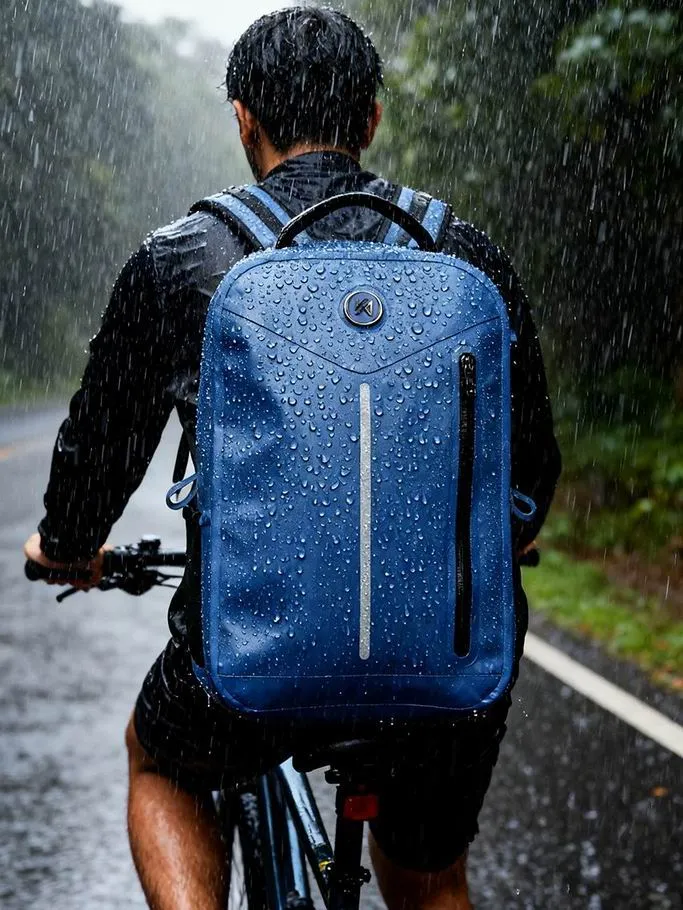
The protection gap is not marketing nuance, it is a test standard. IPX7 means the product survives 30 minutes at 1 meter immersion with a dry interior — verified by dunking, per IEC 60529 method. IPX4 means splashing from any direction; IPX6 adds powerful water jets. Fabric-level spray resistance is graded separately by AATCC and ISO spray-test methods, which is why a shell can shed rain while the assembly still fails immersion. A zippered duffel can reach IPX6 with a fully sealed AquaGuard zipper and welded seams, but the zipper slider dock remains a weep point under sustained immersion: no honest manufacturer rates a zippered bag IPX7. If your customers’ use case includes "bag goes in the water" — rafting, kayaking, SUP, fishing from a kayak, boat decks in weather — the roll-top is the only correct answer.
The nuance most guides miss: many real use cases never involve immersion. Airport rain, wet locker rooms, boat spray, monsoon sidewalks — all of these are IPX4–IPX6 problems, and the duffel’s access advantage dominates there. Rating your program correctly starts with an honest read of how the bag will actually meet water; the full rating system is decoded in our IPX rating explainer.
Use-case matrix: which format wins where
| Use case | Winner | Why |
|---|---|---|
| Rafting / kayaking / SUP | Dry bag | Immersion is a when, not an if |
| Boat days & sailing | Dry bag (electronics) + duffel (clothing) | Split the kit by water risk |
| Gym & daily commute | Duffel | Access speed and organization dominate |
| Motorcycle touring | Dry bag (rack-mounted) | Immersion-rated, lash-friendly, no zip to clog with dust |
| Adventure travel | Duffel | Living out of the bag; rain not immersion |
| Fishing | Dry bag | Deck wash, wading, catch separation |
| Photography expeditions | Duffel (padded) + dry bag (backup) | Gear access + worst-case insurance |
| Beach & resort amenity | Dry bag (5–10L) | Sand, splash, price point |
The pattern: immersion risk chooses dry bag, daily-living use chooses duffel, and anything involving boats benefits from the split-kit approach — duffel as the mothership, one or two 10–20L dry bags inside for the electronics-and-documents layer. That layered architecture is exactly how professional guides and expedition operators pack.
The hybrid option: waterproof duffel-backpacks
Between the two poles sits the hybrid category we produce for travel and moto brands: a welded-seam duffel with a roll-top main closure (IPX7-rated), shaped like a duffel, carried like a backpack. It trades some access speed for genuine immersion protection while keeping external pockets, lash points and padded straps. Price lands between the formats at $7.20–$9.60 (MOQ 500), and for many adventure-travel programs it is the single-format answer that avoids the two-bag conversation entirely.
- Choose hybrid when: your customer flies then rafts (adventure travel), rides then hikes (moto touring), or wants one bag for boat and hotel
- Skip hybrid when: the use case is purely daily-access (gym, commute — zipper wins) or purely immersion (whitewater — pure roll-top wins on price and simplicity)
- Spec note: hybrids need the same roll-three-times discipline as dry bags; publish sealed capacity in your product content
Hybrid development is an ODM platform adaptation in our catalog — your branding, colors and feature mix on a proven chassis, sampling in 6–10 working days. The platform-vs-custom decision framework is in our OEM vs ODM guide.
Program economics: cost, retail bands and margins
| Format | Unit cost (500+) | Typical retail | Margin multiple | Best channel |
|---|---|---|---|---|
| Dry bag 5–10L | $2.90–$4.20 | $15–$30 | 4–7× | Events, promo, entry retail |
| Dry bag 20–40L | $3.90–$6.40 | $25–$55 | 5–8× | Outdoor & marine retail |
| Waterproof duffel 40–60L | $6.40–$9.80 | $59–$120 | 7–12× | Travel & premium outdoor |
| Hybrid roll-top duffel | $7.20–$9.60 | $69–$130 | 8–13× | Adventure travel, moto |
The margin story favors duffels at retail but dry bags at volume: a dry bag program turns inventory 2–3× faster because the price point is an impulse buy, while duffels carry the margin dollars per unit. Brands that run both capture both curves — the dry bag as the traffic product, the duffel as the profit product. Program-level cost mechanics are mapped in our cost breakdown.
Branding and customization: what differs between formats
Both formats take the same branding methods — screen print, embroidery, silicone patches, woven labels, full-coverage prints — but the canvas differs. Dry bags offer an uninterrupted tube: ideal for bold logos and full-wrap prints that photograph beautifully on beaches and boats. Duffels offer structured panels: better for a premium "luggage" look with embroidery and metal-logo plates, and the multiple panels support sponsor or co-brand layouts. Pantone matching holds at Delta E ≤2 across both formats, so a mixed program reads as one product family — details in the Pantone matching guide and the logo options guide.
Decision framework: five questions that pick your format
- Will the bag ever go in the water? Yes → dry bag (or hybrid). No → keep reading.
- Does the user live out of the bag daily? Yes → duffel. The access speed is the product.
- What is the target retail price? Under $40 → dry bag. $60+ → duffel or hybrid.
- Is organization a stated need? Compartments, laptop sleeves, shoe pockets → duffel.
- One format or a program? If both answers scored, split the MOQ 500 across both — the two-format family outsells either alone.
Still split? Sample both. Two samples cost $120–$300 total, arrive in 6–10 working days, and let your team load, carry and dunk both formats with your actual kit — the decision makes itself physically, and both sample fees credit in full against whichever bulk order you place. We have watched this single exercise save programs from five-figure format mistakes more times than we can count; a bathtub and an afternoon is the cheapest product research in the industry.
Durability and failure modes by format
The two formats fail differently, and knowing the failure modes tells you which to spec for your environment. Dry bags fail at the closure (improper rolling, sand in the seal), at the buckle anchor (the bartack under-rated for the load), and at fabric puncture (sharp kit, no liner). They almost never fail at the seams — welded seams outlive the fabric. Duffels fail at the zipper first (grit in the coil, slider wear, dock weep), then at strap anchors, then at corner abrasion on the structured base.
| Failure mode | Dry bag | Waterproof duffel | Mitigation in spec |
|---|---|---|---|
| Closure failure | User error (2 rolls) | Zipper grit/slider wear | Roll-training print; #10 AquaGuard + care card |
| Anchor failure | Buckle bartack | Strap bartacks | 150+ kg rated anchors both formats |
| Abrasion | Tube base | Structured corners | 840D reinforcement panels |
| Puncture | Sharp kit direct | Padded liner standard | Optional liner in dry bags (+$0.35) |
| Seal contamination | Sand/dirt in roll | Grit in zipper coil | Care instructions printed inside |
The warranty data across our programs is unambiguous: duffels generate 3–4× the closure-related claims of dry bags (zippers versus no zippers), while dry bags generate more "user error" complaints that evaporate when the roll-three-times instruction is printed on the bag itself. Spec the instruction print — it is a $0.02 solution to a $40 problem.
Care and maintenance: what to tell your customers
Both formats live longer with minimal care, and the care card contents differ. Dry bags: rinse salt and sand from the closure before rolling, store unrolled and dry, keep away from prolonged UV when not in use, never machine wash (the agitation stresses welds). Duffels: everything above, plus zipper discipline — rinse grit from the coil after beach and boat use, run the slider end-to-end monthly, and apply silicone zipper lubricant two to four times a year. A #10 AquaGuard treated this way outlasts the bag body; neglected, it becomes the claim that defines your brand’s reviews.
We print care instructions inside both formats as standard (your branding, our tested wording), because the cheapest warranty program ever devised is a customer who knows how to close the bag. For retail programs, the care card doubles as a brand touchpoint — one more panel that says quality.
Case patterns: who runs which format
| Program | Format choice | Qty | Logic |
|---|---|---|---|
| Rafting outfitter fleet | Dry bags 10L/20L/40L | 1,500 | Immersion daily; rental-fleet durability; price per unit |
| Adventure travel brand | Hybrid roll-top duffel 60L | 800 | Fly-then-raft customer; one-bag positioning at $89 retail |
| Motorcycle accessories line | Dry bags 20L/30L + duffel 60L | 1,200 | Rack bags for the bike, duffel for the luggage layer |
| Resort retail & amenity | Dry bags 5L/10L | 1,000 | Amenity economics and beach proof; impulse retail price |
Notice what is absent: nobody runs a zippered duffel into whitewater, and nobody runs a 40L roll-top as a daily gym bag. The use case picks the format every time — the only real decision is whether your customer’s life spans both, in which case the MOQ 500 split does too.
Spec your format — or your split
QUANZHOU JUNYUAN BAGS — dry bags, waterproof duffels and hybrids since 2014, produced in our 4,950 m² SGS-verified facility (7 lines, 149 machines, 137 staff, 200,000 pieces monthly). MOQ 500 per design with free splits across formats, sizes and colors, samples 6–10 working days, bulk 35–50 days, AQL 2.5 inspection, 30/70 T/T, FOB Xiamen, delivery to 100+ countries. See how programs run from first inquiry.
Tell us your use case and target price through the inquiry form — we reply within 24–48 hours with a format recommendation, a split suggestion where the data supports one, and a quotation at MOQ 500. For capacity planning within the dry bag format, our dry bag sizing guide maps 5L to 40L; for the complete production picture, the manufacturing guide covers materials through QC.
Frequently Asked Questions
Q1. Which is more waterproof, a duffel or a dry bag?
The dry bag, decisively: roll-top closure with no zipper achieves IPX7 (30 minutes at 1 m immersion). Zippered waterproof duffels reach IPX4–IPX6 — rain and splash — because the zipper dock weeps under sustained immersion.
Q2. Can a waterproof duffel go underwater?
No honest manufacturer rates a zippered bag for immersion. A quality AquaGuard-zipper duffel shrugs off boat spray, rain and deck wash, but sustained submersion finds the zipper. For immersion, use a roll-top dry bag.
Q3. How much do custom waterproof dry bags cost?
At MOQ 500: 5L $2.90–$3.60, 10L $3.40–$4.20, 20L $3.90–$4.90, 30L $4.60–$5.70, 40L $5.40–$6.40 — printing and options priced per position.
Q4. How much do waterproof duffels cost?
At MOQ 500: $6.40–$9.80 depending on size (40–90L) and spec (backpack straps, compartments, hardware grade). Hybrids with roll-top closures run $7.20–$9.60.
Q5. What is the minimum order?
MOQ 500 per design, splittable freely across formats, sizes and colors — a 250 dry bag + 250 duffel coordinated family launch is a standard first-order configuration, and both formats ship on the same production calendar.
Q6. Which format is better for boating?
Both, layered: a duffel for clothing and soft kit, with 10–20L dry bags inside for electronics, documents and anything that must survive a swamping or a wave over the rail. Professional guides and expedition operators pack exactly this way — the duffel is the mothership, the dry bags are the insurance.
Q7. Is a dry bag uncomfortable to carry?
Below 20L, no — a padded sling strap handles day loads fine. At 30L+ under full loads, dry bags need backpack straps (a standard option); duffels carry heavy loads more comfortably by design.
Q8. What is a hybrid roll-top duffel?
A welded duffel-shaped bag with a roll-top main closure: IPX7 protection, external pockets and backpack straps, $7.20–$9.60 at MOQ 500. The one-bag answer for adventure travel and moto touring.
Q9. Which format sells better at retail?
Dry bags turn faster (impulse price point, 2–3× inventory velocity); duffels carry higher margin per unit (7–12× cost). Brands running both capture both curves — traffic product plus profit product.
Q10. Can both formats carry my logo?
Yes — screen print, embroidery, silicone patches, woven labels and full-coverage prints on both. Dry bags suit bold wrap prints; duffels suit premium embroidered panel branding. Pantone-matched across the family.
Q11. How long does production take?
Samples 6–10 working days (both formats sample in parallel), bulk production 35–50 days after golden-sample approval, sea freight 4–6 weeks to most markets. Reorders of established designs skip sampling and ship in 30–35 days.
Q12. What sizes do waterproof duffels come in?
Standard 40L, 60L and 90L, with custom dimensions available. The 60L with backpack straps is the global best-seller for adventure travel.
Q13. Do you make padded camera versions?
Yes — padded waterproof duffels with dividers for photography and drone kit, plus IPX7 dry bags as the wet-boat backup layer. Common expedition configuration.
Q14. Can I sample both formats before deciding?
Yes — parallel samples in 6–10 working days, $60–$150 each, all fees credited against whichever bulk order you place. Load both with your real kit; the decision makes itself.
Q15. Do dry bags work as checked or carry-on luggage?
They fly fine as checked bags (no zipper to burst is actually a genuine advantage in the hold), but the single-tube organization makes them awkward as your only travel bag. Frequent flyers pair a carry-on duffel for the journey with a packed-flat dry bag for the wet leg — it weighs 300 g and disappears until the boat day arrives.
Q16. Which format is better for corporate gifts?
Depends on the recipient: dry bags (5–10L, $2.90–$4.20) for events and volume giveaways; waterproof duffels ($6.40–$9.80) for executive gifts and premium programs where the bag should feel like luggage, not gear. Both embroider and print beautifully.
Q17. Can I get a dry bag with pockets and organization?
Yes — external splash pockets, internal organizer sleeves and padded laptop inserts are available options on 20L+ dry bags, narrowing the organization gap with duffels. The access speed gap remains: a roll-top will never open like a zipper.
People Also Ask
Are dry bags better than duffel bags?
For immersion (rafting, kayaking, boat decks) yes — roll-top dry bags are IPX7-rated and have no zipper to fail. For daily carry and organization (gym, travel) no — zippered duffels win on access and compartments. Most boaters run both.
What is the point of a dry bag?
Absolute waterproofing through simplicity: a welded tube with a roll-top closure has no zipper, no seams below the waterline and no mechanical failure points — it keeps kit dry through full immersion and floats when sealed with air inside.
Can you use a dry bag as a regular bag?
You can, and paddlers do — but the roll-top makes frequent access slow and the single tube offers no organization. For daily commuting or gym use, a waterproof duffel or backpack serves better; the dry bag excels where water is the threat.
What size waterproof duffel should I get?
40L for weekends and carry-on travel, 60L for one-week trips (the best-seller), 90L for expeditions and gear-heavy travel. With backpack straps above 40L — handles alone get old fast past 12 kg.
Do dry bags really keep things dry?
Yes when closed correctly: fill to the marked line, roll three full times, clip. The closure is IPX7-verified — 30 minutes at 1 meter with a dry interior. Most "leaks" trace to two-roll closures or sand in the seal.
Why are waterproof duffels so expensive?
The zipper: a genuine #10 AquaGuard water-resistant zipper costs 10–15× a standard coil zip, and the welded structured construction around it costs more to build than a simple tube. At MOQ 500 the format runs $6.40–$9.80 against $2.90–$6.40 for dry bags.