Glamping customers do not want their luggage to look like outdoor equipment, and that is not a superficial preference — it is the specification. A high-gloss technical shell with a weld line down the front reads as expedition gear and gets left in the car, whatever its rating, while a muted matte piece that matches the tent and the furniture gets used and photographed. The second constraint is scale: a glamping load is furniture-sized. Bedding, throws, lanterns, crockery and glassware do not fit hiking logic, and everything arrives at a pitch where the ground is damp grass or woodland soil, not a dry rock slab.
So the brief is an interiors brief with a moisture problem attached. This guide covers how coatings change the hand and appearance of premium face fabrics, why appearance failures outrank waterproofing failures in this channel, the furniture-scale load case, ground moisture on grass pitches, the short-use cycle that governs how long product actually lasts, crate and car-boot geometry, colour and dye-lot discipline across a collection, cleaning and off-season storage, fragile tableware, damp electrics and lighting, a five-piece glamping range, and how a brand should structure the programme commercially. MOQ 500 pieces per style, sampling in 6–10 working days, bulk in 35–50 days, FOB Xiamen: these are the working terms at QUANZHOU JUNYUAN BAGS, custom waterproof bag production since 2014 in a 4,950 m² SGS-verified facility.
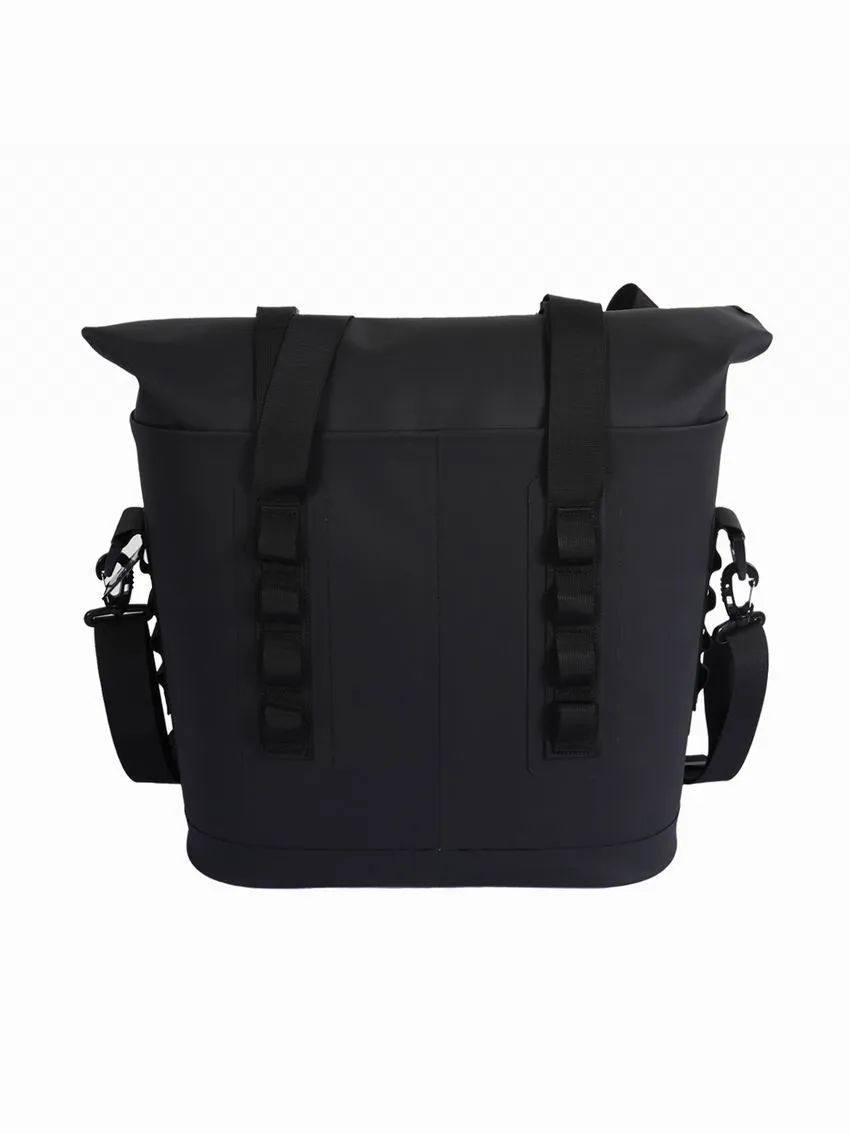
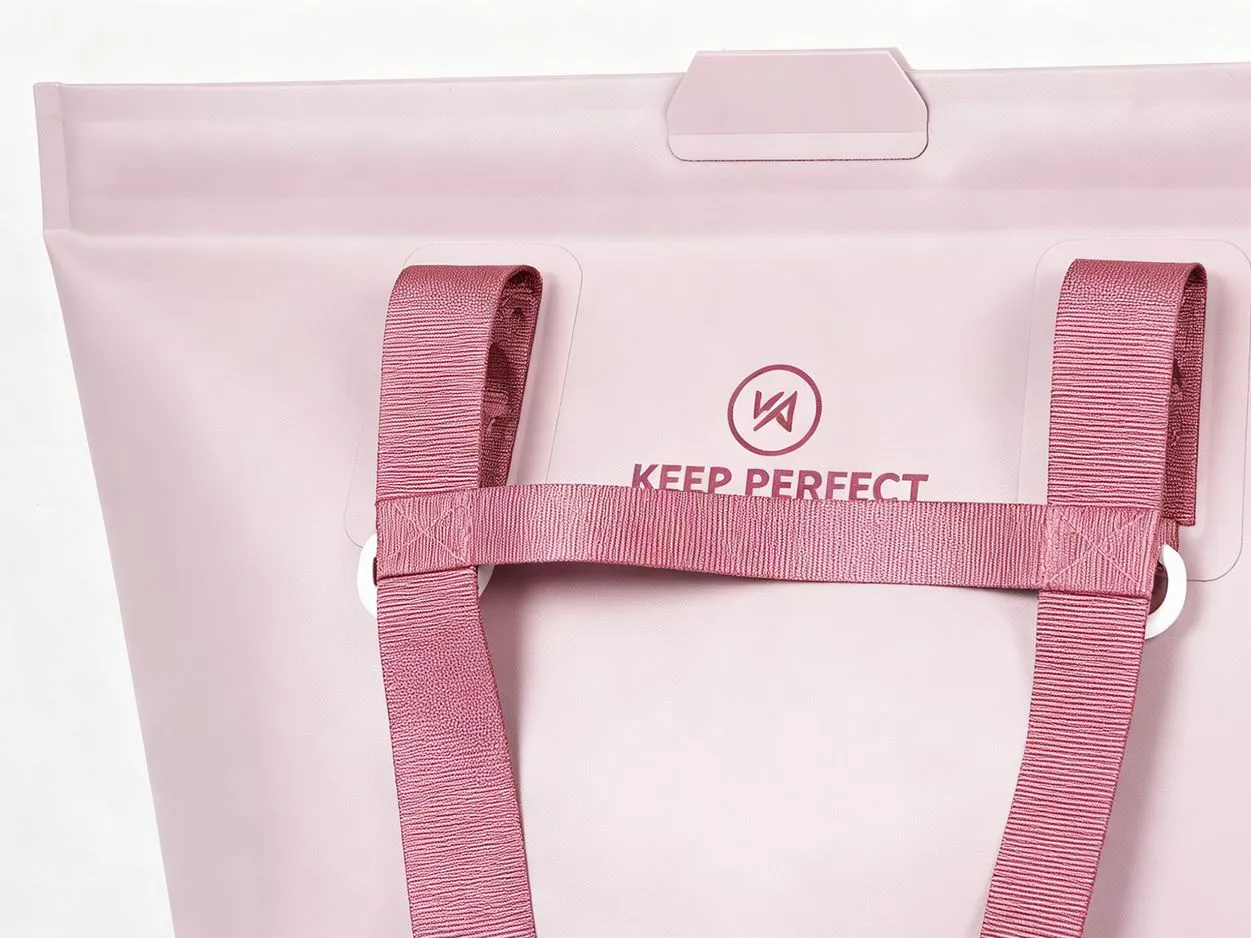
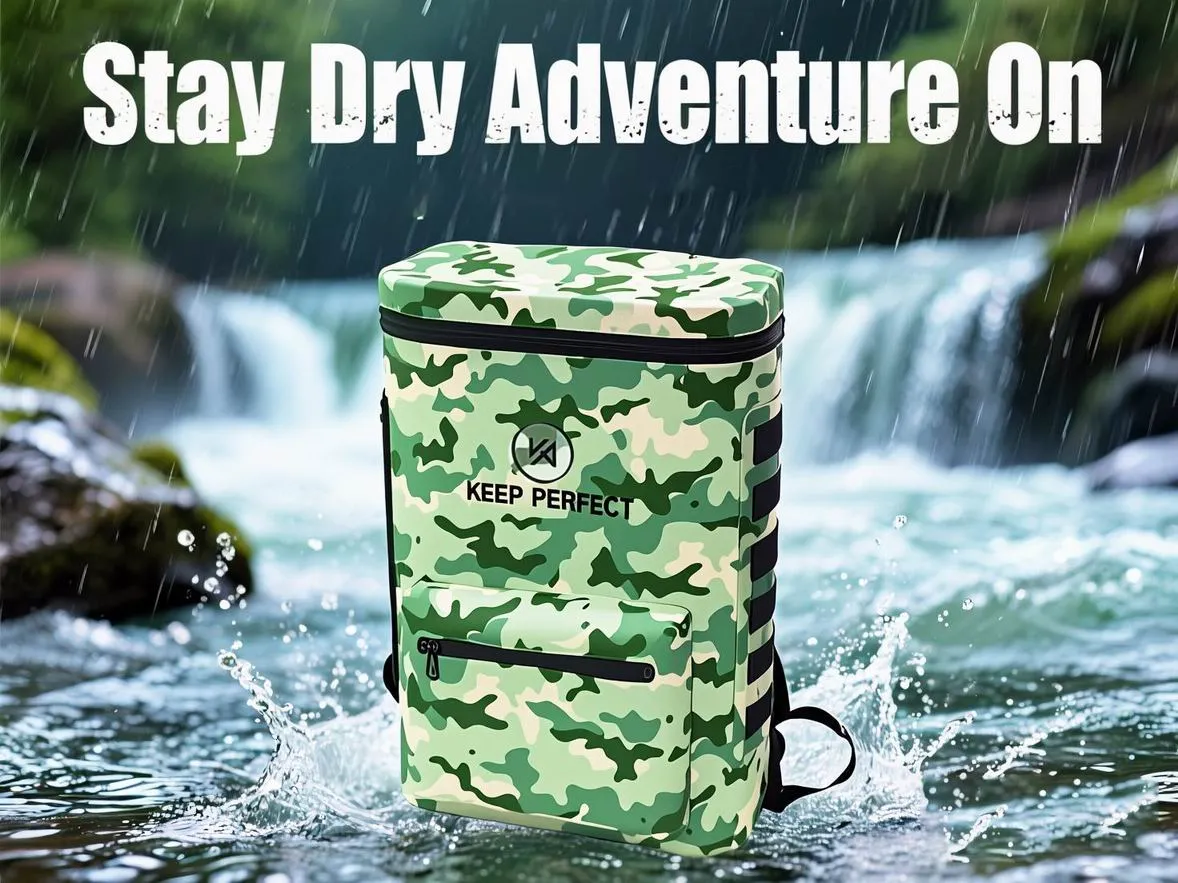
Glamping is an interiors brief, not an expedition brief
The first thing to understand about this channel is that the buyer is furnishing a temporary room, not equipping a body. A hiking pack is sized to a torso and judged by weight on the back; a glamping bag is sized to a car boot and a tent interior and judged by whether it looks like it belongs in the photograph. That single shift reverses several decisions that are settled in every other outdoor category, and brands that carry hiking logic into this channel produce product that performs well and does not sell. So glamping waterproof bags should be briefed as soft furnishings with a waterproof liner, and luxury camping storage should be merchandised as a collection rather than as a piece of kit.
The commercial consequences are concrete. Weight barely matters, because nothing is carried more than forty metres from a car to a pitch. Submersion protection matters even less, because the realistic exposure is dew, ground moisture and a shower while the bag sits under a canopy. What matters, in descending order, is appearance and hand, capacity and shape for awkward furniture-scale items, cleanability, and protection against ground moisture. That ordering is close to the inverse of a mountaineering specification, which is why a range built for one channel rarely crosses into the other without rework.
There is also a service-life question that changes the value engineering. A glamping customer uses their kit perhaps eight to fifteen nights a year, over three or four trips, and stores it for the rest of the year. That means the product does not wear out; it ages out. Failures in this channel are overwhelmingly storage and appearance failures — mildew in a cupboard, a coating that has gone tacky, a colour that has shifted — rather than field failures. Designing against ageing rather than against abrasion is the core discipline, and it is covered in our page on accelerated ageing and durability prediction.
The aesthetic constraint: why outdoor-looking gear is rejected
Say the constraint plainly, because it decides most of the material specification: glamping customers refuse items that look like outdoor equipment. Bright safety colours, technical sheen, visible weld lines, webbing daisy chains, external compression straps and large reflective panels are all read as the wrong object. What is accepted instead is a narrow palette — undyed canvas tones, oatmeal, olive, charcoal, terracotta, deep navy — with matte surfaces, concealed closures, leather-look or webbing-trim details, and hardware in antique brass or matte black rather than bright polymer.
| Visual cue | How the glamping buyer reads it | Technical cost of removing it | Where the compromise sits |
|---|---|---|---|
| High-gloss coated shell | Expedition gear, wrong object | Low; matte coatings are widely available | Matte or soft-touch finish on the same base fabric |
| Visible weld line on the front panel | Industrial | Moderate; welds can be moved to the back and sides | Welded rear and base, clean front face |
| External compression straps | Technical, fussy | None | Internal compression or a shaped body instead |
| Bright safety colours | Camping, not glamping | None | Earth palette; reserve bright for internal linings |
| Large reflective panels | Sportswear | Low | A narrow piping detail, or a removable tag |
| Plastic hardware in primary colours | Cheap | Low | Matte black or antique-finish hardware |
The hidden trap in that table is the last column: almost none of these compromises cost performance. A matte finish on the same coated base fabric has the same hydrostatic head. Moving weld lines to the back and base costs nothing. An earth palette costs nothing. That is why the aesthetic constraint is worth satisfying properly rather than arguing with — it is cheap, and it is the difference between a product that gets used and one that stays in the boot. Our guide to bags where fashion and function meet covers the same tension from the design side.
One detail consistently separates credible premium product from lookalike product: the closure. A concealed zip under a flap, a magnetic or turn-lock fastening on top of a waterproof liner, and a leather-look pull rather than a cord grip all signal the right category instantly. None of them affect the waterproof performance of the liner beneath, and all of them are standard manufacturing operations. Hardware selection is covered in our page on buckles, straps and accessory hardware.
What waterproofing does to the hand and appearance of a premium face fabric
Waterproofing and luxury hand are in direct tension, and pretending otherwise produces disappointment at sampling. A fabric that feels like dry canvas has an open weave and no film; a fabric that is genuinely waterproof has a coating or a laminated film, and both change the drape, the noise and the surface. The heavier the coating, the stiffer and more papery the hand, and the more the fabric creases permanently rather than softening. This is the single most common cause of a rejected first sample in premium outdoor ranges.
| Face fabric route | Waterproof performance | Hand and appearance | Best role in a glamping range |
|---|---|---|---|
| Cotton or cotton-rich canvas with a DWR finish | Shower resistant only; wets through in sustained rain | Best hand; ages well; develops patina | Outer appearance pieces where the liner does the work |
| Polyester canvas look with PU coating | Genuinely waterproof; seams need taping | Good appearance, slightly stiffer, quieter than nylon | The workhorse; most of the range |
| Silicone-coated nylon | Excellent waterproof-to-weight; good drape | Subtle sheen; can read technical | Linings and lightweight pieces |
| TPU laminate on a woven face | Highest and most durable waterproofing | Firmer hand; can look technical if gloss | Base panels, wet compartments, hidden liners |
| Waxed-cotton aesthetic over a membrane | Depends entirely on the membrane beneath | Premium appearance; marks and creases attractively | Hero pieces where price supports it |
The resolution used by most successful premium ranges is a two-layer approach: an appearance shell that is shower-resistant and beautiful, and a hidden welded liner that is genuinely waterproof. The customer sees canvas and leather trim; the moisture sees a welded TPU liner. It costs a little more to build and it solves the conflict entirely. Our comparison of TPU and PVC covers the liner choice, and the coating options are set out in our page on DWR, PU and silicone coatings.
There is one material decision worth making explicitly for this channel: avoid flexible PVC in the visible layers. PVC loses plasticiser, becomes tacky and eventually cracks, and it does so fastest in exactly the condition glamping product experiences — a warm car boot followed by a damp shed. A bag that feels slightly sticky after one winter in storage is a bag that gets returned, and no amount of styling rescues it. Silicone-coated nylon and TPU both age far better; the premium option is discussed in our page on silicone-coated nylon.
Furniture-scale loads: bedding, throws and lighting in transit
The defining physical characteristic of a glamping load is that it is bulky, light and awkwardly shaped. A double duvet, four pillows, a woollen throw and two lanterns occupy a volume roughly equivalent to a 90 to 110 litre expedition pack but weigh perhaps eight kilograms, and none of it is compressible in the way clothing is. Compression bags work poorly on duvets because loft recovery is fast and the bag fights the fill; what works is a large soft-sided body with a wide flat opening, because the problem is getting the item in and out, not squeezing it small.
- A wide, flat-opening mouth matters more than any other feature; a duvet will not go through a narrow collar.
- A rectangular base that stands up on its own, so the bag can be loaded standing on the ground rather than held.
- Grab handles on at least three sides, because furniture-scale loads are lifted by two people from awkward angles.
- A smooth lining that lets a duvet slide in rather than catching on seams.
- Volume stated for the actual item, not for a generic litre figure: a double duvet needs 60 to 80 litres uncompressed.
Glassware and lighting are the fragile exception inside that bulky load, and they need the opposite treatment: rigid or semi-rigid internal protection within a soft outer. Individual sleeves for glasses, a divided base for bottles, and a padded cell for a lantern are all cheap additions that prevent the single most irritating glamping failure, which is arriving to find a broken lantern glass or a chipped set of tumblers. Padding selection is covered in our page on foam padding materials, and the food and drink side of the load is handled by our guide to picnic and outdoor dining bags.
Chilled provisions are the other recurring item, and they have a specific failure mode: meltwater. An insulated bag that does not contain meltwater leaks onto a car boot carpet or a wooden tent floor, and the outside of an insulated bag on a dewy morning runs wet. A welded base and a drain path turn a nuisance into nothing. That is the same construction logic described in our page on insulated waterproof bags.
Ground moisture on grass and woodland pitches
A glamping pitch is grass, soil or woodland floor, and in most of the temperate season it is damp from the evening onwards. Dew forms on the grass before dusk, saturates everything at ground level overnight, and does not clear until well after sunrise. A bag set directly on that ground wicks water through its base fabric within an hour or two, and the contents at the bottom of the bag — usually the bedding — arrive damp. This is the one genuinely waterproof requirement in the whole channel, and it is a base-panel requirement rather than a whole-bag one.
| Ground condition | What it does to a bag | Failure the customer reports | Design response |
|---|---|---|---|
| Dew-saturated grass, overnight | Wicking through the base fabric and lower seams | Bedding damp at the bottom of the bag | Welded base panel; no seams in the lowest thirty millimetres |
| Woodland soil and leaf litter | Abrasion plus persistent damp plus staining | Scuffed, stained base that never looks clean again | Darker base colour; heavier denier at the base; wipe-clean finish |
| Mown grass with irrigation | Standing water in hollows | Water pooled under the bag | A base that sheds rather than absorbs; feet or a stiffened base |
| Wooden decking or a tent platform | Condensation between bag and board | Mildew on the underside after two nights | Air gap; a base that breathes or a bag kept off the deck |
| Sand or gravel pitch | Grit in zips and at closure lines | A zip that will not close by day three | Storm-flapped zips; closures that brush clean |
Two habits are worth designing for rather than instructing. Give the bag a stiffened or welded base that can be wiped and that sheds water, and give it short feet or a raised weld line so it is not sitting in a film of water. And keep the closure off the bottom of the bag entirely: a zip that runs down to the base panel is a zip that sits in dew all night. Our article on choosing the right waterproof level frames this kind of partial specification properly, and the abrasion question behind the woodland row is covered in our page on abrasion resistance.
The wider camping context, including the general case for keeping gear dry on a wet pitch, sits in our guide to keeping camping gear dry. The glamping amendment is simple: because the pitch is furnished and the bag is visible, protection has to be invisible. A base that works because of its construction rather than because of an external rain cover is the only acceptable answer.
Short-use economics: eight weekends a year and eleven months in a shed
Usage pattern drives the durability specification here more than intensity does. A glamping bag is used intensively for two or three days, then stored for months in a garage, a shed, a loft or a holiday-let cupboard. Storage conditions are usually worse than use conditions: unheated, humid, dark, rodent-accessible, and occasionally freezing. So the specification question is not how the bag survives five nights of use, it is how it survives eleven months of neglect and still looks new on the first night of the next season.
- Coating hydrolysis in warm humid storage produces a tacky surface; select coating chemistry for humid storage, not just for wet use.
- Mildew on a stored textile is the most common storage failure; a bag must be stored dry and vented, and linings should resist it.
- Rodents chew fabric and webbing in sheds; no food residue and no soft foam exposed at corners reduces the risk.
- UV through a garage window or in a conservatory fades face fabric; colour-fastness to light matters even in storage.
- Compression set in padding is permanent; do not store bags crushed under other items.
The commercial implication is a care and storage instruction that is actually read, plus packaging that doubles as storage. A breathable storage sack shipped with the product, with a line on it saying dry before storing, prevents a meaningful share of the returns in this channel and costs a fraction of a return. Packaging trade-offs are set out in our page on packaging options for wholesale orders.
There is a price point consequence too. Because the product ages rather than wears, a customer who buys once every five years will pay for a material that still looks right in year five, and will not pay for abrasion resistance they will never test. Spend the budget on coating stability and colour fastness rather than on denier. Colour retention is covered in our page on colour fastness testing, and light-driven ageing in our note on UV resistance.
Crate and car-boot geometry: the shape that actually has to fit
Glamping kit travels by car, and increasingly by the crates and trolleys that glamping operators use to service pitches between bookings. That gives two hard geometric constraints. For the consumer it is the car boot aperture and the fact that the bag has to stack with cool boxes, chairs and a folded awning. For the operator it is a crate footprint, because site staff move kit in standard totes and anything that does not fit gets carried badly or left behind.
Rectangular beats round in both cases, and it is worth stating as a requirement rather than a preference. A rectangular soft bag with a flat lid uses close to all of its footprint in a boot; a round duffel of the same nominal volume wastes roughly a quarter of it and rolls under braking. For operator supply, sizing to the crate footprint means the bag can be pre-packed off-site and dropped straight into a pitch store, which is the difference between a product operators buy once and one they standardise on.
- Rectangular footprint with a flat, stiffened base that stacks two high without slumping.
- Handles on three sides so it can be lifted out of a boot or a crate from any angle.
- A flat lid or top panel that can be written on or labelled for operator use.
- A height that clears the boot aperture when loaded, which is worth measuring on the top three estate cars in your market.
- Nesting or folding when empty, because operators store empty kit between seasons.
Dimensional customisation is unusually valuable here for the same reason it is in vehicle storage: one construction, several footprints, no retooling. Our note on dimensional customisation covers how that is usually handled without fragmenting production volume, and the hospitality parallel — supplying a site that turns rooms or units over repeatedly — sits in our page on bags for the hospitality sector.
Colour, dye lot and keeping a range looking like one collection
In a channel where appearance is the specification, colour control is a manufacturing discipline rather than a design preference. Three problems recur. Dye-lot variation between production runs means the oatmeal tote from this season does not match the oatmeal holdall from last season, which is visible immediately in a furnished tent where both are on display. Metamerism means a colour matched under store lighting shifts under daylight on a pitch. And coating over a dyed base fabric shifts the apparent shade by a small but visible amount.
The controls are straightforward and worth specifying contractually. Reference standards with a defined tolerance in Delta E rather than a verbal description. A master swatch retained by both sides, with approvals made against it rather than against a photograph. A requirement that all pieces in a collection be cut from the same dye lot, or at minimum that panels that appear together come from one lot. And an approval under daylight as well as under store lighting. Our page on Pantone matching and colour customisation sets out the mechanics.
The merchandising opportunity is that colour coding sells sets. A collection where each piece has a defined role signalled by shade — one tone for bedding, one for tableware, one for wet kit — is easier to sell as a set and easier for an operator to train staff on. It also means a customer who buys one piece has a reason to come back for the matching one, which is the repeat-purchase mechanic that makes the channel profitable.
Fragile contents: tableware, glassware and the breakage claim
Glamping is the only outdoor category where customers routinely carry wine glasses and ceramic plates, and breakage is the most common source of a bad review that has nothing to do with waterproofing. The load case is not impact from a height, which is what most padded cases are designed for; it is stacking and vibration. Plates stacked in a bag in a car on a bumpy track chafe against each other and chip at the rim, and glasses fail at the stem where they are constrained.
- Individual cells rather than one divided space, so nothing touches anything else.
- A semi-rigid base that prevents the stack from flexing when the bag is lifted by one handle.
- Cells sized to the actual tableware, which means asking the customer for the plate diameter before sampling.
- A closure that stays shut when the bag is turned on its side, because it will be.
- Padding specified for repeated low-load compression rather than for a single impact.
The commercial version of this is a co-branded opportunity: glamping sites and tableware brands both sell into the same customer, and a bag sized to a specific plate or glass set is a genuinely differentiated product that a generic outdoor brand cannot offer. It also justifies a price point that a generic bag cannot reach. Corporate and co-branded programmes are covered in our page on corporate gifting programmes.
Lighting, electrics and damp: the one place waterproof earns its keep
Modern glamping runs on mains or solar lighting, portable power, speakers and sometimes a small fridge, and that equipment is where waterproof construction genuinely matters. Not because it will be submerged, but because the failure mode is dew. A lantern or a power unit left on a grass pitch overnight sits in saturated air and collects condensation internally, and the result is corrosion at contacts and a unit that fails intermittently rather than outright.
The right construction is a welded or taped compartment that keeps dew out while allowing any condensation that does form to be wiped away, plus a smooth non-absorbent lining that does not hold moisture against metal contacts. Ventilation is not the answer here; a fully vented bag in dew-saturated air admits the moisture rather than excluding it. Corrosion behaviour against damp and salt is covered generally in our review of chemical and environmental resistance.
For the customer the practical rule is simple and worth printing on the product: keep electrics in a sealed compartment with a sachet of desiccant when the pitch is dewy, and dry everything thoroughly before it goes into storage. A ten-gram sachet prevents the majority of damp electrical failures, and supplying one with the product is a small touch that reads as thoughtful rather than technical.
Cleaning, drying and the off-season routine
Because the product ages rather than wears, the care regime determines the service life more than the material does. Three rules cover it. Dry completely before storage, and that means twenty-four hours open in a dry room rather than an hour in the sun. Clean with water and a soft brush rather than solvents, because solvents strip the very coating that makes the bag work. And store vented, off a concrete floor, out of direct light.
| Care mistake | What happens | When it shows | Prevention |
|---|---|---|---|
| Stored damp after the last trip | Mildew in the lining and at seam tapes | Next season, as odour and staining | Dry for twenty-four hours open; ship a breathable storage sack |
| Cleaned with a solvent or a strong detergent | Coating stripped or dulled | Immediately | Water and a soft brush; state it on the care label |
| Stored crushed under heavy items | Permanent compression set in the padding | Next season, as a bag that no longer holds shape | Store upright, stuffed lightly, nothing stacked on top |
| Stored in direct light | Face fabric fades unevenly | After one season | Store dark; specify colour fastness to light |
| Stored on a concrete floor in a shed | Wicking damp into the base panel | One winter | Store off the floor; welded base helps but is not a cure |
Two of those rows are prevented at the point of manufacture rather than by the customer. A breathable storage sack shipped with the product prevents the first, and a care label that says dry before storing in plain language prevents the second half of it. Both are trivial in cost and both reduce returns measurably in a channel where the product spends most of its life in storage.
A five-piece glamping range matrix
Five formats cover the channel well, and the collection logic matters more than any individual piece. The test of a good range is whether the five look like one family on a pitch, whether each has an obvious role signalled by shape and colour, and whether the operator version can be pre-packed into a crate.
| Format | Volume and shape | Job it does | Governing requirement |
|---|---|---|---|
| Bedding carrier | 60 to 90 L, rectangular, flat-opening top | Duvets, pillows and throws from car to tent | Welded base against ground moisture; wide mouth; handles on three sides |
| Tableware case | 20 to 35 L, semi-rigid base, individual cells | Plates, glasses and cutlery sets | Cells sized to real tableware; stays shut when turned sideways |
| Lantern and power pouch | 5 to 12 L, welded, smooth lining | Lighting, portable power, speakers | Dew exclusion; non-absorbent lining; desiccant pocket |
| Wet and utility tote | 30 to 50 L, wipe-clean, drainable | Wet coats, boots, muddy items at the tent entrance | Drain grommet; hangs; does not look technical |
| Chilled provisions bag | 20 to 40 L, rectangular, welded base | Food and drink for the pitch | Contains meltwater; stacks in a boot; wipes clean |
The bedding carrier is the volume driver and the tableware case is the margin driver, because the tableware case is the piece nobody else makes properly and the piece that justifies a premium. Together they also cover the two things customers actually complain about: damp bedding and broken glassware.
Five formats on three constructions, in four colourways, is roughly twelve to fifteen styles with each above the 500-piece minimum per style. That is a workable opening programme for a brand entering the channel, and it is small enough to be sampled in one round. Planning detail is in our note on minimum quantities and production slots.
Building a glamping programme commercially
The channel splits into two buyers with different economics and both are worth supplying. The consumer buyer purchases one or two pieces a year at retail, is highly responsive to appearance, and is influenced almost entirely by photography. The operator buyer — glamping sites, safari-tent operators, yurt and pod providers — purchases in volume, standardises on a specification, and cares about crate fit, cleanability and replacement cost. A range that serves both uses the same construction with different labelling and colourways, which is the most efficient structure available.
- Fix one material tier and one palette across the collection, so replacement pieces match and the range photographs as a set.
- Offer a co-branded option for operators; site logos on a piece their guests see daily is high-value placement.
- Specify decoration for the appearance constraint: embroidery, a leather-look badge or a debossed patch rather than a large glossy print.
- Ship a breathable storage sack and a care card; both directly reduce seasonal returns.
- Ask operator customers for their crate footprint before sampling; getting it right wins a standardisation decision that lasts years.
Decoration is the one place where the aesthetic constraint has a real technical cost. A large glossy print reads as promotional and cheap, while embroidery, a welded badge or a debossed leather-look patch reads as premium — and on coated shells these behave differently in adhesion and durability. Our guide to logo methods for waterproof bags covers the trade-offs by process. Market sizing and participation data for the wider outdoor sector is published by the Outdoor Industry Association, and textile test methods referenced in this article are maintained by ISO. If you are specifying a glamping range, review our process from first enquiry through sampling into bulk production and send us the format list, target palette, any operator crate dimensions and your forecast volumes. Sampling takes 6–10 working days, bulk production runs 35–50 days, and quotations are issued FOB Xiamen.
Frequently Asked Questions
Q1. Do glamping bags need to be fully waterproof?
Rarely. The realistic exposure is dew, damp grass and a shower under a canopy. What matters is a welded base panel against ground moisture and a hidden waterproof liner, not a whole-bag submersion rating.
Q2. Why does the bag base get damp on a grass pitch?
Dew saturates the grass from early evening and does not clear until well after sunrise. A bag set directly on it wicks water through the base fabric within an hour or two, and bedding at the bottom arrives damp.
Q3. What fabrics look premium and still keep water out?
A two-layer build works best: a canvas-look or matte appearance shell for shower resistance and hand, plus a hidden welded liner for real waterproofing. The customer sees canvas; the moisture meets a film.
Q4. Why did my coated bag go sticky in storage?
Plasticiser migration or coating hydrolysis in warm humid storage. It is permanent. Avoid flexible PVC in visible layers and specify coating chemistry for humid storage as well as for wet use.
Q5. What size bag holds a double duvet?
Roughly 60 to 80 litres uncompressed, so a 60 to 90 litre rectangular carrier with a wide flat-opening top. Compression does not work well on duvets because the fill recovers loft quickly.
Q6. Should glamping bags be round or rectangular?
Rectangular. A rectangular footprint uses nearly all of its area in a car boot and stacks, while a round duffel of the same nominal volume wastes around a quarter and rolls under braking.
Q7. How do I stop glasses and plates breaking in transit?
Individual cells rather than one divided space, a semi-rigid base so the stack cannot flex when lifted one-handed, and padding specified for repeated low-load compression rather than a single impact.
Q8. What colour palette sells in glamping?
Earth and undyed tones: oatmeal, olive, charcoal, terracotta and deep navy, in matte finishes with matte black or antique hardware. Bright technical colours are actively rejected.
Q9. Why does the second production run not match the first?
Dye-lot variation. Specify a Delta E tolerance against a retained master swatch, approve under daylight as well as store lighting, and cut panels that appear together from one lot.
Q10. How should glamping bags be stored between seasons?
Dry for twenty-four hours open, store vented and upright off a concrete floor, out of direct light, with nothing stacked on top. Most failures in this channel are storage failures, not use failures.
Q11. Can detergents damage a waterproof bag?
Yes. Solvents and strong detergents strip the coating that makes the bag work. Clean with water and a soft brush, and state it on the care label.
Q12. Is an operator version different from a consumer version?
Yes, mainly in geometry and labelling. Operators buy to a crate footprint so kit can be pre-packed off-site, and they value standardisation, cleanability and a known replacement cost.
Q13. How do I protect lanterns and power units from dew?
Keep them in a welded compartment with a smooth non-absorbent lining and a desiccant sachet. Ventilation admits dew rather than excluding it; dew exclusion is the requirement.
Q14. Why does my insulated bag leave a puddle in the boot?
Meltwater. Insulated bags need a welded base and a drain path, and the outside of the bag runs wet on a dewy morning, so the base has to contain what the ice produces.
Q15. What logo method suits a premium glamping piece?
Embroidery, a debossed leather-look patch or a welded badge. A large glossy print reads as promotional and cheap, and adhesion on coated shells varies by process.
Q16. How many formats should a glamping collection carry?
Five: a bedding carrier, a tableware case, a lantern and power pouch, a wet utility tote and a chilled provisions bag. Three constructions in four colourways keeps each style above the minimum order requirement.
Q17. How often is glamping kit actually used?
Typically eight to fifteen nights a year across three or four trips, with the rest of the year in storage. That is why coating stability and colour fastness matter more than abrasion resistance.
People Also Ask
Do glamping bags need full waterproofing?
No. Dew and damp grass are the real exposures. Specify a welded base panel and a hidden waterproof liner rather than a whole-bag submersion rating.
What is the best size for carrying a duvet?
Around 60 to 90 litres in a rectangular carrier with a wide flat opening. Compression bags work poorly because duvet fill recovers loft quickly.
How do I keep bedding dry on a grass pitch?
Use a bag with a welded base and no seams in the lowest thirty millimetres, and keep it off dew-saturated grass until the morning sun has cleared it.
Why did my bag go sticky in the shed?
Plasticiser loss or coating hydrolysis in warm humid storage. It is permanent, which is why flexible PVC should stay out of visible layers.
How should I store glamping bags off-season?
Dry fully for twenty-four hours, then store vented and upright off a concrete floor, away from light, with nothing heavy stacked on top.
Can I brand glamping bags without ruining the look?
Yes. Use embroidery, a debossed patch or a welded badge instead of a large glossy print, and keep hardware matte black or antique finish.