Waterproofing and refinement are not compatible by default, because they compete for the same surface. Everything that makes a shell shed water — a thick continuous coating, sealed seams, technical hardware, welded edges — is also a property that reads as equipment rather than as design. Brands that simply add waterproofing to a fashion silhouette end up with a product that photographs well and looks cheaper in the hand, because the eye reads sheen, thickness and edge finish long before it reads a specification. The brands that resolve it do something structurally different: they move the water protection into layers and components the eye does not evaluate, and they pay for the result in process rather than in material.
This guide sets out where the tension actually sits and how it is resolved in production. It covers why the conflict is on the surface rather than in the specification, how coating weight changes what the hand perceives, sheen levels and the light test, why flat panels and clean edges carry most of the perception of expense, what seam treatments look like and what they cost aesthetically, how decorative hardware creates leak paths, the real limits of colour matching on coated substrates, which craft operations waterproof construction permits and forbids, what urban buyers actually rank when they choose, which material combinations read refined while still shedding water, where the cost of looking expensive genuinely goes, how to test appearance as rigorously as performance, and how a brand should plan, specify and price a fashion-led waterproof range. Production reference for this guide — QUANZHOU JUNYUAN BAGS, custom waterproof bags since 2014, 4,950 m² SGS-verified facility, MOQ 500 pieces per style, sampling in 6–10 working days, bulk in 35–50 days, FOB Xiamen.
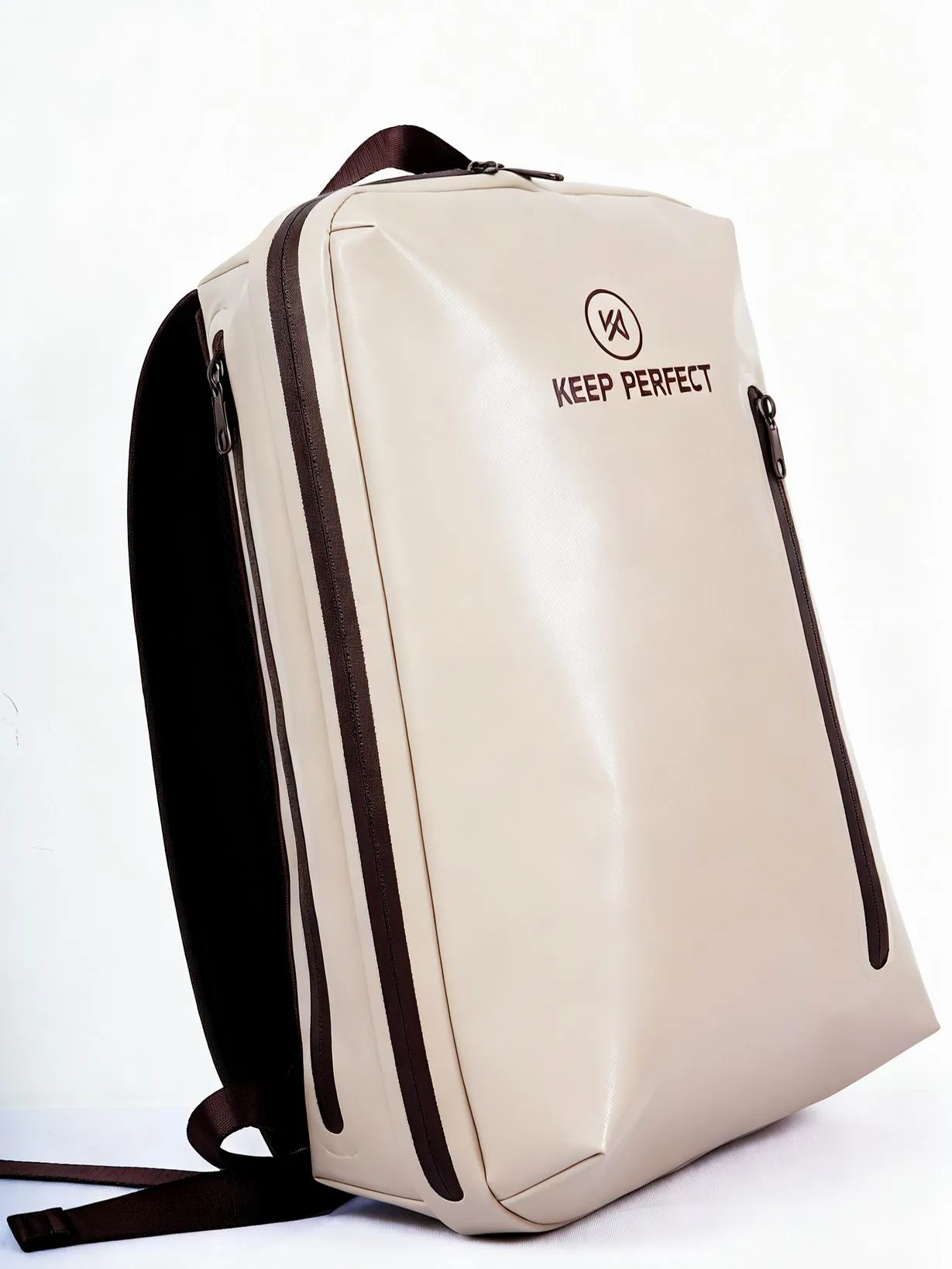
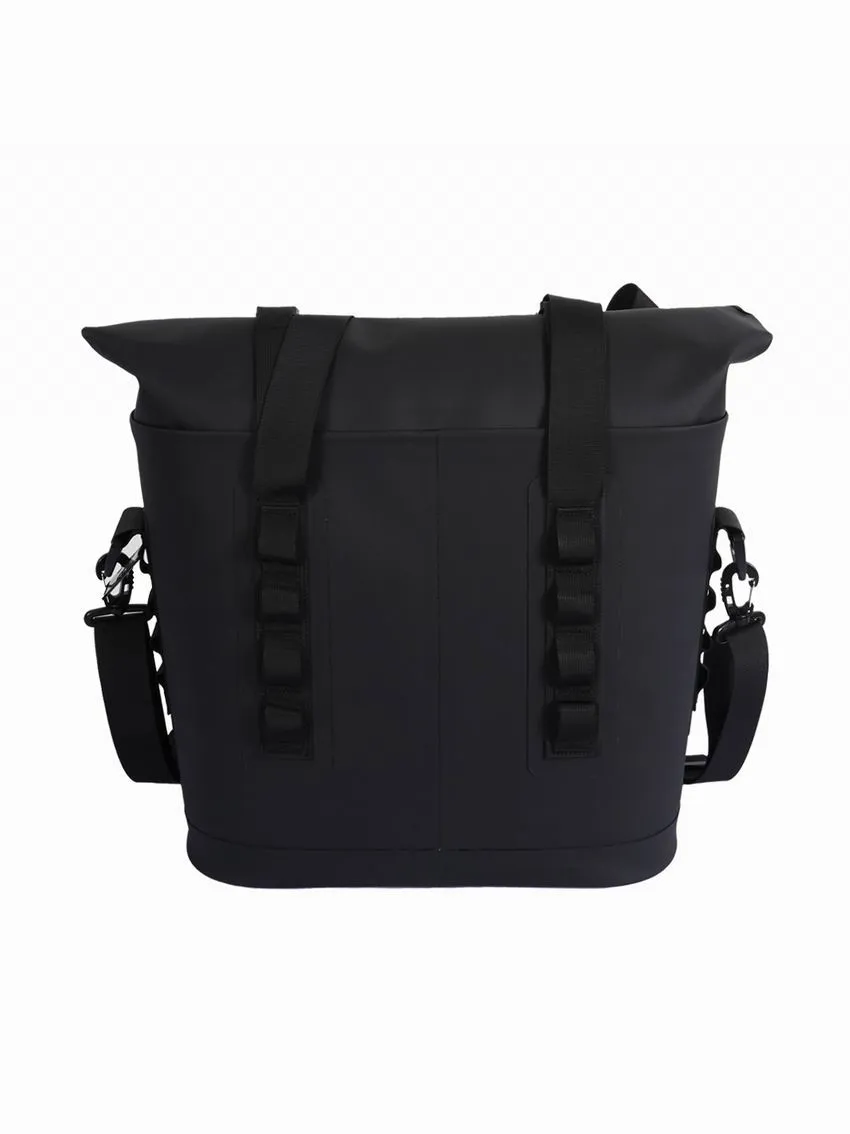
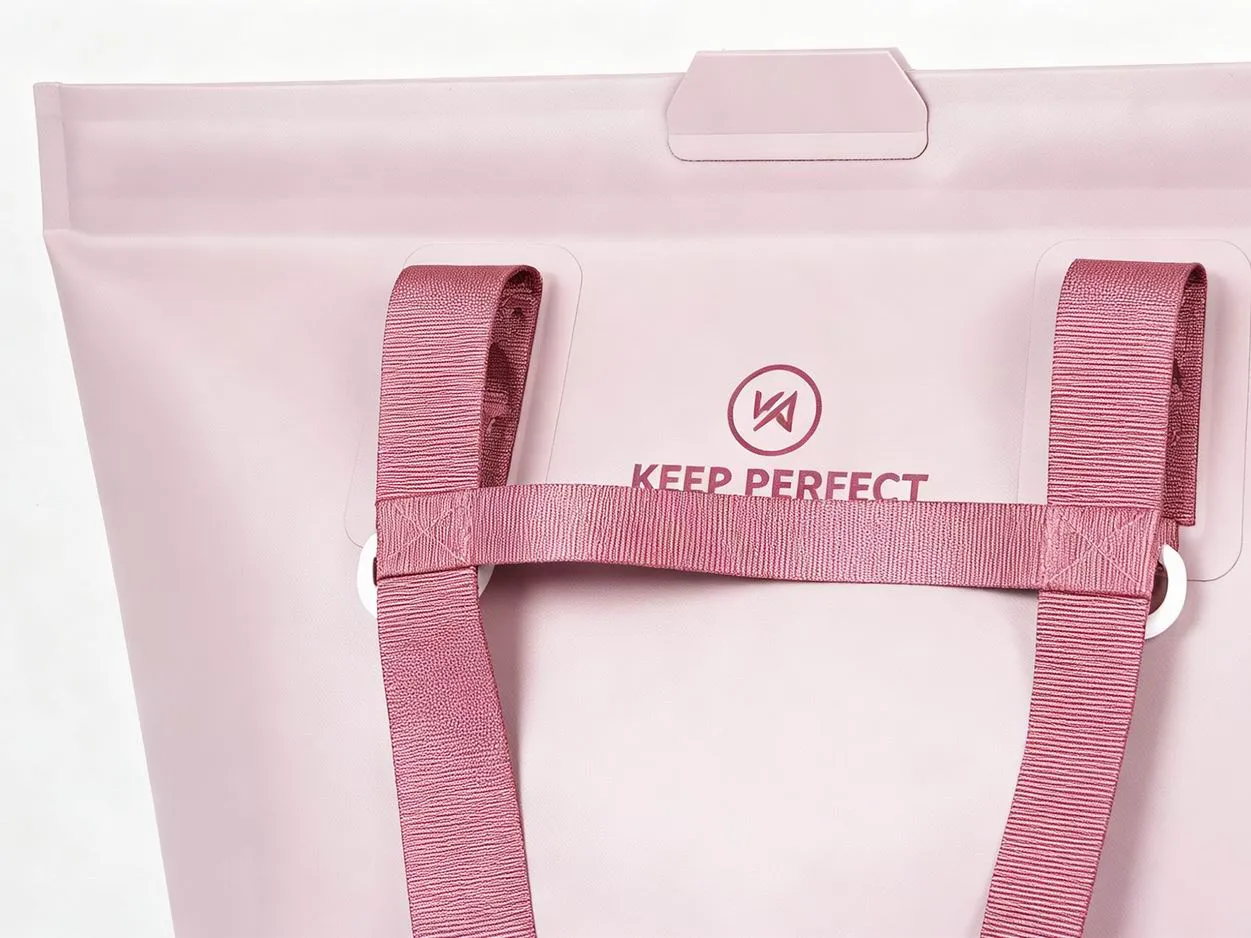
The conflict is on the surface, not in the specification
Ask a designer why stylish waterproof bags are hard and the answer is usually about silhouette. Ask a factory and the answer is about coating. Both are describing the same fashion function balance problem from opposite ends: the properties that deliver water protection are surface properties, and surface is exactly what a buyer judges in the first three seconds. A specification can be perfect on paper while the object reads as a rain cover, and no amount of pattern refinement recovers a surface that looks technical.
This is worth stating because it changes what a development budget should buy. If the conflict is on the surface, then spending more on the water performance of the shell buys little: the performance was never the problem, and extra coating makes the surface worse. The money belongs in the layers and components that carry water protection without being seen — a back-coat rather than a face-coat, a laminated membrane under a conventional face fabric, a sealed compartment inside an ordinary-looking shell, a drainage path hidden in a gusset. Those interventions cost more in process and less in appearance.
There is a second consequence that is less obvious and more useful. Because the buyer judges surface, the appearance-related specifications — sheen, hand, edge finish, hardware consistency — should be written with the same precision as the performance ones. Most specifications in this category contain a hydrostatic head figure to three significant places and no sheen figure at all, then everybody is surprised when the sample looks wrong. A gloss level, a bend-length or handle-ometer value, and a stated edge treatment are not precious; they are the difference between a sample that gets approved and a third round.
The rest of this piece works outward from that surface: what it is made of, how it is finished, what is attached to it, what colour it will accept, and which operations the construction permits. Our companion review of DWR, PU and silicone coatings covers the chemistry behind the first two sections; this piece stays with what the result looks and feels like, and what it costs to get there.
What the hand reads: coating weight and stiffness
The hand of a bag — how the material feels when picked up and squeezed — is the property most closely correlated with perceived price, and it is governed by coating weight more than by the face fabric. A coating adds mass without adding perceived substance, and above a certain thickness it converts a textile into a sheet. Buyers describe the result as "plasticky" without knowing why, and the specification that produced it was chosen for a water figure.
The relationship is not linear in the way people expect. A very light finish leaves a fabric that feels natural and expensive but wets out quickly. A medium finish gives a slightly dry, papery hand that reads as quality in most applications and is adequate for rain. A heavy finish gives a rubbery hand and a tendency to show creases permanently, because a thick polymer layer takes a set when folded. The middle of that range is where almost every successful fashion-led waterproof product sits, and it is narrower than most specifications allow for.
Back-coating rather than face-coating is the single most effective move available. Putting the polymer on the inside of the face fabric preserves the texture, weave definition and sheen of the outer surface while still blocking water, and it allows a face fabric to be chosen for appearance alone — a heathered weave, a slub, a twill with visible texture — none of which survive a heavy face coating. The cost is that the outer surface then needs a durable water repellent finish to stop it wetting out, and DWR is a consumable that wears off. That trade is worth making, and it is the one most often missed.
There is a construction detail that follows. A back-coated fabric can be sewn with conventional methods because the visible surface is unaffected, which means topstitching, edge binding and turned edges are all available — the operations that make a bag look designed rather than assembled. A heavily face-coated fabric resists those operations and pushes the construction toward welding, which produces an object with a different and more technical visual language. Choosing the finish is therefore choosing the construction route, well before that decision is formally made.
Sheen: the fastest signal of price that photography cannot hide
Sheen is measurable and it is the first thing a buyer reads. Gloss is conventionally quantified with a glossmeter at a defined angle, and the useful bands for bag exteriors run roughly as follows: a matte surface sits in the low single digits to around ten gloss units, a satin or semi-matte surface around twenty to forty, and a high-gloss surface above seventy. Technical waterproof products routinely land in the upper half of that range because coating thickness and film lamination push sheen upward, and fashion products almost never should.
| Sheen band | Typical gloss units at 60 degrees | What it communicates | Where it belongs |
|---|---|---|---|
| Deep matte | Below about 10 | Restraint, expense, natural material | Premium urban bags; the safest default for a fashion-led line |
| Semi-matte or satin | Roughly 20 to 40 | Quality with a slight technical edge | Commuter and travel products that need some performance signal |
| Soft lustre | Around 40 to 60 | Luxury, but only on the right base material | Coated canvas and leather-look substrates |
| High gloss | Above 70 | Technical, protective, plastic | Dry bags and rain covers; rarely appropriate in a city range |
| Variable or patchy | Inconsistent across panels | Poor process control | Nowhere; inconsistency is read as a defect before anything else |
Two cautions. Consistency matters more than the absolute level: a shell where the front panel reads at twelve gloss units and the gusset at twenty-six looks like a mistake rather than a choice, and panel-to-panel variation is the most common sheen defect in production. Specify a target with a tolerance and measure several panels per sample. And matte surfaces have a durability problem — a matte finish is usually produced by surface texture or a matting additive, and abrasion burnishes it back to a sheen at the corners and along the base where the bag is set down. Testing appearance after abrasion matters as much as testing it new.
Photography deserves a note because it distorts this decision badly. Studio lighting with large soft sources flattens sheen differences almost completely, so a sample approved from photographs may look entirely different in a shop or on a street. Approve sheen from a physical reference under the lighting the customer will actually stand in, and keep a retained standard sample for every colourway, because sheen drifts between production lots more than colour does.
Flat panels, clean edges and the perception of expense
Perceived price in this category correlates with two geometric properties that have nothing to do with materials: how flat the panels are, and how clean the edges are. A bag whose panels lie flat with no puckering, no waving at the seam lines and no rippling at the corners reads as expensive regardless of what it is made from. A bag with wavy seams and bulky edges reads as cheap even when the fabric cost was high. Both properties are process outcomes rather than material outcomes, which is why they are the best place to spend development money.
Edge treatment is where most of the difference sits. A raw cut edge on a coated fabric looks unfinished and will fray or delaminate. A bound edge — a folded tape stitched over the raw edge — looks considered and costs one operation. A turned edge, where the material is folded back on itself and stitched, is the most refined option and the most demanding, because it requires a fabric with enough body to hold the fold and a coating that tolerates being creased. A welded edge is clean and waterproof but produces a bead that reads as technical. None is universally right, and the choice should be made per edge rather than per bag: turned or bound on the visible edges, welded where water performance matters.
Panel flatness follows from seam construction. A plain seam with a pressed-open allowance lies flatter than one folded to one side; a seam on a coated fabric tends to pucker because the coating and the fabric shrink differently under the needle and under heat. Reducing stitch density reduces puckering but weakens the seam and looks coarser. The resolution most good products use is a slightly heavier interlining behind the seam line rather than a denser stitch, which holds the panel flat without perforating it more.
These are unglamorous specifications and they are expensive ones, because all three — binding, turning, interlining — add labour to a product whose material cost everybody is trying to reduce. That is precisely why they differentiate. Two bags from the same fabric with the same silhouette can sit in different retail bands purely on edge and seam quality, and the difference is visible across a room.
Seams as a design element: taping, welding and topstitch
Seams carry water protection and they are also the most visible craft signal on a bag. The three available treatments sit at different points on both axes, and the choice is genuinely a trade rather than a hierarchy.
| Seam treatment | Water performance | Visual result | Cost and constraint |
|---|---|---|---|
| Sewn, untaped | Leaks through needle holes | Conventional, allows topstitching and detail | Cheapest; acceptable where the lining carries the protection |
| Sewn with tape applied over the seam | Good if the tape bonds and stays bonded | Tape can telegraph as a ridge through thin fabrics | Moderate; tape width and adhesion are the variables |
| Sewn with a sealed lining behind it | Good, and invisible from outside | No external evidence at all | Higher; adds a component but frees the outer seam entirely |
| Welded, no stitching | Best | Clean but produces a visible weld bead and a technical read | Requires weldable polymers; see the craft limits section |
| Welded with a cover strip over it | Best, and the bead is hidden | Closest to a conventional refined appearance | Highest; two operations and demanding alignment |
The third and fifth rows are the ones that resolve the contradiction, and they do it in the same way: they hide the waterproofing behind something the eye reads as normal. A sewn outer seam with a welded lining behind it lets a designer use topstitching, contrast thread and decorative seam placement — the entire vocabulary of bag design — while the water protection lives in a component nobody sees. Our guide to seam taping and sealing methods covers the application detail, and our comparison of stitched, welded and bonded construction sets out which polymers each method requires.
Topstitch density is worth a number because it is a genuine trade-off rather than a preference. A coarse stitch — around six to eight stitches per inch — reads casual and robust. A fine stitch — twelve to fourteen per inch — reads refined and is weaker per unit length and perforates the fabric more, which matters on a waterproof shell. Most fashion-led waterproof products sit around eight to ten, and going finer for appearance alone is a decision that should be made with the water test result in hand rather than from a photograph.
Decorative hardware is a leak path with a price tag
Every fitting attached through a waterproof shell is a hole in a barrier. That sentence is obvious and its consequences are routinely ignored, because hardware is chosen late, chosen for appearance, and attached by whoever is assembling the bag. A rivet, a magnetic snap, a decorative stud, a metal logo plate, a chain strap anchor — each creates either a perforation or a compression point that needs backing and sealing, and each is a place where the product can leak that no amount of fabric specification prevents.
| Fitting | Aesthetic contribution | Water risk | Mitigation that works |
|---|---|---|---|
| Decorative rivets or studs | Strong; reads designed rather than plain | Direct perforation through the shell | Backing patch plus sealant; or fix through a seam allowance instead of a panel |
| Magnetic closure | Invisible, satisfying, premium | Requires a backing plate that can telegraph through thin shells | Reinforcement patch sized to the plate, specified rather than assumed |
| Metal logo plate | The strongest brand signal on the product | Perforation, plus galvanic corrosion against the coating | Fix to a bonded patch, or use a heat-applied mark instead |
| Chain or metal strap | High fashion value | Anchors concentrate load into small areas | Anchor into a reinforced webbing loop that carries the load into the body |
| Exposed metal zip | Clean, urban, precise | Tape wicks; teeth pass water under pressure | Coated reverse-coil tape with a storm guard behind it |
| Feet and base studs | Reads considered and expensive | Perforations at the wettest, most loaded point | Moulded feet bonded rather than riveted; or fix into a reinforced base panel |
The consistent mitigation is to attach decoration to something rather than through something — a bonded patch, a reinforcement layer, a seam allowance — so the perforation is backed and the load is distributed. That costs a part and an operation and it is the only reliable approach. The alternative — relying on sealant alone — works at sampling and fails in production, because sealant application is one of the least controllable operations in bag assembly.
Finish consistency deserves its own line, because it is the cheapest way to look expensive in this category and the most commonly botched. Mixing a warm-toned metal against a cool-toned shell, or two different plating colours on the same bag, is noticed immediately and reads as an assembly error. Specify one metal family, state the plating colour with a reference, and check it under the lighting the product will be sold under. Our review of hardware selection for buckles and straps goes through the specification detail.
Colour on coated substrates: the limits are real
Colour is where fashion-led waterproof products most often fail commercially, and the reason is technical. Achieving a specific shade on a coated or laminated substrate is harder than on an uncoated textile, the achievable gamut is narrower in both directions, and the result shifts with production conditions. Brands discover this at the first bulk lot rather than at sampling, which is the expensive place to discover it.
Three constraints cause most of the difficulty. Pigment loading in a coating changes its physical properties, so a deep saturated shade may require a pigment level that affects adhesion, flexibility or sheen — which is why very dark and very bright shades are the hardest to hold on a waterproof shell. Metamerism is worse on film laminates than on textiles: a colour that matches under the studio light in the sampling room can shift visibly under shop lighting, and the shift is larger when two different materials meet on the same product. And heat history matters, because both the coating cure and the welding operation can shift a shade measurably, so the colour of a welded panel may not match the colour of an adjacent sewn one from the same roll.
The practical responses are unglamorous and effective. Approve colour against a physical standard under at least two lighting conditions, including the type the retail environment uses. Restrict a first range to shades that are known to be stable on the chosen substrate rather than to the shades the trend forecast recommends. Keep a retained reference from the approved sample and compare every bulk lot against it rather than against a memory. And accept a stated tolerance — a colour difference that is measurable is not necessarily a defect, and pretending otherwise produces arguments rather than products.
References exist for both sides of this problem. Pantone standards give the specification language for the target, and the AATCC publishes the grey scale and lightfastness methods by which a match is judged and its durability assessed. Our own guide to Pantone matching on waterproof bags covers what is realistically achievable on each substrate, and it should be read before a colourway is committed rather than after a bulk lot is rejected.
The craft limits: what waterproof construction forbids
Fashion-led products are usually let down not by a bad idea but by a process that cannot execute it. Waterproof construction has hard process limits, and knowing them in advance saves a sampling round and prevents the common pattern of a designer specifying something that has to be quietly dropped at bulk.
| Operation | What it can do | Hard limit | Consequence for the design |
|---|---|---|---|
| RF or high-frequency welding | Fuse two polymer layers into one continuous barrier | Only works on polar polymers such as PVC, TPU and EVA; will not weld PE or PP | Material choice and joining method are the same decision, not two |
| Ultrasonic welding | Fast, neat joins on thin films | Leaves an embossed pattern on the face; limited on thick or textured materials | Visible texture at the join; avoid on large visible panels |
| Hot air or hot wedge welding | Long straight and curved seams on film | Produces a weld bead and needs generous radii | Sharp internal corners are not achievable |
| Turned-edge construction | The most refined edge available | Requires a substrate that holds a crease without cracking the coating | Not available on thick film laminates |
| Edge painting | A clean, luxury edge on cut material | Requires a paintable substrate and multiple coats with drying time | Expensive in labour; not applicable to welded film edges |
| Embroidery | Texture and craft value | Perforates the shell; defeats a water claim unless backed and sealed | Use before assembly, or substitute an applied patch |
The first row is the one that catches teams out most often, because it is invisible until a material is already chosen. A brand selects a recycled polyethylene face fabric for its sustainability story and then discovers that the factory cannot weld it, which forces a sewn-and-taped construction and a lower water performance than the marketing plan assumed. Material and joining method have to be decided together, and the polymer family is the deciding variable.
Radius is the second recurring limit. Welded and turned constructions both need generous radii: tight internal corners create fold-back channels in a weld and cracking in a turned edge. A design with crisp right-angled internal corners will have to be relaxed at the pattern stage, and discovering that after the sample is cut costs a round. Specify minimum radii as a number — 20 millimetres is a reasonable floor for welded internal corners — and check the design against it before sampling.
None of these limits is a reason to avoid waterproof construction. They are reasons to involve the process decision at the concept stage rather than at the specification stage, which is the single change that most improves both the outcome and the development calendar.
What urban buyers actually rank when they choose
The assumption that city buyers want maximum water protection is not supported by how they behave. In urban markets the bag is a daily object seen by colleagues and strangers, and the decision is made on silhouette, weight, colour and hardware long before weather resistance enters. Most urban buyers need a bag that survives a sudden shower and a wet umbrella, which is a materially lower requirement than the one most technical products are built to, and they will not accept a heavier or shinier object to get protection they will not use.
The practical consequence is that "weather resistant" is usually the correct specification and "waterproof" is usually the wrong one. Weather resistance is achievable with a back-coated face fabric, a DWR finish and a coated zip, at roughly half the weight penalty and with a far better hand than a submersible construction. It covers every scenario a city commuter actually encounters, and it leaves the entire fashion vocabulary available. Few decisions in this category improve the product as much as downgrading the claim deliberately.
Three preferences recur in urban middle-income segments and are worth specifying for. Restrained branding: a small, well-executed mark outperforms a large one, and a mark that is embossed, debossed or tonal reads more expensive than a printed contrast logo. Weight: the same buyer who will not compromise on silhouette will reject a bag that feels heavy, and the weight budget is usually tighter in fashion-led products than in technical ones. And hardware consistency, which was covered above and is the cheapest of the three to get right.
Trend direction matters here too, and it moves faster than any product development cycle. Forecasting services such as WGSN track the colour, material and hardware direction that these segments follow, and the practical use of that intelligence is not to chase the current season — a development cycle cannot — but to choose a neutral base that survives two seasons and to carry trend in colourways and trim, which can be changed at reorder. Our own read of the category direction is set out in the 2026 market analysis.
Material combinations that read refined and still shed water
The combinations that work in this segment share a structure: a conventional-looking face, protection behind it, and a compartment that takes the genuinely wet load. That structure allows appearance and performance to be optimised separately, which is the whole point.
- Back-coated woven face fabric with a DWR finish: the face reads as a normal textile, the barrier is behind it, and the full range of conventional sewing and finishing operations stays available.
- TPU film laminated to a fine woven face: better water performance than a back-coat with a slightly firmer hand; choose the thinnest film that meets the requirement, because thickness is what the hand notices.
- Silicone-coated ripstop for lightweight products: an excellent hand and a soft sheen, at the cost of visible abrasion whitening and limited weldability.
- A welded lining inside a sewn shell: the strongest overall answer, because the outer surface is entirely free to be designed and the water protection is a component that can be tested independently.
- Coated canvas with a matte finish for the leather-adjacent look: heavy, but it turns and binds well and carries edge treatments that read as luxury.
Two of those deserve elaboration. Silicone-coated nylon has an unusually good hand for its performance and is the material most often chosen when a brand wants a premium technical feel without a plastic one — our notes on silicone-coated nylon cover its behaviour in detail, including the abrasion whitening that limits it on base panels. And transparent or translucent TPU is a genuine fashion option that almost always disappoints on durability: it scratches, yellows under light and shows every mark, which is why it belongs to accent panels rather than to whole shells. Our review of transparent TPU construction sets out where it can be used successfully.
The comparative material data behind these choices, including the durability and compliance differences between TPU and PVC, is in our TPU versus PVC comparison. The short version for a fashion-led range is that TPU costs more, feels better, ages better and avoids the plasticiser odour that customers notice in a warm shop.
Where the cost of looking expensive actually goes
A fashion-led waterproof bag costs more than a technical one at the same performance, and the premium is almost entirely in operations rather than in materials. Understanding where it sits lets a brand choose deliberately instead of discovering it in a quotation.
The largest single component is usually finishing labour: binding, turning, edge treatment and the additional pressing operations that produce flat panels. These are pure labour, they scale with the number of edges and seams, and they are the first thing a cost-down exercise attacks — which is why cost-down so reliably makes a product look cheaper. The second is sampling rounds, because appearance is judged subjectively and subjective judgement needs iterations. The third is hardware, where a custom puller carries tooling and a minimum quantity of its own.
What is surprisingly cheap in comparison is the face fabric. Moving from a mid-grade to a premium face fabric changes the material cost noticeably and the perceived quality far less than the same money spent on edge finishing and sheen control. This is the most reliable cost-allocation rule in the category and it is almost always inverted in practice.
There is a price-band logic that follows. At lower bands, spend on sheen consistency and one good piece of hardware, and keep the construction simple. At middle bands, spend on edge treatment and panel flatness, which is where the visible jump occurs. At upper bands, spend on lining, interior detailing and hardware weight, because a customer paying more opens the bag and looks inside. Our notes on building a private label programme cover how those choices sit inside a brand architecture rather than a single product.
Testing appearance as rigorously as performance
Appearance is usually approved by eye and performance by instrument, which is why appearance defects reach bulk. The fix is to write appearance specifications with the same discipline, and to test them after the abuse that makes them fail rather than only when new.
- Sheen: measure at a stated angle on several panels, record the range, and re-measure after abrasion, because burnishing at corners and along the base is the most common appearance failure.
- Hand: keep a retained approved sample and compare by touch at every stage, since no instrument captures what the buyer notices.
- Colour: approve under at least two lighting conditions and compare bulk lots against a retained standard rather than against memory.
- Crocking and transfer: rub the surface with a standard cloth under a defined load, particularly on dark and saturated shades, which are the ones that transfer.
- Edge and seam appearance after flexing: flex the panel by hand two hundred times and look for whitening, delamination or tape telegraphing.
- Hardware consistency: check every fitting on the same bag against the same reference, since mixed plating is the cheapest defect to prevent and the most visible when missed.
Two of those are worth contractualising because they are the ones suppliers drift on: the sheen range and the retained colour standard. Both are cheap to hold, both are measurable, and both prevent the argument that costs a season. Our guide to pre-shipment inspection shows how these checks sit alongside the performance ones in a single inspection plan.
Planning a fashion-led range: materials, hardware, logo and pricing
The commercial structure of a fashion-led waterproof range differs from a technical one in one important way: the number of colourways matters more than the number of sizes. A city range typically runs one or two silhouettes across three or four colourways, because colour is where the segment shops. At a minimum order quantity of 500 pieces per style, each colourway is a separate style for minimum purposes, so a two-silhouette four-colourway launch is eight styles and 4,000 units. That arithmetic should be run before the colourway count is agreed, not after.
The way to make it work is to share everything underneath. One shell construction, one lining, one hardware suite across the whole range, with differentiation carried by face colour, trim colour and logo treatment. Custom hardware — a bespoke puller or an engraved plate — should wait for the second season, because it carries its own tooling and minimum and the base silhouette has not yet proven itself. This is the standard pattern in the category and it is the one that survives contact with cash flow.
Logo treatment is the decision that most constrains the design, and it should be made with the substrate. Heat transfer in a tonal or debossed effect gives the most expensive-looking result on a coated shell and stays within the coating’s temperature limit. Screen print is durable and versatile but reads more casual. Embroidery perforates the shell and must be applied before assembly and sealed, or replaced by an applied patch. Metal plates read premium and create the perforation problem described earlier. The full constraint set is in our review of logo printing and embroidery options.
Timing is predictable and generous if planned backwards. Sampling runs 6–10 working days per round and appearance-led products typically need two rounds, because the first reveals how the material behaves rather than how the design looks. Bulk production runs 35–50 days, quoted FOB Xiamen. Our guide to lead times on custom orders sets out the full sequence, and our notes on everyday-carry formats describe one of the silhouettes that performs best in this segment.
The closing advice is to price on the visible result rather than on the specification. Two bags with the same water rating can sit in different retail bands, and the one that commands the higher price is the one whose sheen, edges and hardware are consistent. If you want that combination specified for your own range, send the silhouette, the target retail band and the colourway count. Minimum order quantity is 500 pieces per style, samples take 6–10 working days, bulk production runs 35–50 days, and quotations are issued FOB Xiamen.
Frequently Asked Questions
Q1. Why do waterproof bags often look cheap?
Because the properties that shed water — thick coatings, gloss, welded edges, technical hardware — are the same properties that read as equipment. Resolution means moving protection into layers and components that are not visible.
Q2. Is a fully waterproof rating the right target for a city bag?
Usually not. Weather resistance covers everything an urban commuter encounters at roughly half the weight penalty and with a much better hand. Downgrading the claim deliberately often improves the product.
Q3. What sheen level should a fashion-led waterproof bag have?
A deep matte finish, typically below about ten gloss units measured at sixty degrees. Consistency between panels matters more than the absolute number, because variation reads as a defect.
Q4. Should the coating be on the face or the back of the fabric?
On the back wherever possible. Back-coating preserves the texture and sheen of the face fabric, leaves conventional sewing and finishing available, and needs only a durable water repellent finish on the outside.
Q5. How does decorative hardware affect waterproofing?
Every fitting fixed through the shell is a perforation or a compression point. Attach decoration to a bonded patch or a reinforcement layer rather than relying on sealant, which works at sampling and fails in production.
Q6. Can I weld any fabric I choose?
No. High-frequency welding needs polar polymers such as PVC, TPU or EVA and will not join polyethylene or polypropylene. Material and joining method have to be chosen together.
Q7. Why is colour matching harder on waterproof materials?
Pigment loading affects coating properties, laminates show metamerism under different lighting, and coating cure and welding heat can shift a shade. Approve under two lighting conditions and keep a retained standard.
Q8. What stitch density looks refined without weakening the shell?
Around eight to ten stitches per inch. Finer stitching reads more refined but perforates the fabric more, so it should only be chosen with the water test result in hand.
Q9. Which edge treatment looks most expensive?
A turned edge, where the material folds back on itself and is stitched. It requires a substrate that holds a crease without cracking, which rules it out on thick film laminates.
Q10. Where should a brand spend to make a bag look more expensive?
On edge finishing, panel flatness, sheen consistency and hardware weight. Upgrading the face fabric costs more and changes perceived quality far less than the same money spent on operations.
Q11. Is transparent TPU a good choice for a fashion bag?
As an accent panel, occasionally. As a whole shell, rarely: it scratches, yellows under light and shows every mark, which is why it disappoints in daily use.
Q12. Why does a matte finish turn shiny at the corners?
Abrasion burnishes the matting texture or additive back to a sheen. Test appearance after abrasion, not only when new, and expect corner and base panels to be the first to show it.
Q13. How many colourways should a launch include?
Three or four across one or two silhouettes, bearing in mind that at 500 pieces per style each colourway is a separate style. Run that arithmetic before agreeing the count.
Q14. Should custom hardware be part of the first season?
Usually not. Bespoke pullers and plates carry their own tooling and minimum quantity, so they belong to the second season once the base silhouette has proven itself.
Q15. Which logo method looks most expensive on a coated shell?
A tonal or debossed heat transfer, applied within the coating temperature limit. It reads restrained, adds no perforations and no extra part.
Q16. How do I stop appearance defects reaching bulk?
Write appearance specifications with numbers: a sheen range, a retained colour standard measured under two lighting conditions, and a hand comparison against an approved sample at every stage.
Q17. Does a waterproof lining free up the outer design?
Yes, and it is the strongest overall answer. The shell stays entirely free for conventional design and finishing, while water protection becomes a component that can be tested independently.
People Also Ask
Can a waterproof bag look stylish?
Yes, if the water protection sits in back-coatings, linings and sealed compartments rather than in a thick glossy face finish that the eye reads as technical.
Why do waterproof bags look plastic?
Heavy face coatings and film laminates add thickness and sheen. Back-coating and a matte finish keep the performance while restoring a textile appearance.
What finish looks most expensive on a waterproof bag?
A deep matte, consistently applied, with turned or bound edges and hardware in one metal family. Consistency matters more than the absolute sheen level.
Does decorative hardware ruin waterproofing?
It can. Each fitting is a perforation. Fix decoration to a bonded reinforcement patch rather than relying on sealant alone.
Is full waterproofing necessary for a city bag?
Rarely. Weather resistance handles rain and wet umbrellas at half the weight penalty and leaves far more freedom in materials and finish.
Why does colour matching fail on waterproof fabric?
Pigment affects coating behaviour, laminates shift under different lighting, and welding heat can alter a shade. Approve under two light sources and keep a retained standard.