The waterproof problem at a street market is not the rain. It is the shopping. Travellers and city residents buy a waterproof bag for the market because they imagine getting caught in a downpour, and what actually ruins the bag is the raw chicken that leaked through two plastic bags, the container of soup that tipped over on the walk home, the fish that left an odour a week of airing will not shift, and the hot food that steamed the inside of a closed compartment. Rain is a twenty-minute nuisance that dries. A leak from what you bought is a contamination event inside the very bag you then carry every day.
This guide is built on that reversal. It covers what a market load really contains and what each item does to a bag, the specific problem of hot and cold food in one load, what grease and food oils do to coatings and seam tapes, where the outer plastic bag goes wrong and how to seal a load properly, the sudden downpour in a market with no shelter, why cash, phone and keys need their own zone, why a fold-flat spare bag is the highest-value item in the whole system, how weight and bruising change the pack-out, how to clean a bag after a leak, the capacity and shape that suit irregular market loads, and what a brand should specify for a market shopping line. The production baseline at QUANZHOU JUNYUAN BAGS — custom waterproof bag production since 2014, 4,950 m² SGS-verified facility — is MOQ 500 pieces per style, sampling in 6–10 working days and bulk in 35–50 days, FOB Xiamen.
The reversal: what you bought leaks, not what falls from the sky
Every other waterproof buying decision in travel is about keeping the outside out. Market shopping inverts it, because the water and the contaminants are generated inside the bag by the things you just bought. A traveller choosing waterproof market shopping bags should therefore be choosing for containment rather than for exclusion, and the first specification line is not a coating figure but a welded, wipe-clean liner that can be emptied and cleaned after a leak. wet grocery leak protection is a containment problem, and it is solved by a basin rather than by a barrier.
The practical difference is large and easy to demonstrate. A bag with excellent ingress performance and a fabric-lined interior will keep a downpour off a loaf of bread and will then be ruined by a leaking punnet of berries, because the juice soaks into the liner, into the seam tape and into any padding, and it cannot be wiped out. A simpler open-topped welded tote will let more rain in during a storm and will survive that leak entirely, because there is nothing in it to absorb liquid and the whole interior can be rinsed. For market use the second bag is the better tool, and that is the reversal in one sentence.
- Rain is time-limited and dries without intervention; a leak from purchased food keeps working until the bag is cleaned.
- Rain arrives clean; market liquids arrive with proteins, sugars, oils and odour compounds that bind to textiles.
- Rain is mostly a surface event; a leak reaches the seams, the padding and the base, which are the parts of a bag that are hardest to dry.
- Rain affects the outside of a bag, which is designed for it; a leak affects the inside, which usually is not.
- A bag that excludes water well often traps it well too, so the best exclusion design is frequently the worst containment design.
None of this argues against water resistance. A market has no roof, downpours are real, and a bag that wets through during a shower is unpleasant to carry home. The argument is about ordering: contain first, then exclude. Once a bag can be emptied, rinsed and wiped dry, adding a covered closure and a water-shedding shell deals with the rain at low cost and no downside. The exposure-matching framework is in our page on choosing the right waterproof level.
What a market load actually contains, and what each item does
Market loads are more varied and more hazardous than supermarket loads, because less of the food is sealed and more of it is raw, warm, or wet. Writing the load down makes the specification obvious. Raw meat and fish arrive wrapped in paper or a thin plastic bag with liquid in it. Fresh produce carries surface water and soil. Hot food arrives in a container that was upright when it was handed over and is not upright by the time it is in a bag. Frozen or chilled items sweat as they warm. And baked goods are dry, fragile, and ruined by proximity to any of the above.
| Market item | Liquid or contaminant it carries | What it does to a bag | Containment that works |
|---|---|---|---|
| Raw meat or poultry | Blood and drip, 10 to 50 millilitres | Protein contaminant that soaks into liners and smells within a day | Double-bag at the stall, then place in a welded bin with a flat base |
| Fish and shellfish | Strong-smelling liquid and melting ice | Persistent odour that survives washing of fabric liners | Sealed welded pouch kept separate from everything else; never fabric |
| Leafy greens and herbs | Surface water, soil, grit | Grit in zip tracks and seams, damp that does not dry | A ventilated mesh bag, then into the main welded compartment |
| Berries and soft fruit | Juice from crushed fruit, 5 to 30 millilitres | Sugar solution that stains and turns sticky; attracts insects | Rigid-bottomed container, carried upright, or a hard-sided insert |
| Hot soup, noodles or curry | Steam and spill risk from a tipped container | Condensation inside a closed compartment; grease on the liner | Insulated upright carrier, kept level, never packed flat |
| Chilled or frozen goods | Condensate as they warm, 20 to 100 millilitres over an hour | Water pooling at the base of the bag | Insulated section with its own welded floor |
| Bread and pastry | Dry, but absorbs moisture and odour | Ruined by proximity to wet or smelly items | Separate dry zone, packed last, above everything else |
| Eggs | No liquid unless broken | A single break contaminates the whole compartment | Rigid container, carried upright, never loose |
| Fresh flowers or herbs in water | Open water | Free water inside the bag | Sealed sleeve or a bucket-style welded base |
Two rules fall out of that table and they resolve most market problems. First, anything raw, fishy or liquid goes into a sealed welded container before it goes into the bag; the stall’s plastic bag is not a container, it is a suggestion. Second, dry absorbent items such as bread are packed last and packed above, never below, because any leak works downward and any odour works upward.
Food hygiene is not a bag question but it shapes the same behaviour: raw and ready-to-eat foods should not share a surface or a container, and chilled food should not sit warm for long. International guidance on food safety and cross-contamination is published by the World Health Organization and by the Food and Agriculture Organization. The bag-side version of that guidance is simply that a leak should never be allowed to migrate, which argues for a compartment that is genuinely sealed rather than merely separate.
Hot food and cold food: the steam that wets the inside
Carrying hot food and chilled food on the same trip creates a condensation problem that surprises people, because the water appears from nowhere. A container of hot food at 70 to 90 degrees Celsius loses water vapour continuously; sealed inside a closed compartment, that vapour condenses on the coolest available surface, which is the inside of the bag. A closed litre of air next to a hot container can deposit several millilitres of water on a cool liner within twenty minutes. Meanwhile chilled items are doing the reverse: they are below the dew point of the surrounding air, so water condenses onto them and pools at the base.
- Keep hot food upright in an insulated carrier rather than laying it flat, because a flat container leaks at the lid.
- Vent a hot container for the first minute rather than sealing it immediately, which lets the initial burst of steam escape outside the bag.
- Do not seal hot and chilled items in the same compartment; the hot side drives condensation and the cold side collects it.
- Give chilled items their own welded compartment with a floor, because the condensate has to go somewhere.
- Carry hot food for under about thirty minutes; beyond that, cooling produces more condensation and the food quality drops anyway.
- Wipe the inside of the compartment dry on arrival, even when nothing appears to have spilled.
Insulation and waterproofing solve different halves of this, and the combination is what a market bag needs: insulation slows the temperature change that drives condensation, and a welded liner means the condensate that does form can be wiped out instead of absorbed. Insulated waterproof formats are covered in our page on insulated and waterproof construction, and smaller meal carriers in insulated meal bags. Condensation as a design problem is treated separately in anti-condensation design.
Grease, food oils and what they do to coatings and seam tapes
Oil is the contaminant that does lasting damage, and it is the one shoppers underestimate. Water evaporates; oil does not. Cooking oil, meat fat and fish oils soak into textile fibres, soften some polymer coatings, and attack the adhesive layer under seam tape. A coating that shrugs off rain can be permanently marked or progressively weakened by repeated oil contact, and the practical result is a bag that looks dirty permanently and whose seam tape starts to lift at the corners. Grease is also very hard to remove from any textured surface, which is an argument for smooth interiors in any bag sold for food transport.
| Bag surface or component | Behaviour with food oil and grease | How it ages after oil contact | What to specify instead |
|---|---|---|---|
| Textured woven face fabric | Oil wicks into the weave and along the fibres | Permanent dark marks that spread slowly | A smooth coated face that can be wiped |
| Polyurethane-coated laminate | Generally resistant, but plasticiser can be extracted by oils over time | Gradual stiffening and eventual coating haze | Adequate; choose a higher-grade coating for food use |
| PVC film | Oils extract plasticiser readily | Becomes brittle, tacky and odorous | Avoid for regular food contact |
| TPU film | Good resistance to oils and fats; wipes clean | Minimal change with routine cleaning | The right choice for food-contact interiors |
| Seam tape adhesive | Oil migrates along the tape edge and weakens the bond | Tape lift starting at the corners within months | Welded seams rather than taped in food zones |
| Open-cell foam padding | Absorbs oil and holds odour | Cannot be cleaned; becomes a smell source | Closed-cell foam or no padding in food compartments |
| Sewn fabric liner | Absorbs oil and liquid into the seam allowance | Unrecoverable; the smell persists after washing | A welded liner that can be emptied and rinsed |
The specification conclusion is unusually clear: in any compartment intended for food, use TPU rather than PVC, welded seams rather than taped, a smooth interior rather than a textured one, and no open-cell padding. All four are modest cost decisions at the point of manufacture and all four determine whether the bag survives a year of market runs. The wider chemistry, including solvent and oil resistance across material families, is set out in our page on chemical resistance of waterproof materials.
The outer plastic bag: sealing and where it goes wrong
Almost every market leak follows the same sequence. The stall hands over the item in a thin open plastic bag. The shopper places that bag inside their own bag, standing it upright for about as long as it takes to walk to the next stall. Then it tips. Liquid runs out of the open neck, into the bottom of the bag, and everything below it is contaminated within a minute. The plastic bag was never a container; it was a handle. The fix is not a better bag, it is a closed system, and there are three ways to achieve it in order of effectiveness.
- Best: transfer the item into a rigid, lidded container before it goes into the bag. A 1 to 2 litre container with a sealing lid solves leaks, crushing and odour at once.
- Good: double-bag and twist-and-fold the neck, then secure it with a clip or a knot, and carry the parcel upright in a bucket-style compartment with a flat base.
- Acceptable: knot the bag and place it inside a welded pouch, accepting that a pouch is a second barrier rather than a guarantee.
- Never: place an open bag of anything wet inside a fabric-lined bag and assume the outer bag will keep it upright.
- Always: load wet and raw items last if the bag is packed upright, or first and lowest if there is a dedicated sealed compartment at the base.
- Check: on arrival, before unpacking, look for liquid at the base of the bag, because finding it early is the difference between a wipe and a wash.
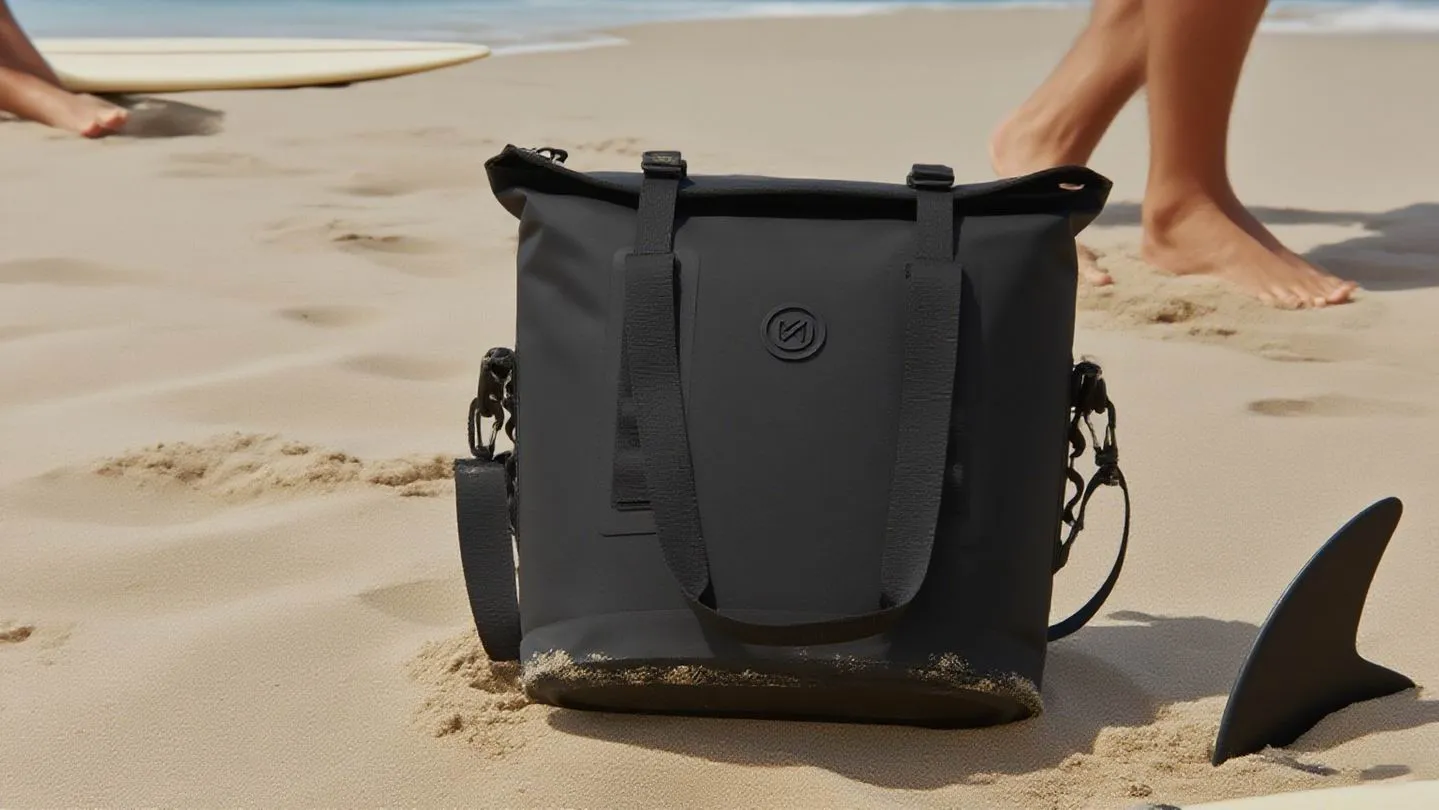
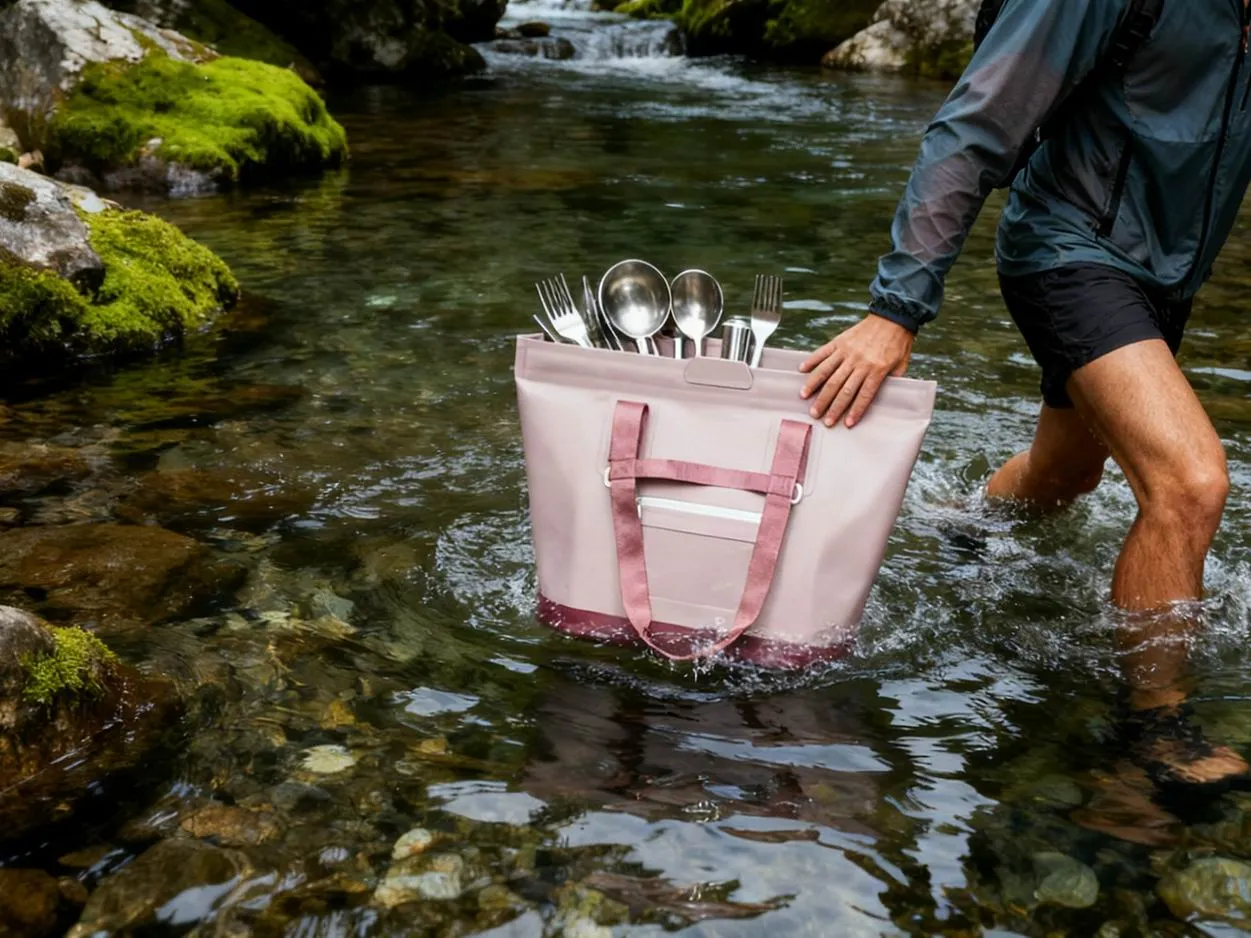
A bucket-style welded bag is the format that makes this easy, because a flat reinforced base and vertical sides keep parcels upright without the shopper having to think about it. Open-topped designs also let a shopper see and reach the whole load, which matters in a market where the bag is opened many times in quick succession. The format and its variants are covered in our page on bucket and drawstring bag designs, and the open-tote alternative in waterproof tote bags.
Sudden downpour: a market has no roof
Having argued that rain is the secondary problem, it is still a real one, and markets make it worse than an ordinary street does. A market is usually open or covered only by awnings, the surfaces underfoot are wet and often muddy, and the shopper is stationary for long periods with both hands full. A sudden convective shower can deliver 20 to 50 millimetres in thirty minutes, and in tropical and subtropical cities that is a routine afternoon event rather than an exceptional one. The shopper’s realistic response is not to deploy a cover; it is to keep buying, because the queue is short and the stall is right there.
- Passive protection only: a covered closure and a water-shedding shell work while both hands are full, which is the state a shopper is actually in.
- An open-topped bag collects rain, so an open tote needs either a roll closure or a willingness to accept some water, and the contents should already be sealed.
- A flat reinforced base keeps the bag out of puddles and mud when it is set down, which happens constantly at a stall.
- A shoulder strap that leaves both hands free is not optional in a market; a hand-carried bag cannot be managed while choosing produce.
- Keep valuables in a closed internal pocket, because a market crowd in a sudden downpour is the classic pickpocketing condition.
- Dry the bag on arrival rather than putting it away wet, particularly if food was involved.
The forecast habit is worth having for markets specifically rather than generally: in convective climates, check the afternoon rather than the morning, and treat a market trip after two in the afternoon as a wet trip by default. Rainfall classification and warning practice is standardised by the World Meteorological Organization. The wider city-rain guidance for everyday carry is in our page on rain protection for daily commuting.
Zoning cash, phone and keys away from the food
A market run has a small theft-and-contamination problem that is easy to design around and easy to get wrong. Cash, phone and keys are handled constantly at stalls, in a crowd, with wet hands and often while holding a bag of something leaking. Putting them back into the same compartment as the shopping means handling food-contaminated surfaces and then handling a phone, and it means opening the main compartment repeatedly in a crowd. The answer is a dedicated closed pocket that is reachable without opening the food compartment at all.
- Keep cash, cards and phone in a closed external pocket that is separate from the food compartment and accessible without opening it.
- Use a small wrist or crossbody pouch for cash at busy markets, so the hands stay free and the money stays visible to the shopper.
- Keys go in the same closed pocket, because a key dropped into a bag of produce is genuinely hard to find and will be greasy.
- Do not put a phone in a bag with raw meat or fish; handling the phone afterwards is a hygiene issue as well as a damage risk.
- Wipe hands before handling a phone at a market; this is basic food hygiene and it is routinely ignored.
- Keep a small hand sanitiser in the valuables pocket, which is the one item shoppers say they wish they had packed.
Small-item carry formats for this purpose are covered in our page on sling and crossbody bags, and device protection in phone and small electronics pouches. The separation principle for the food side is the same one used throughout the category and is explained in wet and dry separation design.
The fold-flat spare bag is the highest-value item in the system
If a market shopper buys one thing beyond a decent bag, it should be a fold-flat spare. The reason is that market loads are unpredictable: the shopper arrives expecting herbs and leaves with a melon, a bottle of oil, a hot dish and a bunch of flowers, and no single bag is right for all of it. A spare bag weighing 80 to 150 grams and folding to the size of a paperback converts an impossible pack-out into two manageable ones, and it is the difference between carrying a leaking parcel upright and carrying it on its side.
- Keep one or two folded spares in the main bag permanently; they weigh almost nothing and are useless if left at home.
- Use the spare for the wet, raw or smelly purchase so it never shares a compartment with anything else.
- Choose a spare with a flat base and vertical sides rather than a soft pouch, because upright is what prevents leaks.
- Pick a spare in a bright colour so it is not left behind on a stall counter, which is the most common way they are lost.
- A spare also covers the unplanned purchase: a market always produces something the shopper did not plan to carry.
- For hot food, a spare with any insulation is better than none, because it slows the cooling that drives condensation.
Brands should note that the spare bag is the single highest repeat-purchase and highest-margin item in this segment, precisely because it is cheap, obviously useful, and lost at a rate that guarantees replacement. It is also the easiest product to sell as an add-on at the point of sale with a main bag. Packaging and positioning for that kind of accessory sale is discussed in our page on packaging design for retail.
Weight, bruising and the pack-out problem
Market loads are heavier and more fragile than shoppers expect, and the two properties conflict. A litre of liquid weighs a kilogram, so a shopper who buys a bottled drink, a jar of sauce, some fruit and a hot dish has easily added 5 to 8 kilograms, and that weight is carried in a bag that was chosen for its shape rather than its load path. At the same time, a meaningful share of the load is crushable: berries, bread, herbs, eggs, pastry. A bag that compresses the load to save space will destroy the fragile items in it.
- Put heavy items low and close to the body if the bag is worn, or low and central if it is carried by hand.
- Give fragile items a rigid container or a hard-sided insert rather than relying on packing order alone.
- Do not use compression straps over a market load; compression is the enemy of soft fruit and bread.
- A wide, padded shoulder strap matters above about 5 kilograms, because a narrow strap concentrates the whole load on one point.
- Consider two lighter bags over one heavy one, because splitting the load protects fragile items and is easier on one shoulder.
- Set the bag down rather than swinging it; a swinging bag crushes what is inside and tips what is upright.
Strap and handle behaviour under this kind of load is the most testable part of the specification and the most commonly skimped. A market bag should be specified with a defined load rating on the handles and with stitching that is anchored into a reinforced structure rather than into the face panel; the testing approach is in our page on load stress testing for straps and handles. Insulated formats that also carry weight well are compared in insulated waterproof bags.
Cleaning a bag after a leak
The correct response to a leak is time-critical and simple, and most people get it wrong by waiting. Protein-rich liquids such as meat drip and fish liquid begin to generate odour within hours, and once the liquid has soaked into a textile liner or into seam allowance, no amount of later cleaning removes it. The sequence matters: empty, rinse, wash with a mild detergent, rinse again, and dry fully open. Solvents and machine washing should be avoided entirely, because both damage coatings and seam tapes and both can set protein stains rather than removing them.
- Empty the bag immediately and remove any absorbent items that were inside it.
- Rinse with cool water first; hot water sets protein stains and fixes the smell.
- Wash with a mild detergent and a soft cloth, paying attention to seam corners where liquid collects.
- Rinse thoroughly, because detergent residue attracts dirt and holds odour.
- Dry fully open, away from direct heat, and leave it open overnight rather than closing it when it is nearly dry.
- For persistent odour, airing works better than perfumed products, which mask rather than remove the cause.
- If the liner is fabric and the leak was protein-rich, accept that the smell may be permanent, and specify a welded liner on the next purchase.
Preventive design makes most of this unnecessary. A welded liner with no seam allowance, a smooth interior, no open-cell padding and a flat floor that can be tipped out turns a leak into a thirty-second event. That is the whole argument for containment-first specification, and it costs less than the premium coatings that do nothing about it.
Capacity and shape for irregular market loads
Market loads are irregular in a way that packed travel loads are not, because the shapes are dictated by the produce rather than by the luggage. A baguette is long, a melon is round and heavy, a bunch of herbs is tall and floppy, and a container of soup wants to stay level. Capacity figures therefore mislead: what matters is whether the bag has a flat base, vertical sides, enough height for tall items, and an opening wide enough to accept an awkward object without forcing it.
| Shopping pattern | Recommended format | Approximate capacity | Critical feature |
|---|---|---|---|
| Small daily shop, one or two items | Fold-flat tote | 10 to 15 litres | Folds to nothing when not needed |
| Regular weekly market run | Bucket-style welded tote | 20 to 30 litres | Flat reinforced base and vertical sides that keep parcels upright |
| Market run including hot food | Tote plus an insulated upright carrier | 20 to 30 litres plus 4 to 8 litre carrier | A level, upright compartment for hot containers |
| Market run including chilled or frozen goods | Insulated tote or cooler bag | 20 to 35 litres | A welded floor and insulation in the same compartment |
| Big shop on foot with no vehicle | Two bags rather than one large one | Two of 15 to 20 litres | Split weight and keep fragile items separate |
| Market run on a bicycle or scooter | Worn backpack with a flat base | 18 to 25 litres | Stable when set down and no wider than the shoulders |
Across all six patterns the constants are the same: a flat reinforced base, vertical or near-vertical sides, a wide opening, and a welded interior. Those four features matter more than any litre figure, and together they describe a bucket or an open tote rather than a technical pack. That is why the market segment rewards simple shapes executed in welded construction, and why complicated organisers sell poorly into it.
Ventilation is the one addition worth considering for produce, because greens and herbs packed wet into a sealed compartment will spoil faster and make the bag damp. A ventilated section for dry produce, kept separate from the welded wet zone, is the configuration that works. Options are covered in our page on ventilated and mesh bag design.
What a brand should specify for a market shopping line
For a brand entering this segment, the product logic is a simple three-part system rather than a hero product. The market shopper needs an open welded tote of 20 to 30 litres with a flat base, an insulated upright carrier of 4 to 8 litres for hot or chilled food, and a fold-flat spare in the 10 to 15 litre range. That ladder covers the whole use case, shares one material story, and reaches 500 pieces per style across two or three colourways without four separate bets.
- Specify TPU rather than PVC for any food-contact interior, because oils extract plasticiser from PVC and the film becomes brittle and odorous.
- Use welded seams rather than taped in every food zone, because oil migrates along tape edges and lifts them from the corners inward.
- Give every food compartment a smooth interior with no open-cell padding and no textile liner, so it can be emptied, rinsed and wiped.
- Design a flat reinforced base and vertical sides, because upright parcels are what prevent leaks.
- Add a closed external pocket for cash, phone and keys that is reachable without opening the food compartment.
- Make the fold-flat spare a standalone SKU in a bright colour, since it is the highest repeat-purchase item in the segment.
- Rate the handles to a defined load and test them; market loads routinely reach 8 kilograms and the handles are the part that fails.
On commercial mechanics, minimum order quantity is 500 pieces per style, which is comfortable across a three-piece ladder in two colourways when planned as one programme. Food-contact claims deserve care: any product sold for food transport should be specified with a material that is documented as appropriate for that contact, and the compliance side is set out in our page on compliance testing. Volume and development sequencing are covered in minimum order quantities and lead times for custom orders. Retailers selling into food markets should also review food delivery and catering bags, which share most of the same specification. To turn this into real dates and a quotation, review the process from first enquiry through sampling into bulk production and send the capacity ladder, material specification and target volumes. Sampling takes 6–10 working days, bulk production runs 35–50 days, and quotations are issued FOB Xiamen.
A buying checklist by shopping pattern
Buying to a specification survives model changes, so this checklist is written as specification rather than as product names. Each line is checkable in a shop in under a minute, and the first three lines decide whether the bag survives its first serious leak.
- Daily small shop: a fold-flat tote of 10 to 15 litres with a flat base, kept permanently in the main bag.
- Weekly market run: a bucket-style welded tote of 20 to 30 litres, vertical sides, wide opening, welded interior, no fabric liner.
- Shopper who buys hot food: add an insulated upright carrier of 4 to 8 litres, and carry it level rather than packed flat.
- Shopper who buys fish or raw meat: a sealed welded pouch dedicated to those items, never a fabric compartment, plus rigid containers for anything with liquid.
- Shopper who buys chilled goods: an insulated compartment with its own welded floor, and a wipe of the interior on arrival.
- Any market shopper: reject any bag with a sewn fabric liner, open-cell padding or taped seams in the food compartment, regardless of the coating figure quoted.
The ordering is deliberate and it is the argument of this page compressed into six lines: containment first, then cleanability, then upright geometry, then load handling, and only last the water-exclusion rating that the market sells on. A bag specified in that order will survive years of market runs and will smell of nothing. A bag specified in the market’s order will keep one downpour off the bread and will be permanently marked by the first leak it meets.
Frequently Asked Questions
Q1. Is rain or leaking shopping the bigger problem at a market?
Leaking shopping, by a wide margin. Rain is time-limited and dries without intervention, while a leak from raw food contaminates the interior, the seams and the padding, and keeps generating odour until the bag is cleaned.
Q2. Why is a waterproof bag not automatically good for market shopping?
Because exclusion and containment are different properties. A bag that excludes water well often traps it well too, and a fabric-lined interior that resists rain will absorb a leak and cannot be wiped out.
Q3. What interior should a market bag have?
A smooth welded liner with no textile, no seam allowance and no open-cell padding. That is the only interior that can be emptied, rinsed and wiped dry after a leak.
Q4. Does cooking oil damage waterproof coatings?
Yes. Oils extract plasticiser from PVC, making it brittle and odorous, and they migrate along seam tape edges and lift them from the corners. TPU resists oils far better and wipes clean.
Q5. How should I carry raw meat or fish from a market?
Transfer it into a rigid sealed container or double-bag it and knot the neck, then place it in a welded compartment kept separate from everything else. The stall’s open plastic bag is not a container.
Q6. Why does the inside of my bag get wet when I carry hot food?
Steam condenses on the coolest surface, which is the inside of the bag. Vent the container for the first minute, keep it upright in an insulated carrier, and wipe the compartment dry on arrival.
Q7. What is the best bag shape for market shopping?
A bucket or open tote with a flat reinforced base and vertical sides. That shape keeps parcels upright, which is the single most effective way to prevent a leak.
Q8. Should a market bag have compression straps?
No. Compression is the enemy of soft fruit, bread and herbs. Use a larger bag or a second one rather than compressing a load that contains anything crushable.
Q9. How much weight does a market load add?
Typically 5 to 8 kilograms once drinks, jars, produce and a hot dish are counted. A litre of liquid weighs a kilogram, and that weight needs a wide strap and a rated handle.
Q10. Why should cash and phone be in a separate pocket?
Because a market crowd in a sudden downpour is a pickpocketing condition, and because handling a phone after handling raw food is a hygiene problem. Use a closed external pocket reachable without opening the food compartment.
Q11. Is a fold-flat spare bag really worth carrying?
Yes, and it is the highest-value item in the system. Market loads are unpredictable, and an 80 to 150 gram spare converts an impossible pack-out into two manageable ones.
Q12. How do I clean a bag after meat or fish leaked in it?
Empty it immediately, rinse with cool water, wash with mild detergent, rinse again and dry fully open. Never use hot water first, since it sets protein stains, and never machine wash.
Q13. Can odour be removed from a fabric-lined bag after a leak?
Often not. Once protein-rich liquid has soaked into a textile liner and the seam allowance, airing is the only option and the smell may be permanent. Specify a welded liner next time.
Q14. Should market produce be sealed or ventilated?
Both, in separate zones. Greens and herbs packed wet into a sealed compartment spoil faster and damp the bag, so use a ventilated section for dry produce and a welded zone for anything wet.
Q15. What should a brand specify first for a market line?
TPU rather than PVC in food zones, welded rather than taped seams, a smooth wipe-clean interior, and a flat reinforced base. Those four decide whether the bag survives a year of market runs.
Q16. How many pieces should a market shopping range have?
Three: an open welded tote of 20 to 30 litres, an insulated upright carrier of 4 to 8 litres, and a fold-flat spare of 10 to 15 litres. That covers the use case and shares one material story.
Q17. Do market bags need a high waterproof rating?
A moderate one is enough. Sustained rain for twenty to thirty minutes plus set-down on wet ground is the realistic exposure; immersion construction adds stiffness and cost without addressing leaks from shopping.
People Also Ask
What ruins a bag at a market?
What you bought, not the rain. Raw meat drip, fish liquid and tipped hot food contaminate the interior, the seams and the padding, and keep smelling until cleaned.
What interior is best for market shopping?
A smooth welded TPU liner with no fabric, no seam allowance and no open-cell padding, so a leak can be emptied, rinsed and wiped away.
How do I stop hot food wetting my bag?
Keep it upright in an insulated carrier, vent it for the first minute so steam escapes outside, and wipe the compartment dry on arrival.
Why does oil damage waterproof bags?
Oils extract plasticiser from PVC and migrate along seam tape edges, lifting them from the corners. TPU resists oils and wipes clean.
What bag shape suits market shopping?
A bucket or open tote with a flat reinforced base and vertical sides, since upright parcels are what prevent leaks.
Is a fold-flat spare bag worth carrying?
Yes. Market loads are unpredictable and a spare weighing 80 to 150 grams turns an impossible pack-out into two manageable ones.