A lunch bag is not a small cooler and treating it as one is why so many of them disappoint. A cooler is an ice-management problem with a meltwater drain and a twenty-litre cavity; a daily meal carrier is a three-to-five-hour warm-or-cold holding problem with no ice, no drain and roughly six litres, used two hundred and twenty mornings a year by someone who will wipe it out at their desk. The physics is different, the failure modes are different, and the honest performance claim is different: not "keeps cold eight hours" but "still pleasantly warm at one o’clock if you heated it properly and closed it immediately". Get that claim right and everything else about the product gets easier, because the specification stops chasing a number the format cannot deliver and starts delivering the one users care about.
This guide covers the daily-use case rather than the outdoor one, for users choosing a carrier and for brands specifying a line. It covers why a lunch bag is a warm-meal problem rather than an ice problem, the thermal arithmetic without ice and why the temperature you start from dominates every insulation choice, what "keeps food warm" can honestly mean hour by hour, food contact compliance for something that touches food twice a day for years, why soup is the first complaint in this category and how the liner has to be built for it, sizing to the container rather than to appetite, closure choice for a bag cycled three times daily, cleaning every day and what grows in the interval, how the bag lives on a commute and in an office fridge, insulation material choices for a small carrier, the failure modes specific to daily lunch use, how to test before committing, and how a brand should develop, brand and cost a lunch range. MOQ 500 pieces per style, sampling in 6–10 working days, bulk in 35–50 days, FOB Xiamen: these are the working terms at QUANZHOU JUNYUAN BAGS, custom waterproof bag production since 2014 in a 4,950 m² SGS-verified facility.
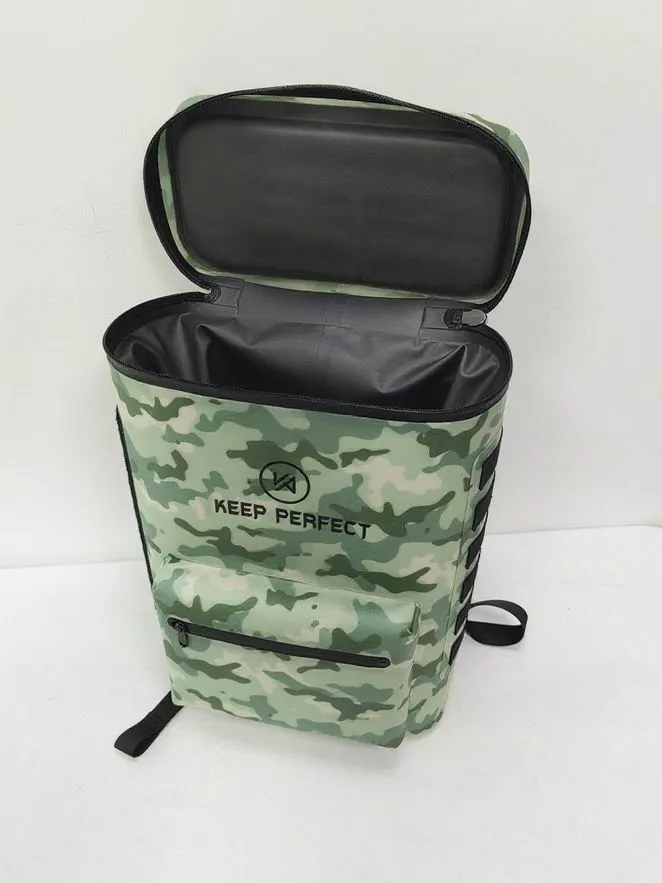
Not an ice problem: what makes a lunch bag different
Start from the distinction, because almost everything else follows from it. A cooler holds a large thermal mass chilled by ice, generates its own water as that ice melts, and needs a drain, a stiff structure and twenty litres of capacity. A waterproof lunch bags daily carrier holds one meal, no phase-change material, and its thermal job is to slow heat transfer for a few hours
The practical consequences are immediate. There is no meltwater, so there is no need for a drain and no benefit from one; there is also no ice reservoir to absorb heat, so every joule that leaks in warms the food directly. The cavity is small, so the ratio of surface area to contents is worse than in a large cooler, which means proportionately more insulation is needed for the same result. And the product is used daily rather than occasionally, so cycle-wear and cleanability dominate the ownership experience.
That last point is the one most often missed. A cooler is used perhaps twelve weekends a year; a lunch bag is used over two hundred mornings. Anything that degrades per cycle — a zip slider, a printed logo, a wipe-clean liner — reaches end of life in the lunch bag first even when both products are built identically. Designing from the cooler drawing downwards therefore produces a product that fails in month nine.
The relationship between the two categories is close enough to be worth reading together and different enough to warrant distinguishing; our separate analysis of insulated cooler bags for outdoor use covers the ice side in detail, including why published ice retention figures are inflated, and this piece assumes that territory belongs to the larger format.
The thermal arithmetic with no ice: start temperature wins
Without ice there are three variables: how hot the food started, how much thermal mass it carries, and how fast heat escapes through the walls. Users fixate on the third and control the first two, which is unfortunate because the first two dominate by a wide margin. A small meal has little thermal mass, so a modest heat loss produces a large temperature drop, and nothing in the insulation changes that.
The arithmetic is easily visualised. A 400 gram portion of food at 65 degrees in a carrier with modest insulation in a 20 degree room loses heat fastest in the first half hour, then progressively slower as the temperature difference falls. Reaching the point where the food is merely warm rather than hot takes a couple of hours; reaching the point where most people would decline to eat it takes a good deal longer. Doubling insulation thickness delays both, but does not halve either, because heat also leaves through the closure and through the top and bottom faces.
The two levers that actually change the outcome are therefore behavioural and they belong in the product. Preheat the carrier while the food is cooking — filling it with hot water for a minute, or simply leaving it near the heat source — removes the initial loss into the insulation itself, and it is worth more than millimetres of foam. And close it immediately, because a carrier left open while the user finishes packing loses a substantial share of the advantage before the commute starts.
For cold food, the mirror applies with one addition: use a frozen element. A small reusable gel pack, cheap and easily branded, converts the product from a slow-heat-leak container into something with a genuine cold reservoir, and because these bags are small it takes only one. Users who are told this get genuinely different performance from the same product, which is the cheapest performance upgrade in the category and belongs on the hangtag.
What "keeps food warm" can honestly claim
The claims on this category are among the least honest in soft goods, largely because they are tested with unrealistic starting conditions and unrealistic loads. Testing with a litre of near-boiling water in a pre-warmed carrier in a temperate room produces numbers that no packed lunch ever achieves, and users discover that in week one. Publishing an honest curve, by contrast, wins the comparison every time.
| Elapsed time | Realistic outcome for a properly heated meal | What the typical claim says | Practical guidance to give the user |
|---|---|---|---|
| 0 to 1 hour | Hot, genuinely enjoyable | Hot | Fine; nothing needed beyond closing it promptly |
| 1 to 3 hours | Warm and pleasant; still clearly better than room temperature | Hot | The honest sweet spot of the category |
| 3 to 4 hours | Borderline; palatable for most dishes, poor for anything with cheese or rice | Warm | Preheat the carrier, or add a small gel pack for cold food |
| 4 to 6 hours | Approaching room temperature; plan accordingly | Still warm | Treat as a cool-room storage benefit rather than insulation |
| Beyond 6 hours | Room temperature; enters the food safety danger band for perishable items | Safe all day | Do not rely on it for meat, dairy or cooked rice without a cold source |
The last two rows are where the serious risk sits and it should be stated plainly. Food safety guidance such as that published by the USDA Food Safety and Inspection Service puts the rapid bacterial growth band between roughly 4 and 60 degrees Celsius and advises leaving perishable food in it for no more than about two hours. No soft lunch bag changes that. A bag that helps a user keep cold food cold with a gel pack, and hot food hot until lunchtime, is doing its job; one whose packaging implies that perishable food is safe all day without a cold source is creating a hazard.
The commercial conclusion is straightforward and slightly counter-intuitive: publish the shorter, honest figure and the better care advice, rather than the longer impressive one. Products that do this consistently outperform competitors on reviews, because the complaint driving returns is not "it cooled too fast" but "it was described as keeping things hot and it did not", and honesty removes the complaint entirely.
Food contact compliance for something used twice daily
A lunch bag contains food directly, every day, sometimes warm and sometimes fatty, for years. That places it in a regulated position that general-purpose bags never reach, and it is the single area where brands most often take unmanaged legal and reputational risk. Surfaces intended to contact food must be made from materials permitted for that use and must be tested by migration testing rather than merely declared.
In practice this means two things for the specification. The liner, and any internal elastic, printed mark or adhesive that food might touch, need traceable material declarations from the supplier. And the finished construction needs migration testing against the relevant simulants for the markets it sells into — acidic, aqueous and fatty are the usual trio, and a curry or a buttery pasta is exactly the fatty, warm, acidic case that any serious test should cover.
- Require supplier declarations for every liner, coating, ink and adhesive that sits inside the food cavity.
- Commission migration testing on the finished liner rather than relying on raw material certificates alone.
- Specify that any printed mark inside the cavity uses a food-contact-appropriate ink system or sits outside the contact zone.
- Keep metal hardware out of the food cavity; where a fitting is unavoidable use stainless rather than plated zamak.
- Record the intended use conditions — temperature and contact time — on the compliance file, since migration limits depend on them.
- Retest if the liner supplier, the ink or the liner material changes, because substitution invalidates the earlier file.
Market differences matter and should be resolved before tooling. European practice is built on framework regulation for materials intended to contact food with specific measures for plastics; the United States system is organized around food contact substances cleared by the US Food and Drug Administration, with state-level requirements such as California’s Proposition 65 adding another layer. Neither is optional and neither is expensive relative to a recall.
This territory is covered from the regulatory side in our guide to compliance and safety regulation for custom bags and in our notes on REACH and CPSIA testing. The short version for anyone developing this product: treat the liner specification as a compliance deliverable from day one, because it is far cheaper than replacing it after a retailer asks for the file.
Soup first: containing the leak that actually happens
Ask anyone who sells this category which complaint leads returns and the answer is consistent and unambiguous: a liquid leak. Not rain, not condensation, not external water — soup, stew, yoghurt, salad dressing, or a water bottle that was not quite closed. A daily lunch bag is a container carried upright most of the time, laid sideways in a bag for part of the commute, and tipped by accident at least monthly, and its liner has to hold all of that.
The construction answer is the same one that appears in every serious waterproof category and is skipped here for cost. The liner must be welded, not sewn, because every stitch is both a hole and a wick, and a sewn liner seam at the base of a bag that occasionally holds standing soup will eventually deliver that soup onto a shirt. The liner must be turned up at least forty millimetres above the base so a spill cannot reach a top edge. And it must be shaped so it does not collapse and pour out through its own opening when set down.
There is a second-order point about orientation that no manufacturer controls and that brands should design around: users lay these bags on their side. A leakproof lid on a container is reliable upright and unreliable sideways, so the bag should assume side carry. That argues for a liner with a genuine sealed closure rather than merely a sealed tray — either a welded pouch with a fold-and-clip or a coated zip with a storm guard behind it — so that a sideways spill stays in the liner rather than finding the top edge.
Corner radius and cleanability do the rest. Spilled soup dries in corners, and an interior corner tighter than about fifteen millimetres radius cannot be wiped clean in one motion, which means residue stays and eventually smells. Welded seams with generous radii convert a weekly annoyance into a ten-second wipe, and this is precisely where seam method pays off; the options are compared in our notes on seam taping and sealing methods.
Sizing to the container, not to the appetite
Lunch bags should be specified around the containers people actually own, because unlike most bag categories their contents are rigid boxes of known dimensions. Designing to litres produces bags that are too tall for a standard container and too narrow for two, and the resulting products either do not close or are padded around empty air.
| What is carried | Typical container footprint | Interior clear space needed | Design note |
|---|---|---|---|
| Single bento-style box, about 700 ml | Roughly 190 x 130 x 55 mm | 205 x 145 x 70 mm minimum | The standard single-meal case; design to this first |
| Two stacked containers | Two of the above | Interior height at least 130 mm | Choose height over footprint here |
| A 500 ml soup flask upright | About 70 mm diameter, 220 mm tall | Interior clear height at least 240 mm | The tallest common item; it drives internal height |
| Sandwich boxes and fruit | Shallow and wide | Wide interior with a low centre of gravity | Base stiffness matters more than insulation depth |
| A 330 to 500 ml drink can or bottle alongside food | About 66 mm diameter, up to 200 mm tall | Either a divider or a taller cavity | Upright storage prevents most spills |
| A small frozen gel pack plus a meal | Typically 150 x 100 x 20 mm | Allow 25 mm of additional width | Design the sleeve rather than letting it float loose |
The internal height row deserves particular attention, because it is the one that most often causes a returned product. People buy a bag for a container they already own, and if that container does not fit the bag comes back regardless of how good it is otherwise. Publishing internal dimensions rather than litres is both honest and commercially protective.
External dimensions matter just as much and for an unglamorous reason: the bag has to fit somewhere. Inside a backpack, under a desk, in a shared office fridge, or in a bicycle basket, and each of those imposes a maximum. A carrier that fits comfortably alongside a laptop in a standard commuter bag outsells a better-insulated one that does not, which is why the depth dimension should usually be the first one fixed. Tolerance discipline across a size range is set out in our guide to dimensional customisation.
Closures for a bag cycled three times daily
Open, close, open, close, wipe, repeat: this product sees more closure cycles per week than anything else a person owns. Three cycles a working day is roughly seven hundred a year, and across a two-year expected life that is over a thousand. Nothing about the thermal performance matters if the closure stops working in month eight, and this is consistently where these products die.
A coated reverse-coil zip with a storm guard is the correct default. The storm guard matters specifically here because food residue plus a closed zip is a recipe for a stiff, eventually jammed slider: the guard keeps the bulk of the spill on the liner side of the closure. And the slider should be specified by brand and cycle-tested, because the slider wears out well before the teeth do and is almost always the first thing to break.
Fold-and-clip and roll-top closures deserve a mention because they are genuinely better at containing liquid and genuinely worse for daily convenience. A roll-top is excellent when someone is carrying soup on purpose and annoying when opening a sandwich at a desk three times a day. That trade is real and should be resolved by asking which the customer is doing; most are doing the second, with occasional soup.
Whatever is chosen should be cleanable, and this is rarely specified. A zip track filled with dried yoghurt becomes stiff and then fails, so the design should let the closure be opened fully flat and brushed out. Testing protocols for closure endurance are covered in our review of zip durability testing, and a reasonable internal target for this category is two thousand cycles to be tested rather than assumed.
Cleaning every day and what grows in between
A lunch bag is wiped out daily at best and left closed overnight at worst, which is close to an ideal condition for microbial growth: warmth, moisture and an excellent nutrient source. Even a careful user leaves microscopic residue in corners and in the zip track, and a careless one leaves a whole spoonful of something with dairy in it until tomorrow morning.
The realistic user protocol, and it belongs on the hangtag, is short. Empty immediately after eating, never store it closed with anything inside, wipe the liner with a damp cloth daily, wash with mild detergent weekly, and dry fully open before putting it away. The drying step is the one users skip and the one that matters most: a liner closed overnight stays damp, and damp plus residue plus warmth produces visible growth within roughly one to two days.
Materials should be selected for that protocol rather than merely for looks. A smooth film liner wipes clean; a textured or fabric-faced liner holds residue in its texture and will smell eventually no matter how carefully it is cleaned. A light interior colour makes residue visible so it gets cleaned; a dark one hides it until it smells. And anything that cannot tolerate a weekly warm wash with mild detergent is the wrong material for this product.
Machine washability is a genuinely attractive claim here and genuinely constrains the build. It is achievable — cool wash, mild detergent, no tumble drying — but it requires a TPU rather than PU liner coating for hydrolysis resistance, a zip specified for repeated wash cycles, and printing tested to the same number of cycles. Brands that want the claim should specify for it from the start rather than discovering at pre-production that the logo survives three washes. Material trade-offs sit in our comparison of TPU and PVC liners and in our notes on surface treatments, which are useful here but never a substitute for drying.
Commuting with it: office fridge, backpack and flat-pack
The daily rhythm of this product is more demanding than its thermal specification suggests. It is carried to work alongside everything else, it usually lives in a shared fridge or under a desk for several hours, and it goes home again empty or half-full. Each of those imposes requirements that no amount of insulation addresses.
- It must fit alongside a laptop in a commuter bag, which usually caps depth at around 100 to 120 millimetres.
- It must survive being squeezed, because a commute involves being compressed against a body and other bags.
- It needs a grab handle positioned so it can be pulled out of a crowded fridge shelf one-handed.
- It must not sweat externally in a fridge, or it will leave condensation rings on the shelf.
- Ideally it folds or compresses when empty, since half its life is spent empty in a drawer.
- A small external pocket for cutlery and a napkin prevents constant opening of the insulated cavity.
That second item deserves expansion, because compression is what quietly destroys insulation. Foam that is squeezed repeatedly loses thickness and its closed cells break down, and once that happens the thermal performance degrades year on year without anything visible happening. Specifying a foam with adequate compression resistance and a shell that protects the corners is cheaper than replacing the whole construction after eighteen months.
Foldability conflicts with structure, and the honest answer is to offer both rather than to compromise. A structured model for people who bring soup and a soft foldable model for people who bring a sandwich share a liner specification and a closure, and together they cover the market far better than one product trying to do both. This kind of split also makes a two-SKU range defensible at a minimum order quantity of 500 pieces per style.
Insulation choices for a small daily carrier
Insulation in a six-litre cavity behaves differently from insulation in twenty litres, and choices that are correct in a cooler are often wrong here. The dominant issue is the surface-area-to-volume ratio: a small bag has proportionally more wall for its contents, so heat transfer per unit of food is inherently worse, and adding insulation reaches diminishing returns faster than intuition suggests.
| Insulation | Typical thickness used | Performance per millimetre | Practical judgement |
|---|---|---|---|
| Closed-cell polyethylene foam | 4 to 8 mm | Good baseline; cheap and reliable | The default; adequate for a three-hour lunch window |
| Cross-linked PE foam | 4 to 6 mm | Slightly better and more compression-resistant | Worth the small premium for daily use |
| EVA foam | 3 to 6 mm | Similar to PE, softer hand | Good where the product must feel less rigid |
| Non-woven or recycled fibre batting | 6 to 12 mm | Lower per millimetre, but bulky | Best where a sustainability story is required |
| Reflective metallised film facing | Microns, always combined | Meaningful against radiant loss only | Useful as a facing, useless alone |
| Air gaps alone | Not applicable | Poor in a small cavity; convection dominates | Avoid relying on trapped air in this format |
A reflective facing deserves a specific comment because it is oversold. Radiant heat transfer matters when there is a large temperature difference across an air gap with a reflective surface facing it; in a small bag where food containers are touching the liner, conduction dominates and the film contributes very little. It is worth including as part of a laminate and worth nothing as a headline claim.
Vapour management inside the cavity is the other half of this and it is consistently overlooked. Warm moist food sealed in an impermeable liner produces condensation on every internal surface, which wets the containers, makes the bag feel damp, and accelerates anything else that wants to grow. A liner that is impermeable to liquid but has a small vent path high up, or simply a care instruction to leave the top open once the food is out, resolves this. The wider mechanism is covered in our notes on anti-condensation design, and film gauge selection in our TPU film thickness guide.
Failure modes specific to daily lunch use
Returns in this category cluster tightly and predictably, and every mechanism below has a specification answer that costs less than the returns it prevents.
| Symptom | Mechanism | Originating decision | Specification response |
|---|---|---|---|
| Soup or yoghurt leaked into a work bag | Unwelded or low-turned liner seam; top edge too low | Liner sewn rather than welded | Welded liner turned up at least 40 mm from the base |
| Closure jammed or separated after a year | Slider wear past a thousand cycles plus food residue | Slider specified by price; no storm guard | Branded cycle-tested slider; storm guard behind the zip |
| Interior smells even though the food containers are sealed | Residue plus overnight moisture in liner corners | Tight corner radii; no drying instruction | Radiused corners; light liner colour; dry-open instruction |
| Food barely warm at lunchtime | Low starting temperature; no preheat; open for too long | Claim written from unrealistic test conditions | Publish an honest curve; instruct preheating and prompt closing |
| Insulation feels flat after a year | Foam compression set from daily squeezing | Foam grade chosen by cost | Compression-resistant cross-linked foam; protected corners |
| Condensation soaking everything inside | Warm moist food sealed in an impermeable cavity | No vapour relief designed in | A high vent path, or a dry-open instruction and honest copy |
| Logo gone within months | Ink system not tested to the cleaning protocol | Print method chosen without a wash test | Match ink to substrate; test to the claimed wash count |
| Bag does not fit alongside a laptop | External dimensions set before the commuter context | Designed to litres rather than to the commute | Fix depth first, usually around 100 to 120 mm |
Only one of those eight is a thermal failure and it is largely a claim-writing failure rather than an engineering one. The product is bought for temperature performance and returned for liquid containment, closure wear, cleaning and sizing, which is the standard pattern wherever something is used daily rather than occasionally.
The process discipline that keeps all of this honest across a production run, rather than solving it once at sampling, is set out in our guide to common waterproof bag defects and prevention, and adjacent requirements for the food service side of the category appear in our notes on bags for food delivery and catering.
Testing a daily lunch carrier before you commit
The test programme should be built around daily use rather than around the thermal standard, and most of it can be run on a desk. What distinguishes this category is that nothing happens quickly: every interesting failure appears somewhere between two months and two years of ownership, so the tests have to compress that.
- Realistic thermal test: heat a representative 400 gram meal to 65 degrees, place it in the carrier at room temperature, and log temperature hourly. Do not pre-warm the carrier unless that is what you intend to instruct.
- Leak containment: pour 150 millilitres of coloured water into the liner, lay the bag on its side for thirty minutes, then inspect the shell and the work surface beneath it.
- Closure endurance: cycle the closure two thousand times, then repeat the leak containment test, because binding appears only after wear.
- Compression ageing: compress the bag laterally to half its depth five hundred times, then measure insulation thickness at the corners.
- Cleaning endurance: follow the intended care protocol twenty times, inspecting liner, print and zip at intervals rather than only at the end.
- Fit check: load with the target containers and place it in a standard commuter backpack alongside a laptop, which is where it will actually live.
Two belong in routine production audit rather than only at development: leak containment and closure endurance. Both are quick, both catch a substituted liner or slider faster than any paperwork review, and together they cover the majority of the return causes in the table above.
One final piece of realism. Ten colleagues carrying their actual lunches for four weeks will find more failures than any bench programme, because real lunches contain combinations nobody anticipated — curry on a hot day, a leaking yoghurt, a forgotten bag in a warm car over a weekend. Run it before tooling rather than after.
Developing a lunch range: compliance, capacity, branding and margin
This is an attractive category to develop and it is worth understanding why. Units are small, so freight per piece is low; patterns are simple; and the product is bought repeatedly and given as a gift, which sustains volume through a range better than most bag types. Minimum order quantity is 500 pieces per style supports a structured model plus a foldable model in one colourway, which is the range most brands should build first.
Sequence matters more here than in most categories because several decisions are expensive to reverse. Compliance first: the liner, its coating, every internal ink and adhesive, and the migration testing, resolved before tooling rather than after a retailer asks for the file. Then internal dimensions, fixed to the containers the target customer already owns. Then insulation and structure, then appearance. Working in that order avoids the two classic mistakes, which are discovering the compliance gap late and discovering that the target container does not fit after launch.
Standardise everything the customer cannot see. One liner construction, one closure suite, one foam specification across two sizes sharing one pattern family keeps development cost down and reduces the number of quality-critical assemblies in the programme. Differentiation then lives in colourway, printed lining patterns and exterior branding, which is where purchase decisions are actually made.
Branding and food-contact interact here in a way that catches people out: a printed logo on the inside of the liner is a food-contact question as well as a printing question, so it needs an appropriate ink system and its own compliance file, or it needs to sit outside the contact zone. External printing behaves as usual for coated woven shells, and embroidery perforates the shell unless sealed by the construction. Methods are reviewed in logo printing and embroidery options, and retail presentation, which matters disproportionately for a gift-led category, in packaging options for wholesale orders.
Finally, price the honest claim. A carrier that publishes its real holding curve, states that perishable food needs a cold source, includes a branded gel pack and prints a cleaning protocol will outsell and out-review one claiming eight hours of insulation, because it sets expectations it can meet every single day. Sampling runs 6–10 working days per round and bulk production 35–50 days, quoted FOB Xiamen; the sequence is set out in our guide to lead times on custom orders. If you want this turned into a costed range, review our own process from first enquiry through sampling into bulk production and send the target containers, the commute context and the holding claim you intend to make. Minimum order quantity is 500 pieces per style, samples take 6–10 working days, bulk production runs 35–50 days, and quotations are issued FOB Xiamen.
Frequently Asked Questions
Q1. Is a lunch bag just a small cooler bag?
No. A cooler manages ice and meltwater in twenty litres; a lunch carrier holds one warm or cold meal with no ice. Different thermal problem, different closure cycling and different cleaning demands.
Q2. How long will it keep food warm?
Realistically hot for the first hour, pleasantly warm for two to three, and borderline by four. Claims of all-day heat assume near-boiling contents and a pre-warmed carrier.
Q3. What actually makes the biggest difference to keeping food warm?
Starting temperature. Pre-heating the carrier with hot water for a minute and closing it immediately gains more than adding insulation thickness, because a small meal has little thermal mass.
Q4. Can I safely keep perishable food in one all day?
Only with a cold source. Food safety guidance puts rapid bacterial growth between roughly 4 and 60 degrees Celsius, so use a frozen gel pack for anything perishable.
Q5. What causes most lunch bag returns?
Liquid leaks. Soup, yoghurt or a badly closed bottle escaping through a sewn liner seam or over a low liner edge is the leading complaint by a wide margin.
Q6. Should the liner be welded or sewn?
Welded. Every stitch through a liner is both a hole and a wick, and soup sitting in a base seam eventually finds its way out onto clothing.
Q7. How high should the liner come up the sides?
At least forty millimetres above the base. Anything lower lets a modest spill reach the top edge and enter the shell rather than staying contained.
Q8. Why does my lunch bag smell even though containers are sealed?
Residue plus overnight moisture in the corners. Tight corner radii cannot be wiped clean, so specify generous radii, a light liner and a dry-open instruction.
Q9. How often should it be cleaned?
Wipe the liner daily, wash weekly with mild detergent, and always dry fully open. Leaving it closed overnight is what allows growth to establish.
Q10. Can it go in the washing machine?
Only where specified for it: TPU rather than PU liner, a wash-rated zip, print tested to the same cycle count, cool wash and no tumble drying.
Q11. What internal dimensions should I design around?
A standard 700 ml bento box is about 190 by 130 by 55 millimetres, so allow at least 205 by 145 by 70. A 500 ml soup flask needs roughly 240 millimetres of clear interior height.
Q12. How thick should the insulation be?
Four to eight millimetres of closed-cell polyethylene foam is the standard answer. Beyond that, returns diminish quickly in a small cavity, since past conduction through the closure and faces dominates.
Q13. Does a reflective metallic lining help?
Marginally. Radiant transfer matters little when containers are touching the liner and conduction dominates; it is a useful facing and a misleading headline claim.
Q14. Do I need drainage like a cooler bag?
No. There is no ice and therefore no meltwater. The requirement is containment of what food might spill, which is a welded liner rather than a drain.
Q15. Why did my closure stop working after a year?
Slider wear combined with food residue in the track. Specify a branded cycle-tested slider and put a storm guard behind the zip to keep spills off the teeth.
Q16. What food contact compliance does this product need?
Declarations for every liner, coating, internal ink and adhesive, plus migration testing on the finished liner against the relevant simulants for each target market, including fatty and acidic foods.
Q17. What sizes should a brand launch first?
Two: a structured model sized around common containers for soup carriers, and a foldable model for sandwich carriers, sharing one liner construction and one closure specification.
People Also Ask
How long does an insulated lunch bag keep food warm?
Hot for the first hour and pleasantly warm for two to three. All-day claims assume near-boiling contents in a pre-warmed carrier.
What makes the most difference to lunch bag performance?
Starting temperature. Pre-heat the carrier and close it immediately; that gains more than extra foam thickness.
How do I stop soup leaking out of a lunch bag?
Use a welded liner turned up at least 40 millimetres from the base, so a spill cannot reach a seam or the top edge.
Is perishable food safe in a lunch bag all day?
Only with a frozen gel pack. Bacteria grow rapidly between 4 and 60 degrees Celsius, and no soft bag changes that.
How often should a lunch bag be cleaned?
Wipe daily, wash weekly with mild detergent, and dry fully open. Never store it closed with food residue inside.
What size lunch bag fits a standard bento box?
Allow at least 205 by 145 by 70 millimetres of clear interior for a typical 700 ml container, and 240 millimetres of height for a soup flask.