A commuting bag is not a dry bag with a laptop sleeve in it. It is a bag that gets opened forty times a day, set down on wet ground, shoved into an overhead rack, carried for an hour on one shoulder or two, and expected to look acceptable in a meeting at the other end. Those conditions decide what fails, and they are not the conditions most waterproof products are designed for. The waterproof level that matters for commuting is resistance to driving rain and splashes, sustained over an hour, through an opening you keep using — not immersion in a river you never fell into.
This guide starts from that observation and works through the choices in the order they affect daily life: what level of protection commuting actually requires and what is overkill, how laptops really get damaged in the rain, which closure survives being opened dozens of times a day, where the capacity sweet spot sits, what makes a technical bag look professional, why carry comfort outweighs litre count, how metro, bus, bicycle and walking differ, why wet and dry separation matters more than it sounds, which fabric properties matter in urban rain, and the central durability point — that handles, straps and closures wear out long before the fabric panel does. It closes with care routines, a budget-tiered buying checklist and what to specify if you are buying for a team. QUANZHOU JUNYUAN BAGS: custom waterproof bag production since 2014, 4,950 m² SGS-verified facility, MOQ 500 pieces per style, sampling in 6–10 working days and bulk in 35–50 days, FOB Xiamen.
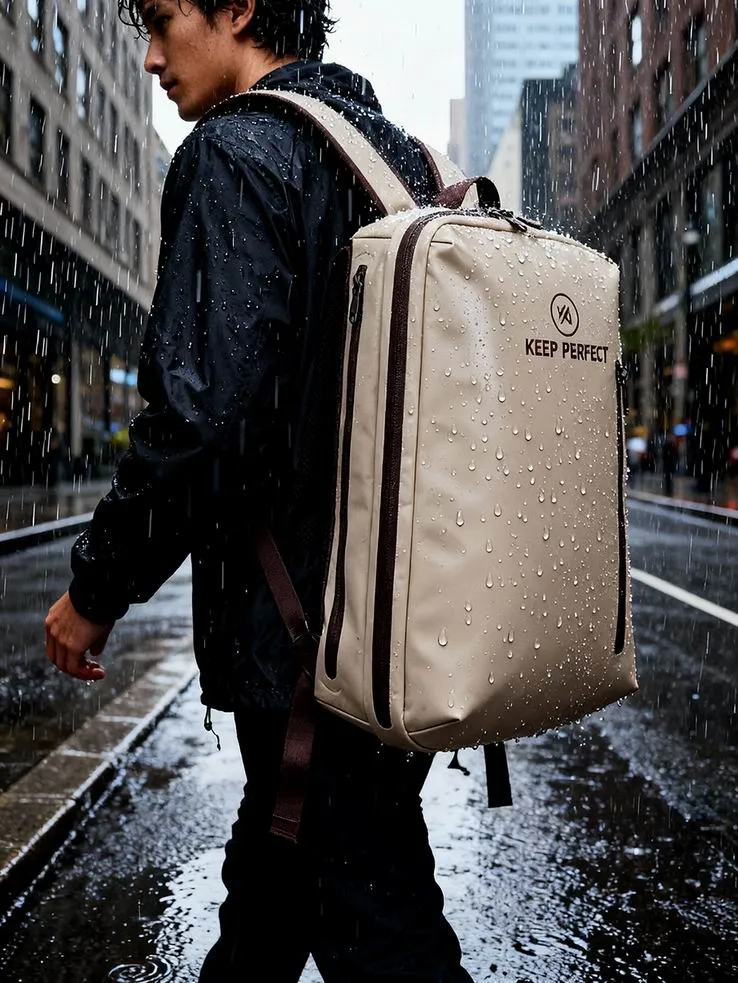
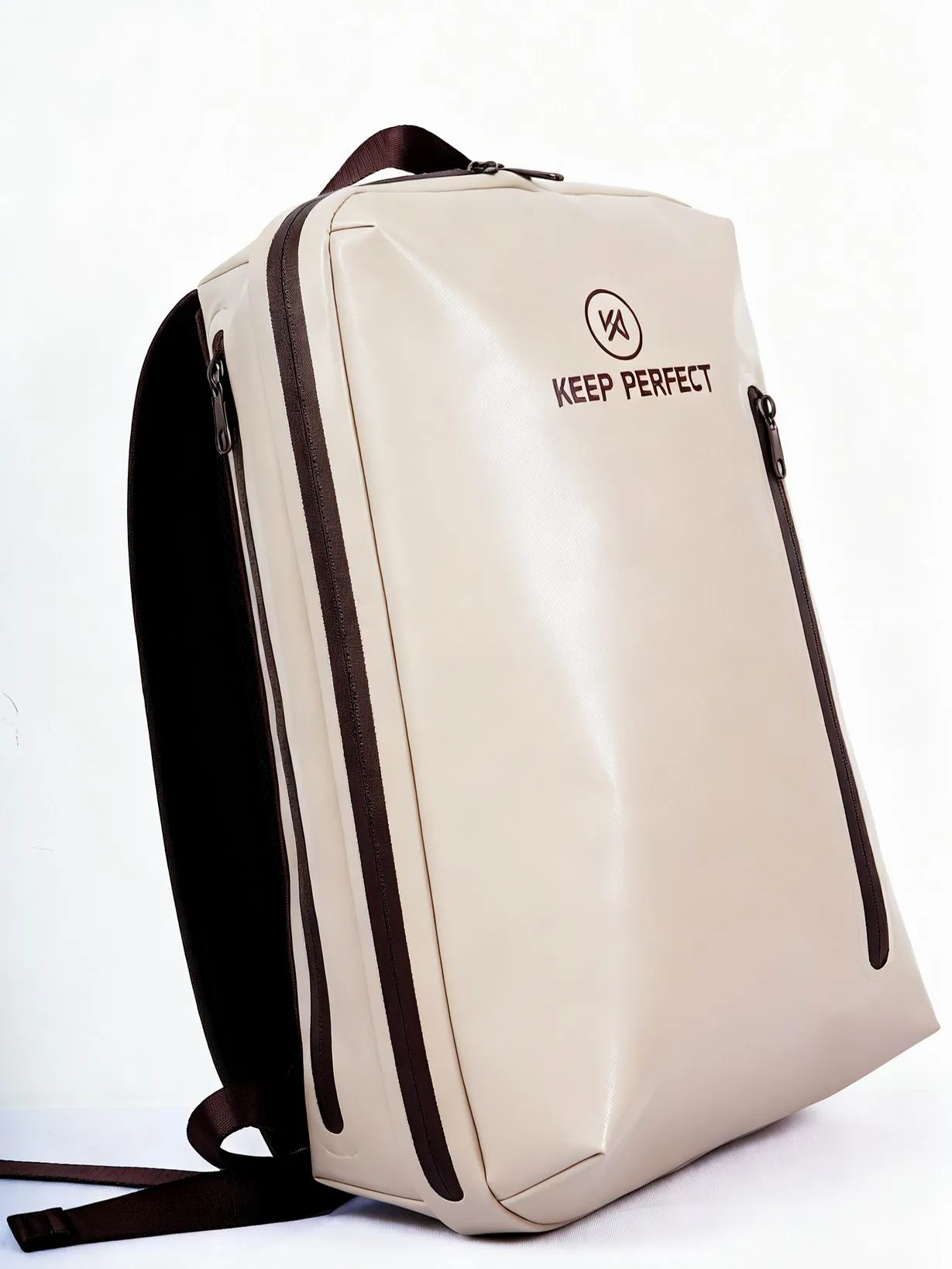

Define the real exposure: rain you walk through, not water you fall into
The first decision is also the one most buyers get wrong, because they buy against the worst condition they can imagine rather than the condition they will actually meet. Good commuting waterproof bags are specified for rain protection daily use: sustained rainfall while moving, spray from traffic, splashes from wet ground, and the five minutes standing at a crossing in heavy rain. None of those require immersion performance, and specifying immersion performance has real costs in weight, stiffness, access speed and appearance.
| Exposure a commuter actually meets | What it demands | What is overkill | Cost of over-specifying |
|---|---|---|---|
| Walking or cycling in steady rain for 20 to 40 minutes | Water-shedding outer face, protected closure, taped or welded seams at the top | Submersion-rated construction | Added weight and stiffness, slower access |
| Setting the bag down on wet pavement or a wet train floor | A base that resists wicking and abrasion, feet or a reinforced panel | A fully sealed one-piece shell | Cost, and difficulty cleaning the interior |
| Shoulder spray and wheel spray while cycling | Coverage over the closure and the back panel seam path | Full dry-bag roll-top on every compartment | Slower access and a less professional silhouette |
| Condensation from a cold drink or a wet umbrella inside | Separation between wet and dry zones | Antimicrobial or exotic coatings | Cost with no measurable commuting benefit |
| A sudden cloudburst with no shelter | Closure that seals quickly with one hand | An internal waterproof liner on every pocket | Bulk and packing time every single morning |
That table has one practical message: the weak point in commuting is almost never the panel. Coated fabric at any reasonable specification sheds rain for the length of a commute. What admits water is the closure, the seam path at the top of the bag, and the zip garage or storm flap that was omitted because it looked untidy on a product page.
Where a rating is quoted, it is worth knowing what it refers to. The ingress protection code published by the International Electrotechnical Commission describes resistance to water jets and immersion under defined laboratory conditions; it says nothing about whether a bag is pleasant to open forty times a day. Use it as one input, not as the decision. The framework in choosing the right waterproof level maps exposure to construction rather than to a number.
Laptop protection: water is rarely what breaks it
Commuters buy a waterproof bag to protect a laptop, and laptops in commuting bags are usually damaged by impact rather than by water. The realistic failure sequence is a knock on a door frame, a drop from a seat, or compression under other bags in an overhead rack — and water damage, when it happens, tends to arrive through an unclosed opening after the owner has been rushing, not through the fabric. Protection therefore means a suspended, padded, correctly sized sleeve plus a closure the owner will actually bother to close.
- The sleeve should suspend the device clear of the bag’s base by a couple of centimetres so a set-down does not transmit directly into the corner.
- Padding needs to be closed-cell or dense foam that does not bottom out; thin open-cell foam compresses to nothing within a season.
- The sleeve must fit the actual device. A sleeve rated for "up to sixteen inch" that leaves two centimetres of play allows the laptop to shift and strike the corner.
- The laptop should sit against the back panel rather than against the outer face, where it is both better protected and better balanced.
- A separate, clearly labelled wet zone matters more than extra padding, because a leaking bottle inside the bag is a common cause of loss.
Two details deserve more attention than they usually get. The first is corner protection: laptops fail at the corner and the port side, so padding should be thickest there rather than evenly spread. The second is closure discipline. A bag whose closure takes fifteen seconds and two hands will be left open in a hurry, and an open bag in rain is not a waterproof bag. Design for the tired version of yourself, not the careful one.
Padding material and geometry are treated in more depth in the guide to padding materials for protection, and the device-specific trade-offs in the waterproof laptop bag guide. If you commute with camera kit or instruments rather than a laptop, the same logic applies with higher severity — the value at risk justifies stricter organisation.
The closure is the product: choose for how often you open it
If one component decides whether a commuting bag works, it is the closure. A commuter opens the bag to get a pass, a phone, a wallet, headphones, a bottle and a laptop, often while standing in the rain and often with one hand. A closure that is excellent at keeping water out and slow to operate will be used badly, and a closure used badly lets water in regardless of its rating.
| Closure type | Behaviour in rain | Everyday usability | Best fit |
|---|---|---|---|
| Coated or water-resistant zipper with a storm flap | Good, provided the flap is actually used and the zipper is parked | Fast, one-handed, familiar | Most commuting; the default choice for a reason |
| Roll-top | Excellent when rolled properly with three or four turns | Slower; needs two hands and habit | Cycling and heavy rain, or a bag that stays closed most of the trip |
| Magnetic or fold-over flap with buckle | Good over the top opening, weaker at the sides | Moderate; fast once adjusted | Professional appearance with moderate rain exposure |
| Welded waterproof zipper | Excellent, and the most reliable under pressure | Stiffer to pull, especially when cold | High-value contents and sustained exposure |
| Drawcord or cinch under a lid | Variable; water pools at the cinch point | Fast but untidy | Light use, or as a secondary closure rather than the main one |
Cycling commuters in particular should look at where reflective elements sit, because visibility from behind at dusk matters more in a European winter commute than any ingress figure. Urban rainfall and climate normals for planning that kind of route are published by the European Environment Agency, and the ingress code itself is defined by the International Electrotechnical Commission.
Two habits matter more than the closure choice. Always park the zipper pull in its garage or under the flap, because the point where a zipper terminates is where water enters. And roll a roll-top with the specified number of turns: two turns looks closed and behaves like an open bag in driving rain, while four turns plus the side buckles actually seals. Most "my waterproof bag leaked" reports are closure reports.
Closures are also the component most likely to fail first through wear, because they are the only part that is cycled every day. Look for a zipper with a substantial tape, a slider with a proper pull, and stitching that is reinforced where the tape meets the panel. Cycle-tested hardware is worth asking about; the mechanisms and their limits are compared in the closure comparison, and zipper construction in the waterproof zipper guide.
Capacity: the sweet spot is smaller than the marketing suggests
Commuting bags are sold by capacity and experienced by bulk. A thirty-litre bag is easier to sell and worse to live with: it is heavier, wider, harder to fit under a train seat or into a locker, and it encourages carrying things that are not needed. For most commuters carrying a laptop, a charger, a water bottle, a light layer and personal items, somewhere between eighteen and twenty-four litres is the workable range, and the difference between twenty and twenty-six litres is felt every single day.
- Check the external width against the space you actually use: a bag wider than your shoulders will catch on doors, turnstiles and seat backs.
- Prefer depth over width. A slightly deeper bag sits closer to the back and is easier to manoeuvre in a crowd.
- Confirm the internal laptop sleeve dimensions against your actual device, not against a nominal size class.
- Compression straps are more useful than extra litres, because they let one bag handle both a light day and a gym kit.
- A flat, structured base keeps the bag upright on a floor, which is more valuable in practice than an extra pocket.
Weight deserves a mention because it is the specification most often ignored until the third month. The bag itself, the padding, the hardware and the strap system all add up before you put anything in it. A kilogram of empty weight carried for an hour a day is a real ergonomic cost, and it is the reason lightweight construction matters more in commuting than in any other use in this category. The trade-offs are set out in the guide to lightweight construction.
Professional appearance: engineering a technical bag to look normal
A commuting bag has to survive a second judgement that outdoor gear never faces: whether it looks appropriate in the place you are going. This is not superficial. A bag that reads as expedition equipment signals that you are travelling rather than working, and in client-facing roles that signal costs something. The good news is that professional appearance is mostly a set of specific, cheap design decisions rather than a compromise on performance.
- Matte or semi-matte outer face. High-gloss TPU reads as technical gear and shows scuffs more visibly.
- Dark, low-chroma colourways with minimal contrast trim. Bright accent colours and reflective webbing read as sports equipment.
- Restrained external webbing. Daisy chains and multiple external straps are the strongest visual signal of outdoor gear.
- Clean silhouette with a structured back panel. A bag that holds its shape on a chair looks like a work bag.
- Hardware in muted finishes — black, gunmetal or matte rather than bright anodised colours.
- A discreet or absent external logo, because large branding pushes the bag toward promotional rather than professional.
None of those decisions reduce water protection. A welded seam, a coated zipper and a storm flap are invisible from the outside, which is exactly the point: the performance can be genuinely technical while the appearance is deliberately quiet. Where reflectivity is needed for cycling safety, put it on an underside, a side panel or a detachable element rather than across the front face.
Two formats cover most professional use cases: a structured backpack for anyone carrying weight more than fifteen minutes, and a tote or slim brief-style bag for shorter, more formal contexts where the bag is carried by hand. The latter is worth considering seriously for client-facing roles; the options are discussed in the tote bag guide, and the wider professional context in business travel and professional protective carry.
Carry comfort beats litre count, every time
Commuters choose on capacity and live with comfort. A bag that is uncomfortable is a bag that gets left at home on the days it is needed, which is a worse outcome than any specification shortfall. Comfort is determined by four things: strap geometry, back panel design, load transfer, and how the bag behaves when it is only half full — the state most commuting bags spend most of their life in.
- Strap width and padding: narrow straps concentrate load and dig in within twenty minutes at any meaningful weight.
- Strap curve: an S-shaped strap follows the shoulder and stays put; a straight strap slides and gets adjusted repeatedly.
- Back panel contact: a panel that touches along the whole back distributes load but traps heat; a suspended panel ventilates but can push the load away from the body.
- Sternum strap and, on larger loads, a hip belt: these transfer a meaningful share of the weight and reduce shoulder fatigue measurably.
- Load stability: a bag that swings or shifts when you walk costs more energy than the weight itself.
One test is worth doing in the shop or on the first day: load the bag with what you actually carry, put it on, and walk briskly for ten minutes including a flight of stairs. Discomfort that appears at minute eight is the kind you will live with for two years. Adjust the straps properly before judging — most bags are worn too low, with the load sitting on the lumbar region rather than high and close to the back.
For anyone carrying heavy loads regularly, a backpack is the only sensible option; a single-shoulder design of any kind puts asymmetric load on the neck and lower back. Sling and crossbody formats are excellent for light, short trips and are covered in the sling and crossbody guide. Strap and handle engineering, and the testing that supports it, is described in the guide to load stress testing for straps and handles.
Metro and bus, bicycle, or on foot: three different problems
Commuting mode changes the specification more than personal taste does. A metro commute is dominated by crowding, theft awareness and the need to access a pass one-handed while standing. A bicycle commute is dominated by sustained rain at speed, spray, stability and visibility. A walking commute is dominated by comfort over a longer period and by the bag being set down frequently.
- Metro or bus: a bag that can be swung to the front, with an external quick-access pocket for a pass or phone, and a silhouette that does not sweep other passengers.
- Bicycle: a stable, close-fitting pack with coverage over the closure, reflective elements placed where they are seen from behind, and ideally a rain cover for the sustained downpour case.
- On foot: comfort and low empty weight dominate, along with a base that survives being set down on wet ground several times a day.
- Mixed mode: prioritise the wettest and longest leg, because that is the one that will cause a failure.
- Scooter or e-bike: similar to cycling but with more spray from the deck and more frequent mounting and dismounting, so strap stability matters more.
Cycling deserves one specific note: sustained rain at speed is genuinely more demanding than walking rain, because water is driven into the closure and the seam path under pressure. Cyclists should treat a storm flap, a covered zipper and a close-fitting back panel as requirements rather than as options, and should consider a rain cover for the worst cases. Guidance specific to that use is in the cycling and bike-packing guide.
For metro commuters, the opposite priority applies: access speed and security. A bag that requires two hands and a moment of balancing to open will be used badly in a crowded carriage, and an external pocket left open in rain will admit water. Choose the closure for the moment you will actually use it in, not for the product photograph.
Organisation: separate what is wet from what matters
Water inside a commuting bag usually arrives from inside the bag: a wet umbrella, a leaking bottle, a damp gym kit or a rain-soaked jacket. That is why wet and dry separation is not a marketing feature but one of the most useful design elements in daily use, and why a bag with a genuinely separated wet zone will keep a laptop dry on more days than a bag with a marginally higher coating specification.
- One externally accessible wet zone for an umbrella or a damp layer, ideally at the base or a side panel so any leak drains away from the main compartment.
- A bottle pocket that is actually sized and elasticated, because a loose bottle is the most common internal leak.
- A dedicated, padded device sleeve separated from everything that could leak.
- A quick-access pocket for pass, phone and headphones, reachable without opening the main compartment.
- A small, light-coloured interior liner, because dark interiors make everything hard to find in a dim morning.
The quick-access pocket is the one commuters miss most when it is absent. Being able to reach a travel pass without opening the main compartment in the rain is a small daily win that changes how the bag is used, and its absence is the reason people leave main closures undone while rushing. Design for the two-second reach, not for the packing list.
Separation design varies a lot in quality, and the difference is usually whether the wet compartment is genuinely sealed from the main one or merely a different pocket in the same space. The construction options are explained in the guide to wet and dry separation. For remote workers whose bag doubles as a mobile office, the organisational demands are higher again; see the guide for digital nomads and remote workers.
Fabric and coating: what matters in urban rain is not depth
In urban use, the coating specification matters less than its durability. Almost any credible coated fabric sheds a commute-length rain shower when new. The question is whether it still does after eighteen months of being scraped against a train seat, rubbed by a coat, exposed to sun through an office window and wiped with a wet hand. Abrasion resistance, coating adhesion and cleanability decide that, and they are rarely the numbers quoted on a product page.
- Denier and weave: a tighter weave in a mid denier resists scuffing better than a coarse weave in a high denier, at lower weight.
- Coating type: polyurethane coatings are common and adequate; silicone-treated fabrics shed water well but can feel slippery and attract dirt differently.
- Durable water-repellent finish: this makes water bead and roll off, but it wears off and must be renewed; it is not the waterproofing itself.
- Colour fastness: dark bags fade at the folds and strap contact points, which is what makes a two-year-old bag look old.
- Cleanability: urban bags get dirty. A face that can be wiped clean matters more than any performance claim after a year.
The face fabric also decides how the bag ages visually, which matters for a professional context. Coated fabrics tend to show scuffs as light marks, and those concentrate at the base corners and where the bag rubs against a coat. A slightly textured face hides this better than a smooth one, and a darker colourway hides it better than a mid-tone. These are aesthetic decisions with real durability consequences.
For anyone specifying rather than buying, the two properties worth asking a supplier about are abrasion performance and coating adhesion after ageing, because both are testable and both predict the eighteen-month outcome far better than a hydrostatic figure. The relevant standards are summarised in the guide to abrasion resistance standards, and coating types are compared in the coatings explainer. Fabric weight trade-offs are covered in the denier guide.
What actually wears out: handles, straps and closures first
This is the single most useful thing to know about daily-use durability, and it contradicts how most people shop. In a commuting bag, the coated fabric panel almost never fails first. What fails is the part that is loaded, cycled and grabbed: the handle, the shoulder strap attachment, the slider and the seam where a strap webbing meets the body. A bag with a pristine panel and a torn strap is not repairable in any practical sense, and it is the most common end-of-life for commuter bags.
| Component | Typical failure mode | How to check before buying | What to specify |
|---|---|---|---|
| Top or side handle | Stitching pulls out of the panel, or the webbing frays at the grab point | Lift the loaded bag by the handle alone and feel for flex at the attachment | Reinforced attachment with a bar-tack or box stitch, and webbing folded back on itself |
| Shoulder strap attachment | Webbing tears at the stitch line or the panel delaminates around it | Pull the strap firmly downwards and sideways; look for the panel moving independently | Load-rated webbing with a reinforced backing panel and stitching into a doubled seam |
| Zipper slider and tape | Slider wears, tape separates from the coating, teeth misalign | Cycle it twenty times under load and check for catching | A branded slider, reinforced tape ends, and a covered or garaged termination |
| Buckle and adjuster hardware | Cracking under cold or impact, or slipping under load | Adjust it fully loaded and check whether it holds position | Metal or engineering-grade polymer hardware, tested for slip and cold impact |
| Base and corner panels | Abrasion through the coating, then through the face fabric | Inspect the base material; a bare coated face at the corner is a weak sign | A reinforced or doubled base panel with a higher-denier face |
The specification implications follow directly. Spend on attachment reinforcement, hardware grade and closure quality before spending on a higher coating figure or a lighter face fabric. A bag with a modest coating and excellent strap attachment will outlast a bag with the opposite, and the cost difference is usually small at the manufacturing level — reinforced stitching and better hardware cost cents; a failed strap costs the whole bag.
For buyers, one practical check covers most of it: lift the loaded bag by each handle and strap in turn, and pull each attachment firmly in the direction it will be loaded. Anything that flexes, creaks or shows the panel moving independently of the webbing is the part that will fail. That thirty-second test predicts more than any specification sheet.
Care routines that add years to a commuting bag
Daily-use bags fail early far more often through neglect than through use. Two habits do most of the work: dry the bag properly rather than leaving it closed and damp, and renew the water-repellent finish when it stops beading. Both take minutes and both are commonly skipped, which is why bags that were structurally sound end up with mildew smells, peeling coatings and seized zippers.
- Empty and open the bag fully at the end of a wet day; do not leave it closed with damp contents inside.
- Dry at room temperature away from direct heat. A radiator or a hairdryer degrades coatings and can distort welded seams.
- Brush off grit from the zipper track and the closure before it gets wet again, because grit is what destroys sliders.
- When water stops beading and starts wetting out the face, renew the finish rather than assuming the waterproofing has failed.
- Clean with a damp cloth and mild soap; solvents and machine washing remove coatings and damage seam tapes.
- Store loosely packed and upright so the panel does not develop a permanent crease at the fold.
The finish-renewal point deserves emphasis because it is the most misunderstood aspect of the category. A durable water-repellent finish makes water bead on the surface; when it wears off, the face fabric wets out and the bag looks like it has failed, even though the waterproof membrane or coating underneath is intact. The bag still protects the contents, but it feels wet, weighs more and looks tired. Renewing the finish restores the behaviour at very low cost.
Zippers deserve their own small habit. A slider that begins to catch should be cleaned and, where the manufacturer permits it, lubricated with a suitable product before it separates the tape. Most zipper failures begin as stiffness, and a stiff slider is the stage at which the problem is cheap to fix. Testing and durability expectations for closures are covered in the guide to zipper durability testing.
A buying checklist, and what to expect by budget
Price in this category buys specific things, and knowing which is which prevents both overspending and false economy. What you are paying for as price rises is better hardware, more considered strap geometry, genuine seam construction and, at the top end, design and materials chosen for longevity rather than for a specification sheet. What you are rarely paying for, at any price, is a meaningfully higher level of rain protection for commuting, because even modest coated fabric handles a commute.
| Budget tier | What you typically get | What to check carefully | Realistic lifespan in daily use |
|---|---|---|---|
| Entry | Coated polyester shell, basic padding, unbranded hardware | Strap attachment stitching and whether the closure has any storm protection | One to two years, usually ending at a strap or zipper |
| Mid | Better face fabric, reinforced attachments, branded zippers, padded sleeve | Whether the sleeve actually suspends the device and whether the back panel ventilates | Three to four years with basic care |
| Premium | Welded or taped construction, engineered strap system, metal hardware | Repairability and warranty terms, since the materials outlast the hardware | Five years or more, often limited by appearance rather than function |
- Check the closure first: park the pull, look for a garage or storm flap, and cycle it under load.
- Check attachments second: lift the loaded bag by each handle and pull each strap attachment firmly.
- Confirm the laptop sleeve dimensions against your actual device, not a nominal size class.
- Confirm the empty weight, since you carry it every day regardless of what is inside.
- Confirm the bag stands up on its own and fits the space you will put it in.
- Confirm the warranty names what is covered and for how long.
The checklist is deliberately ordered by what fails, not by what is advertised. If a bag passes the closure and attachment checks, it will probably keep your things dry and keep working. If it fails either, no coating figure will save it, and the failure will arrive at the least convenient possible moment — usually on a Monday morning in heavy rain.
Specifying a commuting bag for a team or a brand
Buying commuting bags for staff, clients or a branded programme shifts the priorities slightly. The product still has to work in daily rain, but three additional factors decide whether the programme succeeds: whether the specification holds across reorders, whether the branding is discreet enough that people actually use the bag, and whether the delivery date is met. A branded bag that sits in a cupboard because it looks like promotional merchandise has a cost and no benefit.
- Hold the specification stable across reorders so replacement units match the ones already in use.
- Keep branding small and placed where it reads as a maker’s mark rather than as advertising.
- Choose a colourway that suits the most formal context the recipient will carry it into.
- Specify the attachment and hardware grade explicitly, since these are the parts that fail and generate complaints.
- Confirm the device size the recipients actually carry before specifying the sleeve.
- Plan the reorder while placing the first order, because staff join and bags wear out on a known cycle.
For gifting or staff programmes, the same durability logic applies with an additional consideration: recipients will judge the organisation by the bag’s weakest part, and the weakest part will be a strap or a zipper. Spending slightly more on hardware and attachment reinforcement reduces complaints more effectively than any other single change, and it costs far less than replacing bags that failed.
If you are specifying rather than buying off the shelf, the sequence is the same as for any custom programme: fix the use case and the exposure, choose the closure for how often it will be opened, set the capacity for the actual daily load, specify hardware and attachment reinforcement explicitly, then sample and approve. To see those steps as real dates and quantities, send your use case, target quantity and timing. Minimum order quantity is 500 pieces per style, sampling takes 6–10 working days, bulk production runs 35–50 days, and quotations are issued FOB Xiamen.
Frequently Asked Questions
Q1. What level of waterproofing does a commuting bag actually need?
Resistance to driving rain, spray and splashes sustained over a commute, with a protected closure. Immersion-rated construction is overkill for commuting and costs weight, stiffness and access speed that you will notice every day.
Q2. Are laptops in commuting bags damaged by water or by impact?
Mostly by impact. Knocks, drops and compression damage far more devices than rain, so a suspended, correctly sized, dense-foam sleeve with corner protection matters more than a higher coating figure.
Q3. Which closure is best for a bag opened many times a day?
A coated or water-resistant zipper with a storm flap and a parked pull. Roll-tops seal better but need two hands and a habit, and a closure that is slow to operate tends to be left open when someone is rushing.
Q4. How many turns should a roll-top have to be sealed?
Three or four, plus the side buckles. Two turns looks closed but behaves close to an open bag in driving rain, which is why most reported leaks are actually closure problems.
Q5. What capacity is right for daily commuting?
Usually eighteen to twenty-four litres for a laptop, charger, bottle, light layer and personal items. Larger volumes add bulk and weight that are felt daily and encourage carrying things you do not need.
Q6. How can a waterproof bag still look professional?
Choose a matte face, a dark low-chroma colourway, restrained external webbing, muted hardware and a structured silhouette. None of those reduce water protection, because welded seams and storm flaps are invisible from outside.
Q7. What is the difference between commuting by metro, bicycle and on foot?
Metro demands one-handed access and a compact silhouette; cycling demands closure coverage, stability and visibility; walking demands comfort and low empty weight. Prioritise the wettest and longest leg of a mixed commute.
Q8. Why does a wet and dry compartment matter so much?
Because water inside a commuting bag usually arrives from inside: a wet umbrella, a leaking bottle or a damp jacket. A genuinely separated wet zone protects the laptop on more days than a marginally better coating.
Q9. Which part of a commuting bag fails first?
Almost never the fabric panel. Handles, strap attachments, zipper sliders and buckles fail first because they are loaded, cycled and grabbed every day, and a torn strap effectively ends the bag’s life.
Q10. How can I check strap durability before buying?
Lift the loaded bag by each handle and pull each strap attachment firmly in the direction it will be loaded. Flex, creaking, or the panel moving independently of the webbing predicts an early failure.
Q11. Does a durable water-repellent finish wear out?
Yes. It makes water bead on the surface and it degrades with abrasion and washing. When the face starts wetting out, renew the finish; the waterproof layer underneath is usually still intact.
Q12. How should a wet commuting bag be dried?
Empty it, open it fully and dry at room temperature away from direct heat. Radiators and hairdryers degrade coatings and can distort welded seams, and leaving a damp bag closed invites mildew.
Q13. What should I look for in a laptop sleeve?
Exact fit for your device, dense closed-cell padding that does not bottom out, corner and port-side protection, suspension clear of the bag base, and separation from anything that could leak.
Q14. Is a rain cover worth carrying for cycling commutes?
Yes for sustained downpours. Sustained rain at speed drives water into closures and seam paths in a way walking rain does not, and a cover is cheap insurance for the worst days.
Q15. How long should a commuting bag last in daily use?
Entry-level bags commonly last one to two years before a strap or zipper fails; mid-range three to four with basic care; premium five or more, often limited by appearance rather than by function.
Q16. What should be specified when buying commuting bags for staff?
A stable specification across reorders, discreet branding, a colourway suited to the most formal context, explicit hardware and attachment reinforcement, the correct device size, and a reorder plan made at the time of the first order.
Q17. Does a higher waterproof rating mean a better commuting bag?
Not necessarily. Laboratory ingress ratings describe defined test conditions, not how pleasant a bag is to open forty times a day or whether the strap survives two years. Use the rating as one input, not as the decision.
People Also Ask
Do I need a fully waterproof bag for commuting?
No. You need rain and splash resistance with a protected closure. Immersion construction adds weight, stiffness and slower access that you will notice daily.
What size bag is best for commuting?
Around eighteen to twenty-four litres for a laptop, charger, bottle and a light layer. Bigger bags add bulk and weight without adding useful daily capacity.
Which closure keeps rain out best?
A welded waterproof zipper or a properly rolled roll-top, but for daily use a coated zipper with a storm flap and a parked pull is usually the right balance.
What wears out first on a commuting bag?
Handles, strap attachments, zippers and buckles. The coated fabric panel almost never fails first, so buy for attachment and hardware quality.
How do I keep a laptop dry on a rainy commute?
Use a correctly sized padded sleeve suspended off the base, keep it away from anything that could leak, and close the bag’s storm protection every time.
How should I dry a wet waterproof bag?
Empty it, open it fully and dry at room temperature away from direct heat. Avoid radiators, hairdryers, solvents and machine washing.