A business trip punishes a bag differently from any other kind of travel, because the things that cannot get wet are the things that cannot be replaced at the destination. A soaked hiking sock is an inconvenience; a soaked contract, a laptop that will not boot in front of a client, or a shirt that travelled two days to arrive creased and damp is a commercial loss measured in the relationship rather than in the bag. Business travel is also the only category where the bag has to survive the weather and still be acceptable sitting on a chair beside the person you are trying to persuade. Most bags sold as waterproof are designed for the first job and ignore the second entirely.
So the selection logic has to be rewritten around failure cost rather than failure probability. This guide covers the inventory a two-day trip really produces, the contents that do not forgive, the urban rain hour between hotel and meeting room, boardroom appearance treated as a specification, closures and cable management under four or more openings a day, the roller-versus-backpack decision, the wear points that fail first at forty trips a year, odour and condensation, and what a brand should specify for a professional range. QUANZHOU JUNYUAN BAGS: custom waterproof bag production since 2014, 4,950 m² SGS-verified facility, MOQ 500 pieces per style, sampling in 6–10 working days and bulk in 35–50 days, FOB Xiamen.
Why business travel breaks bags that survive weekends away
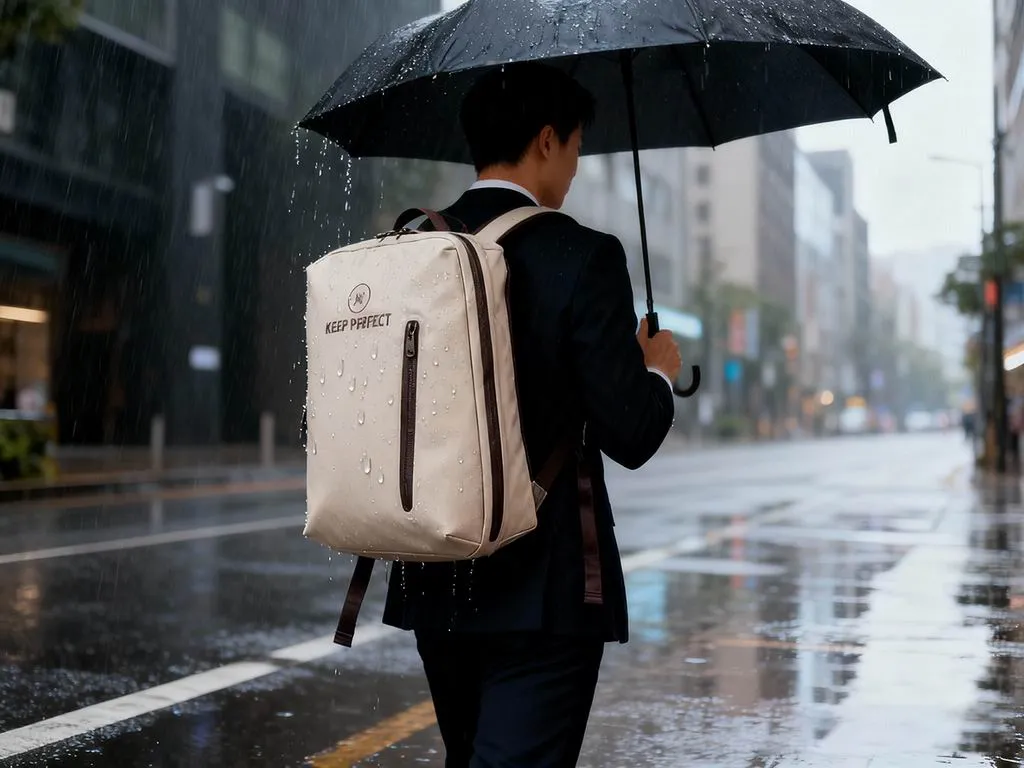
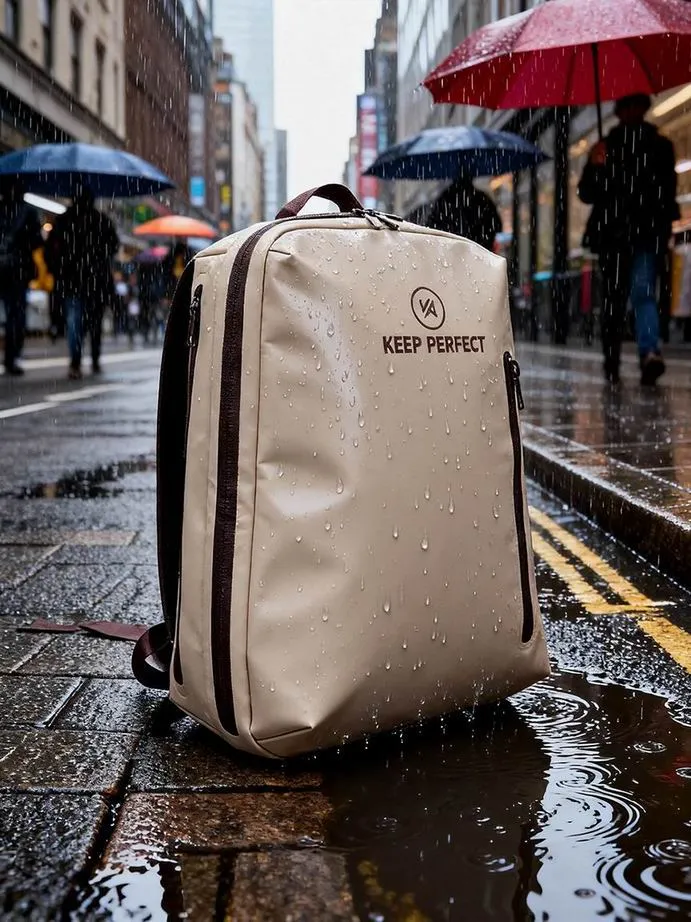
Professionals usually buy to a waterproof rating and then lose the trip to something the rating never measured. Real waterproof business travel bags earn their keep in a smaller register: a taxi door that dumps a litre of water off the roof onto the case as it is lifted out, a twenty-minute walk from a station to a client reception, a water bottle that opens in a bag lying on its side overnight in the hotel. professional laptop protection matters for the same reason — the device is not merely expensive, it is the thing you are about to present from, and a laptop that fails on arrival costs the meeting rather than the machine.
That reframing changes the specification. A business-travel bag has to do three jobs that pull against each other: keep water away from contents that cannot be re-bought locally, open and close cleanly several times a day at checkpoints and reception desks, and look like it belongs in a conference room rather than on a boat. Outdoor waterproof design optimises the first job and largely ignores the other two, which is why a bright expedition roll-top with oversized buckles is a poor business choice even when it is technically the most waterproof object on the shelf.
The practical method is to specify against the worst hour instead of the worst storm. Ask which single sixty-minute window of the itinerary would do the most damage if the bag failed inside it. For most business travellers the answer is not the flight — it is the ground transfer, or the walk from a hotel entrance to a meeting, or an overnight ride in a hire-car boot beside a leaking seal.
What a two-day business trip actually puts in the bag
Before choosing a bag it is worth writing the load down, because business loads are heavier and denser than leisure loads and the mass concentrates in one corner. A typical two-day domestic or short-haul international trip carries a 1.3 to 1.8 kilogram laptop, a 0.4 to 0.9 kilogram charger and cable set, a garment folder or folded suit of roughly 1.2 kilograms, documents and a folder, a wash kit, one change of clothing, and often a gift or sample for the client. That is seven to nine kilograms before the bag itself is counted, which is at or over the 7 kilogram cabin allowance enforced by many European and Asian carriers.
| Item | Typical mass | If it gets wet | Protection that actually works |
|---|---|---|---|
| Laptop, 14 to 16 inch | 1.3 to 1.8 kg | Total loss; meeting cannot proceed | Suspended padded sleeve, welded liner, separate flat-opening compartment |
| Charger, cables, power bank | 0.4 to 0.9 kg | Corrosion at contacts, intermittent faults | Sealed tech pouch with a drainable base |
| Suit or folded garments | 1.0 to 1.5 kg | Crease plus damp; unwearable that day | Flat garment folder, no roll compression, dry interior |
| Contract or tender document | 0.2 to 0.6 kg | Unpresentable; often unrecoverable on the road | Rigid flat document sleeve inside the dry zone |
| Client gift or product sample | 0.3 to 2.0 kg | Packaging ruined; the gesture is lost | Secondary waterproof tote, kept separate |
| Wash kit | 0.4 to 0.8 kg | Leaks onto everything else | Welded wet compartment with a wipe-clean liner |
| Bag itself, waterproof build | 1.1 to 1.7 kg | Not applicable | Pay for shell and closure, not for metal hardware |
Two conclusions fall straight out of that table. The mass is concentrated in one device and one garment, so the bag needs structure that keeps a heavy flat object from bowing the panel and bending the closure out of its sealing line. And almost every catastrophic item is flat: laptop, documents, garment. A bag designed around flat protection — rigid panels, flat-opening compartments, no forced compression — outperforms a bag designed around volume, which is the opposite of what outdoor waterproof design optimises for.
Paper, garments and gifts: the contents that do not forgive
Paper fails by capillary action, and it fails faster than people expect. A document corner touching a damp panel wicks water upward several centimetres within minutes, and once the edge has cockled the sheet cannot be flattened to a presentable state on the road. That is why a rigid flat document sleeve inside the dry zone is worth more than any upgrade to the outer fabric. Garments fail differently: a suit does not need to get wet to be ruined, it needs to be compressed while slightly damp, which sets a crease that a hotel iron will not fully remove.
Gifts and samples are the third unforgiving category, and they are almost always forgotten in the specification. A client gift is frequently cardboard-boxed, and cardboard that has absorbed water at one corner is visibly damaged even if the contents are fine. The fix is procedural rather than technical: carry gifts in a secondary waterproof piece sized for gifting so they never share a compartment with a wash kit or a bottle.
- Put paper in a rigid sleeve, never loose in a main compartment; a soft folder does not stop capillary wicking at the edge.
- Keep garments flat in a folder and pack them last, so nothing is compressed against them during the transfer hour.
- Treat a damp suit as an emergency: hang it in a bathroom during a hot shower within two hours of arrival, which relaxes most travel crease.
- Separate the wash kit into a welded compartment that can be wiped out; a leaking bottle is the single most common internal wet event.
- Carry client gifts and samples in a second waterproof bag rather than packing them around the laptop.
Shoes deserve a mention here because they are the dirtiest item in a business bag and the one most likely to be packed next to clothing. A dedicated waterproof shoe bag costs very little and removes the most common source of internal contamination, particularly after a wet walk between buildings.
The hotel-to-meeting-room hour: what urban rain really does
Urban rain is not a downpour problem, it is a surfaces problem. The water that reaches a business bag in a city arrives as spray from a kerb, runoff from a canopy edge, a puddle reflected off a revolving door, or the sheet of water a taxi roof releases exactly where you are standing. None of these events is intense, and all of them are directional: they hit one face of the bag, repeatedly, over a walk of ten to twenty minutes. That pattern punishes exposed zips and unprotected base seams far more than it punishes fabric.
- Specify a zip garage or storm flap on the outward-facing panel; an exposed coil zip on the front face is a channel that delivers water into the compartment.
- Look for a base with a raised or welded construction rather than stitched seams at the very bottom, because set-down water wicks upward through stitching.
- Prefer a bag that stands upright on its own; a bag that slumps puts its wettest panel onto the floor of the meeting room.
- Carry a packable cover only if it deploys one-handed in under fifteen seconds; otherwise it stays in the pocket and the bag gets wet anyway.
- Choose a top grab handle that lets you lift the bag clear of a puddle without swinging it into your trouser leg.
Rain intensity figures matter less than duration here, but they put the design brief in context: moderate urban rain is typically a few millimetres per hour, while a heavy convective shower common in tropical and subtropical business hubs can deliver 20 to 50 millimetres in thirty minutes. The classification and measurement of these events is standardised by the World Meteorological Organization, and the design implication is simply that a bag rated for a short walk in drizzle will be fully wetted in a tropical shower within eight minutes. The related daily-commute version of this problem is covered in our guide to rain protection for daily commuting.
Boardroom appearance is a specification, not a preference
The most under-discussed constraint in this category is that a bag can be technically excellent and commercially unusable. A client notices three things in about four seconds: silhouette, surface condition, and hardware noise. Any of the three can undermine a presentation that took weeks to prepare. That makes appearance a hard specification with measurable components rather than a matter of taste.
| Appearance factor | What the client reads | Waterproof cost of getting it wrong | Specification that satisfies both |
|---|---|---|---|
| Silhouette and structure | Organised or chaotic | A soft shell that slumps looks cheap when wet | Semi-rigid panel construction that holds shape when empty |
| Surface finish | Professional or outdoors | Glossy TPU reads as sports equipment | Matte or low-sheen coating in charcoal, navy or black |
| Hardware finish and noise | Cheap or considered | Metal hardware rattles and corrodes in coastal cities | Matte acetal hardware with covered sliders |
| Branding scale | Confident or insecure | Large logos on a wet shell look promotional | Debossed or tonal logo under 40 millimetres |
| Base condition | Cared for or neglected | Scuffed coated corners are the first visible wear | Abrasion-resistant base panel in a darker tone |
| Strap management | Composed or untidy | Dangling wet straps mark clothing and floors | Stowable harness or a single flat webbing strap |
The most reliable way to hit all six rows is to design the professional piece around a muted shell and a waterproof zip rather than a roll-top, and to keep branding small and tonal. Logo placement deserves particular care because coating chemistry and print method interact: the adhesion trade-offs are set out in our page on logo options for waterproof bags, and they should be tested on the actual coated fabric rather than on a generic swatch.
Closures, cable management and the fourth opening of the day
Access discipline is where professional travel differs most from leisure travel. On a flight day the main compartment is opened at check-in, at security, at the gate, on arrival, and again at the hotel — five or six times, several of them under time pressure and none of them on a clean flat surface. A closure that needs two hands, a flat surface and fifteen seconds will be closed badly on the fourth opening, and a badly closed waterproof closure is simply not waterproof.
That is the argument for a coated waterproof zip on the main compartment despite its lower ultimate sealing performance: it closes in one motion, it closes the same way whether the bag is full or empty, and it fails in a visible way that the user notices. Keep the roll-top for an inner dry bag holding documents and the wash kit, where graceful degradation matters and speed does not. The manufacturing side of that trade-off is covered in our comparison of zipper and roll-top closures.
Cable management is the other half of the same problem. A laptop must come out of the bag at most checkpoints, and a bag that requires unpacking to reach it turns every security line into a two-minute penalty and a chance of leaving something on the tray. Specify a flat-opening tech compartment with the cable set on the opposite side from the device, a power bank pocket visible for inspection, and a pouch that keeps liquids reachable from the top without opening anything else. Our dedicated page on waterproof laptop protection gives the padding and closure detail; the point here is that the waterproof version of these features must survive daily opening, which is precisely why a zip beats a roll on the tech compartment.
Roller or backpack: the honest trade at forty trips a year
At low trip frequency the roller-versus-backpack question is about comfort. At forty trips a year it becomes a maintenance question, because the two forms fail in different places and only one of them can be repaired cheaply on the road. Rollers fail at the wheel housings, the telescoping handle and the base seam that sits in set-down water; backpacks fail at strap attachment, the back panel and the closure.
The decisive variable is the surface the bag travels over. On smooth airport floors and in cities with lifts, a roller is genuinely easier on the body and keeps a suit flatter. In cities with cobblestones, kerbs, stairs and no lifts — which describes a large share of older European and Asian business districts — the wheel assembly becomes a consumable part, and vibration through the handle transfers into a laptop that is already running.
| Decision factor | Roller | Backpack | How to decide for your pattern |
|---|---|---|---|
| Surfaces encountered | Best on smooth floors | Best on stairs, kerbs and cobblestones | Map the worst surface of your regular route, not the average |
| Garment flatness | Better; the case stays horizontal | Needs a rigid folder to stay flat | If you carry suits twice a month, weight this heavily |
| Laptop vibration | Transmitted through the handle | Isolated by the back panel | Favour a backpack if you carry mechanical drives |
| First failure point | Wheel housing, handle, base seam | Strap attachment, closure, back panel | Rollers fail expensively; backpacks fail cheaply |
| Cabin sizer risk | Wheels and handle count against you | Soft construction compresses | On strict carriers a soft backpack is safer |
| Repair on the road | Usually a specialist part | Often field-repairable | Choose the repairable option above roughly thirty trips a year |
A useful compromise for high-frequency travellers is a soft convertible: a backpack with a stowable harness and a sleeve that slides over a roller handle when one is available. It accepts a small weight penalty and removes the need to own two bags, which is also how a brand can sell one SKU into both preferences.
Carry-on geometry that still holds a garment folder
Cabin rules are the first hard filter in this category because a business bag that has to be checked is a business bag that has failed at its job. The widely quoted 55 by 40 by 20 centimetre figure is trade-association guidance rather than a binding rule, and the spread is wide enough to matter: budget carriers in Europe and parts of Asia enforce the small end with a sizer at the gate, while many long-haul carriers allow around 56 by 36 by 23. Guidance is published by IATA, but the binding numbers are always the individual carrier’s conditions of carriage.
The conflict for business travellers is that a rigid garment folder wants depth while a strict sizer punishes depth. The resolution is to buy to the strictest carrier on the regular route and to choose a bag whose structure is in the panels rather than in a moulded shell, so that a two-centimetre bulge can be absorbed by compression rather than causing a gate charge. Weigh the packed bag: a 1.7 kilogram waterproof build plus a nine kilogram load is over the 7 kilogram allowance before a second pair of shoes is added.
Where a high-frequency bag wears out first
Frequency changes the failure ranking. A bag used twelve times a year usually dies of fabric abrasion or a coating that has hydrolysed. A bag used forty times a year dies of mechanical cycling in a small number of predictable places, and those places are specified components rather than materials. Designing for that cycle count is the difference between a bag that lasts eighteen months and one that lasts five years.
| Component | Duty at 40 trips a year | Typical first failure | Specification response |
|---|---|---|---|
| Wheel housings and axles | Roughly 40 to 80 km of rolling, much of it loaded | Housing crack, axle wear, wheel flat-spot | Sealed bearings, replaceable wheel cassettes |
| Telescoping handle | 80 to 160 extension cycles plus kerb shock | Section bind, latch failure | Two-stage aluminium with a reinforced latch |
| Base seam and corners | Set-down in water several times per trip | Wicking through stitching, coating scuff | Welded base panel, raised corner reinforcement |
| Main closure | 250 to 400 open and close cycles | Coating delamination at the slider end | Coated zip with a covered garage and a serviceable slider |
| Top grab handle seam | Loaded lifts, often at an angle | Stitch pull-out at the bar-tack | Box-stitched webbing carried into the frame |
| Laptop sleeve suspension | Daily insertion, constant corner load | Foam set, corner compression | Suspended sleeve with closed-cell foam and a false bottom |
Two of those rows are load problems rather than waterproof problems, which is why strap and handle load testing predicts service life better than a higher hydrostatic head does, and why abrasion resistance standards deserve a place in the specification even for a bag that never touches a trail.
- Ask for the wheel cassette to be a replaceable part, not a moulded-in housing.
- Specify bar-tack reinforcement at every handle and strap attachment, and check it on the sample by pulling hard by hand.
- Choose a coated zip with a serviceable slider so a worn slider does not condemn the whole bag.
- Keep the base panel darker than the shell; scuffing is inevitable and contrast hides it.
Odour, condensation and wearing the shirt twice
The quiet failure in business travel is not water getting in, it is water that was already inside staying there. A bag moves repeatedly between air-conditioned interiors at around 21 degrees and hot humid streets above 30, and each transition condenses moisture on the coolest surface available — frequently a laptop lid or a shirt packed against the shell. A shirt worn twice on a trip is normal; a shirt that has spent ten hours against a damp panel is not.
Odour follows the same mechanism. A wash kit that leaks once, or a gym kit sealed into a main compartment, produces a smell that is noticeable when the bag is opened in a small meeting room, and it does not clear quickly from a coated shell. The design answers are a welded wet compartment with a wipe-clean liner, a ventilated mesh zone for anything merely damp, and an interior that can actually be dried. The construction logic is explained in our page on wet-dry separation design, and the hygiene upgrade worth specifying for humid markets is covered under antimicrobial treatments.
The user-side habit is trivial and effective: open the bag fully and air it for twenty minutes on arrival, every evening of the trip, whether or not anything got wet. Travellers who do this report almost no odour problems; travellers who do not report them within two trips.
A specification shortlist by trip pattern
Rather than naming models that will be discontinued before this page is, here is the specification that fits each professional pattern. Buying to a specification survives model changes; buying to a brand name does not. Capacities assume a traveller who packs reasonably rather than minimally, and all of them assume the bag must be acceptable in a client-facing room.
- One-night domestic, train or short flight, no garment: 20 to 25 litre soft backpack with a matte coated shell, waterproof zip main access, flat-opening laptop compartment, one 3 litre inner dry pouch for documents.
- Two-night international with a suit: 30 to 34 litre semi-rigid case or convertible, flat garment folder, welded wash-kit compartment, covered zips, stowable harness, weight under 1.5 kilograms empty.
- Weekly commuter pattern on the same route: convertible with a replaceable wheel cassette if a roller is used, serviceable zip slider, base panel in a darker tone, and a spare wheel set kept at home.
- Client-facing with gifts or samples: main case plus a secondary waterproof tote sized to the sample, kept separate so packaging never shares a compartment with liquids.
- Multi-city roadshow with laundry gaps: 35 to 40 litre bag with a genuine wet compartment, a ventilated zone, and a document sleeve that stays flat under compression.
Across all five patterns the constants are the same: waterproof zip on the outside, roll-top dry bag on the inside, muted shell, tonal small-scale branding, and a welded compartment for anything liquid. Those five decisions resolve most of the category.
What a brand should specify for a professional travel line
For a brand building into this segment, the commercial structure is a ladder rather than a hero product. Professional buyers purchase in a predictable sequence: a cabin piece first, a secondary organiser second, and a garment or gifting piece third. A workable opening ladder is a 20 to 25 litre day piece, a 30 to 34 litre cabin bag, a 40 to 55 litre short-trip case, and an organiser set of 3, 5 and 8 litre pieces — three price points sharing one material story.
- Fix one material tier across the ladder so colourways, trim and replacement fabric are shared, and the range reads as one family on a shelf.
- Specify the closure by role: waterproof zip on anything opened at a checkpoint, roll-top only on inner dry bags and wet compartments.
- Choose hardware for silence and corrosion resistance rather than for shine; matte acetal hardware in a professional range outperforms metal in both respects.
- Test logo adhesion on the actual coated shell, because coating chemistry varies and a logo that lifts after three months is a warranty problem rather than a cosmetic one.
- Plan the colour story in two neutrals and one accent, since professional ranges sell in neutrals and the accent is what drives the second purchase.
Volume planning should start from the ladder. Minimum order quantity is 500 pieces per style, which is comfortably reachable across a four-piece ladder in two or three colourways when the range is planned as one programme rather than as separate bets; the mechanics are set out in our page on minimum order quantities, and the development sequence in lead times for custom orders. For brands selling this segment through corporate channels, the private label route is usually the faster path to shelf. If you want those numbers as an actual quotation, send us the capacity ladder, closure specification and target volumes. Sampling takes 6–10 working days, bulk production runs 35–50 days, and quotations are issued FOB Xiamen.
Frequently Asked Questions
Q1. Are waterproof bags worth it for business travel if I mostly use taxis and planes?
Usually yes, because the failure events are small and directional: kerb spray, a taxi roof releasing water as you lift the bag out, and a bottle leaking overnight. Buy for closure and layout rather than for a submersion rating.
Q2. Will a waterproof business bag look out of place in a client meeting?
It should not, if you specify a matte low-sheen shell, covered zips, muted hardware and a small tonal logo. Bright colours, glossy coatings and oversized buckles are what make a waterproof bag read as outdoor equipment.
Q3. Is a roll-top or a waterproof zip better for a professional bag?
A waterproof zip on the main compartment, because it closes in one motion and will be opened five or more times on a flight day. Use a roll-top dry bag inside for documents and the wash kit, where speed does not matter.
Q4. How do I keep contracts and tender documents flat and dry?
Use a rigid document sleeve inside the dry zone, not a soft folder. Paper wicks water several centimetres up an edge within minutes, and once cockled it cannot be flattened to a presentable state on the road.
Q5. Can I carry a suit in a waterproof carry-on without creasing it?
Yes, with a flat garment folder packed last and no compression across the fold. Crease that sets while the fabric is even slightly damp is the version that a hotel iron will not remove.
Q6. How much weight does waterproof construction add to a business bag?
Typically 300 to 600 grams on a 30 litre bag once coating, sealed seams and a coated zip are counted. Against a 7 kilogram cabin allowance that is four to eight per cent, so spend it on the shell rather than on metal hardware.
Q7. What size bag fits both a laptop and a garment folder in the cabin?
Around 30 to 34 litres in a semi-rigid construction, bought to the strictest carrier on your regular route. A moulded shell that cannot compress is more likely to fail a gate sizer than a panel-built soft bag.
Q8. Can I carry a power bank and liquids in a waterproof cabin bag?
Yes, and both belong in the cabin rather than the hold. Power banks are conventionally limited to 100 watt-hours without airline approval, and liquids follow the 100 millilitre container rule in a single resealable bag.
Q9. How many trips a year before a bag should be replaced?
Component cycling rather than calendar time decides it. At forty trips a year, expect wheel assemblies, handle latches and zip sliders to be the first consumables, typically inside eighteen to thirty months.
Q10. What fails first on a rolling business bag?
Wheel housings and the telescoping handle latch, followed by the base seam that sits in set-down water. Specifying a replaceable wheel cassette turns an expensive failure into a cheap one.
Q11. How do I stop a business bag smelling after a humid trip?
Air it fully open for twenty minutes on arrival every evening, and keep the wash kit in a welded compartment that can be wiped out. Odour comes from moisture that was already inside, not from rain getting in.
Q12. Is a rain cover worth carrying on a business trip?
Only if it deploys one-handed in under fifteen seconds. Otherwise it stays in the pocket. A covered zip and a welded base deliver most of the benefit with no deployment step at all.
Q13. Should the laptop compartment be fully sealed or ventilated?
Sealed against external water, but not hermetic. A sealed sleeve holding a warm device in a humid city will condense on the lid, so look for a suspended sleeve with a drainable base rather than a fully welded pouch.
Q14. Is metal hardware better than acetal on a professional bag?
Rarely. Acetal is lighter, quieter, corrosion-resistant in coastal cities and cheaper to replace. Metal reads as premium in a showroom and rattles in a meeting room.
Q15. Can the inside of a waterproof business bag be cleaned after a spill?
Yes, if the wet compartment has a welded liner rather than a sewn-in one. Wipe it out and leave it open to dry; a sewn liner traps liquid under the seam tape and will smell within days.
Q16. What should a brand specify first for a professional travel range?
The capacity ladder and one shared material tier across it, then the closure per role. That structure lets one programme reach 500 pieces per style across several colourways while still looking like a single family.
Q17. How long does it take to develop a custom professional waterproof bag?
Sampling typically takes 6–10 working days once the specification is agreed, and bulk production runs 35–50 days. Both figures assume closure and material decisions are settled before sampling rather than revised during it.
People Also Ask
Do business travellers really need waterproof bags?
Yes, but for kerb spray, taxi roofs and leaking bottles rather than for storms. Specify a covered zip, a welded base and a flat document sleeve.
Which closure suits a professional bag best?
A waterproof zip on the main compartment, since it closes one-handed and is opened many times a day. Keep a roll-top dry bag inside for documents.
How do I keep a suit dry and uncreased in a carry-on?
Use a flat garment folder packed last, with no compression across the fold. Never pack a suit while it is even slightly damp.
What wears out first on a high-frequency business bag?
Wheels, the telescoping handle latch and the main zip slider. Choose replaceable wheel cassettes and a serviceable slider so those do not condemn the bag.
Will a waterproof bag look unprofessional with a client?
Not if you specify a matte shell, muted hardware and a small tonal logo. Glossy coatings, bright colours and large branding are what read as outdoor gear.
What size waterproof bag fits a laptop and still passes the cabin sizer?
Around 30 to 34 litres in a panel-built soft construction. Buy to the strictest carrier on your route and weigh the bag packed.