A canyoning bag is judged on one question: after six hours in a gorge, is the spare thermal layer dry? That single requirement decides the specification. In a canyon the bag is immersed continuously rather than splashed intermittently, it is dragged and slid across wet rock that behaves as a lapping compound, it is dropped down pitches and lowered on the rope, it is hammered by waterfall jets, and at the end of the day it still has to deliver dry clothing at the moment the group is coldest. In water between eight and sixteen degrees Celsius, a dry layer and a damp one are the difference between an uncomfortable walk-out and a hypothermia incident. General purpose dry bags fail this test on the third or fourth descent, in ways no submersion rating predicts.
This guide works through the mechanics: why hours of immersion is not the same problem as thirty minutes of submersion, how wet rock and suspended grit abrade a welded shell, why drain holes are a safety feature rather than a convenience and what they cost in ingress protection, how tether and haul points must be built so a bag can be lowered without ever being tied to a swimmer, what bag hardware does to a rope sheath and what harness and helmet do to the bag, why cold water turns the dry layer into a safety-critical payload, how pack geometry conflicts with a harness, the volume matrix from a half-day descent to a multi-day gorge, which constructions survive a commercial season, the tests that correlate with canyon service, and how a canyoning range is structured commercially. QUANZHOU JUNYUAN BAGS has produced custom waterproof bags since 2014 in a 4,950 m² SGS-verified facility: MOQ 500 pieces per style, sampling in 6–10 working days, bulk in 35–50 days, FOB Xiamen.
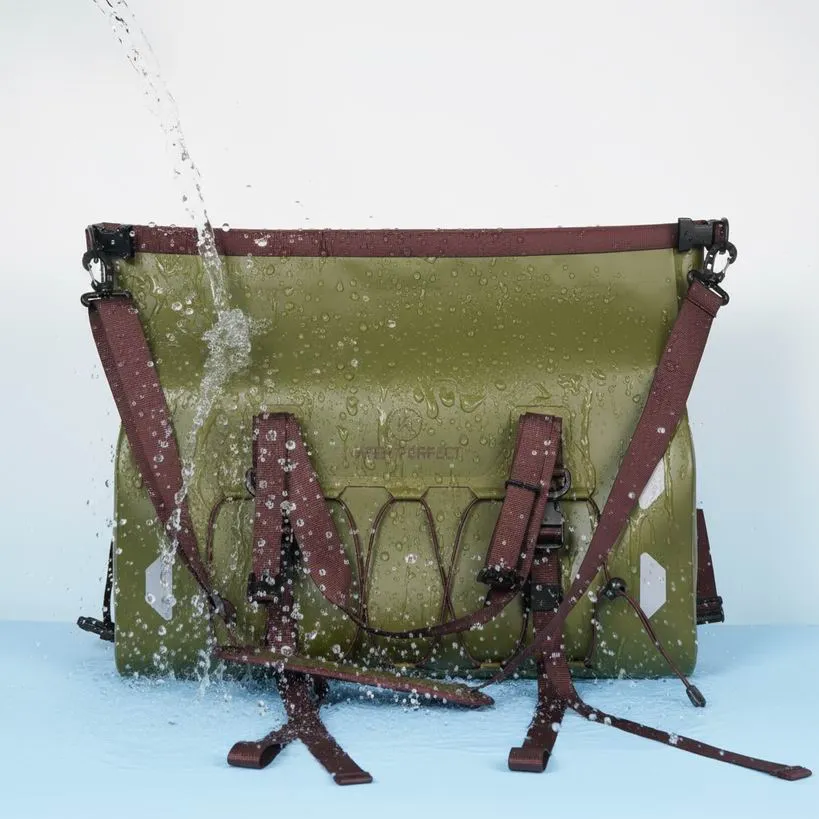
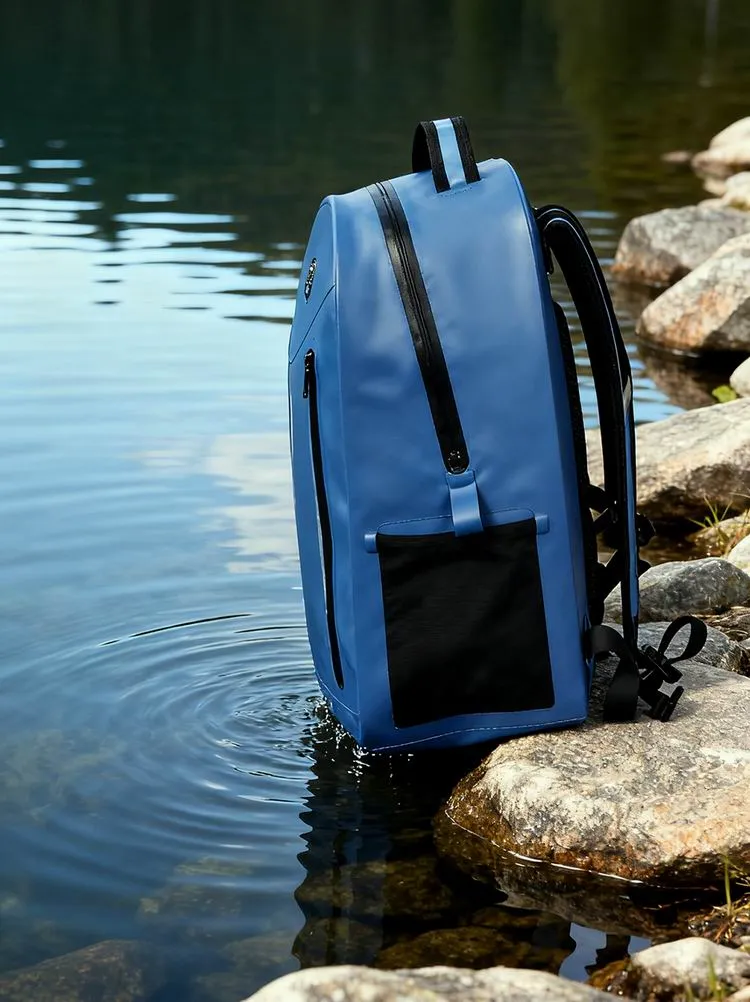
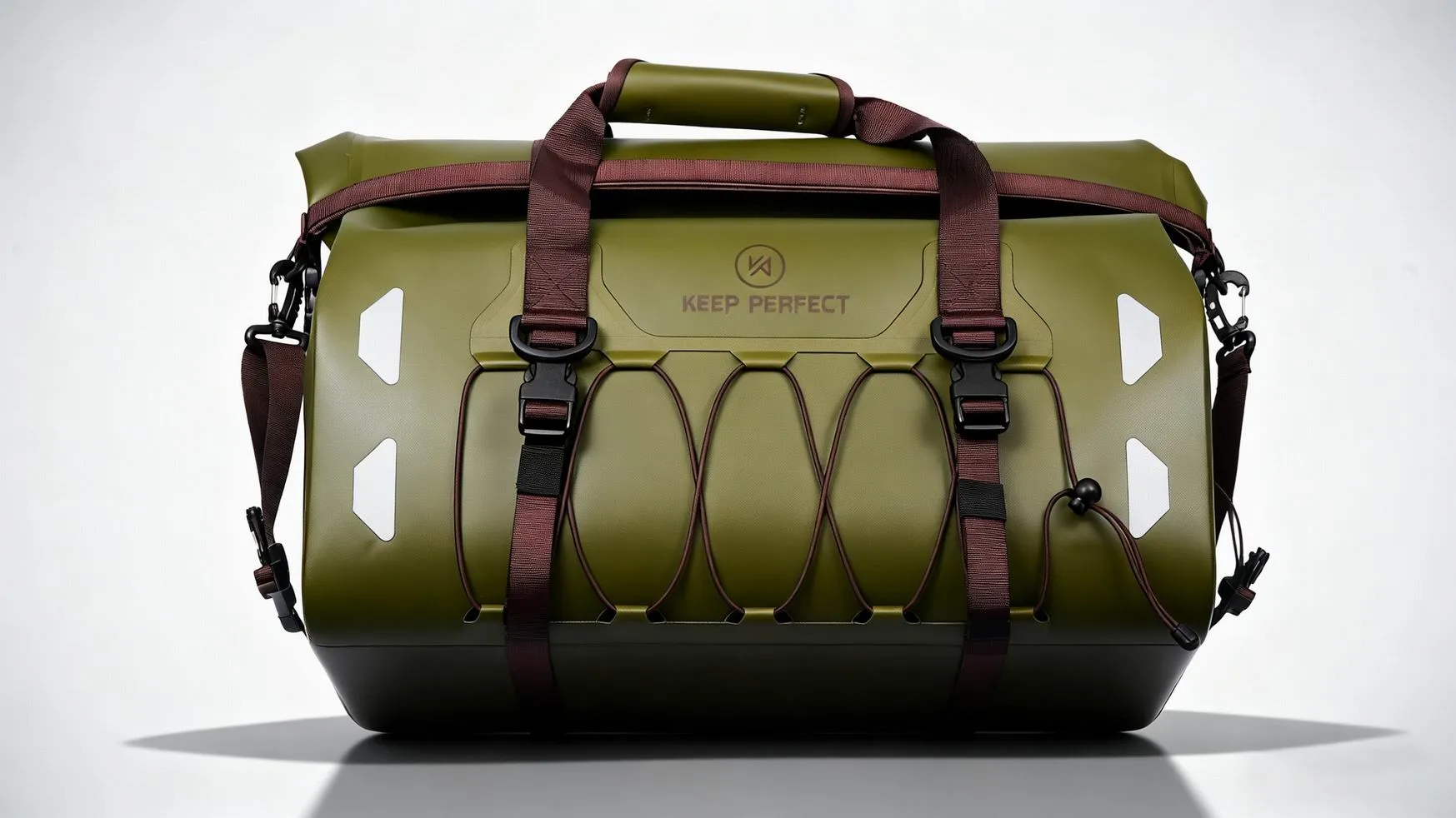
A gorge is continuous immersion, not occasional wetting
Most buyers evaluate canyoning dry bags the way they evaluate a kayaking sack, by asking how long the product survives being underwater. That is the wrong question, and it is why gorge walking waterproof bags are frequently specified from the same catalogue as paddling gear and then replaced twice a season. A paddling bag is splashed, rained on, and occasionally dunked. A canyon bag spends four to eight hours wet, much of it fully immersed, a good part of it pressed against rock while immersed, and some of it under a falling jet of water. Duration and contact load, not depth, are the governing variables.
Put numbers on it. A typical commercial descent involves repeated swims of twenty to ninety seconds, waist-to-chest wading for hours, two to eight abseils where the bag hangs below the person or is lowered separately, and one or two sections where the group passes directly through a waterfall. Plunge pools are rarely deeper than three metres, so hydrostatic pressure at the bag is modest, around 0.3 bar at most. The load that matters is not pressure but time under pressure combined with abrasion while wet, which no standard test combines.
Two consequences follow immediately for specification. First, the closure is the weak point rather than the panel: a roll-top seal line is metres of interface held together by folding, and it is underwater for hours while the bag is being pushed, dragged and squeezed. Second, the shell has to be assessed wet. Many coated fabrics lose a meaningful share of their abrasion resistance when saturated, and a bag tested dry on a Taber machine tells you very little about a bag sliding down a wet granite chute.
This is also why the level of protection required is not the highest one available. The useful framing is a sealed dry core inside a drainable shell, which the article on choosing the right waterproof level sets out generally. The distinction between the two submersible ratings is explained in our comparison of IPX7 and IPX8; read it with the caveat that neither rating involves time measured in hours.
Hours of immersion versus minutes of submersion
The table below is the comparison worth putting in front of a supplier before sampling starts, because it converts an argument about ratings into an argument about mechanisms.
| Factor | A thirty-minute submersion test | Six hours of canyon immersion | What to specify instead |
|---|---|---|---|
| Duration under water | Thirty minutes, static | Four to eight hours, with movement throughout | An immersion test of at least eight hours with the bag repositioned every half hour |
| Pressure profile | Constant, by depth | Constant plus point loading from rock contact and body weight | Immersion with a defined load pressing the bag against an abrasive surface |
| Closure condition | Dry, clean, carefully rolled | Rolled with wet hands, sometimes gritty, often one-handed and hurried | A seal test performed after deliberately contaminating the roll faces |
| Shell state | Dry at test start | Saturated for hours; coating properties change when wet | Wet abrasion testing rather than dry abrasion testing |
| Failure observed | Pass or fail at a single moment | Progressive weeping that starts after hour two or three | Measurement at intervals, because the slope matters more than the endpoint |
Under sustained immersion, three mechanisms run slowly and then present as a single symptom: damp contents. Seam creep is the first. A welded or taped seam under constant hydrostatic load and constant flexing can open at its ends, where stress concentrates, and the opening propagates. Capillary transport along any exposed yarn at an unbound edge is the second, and it is the one most often missed because the shell looks perfect. The third is pressure-driven ingress at the closure, which is a function of how many times the user rolled it and how clean the faces were, neither of which a laboratory controls.
The practical response is unglamorous and cheap. Bind or weld every edge so no yarn cross-section is exposed. Continue the seam beyond the point where the load path ends rather than terminating it at a corner. And write the roll count into the product — four rolls minimum for canyon use, not three — because users cannot be relied on to guess. Our page on seam sealing methods covers the construction options, and the closure detail is developed further in our note on roll-top reliability.
One more immersion-specific point that surprises people: air trapped inside a sealed bag makes it buoyant, which sounds helpful and is not. A buoyant bag being pushed under a waterfall fights the user and pulls at whatever it is attached to. A bag designed for canyon use should be closable with most of the air expelled, which points back to a closure that compresses the contents rather than one that merely seals an opening.
Wet rock is a lapping compound
The abrasive in a canyon is not sand in the beach sense; it is rock, and the water is what makes it destructive. Granite and sandstone are largely quartz and feldspar, sitting around six to seven on the Mohs scale, while every coating, film and elastomer used in this category sits far below that. On its own that hardness difference would be manageable. Add water carrying suspended grit between the two surfaces and you have built a lapping compound: a slurry that removes material from the softer surface continuously and evenly, which is why canyon bags do not tear so much as they thin.
Abrasion concentrates predictably, and designing for those four zones costs far less than specifying a heavier shell throughout.
| Contact zone | What causes it | How it fails | Design response |
|---|---|---|---|
| Base panel | Sliding down natural water chutes with the user’s weight on it | Thinning of the coating, then exposure of the base cloth, then weeping | A heavier denier base with a welded construction and no hardware beneath it |
| Lower corners | Being set down on rock, dropped at the end of a pitch, dragged | Corner seam opening; the classic first failure of a welded sack | Reinforced corner geometry with the weld line moved away from the contact point |
| One flank | The side facing the rock during a slide, and the side rubbing a canyon wall while swimming | Asymmetric wear that looks like a defect rather than a wear pattern | Accept it and specify a sacrificial layer, or rotate handles so the bag cannot be carried on that face |
| Roll-top faces | Grit carried on wet hands into the seal line | Scoring across the seal, then slow weeping that re-rolling cannot fix | Higher durometer seal faces; a wipe instruction; keeping grit out of the closure by geometry |
There is a material consequence worth flagging to any supplier quoting this category: abrasion resistance measured dry and abrasion resistance measured wet are different numbers, and the gap varies by polymer family. Ask for both. The general testing landscape is set out in our review of abrasion standards, and where drainage is acceptable, a mesh or net panel is almost always the right answer because a surface that is mostly holes has almost nothing to abrade — see our discussion of ventilated constructions.
Drain holes are a safety feature, not a convenience
This is the requirement that separates a canyon bag from everything else in the waterproof category, and it is usually the first thing a cost-down exercise removes. A bag that goes under a waterfall, or is simply swum with for long enough, takes on water through the closure, through the fabric if it is not fully impermeable, and through any opening at all. Twenty litres of water is twenty kilograms. Hanging from a shoulder in a current, that is not a nuisance; it is a load that changes a swimmer’s position in the water, and entrainment hazards in canyons are severe enough that guides treat any tethered mass as a risk.
- At least two drain openings at the lowest corners, sized so grit passes through rather than blocking them.
- A stated drain rate in litres per minute, measured with the bag full and upright, not merely the presence of holes.
- A lower mesh or net panel on any volume that will hold wet equipment rather than dry clothing.
- No drain path routed through a seam, because a hole in a weld line is where a canyon bag opens up.
- A clear statement of what the drainage costs in ingress protection, so the buyer is choosing rather than discovering.
The correct architecture is therefore two zones rather than one rating. A sealed dry core holds the thermal layer, a first-aid kit and a phone, and it should be the most reliable closure in the range, tested to full immersion. Everything else — wetsuit, shoes, rope, wet group kit — lives in a drainable volume where ingress is irrelevant because egress is guaranteed. Products that try to make one compartment do both always end up mediocre at the job that matters.
Buoyancy deserves a line of its own because it interacts with drainage. A sealed dry core with air inside will float, and a floating bag that has come off a haul line in a gorge is difficult to retrieve. Commercial operators generally prefer the core to be slightly negatively buoyant when full — packed so it sinks — or to be clipped in, and they will tell you which. It is a design choice, not a detail, and it belongs in the brief.
Tether and haul points: lowered on the rope, never tied to the swimmer
Canyon bags need attachment points, and the reason is often misunderstood. It is not so the bag can be carried while swimming — no competent operator tethers a bag to a person in moving water, for the same reason whitewater practice forbids it. It is so the bag can be lowered down a pitch on the rope and hauled back up, independently of anyone in the water. Designing for the second purpose while accidentally encouraging the first is how a useful feature becomes a hazard.
So specify the haul point as a structural component rather than an accessory. The webbing load path should continue under the base of the bag rather than terminating in a side panel, because a bag lowered loaded puts its entire weight on that one point, repeatedly, usually with a dynamic component as it swings against rock. Ask for a stated static rating with a safety factor and a pull test on production samples rather than on the golden sample. Our article on load testing straps and handles sets out how to write that requirement so it means something.
- One dedicated haul loop, clearly identified, with a stated rating and no ambiguity about which loop it is.
- No metal ring at the attachment point; a ring against a rope under load is a wear point and a hard edge.
- A quick-release characteristic on any strap long enough to wrap, and no loop large enough to admit a head or arm.
- Elastic keepers on every loose webbing end, because dangling straps catch on anchors, karabiners and belay devices.
- Grab handles at two positions so the bag can be passed from person to person across a pool.
Finally, colour and marking belong in this section rather than the branding one. A haul loop should be identifiable by touch and by eye in poor light in a narrow gorge, and operators colour-code bags by rope length or by role — first aid, group kit, client kit. That is a specification decision with a safety dimension, and it is cheap to deliver.
What the bag does to the rope, and what the harness does to the bag
Canyoning equipment is a system, and a bag introduced into it either behaves or causes damage. Rope damage is the serious direction. A semi-static canyon rope is the single most important item in the group, it is expensive, and its sheath is the part that protects the core. A bag lowered alongside a rope, or hung from an anchor while the rope runs past it, presents whatever hardware it carries to that sheath under load. Sharp buckle corners, exposed metal, a stiff moulded edge or a metal ring will all abrade a sheath, and sheath damage discovered mid-descent ends the day.
The specification that follows is simple and should be written literally: no metal on any face that can contact a rope; no sharp internal corners on hardware; covered or recessed buckles; and a preference for acetal or similar engineering polymer over plated alloy, which has the additional advantage of not corroding in canyon water that is often slightly acidic from peat and vegetation. Component-by-component reasoning is set out in our note on selecting buckles, straps and fittings.
The other direction is just as practical. A canyoning harness occupies the waist and the top of the thighs, so a pack’s hip belt sits either above it, where it is uncomfortable under a loaded bag, or over it, where it interferes with the belay loop and the lanyard. Helmets add a further constraint: a pack with a high, stiff collar fouls the back of a helmet and pushes it forward. A canyon pack should therefore be slim, sit high, and have no rigid collar — which is almost the opposite of what a trekking pack brief asks for. Our related reading for climbing-specific bags covers a similar geometry problem from the other direction.
A small but real point: nobody can inspect a bag mid-descent. Every failure in a canyon is discovered at the worst possible moment, which is the argument for building in margin rather than building to a rating. A bag rated exactly to the expected load has no margin for the one time it is dropped five metres onto rock with forty litres in it.
Cold water: the dry layer is a safety payload
Canyon water is cold in a way that swimmers underestimate. Eight to sixteen degrees Celsius covers most commercial descents, and in spring snowmelt and in alpine gorges it can be lower. A wetsuit manages that while the group is moving; it does not manage it during an unplanned stop, a long abseil where the body is stationary and wet, or a walk-out in wind. Every canyon operator carries a warm layer and a windproof shell for exactly that scenario, and the entire value of a waterproof bag in this environment is that this layer is dry when it is needed.
That reframes the payload hierarchy. Ranked by consequence of failure, the contents of the sealed core are: a thermal layer and shell, a first-aid kit with the means to call for help, and only then everything else. A phone in a cold canyon is worth planning for specifically — cold drains batteries far faster than users expect, and a phone that has been immersed will not charge. Our guide to small electronics cases covers pouch construction, and the canyon amendment is that the pouch must be inside the sealed core rather than in an outer pocket.
Cold also acts on the bag itself. Coatings stiffen, roll-top films lose compliance, and a closure that seals perfectly at twenty degrees can weep at four. Specify a cold flex or cold seal test at a temperature the market actually sees rather than at laboratory ambient, and ask what happens to the closure film at the bottom of the range. The general behaviour of these materials across temperature is covered in our page on thermal properties, and the whitewater parallel — bags that must perform after being swum with — is discussed in our article on rafting dry bags.
The consequence for buyers is worth stating plainly: if a supplier cannot tell you which temperature their closure film was validated at, they have not validated it. It is a one-question test of whether a canyon programme has been built before.
Geometry that does not fight the harness
Pack geometry in this category is determined by what the bag must not do. It must not snag, it must not foul the helmet, it must not cover the harness, and it must not swing. Those four negatives define a shape more precisely than any capacity target, and they are the reason a good canyon pack looks under-featured next to a trekking pack at the same volume.
- Slim profile with no external side pockets, because pockets catch on rock and on anchors and fill with grit.
- Shoulder straps shaped to sit outside a harness, with a chest strap positioned clear of the belay loop.
- No rigid collar or high stiff back panel, so the pack does not push a helmet forward.
- A back panel with drainage channels rather than padded mesh that holds water and grit.
- Compression straps that actually compress, so a half-empty bag does not become a pendulum when swimming.
- Two grab handles, positioned for passing the bag across a pool rather than for carrying it.
Two of those items deserve explanation because they are routinely cut. Compression matters more here than in trekking: a bag carried while swimming is a buoyant, unstable object, and a bag with slack volume sloshes, swings, and changes the swimmer’s trim. Drainage channels matter because a padded back panel that absorbs two litres of canyon water adds weight exactly where it affects balance most. Both cost very little to specify and both are visible to the user every descent.
Related context for alpine versions of the same problem, where the bag also has to work with a harness and a helmet, sits in our page on bags for mountaineering and alpinism. The canyon difference is that everything is wet and the consequences of dropping the bag are higher, because retrieval is frequently impossible.
The canyon volume matrix
Four formats cover essentially every commercial canyon operation, and a range that tries to cover them with one adjustable product covers none of them well. The matrix below reflects what operators actually carry rather than what retail catalogues list.
| Format | Volume | Typical contents | Governing requirement |
|---|---|---|---|
| Client personal bag | 20 to 30 L | Spare thermal layer, windproof shell, food, water, personal items | A guaranteed-dry sealed core; drainable outer volume; slim geometry |
| Group kit bag | 30 to 45 L | Wetsuits, shoes, helmets, webbing, spare hardware | Drainage above all; abrasion resistance; haul loop rated for the full load |
| Rope bag | 35 to 50 L | A 30 to 60 m semi-static canyon rope, sometimes two | Wide mouth for flaking; drainage; shoulder carry; colour coding by rope length |
| Emergency and valuables core | 3 to 8 L | Phone, first-aid kit, keys, documents, dry thermal top | The most reliable closure in the range; tested to full immersion; high-visibility colour |
| Multi-day gorge haul bag | 50 to 70 L | Group camping kit for two or three day descents | Haul loop as the primary structure; base reinforcement; tolerates being dragged |
The rope bag is the one operators care most about and retail understands least. Its requirements have nothing to do with keeping a rope dry — canyon ropes are wet by design — and everything to do with managing a long, heavy, awkward object: a mouth that opens wide enough to flake rope in without fighting, enough structure that the bag does not collapse while being filled, drainage, and a carry system that works when the bag weighs fifteen kilograms and the walk-in is an hour. Volume coding by colour is standard practice because nobody measures a rope on a riverbank.
Commercially, the matrix is friendly because four formats at two colourways each is eight SKUs on three constructions, which keeps every style comfortably above a 500-piece minimum while presenting a complete range. The general sizing reasoning is unchanged from other categories and is set out in our capacity selection guide; the canyon amendment is to size against what must stay dry, not against what must be carried.
Constructions and hardware that survive a season
Material selection for canyon duty is a matter of ranking against three risks in the right order: wet abrasion, sustained immersion, and cold flex. Waterproof performance is a lower-order concern because almost every candidate clears it; what separates them is what happens to the coating after two hundred hours of being wet and rubbed.
TPU-laminated constructions generally outperform flexible PVC here, for two reasons that compound. TPU has better wet abrasion behaviour and it does not depend on a plasticiser that can be extracted, whereas PVC stiffens progressively as it loses plasticiser and then cracks at exactly the folds a roll-top relies on. Cold flex is the second reason: PVC films stiffen noticeably below about five degrees, and a stiff roll-top face does not seal. The trade-offs between the two families are set out in our comparison of TPU and PVC constructions, and film thickness selection is covered in our film thickness guide.
- Welded rather than stitched-and-taped at every seam that sits below the waterline of a loaded bag.
- Bound or welded edges at every opening, because exposed yarn wicks and wicking bypasses every pressure test.
- Roll-top closures with a stated minimum roll count, and no coated zipper on any compartment opened in the water.
- Polymer hardware throughout, with no metal on any face that can contact a rope or a rock.
- A base panel one denier step heavier than the shell, welded and free of hardware beneath it.
- Drain openings stated as a rate rather than as a feature, and never routed through a weld line.
One closure detail is worth arguing with suppliers about directly. Coated waterproof zippers have real advantages in other categories and they are wrong for canyons: grit enters the tooth spacing, the remedy is a fresh-water soak which is unavailable until the walk-out, and the failure mode is a slider forced open mid-descent. Our general comparison of zipper and roll-top systems gives the trade-offs; for canyon use the amendment is that maintainability in the field outweighs convenience entirely.
What canyon operators report
Commercial canyoning operators run this product harder than any retail customer, they inspect it at the end of every day because their insurance requires it, and their season is bounded in a way that makes ageing measurable. Their reported failures are consistent across European and Asian operations and are worth treating as a specification checklist.
| Observation at end of season | Mechanism | When it appears | Specification change that helps |
|---|---|---|---|
| Corner seam opening on welded sacks | Repeated impact at the same corner combined with sustained immersion | Between descent forty and eighty | Move the weld line away from the contact point; reinforce the corner geometry |
| Base thinned to the cloth, then weeping | Wet abrasion from sliding with body weight on the bag | Mid-season on high-use bags | Heavier denier base panel; specify wet abrasion data rather than dry |
| Drain holes torn out or blocked | Holes punched through a seam, or undersized and blocked by grit | Within weeks if routed through a weld | Moulded grommets at the lowest corners, clear of every seam |
| Roll-top weeping that re-rolling will not fix | Scoring across the seal face from grit carried on wet hands | Progressive from mid-season | Higher durometer seal faces; wipe instruction printed on the product |
| Haul loop tearing out of a side panel | Load path terminating in the panel rather than continuing under the base | Often the first serious failure, and sudden | Continuous webbing under the base; a stated rating and a production pull test |
| Rope sheath fuzzing where the bag hung | Metal or sharp-edged hardware abrading the sheath under load | Intermittent, discovered during inspection | No metal on contact faces; recessed buckles; polymer hardware throughout |
The replacement arithmetic worth budgeting against is roughly this: a well-specified canyon bag in commercial service delivers two to four seasons, with annual replacement of thirty to forty per cent being normal because bags are retired cosmetically long before they fail functionally. Operations replacing above fifty per cent are almost always buying the cheapest available product and paying for it in rope damage and client complaints, both of which cost more than the bag.
The best operators do two things worth copying. They number bags and log which descent count each failure happened at, which turns an argument about durability into a dataset a supplier can act on. And they retire bags to client use rather than discarding them, which is why a supplier with a repairable design — replaceable buckles, serviceable drain grommets — wins renewals disproportionately often.
Tests that actually predict canyon service
Very little of the standard test menu correlates with this environment, and the useful protocol is mostly assembled from pieces of it. Five tests are worth paying for, and each one is cheap compared with a season of field failures.
- Extended immersion with movement: eight hours submerged, loaded to a stated weight, repositioned every thirty minutes, inspected at two-hour intervals for the onset of weeping rather than for a pass or fail.
- Wet abrasion: an abrasion run with the specimen saturated and an abrasive slurry present, reported against a dry control so the wet penalty is visible.
- Loaded drop: five drops from two metres onto rock, in four orientations, with the bag at stated load, then a full immersion re-test.
- Drain rate: fill the bag, suspend it upright, and measure litres per minute through the drain path, with grit added to check it does not block.
- Haul point pull: a static pull to a stated multiple of the rated load, performed on production samples rather than on the approval sample.
Cold seal belongs on the list as a sixth, specifically because it is never offered. Condition the bag and its closure at four degrees, roll it with wet hands, immerse it, and inspect. It takes a day and it separates suppliers who have built canyon product from suppliers who have built paddling product and relabelled it.
For context on how laboratories structure accelerated programmes and what they can and cannot predict, see our page on accelerated aging and durability prediction. Standard test methods referenced in this category are published by ASTM International, and equipment and safety standards for the ropes and helmets these bags work alongside are maintained by the UIAA. Anyone specifying bags that will hang on a rope should read what those standards say about sheath abrasion before finalising hardware.
Building a canyoning range commercially
The commercial structure of this channel is unusually favourable if understood properly. Operators order to a fixed calendar, their volumes are predictable because they scale with guide numbers, and they value continuity because retraining staff on new equipment costs them more than the equipment. Retail and rental run off the same product, and the rental channel in particular replaces on a schedule rather than on impulse.
A viable programme is three constructions: a client bag in two volumes, a group or rope bag, and a sealed emergency core. Colourways and colour-coding carry the rest of the merchandising work. That structure keeps each style above the 500-piece minimum per style rather than fragmenting volume across six bodies, which matters because tooling and quality work pay off with concentration. Planning detail is discussed in our note on minimum quantities and production slots, and for northern hemisphere operations the order belongs in the previous autumn.
Branding has a hard constraint here that should be stated at the design stage rather than discovered in season: any print on a contact face is gone within weeks, because the bag is being abraded by rock continuously. Keep decoration on protected panels, prefer welded badges or patches over ink films, and note that high-visibility colours are a functional requirement for haul bags rather than a styling question. Our guide to logo methods and durability sets out what survives abrasion by process.
Two commercial notes close it out. Accessories sell disproportionately well in this channel — a spare buckle, a repair patch, a labelled emergency core — and they cost almost nothing to add to a production run. And spares should be treated as revenue: operators buy hardware every year, and being the supplier who can ship a drain grommet in March is worth more than a marginal price advantage.
If you are specifying a canyoning range you have to sell next season, send us the descent profiles, water temperatures, fleet sizes and any failure history you already have. Minimum order quantity is 500 pieces per style, samples take 6–10 working days, bulk production runs 35–50 days, and quotations are issued FOB Xiamen.
Frequently Asked Questions
Q1. What makes a canyoning bag different from a kayaking dry bag?
Duration and abrasion. A canyon bag is immersed for hours while being dragged across wet rock, dropped down pitches and pushed under waterfalls, and it still has to deliver a dry thermal layer. Kayaking bags are splashed and occasionally dunked.
Q2. Why do drain holes matter so much in a canyon?
A bag pushed under a waterfall fills, and twenty litres of water is twenty kilograms hanging from a swimmer in a current. Drainage is a safety requirement, and it should be specified as a measured rate rather than as the presence of holes.
Q3. Should a canyon bag be tethered to the swimmer?
No. Tethering a mass to a person in moving water is an entrapment hazard. The tether point exists so the bag can be lowered down a pitch and hauled back independently of anyone in the water.
Q4. How is the haul loop specified?
As structure, not accessory. The webbing should continue under the base rather than terminate in a side panel, with a stated static rating, a safety factor and a pull test performed on production samples.
Q5. Can bag hardware damage a climbing or canyon rope?
Yes. Metal rings, sharp buckle corners and stiff moulded edges abrade a rope sheath under load. Specify polymer hardware throughout, with no metal on any face that can contact a rope.
Q6. Why is a roll-top preferred over a waterproof zipper here?
Zippers jam when grit enters the tooth spacing and the remedy is a fresh-water soak, which is unavailable until the walk-out. A roll-top has no moving parts and can be re-rolled, though the faces must be wiped clean of grit.
Q7. How cold does canyon water get and why does it change the spec?
Eight to sixteen degrees covers most commercial descents, lower in snowmelt. Coatings stiffen and roll-top films lose compliance at those temperatures, so a closure validated only at room temperature may weep in the field.
Q8. What volume should a client bag be?
Twenty to thirty litres is typical: enough for a thermal layer, shell, food and water, small enough to stay slim and stable while swimming. Group kit runs thirty to forty-five litres and rope bags thirty-five to fifty.
Q9. Why do canyon bags wear asymmetrically?
Because one flank faces the rock during slides and rubs the canyon wall while swimming. That produces a wear pattern that looks like a defect but is predictable, so it should be designed for rather than argued about.
Q10. How long does a bag last in commercial canyon service?
Two to four seasons with annual replacement of thirty to forty per cent. Replacement above fifty per cent usually indicates buying on price, which costs more in rope damage and client complaints than it saves.
Q11. Is a fully submersible rating necessary for canyon use?
Not throughout. The useful architecture is a sealed dry core for the thermal layer and first-aid kit, inside a drainable shell for wet equipment. One compartment doing both jobs ends up mediocre at the important one.
Q12. What is the most valuable test to add to a specification?
Extended immersion with movement: eight hours submerged and repositioned every thirty minutes, inspected at intervals. It catches progressive weeping that a thirty-minute submersion test cannot see.
Q13. Where should branding go on a canyon bag?
On protected panels only. Print on any face that contacts rock is removed within weeks by wet abrasion, so prefer welded badges or patches and treat high-visibility colour on haul bags as functional.
Q14. Why should the bag be closable with the air expelled?
Trapped air makes a sealed bag buoyant, so it fights the user when pushed under a waterfall and pulls at whatever it is attached to. A closure that compresses the contents is preferable to one that only seals an opening.
Q15. How do operators colour-code bags and why does it matter?
By rope length or by role, such as first aid, group kit and client kit. It is a safety and efficiency practice, and it should be accommodated in the range plan rather than treated as a custom request.
Q16. Do welded seams always beat stitched and taped ones here?
For anything below the waterline of a loaded bag, yes. Sustained immersion plus repeated impact opens taped seams at their ends, and canyon bags are set down and dropped on rock constantly.
Q17. What should be inside the sealed dry core?
A thermal layer and windproof shell, a first-aid kit with the means to call for help, and a phone. Ranked by consequence of failure, warmth and communication come before everything else, because an unplanned stop in cold water is the scenario the bag exists for.
People Also Ask
What size dry bag do I need for canyoning?
Twenty to thirty litres for personal kit, thirty to forty-five for group wet gear, and thirty-five to fifty for a rope bag. Size the sealed core against what must stay dry, not against total volume.
Why does my canyoning bag fill with water?
Because it has no drainage. Under a waterfall or during long swims water enters through the closure, and without drain holes it becomes ballast. Specify measured drain openings at the lowest corners.
Are waterproof zippers suitable for canyoning?
Generally no. Grit jams the teeth and the fresh-water soak needed to clear it is unavailable during a descent. Use roll-tops with a stated minimum roll count.
Can a dry bag damage my rope?
Yes, if it carries metal rings, sharp buckle corners or stiff moulded edges that abrade the sheath under load. Choose polymer hardware and keep contact faces smooth.
How cold is canyoning water?
Typically eight to sixteen degrees Celsius, colder in snowmelt or alpine gorges. That is why a dry thermal layer matters and why closures should be validated cold rather than at room temperature.
How often do canyoning operators replace bags?
Around thirty to forty per cent annually, with bags lasting two to four seasons. Higher rates usually mean the product was bought on price rather than specification.