The desert inverts the usual waterproof brief, and every buyer who has not thought about it gets the specification backwards. Water is almost never the problem: annual rainfall in much of the Sahara and the Arabian desert is under twenty-five millimetres, and a traveller can go a week without seeing a cloud. What destroys equipment is dust, which is finer than anything a beach category is designed for, gets into closures by electrostatic attraction as well as by wind, and turns zips and hook-and-loop into grinding paste within days. Add a daily thermal swing from around forty-five degrees Celsius to near zero, ultraviolet intensity several times the temperate norm, and the fact that water weighs a kilogram per litre and must be carried by hand.
This guide covers the load cases in desert order: why waterproof is the least useful line on the specification, dust particle size and the closures it defeats, thermal cycling and what it does to coatings and welds, UV load and which component dies first, static attraction, the water-weight arithmetic that governs every gram, sand as an abrasive, closure selection with a maintenance rule, fabric and coating choice for hot-arid service, colour and heat load, a four-piece desert carry system, how to test before committing to a production run, and how a brand should structure a desert range. Production reference for this guide — QUANZHOU JUNYUAN BAGS, custom waterproof bags since 2014, 4,950 m² SGS-verified facility, MOQ 500 pieces per style, sampling in 6–10 working days, bulk in 35–50 days, FOB Xiamen.
In the desert, waterproof is the least useful line on the specification
Say the counter-intuitive thing first, because it decides the whole brief. Much of the Sahara, the Arabian desert, the Kalahari and the Australian interior receive under twenty-five millimetres of rain a year, and a traveller on a week-long crossing is far more likely to run out of water than to get rained on. Yet the default product sold into desert travel is a submersible dry bag, bought for an IPX rating that will never be exercised, while the properties that are tested every single hour — dust exclusion, thermal stability, UV resistance and low mass — were never specified at all. So desert waterproof bags are, correctly specified, dust bags with a modest water seal, and sand dust ingress protection is the property that should carry the budget.
That is not to say water protection is worthless. There are two real water cases in the desert: a flash flood in a wadi or canyon, which is rare, sudden and lethal to equipment, and the water you carry, which leaks. The second is the everyday one and it is a design issue rather than a rating issue: a water bladder or bottle that leaks inside a bag ruins food, electronics and sleeping kit, and it happens more often than rain does. So the correct specification is a sealed wet compartment for carried water, plus enough general coating to survive a wadi incident, and no more.
The framework for choosing a level deliberately rather than defaulting upward is set out in our article on choosing the right waterproof level, and the rating system itself is explained in our page on IPX ratings. For desert service the answer is usually modest ingress protection with excellent dust sealing and excellent UV stability, which costs less to build than a submersible product and performs better in the conditions that actually occur.
One more framing point that helps buyers: in the desert, a bag failure is rarely a dramatic event. It is a zip that gradually stops closing, a coating that has gone chalky, a weld that has embrittled, a strap that has faded to nothing. These are cumulative mechanisms, and they are all specified against at the design stage rather than repaired in the field.
Dust particle size and the closures it defeats
Desert dust is not beach sand. Aeolian dust and silt run from a few microns to perhaps fifty, with a large fraction below ten microns, against beach sand at several hundred microns. That size difference changes everything about how it behaves. Particles below ten microns stay airborne for hours and settle on every surface including vertical ones. They are small enough to penetrate a closure that comfortably excludes sand grains. And they behave as a powder rather than as grains, so they pack into cavities, absorb what little moisture exists, and turn into a paste inside a zip coil or a hook-and-loop patch.
| Closure | Behaviour against coarse sand | Behaviour against desert dust | Verdict for desert service |
|---|---|---|---|
| Roll-top, three rolls | Good; grains brush out of the fold | Poor; a continuous dust layer forms across the seal line | Use only where water exposure is real; keep it sealed and cleaned |
| Coated zip with a storm flap | Good | Good; the flap excludes the fine fraction and the whole thing brushes clean | The primary closure for desert bags |
| Open coil zip, no flap | Poor; grains jam the teeth | Very poor; dust packs into the coil and the slider wears | Avoid entirely |
| Hook-and-loop tape | Poor | Worst in the category; dust packs between hooks and it stops gripping | Avoid entirely |
| Magnetic or turn-lock closure | Good | Good; no cavity for dust to pack into | Good for outer pockets |
| Drawcord with a toggle | Fair | Fair; dust enters at the gather but the closure cannot jam | Acceptable as a secondary closure |
The striking line in that table is hook-and-loop, which is the most common closure on outdoor bags and the single worst possible choice in desert service. Dust packs into the hook side, the patch progressively stops gripping, and unlike a zip it cannot be cleaned by brushing. Specifying it out of a desert range is close to free and it removes the most common field complaint. Our guidance on closure families gives the general trade-off, and durability testing methods are in our page on zip durability testing.
Maintenance design matters as much as closure selection, because water is too precious to wash a bag with. A desert bag must be maintainable by brushing, shaking and wiping — never by rinsing. That means smooth exteriors rather than textured ones, upward-facing crevices eliminated, closures that can be brushed clean, and no recesses where dust can accumulate and then be pressed deeper the next time the bag is packed. This is the same reasoning used for vehicle storage bays in our guide to camper and overland travel, where dust behaves the same way.
Thermal cycling from forty-five degrees to near zero, every day
A hot desert has one of the largest diurnal temperature ranges on the planet. Daytime maxima in summer commonly reach forty-five degrees Celsius and can exceed fifty, while clear dry skies and low humidity allow radiative cooling overnight that takes the same location to five degrees or below, and below freezing at altitude or in winter. That is a swing of forty degrees or more, once every twenty-four hours, for the whole duration of a trip. Nothing in a temperate test programme reproduces it, and it is a more aggressive regime than a constant high temperature would be.
| Component | What the daily cycle does | How it presents | Specification response |
|---|---|---|---|
| Coated face fabric | Differential expansion between coating and base cloth | Crazing, then delamination at fold lines | Coatings tested for thermal cycling, not just peak temperature |
| Welded seams | Repeated expansion and contraction at the weld boundary | Brittle weld line that cracks | Weld parameters validated across the range, not at ambient only |
| Adhesive seam tape and prints | Creep at elevated temperature, then stiffening when cold | Lifting edges after a few days | Adhesives rated above the peak; test after cycling |
| Flexible PVC film | Accelerated plasticiser loss when hot | Permanent stiffening and cracking | TPU rather than PVC throughout |
| Air sealed inside a bag | Pressure swing twice daily | Stressed welds; a bag that feels taut at midday | A valve, or simply do not seal bags hard |
| Contents with any moisture | Condensation at night on the coldest surface | Damp inside a bag in a desert, which surprises people | Ventilate at night; separate anything damp |
The last row is the one travellers report with genuine surprise: things get damp in the desert. A bag that was forty degrees at dusk is five degrees at dawn, and any moisture inside it — a wet wipe, a condensation film, damp clothing — condenses on the coldest surface available, which is usually a lens or a circuit board. Ventilating the bag overnight and keeping damp items separated is a small habit that prevents a genuinely confusing failure. The mechanism is the same one described in our page on condensation in sealed constructions.
The material behaviour behind the rest of the table is covered in our page on thermal properties of waterproof materials, and structured cycling tests are described in our note on environmental testing. The practical instruction for a development programme is simple: cycle the loaded sample across the full range at least twenty times before approving it, then inspect every adhesive joint and every weld.
UV load and which component dies first
Desert ultraviolet exposure is extreme by any standard: clear skies, high sun angle, low latitude in most of the classic desert regions, and reflection off pale sand that adds a substantial upward component to the direct beam. A pale sand surface reflects a large share of incident radiation, so the underside and the sides of a bag receive meaningful dose as well as the top. The practical effect is that UV-driven ageing in the desert proceeds several times faster than in a temperate climate.
- Face fabric dyes fade first, and fading is uneven: top panels and shoulder straps go before the rest.
- Coatings then chalk, which is a surface powdering that indicates the binder is breaking down.
- Prints and heat transfers lose colour and then crack, usually before the fabric itself fails.
- Webbing loses tensile strength faster than fabric does, because it has a high surface-to-volume ratio.
- Thread, especially on externally exposed stitch lines, degrades before the panels it holds together.
Note that list: webbing and thread fail before fabric does. That is the opposite of what most people assume, and it means the durability specification should pay attention to the trim rather than only the shell. Specify UV-stabilised, solution-dyed webbing and UV-resistant thread, and keep exposed stitch lines to a minimum. Our page on UV resistance in waterproof materials covers the testing, and colour retention is covered in our note on colour fastness.
Colour choice has a UV consequence as well as a thermal one, and the two pull in opposite directions. Pale colours reflect heat and stay cooler to touch, but show dust and UV fading more obviously. Dark colours hide dust but absorb radiative heat and run hotter. The usual resolution is mid-tone, low-saturation colours that hide dust reasonably and do not show fading as dramatically, which is also what most desert travellers prefer for other reasons. The solar radiation and UV context is documented by the World Health Organization.
Static attraction: why a bag collects dust sitting still
One mechanism in the desert has no real equivalent in a temperate climate and it explains a lot of otherwise puzzling behaviour. Dry air with relative humidity frequently below ten per cent, combined with wind-blown dust and synthetic fabrics, produces strong triboelectric charging. A coated nylon or polyester shell becomes a charged surface that actively attracts dust from still air, so a bag left sitting for an hour in a supposedly calm camp collects a visible film while nothing else in the camp does. It is not the wind doing it; it is the bag.
- Smooth, low-friction exteriors charge less than textured or high-friction ones, and they also wipe clean.
- Antistatic finishes on the face fabric reduce attraction measurably and are a cheap addition.
- A dust cover or a simple over-bag eliminates the problem entirely when the bag is stationary in camp.
- Keeping the bag off the ground reduces both charging and direct dust contact.
- Wiping with a damp cloth discharges the surface, though water is too precious to use this way often.
The practical implication for the traveller is that a stationary bag should be covered or bagged, not left exposed, and that the cover is one of the few accessories in this category that earns its weight. For a brand it is a cheap, differentiated accessory: a lightweight over-cover that packs to nothing and stops the bag collecting dust in camp. It also happens to protect against the UV dose described in the previous section, which is a second benefit from one item.
There is a related and more serious version of the same physics: dust attraction into closures. A charged surface near a zip line will pull fine particles into the coil even when the zip is closed, which is why dust appears inside a sealed zip in the desert in a way it does not in a damp climate. A storm flap over the zip is the effective countermeasure, because it removes the direct path and it can be brushed.
Water weight: the arithmetic that governs every gram
Drinking water weighs one kilogram per litre, and a person in a hot desert working or walking needs somewhere between four and ten litres a day depending on load, temperature and acclimatisation. That is four to ten kilograms of water, before any food or equipment, and it has to be carried by hand or by vehicle. In that arithmetic every gram of bag is a gram of water not carried, which is a much harder constraint than the weight obsession in any other outdoor category. A bag that is three hundred grams heavier than it needs to be is not a comfort issue; it is an eighth of a litre of water, every single day.
| Decision | Typical mass impact | Water equivalent | Verdict in desert service |
|---|---|---|---|
| Heavier denier shell "for durability" | plus 150 to 300 g | 0.15 to 0.3 L per day | Reject unless abrasion actually demands it |
| Metal hardware instead of polymer | plus 120 to 250 g | 0.12 to 0.25 L per day | Reject; polymer is lighter and does not heat |
| Full submersible construction | plus 200 to 400 g | 0.2 to 0.4 L per day | Reject; the rating is never exercised |
| A lightweight over-cover | plus 60 to 120 g | 0.06 to 0.12 L per day | Accept; it prevents dust and UV for little mass |
| An extra litre of water instead | plus 1,000 g | The actual currency | Usually the better use of the mass |
The table says something worth stating plainly: in the desert, a brand should strip mass out of the bag and let the customer spend it on water. That is a different value proposition from every other outdoor category, where durability and features justify weight. It also means the lightweight discipline described in our page on lightweight material optimisation is not a marketing angle here, it is the core engineering requirement.
The second half of the water problem is containment, and it deserves a specification line because it is the most common real water event in the desert. A leaking bladder, a weeping bottle cap or a burst hose inside a bag destroys food, electronics and sleeping kit, and it does so in a place where replacing water is the hardest possible task. A welded wet compartment sized to the water carried, with a drain path, converts a trip-ending failure into an inconvenience. Our page on wet-dry separation construction covers the build.
Sand as an abrasive: where it actually wears
Desert sand is a harder problem than most people expect because quartz is hard and the particles are angular rather than rounded. But the wear is not evenly distributed, and knowing where it goes is what makes the specification efficient. Wear concentrates at three places: at the base of the bag where it is set down on abrasive ground, at closure lines where grit is trapped and then worked back and forth, and at any point where two surfaces move against each other with grit between them, which means strap adjusters, buckles and slider channels.
- A heavier denier and a harder-wearing coating at the base only, rather than across the whole shell.
- Storm flaps over every closure, so grit never reaches the working parts.
- Slider channels and adjusters designed so grit can fall out rather than being trapped and worked in.
- Avoid external pockets with upward-facing crevices, which collect sand and grind it into seams.
- Set the bag on a mat or a cover rather than directly on the ground; it costs thirty grams and saves the base.
A useful distinction: dust and sand damage differently. Fine dust is a poor cutting abrasive and mostly causes ingress and contamination problems; coarse sand is an effective cutting abrasive and causes wear problems. A desert route often has both, sometimes within the same day, which is why the specification needs a dust-sealed closure and a hard-wearing base rather than one or the other. Comparison methods are in our page on abrasion resistance standards, and the fabric-weight side is in our note on denier and durability.
There is a maintenance instruction that follows and that is worth printing on the product: brush closures out at the end of every day, before packing rather than after. Grit left in a zip overnight absorbs the small amount of moisture that condenses at dawn, and by morning it is a paste rather than a powder. The habit costs ninety seconds and roughly doubles closure life.
Fabric and coating selection for hot-arid service
Given the combination of high UV, large thermal swings, low humidity and abrasive ground, the material shortlist is narrower than in most categories. Flexible PVC should be excluded outright: it loses plasticiser fastest at exactly the temperatures a desert surface reaches, and once lost the film stiffens and cracks at the fold lines a closure depends on. Standard PU coatings are usable but should be specified with hydrolysis and UV data, because the combination of heat and UV is what breaks them down. TPU laminates and silicone-coated fabrics are the safest routes for a shell.
| Route | UV behaviour | Thermal behaviour | Verdict |
|---|---|---|---|
| TPU laminate on a woven face | Good to very good | Stable across the full desert range | Preferred for shells and welded bases |
| Silicone-coated nylon | Good | Good; stays flexible when cold | Preferred where low mass matters most |
| PU-coated polyester | Fair to good depending on formulation | Hydrolysis risk in heat and humidity combined | Acceptable with documented test data |
| Flexible PVC | Poor; plasticiser loss accelerates with heat | Poor; stiffens then cracks | Exclude from desert ranges |
| Solution-dyed face fabric | Best colour retention | Stable | Preferred wherever fading would be visible |
Construction follows the same logic as elsewhere in this library: welded bases wherever a water spill could occur, welded or taped seams on the top and upper panels where the UV dose is highest, and stitched construction kept to internal, protected seams where it can be repaired. Repairability matters more in the desert than almost anywhere else, because there is no shop and no replacement. A patch kit carried in the bag is standard practice, and the material should be specified so that a heat-applied or adhesive patch will actually bond to it. Our article on stitched, welded and bonded construction sets out the trade-offs.
One additional specification line that is easy to miss: metal hardware gets hot enough to burn in direct desert sun, and it also conducts that heat into whatever it touches. Polymer hardware is lighter, does not heat to the same degree, does not corrode and does not rattle. It is the correct choice on every count and there is no argument for metal in this category. Hardware selection detail is in our page on hardware for buckles and straps.
Colour, heat load and being found
Colour in the desert is a three-way trade rather than a style choice. Pale colours reflect solar radiation and stay markedly cooler to touch, which matters when a bag is handled with bare hands at midday, but they show dust film and UV fading more obviously and they can be visually harsh. Dark colours hide dust well and are favoured by many travellers for that reason, but they absorb radiative heat and the surface can reach temperatures that are uncomfortable to handle. Mid-tone, low-saturation colours sit between the two and are what most desert travellers actually prefer.
- Mid-tone, low-saturation colours hide dust and do not show fading as dramatically as either extreme.
- Solution-dyed face fabric is worth specifying because fading is the most visible ageing effect in this category.
- Keep reflective detailing minimal and protected, because dust and abrasion remove exposed reflective film quickly.
- A high-visibility panel has a genuine safety use for vehicle-based travel, placed where it will not be abraded.
- Interior colour should be light, so the contents can be found in a dark bag at dawn or dusk.
The safety dimension is worth stating explicitly because it is the one argument for a bright element. In vehicle-based desert travel, being found matters, and a panel that can be seen from the air or from a vehicle at distance is a genuine safety feature rather than a marketing one. The compromise is to place it on a panel that does not contact the ground and is not continuously abraded. Our page on reflective material integration covers how it is done without compromising the shell.
A four-piece desert carry system
Four formats cover desert travel well, and the system test is whether the whole set can be maintained by brushing and shaking with no water, whether it can be stripped of mass, and whether carried water is contained separately from everything else.
| Format | Volume and shape | Job it does | Governing requirement |
|---|---|---|---|
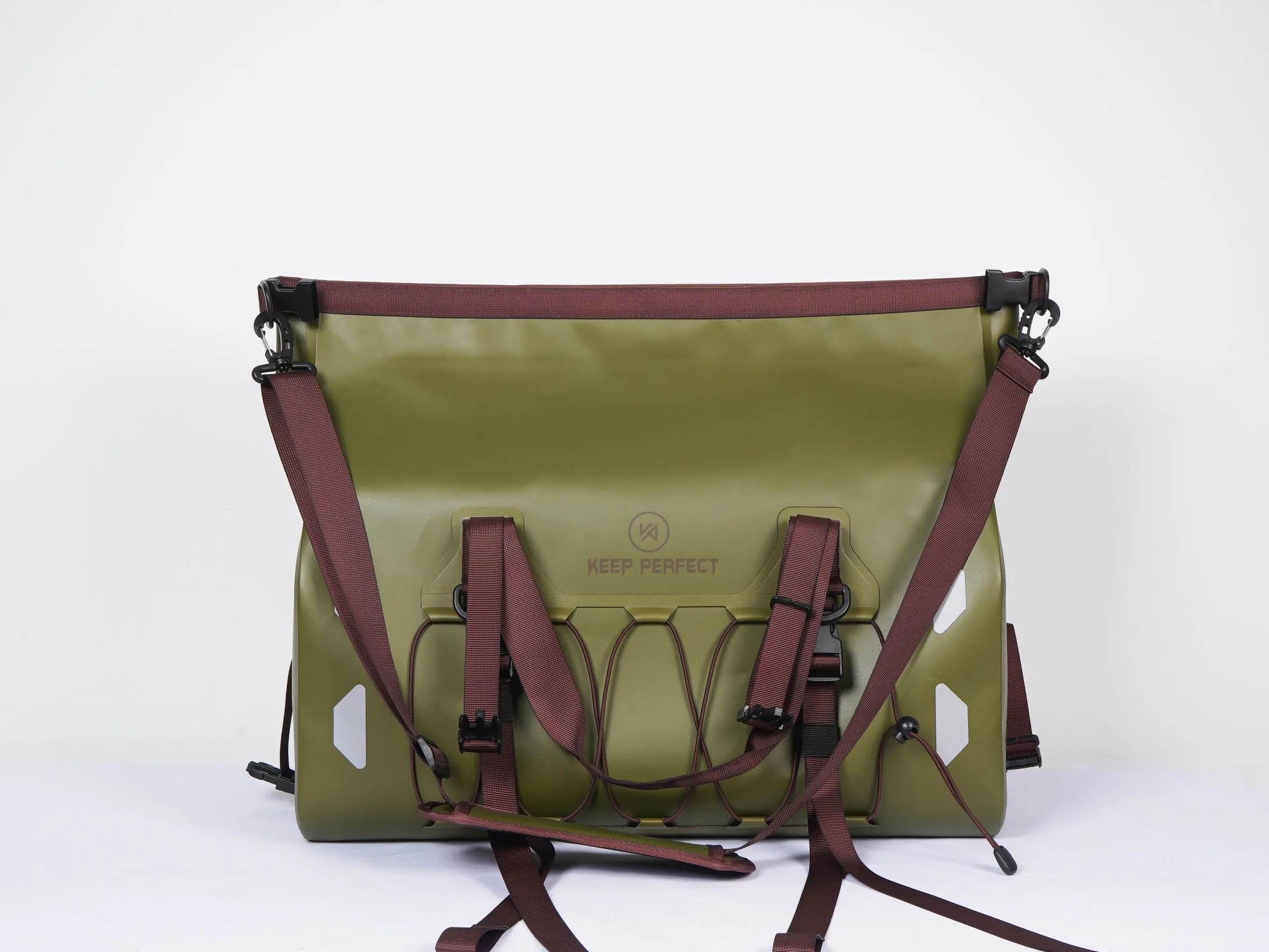
| Main carry bag | 40 to 65 L, lightweight, flap-covered closures | Clothing, food, sleeping kit | Storm-flapped zips throughout; no hook-and-loop; welded wet compartment for water |
| Optics and electronics pouch | 3 to 8 L, sealed, light interior colour | Camera, phone, GPS, spare batteries | Dust-sealed; brush-clean; light interior so contents can be found |
| Water containment compartment or bag | Sized to the litres carried | Water bladders and bottles | Welded base; holds a leak; separate from food and electronics |
| Over-cover | Packs to under 100 g | Dust and UV protection when stationary in camp | Covers the bag fully; packs to nothing; doubles as a ground sheet |
The over-cover is the piece most ranges omit and the one that solves the two problems described earlier in this guide: static dust attraction and UV dose while stationary. It is also the cheapest item in the range and the easiest to sell as an accessory. The water containment item is the one that prevents the most common real water failure.
Four formats on three constructions, in two or three colourways, is a compact programme with every style above the 500-piece minimum per style. Planning detail is in our note on minimum quantities and production slots.
How to test a desert bag before committing to a production run
Desert performance is unusually cheap to test badly and unusually cheap to test well, and the difference matters because the failure modes are cumulative. Four tests are worth specifying in a sampling programme, none of which require exotic equipment.
- Dust exposure: expose the loaded bag to fine dust in a sealed chamber with agitation for several hours, then open every closure and inspect for ingress. Talc or standardized test dust both work as proxies.
- Thermal cycling: cycle the loaded sample across the full daily range at least twenty times, then inspect every adhesive joint, weld line and print.
- UV exposure: an accelerated weathering exposure to a defined dose, then check for chalking, fading and tensile loss in webbing and thread rather than only in the face fabric.
- Mass audit: weigh every component against the water-equivalent arithmetic, and strip anything that does not earn its grams.
The third test is where programmes most often go wrong, because they test the fabric and forget the trim. Webbing and thread have high surface-to-volume ratios and they lose strength before the panels do, so the acceptance criterion should be written against webbing and thread tensile retention as well as against fabric appearance. The general test framework is set out in our page on lab to real-world validation, and ageing prediction is covered in our note on accelerated ageing tests.
One field-validation point closes the loop: dust behaviour depends on the local particle population, which varies significantly between regions. A bag tested with one dust standard may behave differently in another desert. Any brand selling seriously into this channel should ask customers which regions they operate in and validate against the local conditions rather than against a single laboratory proxy.
Building a desert range commercially
Desert travel is a smaller channel than general hiking but a disproportionately attractive one. It splits into three buyers with different economics: expedition and overland operators who buy in volume and standardise, guided trek and safari companies who buy mid-volume and rebrand, and individual travellers who buy retail at a premium and are heavily influenced by field reports. The same range serves all three with different labelling and colourways, which is the most efficient structure available.
- Standardise on polymer hardware, TPU or silicone-coated shells and storm-flapped closures across the range, and state it; that combination is the product story.
- Specify hook-and-loop out of the range entirely, and say why; it is a genuine differentiator that customers understand immediately.
- Sell the over-cover as an accessory; it is cheap, lightweight and solves a problem every desert traveller recognises.
- Offer light interior colours so contents can be found in a dark bag, which is a small feature that gets reviewed well.
- Ask operator customers which regions they run in, because dust behaviour varies and regional validation is worth having.
Branding has one hard constraint in this channel: decoration sits under the highest UV dose of any category in this library, and it is often the first visible thing to fail. Solution-dyed face fabric, UV-stable ink systems and decoration placed away from the top and shoulder panels all extend the life of the branding, and embroidery generally outlasts a printed film under high UV. Our guide to logo methods for waterproof bags covers durability by process. Information on desert environments, dust and sand processes is published by the United States Geological Survey, and on desert protected areas by the National Park Service.
If you are specifying a desert range, review our process from first enquiry through sampling into bulk production and send us the regions you serve, the formats you want, the water volumes your customers carry and your target volumes. Sampling takes 6–10 working days, bulk production runs 35–50 days, and quotations are issued FOB Xiamen.
Frequently Asked Questions
Q1. Do desert bags need to be waterproof?
Barely. Annual rainfall across much of the Sahara and the Arabian desert is under twenty-five millimetres. Dust exclusion, thermal stability, UV resistance and low mass are what get tested every hour.
Q2. What is the biggest real water risk in the desert?
Your own water leaking. A bladder or bottle that weeps inside a bag ruins food, electronics and sleeping kit, and it happens far more often than rain. Use a welded wet compartment for carried water.
Q3. Why is hook-and-loop so bad in the desert?
Fine dust packs between the hooks and the patch progressively stops gripping, and unlike a zip it cannot be cleaned by brushing. It is the worst closure choice available in this environment.
Q4. Is a roll-top or a zip better against desert dust?
A coated zip under a storm flap. Dust is fine enough to form a continuous layer across a roll line, while a flap-backed zip excludes it and can be brushed clean without water.
Q5. How much does temperature swing in a desert in one day?
Commonly from around forty-five degrees Celsius by day to five or below at night, so a swing of forty degrees or more every twenty-four hours. That cycling damages coatings and welds more than a constant high temperature would.
Q6. Why does my bag collect dust when there is no wind?
Triboelectric charging. Dry air below ten per cent humidity plus wind-blown dust plus a synthetic shell makes the bag a charged surface that attracts particles from still air. A cover stops it.
Q7. How much water does a desert traveller need per day?
Roughly four to ten litres depending on load, temperature and acclimatisation, which is four to ten kilograms. That is why every gram of bag competes directly with water.
Q8. Should I choose a pale or a dark bag for the desert?
A mid-tone, low-saturation colour. Pale stays cooler but shows dust and fading; dark hides dust but absorbs heat and can be too hot to handle. Most travellers prefer a mid-tone.
Q9. What material should a desert bag be made from?
TPU laminate or silicone-coated nylon on a woven face, with solution-dyed fabric for colour retention. Exclude flexible PVC, which loses plasticiser fastest at exactly the temperatures desert surfaces reach.
Q10. Why does webbing fail before the fabric does?
Webbing and thread have high surface-to-volume ratios, so UV degrades them faster than the panels. Specify UV-stabilised solution-dyed webbing and UV-resistant thread, and minimise exposed stitch lines.
Q11. Can I wash a dusty bag with water?
It should not need it. Desert bags must be maintainable by brushing, shaking and wiping, because water is too precious to spend on cleaning. Choose smooth exteriors with no upward-facing crevices.
Q12. Should desert bags use metal hardware?
No. Polymer is lighter, does not heat to the point of burning in direct sun, does not corrode and does not rattle. There is no argument for metal in this category.
Q13. How often should I clean a zip in the desert?
Brush it out at the end of every day, before packing. Grit left overnight absorbs the moisture that condenses at dawn and becomes a paste by morning; the habit roughly doubles closure life.
Q14. Does desert dust behave like beach sand?
No. It runs from a few microns to about fifty against several hundred for beach sand, stays airborne for hours, penetrates closures that exclude sand, and packs into cavities as a powder.
Q15. How should I test a bag before a bulk desert order?
Four tests: a dust chamber exposure with agitation, at least twenty full thermal cycles, an accelerated UV exposure checked against webbing and thread as well as fabric, and a mass audit against the water-equivalent arithmetic.
Q16. Why do things get damp inside a bag in a desert?
Night-time radiative cooling. A bag that was forty degrees at dusk is five degrees at dawn, and any moisture inside condenses on the coldest surface, which is usually a lens or a circuit board.
Q17. How many formats should a desert range carry?
Four: a main carry bag, an optics and electronics pouch, a water containment compartment, and a lightweight over-cover. Three constructions in two or three colourways keeps each style above the minimum order requirement.
People Also Ask
Do I need a waterproof bag for the desert?
Not really. Dust, UV, thermal cycling and low mass matter far more. Buy dust-sealed closures and a welded compartment for the water you carry.
What closure works best against desert dust?
A coated zip under a storm flap. Avoid hook-and-loop entirely, because dust packs into it and it cannot be brushed clean.
How much water should I carry in the desert?
Four to ten litres a day depending on load and heat, so four to ten kilograms. Strip mass from the bag and spend it on water.
Why does my bag get dusty with no wind?
Static charge. Dry air and synthetic fabric make the bag attract dust from still air. Cover it when it is stationary in camp.
What colour bag is best for desert travel?
A mid-tone, low-saturation colour. Pale shows dust and fading, dark absorbs heat; mid-tone balances both.
How do I maintain a bag without wasting water?
Brush closures out daily before packing, choose smooth exteriors with no crevices, and use an over-cover in camp. Never rinse with drinking water.