Bags in a camper van or motorhome fail for reasons that have almost nothing to do with rain. The interior of a parked vehicle in sun reaches temperatures that soften adhesives and drive plasticiser out of coatings, then falls below freezing overnight, and it does that for weeks rather than days. The external storage bay is not a dry locker: it is a dusty, damp, chemically busy compartment that shares space with hoses, fuel cans and cleaning agents. And everything aboard is subjected to continuous low-amplitude vibration for thousands of kilometres, which fatigues strap anchors and rattles hardware loose long before anything wears out. Specifying for immersion in this channel is answering a question nobody asked.
This guide works through the real load cases in the order they matter: why thermal cycling beats thermal extremes in camper interiors, what an external storage bay actually exposes a bag to and why dust sealing ranks above water sealing there, how road vibration produces fatigue failures that no static test predicts and how to specify against it, why modularity and compression are worth more than litres, how mounting and hanging points should be built so they survive being shaken, how fine dust defeats closures differently from sand, where water in a camper actually comes from, what fuel and cleaning chemicals do to coatings, why campfire embers are a genuinely distinct hazard, a modular system matrix for the range, what rental fleets and long-distance travellers report, and how an RV programme is structured commercially. MOQ 500 pieces per style, sampling in 6–10 working days, bulk in 35–50 days, FOB Xiamen: these are the working terms at QUANZHOU JUNYUAN BAGS, custom waterproof bag production since 2014 in a 4,950 m² SGS-verified facility.
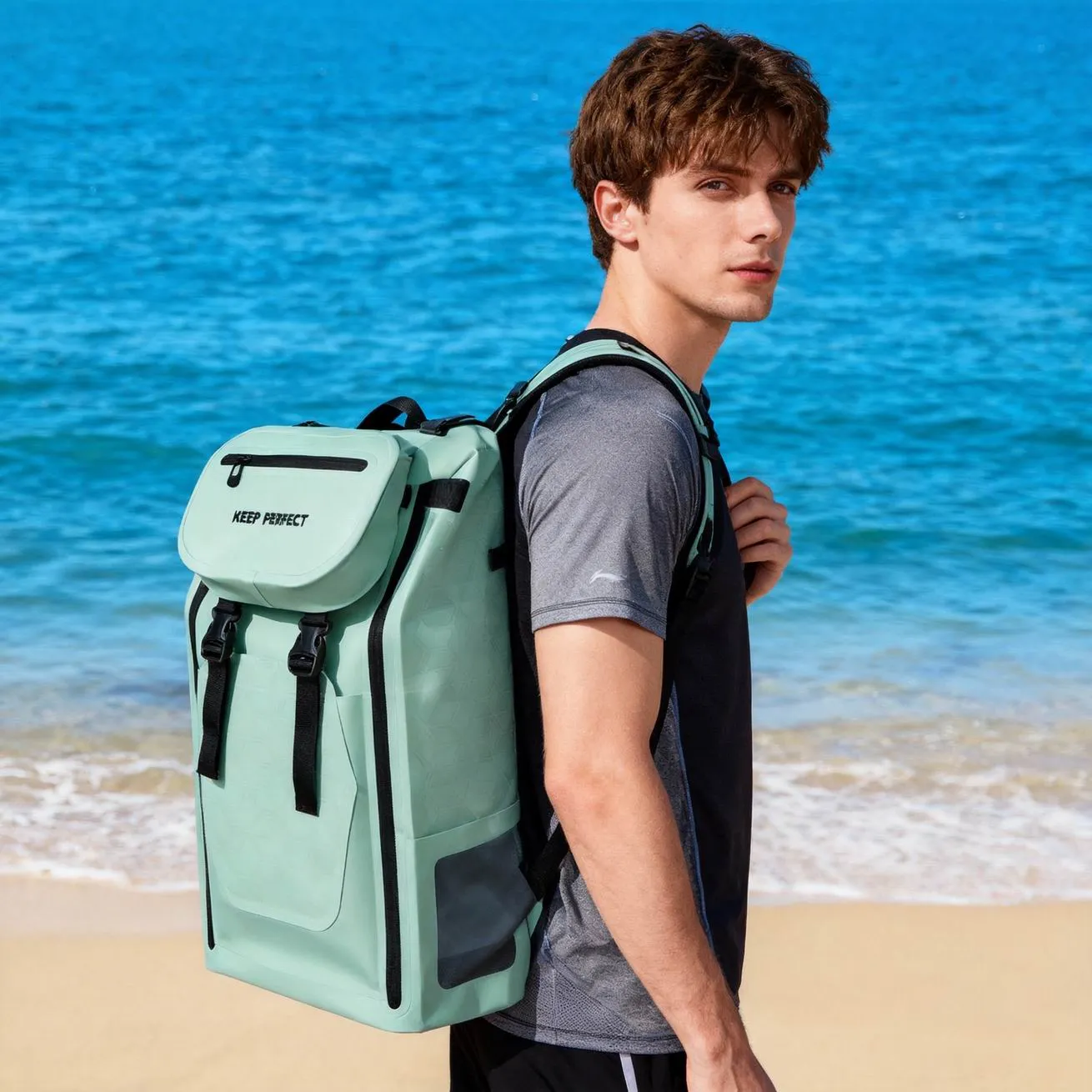
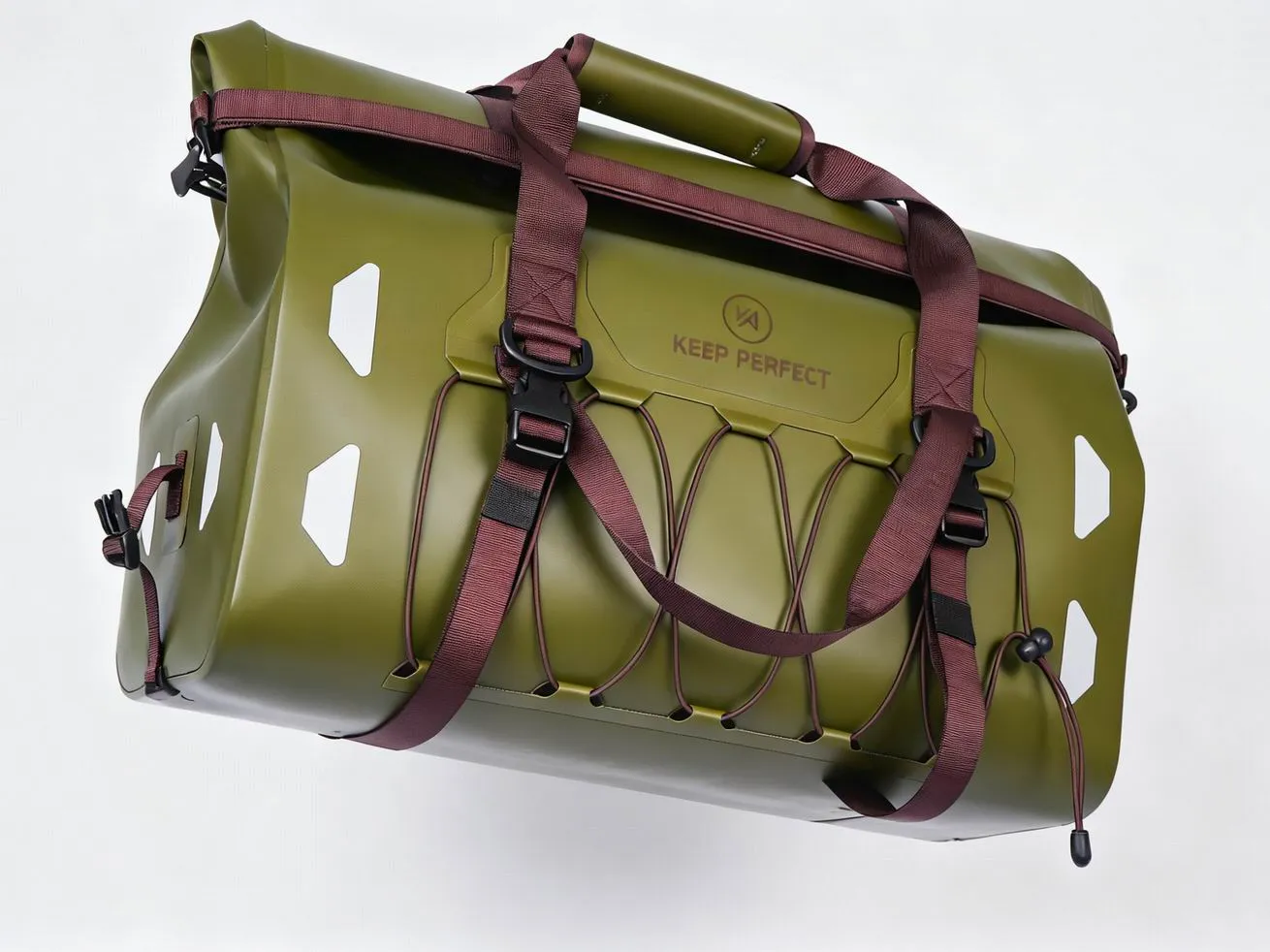
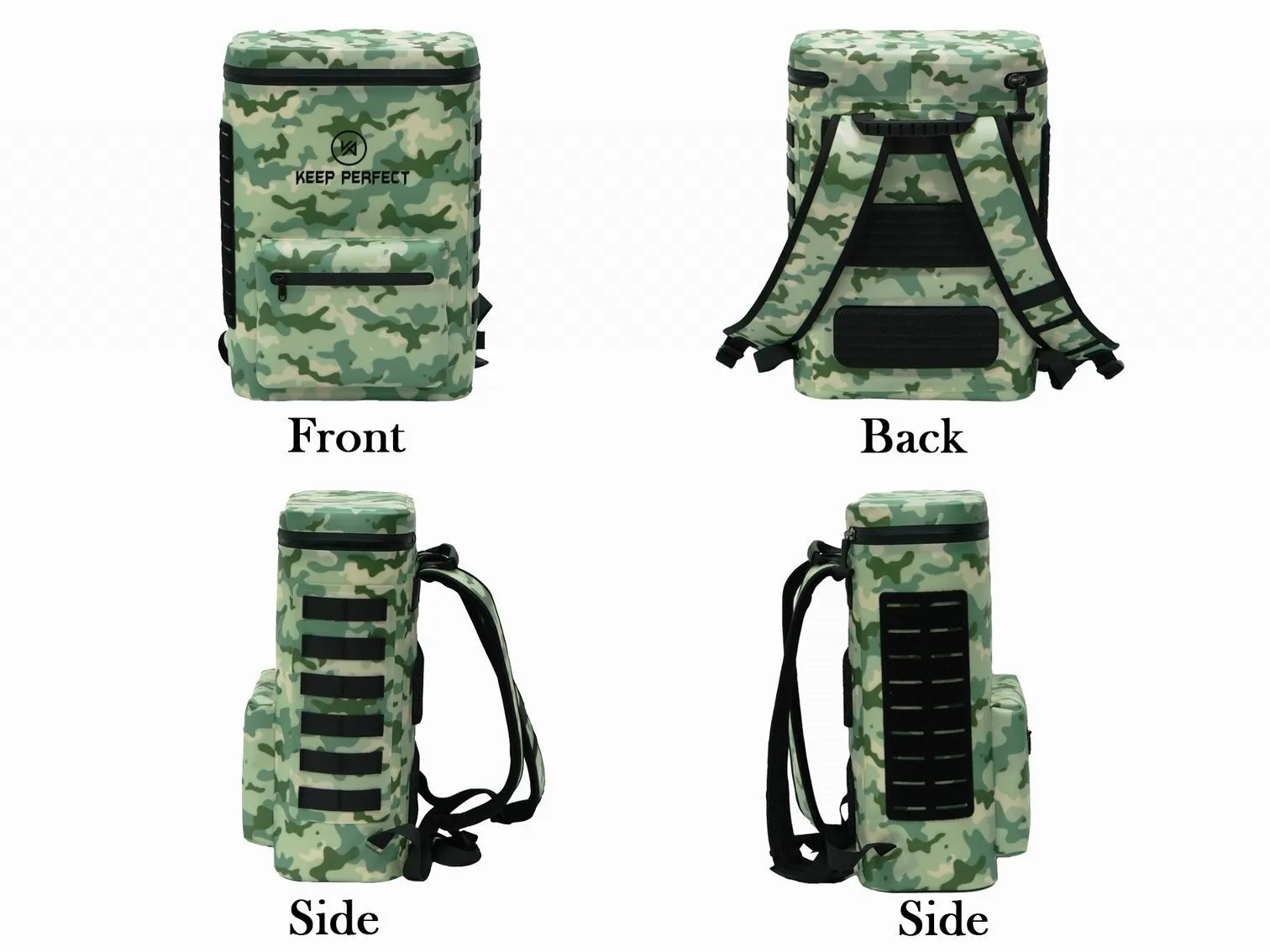
A camper is a vibrating, cycling box with a dust problem
The brief for this category is usually written as "waterproof bags for outdoor travel", and that brief produces the wrong product. Nothing in a camper van immerses a bag, which is why rv waterproof bags are so often specified against a rating that is never tested while camper road trip bags judged on thermal stability, dust sealing and vibration resistance are the ones that last. What damages bags aboard is heat cycling, dust, and sustained vibration, in that order, and each of the three has a different specification response. Understanding the ranking is most of the work, because it decides where money goes.
That ranking is the lens in which rv waterproof bags should be judged, and it explains why camper road trip bags sourced from a general outdoor catalogue disappoint within one season. A bag bought for its hydrostatic rating has spent its budget on a property that is never tested, while the three properties that are tested every single day — thermal stability, dust exclusion and vibration resistance — were never specified at all.
The duration matters as much as the intensity. A two-week holiday is a mild exposure. A three-month overland trip, or a rental vehicle in continuous service, is roughly ninety consecutive cycles of heat and cold plus several thousand kilometres of vibration, and the failures that appear in month three are cumulative mechanisms that a two-week trip never reveals. Commercial buyers should specify against the long trip even when most customers take short ones, because the long-trip customer writes the reviews.
The framework for choosing how much protection to specify, rather than defaulting to the maximum available, is set out in our article on choosing the right waterproof level. For this channel the answer is usually modest ingress protection with excellent dust sealing, which is a combination almost no retail product offers and which costs less to build than a fully submersible one.
Two climates a day, for weeks on end
A parked vehicle in sun is one of the hottest environments consumer goods ever sit in. Interior air temperatures routinely run thirty to forty degrees above ambient, so a summer afternoon in a warm climate puts the cabin at sixty to seventy degrees Celsius, and surfaces facing the windscreen run higher than the air. Overnight, particularly at altitude or in shoulder seasons, the same interior drops to single digits or below. That cycle runs once every twenty-four hours for the whole trip.
Three consequences follow, and each is cheap to design against if it is known in advance. Adhesive-backed components — seam tapes, heat transfers, bonded patches — are at their least reliable at elevated temperature, and failures cluster in the first hot season. Flexible PVC loses plasticiser faster when warm, which is a permanent loss rather than a temporary softening, and once lost the film cracks at exactly the folds a closure depends on. And anything sealed with air inside develops internal pressure that adds to whatever load is stacked on it.
The honest test for this is free and almost nobody runs it: leave the loaded bag in a closed vehicle in direct sun for a full afternoon, then inspect every adhesive joint, every print and every seal line. Doing it once during sampling prevents a season of field complaints. The general behaviour of these materials across temperature is covered in our page on thermal properties, and structured versions of the same cycling are described in our note on temperature and humidity testing.
Cold deserves its own line because it is the half people forget. A bag stored in a cold vehicle and then brought into a heated cabin or a warm awning space collects condensation on its outer surface, exactly as it does in a cruise cabin, and the interior of a small van has very little airflow to clear it. Our discussion of condensation in sealed constructions covers the mechanism; the camper amendment is that the swing happens daily and the space is too small to ventilate.
The external storage bay is dusty before it is wet
Motorhomes and camper vans have external lockers, and those lockers are where the awkward, dirty, wet and bulky items go: water hoses, levelling blocks, muddy boots, folding chairs, a portable toilet cassette in some layouts, jerry cans, cleaning agents. The door seals against weather when it is closed, but it is opened several times a day in whatever weather is happening, and the compartment is not ventilated and not lit.
| What is in the bay | What it does to a bag | How the bag fails | Design response |
|---|---|---|---|
| Fine road and desert dust | Penetrates closures and settles on every surface | Zippers and roll-tops become gritty; contents coated in silt | Dust-sealed closures with storm flaps; wipe-clean exteriors |
| Water hoses and connectors | Residual water drains onto the compartment floor | Standing water at the base; wicking along lower seams | Welded base panel; no seams in the lowest twenty millimetres |
| Fuel cans, diesel and AdBlue | Vapour and occasional spillage | Coating softening; odour absorbed permanently | Solvent-resistant outer; a bag dedicated to that compartment |
| Cleaning agents and detergents | Leaks from poorly sealed bottles | Localised coating damage; stiffening or tackiness | Chemical-resistant lining; separate containment for liquids |
| Gritty equipment and tools | Abrasion from being stacked and slid | Scuffing and thinning at contact faces; print removed | Heavier denier outer; decoration kept off contact faces |
| Sustained damp with no airflow | Mildew conditions in a closed locker | Odour and staining that survive cleaning | Ventilated construction; a design that compels drying |
The ordering in that table is the point. Water is one of six exposures and not the most damaging one. A bag specified to be submersible will still fill with dust, absorb fuel vapour and develop mildew, because none of those are water-ingress problems. The correct brief for a bay bag is dust-sealed, wipe-clean, solvent-tolerant and vented — four properties, none of which appear on a waterproof rating.
Two construction notes follow. A coated zipper with a storm flap is better for dust exclusion than a roll-top, which reverses the recommendation made in sandy beach categories, because dust is fine enough to sit in a roll line and a flap-backed zip can be brushed clean. And exteriors should be smooth rather than textured, because a textured face holds silt and a smooth one wipes off. Our general comparison of closure families gives the trade-offs, and the base cloth question is covered in our note on denier and durability.
Vibration is the failure mode nobody designs for
This is the most distinctive mechanism in the category and the one with the least literature. A bag in a moving vehicle is subjected to continuous low-amplitude vibration from the road surface and the engine, for hours at a time, at frequencies that depend on speed, road texture and suspension. Nothing about that regime appears in a static load test, and the failures it produces look like mystery defects to anyone who has not thought about it.
Four mechanisms run. Fatigue at strap anchors: a webbing tab bonded or stitched to a panel sees millions of small load reversals and eventually separates, and it separates at the attachment rather than in the webbing itself. Fretting at stitch lines: two surfaces rubbing microscopically wear through thread faster than through fabric. Self-loosening: a side-release buckle under vibration can walk itself open, and a bag that opens in a locker empties onto whatever is beneath it. And chafe: a bag resting against a hard edge in a locker wears a hole at that spot, slowly and then suddenly.
- Continue webbing under the base rather than terminating it in a panel, so the fatigue load is shared rather than concentrated.
- Reinforce or eliminate strap anchor tabs, because that is where vibration fatigue starts.
- Specify buckles that cannot walk open, or add a secondary retention that does not depend on the primary closure.
- Add chafe protection at every point where the bag will rest against a hard edge or another object.
- Ask for a vibration or shake test with the bag loaded, rather than accepting a static pull result alone.
Rattle deserves a mention because it is the complaint customers actually make. A bag with metal hardware in a locker rattles all night, and people notice it at two in the morning in a small space. Soft loops, polymer hardware and covered attachment points are all cheap decisions that materially improve the ownership experience, which matters more in a camper than in almost any other environment because the living space and the storage space are the same volume.
Our article on load testing straps and handles covers the static case; the amendment for this channel is to ask whether the supplier has ever run a cyclic or vibration test, because a static rating says nothing about fatigue life. The trades analogue, where tools and bags live in moving vehicles permanently, is discussed in our page on bags for tradespeople.
Modularity and the compression premium
Space aboard a camper is not scarce in the abstract; it is scarce in specific shapes. Lockers have apertures, under-seat voids have heights, and the space under a bed has a clearance that varies along its length. A bag with the right number of litres and the wrong shape is unusable, and a bag that cannot be compressed when partly empty wastes space every single day of the trip.
So the specification priority is a set of items that nest and compress, rather than one large item. Three soft bags that nest into one another outperform one large bag in every practical measure aboard: they fit awkward apertures, they can be distributed to balance weight, they can be unpacked selectively without disturbing everything, and they empty completely when not in use. This is the same reasoning that makes modular organisation systems work in small homes, and it is covered generally in our page on stuff sacks and organisation systems.
- State the packed height when the bag is empty and compressed, not only the filled volume.
- Design sizes to nest, so three items occupy the volume of the largest rather than the sum.
- Prefer soft bodies throughout; anything semi-rigid fails to use irregular space.
- Give each item a clear external identity — colour, patch or label panel — because lockers are dark.
- Size against the locker aperture the customer actually has, which is worth asking about in the brief.
Weight distribution is a consideration that surprises people. In a camper, where items go affects handling and axle loading, and a bag that is convenient to put high is the wrong place for anything heavy. A modular system with an obvious size hierarchy lets a traveller put dense items low without thinking about it, which is a small design contribution to something that matters.
Dimensional customisation is also unusually valuable in this channel, because every vehicle layout is different and a range that can be offered in three heights at the same construction sells into far more layouts than one fixed shape. Our note on dimensional customisation covers how this is usually handled without fragmenting production volume.
Hanging, mounting and the hook that survives being shaken
Vertical space is the most under-used resource in a camper, and bags that hang are the cheapest way to use it. Wall-mounted organisers, over-door storage and hanging kits are standard equipment in the aftermarket for exactly that reason. But a hanging bag in a moving vehicle is a pendulum with a road-induced input, and the attachment is the component that fails.
The load is small and the cycle count is enormous, which is the classic fatigue condition. A hang loop carrying three kilograms in a vibrating vehicle sees perhaps a million small load reversals over a long trip, and a loop stitched into a single panel will eventually tear out at the stitch line rather than break in the webbing. The remedy is the same one used for strap anchors: spread the load, reinforce the attachment, and avoid concentrating it at a point.
- A hang loop with webbing continued into the body rather than stitched onto the surface.
- A stiffened or moulded attachment point if the bag will hang loaded for weeks.
- Two hanging points rather than one, so the bag cannot swing and twist.
- Grommets only where the surrounding material is reinforced; an unsupported grommet tears out under vibration.
- A hook or loop geometry that cannot disengage itself, which rules out some open hook designs entirely.
Mounting hardware deserves the same caution as elsewhere in the vehicle. Anything metal should be polymer or corrosion-resistant, because camper interiors see condensation and coastal trips see salt air. And any mounting system should be quick to remove, because bags have to come down and be packed away whenever the vehicle moves on, which is most days.
Dust is finer than sand and behaves differently
Dust deserves separate treatment from beach sand because it is a different particle population with different behaviour. Road dust and desert silt run from a few microns to perhaps fifty, compared with beach sand at several hundred microns. That size difference matters in three ways: fine particles stay airborne and settle on everything, they penetrate closures that exclude sand comfortably, and they behave as a powder rather than as grains, so they pack into cavities and hold moisture.
The closure consequence is the practically important one. A roll-top that shrugs off beach sand can weep with dust, because a fine particle layer across the seal line is continuous rather than discrete, and wiping it off is harder than brushing off grains. A zipper with a storm flap does better against dust than against coarse grit, because the flap excludes the fine fraction that would otherwise reach the teeth. So the closure recommendation for a camper bay is the opposite of the recommendation for a beach, and that reversal is worth stating explicitly in any range plan that spans both.
The maintenance consequence follows: dust bags should be designed to be wiped and shaken rather than rinsed, because water is a scarce resource on a road trip and a bag that needs washing to work is a bag that will not be maintained. Smooth exteriors, upward-facing crevices eliminated, and closures that can be brushed clean are the three design rules that matter.
Abrasion behaviour is gentler than in sand categories, because fine dust is less effective as a cutting abrasive, which is a rare piece of good news: it means an exterior chosen for cleanability need not be the heaviest available. Where abrasion does matter is at chafe points, and that is a geometry question rather than a materials one. Our review of abrasion standards sets out how to compare candidates properly.
Water inside a camper comes from hoses, not rain
Ask where water actually enters a camper and the answer is almost never weather. It is the fresh water hose, which drips when disconnected and is stored wet; the outdoor shower, which wets the doorway area; the awning, which sheds a concentrated line of water exactly where people stand; wet footwear and wet coats brought inside; and condensation on cold surfaces overnight. All of it arrives at floor level and all of it is fresh water rather than salt, which makes it easier to live with and no less persistent.
The design response is a wet zone near the door rather than anywhere else, and it should drain rather than contain. A boot bag, a wet coat holder and a small mat-side container that drains and dries do more for daily life aboard than any amount of general waterproofing. Wet footwear is the specific problem worth solving properly: it is heavy, it is dirty, it never dries in a small space, and it is the main source of the smell people associate with camper travel.
- A drainable wet zone positioned at the doorway, so nothing wet is carried deeper into the vehicle.
- A boot bag that opens fully, drains and can be hung outside under an awning.
- A wipe-clean mat-side surface, because the floor area near the door is permanently damp.
- No textile linings in the wet zone; they hold water and guarantee odour within a week.
- A hanging point outside the vehicle, since almost everything dries faster in moving air than inside.
Insulated and refreshment formats have a small water problem of their own: condensation and ice melt. A cooler bag that does not contain meltwater leaks into the vehicle, and the outside of an insulated bag in a humid camper runs wet. Our page on insulated waterproof bags covers the construction, and the general camping context sits in our guide to keeping gear dry in the wilderness.
Fuel, cleaning agents and the chemistry of the bay
The chemical exposure in a camper bay is more varied than in most outdoor categories, because a vehicle carries fluids that have no equivalent in a rucksack. Diesel and petrol vapour, AdBlue or diesel exhaust fluid, which is corrosive and crystallises as it dries, screen wash, detergents, toilet chemicals, and occasionally leaked propane system components. None of these are exotic, and most are more aggressive than seawater.
The failure pattern is familiar from other chemical exposures: softening or swelling of the coating, then tackiness, then loss of integrity, and it is usually localised around a spill or a leaking bottle. The response is the same one used everywhere in this library and worth repeating because it is consistently ignored: separation beats resistance. Give fluids their own containment, in a bag with a chemical-resistant lining and a welded base that will hold a spill, and the rest of the range never needs to be engineered against diesel.
Odour deserves a line because it is permanent and it is the complaint that ends a product’s life in this channel. Diesel and toilet chemical odours absorbed into a textile lining do not wash out. A smooth, non-absorbent lining in anything stored in the bay prevents it entirely, at trivial cost, and it is the kind of detail that earns repeat purchase from people who have been through it once.
The underlying comparison data for these exposures is set out in our review of chemical resistance in waterproof materials; read the oils and solvents columns rather than the salt one for this channel. Construction selection then follows the same logic described in our article on stitched, welded and bonded constructions, with welded bases preferred wherever a spill could pool.
Campfire embers and heat at the pitch
One hazard in this category has no equivalent anywhere else in outdoor travel: the campfire. Bags sit around fires, they are set down on ground near them, and embers travel. Synthetic fabrics do not burn well but they melt readily, and a single ember produces a hole through a coated shell in a second or two, usually on the top panel where nobody was looking.
No realistic product specification makes a bag ember-proof at a viable price, so the honest response is a different one: accept the hazard, keep the bag away from the fire by design, and make the damage repairable. In practice that means offering a repair patch with the product, specifying a material that can be patched with a heat-applied or adhesive patch, and saying so in the product literature. It is a small thing that converts a ruined bag into a five-minute repair.
The second heat source is less dramatic and more common: radiant heat from a vehicle parked in sun, from a barbecue, and from heaters and inverters inside the van. Anything stored against a warm surface in a small space sees sustained elevated temperature at a localised point, which is exactly the condition that softens adhesives and accelerates plasticiser loss. Keeping bags off warm surfaces is a user behaviour, but designing a flat base that can also stand on edge helps.
Reflective and high-visibility detailing has a use here too, and it is not only about being seen on a road at night. A bag left outside a tent or a van in the dark is found by torchlight, and a reflective panel turns a five-minute search into an instant one. Our page on integrating reflective materials covers how it is done without compromising the shell.
A modular system matrix for a camper range
Five formats cover camper life well, and the system logic matters more than any individual item. The test of a good range is whether three of the five can be nested, hung and identified in a dark locker, not whether each one is individually excellent.
| Format | Volume and shape | Job it does | Governing requirement |
|---|---|---|---|
| Bay bag | 30 to 50 L, soft, wipe-clean | Dirty, wet and bulky items in the external locker | Dust sealing with a storm flap; solvent-resistant outer; welded base |
| Cabin nest set | 5 to 25 L, three nesting sizes | Clothing and personal kit inside the living space | Compresses flat when empty; nests; identifiable in a dark locker |
| Wet zone bag | 15 to 25 L, vented | Boots, wet coats, towels at the doorway | Drainage; opens fully; hangs outside under an awning |
| Fluid containment bag | 10 to 20 L, welded base | Fuel cans, AdBlue, cleaning agents | Chemical-resistant lining; holds a spill; non-absorbent interior |
| Hanging organiser | 10 to 20 L, flat, two hang points | Keys, documents, chargers, small items on a wall or door | Reinforced hang loops; quick release; does not rattle |
The nesting set is the commercial core and the one where compression is the product. Its value is that three bags occupy the volume of the largest when empty, which in a camper is worth more than any feature. It also sells as a set, which suits retail and gifting channels far better than a single bag does.
Commercially, five formats on three or four constructions is ten to twelve SKUs with every style above the 500-piece minimum per style, which is the structure that makes the channel viable. General sizing reasoning is in our capacity selection guide, and the home and garage parallel — the same modular logic applied to a fixed space — sits in our page on storage and organisation bags.
What rental fleets and long-distance travellers report
Two sources generate reliable data here. Rental fleets inspect vehicles between hires and see bags at high utilisation with known mileage. Long-distance travellers, the overland and full-time community, run product for months continuously and are unusually systematic about what failed and when. Their reports agree closely.
| Observation | Mechanism | When it appears | Specification change that helps |
|---|---|---|---|
| Strap anchor separating from the body | Vibration fatigue at the attachment rather than failure in the webbing | After several thousand kilometres | Continue webbing under the base; reinforce anchor tabs; ask for a cyclic test |
| Buckle found open, contents spilled | Vibration walking a side-release buckle open over hours | Intermittent, unpredictable | Specify buckles that cannot self-release; add secondary retention |
| Hole worn at one spot on the bag | Chafe against a hard edge or another object in a locker | Mid-trip, then sudden | Chafe protection at contact points; a smooth exterior; separated storage |
| Interior permanently odorous | Fuel or toilet chemical vapour absorbed into a textile lining | Once, and permanently | Non-absorbent lining; dedicated containment for fluids |
| Print and bonded patches lifting | Sustained high interior temperature in a parked vehicle | First hot season | Adhesives rated for the temperature; decoration kept off heated faces |
| Hang loop tearing out | Fatigue at a loop stitched into a single panel, under a small load for a very long time | Late in a long trip | Webbing continued into the body; two hanging points; reinforced grommets |
The replacement arithmetic worth budgeting against is roughly two to four years for personal use and one to three seasons for rental fleets, with fleets replacing twenty to thirty per cent annually. Fleets replacing faster are usually losing bags to vibration failures and chafe rather than to any materials deficiency, which is worth knowing before spending money on a heavier fabric that will not fix it.
The most useful thing rental operators do is log mileage against failures, because it converts an argument about durability into a number a supplier can act on. Any brand selling into this channel should ask its customers for that data; it is the difference between a specification and a guess.
Building an RV and camper programme commercially
The camper and RV aftermarket is commercially attractive for structural reasons: it is a growing channel, it has a strong accessories culture, customers buy sets rather than singles, and the same range serves motorhome, camper van, overland and general car-camping segments with only graphic changes. Volumes follow vehicle registrations, which are published and therefore forecastable.
The structure that works is a platform: three or four constructions across five formats, with colourways and labelling carrying the merchandising work. Nesting sets should be sold as sets, because that is both higher value and genuinely better for the customer. That structure keeps each style comfortably above the 500-piece minimum per style rather than fragmenting volume across eight bodies. Planning detail is in our note on minimum quantities and production slots, and for northern hemisphere seasons the order belongs in the preceding autumn.
Branding has one constraint and one opportunity. The constraint is that bay bags live in a dusty, abrasive, chemically active compartment, so ink films on contact faces are removed within weeks and decoration belongs on protected panels or as a welded badge. The opportunity is identity: dark lockers make colour and labelling genuinely functional, and a range that uses colour to signal which bag belongs where earns a loyalty that price competition does not. Our guide to logo methods covers durability by process.
Two commercial notes close it out. Repairability sells in this channel, because people on long trips fix things rather than replace them, and a spare buckle, a patch and a spare slider in the pack cost almost nothing and generate goodwill out of proportion. And the accessory that sells best is the hanging organiser, because vertical space is the one resource every camper owner knows they are wasting.
If you are specifying an RV or camper range, send us the vehicle layouts, locker dimensions, trip profiles and any failure history you already have. Minimum order quantity is 500 pieces per style, samples take 6–10 working days, bulk production runs 35–50 days, and quotations are issued FOB Xiamen. Industry statistics and standards for the vehicles themselves are published by the RV Industry Association, and vehicle-level test practices by SAE International.
Frequently Asked Questions
Q1. Do camper bags need a high waterproof rating?
Usually not. Nothing aboard immerses a bag. Dust sealing, thermal stability and vibration resistance are the properties tested daily, and they cost less to deliver than full submersion protection.
Q2. Why do straps come off camper bags?
Vibration fatigue. A webbing anchor in a moving vehicle sees millions of small load reversals and separates at the attachment rather than breaking in the webbing. Continuing the webbing under the base fixes it.
Q3. Is a roll-top or a zip better for a storage bay?
A zip with a storm flap, which reverses the beach recommendation. Dust is fine enough to form a continuous layer across a roll line, while a flap-backed zip excludes it and can be brushed clean.
Q4. How hot does a parked camper get inside?
Interior air commonly runs thirty to forty degrees above ambient, so sixty to seventy degrees Celsius in summer. That softens adhesives and drives plasticiser out of coatings permanently.
Q5. What should I store fuel and cleaning chemicals in?
A dedicated bag with a chemical-resistant lining and a welded base that will hold a spill. Separation is cheaper and more reliable than trying to make every bag resist diesel.
Q6. Why does my bag smell permanently after one trip?
Fuel or toilet chemical vapour absorbed into a textile lining. It does not wash out. Specify a smooth non-absorbent interior for anything kept in an external bay.
Q7. How do I stop bags rattling in a camper at night?
Choose polymer hardware, soft loops and covered attachment points, and keep metal off contact faces. In a small living space, noise is a quality issue rather than a minor annoyance.
Q8. Why did my bag open itself in a locker?
Vibration can walk a side-release buckle open over hours of driving. Specify buckles that cannot self-release, or add secondary retention that does not depend on the primary closure.
Q9. Should camper bags be hard or soft sided?
Soft. Irregular locker apertures and limited space mean a soft bag conforms and compresses, and it can be squeezed into space a semi-rigid bag cannot use at all.
Q10. What is the best way to handle wet boots in a camper?
A drainable wet zone at the doorway that opens fully and can be hung outside under an awning. Textile linings in that zone guarantee odour within a week.
Q11. How should hanging bags be attached in a moving vehicle?
With webbing continued into the body rather than stitched onto a panel, at two points rather than one, so the load is shared and the bag cannot twist and swing.
Q12. Can campfire embers be designed against?
Not economically. Accept the hazard, keep bags away from the fire, and make damage repairable by supplying a patch and specifying a material that can be patched.
Q13. How often do rental fleets replace camper bags?
Roughly twenty to thirty per cent annually, with one to three seasons of service. Faster replacement usually indicates vibration and chafe failures rather than any material deficiency.
Q14. Why is compression more valuable than capacity aboard?
Because space is scarce in specific shapes. A set of bags that nests and compresses flat uses irregular lockers far better than one large bag, and it distributes weight more sensibly.
Q15. What is the single most useful accessory in this channel?
The hanging organiser. Vertical space is the resource every camper owner knows they are wasting, and a wall or door mounted bag recovers it immediately.
Q16. Does desert dust behave like beach sand?
No. It is far finer, stays airborne, penetrates closures that exclude sand, and packs into cavities as a powder that holds moisture. Design for wiping and shaking rather than rinsing.
Q17. How many formats should a camper range carry?
Five: a bay bag, a nesting cabin set, a wet zone bag, a fluid containment bag and a hanging organiser. Three or four constructions behind them keeps every style above the minimum order requirement.
People Also Ask
What bags do I need for a camper van trip?
A dust-sealed bay bag, a nesting set for clothing, a drainable wet zone bag for boots, a containment bag for fluids and a hanging organiser for small items.
Are waterproof bags useful in a motorhome?
Yes, but for dust and spills rather than rain. Look for dust-sealed closures, welded bases and solvent-resistant linings instead of a high submersion rating.
Why does my bag wear a hole in the camper?
Chafe. A bag resting against a hard edge in a moving locker wears through at that spot. Separate it and add chafe protection at contact points.
How do I stop dust getting into camper storage?
Use zip closures with storm flaps rather than roll-tops, smooth wipe-clean exteriors, and closures that can be brushed clean without water.
Can I keep fuel cans in a bag?
Only in a dedicated bag with a chemical-resistant lining and a welded base that contains a spill. Never in a general bag, because absorbed vapour odour is permanent.
How long do camper bags last?
Two to four years for personal use and one to three seasons in rental fleets. Fleet losses are usually vibration and chafe rather than material failure.