"Best waterproof backpack for hiking" is a question with a manufacturer’s answer: the best trekking pack is the one built for the jet band — welded seams, flapped water-resistant zippers, reinforced base and honest load suspension — because a mountain storm at walking speed hits a pack like a fire hose, and splash-rated commuter builds fold under exactly that. This guide is written from the factory side: what the best waterproof hiking backpack formats actually contain, how trekking-grade waterproofing differs from commuting and paddling builds, what the load-carrying structure must add, what these programs cost at MOQ 500, and how to evaluate a waterproof backpack manufacturer or supplier before committing a season’s inventory.
The reference line is our own: QUANZHOU JUNYUAN BAGS, custom waterproof bag production since 2014, 4,950 m² SGS-verified facility, 7 lines, 149 machines, 137 staff, 200,000 pieces monthly. MOQ 500 per design splittable across the trekking family, samples 6–10 working days, bulk 35–50 days, AQL 2.5 inspection, 30/70 T/T, FOB Xiamen, shipping to 100+ countries.
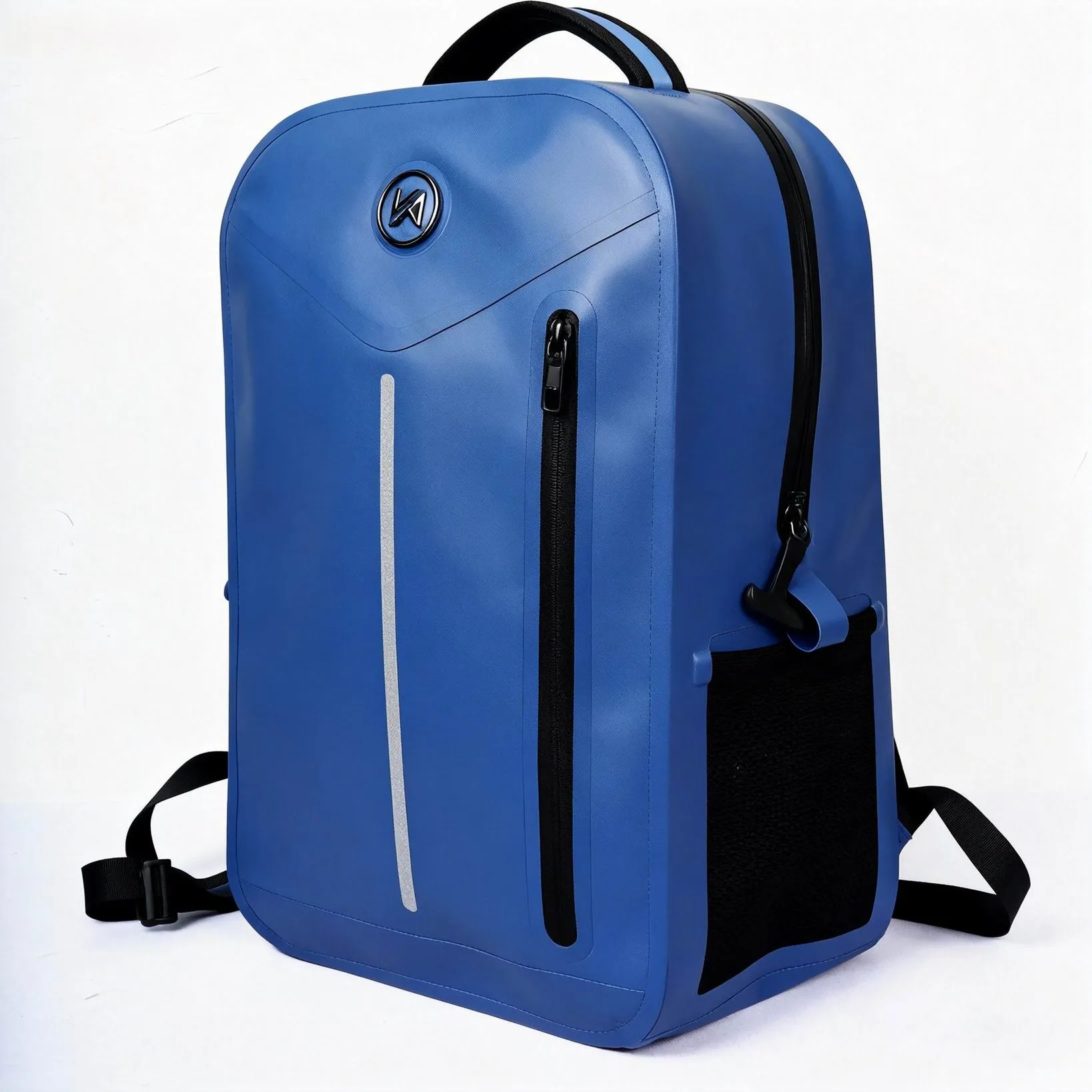
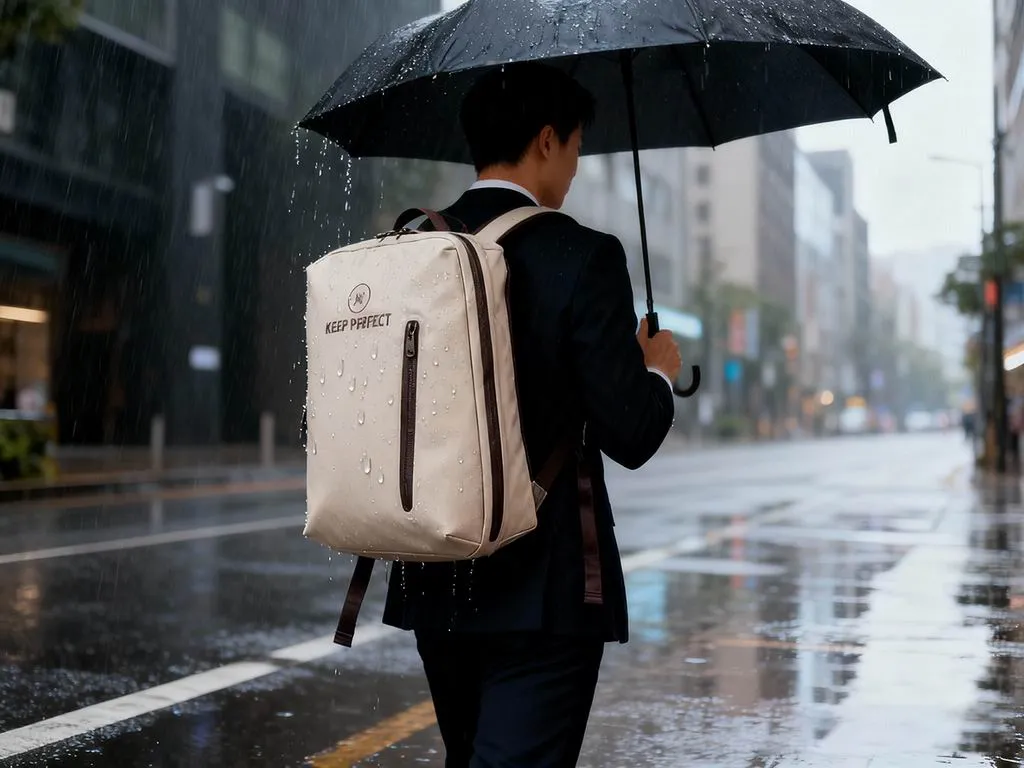
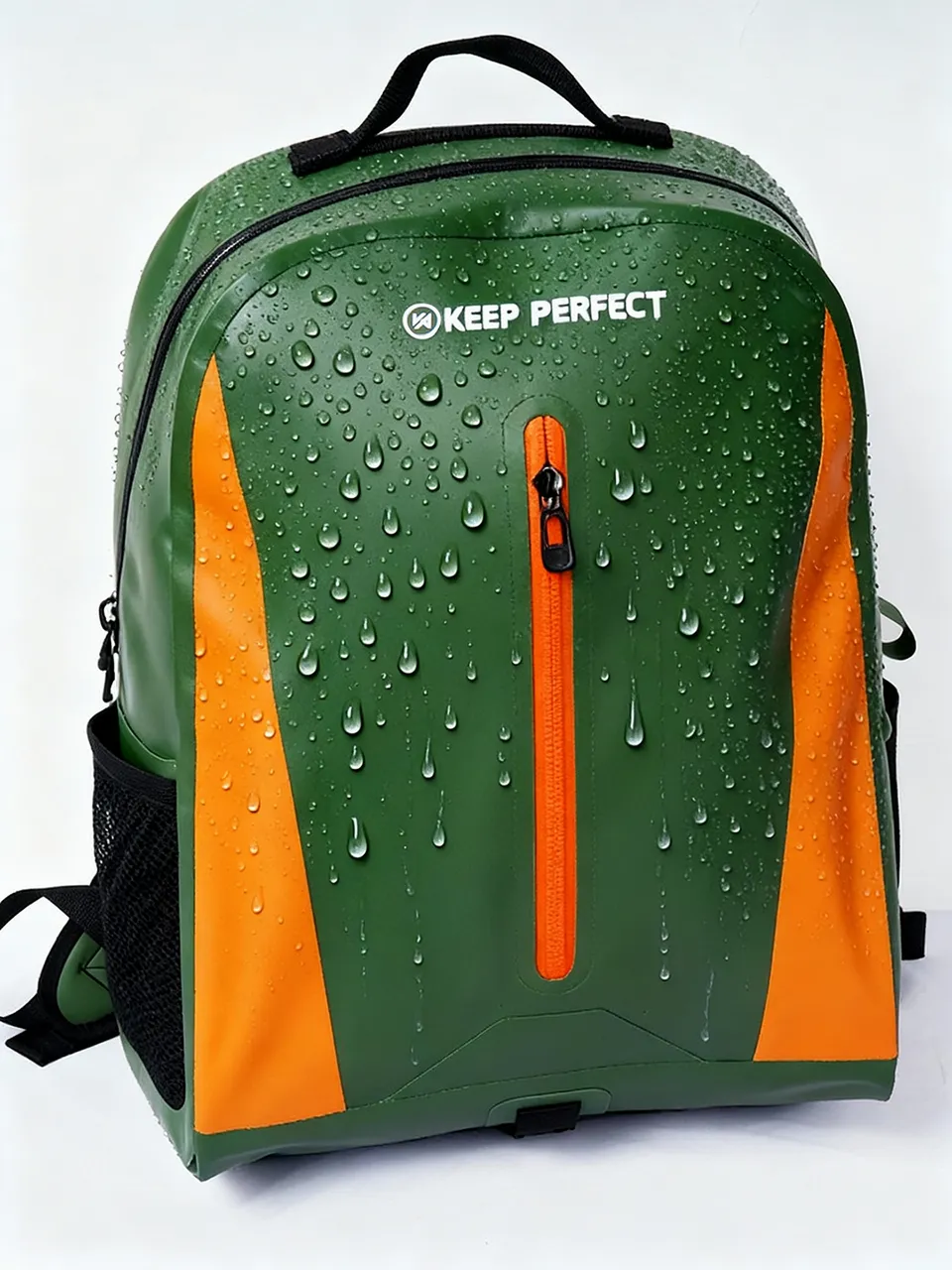
What "waterproof" must mean for hiking
Comparing waterproof backpack manufacturers on equal terms is impossible without a fixed test standard — this guide fixes one for waterproof hiking backpacks in the jet band. Hiking and trekking sit in the jet band of water exposure: not submersion, but sustained driven rain at speed, stream spray, wet brush and the pack riding a loaded roof rack through weather. That profile dictates the construction — and it is the band where spec-sheet language gets abused most, because "water-resistant" commuter packs photograph identically to jet-band trekking packs. The honest minimum for a hiking waterproof backpack: welded seams (or seam-taped sewn construction at the splash tier), a genuine water-resistant zipper behind a storm flap, a coated or laminated body fabric, and a reinforced base for ground and rock contact. The full rating logic — and why jet band is a construction threshold, not a marketing tier — is in our IPX rating system explainer.
| Exposure on trail | Band | Construction that passes |
|---|---|---|
| Drizzle on valley paths | Splash IPX4 | Coated fabric, WR zipper, taped seams |
| Storm on exposed ridge | Jet IPX6 | Welded seams, flapped AquaGuard-class zip |
| Stream crossings, monsoon | Submersion IPX7 | Roll-top welded pack or pack cover add-on |
| Wet brush, loaded rack in rain | Jet IPX6 | Welded + abrasion-resistant base panel |
The four formats that define the category
Across custom programs, four hiking silhouettes cover the market. The day trekker (20–30L): the volume SKU — enough for layer, food and kit, with the organization hikers expect at this size. The multi-day trekker (35–45L): load-carrying structure enters — a real hip belt that transfers weight off the shoulders, load lifters, a vented or suspended back panel. The ultralight hybrid (25–35L): minimalist welded builds in lighter laminates for the fast-and-fleet segment. The roll-top crossover (30–40L): submersion-rated welded packs for river-trip and monsoon-region programs, which carry like a trekker and seal like a dry bag. Capacity-to-kit mapping for the crossover format follows the same liter logic as our dry bag sizing guide.
- Day trekker 20–30L: the volume SKU; organization and branding panels drive the spec
- Multi-day 35–45L: hip-belt transfer and load lifters are non-negotiable engineering
- Ultralight 25–35L: lighter laminates, welded minimalism, premium tier
- Roll-top crossover 30–40L: the monsoon and river-region answer — IPX7 in a backpack format
The load-carrying structure: what separates trekkers from totes
Waterproofing is half a trekking pack; the other half is carrying 12–18 kg comfortably for eight hours, and that structure is where cheap builds reveal themselves. The engineering that matters: an internal frame or framesheet that holds the back shape under load, a hip belt padded and anchored to transfer roughly 80% of weight to the hips, load-lifter straps that pull the shoulder straps toward the frame, and a back panel that manages sweat — the quiet conflict in waterproof packs, because a fully sealed back traps moisture from the user. The solutions in production: ventilated suspended mesh panels on splash-band builds, and anti-condensation channel designs on sealed builds — the physics of both is covered in our anti-condensation design guide. Strap anchors rated for the load path are the failure point that ends seasons — the test regime is in our load stress testing guide.
Materials for trail duty
Trail duty is the toughest everyday environment a bag meets: UV at altitude, rock abrasion, repeated saturation-drying cycles and load stress on every seam. The material answers track the threats: 420D nylon TPU-lamination as the do-everything standard (abrasion resistance plus weldability), 500D–840D polyester laminates for base panels and full-abrasion builds, and silicone-treated nylons for the ultralight tier with the caveat that silnylon sews rather than welds — a splash-band technology. The fiber trade-offs are compared in our nylon vs polyester guide; the tear-strength numbers that predict trail survival and the denier system behind them are decoded in the denier rating guide and the fabric strength testing guide. UV survival — the aging question that decides year-three color and weld integrity — is covered in the UV resistance materials guide.
Comparing the builds: an honest table
| Build | Band | Weight (35L) | Unit cost (MOQ 500) | Best program |
|---|---|---|---|---|
| Coated sewn trekker | IPX4 | 0.9–1.1 kg | $5.20–$7.20 | Value lines, fair-weather regions |
| Welded jet-band trekker | IPX6 | 1.1–1.4 kg | $7.20–$9.80 | The standard serious-trekking build |
| Ultralight welded hybrid | IPX5–6 | 0.7–0.9 kg | $8.40–$11.20 | Fastpacking, premium tier |
| Roll-top crossover | IPX7 | 1.0–1.3 kg | $5.90–$8.50 | Monsoon and river programs |
Note the counterintuitive line again: the submersion-rated roll-top crossover costs less than the jet-band zippered build, because eliminating the waterproof zipper eliminates the most expensive component in the construction. Buyers who equate "more waterproof" with "more expensive" systematically misprice the crossover.
Pack covers versus built-in waterproofing: the program question
The category’s oldest debate resolves by program economics. Pack covers — the elasticized rain shells — cost $0.80–$1.60 to include, solve driven rain for the pack body, and fail at three points: they blow off in gusts, they leave the back panel and harness soaked, and they are separable (lost covers are a warranty-adjacent complaint category). Built-in waterproofing solves the whole pack at the construction level and costs $2.00–$4.00 more per unit. The program logic: covers suit value lines and fair-weather regions; built-in suits brands whose reviews will be written in weather. Hybrid programs bundle a stowable cover with a jet-band build and market the redundancy — which also answers the "wet harness" complaint that covers alone generate.
Evaluating a waterproof backpack manufacturer
The trail is unforgiving, so the sourcing screen should be too. Five questions separate manufacturers from assemblers in one email thread: Can they name the weld method for the seams (RF welding with parameters, not "we waterproof everything")? Do they quote the zipper by class and tested performance, not by "quality"? Will they show load-stress testing on strap anchors — the trekking-specific failure point? Can they produce the fabric’s mill certificate with fiber, denier and coating identified? And do they offer a golden-sample protocol that becomes the AQL reference — or only a price list? A waterproof backpack supplier who clears all five is buildable; one who clears three is a trading company with a catalog. The manufacturing-model trade-offs — and what each structure means for your program — are laid out in our OEM vs ODM guide, and the factory-verification side (audit records, SGS status) is covered in the quality assurance buying guide.
Branding on the trail
Trekking packs carry brand equity through the most photographed environments on earth, and the branding plan should exploit it: large back-panel and side-panel print zones (the panels hikers photograph), embroidery on fabric head zones (never on film), woven labels at the harness contact points where hands find them, and reflective details that double as night-trail safety features. Pantone matching at Delta E ≤2 keeps the program reading as one family across formats. The method-by-method comparison is in our logo options guide; the color strategy layer is in the Pantone matching guide.
Trekking program economics at MOQ 500
| Program line | Unit cost (500+) | Typical retail | Margin multiple |
|---|---|---|---|
| Day trekker 25L, jet band | $7.20–$8.80 | $59–$89 | 7–10× |
| Multi-day 40L, jet band | $8.40–$9.80 | $79–$129 | 8–13× |
| Roll-top crossover 35L | $5.90–$8.50 | $49–$89 | 7–10× |
| Ultralight hybrid 30L | $8.40–$11.20 | $99–$159 | 9–14× |
MOQ 500 splits across the family: a launch line of 200 day trekkers, 150 multi-day and 150 roll-top crossovers is one order and one production calendar, and it covers the demand curve from day-hike retail to expedition stockist. The full cost mechanics — freight allocation, duty, packaging and the volume pricing steps above 2,000 units — are in the cost breakdown guide.
Sampling: the staircase test
Trekking samples earn their keep loaded, not admired: fill the sample to rated weight (a 15 kg load of water bottles does fine), wear it for thirty minutes, and judge the hip transfer and shoulder pressure — then run the closure through twenty cycles and check the storm flap’s coverage at full stretch. For the crossover builds, add the basin dunk with paper inside. Samples run 6–10 working days at $60–$150 per configuration, all fees credited against bulk, and the golden sample you approve becomes the AQL 2.5 inspection reference for the production run. The full sampling protocol is in our sampling guide.
Compliance and market access
Trekking programs sell into outdoor retail, which raises the compliance tier: CPSIA and REACH documentation as the legal floor, with OEKO-TEX commonly required by the retail chains above it. The certificate architecture, budgets ($300–$800 per configuration) and the children’s-product threshold for school and scout programs are mapped in our CPSIA and REACH compliance guide. For programs targeting European outdoor retail specifically, the wider certification landscape is in the global certification guide.
Season planning for outdoor retail
Outdoor retail buys against two seasons — spring/summer trekking and the shoulder-season stock — and the production calendar has to land ahead of both: bulk 35–50 days after golden-sample approval, sea freight 4–6 weeks, and buyer windows that close months before shelves fill. The reliable shape: sampling through autumn, golden sample by year-end, bulk on the water in January for spring sets, with reorders of established designs shipping in 30–35 days for mid-season replenishment. The calendar discipline behind seasonal wholesale is developed in our seasonal planning guide.
Regional spec logic: one product family, three weather maps
The same trekking family gets specced differently by the weather it will meet, and getting this mapping right is what separates a regional best-seller from a regional complaint file. For North American and European trail programs — exposed ridgelines, driven storms, dramatic temperature swings — the jet-band welded build is the standard, with the crossover roll-top as the river-trip add-on SKU. For Southeast Asian and monsoon-belt programs — months of sustained saturation, daily downpours, stream crossings as routine — the weighting flips: the roll-top crossover becomes the lead format, and the line adds sealed seam-sealed everything, because a storm flap in a monsoon is a delay rather than a solution. For Mediterranean and desert-adjacent trekking markets — rare but violent rain, dust and grit as the daily enemy — the spec shifts toward closure grit-protection and dust sealing over raw water immersion, with the splash-to-jet band carrying the line.
The commercial logic behind mapping: warranty and review data follow the weather map. A jet-band line sold into a monsoon market generates closure complaints in its first season; a roll-top-heavy line sold into a dry market pays for sealing the customer never needed. Our quotation process starts by asking for the region and season for exactly this reason — the same five-line brief returns a different build sheet for a Colorado trail brand and a Kuala Lumpur trekking operator, and both should be right. The monsoon-market format decisions specifically are developed in our Southeast Asia monsoon season guide.
The five-line brief that gets a real quotation
- Region and season: where it rains, how hard, when it ships
- Band: jet for exposed-weather programs, roll-top crossover for monsoon and river regions
- Silhouette and volume: day 20–30L, multi-day 35–45L, crossover 30–40L
- Load spec: rated weight, hip-belt transfer expectations, back-panel preference
- Retail band and markets: the price tier and the compliance territories
Those five lines return a quotation in 24–48 hours with the build sheet named component by component — weld method, zipper class, laminate spec, load-path rating — at MOQ 500 with free splits across the family. QUANZHOU JUNYUAN BAGS — waterproof trekking packs since 2014, 4,950 m² SGS-verified facility, 7 lines, 149 machines, 137 staff, 200,000 pieces monthly, samples 6–10 working days, bulk 35–50 days, AQL 2.5, 30/70 T/T, FOB Xiamen, 100+ countries. The production chain from first inquiry is, and the complete manufacturing reference is the manufacturing guide.
Frequently Asked Questions
Q1. What is the best waterproof backpack for hiking?
The jet-band welded build: welded seams, a flapped water-resistant zipper, reinforced base and real load suspension — because mountain storms at walking speed hit like a fire hose, and that is what the construction must survive. Brand names vary; the construction spec is the answer.
Q2. How much do custom waterproof hiking backpacks cost?
At MOQ 500: day trekkers $7.20–$8.80, multi-day 40L $8.40–$9.80, roll-top crossovers $5.90–$8.50, ultralight hybrids $8.40–$11.20. Retail lands at $49–$159 across the family.
Q3. What is the minimum order from a waterproof backpack manufacturer?
MOQ 500 per design, splittable across the trekking family — a three-silhouette launch line is one 500-unit order and one production calendar.
Q4. Are waterproof backpacks good for trekking?
The jet-band builds are: they answer driven rain, stream spray and wet brush with construction rather than coatings. The mistake to avoid is splash-rated commuter packs sold into mountain programs.
Q5. What does IPX6 mean for a hiking backpack?
It survived powerful water jets — 12.5 mm nozzle at 100 kPa — which is the laboratory version of a mountain storm at speed. It is the band where welded construction becomes non-negotiable.
Q6. Do I need a pack cover if the backpack is waterproof?
Not for water, and covers still help in sustained storms because they shield the wet harness. Hybrid programs bundle a stowable cover with a jet-band build and market the redundancy.
Q7. What size waterproof backpack for a day hike?
20–30L for a day trek (layer, food, water, kit), 35–45L for multi-day with load-carrying structure. Match volume to the kit list of the worst realistic day, not the average one.
Q8. Which fabric is best for hiking waterproof backpacks?
420D nylon TPU-laminated and welded as the do-everything standard; 500D–840D polyester laminates for base panels and abrasion zones; silnylon only in the ultralight splash-band tier.
Q9. Can a waterproof backpack carry heavy loads?
The multi-day builds are engineered for it: framesheet, hip belt transferring roughly 80% of weight to the hips, and load lifters. Ask for load-stress test evidence on strap anchors — that is the trekking-specific failure point.
Q10. Do waterproof hiking backpacks sweat on the back?
Sealed backs trap user moisture, which is why serious builds spec ventilated suspended mesh panels or anti-condensation channels. Moisture from the user and water from outside are separate engineering problems.
Q11. How do I choose a waterproof backpack manufacturer?
Five questions: named weld method with parameters, zipper quoted by class and tested performance, load-stress evidence on anchors, mill certificate for the fabric, golden-sample protocol into AQL. Three or fewer clears means a catalog, not a factory.
Q12. How long does production take?
Samples 6–10 working days, bulk 35–50 days after golden-sample approval, sea freight 4–6 weeks. Spring-season sets need bulk on the water in January; reorders ship in 30–35 days.
Q13. Can I put my logo on trekking backpacks?
Yes — large panel print zones, embroidery on fabric head zones, woven labels at harness contact points, reflective details for night-trail safety. Pantone matching at Delta E ≤2 across the line.
Q14. What testing should trekking packs pass?
Jet-band water testing per build, load-stress testing on straps and anchors, tear and tensile on the fabric, UV aging for season-over-season survival, and the CPSIA/REACH compliance package for market access.
Q15. Are roll-top backpacks good for hiking?
For monsoon regions and river trips, they are the best answer: IPX7 submersion rating in a backpack format, at lower cost than jet-band zippered builds. The trade is zipper-speed access for absolute sealing.
Q16. Can I order different sizes and colors in one MOQ?
Yes — the 500 splits freely across silhouettes, sizes and colorways, which is how a three-format launch line ships as one order.
People Also Ask
What makes a hiking backpack waterproof?
Construction, not coating claims: welded or taped seams, a genuine water-resistant zipper behind a storm flap, laminated body fabric, reinforced base. The jet band (IPX6) is the honest target for mountain weather.
Are expensive waterproof backpacks worth it?
The premium buys real engineering — welded seams, AquaGuard-class zippers, framesheets and hip-belt transfer. Past that tier, price buys brand; below it, weather finds the shortcut. Spec the band, then judge the price.
Can I use a dry bag as a hiking backpack?
The roll-top crossover formats are exactly that — IPX7 dry-bag construction in a backpack with straps. For most hiking, the jet-band zippered pack is more livable; for monsoon and river regions, the crossover wins.
Why do waterproof backpacks have storm flaps?
To break the water’s path: the flap covers the zipper line so driven rain must navigate a covered, channeling gap instead of a direct hit. It is the architecture that makes water-resistant zippers survive jet-band exposure.
What size backpack do I need for a 3-day trek?
35–45L with load-carrying structure: hip belt, framesheet, load lifters. The waterproof spec should be jet band for exposed routes, roll-top crossover for monsoon and river-heavy itineraries.
How do I know if a backpack is really waterproof?
Ask the manufacturer three things: the seam construction method, the zipper class and its tested performance, and the band the finished pack was tested to. A pack that cannot be described in those three answers is water-resistant at best.