The job nobody puts on the packaging is the one that decides whether a laundry bag works: getting damp fabric home without dripping, and then letting it survive until wash day. Everything else — capacity, closure, colour — is secondary to a single uncomfortable fact, which is that damp organic fibre sealed in an impermeable bag begins to smell within roughly a day and can show visible microbial growth within two to three at ordinary room temperature. A bag that is brilliantly waterproof will do that faster than one that merely contains drips, because it also blocks the vapour that lets anything dry. The correct product is therefore asymmetric: waterproof at the base and the seams where leaks actually happen, and breathable somewhere high up where moisture can leave.
This piece covers that trade-off for users and for brands developing a line, since both are making the same decisions. It covers why the honest specification is hours rather than millimetres, what actually happens to damp fabric hour by hour inside a sealed bag, how to choose between a barrier and a vapour path for each scenario, how much a wet load really weighs and what that does to handles and seams, why "machine washable" is a demanding claim rather than a reassuring one, what genuinely controls odour and what merely masks it, three scenario clusters with very different sizing requirements, base and seam construction for something that occasionally holds standing water, the failure modes specific to this category, how to test a laundry product before committing, and how a brand should specify, brand and cost a laundry range. The production baseline at QUANZHOU JUNYUAN BAGS — custom waterproof bag production since 2014, 4,950 m² SGS-verified facility — is MOQ 500 pieces per style, sampling in 6–10 working days and bulk in 35–50 days, FOB Xiamen.
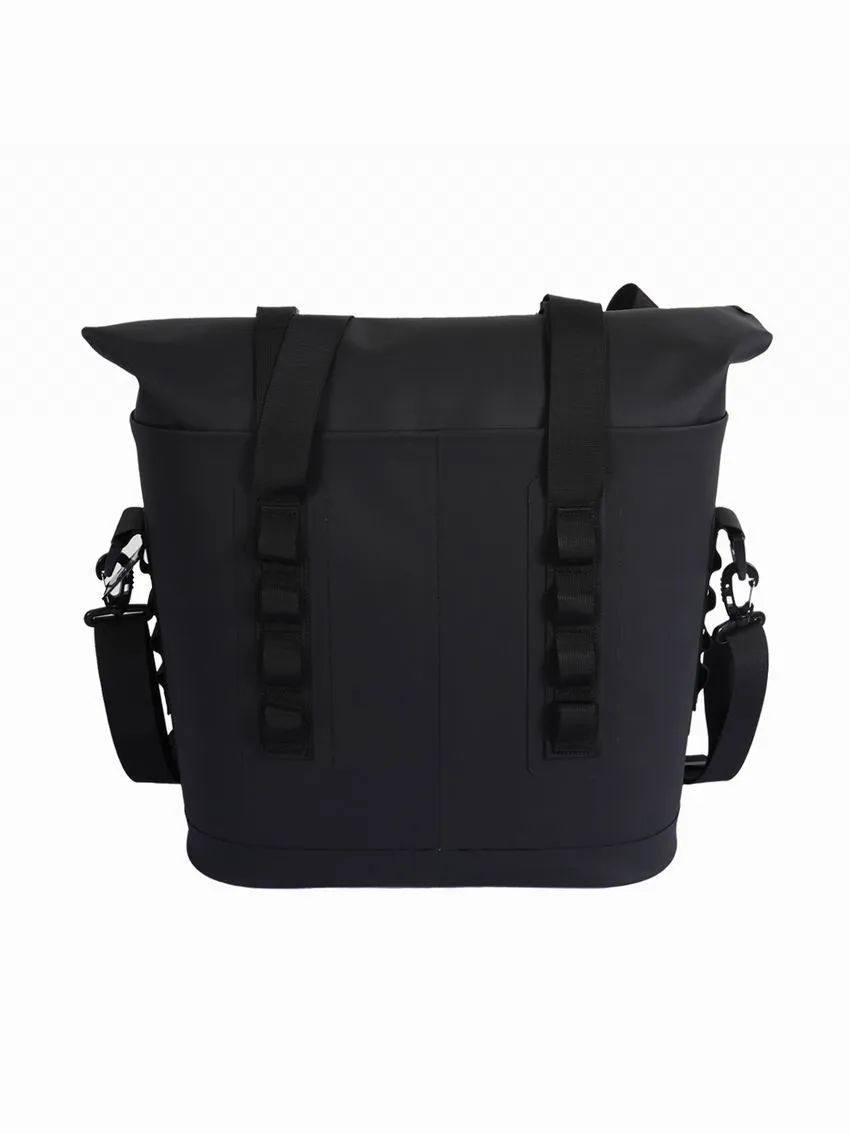
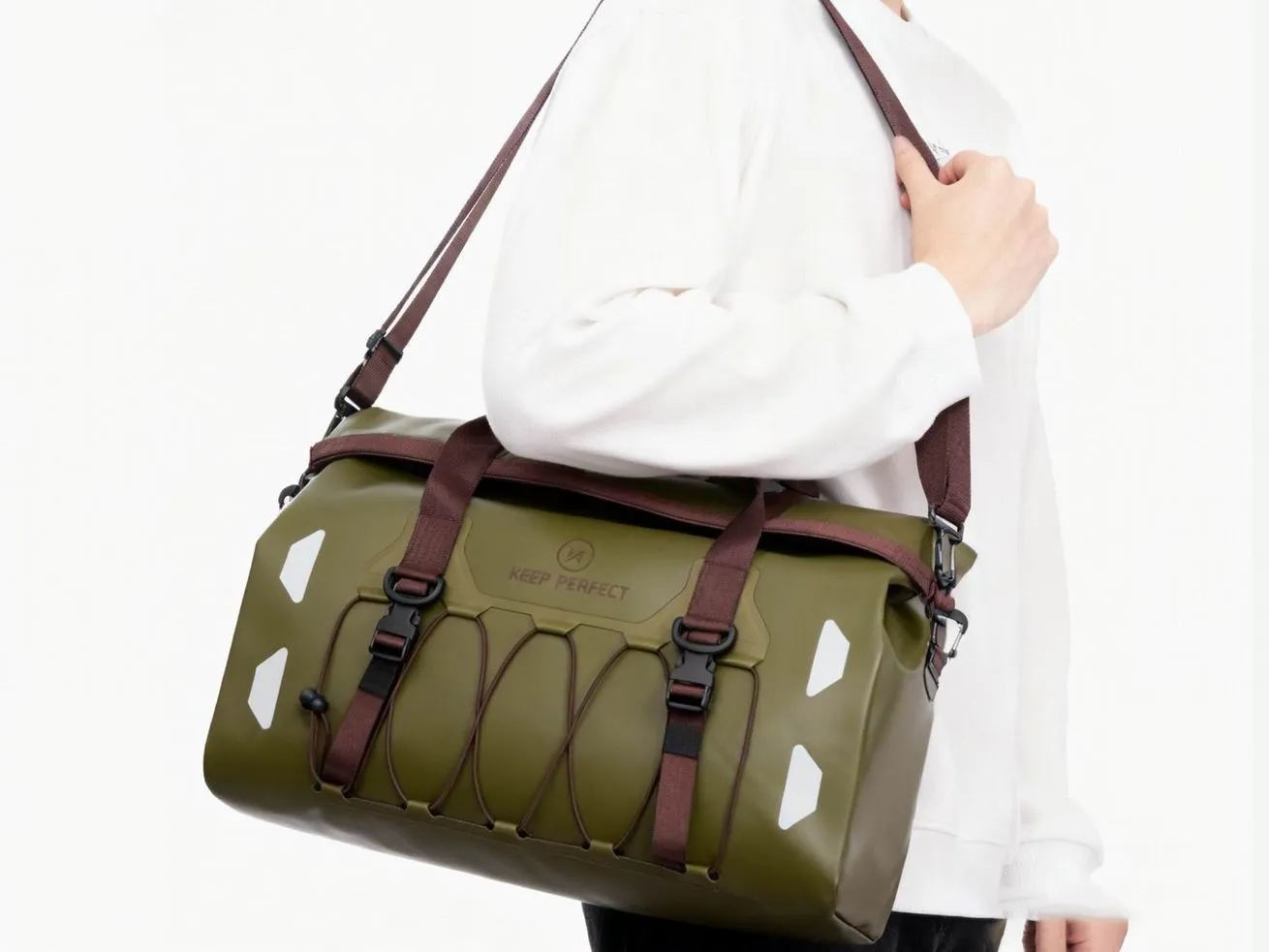
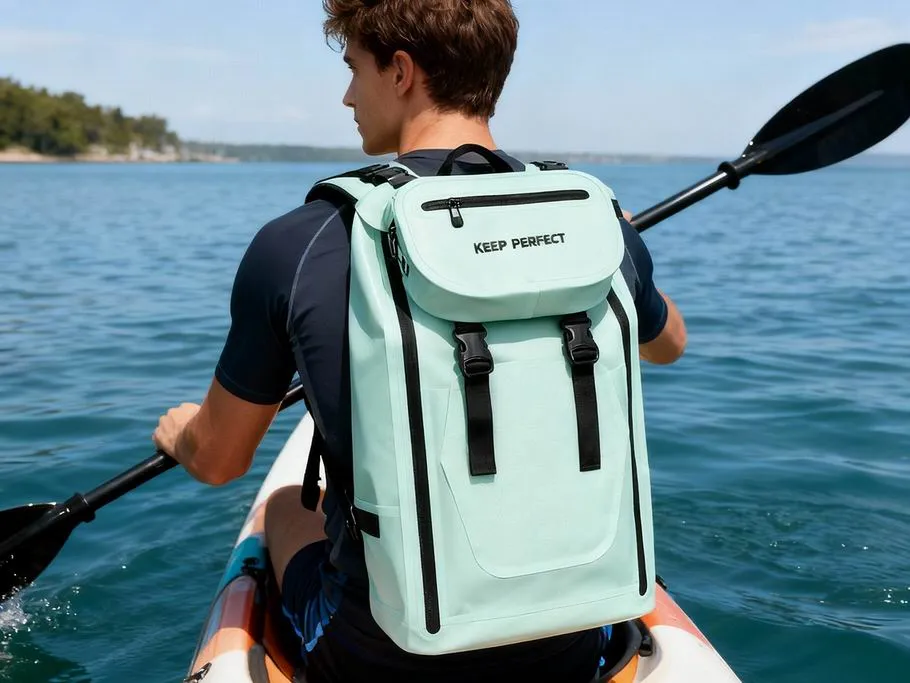
Why the honest specification is hours, not millimetres
Almost every waterproof laundry bags listing leads with a fabric figure — a denier, a coating, a hydrostatic head — and none of those describes what the user is buying. The person who bought the bag wants to put yesterday’s gym kit in it, get wet clothes storage right through a commute and a working day, wash the whole thing on Sunday, and have the bag not smell. That is measured in hours, and it is governed by whether moisture can leave rather than by how thick the film is.
Two product logics follow, and they are genuinely different products rather than two versions of one product. The "get it home" bag has to be leak-proof enough that a soaked towel does not leave a trail through a car or a hallway, and it is used for hours at a time. The "hold it until wash day" bag sits in a bathroom or a utility room for several days, and for that job a fully impermeable bag is simply the wrong choice, because it will hold everything the contents brought with them and nothing will leave.
Brands routinely build one product for both jobs and then field complaints from the second group describing a design that succeeded at the first. The distinction should be drawn explicitly in the range: a sealed transport bag with a stated maximum hold time, and a ventilated holding bag intended for multi-day use. Both are legitimate, both sell, and selling them as one item produces the returns.
For users there is an equally useful framing. Ask one question before buying: how long will damp things sit in this bag? Under about twelve hours and sealed is fine. Over twenty-four and ventilation becomes more important than waterproofing. Everything else follows from that answer, including whether the bag should have a drain, a mesh panel or neither. The broader logic of separating liquid water from water vapour is set out in our guide to wet-dry separation design.
What happens hour by hour inside a sealed bag
Numbers make this concrete and they are worth stating because most people assume mould takes weeks. In practice a sealed bag containing damp cotton at ordinary room temperature moves through recognisable stages within about two days, and by the second day the bag itself is contaminated rather than merely the contents.
| Elapsed time | What is happening inside the bag | Detectable sign | What it means for the product |
|---|---|---|---|
| 0 to 2 hours | Evaporation from the fabric; relative humidity in the air space approaches saturation | None | No problem yet; a sealed bag is legitimate here |
| 2 to 8 hours | Saturated air; condensation begins on the coolest surface, usually the bag wall | Interior feels clammy | A commute-length window; the bag still works for its purpose |
| 8 to 24 hours | Odour-forming bacterial activity begins on organic residue such as skin cells and detergent leftovers | Slight sour smell on opening | This is the real limit of a sealed bag used daily |
| 24 to 48 hours | Visible microbial growth becomes possible; smell becomes obvious | Musty odour; spots on pale fabric | A sealed bag has now caused damage rather than prevented it |
| 48 to 96 hours | Growth spreads to the bag interior; odour transfers to the next load | Persistent smell after emptying | The bag needs washing and often cannot be recovered |
| Beyond four days | Staining and permanent odour in both contents and bag | Discolouration on seams and corners | Contents may be ruined; the bag usually is |
The times above assume a temperate room. Warmth compresses every one of them considerably — a bag left in a hot car or a warm utility room can reach the twenty-four-hour stage in under half a day — and cold slows them, which is why a bag used exclusively in winter often appears better than it is until the first warm week. Public health guidance consistently puts moisture control first here; bodies such as the US Centers for Disease Control and Prevention treat moisture as the primary lever in mould prevention, which translates directly into a design brief rather than a cleaning instruction.
Two practical rules follow for anyone specifying this category. Give the product a stated maximum hold time and print it, because it is the single most useful number a user can be given and no competitor publishes one. And give the product a way to dry itself quickly, because a bag that dries in three hours between uses never reaches the second row of that table at all.
Note also that the contents are not passive. Synthetic sports fabric holds less water than cotton and dries faster, but it carries more odour-forming residue and requires a hotter or longer wash to release it. A load of technical gym kit is in some ways a worse challenge for a laundry bag than a load of cotton towels, and it is the load this product mostly sees.
Waterproof at the bottom, breathable at the top
Once the mechanism above is understood, the construction answer is obvious and it is not what the category sells. The bag needs a continuous barrier at every point where liquid water could escape onto a car seat, a floor or a hotel chair, and it needs a vapour path somewhere high on the bag where warm moist air collects and where nothing will drip onto.
Three constructions cover most of the realistic cases. A welded film pouch is brilliant for transport and bad for holding, and it is the right choice for a swim bag or a gym bag emptied the same evening. A coated woven body with a mesh upper panel is the best all-round answer and covers transport and two-day holding. And an open-top hamper with a coated base is correct for long-term holding, because it maximises airflow and needs only to resist its own drips.
| Construction | Contains liquid leaks | Allows vapour out | Recommended maximum hold | Best scenario |
|---|---|---|---|---|
| Fully welded film pouch with roll-top | Excellent, including squeezing a soaked item | Essentially none | Up to about 12 hours | Swim kit and gym kit emptied the same day |
| Coated woven with a mesh or vent upper panel | Good, provided the base is welded or taped | Good | 24 to 48 hours | General household and travel laundry |
| Coated woven, sewn with taped seams, no vent | Moderate; tape lifts over time | Poor | Under 12 hours | Budget transport bags |
| Open-top hamper with a welded coated base | Drip containment only | Excellent | Several days | Nursery, household and long-term holding |
| Two-part bag: sealed inner pouch in a ventilated outer | Excellent with a vapour path around it | Best combination | 24 to 48 hours | Premium gym and travel products |
The last row deserves attention because it is genuinely better than everything above it and it is not complicated. A welded pouch suspended inside a ventilated outer bag gives the pouch’s liquid containment and the outer’s drying behaviour at the same time, and because the pouch lifts out, the whole assembly can be dried in an afternoon. The ventilated-panel approach is covered in more detail in our notes on ventilated mesh panel design.
Closure choice interacts with this more than it appears to. A drawstring or roll-top gathers and closes reasonably; a full-length zip lets a bag be opened flat to air, which is a genuine drying advantage and also the reason zips dominate this category despite their maintenance cost. There is a specific caution though: a zip tape is a wick, so a zip down the side of bag holding wet clothes will draw water out along its tape and leave a trail. Specify a coated or laminated tape and a storm guard behind it. Our closure guide zips, roll-tops and other closures covers the detail.
How heavy wet laundry actually is
Wet fabric is heavier than people estimate, and the difference matters because it sets every structural requirement in the product. Cotton holds roughly its own weight in water after a light spin and more than its own weight soaking wet; terry towelling is worse; technical sports fabric holds considerably less. A representative load of damp gym kit — shorts, a shirt, socks, a small towel — runs somewhere around one and a half to two kilograms, and a family-sized load of damp towels can exceed ten.
That number drives three specifications that are rarely derived from it. Handle construction, because a bag lifted by a loop sewn into a single layer of fabric will tear out somewhere between six and ten kilograms depending on the stitch pattern and the fabric. Base seams, because a loaded bag set down hard puts the whole dynamic load onto the lowest seam. And the carry experience, because a two-kilogram load in a soft bag with narrow handles is uncomfortable enough that users carry it against their body, which is how damp patches get onto clothing.
- Design handles for the wet weight, not the dry weight; assume at least 100 per cent added mass for cotton and towelling.
- Run handle webbing continuously under the base so load travels through webbing rather than through fabric.
- Specify tube-webbing handles rather than flat webbing above roughly five kilograms; they are far more comfortable in the hand.
- Bar-tack every handle termination and test the anchor to at least twice the intended load.
- Add a second grab point low on the bag, so a heavy wet load can be tipped out rather than lifted out by the handles.
- Consider shoulder carry above about six kilograms, since carrying a heavy soft bag by hand strains the wrist quickly.
Testing expectations for this kind of loading are set out in our guide to load testing straps and handles, and reinforced done correctly, it is one of the cheapest things to specify at sampling and one of the most expensive to fix afterwards, because it needs a pattern change rather than a material change.
What "machine washable" actually requires
Machine washable is the most consequential claim on this product and the least examined. Users assume anything textile can be washed; manufacturers know that washing is exactly what kills waterproof bags, because it combines heat, detergent chemistry, mechanical flexing and often tumble drying, and each of those attacks a different part of the construction.
Breaking it down: heat attacks coatings and can shrink or distort the base fabric relative to its coating. Detergent and any bleach content attack coatings and printed logos and leave residue that itself becomes a nutrient source. Mechanical flexing creases coated fabric permanently and abrades printed marks. And tumble drying combines all three at once, which is why "do not tumble dry" belongs on every such product regardless of what the rest of the label says.
Three material systems behave differently and should be selected deliberately. Polyester with a TPU coating handles repeated washing well and resists hydrolysis, which makes it the default for a washable laundry product. Polyester or nylon with a PU coating is cheaper and more susceptible to coating breakdown over many wash cycles, typically appearing as stickiness then flaking. PVC-coated fabric survives washing but stiffens in cold and raises compliance questions in several markets. The trade-offs are set out in our comparison of TPU and PVC materials.
Construction has to match the claim. Welded seams generally survive washing better than taped seams, because there is no adhesive to attack; where tape is used, it should be specified and tested to a wash-cycle count rather than merely to a peel value. Printed logos need an ink system tested to the same cycle count or they will be gone before the bag wears out. Colour fastness to laundering is assessed by defined methods catalogued by bodies such as AATCC, and asking for a named method plus a grade is the only way to make a washable claim defensible.
Odour control: remove moisture, not microbes
Odour in this category is reported as a product failure and is almost always a drying failure. The mechanism is straightforward: bacteria metabolise organic residue — skin cells, sweat components, detergent leftovers — in the presence of moisture, and the volatile compounds they produce are the smell. Remove the moisture quickly and the process slows enormously; leave it and no surface treatment will keep up.
Ranked by effectiveness, the interventions are structural first and chemical last. Empty the bag the same day. Dry the bag open, inverted if possible, in moving air. Give it a light interior colour, so dampness and residue are visible rather than hidden. Use a smooth film rather than a textured coating, so residue wipes off rather than lodging in the texture. And only then consider a finish.
A cleaning routine should be specified rather than left to the user, and it is short: rinse loose residue, wash with a mild detergent at no more than 40 degrees, rinse thoroughly, dry fully open. Bleach will kill what is living in there and will also shorten the life of the coating and any elastic, so it should not be recommended as routine even though it works. Vinegar solution is safer for the materials and adequate for routine deodorising. Wash the bag monthly under normal use and immediately after any load that sat for more than a day.
Where a finish is genuinely wanted, be precise about the claim and the evidence. Antimicrobial treatments inhibit growth on the treated surface; they do not clean it, do not remove odour already present, and lose effectiveness with abrasion and washing. Buyers should ask for a named standard method and a measured result. Our review of antimicrobial treatments for bag materials sets out what these finishes do and where they stop.
Three scenarios, three completely different size sets
The category looks like one product and is three, and they do not overlap much. A gym bag wet compartment, a travel laundry bag and a nursery nappy bag share almost nothing beyond the word waterproof, so a range built on one size adapted three ways will fail in two of the markets.
| Scenario | Realistic load | Recommended volume | Closure and feature priority | Hold time expectation |
|---|---|---|---|---|
| Gym and pool, single session | Kit plus a small towel, 1.5 to 3 kg wet | 8 to 15 litres | Fast closure, wipe-clean liner, hanging loop, carabiner clip | Same day, often 4 to 10 hours |
| Team sport and gym locker storage | Full kit including shoes, 3 to 5 kg | 15 to 25 litres | Vent panel, wide opening to air, tether inside a larger bag | Overnight, up to 24 hours |
| Travel laundry, one person two weeks | Accumulating dirty clothing, 2 to 4 kg | 12 to 20 litres with compression | Odour containment, packability, separation from clean items | Several days accumulating |
| Family travel laundry | Everything for three or four people | 25 to 40 litres | Multiple compartments, strong handles, wipe-clean base | Several days accumulating |
| Nursery nappies and soiled clothing | Small but highly contaminated items | 8 to 12 litres | Sealed seams, wipe-clean interior, odour containment, machine washable | 12 to 36 hours before washing |
| Household hamper, long-term holding | Full loads that sit for days | 40 to 70 litres | Maximum ventilation, open top, welded base only | Several days by design |
The nursery row has a requirement that overrides everything else and it is worth naming: containment of biological contamination. A nappy bag must be genuinely liquid-tight at every seam, must have a smooth cleanable interior, and must survive frequent hot washing. Approval of a welded interior construction with radiused corners that can be wiped clean in one motion is the right answer here, and it is the one case in this category where a fully sealed interior is correct rather than a compromise.
The travel rows have the opposite priority: odour containment across several days inside a suitcase, where a leaking smell ruins clothing the user cares about. Here a smooth film liner matters more than a mesh panel, because the objective is to protect the clean items from the dirty ones rather than to dry anything. Related expectations for family travel are covered in our guide to keeping family gear dry, and the gym-specific commercial context in our notes on waterproof bags for the fitness industry.
Base and seam construction for occasional standing water
Laundry bags occasionally hold water rather than damp fabric — a swimming costume thrown in un-wrung, a nappy leak, a load left long enough for water to separate and pool. That puts the product in a position most soft bags never face: hydrostatic pressure against the lowest seam, sustained for hours. It is a genuinely different requirement from resisting rain.
The response is a welded base wherever the substrate permits it. A circular or oval base panel RF-welded or heat-sealed to the body has no perforations and no adhesive, and it resists standing water indefinitely. A sewn and taped base seam will resist it for a while and then fail, because tape on a wet surface under sustained pressure is the classic failure case for adhesive systems; anyone who has watched a leaking dry bag will recognise the mechanism.
Corner geometry does the rest. Water pools in corners, and a tight corner radius both concentrates stress and creates an uncleanable crevice. Specify generous radii — twenty millimetres or more — and avoid any seam intersections inside the wet zone, because a four-way intersection is the hardest geometry to seal consistently. Detailed options are set out in our notes on seam taping and sealing methods and in our review of stitched, welded and bonded construction.
There is a decision to be made about drainage and it should be made explicitly rather than by omission. A small drain grommet at the lowest point solves both emptying and residual moisture, and it costs almost nothing; it also means the bag is not watertight in the strict sense and cannot be described as such. For most laundry applications that trade is obviously correct, and the honest move is to state it. A user who discovers a hole in the bottom of a bag sold as waterproof reports it as a defect regardless of whether the hole was a good idea.
Where the bag sits between uses
A laundry bag spends most of its life doing nothing, and what it does while doing nothing determines most of the complaints about it. The near-universal habit is to leave it hanging on a door hook or standing in a corner of a bathroom or utility room — the two most humid rooms in a typical home, and the two rooms where ventilation is worst. A bag that is left in either with its top closed and a little residue inside will be damp continuously, whether or not it ever held water.
Three features change that behaviour cheaply. A hanging loop positioned so the bag hangs open rather than folded over the hook is the most effective, because gravity plus airflow does the work without the user deciding anything. A stiffened or weighted base that lets it stand open on a shelf is the second. And a light interior colour is the third, not because it changes the physics but because it makes dampness and residue visible, and users act on things they can see.
Placement advice is worth giving explicitly because it is free and effective: hang rather than stand, open rather than closed, away from the shower rather than beside it, and off a cold external wall where condensation forms first. A bathroom with a shower in daily use cycles through very high relative humidity several times a day, and a bag on the floor against an external wall sits in the worst microclimate in the room. Users who move the bag two metres report better outcomes than users who buy a more expensive one.
There is also a product decision buried in this. A bag intended to hang should be specified with its hanging point carrying wet weight plus a margin, since users hang a loaded bag rather than an empty one; a loop bar-tacked into the body fabric will tear out within a season, whereas a loop sewn into a webbing extension that runs down into the body is effectively permanent. It costs a few cents and removes one of the smaller but more irritating failures.
What belongs on the hangtag
Care labelling is treated as compliance text and functions as product performance. In this category more than most, the outcome depends on what the user does between uses, so the instruction is a genuine part of the specification rather than an afterthought, and it costs nothing compared with the returns it prevents.
- Maximum hold time, because it is the most useful number a user can be given and nobody publishes it: state empty within 24 hours, or within 12 if fully sealed.
- Dry open after every use, since drying is the primary odour control and hanging closed produces a permanently damp liner within a month.
- Wash protocol and temperature, because heat and detergent are what destroy coatings: machine wash cold to 40 degrees with mild detergent.
- No tumble drying, because heat plus tumbling creases coated fabric permanently and de-laminates it.
- Avoid routine chlorine bleach, which kills growth but attacks coatings and elastic; a vinegar solution handles odour adequately.
- A monthly bag wash, because residue accumulates in the bag itself rather than only in the clothes it carried.
Note that none of those is a warranty disclaimer; every one of them is actionable and improves the user’s result. Brands that treat the hangtag as a marketing surface rather than as an instruction surface spend more on returns than they would on printing.
Failure modes specific to laundry bags
This category has a distinctive return pattern because nearly every complaint is about something that happened over time rather than on the first use. The table below traces each symptom to its cause, and every cause has a specification answer that is cheap at sampling and expensive afterwards.
| Symptom | Mechanism | Originating decision | Specification response |
|---|---|---|---|
| Bag smells after a few weeks and washing does not fix it | Residue plus retained moisture permanently inside a textured liner | No drying path and no care instruction | Dry it open after each use; smooth film interior; light colour; printed care guidance |
| Water trickles out onto a car seat | Untaped or wicking base seam under hydrostatic load | Base seam construction | Welded base; no stitched line below the water line; taped if unavoidable |
| Handle torn away from the body | Load into a single fabric layer, wet weight underestimated | Handle anchoring | Continuous webbing under the base; bar-tacked terminations; design for wet mass |
| Interior coating flaking after twenty washes | Hydrolysis or heat damage to a PU coating | Coating chemistry for the claim | TPU coating for washable products; state 40 degrees maximum |
| Zip leaves a wet trail down the bag | Capillary wicking along uncoated zip tape | Zip specification | Coated or laminated reverse-coil tape plus a storm guard |
| Mildew spots on pale clothes that were clean | Contents held beyond roughly 48 hours in a sealed bag | Wrong product for the hold time | Ventilated panel above the water line; print a maximum hold time |
| Printed logo gone from a bag that still works | Ink system not tested to the wash cycle count | Logo method selected by appearance | Match the ink to the substrate and test to the claimed wash cycles |
| Bag never fully dries between uses | No drying path; stored closed | Architecture | Wide opening, hanging loop, hangtag instruction to dry open |
The cluster worth noticing is that five of those eight have nothing to do with how waterproof the bag is. The category is bought for leak protection and returned for drying, wash durability, odour and anchoring, which is the standard pattern for products that sit damp for long periods. A development programme organised around the marketing claim will over-invest in hydrostatic head and never test forty wash cycles.
The prevention discipline across a production run — how these defects are caught before shipment rather than designed out individually — is covered in our guide to common waterproof bag defects and prevention, and the level-setting question of how much waterproofing this product genuinely needs is answered in our waterproof level decision guide.
Testing a laundry product before you commit
The test programme should be built around time and washing rather than around water ingress, because those are where the failures are. None of it requires a laboratory and all of it can be run on a single sample plus a spare.
- Standing water test: put two litres in the bag, hang it for four hours, and inspect the base seam and the floor beneath it rather than merely the interior.
- Sealed hold test: seal a damp cotton load, hold at room temperature for 48 hours, then open and record both odour and visible growth. This is the number that should be printed as a maximum hold time.
- Drying test: wet the bag, invert and hang it, and record the time to completely dry under defined conditions. This is the single best predictor of odour returns.
- Wash cycle endurance: wash the bag twenty times to the stated protocol and inspect coating, seams, print and handle anchors at intervals rather than only at the end.
- Handle load test: load to twice the intended wet weight and lift one hundred times, inspecting the anchors rather than waiting for failure.
- Zip wick check: if there is a zip, run water over the closed tape for two minutes and inspect the inside of the tape for wicking.
Two belong in routine production audit as well as at sampling: the standing water test and the wash endurance spot-check. Both detect a material substitution faster than a document review ever will, and both take minutes on the floor.
For brands, this is also where the honest claim is won. A laundry bag sold with a stated hold time, a stated wash protocol and a printed drying instruction outperforms a competitor claiming more generic performance, because it sets expectations it can actually meet — and expectations met are what reviews are made of.
Developing a laundry range: sizing sets, materials, branding and costing
Commercially this is a friendly category. The patterns are simple, there is no structure to engineer, no fit to get right, and the whole range can share one construction with two or three sizes. Minimum order quantity is 500 pieces per style, which at three sizes in one colourway is a realistic first commitment and permits a proper launch rather than a tentative one.
The combination that works is a TPU-coated polyester body with a welded base, a coated zip along the top, a hanging loop, and either a mesh vent panel or a sealed interior depending on which of the three scenarios the product targets. Two synthetic levers make a real difference at low cost: a light interior colour, which converts invisible damp problems into visible ones users fix themselves, and radiused corners, which turn an uncleanable crevice into something wiped clean in one motion.
Sizing should be a coordinated set rather than three arbitrary volumes. A useful laundry set runs roughly eight litres for a single gym session, eighteen litres for travel or family use, and forty litres as a ventilated household hamper, with the two smaller sizes nesting when empty. Coordination matters commercially because it lets a retailer present a set rather than a single bag, and dimensional discipline is covered in our guide to dimensional customisation.
Branding on these products gets washed harder than on anything else in a range, which makes method selection unusually consequential. Screen print with a wash-tested ink system on a coated polyester is the safe default; heat transfer within the coating’s temperature limit is an option; direct embroidery perforates a waterproof shell and requires sealing by the construction. Test whatever method is chosen to the claimed wash count rather than to a pull test. Our review of logo printing and embroidery options covers the constraints, and coordination with the shell material’s compliance requirements sits in our notes on REACH and CPSIA compliance.
Pricing should follow the honest specification. A bag with a stated hold time, a stated wash protocol and drying guidance, backed by a documented standing-water test, carries a defensible premium over a bag described merely as waterproof. Sampling runs 6–10 working days per round and bulk production 35–50 days, quoted FOB Xiamen; the sequence is set out in our guide to lead times on custom orders. If you want the specification above costed for a range, review our own process from first enquiry through sampling into bulk production and send the target scenario, the size set and the hold time you intend to claim. Minimum order quantity is 500 pieces per style, samples take 6–10 working days, bulk production runs 35–50 days, and quotations are issued FOB Xiamen.
Frequently Asked Questions
Q1. How long can wet clothes stay in a waterproof bag?
Roughly twelve hours in a fully sealed bag, up to about forty-eight in one with a vent panel. Beyond that, visible growth becomes likely and odour transfers to the bag itself.
Q2. Why does my laundry bag smell even after I empty it?
Residue plus retained moisture inside the bag. The smell lives in the liner rather than in the clothes, so the bag itself needs washing and then a full open-air dry.
Q3. Should a laundry bag be fully waterproof?
For transport, yes; for storing until wash day, no. The useful specification is a welded base to stop leaks and a vented area high up so moisture can leave.
Q4. Should it have a drain hole at the bottom?
Usually yes for laundry use. It lets water out and lets the bag dry, at the cost of not being strictly watertight — say so rather than hiding it.
Q5. How much does wet laundry weigh?
Cotton and towelling hold roughly their own weight in water or more, so a two kilogram dry load can be four kilograms wet. Design handles and anchors for the wet number.
Q6. What causes handles to tear off laundry bags?
Load going into a single layer of fabric. Run the handle webbing continuously under the base instead so tension travels through webbing, and bar-tack every termination.
Q7. Is it safe to machine wash a waterproof laundry bag?
Yes if it is specified for it: wash at no more than 40 degrees with mild detergent, and never tumble dry. Heat plus tumbling creases coated fabric permanently and attacks coatings.
Q8. Why is the coating on my bag flaking?
Usually hydrolysis of a PU coating from repeated warm washing, sometimes combined with detergent residue. TPU coatings survive repeated washing considerably better.
Q9. What size do I need for gym kit?
Around 8 to 15 litres for a single session including a small towel. Team kit with shoes needs 15 to 25 litres, and nursery use sits around 8 to 12 litres.
Q10. What is different about a nappy or nursery laundry bag?
It must contain biological contamination, so it needs genuinely sealed seams, a smooth wipe-clean interior, and the ability to survive frequent hot washing. A fully sealed interior is correct here.
Q11. How do I get rid of established odour in the bag?
Wash it, then dry it completely open in moving air. Vinegar solution is safer than bleach for routine deodorising; bleach kills what is living but shortens coating and elastic life.
Q12. Do antimicrobial treatments stop the smell?
No. They inhibit growth on the treated surface, do not clean it, and lose effectiveness with washing. Removing moisture quickly is the intervention that works.
Q13. Will a zip leak on a laundry bag?
It will wick rather than leak, along an uncoated tape. Specify a coated reverse-coil tape with a storm guard behind it and water will not track out of the bag.
Q14. How often should the bag itself be washed?
Monthly under normal use, and immediately after any load that sat for longer than a day. The bag carries residue from everything it held.
Q15. What is the most important feature to look for?
The ability to dry. A wide opening, a hanging loop and a smooth interior prevent more problems than any waterproof rating, because nearly every complaint traces to retained moisture.
Q16. Are these bags suitable for long-term storage of dirty clothes?
Use a ventilated open-top hamper with a welded base instead. Its job is maximum airflow with drip containment, which is a different product from a sealed transport bag.
Q17. What sizes should a brand launch a laundry range with?
A coordinated three: roughly 8 litres for gym, 18 litres for travel and family use, and 40 litres as a ventilated hamper. Shared construction across the three keeps development cost down.
People Also Ask
How long can wet clothes stay sealed in a bag?
About twelve hours before odour begins, and two days before visible growth is likely. A vented bag roughly doubles that window.
Should a laundry bag be waterproof or breathable?
Both: a welded waterproof base to stop leaks, and a vented upper area so moisture can escape. Full sealing is right only for short transport.
Why does my laundry bag smell bad?
Residue plus retained moisture in the liner. Wash the bag at 40 degrees maximum, then dry it fully open in moving air.
How heavy is a load of wet laundry?
Cotton holds roughly its own weight in water, so expect a dry two kilogram load to become four when wet. Handles should be specified for the wet figure.
Can waterproof laundry bags go in the washing machine?
Yes if specified for it at up to 40 degrees with mild detergent. Never tumble dry, because heat plus tumbling creases coated fabric permanently.
What size laundry bag do I need for the gym?
Around 8 to 15 litres for one session with a small towel, and 15 to 25 litres if shoes and team kit go in too.