A baby bag is the only waterproof category where the water starts inside. A dry bag protects against rain; a diaper bag has to protect against a bottle of warmed milk that leaked, a food pouch that burst under pressure, a wet swimsuit after a paddling pool, and a soiled onesie that has to come home in the same bag as everything else. That reversal changes the whole construction, and it explains why the obvious solution — a roll-top dry bag with a baby print — fails in use: a roll-top needs two hands, and a parent almost never has two hands free.
This guide is built around that constraint. It covers where leakage actually originates and how much volume it involves, how zoning keeps a contaminated item away from everything else, why one-handed operation rules out the best sealing closure and what replaces it, what a stroller hook does to a stroller and to the bag, the chemical safety limits that apply specifically to baby articles and why baby limits are stricter than adult ones, wash durability over several hundred cycles, hardware safety including small parts and magnets, how capacity should follow the age curve, which modular accessories sell, the wear points that decide whether a bag survives a second child, the compliance gates before sampling, and how a brand should assemble the range. MOQ 500 pieces per style, sampling in 6–10 working days, bulk in 35–50 days, FOB Xiamen: these are the working terms at QUANZHOU JUNYUAN BAGS, custom waterproof bag production since 2014 in a 4,950 m² SGS-verified facility.
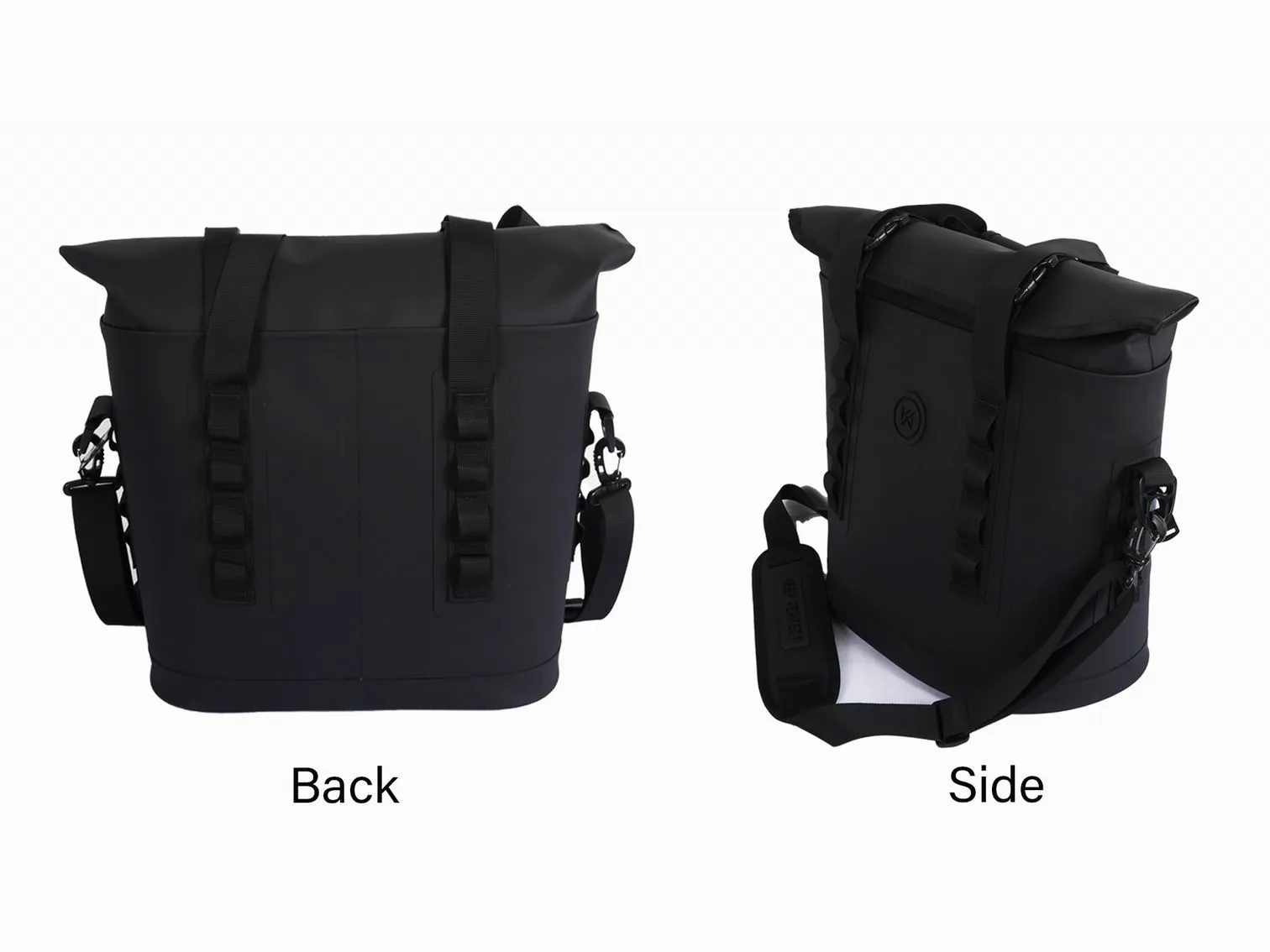
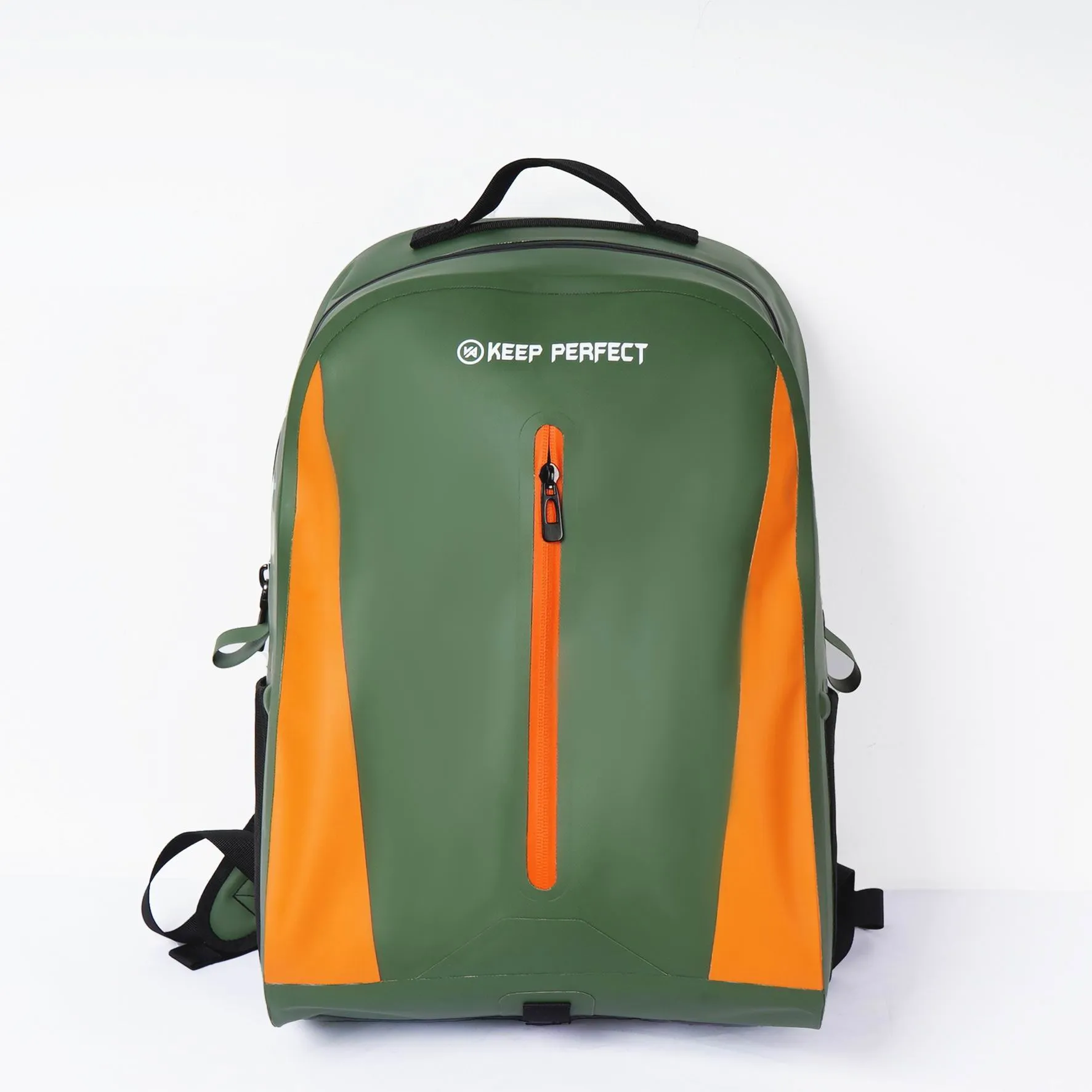
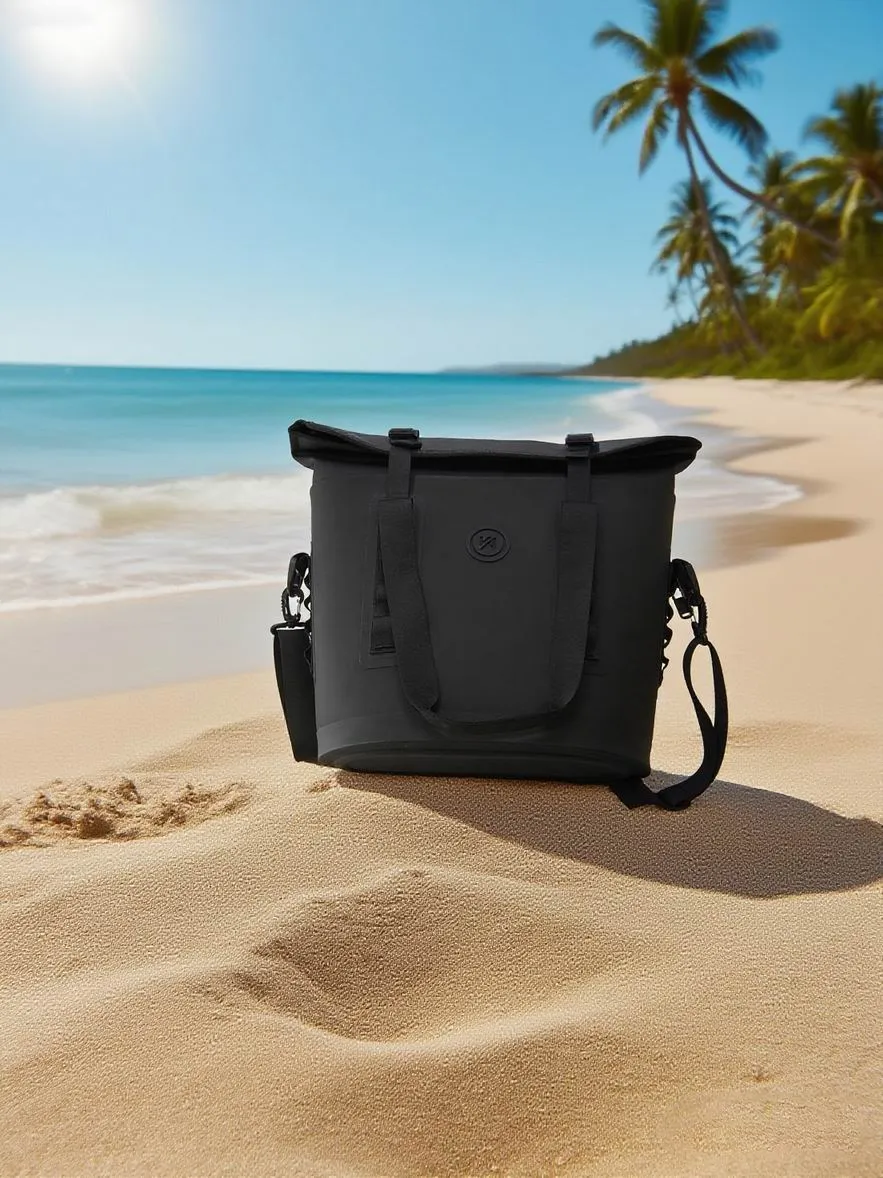
The leak starts inside the bag
Every other waterproof category is designed around an external threat. Rain, spray, submersion, splashes. A waterproof diaper bags programme is designed around an internal one, and that single inversion explains most of the differences between a good baby bag and a rebranded dry bag. The aggressor is inside, it is warm, it is biologically active, and it is frequently under pressure because a bag gets squeezed into an overhead bin, a car footwell or the basket of a stroller.
The volume involved is small and the damage is large. A bottle that has been warmed to around forty degrees and then laid on its side with a loose collar will release tens of millilitres, which is enough to wet the entire base of a medium bag. A food pouch under pressure in a crowded bag can release more. And unlike clean water, milk and formula leave residue that becomes rancid within a day, so the failure is not just wetness — it is odour that survives washing. That is why leakproof bottle compartments exist as a distinct component rather than as a pocket.
Two design consequences follow immediately and both are cheap. The bag needs a liner that is welded rather than stitched, because stitch holes are where liquid leaves the compartment and enters the shell. And it needs a compartment whose closure does not depend on the user remembering to do anything, because the leak happens when the bag is closed and jostled, not when it is open on a changing table.
The third consequence is the interesting one commercially: because the threat is internal, the outer shell does not need submersion performance. It needs to be wipeable, abrasion-resistant and quiet. A brand that specifies IPX8 for a diaper bag has spent money on the wrong property, and the customer will not perceive the benefit.
Where the liquid comes from and what each source demands
Four sources account for nearly every contaminated bag, and they are chemically different enough to require different treatments. Milk and formula are protein and fat, so they smell and they support bacterial growth. Fruit puree and yoghurt are acidic and sugary, and they stain. Urine and soiled clothing are low hazard but high volume and highly objectionable. And swim or rain gear is clean water, which is the easiest case of all.
| Source | Typical volume released | What it does to the bag | Design response |
|---|---|---|---|
| Warmed bottle or sippy cup | 20 to 80 mL | Wets the base; residue turns rancid within a day | Dedicated welded bottle compartment with a smooth, coved interior and a drainable shape |
| Food pouch or jar under pressure | 20 to 60 mL | Stains and feeds microbial growth in any textile layer | Smooth liner, no absorbent seam tape inside, compartment isolated from textiles |
| Soiled clothing or a leaking nappy | 50 to 200 mL | Contaminates everything it touches; the objection is psychological as much as physical | A fully sealed, removable wet pouch that can be taken out and rinsed |
| Wet swim or rain gear | 100 to 400 mL | Adds weight and humidity; mildew risk if sealed for hours | Ventilated or removable wet zone rather than a sealed one |
| Condensation from a cold bottle | 5 to 20 mL | Damp base and eventual odour in the foam or padding | Non-absorbent base panel and a liner that can be wiped dry |
Two rows carry most of the engineering load. The bottle compartment should be sized to upright bottles of the common diameters rather than to a marketing capacity, because a bottle that fits lying down will leak from its collar, and the compartment should have a base that can be inverted and dried. The soiled-item pouch should be removable and washable on its own, because nobody wants to wash a whole bag because of one item, and because a removable pouch can be replaced — which is a small recurring revenue line most brands miss.
The separation logic that ties this together, including where a ventilated wet zone beats a sealed one, is set out in more depth in our article on wet and dry separation in bag design. The baby-specific point is that the separation has to survive being packed in a hurry by someone holding a child.
One-handed operation rules out the best closure
Here is the constraint that separates this category from every other waterproof one. A roll-top closure is the most reliable liquid seal available and it is useless here, because rolling and clipping needs two hands, a clear surface and about five seconds of attention. A parent holding a baby in one arm and reaching into a bag with the other cannot do it. Any closure that requires two hands will in practice be left undone, and an undone closure converts a leakproof product into a leaking one.
- Primary opening: a coated zip with a generous pull, operable with one hand and closable by feel rather than by sight.
- Secondary closure: a magnetic or mechanical snap on top of the zip, which holds the bag closed even if the zip is left part open.
- Wipe access: an external slot or pocket that dispenses wipes one-handed, because this is the single most frequent action performed on the product.
- Bottle compartment: a structured opening that stays open while a bottle is inserted, rather than a flap that has to be held.
- Noise: closures must not jingle or click loudly. A sleeping baby is the reason parents buy silent hardware and the reason they return noisy bags.
The engineering trade this creates is explicit: you give up the best seal and buy the performance back elsewhere. Practically, that means a genuinely welded liner with coved corners, a coated zip with a storm flap rather than a submersible zip with none, and a base panel with no stitch holes. The system then resists the leaks it will actually meet — an internal spill of tens of millilitres, not thirty minutes under a metre of water — and it does so while remaining operable one-handed.
For brands, this is worth stating publicly. Publishing "sealed liner, wipe clean, one-handed zip" converts better than an IPX rating in this category, because the buyer’s mental model of failure is a spilled bottle, not a downpour. Our overview of zipper and roll-top closures explains why the zip needs a flap and where coated coil behaviour degrades; the construction side is covered under stitched, welded and bonded construction.
Carry modes: the stroller hook is a safety question
A bag in this category is carried four ways — hooked on a stroller, worn as a backpack, slung crossbody, or carried by hand — and each one has a failure mode worth designing for. The stroller hook is the one with an actual safety dimension and it is the one most often ignored in the brief.
| Carry mode | Typical load | What goes wrong | What to specify |
|---|---|---|---|
| Stroller handlebar hook | 3 to 8 kg as packed | Stroller becomes unstable and can tip backwards, especially with a lightweight or three-wheeler frame | Publish a load limit, place hooks low and close to the frame rather than high on the bar, and warn against hanging with the child out |
| Backpack | 4 to 8 kg | Straps dig in under a load carried for hours; access requires taking the bag off | Wide, padded straps with a stated width, a sternum strap, and a back panel that does not soak up sweat |
| Crossbody or sling | 3 to 6 kg | Rotates to the front when bending; single-shoulder load becomes painful within an hour | A wide, non-rolling strap and a stabilising secondary point |
| Hand or tote carry | 3 to 6 kg | Handles cut in; the bag is set down on the ground constantly | Reinforced welded handle attachment and a base that tolerates being put down on wet pavement |
The tipping risk deserves emphasis because it is a genuine injury mechanism and a genuine liability. Many stroller manuals specify a handlebar load limit, commonly in the region of two to three kilograms, and a fully packed baby bag routinely exceeds that. The responsible design response is to offer attachment points that sit low and inboard rather than a hook that hangs the load high and behind the rear axle, and to state the limit in the instructions. A brand that does this is not being cautious for its own sake; it is removing a foreseeable claim.
The hardware used for the attachment matters as much as where it goes. Hook-and-loop wrap straps work well for strollers because they fit any bar diameter and they do not rattle, but the loop side loads with fluff and grit and loses grip over months, so specify a strap that can be replaced. Metal carabiner-style clips feel premium, mark the frame and rattle against it, and they concentrate load at a small radius. Our guide to selecting buckles, straps and fittings covers the alternatives, and the load methodology is set out under load stress testing for straps and handles.
Chemical safety: baby limits are stricter than adult ones
Everything in this category is a children’s product in the eyes of regulators and retailers, and that changes the compliance burden materially. The restricted substance lists are the same ones that apply to general consumer goods, but the limits applied to articles intended for babies and toddlers are the strictest available, and a brand that quotes adult limits will fail a retailer technical review.
| Substance or parameter | Where the risk comes from in a bag | How the strictest class is applied | Practical action |
|---|---|---|---|
| Lead in substrates and prints | Pigments in printed panels, coatings, and metal hardware | Baby articles are tested to the tightest limits available, an order of magnitude below general limits | Require a tested declaration per colourway, including the print and the coating, not just the base fabric |
| Phthalate plasticisers | Soft PVC films, coated textiles, some printed inks and grips | Restricted by name at low percentages in children’s products and in food contact articles | Specify PVC-free films and an additive declaration from the film supplier |
| Formaldehyde | Resins used in finishes and in some coatings | Baby class limits sit far below those for adult articles | Ask for the tested value per material, not a generic pass statement |
| Azo colourants that cleave to listed amines | Dyed linings and printed panels | Prohibited by name; testing is by cleavage rather than by content | Test the dyed and printed layers separately from the base fabric |
| Extractable heavy metals | Hardware coatings, prints, and any painted trim | Migration-based limits under toy-style methods, applied by many retailers to baby articles | Test hardware as supplied, including coating, and avoid painted trim on reachable parts |
| Odour and volatile organic compounds | Adhesives, films and foam in a small enclosed volume | Not always regulated, but the commonest cause of bad reviews and returns | Specify low-odour adhesives and a cure period before packing |
The mechanism worth understanding is that these substances are almost never in the base polymer. They arrive with the pigment in a print, the plasticiser in a soft film, the catalyst residue in a coating, or the plating on a buckle. That is why a component-level declaration is worth more than a certificate for the fabric, and why a range with six colourways needs six sets of print testing rather than one.
On documentation: the US regime for children’s products is administered by the Consumer Product Safety Commission, the EU chemical regime and its restricted substance list are administered by the European Chemicals Agency, and the textile-specific label that most retailers accept for baby articles is described in our article on OEKO-TEX Standard 100. The test planning is covered under REACH and CPSIA testing, and the broader obligations in our note on regulatory compliance for custom bags.
One commercial caution. Compliance cost is per material and per colourway, not per style. A range that shares one liner and one hardware set across four colourways has a far smaller test bill than four ranges that each introduce a new print and a new trim, which is a further argument for a platform approach.
Hardware safety: small parts, magnets and noise
Hardware on a baby bag is within reach of a child in a stroller, which brings small-part and sharp-edge considerations that do not apply to adult product. Anything that can be detached by pulling, biting or twisting should be evaluated as a potential small part, and anything with a sharp edge or a burr should be eliminated regardless of how it looks on the sample.
- Avoid detachable decorative elements of any kind on the lower half of the bag, which is the part a child in a stroller can reach.
- Treat magnets with caution. A magnet that can come loose is a serious ingestion hazard, so specify encapsulated magnets in a welded or fully enclosed pocket and pull-test them.
- Deburr and radius every metal edge; specify the requirement, because it is not something a supplier will add unbidden.
- Specify quiet hardware. A metal slider tapping against a buckle wakes a sleeping baby, and this is a documented reason for return in this category.
- Make zip pulls large enough to grab with one hand and soft enough not to scratch a child or a car interior.
- Avoid long cords or loose webbing ends, which create an entanglement risk around a stroller or a cot.
The magnet point deserves its own paragraph because magnets are the obvious way to get one-handed closure and the obvious hazard at the same time. A magnetic snap used for the main opening is fine when the magnet is encapsulated in a welded pocket and tested to a pull force well above anything a child can apply. A decorative magnet, or a magnet held in place by a thin fabric layer, is not acceptable. Ask the supplier how the magnet is retained and require a pull test result rather than an assurance.
Noise is the least technical and most commercially significant item on that list. Parents buy this product partly to keep a sleeping child asleep, and a bag that clicks and jingles through a doorway is a bag that gets a two-star review. Specifying soft pulls, covered buckles and no loose metal-on-metal contact costs very little and is noticed immediately.
Washability: this is the most-washed bag in the house
A baby bag is cleaned more often than any other item of soft goods a household owns. Realistically it is spot-cleaned several times a week and fully cleaned somewhere between weekly and monthly, and over a service life of two to three years that is easily a hundred to three hundred cleaning cycles. Very few bag specifications are written with that cycle count in mind, which is why the failure pattern in this category is loss of appearance rather than loss of function.
The failure modes are predictable. Coatings degrade under repeated wetting and drying, particularly ester-based polyurethanes which are vulnerable to hydrolysis in warm humid conditions — exactly the conditions inside a bag that holds a damp item. Prints and heat transfers lose adhesion at the edges after repeated wiping. Stitch holes in the liner wick and hold residue. And any absorbent layer, including a padded changing mat stored inside, becomes the odour reservoir.
- Weld the liner rather than stitching it, and keep the interior free of absorbent materials entirely.
- Choose a coating rated for repeated wetting and drying, and ask for a hydrolysis result rather than a generic durability claim.
- Test colour fastness to washing and to rubbing at the cycle count you expect, not at a single wash.
- Specify that the bag must dry open within a few hours, which means a wide opening and no closed foam compartments.
- Make the changing mat removable and washable separately, because it is usually the first thing to smell.
Care instructions are part of the design. "Wipe with a damp cloth, mild detergent, dry open" should be printed on the product rather than buried in a leaflet, and machine washing should be either explicitly permitted with conditions or explicitly discouraged — ambiguity here generates warranty claims that are really instruction failures. Colour fastness methods are described in our note on colour fastness testing, and the defect patterns that show up after washing are catalogued in our guide to common defects and how to prevent them.
Antimicrobial finishes are frequently requested in this category and are worth a clear-eyed view: they suppress growth on the treated surface, they do not remove residue, and they lose effectiveness with abrasion and washing. They are a supplement to a wipeable welded liner, not a substitute for one. The realistic position is set out in our review of antimicrobial treatments for bag materials.
Capacity should follow the age curve
Baby bags are bought at a moment and used for years, and the contents change substantially over that period. A newborn kit is bulky but light: nappies, a full pack of wipes, two bottles, a change of clothes, a blanket, burp cloths and cream. A toddler kit is smaller but messier: fewer nappies, snacks, a drink cup, a toy, spare trousers and, critically, the soiled items that have to come home.
| Stage | Usable volume | Dominant contents | Design emphasis |
|---|---|---|---|
| Newborn to six months | 14 to 20 L | Nappies, wipes, bottles, blanket, spare outfit | Bottle compartments and wipe access; interior visibility matters more than pockets |
| Six to eighteen months | 12 to 18 L | Food pots, drink cup, wipes, spare clothes | Sealed food compartment and a real wet zone for soiled items |
| Eighteen months to three years | 10 to 15 L | Snacks, cup, toy, one spare outfit, pull-ups | Quick-access external pocket; the bag is increasingly a day bag |
| Beyond three years | 10 to 14 L | Snacks, water, a change of clothes | The product is now a family day bag; the baby print is the problem, not the capacity |
| Twins or two close in age | 20 to 28 L | Double of everything, plus organisation | Zoning and structure decide the review, not volume |
The last row of that table is the commercial opportunity most brands miss. A parent who has outgrown the baby print still needs exactly the same bag, so a range that offers a plain or adult-styled version of the same internal architecture converts a second purchase instead of losing the customer to a general backpack brand. That is the cheapest growth available in this category and it costs one colourway.
Volume claims should be internal and verified with the liner in place, and the brief should state what the bag must hold upright rather than what it can be stuffed with. Sizing methodology is covered in our general capacity selection guide, and dimensional customisation is discussed under size and dimension customisation.
Modules and accessories that actually sell
This category converts accessories into margin better than almost any other, because parents buy for a specific problem and an accessory that solves it is an easy yes. The mistake is to design accessories that are cute rather than useful; the useful ones are the ones that get bought twice.
- A removable, washable changing mat with a wipeable surface and a fold that does not put the dirty side against the clean side.
- A removable sealed pouch for soiled items, sized for a folded outfit and machine washable.
- An insulated bottle sleeve that fits common bottle diameters and can be wiped inside.
- A wipes case with a one-handed dispensing aperture and a closure that actually keeps wipes moist.
- A stroller attachment strap set sold as a spare, because straps are the part that wears and gets lost.
- A pram clip or a pram-organiser variant that uses the same shell, which extends the range without new tooling.
The attachment method for modules is the decision that determines whether the system works. Hook-and-loop is forgiving and silent but loads with fluff; press studs are positive but noisy and can pop open under load; a zip-in module is secure and expensive. For baby product the usual answer is a hook-and-loop or a zip-in module for the heavier items and a simple slip pocket for light ones, chosen so that every module can be removed and washed separately.
Commercially, offer the modules in two bundles rather than as a long list: a "newborn" bundle and a "toddler" bundle, each attached to the same shell. That gives a retailer a simple story, raises average order value, and keeps the number of distinct items in the warehouse low enough to hold each at a sensible minimum order quantity.
Wear points and the hand-me-down factor
This is one of the few categories where second-owner experience feeds directly back into brand reputation, because baby bags are handed on, resold and given to a second child. A bag that looks tired after one child loses the next sale in the family, and it loses it publicly through the resale market and through parent groups.
- The base, which is set down on wet pavement, sand and supermarket floors more than any other bag base.
- The stroller attachment points, which are loaded and abraded every single day and are usually the first structural failure.
- The wipe-dispensing aperture, which is operated more often than any other feature and frays at the edge.
- The handle and strap attachment welds, which see the full packed load repeatedly.
- The interior print or pattern, which is where wear is noticed first because parents see it every time the bag is opened.
The specification response is to over-build exactly those five places and to economise nowhere else: a heavier denier or tarpaulin base, reinforced and replaceable attachment straps, a bound or welded aperture edge, a welded handle patch, and an interior chosen for wear rather than for the photograph. The abrasion-skill set is described in our guide to abrasion resistance standards, and material weight trade-offs are discussed under denier ratings and durability.
There is also a repairability argument that pays twice. If the attachment strap can be replaced, the brand sells a part and keeps the customer; if it is moulded in, the customer buys another brand. Spare straps and spare pouches are the two lines worth stocking from the first production run.
Compliance and test gates before the first sample
The cheapest time to discover a compliance failure is before tooling, and the discipline is simply to write the gates into the enquiry rather than to ask about them afterwards. A brand that sends the list below with its first email removes most of the usual two-round delay.
- Restricted substance declaration per material and per colourway, including prints, coatings and hardware plating.
- Migration or extractable metals testing on hardware as supplied, not on the base metal.
- Small parts and sharp edge assessment on every detachable or reachable component, with magnets pull-tested in their enclosure.
- Colour fastness and coating durability at the expected wash and wipe cycle count rather than at one cycle.
- Liner leak test with a realistic volume held in the bottle compartment for several hours, in the orientation the bag is actually carried.
- Load test on the handle and strap attachment at the packed weight, plus a separate test on the stroller attachment method.
- Odour assessment on a production sample taken from the line, packed and opened after a simulated transit period.
Two of those deserve emphasis because they are the ones usually skipped. The liner leak test in the carried orientation catches the failure that generates the category’s worst reviews, and it costs almost nothing. The odour assessment on a packed production sample catches the failure that generates returns before the product is even used, and it is invisible if you only ever smell an open sample on a factory bench.
For brands unfamiliar with the regulatory side, our notes on compliance and safety requirements and on chemical transparency in manufacturing set out what to ask for and what a meaningful answer looks like. The governance of children’s product rules in the United States sits with the Consumer Product Safety Commission, and practical child-health guidance for parents is published by the American Academy of Pediatrics.
Building a baby range commercially
Baby is a high-consideration, high-return category with unusually strong word-of-mouth in both directions, which means the commercial structure should optimise for consistency and for repeat purchase rather than for novelty. The structure that works is one shell architecture offered in a small number of sizes, with the differentiation carried by modules and colourways.
Concretely: one welded liner material across the range, one coated zip family, one hardware set, and two shells — a backpack and a tote — each offered in two volumes. That is four styles, each at a minimum order quantity of 500 pieces per style, covering the newborn-through-toddler matrix and the twin case, while the colourways and module bundles create the retail variety. Adding a fifth shell costs more in tooling and compliance testing than it returns in sales. Planning detail is in our note on minimum quantities and production slots.
Logo durability on baby product has a specific enemy, and it is washing. A print that survives abrasion may still lift at the edges after fifty wipes with a damp cloth, so the placement should avoid the highest-contact wipe zones and the process should be chosen for wash durability rather than for showroom appearance. Heat transfer onto a coated shell performs well; embroidery perforates a liner and holds residue; a welded silicone badge survives both wiping and washing and reads as premium. The comparison is set out in our guide to logo printing and embroidery options.
The colourway decision carries more weight in this category than in any other, and it should be made with the resale and hand-me-down market in mind. Mid tones and small-scale patterns hide the staining that is inevitable in a bag used for food, whereas large areas of pale colour show every mark within a month. This is not an aesthetic preference; it is the difference between a bag that still looks presentable when it is handed to a second child and one that does not.
Packaging matters more here than in most categories because a large share of these bags are given as gifts. A presentation box, a printed care card and a bundled module turn a bag into a gift set, and gift sets are a channel with their own buyers and their own season. Our notes on packaging options for wholesale orders and on corporate gifting programmes cover the mechanics.
Finally, plan the compliance testing into the calendar rather than into the budget surprise. Testing is per material and per colourway, it takes weeks, and it gates the season. Brands that sequence it before sampling launch on time; brands that sequence it after pre-production samples launch a season late.
If you are building a baby range, send the formats, target markets, compliance requirements and volume plan. Minimum order quantity is 500 pieces per style, samples take 6–10 working days, bulk production runs 35–50 days, and quotations are issued FOB Xiamen.
Frequently Asked Questions
Q1. Why is a diaper bag different from a waterproof dry bag?
Because the leak starts inside. Milk, formula and food spill within the bag, and a roll-top — the best seal available — cannot be operated with one hand while holding a baby.
Q2. What is the most important feature in a waterproof diaper bag?
A welded, wipeable liner with a dedicated sealed bottle compartment. The shell only needs to be wipeable and abrasion-resistant; submersion performance is irrelevant to how these bags actually fail.
Q3. Can a diaper bag be machine washed?
Usually not, and the instructions should say so clearly. Specify a liner that wipes clean and dries open, and make the changing mat and soiled pouch removable and machine washable separately.
Q4. How much weight can I hang on a stroller handlebar?
Many stroller manuals specify around two to three kilograms, and a packed baby bag often exceeds that. Use low, inboard attachment points, publish a limit, and never hang the bag with the child out of the stroller.
Q5. What chemicals should I worry about in a baby bag?
Lead in prints and coatings, phthalate plasticisers in soft films, formaldehyde in finishes, azo dyes in printed layers and extractable metals in hardware. Baby articles are tested to the strictest limits available.
Q6. Are magnets safe on a baby bag?
Only if fully encapsulated and pull-tested. A loose magnet is a serious ingestion hazard, so specify welded or enclosed magnet pockets and require a pull test result rather than an assurance.
Q7. Why does my baby bag smell even after cleaning?
Residue has reached an absorbent layer: seam tape, a textile liner, padding or the changing mat. Remove or replace the absorbent element, and specify a liner with no absorbent materials at all.
Q8. What size bag do I need for a newborn?
Roughly fourteen to twenty litres of usable internal volume, driven by nappies, a full wipe pack, bottles, a blanket and a spare outfit. Internal volume matters more than external dimensions.
Q9. Should the wet compartment be sealed or ventilated?
Sealed for soiled items, ventilated for damp swim or rain gear. A sealed wet zone holding a damp item for hours will grow mould, so match the compartment to the contents.
Q10. How often does a baby bag get cleaned?
Spot-cleaned several times a week and fully cleaned weekly to monthly, which is a hundred to three hundred cycles over a service life. Test coatings and prints at that cycle count.
Q11. What makes a baby bag quiet?
Soft zip pulls, covered buckles and no loose metal-on-metal contact. Noise is a documented cause of return in this category because it wakes a sleeping child.
Q12. Should I buy a bag with a print or a plain one?
Consider both. Parents often outgrow the baby print before they outgrow the bag, so a plain version of the same architecture converts a second purchase instead of losing it to a general brand.
Q13. What is worth stocking as a spare part?
The stroller attachment strap and the soiled-item pouch. Both wear out or get lost, both are cheap, and selling them keeps the customer with the brand.
Q14. What fails first on a baby bag?
The stroller attachment points, then the base from being set down on wet and dirty surfaces, then the wipe aperture edge. Over-build those three and economise nowhere else.
Q15. Do antimicrobial finishes help in a baby bag?
They supplement a wipeable welded liner but do not replace it. They suppress growth on the treated surface only and lose effectiveness with abrasion and repeated washing.
Q16. How do I test whether a bottle compartment really seals?
Fill a bottle with warm water, lay it in the compartment in the orientation the bag is carried, and leave it for several hours. Check for liquid outside the compartment, not just inside it.
Q17. How should a brand structure a baby range to keep minimums workable?
One liner, one zip family, one hardware set and two shells in two volumes each. Colourways and module bundles provide variety while each style stays at a 500-piece minimum.
People Also Ask
Are waterproof diaper bags worth it?
Yes, if the liner is welded and wipeable. The real risk is an internal bottle or food leak, not rain getting in.
Can you machine wash a diaper bag?
Usually no. Wipe the liner with mild detergent and dry it open; wash the removable mat and pouches separately.
How much weight can hang on a stroller?
Often only two to three kilograms per the stroller manual. Hang low and inboard, and never with the child out.
What size diaper bag for a newborn?
About fourteen to twenty litres of usable internal volume, sized by nappies, wipes, bottles and a spare outfit.
Are magnets on baby bags safe?
Only when fully encapsulated and pull-tested. A detachable magnet is an ingestion hazard.
Why does my diaper bag smell?
Residue has soaked into an absorbent layer such as seam tape, padding or the changing mat. Remove it and dry the bag open.