A garment bag has to do two jobs that actively interfere with each other. Keeping a suit dry wants a sealed, impermeable, tightly closed envelope. Keeping a suit unwrinkled wants space, structure, air movement and as few folds as possible. Every design decision in this category is a negotiation between those two requirements, and the products that fail are almost always the ones that optimised one and ignored the other: a genuinely submersible carrier that delivers a jacket with a hard crease across the chest, or a beautifully structured carrier that lets a suit arrive damp and smelling of its own lining.
This guide works through that negotiation in the order a buyer discovers it. It covers why the two goals conflict mechanically, what a fold actually does to a woven fabric and why fabric type changes the answer, the real cost of hanging versus folding, why the shoulder is the single place shape is decided, how internal support and fold radius determine whether a crease sets, why breathability is a hard requirement rather than a comfort feature, how shoes and accessories must be separated, what carry-on dimensions and fold counts actually mean for a jacket, closures and access in a hotel room with no hanging space, materials and seam strategy, the tests that make a wrinkle-free claim meaningful, the trips a garment bag is the wrong answer to, and how a brand should structure a garment range. The production baseline at QUANZHOU JUNYUAN BAGS — custom waterproof bag production since 2014, 4,950 m² SGS-verified facility — is MOQ 500 pieces per style, sampling in 6–10 working days and bulk in 35–50 days, FOB Xiamen.
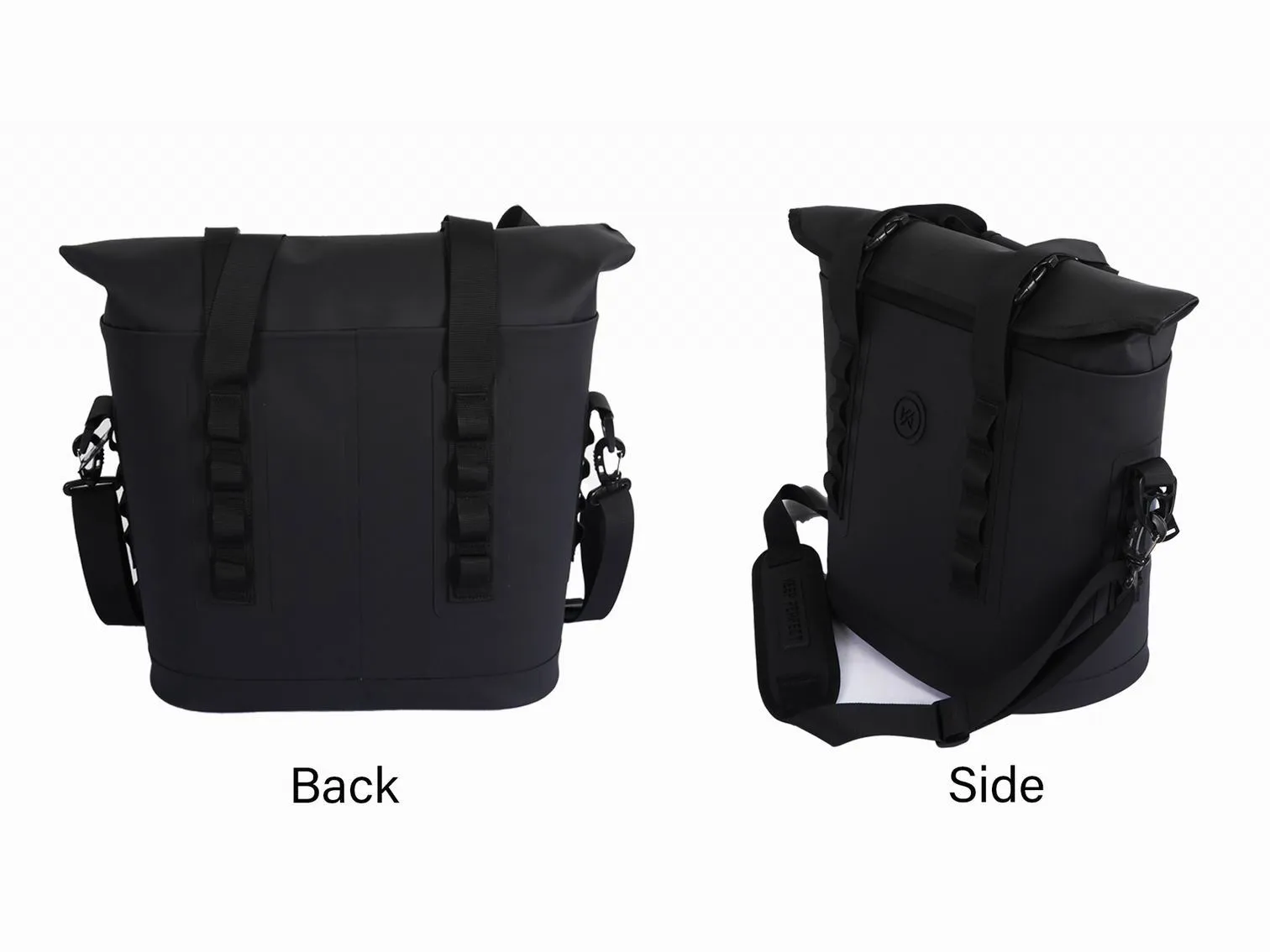
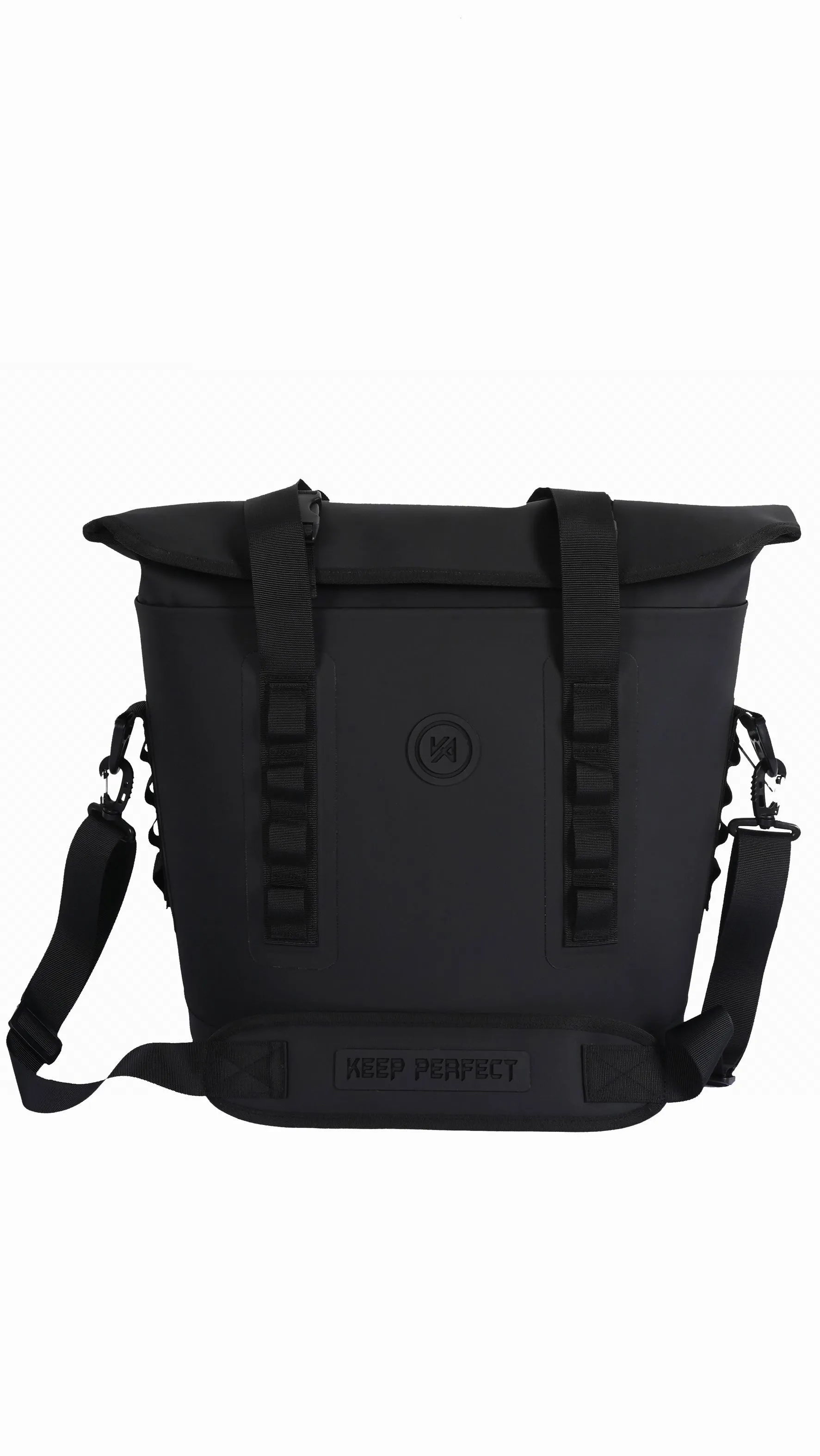
Two goals that pull against each other: crease control and water protection
A waterproof garment bag is asked to be an impermeable envelope and a portable wardrobe at the same time, and those are structurally incompatible requirements. Impermeability wants welded seams, coated laminates, sealed closures and minimum volume, because every extra litre of air space is volume that has to be closed and sealed. Crease control wants the opposite: generous internal space, a stiffened structure that holds the garment away from any fold, and ideally some air exchange so the fabric is not compressed and steamed inside its own enclosure. All of wrinkle free suit travel is a negotiation between those two requirements.
That is why the category splits so cleanly in use. The products that keep suits genuinely dry tend to be roll-top or zip-sealed carriers with welded construction, and they deliver garments that need pressing. The products that deliver garments ready to wear tend to be structured, semi-rigid, hanging-format carriers with breathable panels and generous volume, and they are water-resistant rather than waterproof. A brand that promises both in one product is either compromising both or is about to disappoint a customer, and the honest move is to build two formats and describe what each does.
The practical consequence is that the buyer has to be told which failure they are choosing to avoid, because the product cannot avoid both at once. A traveller flying into a monsoon and driving to a hotel needs the sealed version and should expect to press. A traveller flying business to a meeting needs the structured version and should expect to keep the bag out of heavy rain. Giving that choice explicitly, on the product page, is the single highest-value piece of copy in this category and almost nobody writes it.
Why creases form: what a fold does to a woven fabric
A crease is not a surface mark; it is a mechanical event in the fibre. Wool and the wool blends used in suiting are composed of fibres with a crimp and a scale structure, and when the fabric is folded under pressure and held, the fibres on the inside of the fold are compressed and those on the outside are stretched. Given enough time under pressure, and especially with any warmth or humidity present, the fibres take a partial set in that new configuration. Remove the pressure and the fabric does not fully return. That residual is the crease.
Three variables govern how bad it gets, and all three are design-controllable. Radius is the dominant one: a tight fold produces a small radius and a severe crease, a gentle fold produces a large radius and a mild one, and a roll produces the largest radius of all and the least damage. Time matters because the set is time-dependent, so a fold held for twelve hours is worse than the same fold held for twenty minutes. Pressure and humidity matter because both accelerate the set, which is why a tightly packed garment bag in a warm aircraft hold does more damage than the same bag in a cool car.
Fabric type changes the answer substantially and is worth stating on the product. Wool has excellent crease recovery because the fibre is resilient, and a wool suit folded once and hung for a few hours will often recover completely. Linen has poor recovery and creases almost immediately, which is why linen garments should be rolled or carried flat rather than folded at all. Cotton and cotton blends sit in between. Silk creases readily and is additionally sensitive to abrasion. A product that claims crease-free performance without saying which fabrics it was tested on is making a claim that cannot be checked.
| Fabric | Crease recovery | Recommended handling | Honest product claim |
|---|---|---|---|
| Wool and wool blends | Good to excellent | One soft fold is acceptable; hang on arrival | Arrives ready to wear after a single fold |
| Wool with synthetic blend | Good | One soft fold, avoid heat | Recovers within a few hours when hung |
| Cotton and cotton blends | Moderate | Roll rather than fold | Will need light pressing after folding |
| Linen | Poor | Roll or carry flat; never fold | Not suitable for folded transport |
| Silk | Poor, plus abrasion sensitive | Roll in tissue, isolate from hardware | Requires rolling and separation from hardware |
| Structured tailoring with canvas | Varies by shell fabric | Protect the shoulder above all | Shoulder form required; folding damages the canvas |
Hanging versus folding: what each format actually costs
The format decision is the whole product, and it is worth being blunt about the trade because marketing copy in this category routinely obscures it. A hanging garment bag keeps the garment on a hanger, on a hook, inside a full-length enclosure. It avoids folds almost entirely, which is the only reliable way to deliver a jacket ready to wear. Its cost is bulk: a full-length hanging carrier is roughly 100 to 120 centimetres long, will not fit in most overhead bins laid flat, needs a wardrobe or a door hook at the destination, and is awkward through an airport.
A folding garment bag halves or thirds the garment with soft folds, usually over a stiffened panel, and fits in a carry-on footprint. Its cost is the fold. A single fold across the middle of a jacket, over a generous radius, with the shoulder supported, is survivable for wool and is what most travellers accept. Two folds is materially worse. Three folds, which is what the smallest “half” formats effectively impose on a full-length jacket, will leave creases that need pressing on almost any fabric except a high-wool-content cloth given time to recover.
There is a third format that deserves more attention than it gets: the roll. Rolling a jacket around a soft core produces the largest fold radius available and the least fibre set, and it is how experienced travellers move tailoring. It is less intuitive to customers, it does not photograph well, and it works best with unstructured garments rather than canvassed ones. For a brand, offering a structured core and a clear rolling instruction is a genuine differentiator that costs nothing in materials.
| Format | Folds imposed | Crease risk | Bulk and handling | Best use case |
|---|---|---|---|---|
| Hanging, full length | None | Very low | 110 cm or longer; needs a hook at the destination | A single suit and a meeting on arrival |
| Folded once over a stiffened panel | One, large radius | Low for wool, moderate otherwise | Carry-on footprint | The standard compromise for air travel |
| Folded twice | Two | Moderate to high | Compact | Short trips where pressing is available |
| Rolled around a soft core | Continuous, large radius | Low, and lowest for linen | Compact, unusual shape | Unstructured garments and linen |
| Flat, unfolded, in a rigid case | None | Very low | Very large; effectively a case rather than a bag | Multiple garments, checked or car transport |
The commercial reading is that a range should include a hanging format and a single-fold format and should say which is which. The most common return in this category is a customer who bought a compact folding carrier expecting it to deliver a jacket ready to wear, and the fix is expectation-setting rather than engineering.
The shoulder form: where shape is won or lost
If there is one place a garment bag succeeds or fails, it is the shoulder. A jacket’s shoulder is a three-dimensional structure built from canvas, wadding and a shaped sleeve head, and it cannot be flattened without damage. Flatten it under pressure and it takes a set that no amount of hanging will fully reverse, because the internal structure has been compressed rather than the surface cloth creased. This is the specific failure that turns an expensive suit into a permanently second-rate one, and it is completely preventable.
The correct response is a shoulder form: a shaped insert, typically moulded foam or a moulded shell, that occupies the shoulder cavity and holds its three-dimensional shape while the bag is folded or compressed. The form should match a reasonable range of shoulder widths rather than one, which in practice means a form sized for a medium-to-large shoulder with compressible edges, or a two-part form that adjusts. A flat stiffened panel under the shoulders is not a substitute; it holds the bag flat and does nothing for the garment’s shape.
The second half of shoulder protection is the hanger interface. A garment that is clipped in by a hanger hook alone will slide, bunch and eventually sit against a fold. A proper interface captures the hanger: a hook or loop at the top of the bag that holds a standard hanger hook, plus a strap or a retainer around the hanger body so the garment cannot migrate downwards. This is cheap, it is the difference between a garment that arrives as packed and one that arrives in a heap at the bottom of the bag, and it is missing from a surprising proportion of products.
- Provide a shaped shoulder form, not a flat stiffener; the shoulder is a three-dimensional structure.
- Size the form for a range of shoulder widths, or make it adjustable in two parts.
- Capture the hanger hook at the top and retain the hanger body so the garment cannot slide.
- Keep the sleeve heads away from any fold line; a creased sleeve head does not recover.
- Do not compress the chest area with a strap; distribute any compression across the skirt of the jacket.
Internal support: stiffeners, bars and the fold radius that matters
Beyond the shoulder, the job of internal support is to guarantee a large fold radius wherever the bag folds, and to stop anything hard pressing into the garment. A fold over a 40 millimetre radius rod sets a crease; the same fold over a 120 millimetre padded panel barely marks wool. That single dimension, the radius of whatever the garment bends around, is the most useful number in this product and it is almost never published.
There are three ways to deliver it and they suit different price points. A removable stiffened panel, typically 3 to 6 millimetres of closed-cell foam or a moulded sheet in a sleeve, is the standard answer and it works well provided the panel spans the full fold width. A padded roll or tube placed at the fold line, around which the garment bends, is cheaper and delivers a larger effective radius for the same material. A semi-rigid moulded shell is the most protective and the heaviest, and it is the right answer for true hanging formats where the bag is not folded at all.
The second job is isolation. Every buckle, zip pull, stiffener edge and strap adjuster inside the bag is a hard object that will press into the garment over a long journey and leave a mark, and on silk it can leave a permanent abrasion. The fix is a full-width liner flap between the garment and everything else: one layer of smooth fabric that separates the garment from every piece of hardware in the product. It costs a small amount of material and it prevents the second most common complaint in the category.
- Publish or at least specify the fold radius; 120 millimetres is a reasonable target, 40 is not.
- Span the full fold width with the stiffener; a panel narrower than the garment concentrates pressure.
- Separate the garment from all hardware with a full-width liner flap.
- Avoid internal straps across the chest; compress the skirt instead if compression is needed.
- Make stiffeners removable so the bag can be cleaned and so the user can tune the structure.
Breathability: why a suit cannot live in a sealed bag
This is the requirement most often missed by brands coming to garment bags from other waterproof categories, and it is a hard requirement rather than a preference. A worn suit carries moisture: several grams of absorbed water in the cloth from wear, plus whatever the wearer contributed. Seal that into an impermeable bag for a day in a warm aircraft hold and the result is a garment that arrives damp, warm and beginning to smell, with the humidity available to accelerate every crease-set mechanism described earlier. A fully welded, fully sealed garment bag produces a dry suit and a spoiled one.
The resolution is to make the bag water-shedding rather than water-proof, and to give it a controlled vapour path. In practice that means a coated or laminated shell that sheds rain, welded or taped seams at the points that see water, and at least one breathable panel, typically a mesh or a membrane-protected vent, positioned where rain will not enter but vapour can leave. The exchange rate needed is modest: a suit needs to lose a few grams of water over several hours, which is well within what a small panel provides.
There is a specific mechanism worth designing against because it is counter-intuitive and it generates warranty claims. A bag that has been in cold air and is then brought into a warm humid room will condense water on its inner surface if the shell is impermeable and cold, and that condensation forms on the inside, directly onto the garment. The same applies in reverse when a warm bag is taken into cold air. A breathable panel and a liner that does not hold water at the surface both mitigate this, and the physics is the same one discussed in our note on condensation in sealed waterproof cases.
- Specify water-shedding rather than fully impermeable for any bag holding worn tailoring.
- Include at least one breathable panel positioned so rain cannot enter but vapour can leave.
- Use a liner that does not hold water at its surface, so condensation cannot wet the garment.
- Never store a suit long-term in a sealed bag; the bag is for transport, not storage.
- Tell the user to open and air the bag on arrival; it takes minutes and prevents most odour complaints.
Shoes, belts and accessories: keeping the dirty away from the clean
Any bag carrying a suit is also carrying shoes, and shoes are the dirtiest objects in a travel kit. They carry street grit, they have been worn, and their soles abrade. Put them in the same volume as a jacket and two things happen: grit transfers onto the cloth and abrades it at contact points, and the hard shape of the shoe presses into the garment for hours. Both are avoidable with a genuinely separate compartment, and “separate” here means physically separated by a welded or lined wall, not a mesh pocket inside the main volume.
The specification for a shoe compartment in this product is simple and it is the same specification as a standalone shoe bag, which is why the two should be considered together. It should be a fully sealed pocket lined with a smooth wipeable material, sized to a pair up to about UK 12 or EU 47, positioned at the end of the bag furthest from the shoulder so any compression happens at the hem rather than at the chest. Our dedicated note on shoe and boot bags covers the sizing and lining detail in full.
Belts, cufflinks, collar stays and a watch need their own treatment because they are small, hard and easily lost. A zip pocket with a few elastic loops is the right answer and it should be positioned so it cannot press into the garment, which in practice means on the outside face of the bag rather than inside the garment envelope. Ties are the awkward case: they crease easily, they are small, and the right answer is a flat sleeve with a soft fold or a roll, positioned along the length of the bag rather than across it.
- Physically separate the shoe compartment with a lined wall, not a mesh pocket in the main volume.
- Put shoes at the end furthest from the shoulder, so any compression lands at the hem.
- Line the shoe pocket with a smooth wipeable material and weld the seams.
- Put small hard accessories on the outside face, where they cannot press into the garment.
- Give ties a flat sleeve along the length of the bag; never fold them across the bag.
Carry-on dimensions and how many folds a jacket survives
Airline cabin baggage rules are the constraint that forces folding in the first place, and the numbers are worth knowing because they set the geometry. The industry body IATA publishes a widely referenced cabin baggage guideline of roughly 55 by 40 by 20 centimetres, although it is a recommendation rather than a rule and individual airlines set their own limits, with many carriers in the region of 56 by 36 by 23 centimetres and some smaller. The practical implication for a garment bag is that anything intended for cabin carriage has to fit inside a footprint near 55 by 40 by 20, and a full-length hanging bag will not.
That footprint is what imposes the fold. A jacket laid flat is roughly 75 to 80 centimetres from shoulder to hem for a regular size, and around 55 to 65 centimetres across including both sleeves. To fit inside a 55 by 40 rectangle it must be folded at least once, and to fit the smaller limits comfortably it is often folded in a way that produces two crease lines. Knowing the garment dimensions and the bin dimensions lets a brand state honestly how many folds a given format imposes, which is a far more useful piece of information than a capacity figure in litres.
Weight limits matter too, because a structured garment bag with a stiffened panel, a shoulder form and a shoe compartment is not a light product. Cabin weight allowances vary widely, with some carriers allowing 7 kilograms and others 10 or more, and a structured carrier typically weighs between 1.2 and 2.2 kilograms empty. A brand selling into air travel should publish the empty weight, because a traveller who packs a suit and shoes into a 2-kilogram bag is using a significant share of a tight allowance.
| Garment or component | Typical laid-flat size | Folds needed for a 55 x 40 cm bin | Expected outcome |
|---|---|---|---|
| Jacket, regular size | 75 to 80 cm shoulder to hem | One fold, or two at the tighter limits | Wool recovers when hung; other fabrics may need light pressing |
| Trousers | 100 to 110 cm long | One or two folds | Recovers well; fold along the existing crease line |
| Shirt, folded | 40 by 30 cm | None | Fine folded; use a folding board if supplied |
| Dress, full length | 140 to 160 cm | Two or three folds, or roll | High crease risk; a hanging format is strongly preferable |
| Shoes, pair to EU 47 | 32 by 22 by 12 cm | None; own compartment | Must be sealed and separated from the garment |
| Shoulder form plus stiffener | Adds 3 to 6 mm thickness | None | Adds mass but is the reason the garment arrives shaped |
One practical instruction belongs on the product and in the listing: the wearer should hang the garment up as soon as they arrive, and ideally steam it in a bathroom. That single habit recovers most of the creasing that any folding format imposes, and a brand that says so will get better reviews than one that over-promises on crease performance and then gets blamed for normal physics.
Closures and access in a hotel room with no hanging space
The closure on a garment bag is used in a specific and unglamorous context: on a bed or a luggage rack, in a hotel room, often in a hurry, frequently with the garment already on a hanger in one hand. That context disqualifies closures that need the bag to be held in a particular orientation or that require two hands for several seconds. It also disqualifies closures that can catch the garment, which is a real risk: a zip running the full length of a bag is a zip that can catch a shirt cuff or a dress hem if there is no guard.
The two closures that work are a full-length zip with a proper internal guard, and a wrap closure with a buckle or a hook-and-loop panel. The zip is faster and seals better, and it needs a fabric guard running alongside the whole length on the garment side, plus a garage at both ends. The wrap closure is slower and seals less well, but it cannot catch a garment and it tolerates an overfull bag, which matters because users consistently pack more than the bag was designed for.
Access while travelling is a separate question and it is where hanging formats earn their keep. A bag that opens along its full length and lays flat lets a traveller lift the garment out on its hanger without disturbing anything else. A bag that opens only at the top requires the garment to be extracted upward, which means handling the cloth and undoing whatever crease control was achieved. Full-length opening is one of the clearest quality signals in the category and it is worth the extra zip length.
- Use a full-length zip with an internal guard along the garment side and garages at both ends.
- Or use a wrap closure that cannot catch cloth and tolerates an overfull bag.
- Open along the full length so the garment can be lifted out on its hanger.
- Add a hang loop or a hook at the top that works on a door, a shower rail or a wardrobe bar.
- Keep the shoe compartment accessible without opening the garment envelope.
The hanging hardware deserves a note because it is the most commonly broken component in this category. A hook or loop that has to take the whole weight of a loaded bag from a door or a rail is carrying several kilograms on a small stitched attachment, and it needs the same load-path treatment as any other handle. The methodology is set out in our review of load and stress testing for straps and handles, and the hardware families are compared in our guide to buckles, straps and hardware.
Materials: shell, liner and the seam strategy for a garment carrier
Material selection here is driven by three requirements that are not the usual ones: the shell has to shed rain, the interior has to be smooth and non-abrading, and the whole product has to be quiet and pleasant to handle because it is a professional item used in front of clients. That last point is underrated. A stiff, crackling laminate is technically excellent and feels cheap, and in a business-travel product the hand of the material is part of the perceived quality.
The shell should be a coated woven fabric in the 420 to 600 denier range, or a laminated fabric if a softer hand is wanted, with a durable water-repellent finish. Fully welded construction is appropriate for the shoe compartment and for the base, where standing water is a real risk, and it is inappropriate for the main garment envelope, which needs vapour exchange. That means the seam strategy is deliberately mixed within one product, which is unusual and which needs to be stated clearly on the technical pack rather than left to the sampling round.
The interior wants a smooth, low-friction, non-absorbent facing that lets a garment slide rather than drag, in a light colour so the user can see what is inside. A brushed tricot feels premium and is the wrong choice on two counts: it holds moisture, and it creates friction that makes garments harder to slide in and out. A smooth woven or a light TPU-laminated facing is better and cheaper. Any stiffener edge inside the bag must be bound or covered, because a raw cut edge abrades cloth over a long journey.
| Component | Recommended specification | Why | What to avoid |
|---|---|---|---|
| Shell | Coated woven polyester or nylon, 420 to 600 denier, DWR | Sheds rain with a reasonable hand | Stiff laminates that crackle and feel cheap |
| Garment envelope seams | Sewn with taped interior at the exposed edges | Vapour exchange matters more than absolute sealing | Fully welded envelope with no vapour path |
| Shoe compartment and base | Welded, smooth wipeable lining | Standing water and grit need a sealed, cleanable pocket | Sewn seams, which wick and hold dirt |
| Interior facing | Smooth, low-friction, light-coloured woven or light laminate | Garments slide, user can see inside, no moisture held | Brushed tricot, which holds moisture and adds friction |
| Shoulder form | Moulded foam or shell, compressible edges, sized for a range | Holds a three-dimensional structure | A flat stiffened panel, which does nothing for shape |
| Stiffener | 3 to 6 mm closed-cell foam or moulded sheet in a sleeve, removable | Large fold radius, washable | Raw cut stiffener edges that abrade cloth |
Fabric and component testing for this product should focus on colour transfer and abrasion rather than on water column, because the failure the user notices is a mark on the garment, not a leak. Crocking, which is colour transfer under rubbing, matters because a dark lining rubbing against a light suit is a real risk, and the relevant methods are published by bodies including AATCC. Abrasion of the lining against the garment and of the shell against airport surfaces is covered by methods from ASTM International, and our overview of test standards for custom bags sets out which method maps to which claim.
Verifying a wrinkle-free claim: the tests that mean something
Almost every product in this category claims crease resistance and almost none of them can be compared, because the claim is not tied to a method. That is fixable at modest cost, and a brand that publishes a method immediately differentiates itself in a category where every competitor looks identical. The tests below are cheap, they need no laboratory, and they produce numbers that can go on a specification sheet.
- Fold-and-hang test: fold a wool test garment once over the bag’s stiffener, leave it loaded for twelve hours at ambient, hang it for four hours, then photograph and grade the residual crease against an agreed reference.
- Shoulder compression test: compress the shoulder area to a stated load for eight hours, then hang and measure whether the shoulder has taken a set.
- Humidity test: repeat the fold-and-hang test inside a closed warm environment with a damp cloth, because humidity accelerates crease set and this is the realistic travel condition.
- Breathability test: seal a damp garment in the bag for twelve hours, then measure whether the garment and the liner are still damp.
- Hardware mark test: pack the bag with a garment and shake it on a rough-road rig or carry it for an hour, then inspect the cloth for marks from buckles and stiffener edges.
- Zip catch test: open and close the full-length zip twenty times with a shirt cuff deliberately near the line, and check for snagging.
- Hanger retention test: load the bag, hold it by its hang loop, invert it, and confirm the garment has not migrated.
- Rain test: stand the closed bag in driving rain for ten minutes against a wall and inspect the interior and the garment envelope.
The fold-and-hang test and the humidity test are the two to institutionalise, because they detect both material substitution and structural change. A supplier who quietly reduces stiffener thickness or swaps to a softer foam will pass a visual inspection and fail the fold test clearly. Both take half a day per lot and both are far cheaper than the returns they prevent. The inspection structure that catches this per shipment is set out in our note on pre-shipment inspection, and the sampling logic in our guide to AQL sampling for buyers.
What a garment bag is for, and the trips it is the wrong answer to
Honesty about use cases reduces returns more than any feature in this category, because the product is frequently bought for the wrong trip. A garment bag is the right answer for one or two structured garments, carried by the traveller, on a trip where there is somewhere to hang the garment at both ends. It is the wrong answer for several garments, for long-term storage, for checked baggage, and for any trip where the wearer will not have a hook or a rail.
For multiple garments, a rigid or semi-rigid case with flat stacking beats any soft bag, because garments lie flat without folding and without being compressed by each other. For long-term storage, the answer is a breathable garment cover in a wardrobe and not a waterproof bag at all, because sealing tailoring for weeks produces mildew risk and permanent smell. For checked baggage, the answer is a soft bag inside a hard case, because a garment bag alone offers no crush protection in a hold.
A brand that states the boundary conditions on the product page converts a category with a high return rate into one with an unusually loyal customer base, because business travellers are repeat buyers who value being told the truth. This is also the argument for positioning garment bags inside a broader travel range rather than as a standalone product: the customer who needs a suit carrier also needs the rest of the kit, and the commercial logic for that range structure is set out in our notes on business travel and professional protection and on short-trip formats.
Building a garment bag line: formats, branding and ordering
The natural range structure is three formats sharing materials and hardware: a full-length hanging carrier for the customer who wants a jacket ready to wear, a single-fold carry-on carrier for air travel, and a compact half-format for shirts and trousers or for a single unstructured jacket. Three formats covers most of the market and shares a shell specification, a zip specification and a hardware set, which is what keeps the economics workable at moderate volumes.
Branding on this product has an unusually good opportunity because it is carried into professional settings and is seen by clients. A debossed or embossed patch, or a small woven label on the outer face, reads as quality and survives abrasion better than a print. Print placement should avoid the fold lines, because a print across a fold line cracks within a season, and it should avoid the base wear zone. The durability trade-offs by method are covered in our review of printing and embroidery options, and shade matching across a shared range is described in our note on colour and shade matching.
On cost, the unusual feature of this product is that the internal structure costs more than the shell. The shoulder form, the stiffeners, the hanger retention hardware and the lining flap together frequently exceed the cost of the outer fabric and the zip, because they are shaped components rather than cut fabric. Any value engineering exercise that starts with the internal structure will produce a bag that looks identical on a sample table and performs completely differently on a twelve-hour flight, and that is the wrong place to save money.
On ordering and timing, the minimum order quantity is 500 pieces per style, so a three-format range in one colourway is 1,500 units. Sampling takes 6–10 working days per round and bulk production runs 35–50 days, quoted FOB Xiamen; because the shoulder form and the stiffener geometry usually need one round of adjustment, budget two sampling rounds for a first garment programme. Corporate and hospitality channels are strong for this product, and the commercial framing is set out in our notes on corporate gifting programmes and hospitality programmes. If you want this specification turned into a costed range, review our own process from first enquiry through sampling into bulk production and send your target formats, garment mix, intended price band and preferred decoration. Minimum order quantity is 500 pieces per style, samples take 6–10 working days, bulk production runs 35–50 days, and quotations are issued FOB Xiamen.
Frequently Asked Questions
Q1. Can a garment bag be both waterproof and wrinkle-free?
Not fully. Sealing wants a tight welded envelope; crease control wants space, structure and vapour exchange. Choose which failure you are avoiding.
Q2. Should I hang or fold a suit for travel?
Hang if you can. A full-length hanging carrier imposes no folds, while a folding carrier imposes one or two and the garment will need time on a hanger to recover.
Q3. How many folds can a jacket survive?
One soft fold over a large radius is acceptable for wool. Two folds will usually need pressing, and linen should be rolled rather than folded.
Q4. Why does the shoulder matter so much?
The shoulder is a three-dimensional structure built from canvas and wadding. Flatten it under pressure and it takes a set that hanging will not fully reverse.
Q5. Do I need a shoulder form?
Yes for structured tailoring. A flat stiffened panel holds the bag flat but does nothing for the garment’s shape.
Q6. Can I keep a suit in a waterproof bag long term?
No. Sealing worn tailoring for weeks produces damp, odour and mildew risk. Use a breathable cover for storage and the bag for transport.
Q7. Why does my suit arrive damp?
A worn suit carries absorbed moisture and a fully sealed bag has nowhere to put it. The bag needs a breathable panel and the garment needs airing on arrival.
Q8. Should shoes go in the same compartment as the suit?
No. Shoes carry grit and have hard shapes. They need a sealed lined compartment at the end furthest from the shoulder.
Q9. Will a garment bag fit in carry-on?
A folding format will, inside roughly 55 by 40 by 20 centimetres. A full-length hanging carrier will not, and airlines set their own limits in any case.
Q10. How much does a garment bag weigh empty?
Typically 1.2 to 2.2 kilograms for a structured carrier with a shoulder form and shoe compartment. Publish the figure; cabin weight allowances can be tight.
Q11. Which fabrics crease worst?
Linen creases almost immediately and should be rolled. Silk creases and abrades easily. Wool has the best recovery and tolerates one soft fold.
Q12. Should the garment envelope be welded?
No. The shoe compartment and base should be welded, but the garment envelope needs vapour exchange, so sew and tape the exposed edges instead.
Q13. What closure is best on a garment bag?
A full-length zip with an internal guard and garages, or a wrap closure that cannot catch cloth. Full-length opening lets the garment come out on its hanger.
Q14. How do I stop hardware marking the garment?
Use a full-width liner flap between the garment and every buckle, zip pull and stiffener edge, and bind all stiffener edges.
Q15. How do I test a wrinkle-free claim?
Fold a wool test garment over the stiffener, load it for twelve hours, hang it for four, then grade the residual against a reference. Repeat in humid conditions.
Q16. Is a garment bag right for checked baggage?
No. It offers no crush protection in a hold. Use a soft bag inside a hard case if the garment has to be checked.
Q17. What is the minimum order quantity for a custom garment bag?
500 pieces per style. A three-format range in one colourway is 1,500 units, which is a realistic opening buy.
People Also Ask
Do garment bags keep suits from creasing?
A hanging format prevents creasing; a folding format reduces it. No bag eliminates it entirely, so hang the garment on arrival.
Should you fold or roll a suit?
Roll for linen and unstructured garments, one soft fold for wool, and never fold across the shoulder.
Can you store a suit in a garment bag?
Not long term. Sealed storage traps moisture and causes odour; use a breathable cover in a wardrobe instead.
Do garment bags fit in carry-on?
Folding formats fit within roughly 55 by 40 by 20 centimetres. Full-length hanging carriers do not.
How do you keep shoes away from a suit?
Use a sealed, lined shoe compartment at the end furthest from the shoulder, physically separated from the garment envelope.
Why does my suit smell after travelling?
A worn suit carries absorbed moisture and a sealed bag has no vapour path. Air the bag and garment on arrival.