Kitesurf and windsurf equipment is rarely destroyed by water getting into a bag. It is destroyed at pack-down, on a windy beach, when a kite or sail that is still coated in wet sand and salt is folded into a bag that then carries that abrasive paste home through the coating, the zipper and the seams. The dominant failure is not ingress; it is contamination carried inward and equipment blown away while it is being handled. That reverses the usual buying logic. A rinseable open format often beats a sealed one, ground anchoring matters more than a waterproof rating, and sand exclusion at the closure is worth more than another metre of hydrostatic head.
The sections below work through sand and salt as a mechanical abrasive system, why long sails and boards defeat ordinary duffels, how wind blows equipment away and what anchoring actually prevents, ultraviolet and salt cycling on fabric and hardware, organising a beach change, board protection for travel, closure and hardware choices for gritty conditions, the tests that predict a season at a windy beach, and how a brand should build a coherent wind-sports range. The production baseline at QUANZHOU JUNYUAN BAGS — custom waterproof bag production since 2014, 4,950 m² SGS-verified facility — is MOQ 500 pieces per style, sampling in 6–10 working days and bulk in 35–50 days, FOB Xiamen.
Sand and salt are an abrasive paste, not a cosmetic mess
The failure that defines kitesurfing gear bags is contamination carried inside at pack-down. A kite or sail folded on wet sand carries a paste of quartz grains in a salt solution, and once that paste is inside a closed bag it works on everything it touches for the whole journey home. Good windsurf sail bags therefore manage sand before they manage water: an outer face that sheds grains, a closure that does not trap them, and a construction that can be hosed out and dried.
Quartz sand is harder than most coating systems and harder than the anodising on many fittings. Under the vibration of a car roof rack or a beach trolley, a grain caught in a zipper tooth becomes a cutting tool, and grains trapped against a welded seam become a slow abrasion site. Salt makes it worse by staying damp: sodium chloride absorbs moisture from the air above roughly seventy-five per cent relative humidity, so the paste never truly dries unless it is rinsed with fresh water.
The practical conclusion is that a bag for this sport should be designed to be dirty rather than to stay clean. Smooth, low-texture faces that shed sand, closures that can be flushed, a drain path at the low corner, and an interior that tolerates being hosed out are worth more than a higher ingress rating. A sealed bag with no way to get sand out becomes a sandpaper box.
Rinsing discipline is part of the product. A printed instruction to shake off, rinse the closure, and dry open before storage changes the life of the bag more than any material upgrade, and it costs nothing. Brands that print it and clubs that follow it see the difference within one season.
Long sails, masts and boards defeat ordinary duffel geometry
Windsurf sails roll to roughly 1.6 to 2.2 metres depending on size, masts are two-piece or one-piece lengths of similar scale, and booms are long rigid assemblies with awkward ends. A kite packs softer but arrives with a bar, lines and a pump, while boards run from about 2.2 metres for a twin tip to well over 2.4 metres for a race board. None of this fits a general duffel, and cramming it in is how tips, windows and mast ferrules get damaged.
| Item | Typical packed dimension | Dominant risk | Correct format |
|---|---|---|---|
| Windsurf sail, rolled | 1.6 to 2.2 m long, 300 to 450 mm diameter | Creasing at the window and panel abrasion | Long sleeve with a smooth lining and a padded mast pocket |
| Mast, one or two piece | Up to about 2.3 m | Ferrule damage and bending point loads | Separate padded mast compartment, never bundled with the sail |
| Boom | 1.4 to 2.5 m, rigid with sharp ends | Puncture and end-cap damage | Sleeve with reinforced ends and a carry handle at the balance point |
| Kite with bar and lines | Soft, roughly 1.2 m folded | Line tangling and sand in the bag | Wide-mouth bag with a bar pocket and a line wrap |
| Twin-tip or directional board | 1.3 to 2.4 m | Rail and nose impact, deck heat | Board bag with reflective or heat-managing outer and padded rails |
| Wetsuit, harness and small parts | 10 to 40 L | Sand and salt carried into the car | Rinseable open tote or draining wet compartment |
Separation is the governing principle. A mast should never share a compartment with a rolled sail, because the ferrule and the boom clamp ends concentrate load exactly where the sail film is most vulnerable. A dedicated padded mast pocket costs little in a long sleeve and prevents the most common transport damage in the sport.
Carry geometry matters too. A long sleeve needs a handle at its balance point and a shoulder strap positioned so it can be carried nose-down into the wind without behaving like a sail. Anyone who has walked a beach with a rolled sail in a crosswind already knows this; the bag should be designed for it.
Wind takes equipment away: anchoring beats waterproofing
On an exposed beach the wind is the strongest force in the system, and it acts on equipment continuously. An empty kite bag is a sail; a board left flat on sand becomes a wing; an open jacket becomes litter in the dunes. Equipment lost this way is rarely recovered, and a kite launching itself is a genuine hazard to other beach users. Anchoring is therefore a primary requirement rather than an accessory.
- Provide anchor points at both ends of every long bag, not just at one, so it can be pegged along its axis.
- Specify sand anchors or stake sleeves as part of the system, because tying a strap to a bag handle is not anchoring.
- Add an internal pocket for ballast or wet sand so a kite bag can be weighted during a change.
- Keep the mouth facing downwind or closed during any change, since an open mouth is how sand enters.
- Use high-visibility pullers and panels, because equipment is often recovered by being spotted rather than remembered.
- Avoid long loose webbing that can whip in strong wind; capture every tail.
A useful acceptance test is simple and honest: place the empty bag on sand in a stated wind, open it as a user would, and record whether it moves, how far, and whether the closure stays where it was put. Repeat with a board bag and with a kite bag. Most products fail this immediately, which is why anchoring is a differentiator rather than a checkbox.
Safety deserves one explicit note. A kite must never be left inflated and unattended, and no bag feature changes that rule. What a bag can do is make the safe routine easier: a place to put the bar, a weighted pocket for the canopy and a sand anchor that actually holds.
Ultraviolet and salt cycle together, and that is the real ageing test
Wind-sports equipment lives at the intersection of the two most damaging outdoor exposures. Ultraviolet breaks polymer chains at the surface and creates micro-cracking and chalking; salt solution then penetrates that damaged surface more deeply than it would penetrate pristine material, dries into crystals inside the polymer, and those crystals act as stress concentrators and as abrasive particles under the next flex. Alternating exposure is worse than either alone, and it is not multiplicative.
This has two specification consequences. First, require a cyclic test rather than two separate ones: wet, dry, ultraviolet, rinse, repeat, with assessments at intervals. Two constructions can both survive five hundred hours and age at completely different rates, so the slope between intervals is the useful data, not the endpoint. Second, stabilise the whole assembly: face film, webbing, thread and print, because the component that fails first is usually the one nobody specified.
Colour is a functional choice here. Dark surfaces absorb more heat, and on a beach in summer the surface temperature of a dark bag left in the sun can be high enough to accelerate both ultraviolet degradation and hydrolysis, and to make the handle unpleasant to touch. Mid-tones with light-stable pigment systems usually age better than deep saturated colours, and a lighter interior makes sand and grit visible before they damage anything.
Hardware follows the same logic. Acetal buckles and welded webbing loops survive this environment; plated zinc alloy dezincifies and fails unpredictably. Where metal is required, one alloy throughout with no dissimilar contact, and 316 rather than 304 in a chloride environment. The mechanism and the material choices are set out in our guides to ultraviolet resistance in outdoor materials and abrasion-resistant exterior coatings.
Organising a beach change so sand stays outside the bag
A beach change is a short, windy, sandy sequence repeated several times a day. The bag system should support that sequence rather than fight it. In practice that means three zones: a dirty rinseable zone for the wetsuit and harness, a clean zone for dry clothes and electronics, and a hard-organised zone for the bar, pump and small parts that must not be lost.
| Zone | Contents | Design requirement | Why the ordinary answer fails |
|---|---|---|---|
| Dirty and rinseable | Wetsuit, harness, sandy booties | Open or draining, smooth face, hose-out interior | A sealed wet bag keeps sand and keeps it working as an abrasive |
| Clean and dry | Dry clothes, phone, keys, documents | Sealed closure with sand exclusion at the seal line | A general dry bag gets sand on the seal every time it opens |
| Hardware organiser | Bar, pump, fins, straps, tools | Individual slots and high-visibility panels | Small parts disappear into sand and are the most expensive losses |
| Long-gear sleeve | Rolled sail, mast, boom | Separate compartments, balance-point carry | Bundling concentrates load on the most fragile component |
| Board protection | Board in transit | Padded rails, heat-managing outer, nose and tail reinforcement | General covers abrade rails and trap heat against the deck |
The order of operations matters as much as the zones. Sand should be shaken off before anything goes in a bag, the closure should be rinsed before it is rolled, and the bag should be dried open at the end of the day. A card printed with those three steps, attached to the product, is the cheapest durability measure available.
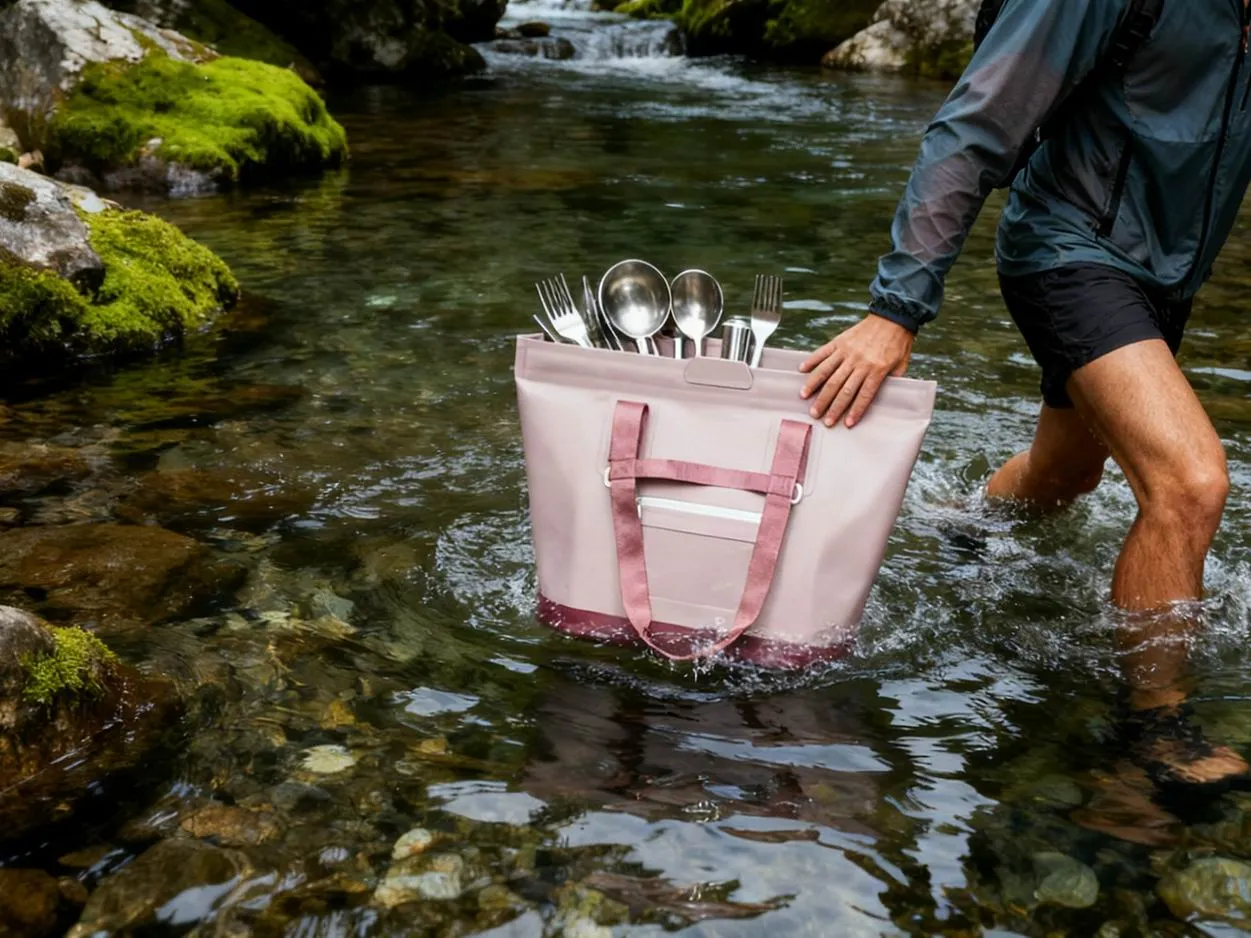
For centres and schools, an open waterproof tote often outperforms a roll-top for the dirty zone simply because it can be tipped out and rinsed. The general formats suited to this kind of sandy beach work are covered in our guide to bags for surfing and beach sports, and the wet-dry separation principle is explained in wet and dry separation design.
Board protection in transit: heat, rails and point loads
A board on a roof rack or in an aircraft hold faces heat, compression and impact. The highest risk is thermal: a dark bag in direct sun can raise the deck temperature enough to affect adhesives and laminates, which is a slower and less visible failure than a cracked rail but a real one. A heat-managing or reflective outer, or simply a lighter colour, is a genuine specification item rather than a marketing one.
- Pad the rails and reinforce nose and tail, because those are the impact zones in every handling scenario.
- Use a reflective or light-coloured outer face and avoid leaving a packed board in direct sun before travel.
- Add internal compression straps so the board does not shift inside the bag on a rack.
- Give the bag a drain path, because a wet board going into a sealed bag creates a humidity chamber.
- Provide a shoulder strap and a balanced carry handle, since boards are carried long distances at most spots.
- Check the bag fits the actual board: an over-long bag lets the board slide and hammer its own nose.
Air-travel board bags are a distinct product with distinct insurance consequences. Airlines treat damage claims differently depending on whether the bag was a recognised board bag, and a padded, purpose-built bag is easier to claim against than a general cover. Buyers selling into travel should state the board length range clearly and avoid implying a fit that leaves 300 mm of slack.
For the sail and mast side, the failure is more often creasing than impact. A rolled sail stored compressed for months under a strap develops a permanent crease at the window, so long-term storage should be loose rather than tightly rolled, and the bag should make loose storage possible rather than forcing compression.
Closures and hardware for gritty conditions
Every closure family has a sand-specific failure mode. A coated waterproof zipper collects grains between teeth and then cuts its own coating when the user pulls harder; a roll-top seal is defeated by a single grain across the roll line; hook-and-loop packs with sand and stops engaging; a cam buckle loses grip when grit fills its teeth. The correct response is not a better rating but a closure that can be flushed and a maintenance instruction that people will actually follow.
| Closure | Behaviour with sand and salt | Field maintenance | Best application here |
|---|---|---|---|
| Coated waterproof zipper | Grit jams the slider; salt crystals stiffen the coil | Rinse in fresh water and work the slider while wet | Small clean-zone items, with a covered garage |
| Roll-top closure | A single grain across the roll line creates a leak path | Shake, rinse the roll faces, inspect before rolling | Bulk clean storage where sand is excluded first |
| Drawcord with cover | Grit enters the cord lock and jams it | Flush the channel; keep the cover closed | Dirty-zone totes and wetsuit bags |
| Wide hook-and-loop | Packs with sand and loses engagement | Rinse and brush; accept as consumable | Tidying only, never structural retention |
| Cam or ladder buckle | Grit in the teeth reduces grip on webbing | Flush with fresh water before tensioning | Rack and roof-rack compression only |
The design detail that helps most is exclusion: a flap over the closure, a garage at the zip end, a covered cord channel and a roll collar long enough that the roll faces can be shaken clear. These cost almost nothing and they address the mechanism rather than the symptom.
Webbing and stitching deserve a final note. Sand works into stitch holes and into the weave, so welded or bar-tacked attachments with a covered edge generally outlast long runs of exposed stitching on the contact faces. Hardware and webbing selection for this environment is covered further in our notes on buckles, straps and fittings.
Tests that predict a season at a windy beach
A beach season is bounded and repeatable, which makes it testable. The mechanisms worth reproducing are sand abrasion, ultraviolet and salt cycling, closure contamination, wind movement of the empty bag, and heat on a dark board bag. None of these is covered by an ingress rating, and a supplier offering only a hydrostatic figure has not tested the product for this sport at all.
| Test | How to run it | Pass criterion worth writing | Failure it prevents |
|---|---|---|---|
| Sand abrasion on face and base | Standard sand slurry, loaded contact, repeated drag cycles | No exposure of substrate and no coating perforation | A sandpaper box that destroys itself by mid-season |
| Cyclic ultraviolet and salt | Alternate wetting, drying and ultraviolet with interval checks | Stated retained strength and no chalking at the interval | Premature ageing of film, webbing and print |
| Closure grit contamination | Grit slurry on the closure, operate, rinse, then re-test | Operates and still excludes water after cleaning | Zippers that jam and roll-tops that weep |
| Wind stability of the empty bag | Stated wind speed on sand, opened as a user would | Movement below a stated distance with anchors deployed | Equipment blown down the beach and lost |
| Board bag thermal check | Dark and light outer in direct sun, instrumented deck | Deck temperature below a stated limit | Heat damage to laminates and adhesives |
| Hose-out and dry | Fill with slurry, hose out, hang open, re-inspect | No retained grit in corners or closure channels | Grit retained and working on the coating all winter |
Interval data matters more than endpoints. Ask for results at intervals and compare slopes between two candidate constructions, because the product that is still intact at the end may have aged twice as fast in the first third of the test.
Independent reference methods already used across materials programmes are the right base: ASTM International publishes abrasion, light and salt exposure methods, and ISO provides the general testing frameworks. For the sport context, World Sailing and the International Kiteboarding Organization shape how equipment is handled and taught, which is what a bag must fit around.
Building a wind-sports range commercially
Wind-sports retail is concentrated in schools, centres and a relatively small specialist dealer network, which changes the range logic. Continuity beats novelty, fit matters more than features, and the products that sell are the ones that solve the pack-down problem visibly. A brand entering this category should lead with the dirty-zone and hardware-organisation products rather than with another sealed duffel.
| Product | Typical size | Market role | Sourcing note |
|---|---|---|---|
| Rinseable dirty-zone tote | 25 to 40 L | Entry product for schools and centres | Highest reorder rate; shares tooling with beach ranges |
| Hardware organiser pouch | 3 to 8 L | Prevents the most expensive small losses | Cheap, high margin, strong attachment product |
| Sail and mast sleeve | 1.8 to 2.4 m | The credibility product for windsurf | Long-axis opening; measure the racks and roof bars |
| Kite bag with bar pocket | 1.2 to 1.6 m | Core kitesurf item | Wide mouth, anchor points at both ends |
| Board bag | 1.3 to 2.5 m | Travel and roof-rack protection | Heat-managing outer, padded rails, stated length range |
| Wet and dry backpack | 30 to 45 L | General beach-day product | Crosses over into other beach categories |
Order economics argue for concentration. With a 500-piece minimum per style, the first buy should cover one dirty-zone tote and one long sleeve rather than six unvalidated formats. Colourways can differentiate retail SKUs, but each style still needs its own minimum and inspection plan, and the long sleeve and the board bag should not share a tooling assumption simply because both are long.
Branding placement has a sand-specific rule: never put the principal mark on a face that contacts the ground during pack-down, and never on a fold line. Welded badges and flexible ink systems tolerate the flex and the rinsing better than thick rigid transfers, and embroidery should stay off any welded waterproof chamber unless backed and sealed. Our logo method comparison covers the trade-offs, and the general capacity arithmetic is in our capacity selection guide.
Accessories sell disproportionately well here and cost little: a sand anchor set, a rinse card, a spare slider, a line wrap and a small bar pouch bundled with the main bag. For a school or centre these are the difference between a system that works and a bag that sits in the sand.
Kitesurf kit: canopy, bar, lines and the pump nobody wants to lose
A kite packs soft, which tempts brands into treating it like laundry. It is not. The canopy is a coated fabric with bonded seams and a specific fold geometry; the bar carries a depower line and a safety release that must stay clean and untangled; the lines must be wound rather than stuffed; and the pump is the item most often left on the beach because there is nowhere obvious to put it. A kite bag is therefore an organiser for four very different sub-assemblies.
- Give the bar a dedicated pocket with a sleeve for the depower line, so it cannot abrade the canopy or tangle the lines.
- Add a line wrap or a pair of winders inside the bag; stuffed lines cost more time at the next session than any other single problem.
- Provide an external pump sleeve with a drain hole, because the pump is always sandy and always wet.
- Keep the mouth wide enough to load a canopy without forcing it, since forcing creates creases at bonded seams.
- Add two end anchor points so the bag can be pegged while the canopy is being folded.
- Use a light-coloured interior so sand and grit are visible before the bag is closed.
The safety system deserves explicit care. The release and depower mechanisms must remain accessible and free of grit, which argues strongly for a dedicated covered pocket rather than a shared compartment. A bag design that forces the user to dig past a sandy canopy to reach a safety component is a poor design regardless of its fabric.
For schools and centres, the kite bag is also a teaching tool. A bag with labelled slots makes a student routine repeatable, and repeatable routines are what prevent lost bars and tangled lines in a busy teaching environment. That is why centres buy systems rather than individual bags.
One caution on storage: a canopy stored wet and compressed for weeks can develop mildew along bonded seams, and mildew on a coated canopy is difficult to remove. Rinse with fresh water where possible, dry open in shade, and store loose rather than rolled tight.
Windsurf kit: monofilm, masts and the crease that never comes out
Windsurf sails are the most fragile long object in the sport. The window area is a transparent film that creases permanently if it is folded or compressed, and the panel seams and the luff sleeve are the next most vulnerable features. Damage rarely arrives as a tear in the middle of a panel; it arrives as a crease at the window or an abrasion at a seam, usually during transport or storage rather than sailing.
| Sail-size band | Rolled length | Bag format | Storage caution |
|---|---|---|---|
| Up to about 4.5 m² | 1.6 to 1.8 m | Single sail sleeve with a padded mast pocket | Roll loosely; never strap tightly for storage |
| 5.0 to 7.0 m² | 1.9 to 2.1 m | Sleeve with a separate mast compartment | Keep the window on the inside of the roll |
| 7.5 m² and above | 2.1 to 2.3 m | Wide sleeve with a semi-rigid liner | Store flat or loosely rolled; avoid compression creases |
| Racing cambered sails | Varies, often with cambers fitted | Sleeve with camber protection panels | Cambers create point loads; pad them specifically |
| Mast, two-piece | Up to about 2.3 m | Dedicated padded mast bag | Protect the ferrule from bending loads |
The mast is the hidden damage source. A two-piece mast has a ferrule that must not be loaded in bending, and a boom has clamp ends that concentrate load into a small area. If either shares a compartment with a rolled sail, the sail loses. A separate padded mast compartment is the single most valuable feature in a windsurf bag and it is frequently omitted to save cost.
Transport on a roof rack adds vibration to compression. A long sleeve on bars sees continuous low-amplitude motion for hours, which is exactly the condition under which a trapped grain of sand abrades a seam. Rinse the sleeve before loading, and use compression straps that hold without crushing the roll.
Long-term storage should be loose. A sail rolled tightly and strapped for a winter will show a permanent crease at the window in spring, and that crease is both cosmetic and a stress concentrator. Bags that allow loose storage, or centres that provide flat racks, avoid the most common off-season damage in the sport.
Materials: what to put in the specification for sand and salt
The brief for a wind-sports range reduces to six decisions, and all six should be settled before the first sample because each one constrains the others. Choose them as a set rather than optimising any single property, because the sport punishes the weakest component rather than the average one.
- Face film and coating: a smooth, stabilised TPU-laminated woven face that sheds sand and tolerates rinsing, with the polymer family stated rather than a trade name.
- Base and contact panels: heavier denier with covered or welded edges, because these are dragged across sand and concrete every session.
- Closure set: covered channels, garages and long roll collars, chosen for flushability rather than for the highest rating.
- Hardware: acetal buckles, welded or bar-tacked loops with covered edges, and 316 stainless only where metal is unavoidable.
- Thread and webbing: ultraviolet-stabilised with a stated retained-strength figure, because every component sits in unshaded sun.
- Print system: flexible ink or welded badge placed off fold lines and off every ground-contact face.
Platform discipline keeps this affordable. One film system in two deniers, one hardware family, one closure set and colourway differentiation let a six-product range stay inside a workable budget and inside a workable minimum per style. Every additional fabric family adds cost, risk and a new failure mode to validate.
Chemical compatibility deserves a specific test rather than an assumption. Sunscreen, neoprene cleaners, tropical insect repellent and, in warm markets, resort cleaning agents all contact these bags. Test coupons against short wipe-off exposure to each and inspect for swelling, tack, colour transfer and retained peel strength. The underlying method is set out in our guide to chemical resistance of waterproof materials.
Finally, specify the construction method explicitly. Welded seams with covered edges generally outperform long runs of exposed stitching in an environment where sand works into stitch holes, and a bound or welded edge also removes the wicking path that carries salt solution past the waterproof layer. Construction trade-offs are covered in stitched, welded and bonded construction.
What to put in the enquiry and the pre-season check
- Board, sail, mast and boom dimensions, plus whether storage is flat, hung or on a roof rack.
- Typical spot conditions: wind range, whether the beach is fine sand or coarse, and whether fresh-water rinse is available.
- Whether the bags are for school fleets, retail or travel, and the reorder calendar.
- Closure preference for the dirty zone and whether hose-out is expected.
- Required tests: sand abrasion, cyclic ultraviolet and salt, closure grit, wind stability, thermal check.
- Branding placement, colour strategy and the number of retail variants needed from one production style.
Two questions make the quotation more useful. Ask which component the supplier expects to fail first at a sandy spot and why; a specific answer about a closure channel, a base denier or a buckle polymer indicates real experience. Then ask for the product quoted two ways, as specified and as the supplier would build it by default, because the gap between those two is the map of where assumptions diverge.
The pre-season check is short and worth putting on the hangtag: shake sand off before packing, rinse the closure, dry the bag open, and anchor it before walking away. Four steps, repeated by every user, determine whether the bag lasts one season or four, and no material upgrade substitutes for them.
If you are building a wind-sports range for next season, review our process from first enquiry through sampling into bulk production and send the equipment dimensions, spot conditions, target channels and volume plan. Minimum order quantity is 500 pieces per style, samples take 6–10 working days, bulk production runs 35–50 days, and quotations are issued FOB Xiamen.
Frequently Asked Questions
Q1. Why does kitesurf gear fail even when the bag is fully waterproof?
Because the damaging event happens at pack-down, not in the water. Sand and salt carried inside a sealed bag work as an abrasive paste for the whole journey home. Sand management and hose-out matter more than a higher ingress rating.
Q2. Is a sealed bag or an open rinseable bag better for wetsuits and sails?
An open, draining and hoseable format is usually better for dirty kit. A sealed bag with no way to remove sand becomes a sandpaper box. Reserve sealed compartments for genuinely dry items.
Q3. How do I stop a kite bag blowing away on the beach?
Anchor it: anchor points at both ends, sand anchors or stake sleeves supplied with the bag, an internal ballast pocket, and high-visibility panels. Tying a strap to a handle is not anchoring.
Q4. Does sand really damage waterproof zippers?
Yes. Grains between the teeth jam the slider, and users pull harder, which tears the coating. Rinse in fresh water and work the slider while it is wet, and choose a closure with a garage and a cover.
Q5. What is the right way to pack a rolled sail?
In a long sleeve with a separate padded mast pocket, never bundled with the mast or boom. For long-term storage, keep it loose rather than tightly strapped, because compression creases the window.
Q6. Why should a board bag be light-coloured or reflective?
Heat. A dark bag in direct sun can raise deck temperature enough to affect laminates and adhesives. A heat-managing outer is a genuine specification item, not a styling choice.
Q7. Should a wet board go into a sealed bag?
No. A wet board sealed in a bag creates a humidity chamber. Use a bag with a drain path and dry it open before storage.
Q8. Which hardware survives sand and salt best?
Acetal buckles, welded or bar-tacked webbing loops with covered edges, and 316 stainless where metal is needed. Avoid plated zinc alloy, which weakens internally while looking intact.
Q9. Why is ultraviolet and salt cycling worse than either alone?
Ultraviolet micro-cracks the surface, salt solution penetrates deeper through that damage, and crystals then act as stress concentrators and abrasives under the next flex. Require a cyclic test, not two separate ones.
Q10. What capacity does a beach change actually need?
Typically a 25 to 40 L rinseable dirty-zone tote plus a small hardware organiser, and a sealed clean-zone pouch for phone, keys and documents. Three zones beat one big bag.
Q11. How should schools and centres organise kit?
By zone: dirty and rinseable, clean and dry, and a hardware organiser with individual slots. The organiser prevents the most expensive losses, because small parts disappear into sand.
Q12. What tests predict a season at a sandy spot?
Sand abrasion on face and base, cyclic ultraviolet and salt with interval checks, closure grit contamination, wind stability of the empty bag, a board bag thermal check and a hose-out test.
Q13. Does a hydrostatic head rating tell me anything useful here?
Very little. It describes water under pressure through a panel and says nothing about sand abrasion, ultraviolet cycling or wind stability, which are the dominant mechanisms at a beach.
Q14. Why is the minimum order quantity 500 pieces per style?
It covers tooling, material purchasing and a stable inspection plan for one construction. Concentrate the first buy on one tote and one long sleeve rather than fragmenting across six unvalidated formats.
Q15. Where should the logo go on a wind-sports bag?
On a protected face that never contacts the ground during pack-down and never lies on a fold line. Welded badges and flexible inks tolerate flex and rinsing better than thick rigid transfers.
Q16. Are board bags worth specifying separately from sail bags?
Yes. Both are long, but one manages impact and heat and the other manages creasing and abrasion. Sharing a tooling assumption between them is the commonest sourcing mistake in this category.
Q17. What should a pre-season hangtag say?
Shake sand off before packing, rinse the closure, dry the bag open, and anchor it before walking away. Those four steps determine service life more than any material upgrade.
People Also Ask
What bag do kitesurfers actually need?
A rinseable dirty-zone tote for the wet kit, a kite bag with a bar pocket and anchor points, and a small organiser for fins, pump and tools.
Why is sand worse than water for windsurf gear?
Sand is an abrasive that stays in the bag and works on coatings, seams and closures. Water drains or dries; sand does neither unless it is rinsed out.
How do you stop equipment blowing away at the beach?
Use anchor points at both ends of the bag, sand anchors or stake sleeves, an internal ballast pocket and high-visibility panels.
Should wetsuits be stored sealed in a dry bag?
No. Use a draining, hoseable compartment. A sealed bag keeps sand against the fabric and turns it into an abrasive paste.
Does a dark board bag damage a board?
It can. Dark outers raise deck temperature in direct sun, which can affect laminates and adhesives. Choose a light or reflective face and avoid sun exposure before travel.
Which zipper works in sandy conditions?
A covered waterproof zip with a garage, rinsed in fresh water and worked while wet. Even the best zip fails if grit is left in the teeth.