A request for quotation is not an invitation to guess, but most of them are written as one. Send a paragraph describing "a waterproof backpack, about 30 litres, TPU, custom logo, need a price" and you will get a number back within a day — and that number will move by twenty percent or more before the order ships, because the supplier priced the gaps with assumptions and each assumption will be corrected later in its favour. A complete RFQ takes two hours to write and typically narrows the spread between suppliers from roughly twenty-five percent to under five, which is the difference between comparing quotations and comparing guesses.
This guide gives the full structure: why the RFQ determines quotation quality before any negotiation happens, the technical pack fields that must be filled, the commercial terms that have to be stated rather than assumed, the three items that must be pinned down or the quote is fiction, how specific wording changes the number you receive, how to write acceptance criteria so the price means something, what quantity ladder to ask for, how to specify delivery and split shipments, the items most often forgotten — packaging, labelling, compliance, accessories and colour standards — how to read a supplier’s response for signs of quality, how to send the same RFQ to several suppliers without triggering an auction, and how to manage revisions. QUANZHOU JUNYUAN BAGS has produced custom waterproof bags since 2014 in a 4,950 m² SGS-verified facility: MOQ 500 pieces per style, sampling in 6–10 working days, bulk in 35–50 days, FOB Xiamen.
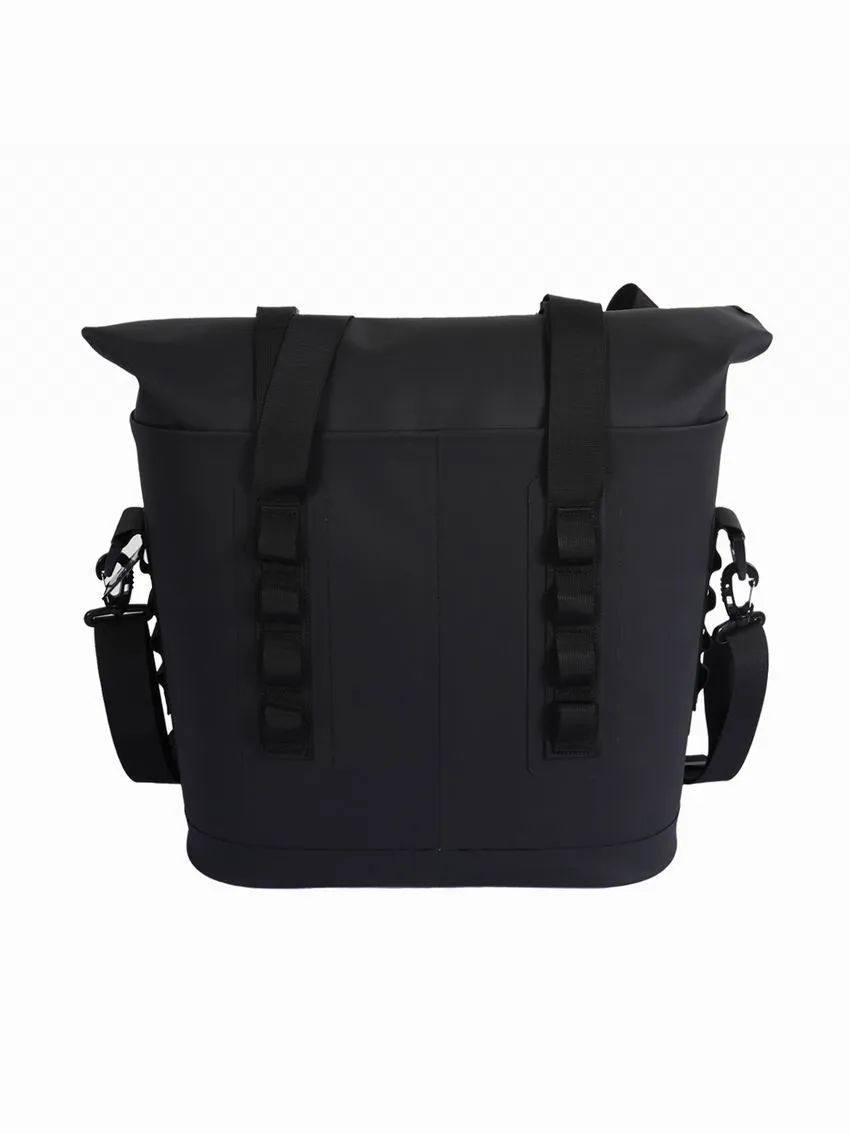


The RFQ determines whether you get a quotation or a guess
Every gap in a request for quotation gets filled by someone, and it will not be you. A supplier quoting an underspecified product has to assume a film thickness, a hardware grade, a packing method, a compliance scope and a colour tolerance, and it will assume whichever version keeps the number attractive. Those assumptions do not disappear at order placement — they surface as clarifications, then as change requests, then as a revised price. A complete RFQ template is therefore not paperwork; it is the mechanism by which you keep control of the specification while the price is still being set. In waterproof bag sourcing, where material is sixty to seventy percent of the ex-works price and the material choices are invisible from outside, the specification is the price.
The measurable effect is on the spread. Send an incomplete RFQ to three suppliers and you will typically receive quotations differing by twenty to thirty percent, almost all of it attributable to different assumptions rather than different efficiency. Send a complete one and the spread usually collapses to under five percent, at which point the difference is real and worth negotiating. The first case is not a negotiation opportunity; it is three different products being priced.
There is a second effect that matters just as much: completeness signals seriousness. A supplier receiving a detailed, internally consistent pack with drawings, tolerances and test criteria knows it is dealing with a buyer who will notice things, and it prices and schedules accordingly. A one-paragraph enquiry goes into the same queue as forty others and gets a number generated from a similar product. Our guide to submitting effective design files covers the drawing side of the same principle; the RFQ is the commercial wrapper around it.
The technical pack: fields that must be filled
A usable technical pack for this category fits on one page plus drawings. It does not need to be beautiful and it does need to be complete, because each field below closes a specific assumption a supplier would otherwise make. Where you genuinely do not know, say so and ask for a recommendation — an honest "advise" is far better than a silent gap, because it invites a stated assumption you can then correct.
| Field | What to specify | Why a gap costs you |
|---|---|---|
| Product type and construction | Welded, stitched and taped, or bonded; roll-top, zipper or clip closure | The single largest driver of cost and performance |
| External dimensions | Length, width, height with tolerance; filled or flat state | Quotes change once the real size is known |
| Capacity and how measured | Litres, and whether roll-top is measured rolled three times | A 30 litre bag varies by 15% depending on the method |
| Base material | Face fabric denier and weave, coating or film type, thickness in mm | Material is most of the price and invisible in a photo |
| Lining and internal structure | Lining material, stiffener, any internal frame or divider | Usually assumed away, then added |
| Hardware | Buckle type and size, zipper type and gauge, D-rings, strap width | Branded versus generic alone can move price 10% |
| Seam and closure method | Weld width, tape width, stitch density, seam seal method | Directly determines the water resistance claim |
| Performance requirement | Water resistance rating and test method, load, abrasion | Without a method, the claim is unenforceable |
| Branding | Method, size, position, number of colours | Four-colour versus one-colour is a real difference |
| Colour | Reference standard and numeric tolerance, per component | The most common source of dispute after placement |
| Quantity and ladder | First order size and the levels you want priced | Determines which price breaks the supplier can offer |
| Target price | Your target, stated as a target rather than a demand | Lets the supplier engineer toward it instead of discounting |
Two habits improve the pack immediately. Attach dimensioned drawings rather than describing dimensions in prose — our sizing and dimension guide shows the standard way to express them — and state tolerances explicitly, because an untoleranced dimension is an invitation to a later argument about whether the delivered product met the specification. A dimension of 320 millimetres means something different at plus or minus 3 than it does at plus or minus 10, and the price differs accordingly.
Commercial terms that must be written, not assumed
Commercial terms are where quotations become incomparable. If you do not state them, each supplier fills them differently, and the resulting numbers describe different transactions. State all of the following in the RFQ itself and require the supplier to quote on that basis, so the comparison is real.
- Incoterm and named port or place. FOB Xiamen, EXW, or DDP to your door — and if DDP, which duties and taxes are included.
- Currency and validity period. A price in US dollars valid for thirty days is a different proposition from one in RMB valid for seven.
- Payment terms: deposit percentage, balance trigger, and method. Note whether a letter of credit is involved and who bears the charges.
- Whether tooling, mould or sample fees are included or quoted separately, and whether sample fees are credited against the bulk order.
- Whether the price includes packaging to your specification, and what that specification is.
- Whether third-party testing and certification costs are included or borne separately.
- Validity of the price against quantity: does it hold if you order less than the quoted quantity?
The Incoterm line deserves emphasis because it is the most consequential and the most often left implicit. The International Chamber of Commerce publishes the current Incoterms rules, and the practical consequence is that an EXW price and a DDP price for the same bag can differ by twenty-five percent with no difference whatever in the product. Always state the term, and always compare on the same one.
Payment terms belong in the RFQ for the same reason: they are priced. A supplier quoting 30 percent deposit with balance before shipment and a supplier quoting 30 percent with balance thirty days after delivery are offering different financing, and the difference is worth roughly one to three percent of the order value. Our payment terms guide sets out the options and their real cost.
Three things you must nail down or the price is fiction
Of everything in an RFQ, three items determine whether the quotation survives contact with reality. Get them wrong and every other field is decoration, because each of them opens a door through which the price will be revised.
| Item | Vague version | Pin-down version | What happens if you leave it vague |
|---|---|---|---|
| Target price and quantity | "Best price please, quantity TBC" | "Target $12.50 FOB at 2,000 pieces; please quote 500, 1,000, 2,000 and 5,000" | Supplier prices an optimistic quantity, then re-quotes when your real volume is smaller |
| Acceptance criteria | "Good quality" | "IPX7 per the stated submersion method; AQL 2.5 for major defects; hydrostatic head above 5,000 mm" | The price describes a product you cannot reject, because nothing was defined as a failure |
| Delivery and split | "As soon as possible" | "500 pieces by 15 March, balance 1,500 by 30 April; confirm both dates" | Supplier quotes a best-case date and the slip becomes your problem |
On the first: stating a target price is not weakness, it is the single highest-leverage line in the document. A supplier told the target and the volume can engineer the specification toward it — a different film, a simpler closure, a consolidated part — and come back with options at your price. A supplier told nothing comes back with its standard construction at its standard margin, and every subsequent conversation is a discount request. Our value engineering guide describes what happens once a target exists.
On the second: acceptance criteria are what convert a price into a promise. Without them, "quality" is whatever arrives. With them, a shipment either meets the stated method and level or it does not, and the conversation is about evidence rather than opinion. Reference a specific test method and a specific sampling level, and require the supplier to confirm in writing that it can meet both — that confirmation is worth more than any price concession.
How wording changes the number you receive
Two RFQs describing the same bag can produce quotations ten percent apart purely on phrasing, and the mechanism is always the same: the supplier prices the risk it can see. Ambiguous language reads as risk and is priced accordingly. Precise language removes the risk and removes the premium. These are the rewrites that matter most.
- "Waterproof" becomes "IPX7 per the stated submersion method, verified on three production samples per 1,000 units". The first invites a claim; the second invites a test.
- "Strong straps" becomes "25 mm webbing, minimum 900 N tensile at the attachment, tested per the stated method". One is unenforceable, the other is a specification.
- "Custom logo" becomes "one-colour heat transfer, 60 by 25 mm, centred on the front panel, colour reference supplied". The second can be priced exactly.
- "Similar to the photo" becomes "construction as per attached drawing revision C". A photograph is not a specification and cannot be inspected against.
- "Recycled material" becomes "GRS-certified recycled polyester with transaction certificate provided per lot". The second has a document and a cost; the first has neither.
The corollary is worth stating: if you cannot write it measurably, you cannot reject it when it is wrong. Every unmeasurable requirement in an RFQ is a term you have already lost, and the supplier knows it. That is why the discipline of writing numbers rather than adjectives is not pedantry — it is the whole mechanism by which the price becomes enforceable.
Acceptance criteria: the section most RFQs omit
Most RFQs specify the product and leave the acceptance criteria to a later conversation, usually the awkward one. Put them in the RFQ and ask the supplier to confirm it can meet them, and two things improve at once: the price becomes comparable across suppliers, and the first shipment becomes rejectable on evidence rather than argument.
- Water resistance: the rating, the test method, the sample size and the frequency — per lot or per production run.
- Dimensional tolerance: plus or minus in millimetres on each stated dimension.
- Colour tolerance: delta E against the supplied reference, per component.
- Defect acceptance: the AQL level and the classification of major, minor and critical defects.
- Hardware performance: cycle life for zippers, tensile for buckles and straps, with test methods.
- Labelling and packaging accuracy: what happens if the packing list, carton marks or barcode are wrong.
- Documentation: which certificates and test reports must accompany each shipment.
The AQL line is the one that does the most work per word. Naming the sampling level and the defect classification in the RFQ prevents the single most common post-placement argument — whether a particular defect is major or minor — and it does so before there is a shipment to argue about. Our AQL sampling guide explains the levels, and our testing standards overview covers which methods are appropriate for which claim.
Quantity, minimums and the price ladder to ask for
Ask for a ladder rather than a single price. A quotation at one quantity tells you almost nothing about your real costs, because you will probably not order that quantity and because the shape of the curve tells you where the economies actually are. Four points is enough: 500, 1,000, 2,000 and 5,000 pieces, quoted FOB on identical terms.
The shape is informative. Steep drops between 500 and 1,000 usually reflect setup and material buy quantities; flat sections above 2,000 indicate that material, not labour, dominates and that further volume will not help much. If the curve is nearly flat everywhere, the product is material-dominated and the only real lever is the specification — which is exactly the point at which a cost engineering conversation becomes more productive than a volume commitment.
State your real expected annual volume separately from the ladder. It is the number that determines how seriously the supplier takes you, and it is honest to give it: "first order 1,000, expected 4,000 to 6,000 across the first year" lets the supplier quote the first order realistically while planning material and capacity for the year. Note that the standard minimum in this category is 500 pieces per style, and asking for a price below that level usually produces either a refusal or a number with a large setup component baked in. Our MOQ guide explains what drives that floor.
Delivery, split shipments and the calendar
Delivery specification is where most otherwise-good RFQs are weakest, usually a single phrase along the lines of "lead time?" A supplier asked for a lead time gives you its best case, because that is what the question invites. Ask instead for what you need and require a confirmation.
- State the dates you need, not the lead time you hope for: "first 500 pieces delivered FOB by 15 March".
- Ask for sampling time and bulk time separately, since they are different processes with different constraints.
- Specify split shipments explicitly if you want them, with quantities and dates per shipment.
- Ask what the supplier needs from you by when — approvals, artwork, deposit — because your own delays are the most common cause of slippage.
- Request a written confirmation of the schedule with the quotation, not after the order.
- Ask about the peak-season position: does the quoted lead time hold in the pre-season months?
That last question is the one that saves seasons. Lead times quoted in a quiet month are often not achievable in the months before a major retail season, and a supplier that confirms a schedule without being asked about seasonality has not told you anything you can plan on. Our lead time guide breaks the cycle into its parts, and our capacity planning page explains why the calendar matters more than the number.
The omissions that turn a quote into a partial quote
The items below are the ones most often missing, and they share a property: each is small relative to the product price and large relative to the surprise it causes. None is exotic, and collectively they are the difference between a quotation you can compare and one you have to re-do.
| Commonly omitted | What to state | Typical cost impact | Consequence of omitting |
|---|---|---|---|
| Packaging | Individual polybag or not, carton specification, inner pack count, palletisation | $0.10 to $0.60 per unit | Charged later as an extra, or arrives unsellable for retail |
| Labelling and marks | Carton marks, barcode, hangtag, care label, country of origin | $0.05 to $0.35 per unit | Warehouse cannot receive; retailer rejects |
| Compliance scope | Which markets, which standards, who pays for testing | $600 to $2,200 per programme | Tests needed after production, at the worst possible time |
| Accessories and spares | Spare buckles, straps, repair patches, instruction sheet | $0.05 to $0.30 per unit | Warranty service becomes whole-bag replacement |
| Colour standard | Physical reference, numeric tolerance, which components must match | Can add 3% to 8% | Dispute at inspection with no way to resolve it |
| Artwork and plates | Who supplies print-ready files, who pays for plates or screens | $80 to $600 one-off | Billed after approval, when it cannot be refused |
| Documentation | Certificates, test reports, declarations required per shipment | Usually small but blocking | Clearance or retailer onboarding delayed |
Packaging deserves a note because it is routinely underestimated. Whether a bag ships in an individual polybag, a retail-ready carton or a bulk pack changes both cost and cube, and cube changes freight — so a packaging decision made after the quotation can move landed cost more than the packaging itself costs. Our packaging options guide covers the choices, and our damage prevention page covers what happens when the choice is wrong.
Compliance scope is the other one worth stating early, because it is not a cost item that can be added later without delay. Naming the target markets and the standards they require at RFQ stage means the supplier can confirm capability and price the testing; discovering it after sampling means a re-test on a finished product, which is slower and more expensive than doing it once. Our restricted substances testing guide and certification overview set out what each market typically requires. Where the requirement is expressed as a standard rather than a regulation, cite the standard number so the supplier quotes against the same document — the ISO catalogue covers most of the test methods used in this category, and a method number is the difference between a comparable quote and a claim.
Reading the response: what a good answer looks like
The quality of a supplier’s answer to your RFQ predicts more about the relationship than the price it contains. Read it for these signals, because they are far more informative than the number and they are visible immediately.
- Questions. A supplier that asks two or three specific questions has read the pack. One that asks nothing has either not read it or intends to resolve the gaps later, in its favour.
- Completeness. Does the quotation answer every field, including packaging, validity and delivery confirmation, or does it quote a unit price and stop?
- Stated assumptions. A good quotation lists what it assumed. That list is exactly the thing to check first, because every assumption is a future revision.
- Price ladder. Did it quote the quantities you asked for, or substitute its own?
- Speed relative to complexity. Five to ten working days for a complete pack is normal and reasonable. Two hours suggests it did not read the pack.
Be alert to the most common pattern in a weak quotation: an attractive unit price with a short list of exclusions at the bottom. Tooling excluded, packaging excluded, testing excluded, artwork excluded, validity seven days. Each exclusion is legitimate in itself — the problem is that they are not the same exclusions the other suppliers made, and the comparison is therefore meaningless until everything is normalised. That normalisation exercise is exactly what our quotation comparison guide is for.
Sending the same RFQ to several suppliers
There is a right way and a wrong way to run a competitive RFQ, and the difference is whether you are gathering information or running an auction. The wrong way is to send the pack to six suppliers, take the lowest number and feed it back to the others. Suppliers recognise this immediately, and the responses they give are designed to survive the round rather than to be accurate — which is why the cheapest number from a six-way auction is very often the one that moves most before shipment.
The right way is to send the identical complete pack to two or three qualified suppliers, state that you are comparing, commit to a decision date, and refuse to relay numbers between them. If you want a supplier to sharpen its price, tell it what it needs to beat and let it decide how — a specification change, a volume commitment, a different material. That produces a genuine improvement rather than a number engineered to win a round.
Two further practices keep the process honest. Give all recipients the same information at the same time, including your expected annual volume, so no one is disadvantaged by knowing less. And tell them what the decision will be based on — price, sampling speed, compliance capability, capacity — because a supplier that knows the criteria can respond to them, and that is the point. Our second source qualification guide covers what to do with the winner and the runner-up afterwards.
Revision control: version the RFQ or lose the specification
RFQs change, and uncontrolled change is how two suppliers end up quoting different products under the same reference. Every revision should carry a number and a date, and every recipient should receive the same revision. It sounds administrative and it prevents a genuinely expensive class of error, because the failure it causes is invisible until the shipment arrives.
- Number every version: RFQ-2214 revision A, B, C, with the date and a one-line summary of what changed.
- Send revisions to all recipients on the same day, even the ones you have provisionally eliminated, until the decision is formally made.
- Require each quotation to state which revision it responds to. A quote without a revision reference should be returned.
- Keep the drawings under the same revision control as the document. A drawing updated without a version bump is the most common failure.
- After placement, freeze the revision and attach it to the purchase order as the controlling specification.
The final point is the one that makes the rest worthwhile. The revision that was quoted is the specification that was bought, and attaching it to the purchase order is what prevents a slow drift between what was priced and what is made. Without that link, the specification lives in an email thread and the product lives on a line, and they diverge.
A checklist to copy into every RFQ
The list below is the practical takeaway: twenty-two items, in the order they appear in a pack. If every one is either filled in or marked "supplier to advise", the quotation you receive will be comparable, and the spread across suppliers will usually be under five percent rather than twenty-five.
- Product type, construction method and closure type.
- External dimensions with tolerances, and whether measured filled or flat.
- Capacity and the method used to measure it.
- Base material: fabric denier, coating or film type, thickness.
- Lining, stiffener and any internal structure.
- Hardware specification: buckles, zippers, rings, strap widths.
- Seam and closure method, including weld or tape width and stitch density.
- Performance requirements with the test method for each.
- Branding method, size, position and number of colours.
- Colour references and numeric tolerance per component.
- Drawings, with revision number and date.
- Quantity ladder: 500, 1,000, 2,000, 5,000, plus expected annual volume.
- Target price, stated as a target with the basis.
- Incoterm, named port, currency and quotation validity.
- Payment terms, and whether tooling or sample fees are included.
- Acceptance criteria: AQL level, defect classification, test frequency.
- Packaging specification, including inner pack count and palletisation.
- Labelling, carton marks, barcodes and documentation per shipment.
- Compliance scope: target markets, standards, and who pays for testing.
- Accessories, spares and instruction material.
- Delivery dates, split shipment schedule, and what you must supply by when.
- Decision criteria and decision date, stated to all recipients.
Two hours spent on that list replaces weeks of clarification and, more importantly, removes the class of surprise that arrives after the deposit has been paid. It is the least glamorous hour in the whole sourcing process and probably the highest-return one.
If you would like your specification priced against a real production route, send the completed pack — drawings, quantity ladder, target price and target market — and review how a custom bag programme runs from first sample into bulk production. Minimum order quantity is 500 pieces per style, sampling takes 6–10 working days, bulk production runs 35–50 days, and quotations are issued FOB Xiamen with the quantity ladder, validity and packaging basis stated on the quote itself.
Frequently Asked Questions
Q1. What should a waterproof bag RFQ include?
A technical pack — construction, dimensions with tolerances, materials, hardware, seam method, performance requirements, branding and colour standards — plus commercial terms: Incoterm, currency, validity, payment terms, acceptance criteria, packaging and delivery dates.
Q2. Why do quotations from different suppliers vary so much?
Usually because each supplier filled the gaps in the RFQ differently. A complete pack typically narrows the spread from twenty to thirty percent down to under five percent, because everyone is then pricing the same product.
Q3. Should I state my target price in an RFQ?
Yes. A target plus a volume lets the supplier engineer the specification toward the number. Withholding it gets you the standard construction at the standard margin, and every later conversation becomes a discount request.
Q4. What acceptance criteria belong in an RFQ?
Water resistance rating with the test method and frequency, dimensional tolerance, colour tolerance, AQL level with defect classification, hardware performance, labelling accuracy and the documentation required per shipment.
Q5. How many quantity points should I ask to be quoted?
Four: 500, 1,000, 2,000 and 5,000 pieces on identical terms. The shape of the curve tells you where the economies are and whether the product is material-dominated or labour-dominated.
Q6. What is the most commonly omitted item in an RFQ?
Packaging. It changes unit cost, carton cube and therefore freight, so deciding it after the quotation can move landed cost more than the packaging itself costs.
Q7. Should I ask for lead time or state the date I need?
State the date. Asking for a lead time invites a best-case answer; stating the date and requiring written confirmation produces something you can plan against.
Q8. How long should a supplier take to quote?
Five to ten working days for a complete pack is normal. A quotation returned in a few hours usually means the pack was not read, and a number that took five minutes to produce will move.
Q9. Is it a problem if a supplier asks questions about my RFQ?
No, it is a good sign. Two or three specific questions mean the pack was read. A quotation with no questions usually means gaps will be resolved later, in the supplier’s favour.
Q10. Should I tell suppliers I am comparing quotations?
Yes, and tell them the decision criteria and the decision date. What damages the process is relaying one supplier’s number to another, which turns it into an auction and produces numbers built to survive the round.
Q11. How should I handle changes to the RFQ?
Version it. Number every revision with a date and a summary of what changed, send it to all recipients on the same day, and require each quotation to state which revision it responds to.
Q12. Why does colour need a numeric tolerance?
Because "match the sample" cannot be inspected against. Specify a physical reference and a delta E tolerance per component, and keep a retained sealed sample from each production batch.
Q13. Do I need to specify compliance requirements at RFQ stage?
Yes. Naming the target markets and standards lets the supplier confirm capability and price the testing. Discovering it after sampling means re-testing a finished product, which is slower and dearer.
Q14. What payment terms should I state?
Deposit percentage, balance trigger, method, and whether a letter of credit is involved and who bears the charges. Terms are priced, and the difference between them is worth roughly one to three percent of order value.
Q15. Should tooling and sample fees be in the quotation?
State whether they are included or separate, and whether sample fees are credited against the bulk order. Ambiguity here is one of the most common sources of a post-approval surprise.
Q16. What does a weak quotation look like?
An attractive unit price with a short list of exclusions at the bottom: tooling, packaging, testing, artwork, seven-day validity. Each is legitimate, but different exclusions make the comparison meaningless until normalised.
Q17. How many suppliers should I send an RFQ to?
Two or three qualified ones, with identical information at the same time. Six recipients with the lowest number fed back produces responses engineered to win a round rather than to be accurate.
People Also Ask
What is an RFQ in bag sourcing?
A request for quotation containing a complete technical pack and commercial terms, so suppliers price the same product on the same basis rather than filling gaps with assumptions.
How do I get an accurate bag quote?
Specify materials, dimensions with tolerances, hardware, acceptance criteria, packaging, compliance scope and delivery dates, and require written confirmation of each.
Why do supplier quotes vary so much?
Because each one fills unspecified gaps differently. A complete RFQ usually narrows the spread from around 25 percent to under 5 percent.
Should I tell a supplier my target price?
Yes. With a volume attached, it lets the supplier engineer toward the number instead of discounting a standard construction.
What is usually missing from an RFQ?
Packaging, labelling, compliance scope, accessories and colour standards. Each is small in price and large in surprise.
How long should a supplier take to quote?
Five to ten working days for a complete pack. A quote returned in hours usually means the specification was not read.