Cost engineering is the discipline of removing cost from a product without removing the function the customer is actually paying for. On a waterproof bag those functions are unusually easy to name: keep water out at a stated depth, carry a stated load, survive abrasion against rock and boat decks, close and reopen a few thousand times, and look like the brand. Ask a supplier for "a cheaper version" and you will get one, because that is what a price request buys — thinner film, fewer stitches per inch, a lighter buckle, a generic zipper. Ask instead which functions are essential and which are inherited decoration, and the same drawing usually gives up eight to fifteen percent of its cost with no measurable loss of performance. Both routes start from the same sentence and end in different products.
This guide walks the method in the order it has to happen: why a price request and a value engineering request produce different products, how to write functions so they can be costed, the four reduction paths and what each one costs you in performance, why the most common saving is really cost pushed downstream, what evidence a change proposal must carry, how target costing reverses the whole calculation, a worked reduction table, how to run the session with a supplier without poisoning the relationship, and when not to do it at all. MOQ 500 pieces per style, sampling in 6–10 working days, bulk in 35–50 days, FOB Xiamen: these are the working terms at QUANZHOU JUNYUAN BAGS, custom waterproof bag production since 2014 in a 4,950 m² SGS-verified facility.

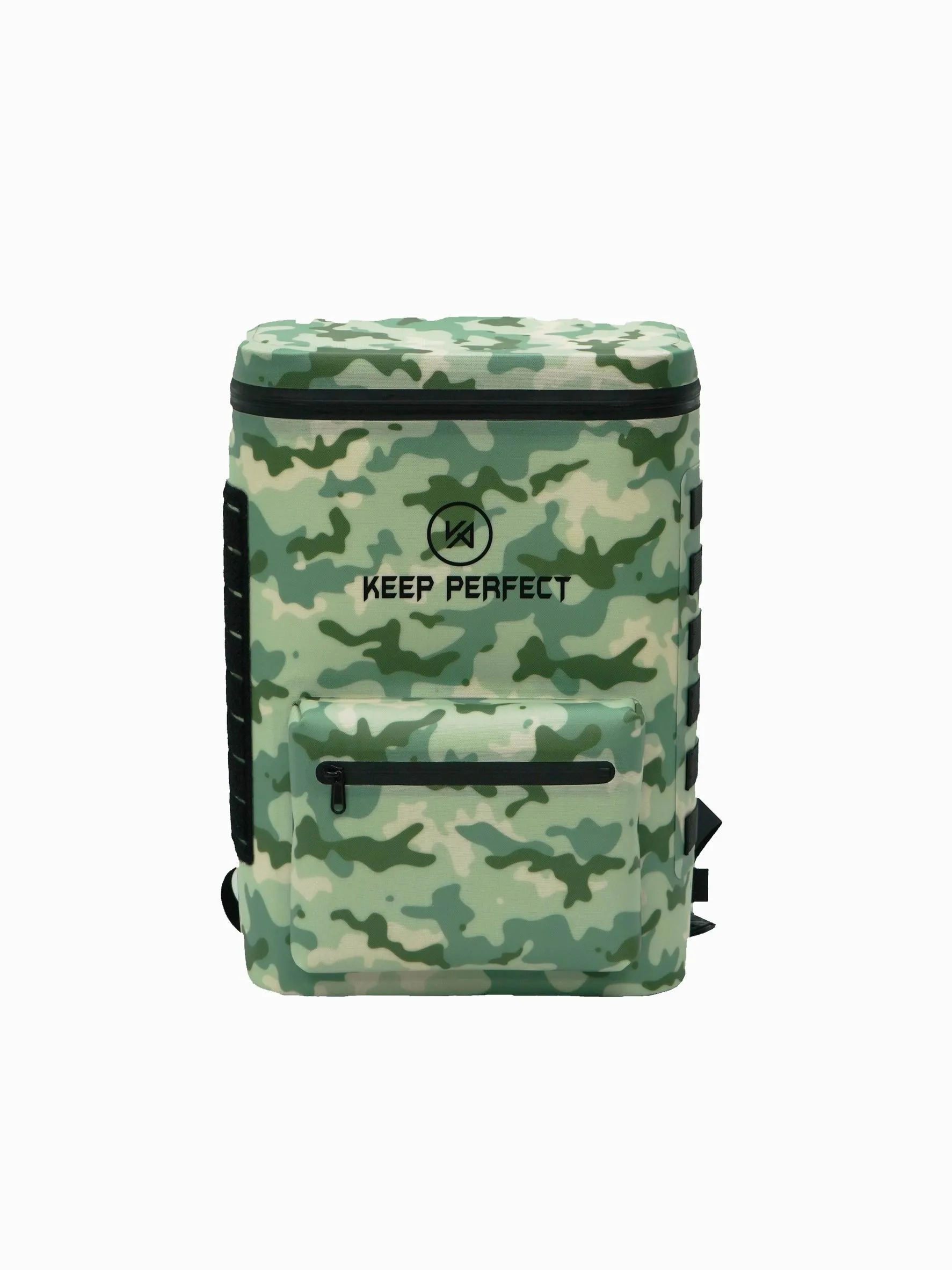

A price request and a cost engineering request are different products
The sentence "can you do this for less" is answered honestly and badly. A factory asked for a lower price has exactly one lever it can pull without redesigning anything: reduce what goes in, or reduce what gets done. So it quotes thinner film, a lower-denier face fabric, a lighter webbing, a non-branded zipper and a looser inspection standard. Each of those is a real saving, and each of them is withdrawn from the customer rather than from the cost. Good value engineering asks a different question — which functions must survive — and therefore produces a different list. Serious waterproof bag cost reduction work starts from the function, not from the target number, because the function is the only thing that tells you which costs are safe to remove.
The practical difference shows up as a number. On a mid-specification 25 litre welded dry bag quoted at $11.80 FOB, a blunt price request typically returns a $10.40 quote built from a 0.10 mm film reduction, a 25 mm to 20 mm webbing change and a generic #8 zipper. The same product under function-led review usually yields $10.60 to $10.90 from removing a decorative topstitch, relaxing a cut tolerance nobody needed, consolidating two reinforcement patches into one, and dropping the inner retail polybag for a band — with the film, webbing and zipper untouched because those functions were declared essential.
| Change produced by a price request | FOB saving per unit | What the customer loses | Net effect after 12 months |
|---|---|---|---|
| Film 0.42 mm to 0.32 mm | $0.38 | Hydrostatic head roughly 8,000 mm to 3,500 mm; abrasion cycles halved | Negative once returns rise past about 2% |
| Webbing 25 mm to 20 mm | $0.11 | Strap pull strength about 900 N to 620 N | Negative for any load-bearing strap |
| Stitch density 8 spi to 6 spi | $0.22 | Seam strength down roughly 18% | Negative on welded-plus-stitched seams |
| Branded to generic #8 zipper | $1.40 | Cycle life roughly 8,000 to 2,500 cycles | Negative; also the most complained-about part |
| Dropping incoming film inspection | $0.06 | One bad film lot reaches bulk | Catastrophic; a full batch is at risk |
Read that table as a rule rather than a list: any saving that lives in a function the customer can perceive will come back as a return, a review or a claim, and those arrive at your cost, not the factory’s. It is also worth knowing where the money actually is. Our cost breakdown for custom waterproof bags shows the split between material, labour, overhead and margin on a typical unit; for most welded styles, material is sixty to seventy percent of the ex-works price, which is exactly why material substitution is the first thing offered and the last thing to accept blindly.
Write the function before you write the target
Function analysis is a small discipline with an outsized effect: express every feature as a verb plus a measurable noun, then ask what it costs and what it is worth. "Waterproof" is not a function because it cannot be measured against a price. "Exclude water at one metre for thirty minutes, per the agreed submersion method" is a function, and it can be tested, costed and traded. The same test applied across a bag usually exposes two things: functions that are essential and over-specified, and features that are neither.
Over-specification is the larger prize and almost nobody looks for it. A bag sold as splash-resistant for a commuter range does not need the film thickness of a whitewater dry bag, yet it is routinely specified that way because someone copied a competitor’s sheet. A roll-top closure on a bag that never goes near water is decoration with a real cost — extra panel length, an extra weld pass, an extra buckle, four more minutes of assembly. Write the function, then check the specification against it, and the gap is the first place to look for cost.
| Function (verb + measurable noun) | Current means | Approx. cost share | Essential? | Verdict |
|---|---|---|---|---|
| Exclude water at 1 m / 30 min | 0.42 mm TPU film, RF welded seams | 31% of BOM | Yes | Do not touch |
| Carry 8 kg on shoulder straps | 25 mm webbing, boxed attachment | 7% | Yes | Do not touch |
| Close and reopen 5,000 times | Branded #10 zipper | 12% | Yes | Do not touch |
| Resist abrasion on base | 840D panel, 0.6 mm | 9% | Situational | Down-spec for urban ranges |
| Communicate brand on front | Silicone patch, 4-colour | 6% | Yes, but cheaper | One-colour or heat transfer |
| Look premium on shelf | Roll-top closure | 8% | No for this SKU | Remove or make it functional |
| Protect during retail handling | Individual polybag | 2% | No | Replace with band |
Two habits make this work. First, do the analysis on the bill of materials, not on the finished sample, because the BOM is where cost and function are joined line by line — our BOM breakdown guide sets out the line structure to work from. Second, do it with the person who will produce the bag in the room, because roughly a third of the savings that survive validation are manufacturing changes rather than material changes, and only the production side knows which steps are there by habit.
The four reduction paths, and what each one costs you
Almost every legitimate saving in this category falls into one of four paths, and they are not equal. They differ in how much they save, how long they take to validate, and what they cost you in performance or risk. Knowing which path a proposal belongs to tells you immediately how much scrutiny it deserves.
| Path | Typical FOB saving | Validation effort | What it costs you | Best used when |
|---|---|---|---|---|
| Material substitution | 4% to 12% | High: test the performance claim | Measurable performance, unless the spec was over-set | The original spec was copied, not derived |
| Process simplification | 3% to 9% | Medium: pilot run plus inspection | Little, if the removed step added no function | A step exists for habit or for a defect long fixed |
| Part consolidation | 2% to 7% | Medium: tooling or pattern change | Flexibility; one part now does two jobs | Tooling amortises across your volume |
| Tolerance relaxation | 1% to 4% | Low: usually just yield data | Nothing measurable, if the tolerance was decorative | Yield loss or rework is visible in the line |
The ordering matters. Tolerance relaxation and process simplification are the cheapest to prove and the least likely to hurt the customer, which is why they should be exhausted first even though they save less. Material substitution saves the most and carries the most risk, which is why it should be last and always validated. The common failure is the reverse order, because material substitution is the easiest quote to obtain and therefore the first one on the table.
Material substitution: where the saving hides and where it bites
Material is the biggest line and the most dangerous one. The honest version of substitution is not "use a cheaper film" but "the specification was set for a use case this SKU does not have". A commuter backpack that ships with the film thickness of a rafting dry bag is carrying cost for a function nobody bought. Down-specifying against the declared function — for example from 0.42 mm to 0.35 mm while holding hydrostatic head above 5,000 mm and abrasion above 8,000 cycles — is a legitimate saving of around $0.22 per unit, and it is defensible because the function was written down first.
The dishonest version is the same change made without a declared floor, and it fails in a specific way: the property that drops first is almost never the one being watched. Film thickness reduction hits puncture and abrasion resistance before it hits hydrostatic head, so a bag that still passes a water test can fail in the field within a season. Hardware behaves the same way — a generic acetal buckle looks identical to a branded one and typically loses twenty to thirty percent of its tensile strength, which shows up as breakage at the attachment point rather than as a buckle failure anyone photographs.
Three rules keep this path honest, and the third is the one that connects this work to the broader literature on the cost of quality, which the American Society for Quality frames usefully as prevention, appraisal and failure cost — a substitution that removes appraisal cost usually increases failure cost. Never substitute more than one material variable per trial, or you will not know which change caused the result. Never substitute into a safety or regulatory function — flame resistance, restricted substances, food contact — without re-testing the compliance claim, because the certificate does not travel with the price. And always re-quote the substitute against the same quantity, because a cheaper material that carries a higher minimum buy quantity can increase your working capital more than it reduces your unit cost.
Process simplification: fewer steps, fewer defects, less cost
Every step in a manufacturing route costs money twice: once in labour and machine time, and again in the defects the step can introduce. This is the path people undervalue, because the saving does not appear as a line on the BOM — it appears as minutes removed from a route and as a lower defect rate afterwards. On a bag with eleven operations, removing one four-minute operation at a fully loaded labour rate of roughly $0.09 per minute saves about $0.36 per unit, which is comparable to a material change and far easier to prove.
The candidates are usually known to the line rather than to the spec sheet: a secondary topstitch added years ago to cover a pucker that a later pattern change already fixed; a pre-trim operation made unnecessary by a better cutting die; a manual turn-and-press where a jig would do it in one motion; an inspection station that duplicates the next one. Ask the production supervisor which stations exist because of a problem that no longer exists, and you will get a list.
The risk with this path is that a step sometimes carries a function nobody recorded — a basting stitch that holds a curve during welding, a cooling dwell that lets a weld set before the next fold. Remove it on paper and the defect appears four stations later. That is why process changes are validated with a pilot run rather than a sample: twenty to fifty pieces built on the production line under normal conditions, then inspected and tested, tells you in a day what a single hand-made sample cannot. Our comparison of welding routes in production shows how much the step count and the defect profile move together.
Part consolidation: merging two components into one
Consolidation removes parts, and a removed part is a remarkably good saving because it is charged five times in the original cost: the part itself, the purchase order and inbound inspection for it, the inventory and handling, the assembly time to fit it, and the quality risk of it being wrong. A buckle-and-adjuster pair that becomes a single moulded component might save $0.18 in purchase price and another $0.20 in handling and assembly, which is why consolidation often outperforms its apparent BOM saving.
In this category the usual candidates are a reinforcement patch merged into a panel pattern, a webbing anchor merged into a welded seam, a daisy chain produced as part of the panel rather than applied to it, and a stiffener whose job is done by a folded edge. Each of these also removes a weld or stitch line, which removes a leak path — so consolidation is one of the few changes that lowers cost and raises reliability at the same time.
The cost of this path is tooling and flexibility. A merged part usually needs a new die, a new mould or a new pattern, and tooling in this category runs from a few hundred dollars for a cutting die to several thousand for a moulded component, amortised over your volume. At 500 pieces per style, a $2,400 mould adds $4.80 per unit and destroys the business case; at 6,000 pieces across a season it adds $0.40 and looks obvious. Our guide to tooling and mould costs and ownership covers how to structure that spend and who should hold the asset.
Tolerance relaxation: the cheapest saving nobody asks for
Tolerances are specifications nobody negotiates and everybody pays for. A cut panel held to plus or minus two millimetres when the assembly tolerates five costs money in three places that never appear on a quote: slower cutting, higher material trim waste, and rework or rejection when a panel falls outside a limit that did not need to be that tight. Loosening a tolerance that the assembly demonstrably does not need typically moves first-pass yield from around 94 percent to 98 percent, and on a $9 material-and-labour base that is worth roughly $0.35 per unit — for a change that costs nothing to implement.
The same logic applies to appearance tolerances. A colour match specified at a delta E of 1.0 across all components, when the parts are never adjacent in use, forces a supplier to sort or re-dye; specifying 1.0 where parts meet and 2.0 where they do not is a real saving with no visible consequence. Weld width specified as a single value rather than a minimum is another: a 12 millimetre weld with a plus or minus one millimetre band is more expensive to hold than a 10 millimetre minimum with no upper limit, and performs identically.
The discipline is to relax tolerances only where you can show the assembly tolerates it, which means asking for yield and rework data by station before proposing anything. A supplier that cannot produce that data is telling you something about its process control, and that is worth knowing before you ask it to change anything at all.
The most common fake saving is cost pushed downstream
This is the single failure mode that separates real cost engineering from cost cutting, and it is common because it is invisible at the moment of decision. A change that removes $0.40 from the FOB price and adds $0.55 of cost at your warehouse is a price increase wearing a saving’s clothes. The cost does not disappear; it moves to whichever party is least able to see it coming, and that is usually the brand.
| Saving taken at the factory | FOB saving | Cost that appears downstream | Where it lands | Verdict |
|---|---|---|---|---|
| Thinner film | $0.38 | Field failures and returns; each return costs roughly $14 all-in | Your P&L and your reviews | Negative above about 2% return rate |
| Skipping per-lot hydrostatic testing | $0.05 | One untested lot across 3,000 units | A full recall or a silent quality collapse | Never acceptable |
| Generic zipper | $1.40 | Warranty claims at roughly 3% at $22 per claim | Your warranty provision and your reviews | Negative |
| Removing desiccant from cartons | $0.09 | Container rain staining on arrival | Write-down on part or all of a shipment | Negative on sea freight |
| Lighter carton board | $0.07 | Crushed bottom rows after a long voyage | Damaged goods on receipt | Negative above modest stack heights |
| No spare parts allowance | $0.04 | No replacement buckles for warranty service | Whole-bag replacements instead of $0.60 parts | Negative |
The arithmetic is simple enough to do on every proposal: expected downstream cost per unit equals the change in failure rate multiplied by the cost of a failure, and it has to be charged against the saving before the change is approved. A $0.38 film saving that moves the return rate from 1.8 percent to 4.6 percent costs 2.8 percent times $14, which is $0.39 — the change is already losing before any reputational effect is counted. Our warranty and return rate analysis gives the method for measuring that rate properly by SKU and by reason, which is the input this calculation depends on.
There is a second, subtler version of the same failure: a change that is free for you and expensive for the factory. Asking for faster sampling, smaller batches or a lower price on the same specification does not remove cost, it transfers it into a relationship that will be settled later through priority, honesty about problems, or willingness to hold capacity for you in peak season. Cost pushed downstream includes cost pushed into the relationship.
What a defensible cost reduction proposal must contain
A change proposal without evidence is a preference, and preferences should not be approved. The standard for a waterproof bag change is not high — it is about eight items — but all eight have to be present, because each one closes a specific way the change can fail.
- The baseline: the current specification, the current measured performance, and the current unit cost, stated as numbers rather than adjectives.
- The single variable being changed, with everything else held constant. Two variables in one trial produces a result nobody can attribute.
- Sample size and how the samples were made — hand-made samples prove nothing about a production route; twenty to fifty line-built pieces do.
- The test method and the standard it follows, so the result can be repeated by someone else.
- Before and after numbers for every property the change could plausibly affect, not only the one being watched.
- A production feasibility note: same machines, same operators, same cycle time or better.
- A pilot quantity and a sign-off criterion, agreed before the pilot runs rather than argued after.
- The downstream cost estimate, including returns and warranty, charged against the saving.
Two further points decide whether the proposal is credible. Any change touching water resistance must be validated on production-built samples after at least one full wash or conditioning cycle, because film and coating behaviour changes after wetting and drying in a way a fresh sample will not show. And any change touching a regulated claim needs the compliance test repeated, since the certificate was issued for the original construction. Our guidance on moving validation from the lab to the real world covers which tests are worth running and which are theatre. Where a proposal cites a test method, cite the standard itself rather than a summary — the ISO catalogue is the reference most waterproof and textile test methods trace back to, and the standard number makes the result repeatable by someone else.
Finally, put the proposal in writing and keep it. Twelve months later, when the question is why the 30 litre bag developed a seam problem and the 20 litre did not, the only thing that will answer it is a dated record of what changed, what was tested and what the numbers were.
Target costing: start from the shelf price and work backwards
Cost-plus pricing takes the factory quote, adds the margin stack and discovers the retail price, which is how brands end up with a product the market will not pay for. Target costing reverses it: fix the price the market will pay, subtract the margin the channel and the business require, and the remainder is the cost the product is allowed to have. The design is then engineered to hit that number rather than priced after it is finished. It is uncomfortable and it is the only method that reliably produces a viable product.
| Step | Worked figure | Note |
|---|---|---|
| Retail price the market will pay | $69.00 | Set by competitive shelf, not by your costs |
| Less retailer margin at 2.2x | – $37.60 | Leaves your wholesale price at $31.40 |
| Less freight, duty, clearance and delivery | – $4.20 | Use your real landed cost model |
| Less fulfilment, packaging and overhead | – $4.10 | Per unit at planned volume |
| Less marketing as a share of revenue | – $2.50 | Percentages scale; fixed budgets do not |
| Less returns and warranty provision | – $1.40 | Charge the real rate, not zero |
| Target cost the product may have | $18.80 | This is the number the design must meet |
| Target FOB price | about $14.60 | Working back through landed cost |
The value of that table is not the arithmetic, it is the conversation it forces. Once the target FOB is $14.60 and the current design quotes at $17.10, the question changes from "can you do better on price" to "here is the function this product must deliver and here is the cost it has to deliver it at". That is a brief a supplier can actually work on, and it is the brief our pricing strategy guide builds from the other direction. Suppliers respond to a defined engineering problem very differently from a demand for a discount.
One caution: a target that cannot be met by any construction is not a target, it is a wish, and chasing it produces exactly the downstream-pushing behaviour described earlier. When the gap is large, the honest options are to move the retail price, change the channel, reduce the feature set, or decline the product. Cutting validation to close the gap is the one option that always costs more than it saves.
A worked reduction table for one welded dry bag
The following is a composite of the kind of sheet a VA/VE session actually produces for a 25 litre welded dry bag quoted at $11.80 FOB at 3,000 pieces. Savings and validations are indicative of what these changes typically deliver, not a promise for any specific product.
| Candidate change | Path | Unit saving | Validation required | Verdict |
|---|---|---|---|---|
| Relax panel cut tolerance from ±2 mm to ±5 mm | Tolerance | $0.33 | Yield data over one production run | Approve; no customer-visible effect |
| Remove secondary decorative topstitch | Process | $0.36 | Pilot of 30 pieces, visual and leak test | Approve once pilot passes |
| Merge base reinforcement into panel pattern | Consolidation | $0.41 | New die $380, abrasion test | Approve at this volume |
| Down-spec film 0.42 mm to 0.35 mm | Material | $0.22 | Hydrostatic, abrasion and puncture; full test set | Approve only with a written floor |
| One-colour brand mark instead of four | Process | $0.28 | Colour fastness and adhesion | Approve |
| Replace retail polybag with paper band | Material | $0.14 | Scuff inspection after transit test | Approve for direct channel |
| Drop one incoming inspection station | Process | $0.06 | Risk assessment | Reject; removes a control |
| Generic zipper substitution | Material | $1.40 | Cycle life and salt spray | Reject; cycle life halves |
The shape of that table is the point. Five approved changes totalling about $1.74 per unit, or roughly fifteen percent, none of which touches a function the customer declared essential — and two rejected candidates, one of which would have been the largest single saving on the page. A session that approves everything is not a value engineering session; it is a discount with extra steps.
Note also that the largest approved item is a consolidation that required a $380 die. Tooling is frequently the thing that unlocks the saving, and it is worth modelling explicitly rather than treating it as an obstacle — amortised over a season it is usually the cheapest cost on the sheet.
Running the session with your supplier without wrecking the relationship
Cost engineering works only if the supplier brings real ideas, and suppliers bring real ideas only when they believe the exercise is not a prelude to a price demand. Four practices make that difference. Share the target price and the volume, not your margin — a supplier that knows the target can engineer toward it, while a supplier that only knows you want "less" will simply shave. Commit to something in return: a share of the saving for a defined period, a longer term, a larger allocation, or a simplified range. And accept that some proposals will be rejected on evidence, which is how the supplier learns what you actually value.
Conversely, three behaviours reliably destroy the exercise. Running the same specification to three suppliers and feeding the lowest number back is a reverse auction, and the only thing it engineers is the quality. Asking for a quote against a change that has not been validated invites the supplier to price a guess, which is how unvalidated changes enter production. And changing the specification after price agreement — the classic move of accepting a quote and then asking for the original features back — is the fastest way to be quoted defensively for the next five years.
Structure the session as an agenda with a decision at the end: review the function list, walk the four paths in order, capture candidates with owners and validation dates, agree which are approved subject to evidence, and set the next review. Sixty to ninety minutes is enough for a single style. Our negotiation guide covers the commercial framing around this, and our method for normalising quotations is the right tool when you do need to compare competing numbers.
When not to cost engineer
There are situations where the method is the wrong instrument, and knowing them is part of knowing the method. A product in its first season has no return data, no field feedback and no stable specification; engineering cost out of it before you know what customers actually complain about is optimising the wrong variable. Wait until there is a season of data, then work on what the data points at.
- The function is safety or regulatory: restricted substances, flame resistance, load ratings, child-safe closures. Re-validating costs more than the saving.
- The SKU is the hero product: the one that carries the reviews, the photography and the brand story. Its cost is marketing spend as much as manufacturing cost.
- The saving depends on a variable you cannot test in-house or at a third-party lab. Unmeasured risk is not a saving.
- Volume is too low to amortise the tooling the change requires. At 500 pieces per style, a $3,000 mould is $6.00 per unit.
- The change would alter a documented claim on the packaging or listing. That is a compliance and labelling project, not a cost project.
There is also a timing rule that saves a lot of wasted work: cost engineering belongs after the sample is approved and before the tooling is committed. Before approval, the design is still moving and any saving is provisional. After tooling, every change carries a tooling cost and a re-validation cost, and the business case collapses for anything small. The window is short and it is worth planning for deliberately rather than discovering it has closed.
Done in that window, with functions written down and evidence required, the method typically returns eight to fifteen percent without touching anything a customer would notice — which is a very different result from the same percentage taken out of the specification. If you want to run this against a real design, the practical next step is a target price, a function list and a specification you are willing to share. Review how a custom bag programme moves from first sample into bulk production and send us the drawing, the target price and the planned volume. Minimum order quantity is 500 pieces per style, sampling runs 6–10 working days, bulk production 35–50 days, and quotations are issued FOB Xiamen.
Frequently Asked Questions
Q1. What is the difference between value analysis and value engineering?
Value analysis examines an existing product to find cost that delivers no function. Value engineering applies the same method during design, before the specification is fixed. In practice both use the same tool: write the function as a verb plus a measurable noun, then ask what the current means costs and whether a cheaper means still delivers it.
Q2. How much can VA/VE realistically save on a waterproof bag?
Typically eight to fifteen percent of the FOB price without touching a function the customer declared essential. Savings beyond that almost always come from material down-specification and should be treated as a performance change with validation attached, not as free cost reduction.
Q3. Why is asking for a cheaper version the wrong opening move?
Because the factory has only one lever it can pull without redesigning: reduce what goes in or what gets done. That produces thinner film, lighter webbing and generic hardware, all of which withdraw value from the customer and return to you as returns, reviews and warranty claims.
Q4. How do I write a function so it can be costed?
Use a verb plus a measurable noun. "Waterproof" cannot be costed or traded; "exclude water at one metre for thirty minutes by the agreed submersion method" can be tested, priced and compared against a cheaper means of achieving it.
Q5. What is the cheapest cost reduction that is usually missed?
Tolerance relaxation. Loosening a cut tolerance the assembly does not need typically moves first-pass yield from around 94 percent to 98 percent, worth roughly $0.35 on a nine dollar base, for a change that costs nothing to implement.
Q6. What does it cost to remove one production step?
About $0.36 for a four-minute operation at a fully loaded labour rate near $0.09 per minute, plus the defect reduction from having one fewer operation that can go wrong. The pilot run to confirm it typically costs a day of line time.
Q7. When does part consolidation pay for its tooling?
When the volume amortises it. A $2,400 mould is $4.80 per unit at 500 pieces and destroys the business case; the same mould at 6,000 pieces across a season is $0.40 per unit and is usually the cheapest saving on the sheet.
Q8. What is the most common fake cost saving?
Cost pushed downstream. A change that removes $0.40 from the FOB price and adds $0.55 of returns, warranty or damage cost at your warehouse is a price increase. Always charge the change in failure rate multiplied by the cost of a failure against the saving.
Q9. How do I calculate whether a material down-specification is worth it?
Multiply the expected change in failure rate by the fully loaded cost of a failure, then compare to the saving. A $0.38 film saving that moves returns from 1.8 percent to 4.6 percent costs 2.8 percent times $14, or $0.39, so it is already losing before reputation is counted.
Q10. Why must only one variable change per trial?
Because two variables produce a result nobody can attribute. If both film thickness and weld temperature move together and the seam fails, you have learned nothing about which change caused it, and you will have to run the trial again.
Q11. How many pilot pieces are enough to validate a change?
Twenty to fifty pieces built on the production line under normal conditions. Hand-made samples prove nothing about a production route, because they bypass exactly the steps where the change will either work or fail.
Q12. What is target costing and how does it differ from cost-plus?
Target costing fixes the price the market will pay, subtracts channel margin, landed cost, marketing and warranty provision, and the remainder is the cost the product is allowed to have. Cost-plus does the reverse and frequently produces a product the market will not pay for.
Q13. Should I run the same specification past three suppliers to get the best cost idea?
Not as a cost engineering exercise. Feeding the lowest number back is a reverse auction, and the only variable it engineers is quality. Share a target price and a volume instead, and the supplier can engineer toward a defined problem.
Q14. What should I offer a supplier in return for cost engineering work?
Something concrete: a share of the saving for a defined period, a longer agreement, a larger volume allocation, or a simplified range. A supplier that believes the exercise precedes a price demand will bring no real ideas to it.
Q15. When should I not attempt cost engineering?
In a product’s first season, on safety or regulatory functions, on the hero SKU that carries your reviews, when the saving depends on something you cannot test, and when volume is too low to amortise the tooling the change needs.
Q16. When in the development cycle should the session happen?
After the sample is approved and before tooling is committed. Earlier, the design is still moving and savings are provisional; later, every change carries tooling and re-validation cost and small candidates stop being worth doing.
Q17. Can a change that lowers cost also improve quality?
Yes, and part consolidation is the clearest case: merging a reinforcement into the panel pattern removes a part, an assembly step and a seam at the same time, so the product gets cheaper and has one fewer leak path.
People Also Ask
What is value engineering in bag manufacturing?
A structured method that removes cost without removing function. You write each function as a measurable statement, find a cheaper means of delivering it, and validate before approving.
How much cost can value engineering remove?
Typically eight to fifteen percent of FOB without touching anything the customer notices. Beyond that, expect material down-specification and treat it as a performance change.
What is the biggest risk in cost reduction?
Cost pushed downstream. A saving at the factory that becomes returns, warranty claims or freight damage at your warehouse is not a saving at all.
What is target costing?
Fix the retail price the market will pay, subtract every layer of margin and cost, and the remainder is the cost the design is allowed to have. Then engineer to that number.
Do I need test data before accepting a cheaper material?
Yes. Require before and after numbers for every property the change could affect, tested on production-built samples, not hand-made ones.
When should I run a VA/VE review?
After sample approval and before tooling commitment, on a product with at least one season of return data if it is an existing style.