Terminal tackle damages bags in a way no other cargo does, because the contents are simultaneously sharp, chemically active and salt-contaminated. A treble hook has three points and one of them is always facing whatever touches it, soft plastic baits carry plasticiser systems that migrate into coatings and inks, and every hook in the box is a corrosion source once the salt dries. A bag designed around capacity rather than around those three behaviours will be punctured, softened and rust-stained within one season.
This guide takes the terminal tackle problem on its own terms: why hook snagging is the single biggest complaint in the category and what containment actually works; how soft bait chemistry attacks coated fabrics and printed surfaces in both directions; how hard lures damage each other and themselves; how to size dividers to real lure classes rather than to a sketch; why drainage and rinseability matter more than any ingress rating; the true weight problem created by lead and tungsten; where transparent panels help and where they become the failure point; which liner chemistry survives contact with bait; the tests that reproduce field complaints; how to lay out compartments around the sequence of a session; and finally how a brand should build, cost and sequence this line. QUANZHOU JUNYUAN BAGS has produced custom waterproof bags since 2014 in a 4,950 m² SGS-verified facility: MOQ 500 pieces per style, sampling in 6–10 working days, bulk in 35–50 days, FOB Xiamen.
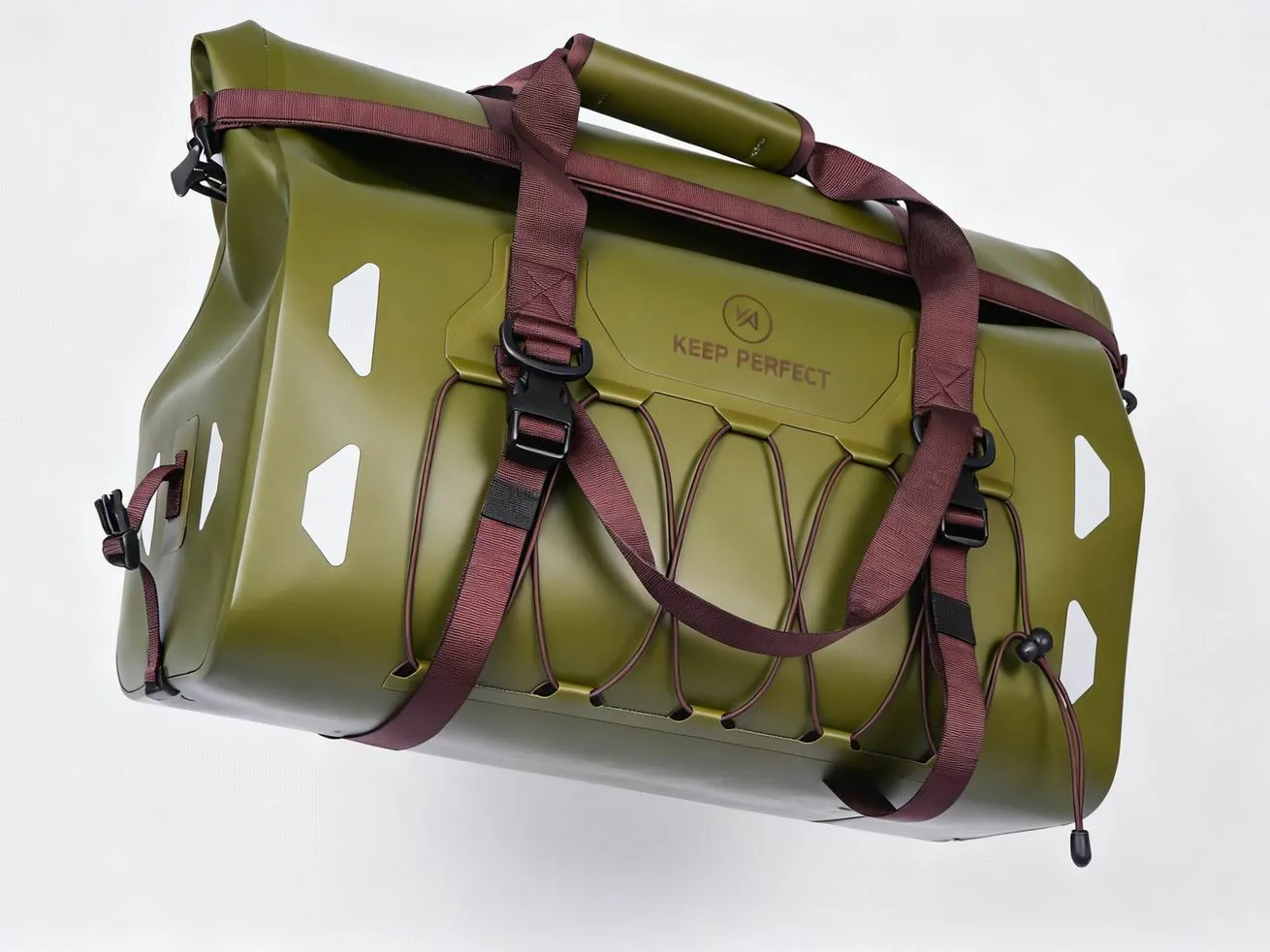
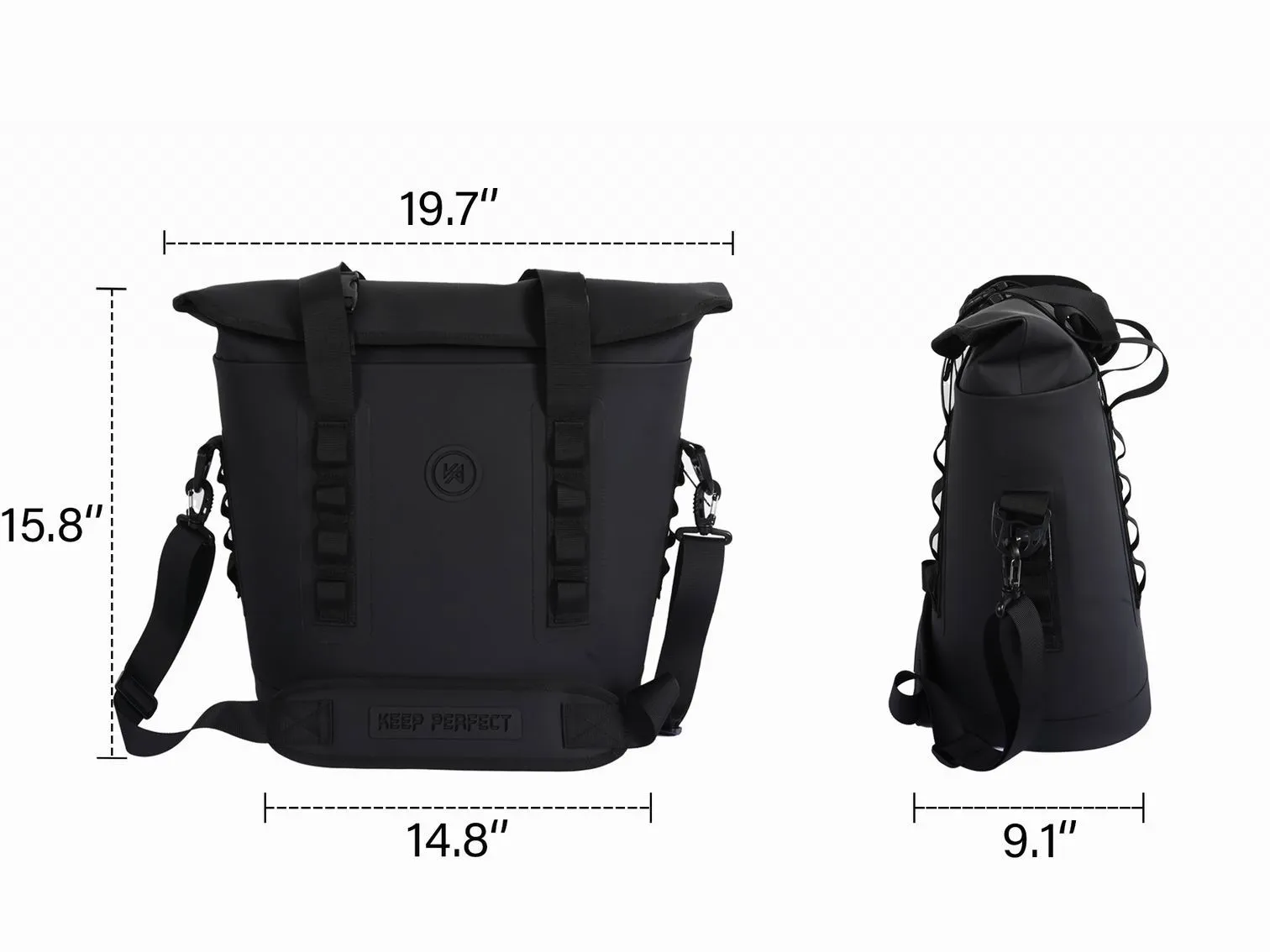

Terminal tackle attacks a bag three ways at once
A rod sleeve protects a rod. A tackle container protects everything else from cargo that bites back. Waterproof tackle bags sit in the second group, and lure storage dividers are the part that determines whether the product is recommended or returned, because every complaint in this category reduces to contact that should not have happened.
Contact damages the bag: hooks snag fabric, points tear rather than simply penetrate, and withdrawal is the destructive half of the event. Contact damages the cargo: hard lures chip each other’s finishes, hooks rust where they touch other hooks, and soft baits lose their tails to compression. And Chemistry damages both: the plasticiser and oil system in soft bait is deliberately mobile, so it migrates into whatever it touches, softening some coatings, lifting some prints and even attacking the rigid polymers used in cheaper tackle trays.
These three arrive together, which is why single-axis solutions fail. Making the liner thicker resists puncture but does nothing about migration; specifying a chemically resistant liner fixes migration but often sacrifices abrasion performance; adding compartments helps everything but costs conversion time. The art of the specification is deciding which axis dominates for a given product and being honest about the rest.
Note also that the damage is cumulative and invisible until late. A liner softened by bait oil looks fine for weeks and then tears at a seam. A hook rusting against another hook looks like minor corrosion and is really the beginning of structural loss in a split ring. The product therefore has to be designed for month six, not for the first trip out.
Treble hooks: why snagging is worse than puncture
A treble hook is three hooks sharing a shank, set at roughly one hundred twenty degrees. Whichever way it lands, one point is presented outward, which means any soft surface within reach will be caught. It is worth distinguishing two mechanisms, because they have different answers. Penetration is the point passing through a material; snagging is the barb engaging the yarn structure and refusing to release. Bags survive the first and are destroyed by the second, because removing a snagged hook tears laterally through fabric that never had a chance against a sideways load.
The consequence for design is that containment beats resistance. Every effective solution removes the opportunity for the hook to meet fabric rather than trying to outrun it. Rigid or semi-rigid lure boxes are the cleanest answer and the reason serious anglers own dozens. Where the product must accept loose lures, a hook-receptive panel — a dense loop material into which the point is pressed and held — or a row of moulded silicone retainers performs far better than any woven panel, because the hook is held by geometry at a defined location the user can see.
| Containment option | How it holds the hook | Advantages | Limitations and where it fits |
|---|---|---|---|
| Rigid lure box with defined slots | Physical enclosure; nothing outside the plastic | Best protection for finishes and for the bag; washable | Bulky and rigid; belongs in structured bags, not slings |
| Moulded silicone retainer strip | Point pressed into a slit; mild friction holds it | Light, cheap, visible, easy to use one-handed | Wears after many cycles; replaceable strips are worth specifying |
| Dense loop panel | Point engages the loops and is pulled free deliberately | No moving parts; very low cost; conforms to any hook size | Collects debris and salt; needs periodic cleaning |
| Individual soft sleeves | Each lure isolated in its own enclosure | Protects adjacent finishes as well as the bag | Slow to use; better for premium and travel products |
| Magnetic retention strip | Steel hook held by magnetic force | Fast, satisfying to use | Strong magnets near electronics and cards; niche applications only |
| Hook-less storage by design | Hooks stowed in a separate external sheath zone | Removes the problem entirely from the main volume | Requires user discipline; best paired with a labelled zone |
Two practical rules follow and both are cheap. First, every hook zone should be visible when the compartment opens, because a point hidden under three lures is a point eventually found by a thumb. Second, hook retention components should be replaceable: a retainer strip or loop panel that can be swapped costs cents and converts a warranty return into a spares sale.
Puncture resistance still has a place in the shell specification, and the test side is explained in our review of tear, tensile and burst testing. Just remember what those numbers describe: they describe how a material behaves once a defect exists, not whether a hook will snag in the first place.
Soft bait chemistry: migration runs in both directions
This is the failure most brands have never heard of and will encounter anyway. Soft plastic lures are made from plasticised polymer — typically a soft PVC or an elastomer blended with oils and plasticisers to keep them supple. That softness is the product feature, and it is chemically identical to the thing that damages a bag: those additives are mobile by design and they move into anything in contact, particularly under warmth and pressure.
Put a bag of soft baits against a coated fabric in a hot car and three things can happen within weeks. The surface softens and turns tacky as an adsorbed layer forms. Printing lifts, because the migrated layer attacks the ink system. And in PVC-coated materials the urge is mutual — plasticiser can move out of the liner and into the bait, leaving the fabric stiff and embrittled while the bait itself becomes greasy and deformed. Regulators including the European Chemicals Agency publish extensive material on plasticiser mobility, and the US Environmental Protection Agency is a useful reference for how these compounds behave in the environment, which is also why anglers are increasingly aware of the issue.
The reverse direction matters just as much to the customer. It is well known among anglers that soft baits attack certain rigid plastics: leave a worm in a polystyrene tray and it melts through. The same chemistry will attack some tray polymers, some printed surfaces and some adhesives, so the safe answer for anything contacting soft bait is a barrier rather than a coating. Polypropylene or polyethylene film presents a surface that these systems barely wet, which is why welded polyolefin liners have become the default where soft bait is stored.
| Contact surface | Behaviour against soft bait additives | Long-term appearance | Verdict |
|---|---|---|---|
| Welded polypropylene or polyethylene film | Very low uptake; resists surface wetting by oils | Remains smooth and printable safe | Recommended for any soft bait contact zone |
| TPU film laminate | Better than PVC but still absorbs some mobile phase | Slight tack after prolonged exposure | Acceptable with a stated exposure limit |
| PVC-coated woven fabric | Mutual plasticiser exchange; both materials change | Liner stiffens and crazed; baits deform | Avoid in direct contact with soft bait |
| Printed graphics in contact with bait | Ink systems can lift, smear or transfer onto lures | Ruined graphic and stained product | Keep print outside contact zones; use welded patches |
| Polystyrene or ABS tray | Dissolves or stress-crazes on contact | Tray destroyed in days | Never specified for soft bait contact |
| Silicone-coated fabric | Good release; resistant to most bait systems | Holds up well | Premium option where cost allows |
The practical specification is therefore a barrier zone: any compartment intended for soft bait gets a welded polyolefin liner, printed graphics stay outside that zone, and the product documentation states plainly that soft baits should be stored in their retail packets or in a barrier-lined pocket. That last sentence is free and it prevents reviews describing a ruined bag as a manufacturing fault.
Readers wanting the wider compatibility picture should see our review of oil, solvent and saltwater resistance, and the base material comparison in TPU against PVC.
Hard lures destroy each other and themselves
Hard lures are painted metal or plastic assemblies hung with split rings and treble hooks, and they are remarkably fragile relative to how they are stored. Contact damage takes three forms. Finish chipping occurs where one lure knocks another, typically at the tail and along the back where lips and hooks strike. Hook rash is the scuffing paint receives from adjacent hooks, and it always starts on the most visible panel. And corrosion begins wherever two damp hooks rest together after a salt session, because the contact area stays wet longest.
Segregation is the answer, and it should be designed around the largest lure in the intended class rather than around an average. A divider that comfortably accepts a 90-millimetre crankbait will let a 140-millimetre jerkbait lie diagonally, which is exactly how two adjacent lures end up touching. Laying out compartments to the largest dimension in each class, then subdividing below that, is more work at the design stage and much cheaper than the returns it avoids.
- Design each divider cell to the largest lure actually intended for the compartment, not to the average.
- Cushion nothing: separation prevents contact damage far more effectively than thin padding.
- Orient lures consistently, because hooks resting against a neighbour is how corrosion starts.
- Give saltwater products drainage plus airflow so damp hooks dry rather than sit in brine.
- Consider removable dividers so users can reconfigure for seasonal changes in their own kit.
There is also a user-behaviour point worth designing for, because it decides whether the system gets used. Anglers choose lures by looking across a set and picking one, which means lures should be visible from above when the compartment opens. Deep layered storage that requires lifting each lure is technically excellent storage and poor tackle storage.
Divider dimensions for real lure classes
Sizing is where a tackle product either feels designed or feels generic. Below is a practical matrix built from the dimensions of lures anglers actually own. Figures describe the clear internal cell, and each assumes a few millimetres of clearance so lures can be lifted out with wet fingers rather than prised out.
| Lure class | Typical body length | Suggested clear cell | Compartment note |
|---|---|---|---|
| Small crankbaits and minnows | 50 to 70 mm | 75 x 35 x 30 mm per cell | Usually populated densely; visibility from above matters most |
| Medium crankbaits and lipless | 70 to 100 mm | 110 x 45 x 35 mm per cell | The volume class for bank and boat anglers alike |
| Jerkbaits and topwater walkers | 100 to 140 mm | 150 x 50 x 40 mm per cell | Tail width often exceeds body width; measure with hooks fitted |
| Swimbaits and larger glide baits | 150 to 250 mm | 270 x 70 x 60 mm per cell | Often stored in individual sleeves rather than open cells |
| Spinnerbaits and buzzbaits | Blades dominate the envelope | 150 x 60 x 60 mm per cell | Wire arms snag easily; use retainers rather than loose stacking |
| Spoons and jigging metal | 40 to 120 mm | 130 x 40 x 25 mm per cell | Heavy and thin; rust transfer is the main risk when mixed |
| Jigs and soft trailers | Head plus trailer 60 to 120 mm | 120 x 60 x 30 mm per cell | Lead contact darkens fabric; dedicate a barrier-lined pocket |
| Retail soft bait packets | Around 150 x 100 mm | 160 x 110 x 40 mm flat slot | Flat storage keeps packets readable and prevents spill |
Measure with hooks fitted, not with the lure body alone, since the hook envelope is usually what catches. And remember that anglers mix classes: a compartment sized only for one class will be used for three, so the better products publish the clear internal cell dimensions on the hangtag and let the customer decide.
External dimensions then follow from the layout, and this is where freight cost enters. Every additional cubic centimetre of rigid structure costs money twice — once in material and again in shipping — which is discussed for this category in our notes on setting custom bag dimensions.
Drainage after rinsing beats any ingress rating
A tackle bag gets rinsed. In freshwater it is rinsed because it has mud inside; in saltwater it is rinsed because leaving dried salt anywhere accelerates corrosion of every hook, split ring and swivel stored inside. Either way, the rinse water has to leave. A bag that keeps water out brilliantly and holds water in just as brilliantly is the wrong product, which is the same argument we make for angling generally in our overview of waterproof bags for angling.
The details are unglamorous and they work. Drain grommets at the lowest corners of each wet cell allow water out when the bag is set down upright. A smooth welded floor with no absorbent facing prevents water clinging to the substrate. A structure that holds itself open lets everything air dry in an evening rather than in three days. And any removable liner insert can be inverted and hosed, which is the single most appreciated feature in this category once anglers have owned one.
Rust is worth dwelling on because it is the visible consequence of poor drying, and it is permanent. A single damp hook resting against fabric leaves an orange-brown ring that does not come out, and after a season the interior looks destroyed even though the structure is intact. Designing so hooks dry separately and quickly is the cheapest way to preserve the appearance that customers judge.
Weight: lead, tungsten and the failure of soft floors
Terminal tackle is dense to a degree most bag designers underestimate. Lead is around eleven grams per cubic centimetre and tungsten alloys approach eighteen, so a modest pile of jigs, weights and metal lures reaches several kilograms in a volume that looks trivial. Compare that with the same volume of clothing and the implication is obvious: the load-bearing path is the floor, the handle and the attachment points, not the shell panels.
The failure mode is specific and common. A soft unstructured floor carrying four kilograms of metal deflects, the deflection opens or strains the corner seams, and once the corners have opened the weight is transferred to a zip or a closure that was never intended to carry it. Within a month the base has a permanent sag and the closure no longer aligns. None of it is caused by the hooks or the salt; it is caused by treating a dense load like a bulky one.
- Specify a moulded or double-wall floor panel with a stated deflection limit at maximum intended load.
- Bring the strongest shell material up the lower walls rather than concentrating cost in the lid.
- Rate and test handles at the loaded weight, and say the number in the product documentation.
- Keep heavy metal storage low and centred; a bag loaded high pulls an angler off balance while wading.
- Test the closure after load cycling, since misalignment from floor deflection is what actually breaks zips.
Testing guidance for the load path is set out in our review of load testing on straps and handles, and fabric choices for the lower panel are compared in our piece on what denier ratings actually predict.
Transparent panels: useful until they are the weak point
Anglers want to see their lures, so transparent windows are requested constantly, and they introduce three problems. Transparent TPU film is softer and more prone to puncture than a woven shell, so a hook pressing against a window finds purchase quickly. Films haze and craze under abrasion and ultraviolet exposure, which means a window that was clear on the first trip is milky by mid-season. And welding a dissimilar film into a woven shell creates a differential-flexing boundary that cracks in cold weather.
None of this means windows should be avoided, only that they need their own specification. Film thickness around 0.4 to 0.6 millimetres resists hook contact far better than decorative gauge film; positioning windows away from any contact or load path is essential; and the window should be welded rather than sewn, with a test radius rather than a sharp corner at every transition. Our deeper look at transparent construction in see-through products covers the manufacturing side, including the cold flex issue.
A better answer in most cases is indirect visibility: a light interior colour, an open-top structure showing the tops of lures, and a labelled index card in a sleeve facing the user. Together these give the recognition customers want without putting 0.3 millimetre of soft film between a treble hook and the outside world.
Choosing liner chemistry for bait contact zones
By this point the liner decision has three inputs: resistance to mobility from bait plasticisers, resistance to hook snagging, and washability. Those three pull against each other, and the honest conclusion is that there is no single winner — only a zoning decision. A welded polyolefin film handles chemistry superbly and punctures moderately well; a coated woven fabric takes abrasion better and loses the chemical argument; a TPU laminate sits in the middle and costs more.
Zoning is therefore the standard answer. Soft bait and leader storage in a polyolefin-lined pocket; hard lures in retainer-fitted cells against a woven panel with an adequate puncture rating; anything wet given drainage; anything printed placed outside contact surfaces entirely. This is not complexity for its own sake — it is simply matching each material to the only failure it needs to resist in that location.
There is a maintenance note attached to chemical zoning. Barrier liners resist uptake but they still hold a film of bait oil on their surface, and that film transfers. The instruction panel should say which cleaners are safe, and our guide to common defects and their prevention explains why welded seams tolerate these cleaners better than taped or stitched constructions do.
Tests that reproduce what anglers complain about
Standard strength figures are of limited use here, because they describe material behaviour in isolation. What predicts field performance is a short list of contact and exposure tests, each of which can be run during a sampling round and each of which maps directly to a review someone will eventually write.
| Test | Method in plain terms | Suggested criterion | Complaint prevented |
|---|---|---|---|
| Hook snag and release | Press a representative treble into candidate surfaces, then withdraw at a defined angle and rate damage | Release without tearing below a stated withdrawal force | "It ripped the lining the first time I took a lure out" |
| Soft bait contact | Candidate material held against commercial soft baits for seven days at elevated temperature | No tackiness, no print transfer, no embrittlement | "The lining went sticky and the printing came off" |
| Rust transfer after salt | Wet hooks placed against the candidate lining, dried, cycled three times, then assessed for staining | Staining below a defined grade on a grey scale | "The inside looks ruined after one season" |
| Drainage check | Rinse the loaded compartment, set upright, measure residual water after a stated time | Below a stated mass of retained water | "Bait water sitting in the bottom every trip" |
| Floor deflection under load | Load with representative metal, hold, measure permanent deflection | Below a stated millimetre figure with no seam strain | "The bottom sagged and the zip no longer lines up" |
| Closure alignment after load cycling | Cycle between loaded and unloaded, then test water resistance at the closure | No measurable loss of performance | "It stopped closing properly after a month" |
Run all of them on pre-production samples made with production tooling, because migration behaviour in particular depends on coating cure and weld parameters as much as on material choice. Where claims appear on packaging, verification is worth arranging through an independent laboratory; our overview of what a competent third-party report contains explains what to ask for.
Layout follows the sequence of a session, not the shape of the box
Compartment layouts in this category are usually drawn to look tidy and then used in the opposite order. A session goes roughly: arrive, rig the first lure, fish, change lure several times as conditions change, put spent and damaged items somewhere, then pack up with everything wet and dirty. The bag should be arranged around those transitions rather than around a grid.
Two consequences are worth building in. First, active selection storage needs to be the fastest to reach and the most visible, because it is used dozens of times per trip, while backup storage can be deeper and slower. Second, there must be somewhere for the failed items — the lure with a bent hook, the leader with a frayed end, the soft bait torn in half — because without a designated place those items go back on top of the good ones and cause the damage described earlier.
Third, the wet/dirty transition at pack-down is where most long-term contamination originates. A drainable external pocket for anything wet or fishy, separated from the cells holding clean stock, is the layout decision that most reliably keeps a product looking presentable after a season. The broader principle is set out in our guide to wet and dry separation design.
Building the tackle range: tooling, quantities and sequencing
The commercial structure of this category favours shared internals. One shell platform, one closure set, one retainer family and one floor panel can be recombined into a small sling, a mid-size shoulder bag, a structured box carrier and a soft bait wallet. Because the tooling for dividers and retainers is shared, adding a size is largely a pattern change rather than a new programme, which is what keeps the whole line viable when every style carries a minimum order quantity of 500 pieces.
Choose the internal architecture before the exterior shape. Retainer pitch, cell pitch and floor panel all need to be fixed early, because changing them after tooling affects every style in the range. Colourway and logo treatment, by contrast, can be varied late and cheaply, and should carry most of the differentiation you need between retail channels.
Branding has one hard constraint here that is different from other categories: any mark inside a bait zone will be attacked by bait chemistry, so in-zone branding should be a welded patch rather than a print, or simply omitted. Exterior marks face salt, sunlight and abrasion against boat decks; screen print on a coated shell or a welded patch performs best, while embroidery perforates a water-resistant layer and is only appropriate with a sealed backing. Our full comparison is in the review of logo methods for waterproof shells, and supply planning for a multi-style launch is covered under how minimum quantities are structured.
Finally, publish the numbers. Cell dimensions, clear internal dimensions, loaded weight rating, drainage provision and the soft bait caveat are five pieces of information that turn a generic bag into a specification an angler can buy with confidence, and they distinguish a considered product from the rest of the shelf.
If you would like these decisions turned into a costed brief, review our own process from first enquiry through sampling into bulk production and send a list of the lure classes, weights and bait types the range must carry, plus whether it targets freshwater or a rinsed saltwater routine. Minimum order quantity is 500 pieces per style, sampling takes 6–10 working days per round, bulk production runs 35–50 days, and quotations are issued FOB Xiamen.
Frequently Asked Questions
Q1. Why do treble hooks tear my tackle bag lining?
Because the barb engages the yarn structure and withdrawal loads it sideways. Penetration is the easy half; snagging is what destroys fabric. Containment, not thicker cloth, is the answer.
Q2. What is the best way to hold loose lures?
Geometry rather than material: moulded silicone retainers, dense loop panels or individual rigid boxes. Anything that fixes each hook at a location the angler can see performs better than a heavier liner.
Q3. Do soft plastic baits damage bags?
Yes. The plasticiser system that keeps them supple migrates into contact surfaces, softening coatings, lifting print and sometimes embrittling PVC liners. Use a polyolefin barrier liner in soft bait pockets.
Q4. Can soft baits melt plastic boxes?
Some combinations will. Certain rigid plastics craze or soften on contact with soft bait, which is why polypropylene or polyethylene trays are used. Store soft bait in its retail packet or a barrier pocket.
Q5. Why does my tackle bag interior look rusty?
Damp hooks resting against fabric leave permanent orange staining. Separate hooks so they dry quickly, provide drainage, and rinse after saltwater sessions.
Q6. How much weight does terminal tackle actually add?
Several kilograms in a small volume. Lead is around eleven grams per cubic centimetre, so jigs and metal lures are far denser than they look and they load the floor, not the walls.
Q7. Do I need a moulded floor panel?
If the product carries metal, yes. Soft floors deflect under dense loads, and that deflection strains corner seams and eventually misaligns closures.
Q8. How should I rinse a tackle bag after saltwater use?
Fresh water over the whole bag, hooks included, then drain and air dry open. Salt left on hooks corrodes them and every component they touch afterwards.
Q9. Are transparent windows a good idea for lure bags?
They help recognition and introduce a weak point. Specify thicker film, keep the window clear of contact and load paths, weld rather than sew it, and cold flex test the boundary.
Q10. What cell size fits a standard crankbait?
Around 110 x 45 x 35 millimetres for a 70 to 100 millimetre body, measured with hooks fitted. Size for the largest lure in the class, not the average.
Q11. How do I stop hard lures chipping each other?
Separation. Design cells around the largest lure in each class so nothing lies diagonally across a neighbour, and keep nothing else in that compartment.
Q12. Should dividers be removable?
Usually yes, because anglers re-kit seasonally. Removable dividers cost little and let one product serve several styles of fishing.
Q13. What is the best way to see lures quickly?
Open-top cells with a light interior and an index card. It avoids relying on a soft transparent panel next to hooks.
Q14. Which liner should I use next to soft bait?
Welded polypropylene or polyethylene film. It resists uptake, wipes clean and tolerates the cleaners anglers use, unlike PVC-coated woven fabrics.
Q15. Can one bag design serve freshwater and saltwater anglers?
Structurally yes. The saltwater version needs drainage, corrosion-resistant fittings and a rinse instruction; the freshwater version can be lighter with less emphasis on drying.
Q16. Which logo method survives bait chemistry?
A welded patch inside contact zones; on exterior panels, screen print on a coated shell or a welded patch. Printing inside a bait pocket lifts, and embroidery perforates water-resistant layers.
Q17. How should a brand start a tackle range?
Fix the internal architecture — cell pitch, retainers, floor panel — first, then generate several sizes from one platform, and vary colourway rather than tooling between retail channels.
People Also Ask
What ruins tackle bags fastest?
Hooks snagging and withdrawing from fabric, followed by soft bait chemistry softening the liner and rust staining from damp hooks.
How do I store treble hook lures safely?
Fix each hook to a retainer or loop panel, or box them individually. Removing the contact is more effective than toughening the material.
Do soft plastic lures damage storage bags?
Yes. Their plasticisers migrate into contact surfaces, softening coatings and lifting print. Use a polyolefin barrier-lined pocket.
Why is my tackle bag heavy for its size?
Lead and tungsten are extremely dense. A few kilograms in a small volume loads the floor and handle, so those parts must be specified for it.
How big should lure compartments be?
Size cells to the largest lure in the class: roughly 110 x 45 x 35 millimetres for mid-size crankbaits, measured with hooks fitted.
Should a tackle bag drain?
Yes. It will be rinsed and loaded with wet gear, and retained water rusts hooks and rots the interior faster than rain ever would.