Fishing bags do not usually fail because water got in. They fail because something got in and stayed: fish slime and blood that bond to a porous liner, salt crystals that pit a plated buckle, bait water that leaks into a car boot, and a hook point that finds the one panel with no reinforcement. If you are choosing or specifying a waterproof bag for angling, the deciding properties are chemical and biological, and the waterproof rating is the least interesting number on the sheet.
This guide covers the failure modes in the order anglers actually meet them: why odour retention is the true durability test, how saltwater attacks hardware and closures, what a live bait compartment has to do structurally, how hooks and knives puncture and tear laminates, how tackle weight dictates floor construction, which cleaning regimes a material must survive, the capacity matrix an angling range needs, the tests worth writing into a specification, why colour and interior finish matter more here than in most categories, and how a brand should source the liner, hardware and logo for this environment. The production baseline at QUANZHOU JUNYUAN BAGS — custom waterproof bag production since 2014, 4,950 m² SGS-verified facility — is MOQ 500 pieces per style, sampling in 6–10 working days and bulk in 35–50 days, FOB Xiamen.
Angling bags fail chemically, not mechanically
Take two bags of identical construction, use one for hiking and one for sea angling, and after a season the hiking bag will look older and the fishing bag will be unusable. That is the whole point. Waterproof fishing bags operate in an environment that combines protein contamination, chloride, ultraviolet exposure and sharp steel, and the materials that survive it are chosen for chemical resistance and cleanability rather than for tensile strength. The same logic applies to angling tackle storage, where the dominant load is not the weight of the gear but what the gear leaks.
Four mechanisms do the damage. Proteins in blood and mucus bond to textile surfaces and cross-link as they dry, which is why a fabric liner holds a smell long after it has been rinsed. Chloride ions break down the passive layer on many metals and pit them at edges and under plating. Fish oils plasticise some coatings and stain most of them. And a hook point concentrates force into an area small enough to push through a laminate that easily resists a blunt load.
None of those are waterproofing problems, which is why a specification written around hydrostatic head and submersion rating produces a bag that passes every test and gets thrown away after one season. Write the specification around surface energy, alloy, cleanability and puncture instead, and the waterproof performance arrives as a side effect of choosing welded, wipe-clean construction.
It is also worth separating freshwater from saltwater use at the design stage, because the two differ more than customers expect. Freshwater anglers mostly fight odour, bait water and mud. Saltwater anglers fight all of that plus a corrosion system that attacks every metal component and every closure on the bag, and they pay for the difference in hardware rather than in fabric.
Odour retention is the real durability test
Seafood science describes this well: the compounds responsible for fishy odour are well documented in fisheries research, and agencies such as NOAA Fisheries publish accessible material on seafood composition and handling. What matters for a bag is the surface the residue lands on.
The smell that develops in a fishing bag has a specific chemistry. Marine fish contain trimethylamine oxide, and surface bacteria convert it to trimethylamine, which is the compound people recognise as fishy. That conversion happens in a moist, protein-rich, oxygen-poor environment, which is precisely the inside of a closed bag holding a damp liner. Controlling the smell therefore means controlling the surface the protein sits on.
And surfaces differ enormously. Smooth welded film has no pores for protein to anchor in and wipes clean in seconds. Woven textile has interstices between yarns, a coating that can craze, and stitch holes that act as capillaries. Open-cell foam padding is worst of all: it is a sponge with a very large internal surface area, and once it is contaminated it cannot be cleaned, only replaced. A bag with foam in the bait compartment will smell permanently by the second month.
| Interior surface | How it holds odour | Cleanability | Where to use it |
|---|---|---|---|
| Welded TPU or PEVA film liner | Very low; no pores and nostitch holes | Wipe or hose; dries in minutes | Bait compartments, catch compartments, anywhere wet |
| Coated woven fabric | Moderate; coating crazing and yarn interstices hold protein | Scrub; slow drying | Exterior shell, dry storage zones |
| Uncoated textile liner | High; wicks protein into the fibre | Poor; needs soaking and still smells | Avoid in wet zones |
| Open-cell foam padding | Very high; acts as a reservoir | Effectively uncleanable | Shoulder straps and back panels only, never in wet compartments |
| Perforated or mesh panel | Low, but holds debris in the holes | Rinse under pressure | Ventilation panels outside the wet zone |
The practical specification is therefore simple to state and easy to get wrong: the wet zone of an angling bag should be a single welded, seamless compartment with no absorbent material inside it, and any padding should sit on the outside of that compartment rather than inside. That one decision removes most odour complaints before any antimicrobial treatment is considered.
Antimicrobial treatments are an addition, not a substitute. They reduce the bacterial load on a surface and can meaningfully slow odour development, but they do not remove protein and they wear off. Where they are used, the specification should state the test organism, the reduction achieved and the number of wash cycles after which the claim still holds. Our overview of antimicrobial treatments for waterproof materials covers what is realistic to claim.
There is one more design lever: the ability to remove the liner entirely. A welded insert that lifts out, hoses off and dries upside down turns a cleaning problem into a two-minute job, and it is the feature that owners of expensive angling bags talk about to their friends.
Saltwater corrosion: the hardware decision that decides the bag
If a bag goes near the sea, the metal components determine its service life. Chloride ions penetrate the passive oxide film on stainless steel and on anodised aluminium, and they attack plated steel at the edges and at any scratch, where the plating is thinnest. The result is not a slow uniform rust; it is pitting, which is localised, starts under load-bearing surfaces and is invisible until a buckle cracks.
| Component and material | Behaviour in saltwater service | When to specify it |
|---|---|---|
| 316 stainless steel | Molybdenum content resists pitting far better than 304; still needs rinsing | Saltwater products, and any load-bearing fitting |
| 304 stainless steel | Good in freshwater, pits in warm chloride service | Freshwater ranges and decorative trim |
| Zinc-plated carbon steel | Plating breaches at edges and scratches, then rusts fast | Avoid wherever salt or long wet service is expected |
| Anodised aluminium | Light and strong, but pits at scratches and where it contacts steel | Freshwater, or saltwater with isolating washers |
| Engineering polymer (POM, PA) | Immune to chloride; creeps under sustained load and degrades in UV | Buckles and ladderlocks in all saltwater ranges |
| Moulded plastic zip (VISLON type) | Immune to corrosion and forgiving of grit | Main closures on saltwater bags |
| Coated metal zip | Seals well, but the slider and teeth corrode and the coating wears | Freshwater, or where a flap covers it in saltwater |
The generalist corrosion community, including organisations such as AMPP, publishes extensive guidance on chloride-induced pitting, and the practical takeaway for a bag specification is that alloy choice outranks plating thickness. A thin plating on cheap steel fails at the first scratch; a correctly specified stainless or polymer component does not need a plating at all.
Closures deserve their own paragraph because they combine corrosion with abrasion. Salt crystals form inside a zip as water evaporates, and those crystals are harder than the coating on the teeth, so every operation grinds the closure. The bag therefore needs either a moulded plastic zip, which tolerates both salt and grit, or a metal zip that is rinsed and covered by a storm flap. Anything else produces the classic complaint of a zip that "just stopped sealing" after three trips.
Finally, specify the rinse instruction as part of the product. A bag that is rinsed in fresh water and dried open lasts several times longer than the same bag left closed in a boot, and the difference is large enough that it should appear on the hangtag rather than in a manual nobody reads. Rinsing the hardware, not just the fabric, is what actually matters.
Live bait, water and the leak nobody forgives
A live bait compartment is the hardest thing to build in this category, because it must hold water like a bucket and behave like a bag the rest of the time. Welded floors and corners are mandatory, seams in the lower third are a liability, and any stitched handle attachment that penetrates the wet zone will wick water out by capillary action no matter how well the thread is sealed.
Weight comes next. Water is one kilogram per litre, so a ten-litre bait well is a ten-kilogram load sitting wherever the compartment happens to be. That load has to be low and close to the wearer’s spine, the floor panel needs to be stiff enough to stop it bulging into a sway, and the handle has to be rated for the wet weight rather than the dry weight. Most carrying failures in angling bags are bait water, not tackle.
Aeration adds the awkward bit: a live bait system wants air exchange, which wants holes, and holes conflict with containment. The workable compromise is a stiff, closeable spout or valve high on the compartment, plus a lid that seals against slosh but is not claimed to be watertight when inverted. If a product promises both full aeration and full containment, one of the two has not been tested.
- Keep every seam, stitch and penetration above the maximum water line; the wet zone should be one continuous welded volume.
- Rate handles and floor panels for the filled weight, and state the filled weight on the product documentation.
- Use a closeable valve or spout rather than permanent holes, and test it closed for slosh, not for inversion.
- Make the compartment wide enough to clean a hand inside; a compartment nobody can reach is a compartment nobody cleans.
- Plan for the journey home: a wet compartment that drips into a vehicle is the single fastest way to lose a customer.
The journey home point deserves emphasis because it is where the emotional damage happens. A bag that leaks bait water into a car boot produces a smell that survives valeting, and the owner will blame the bag forever, even if the bag was only half the cause. A drip tray, a drainable outer pocket and a clear instruction to empty before transport are cheap insurance against a permanently lost customer.
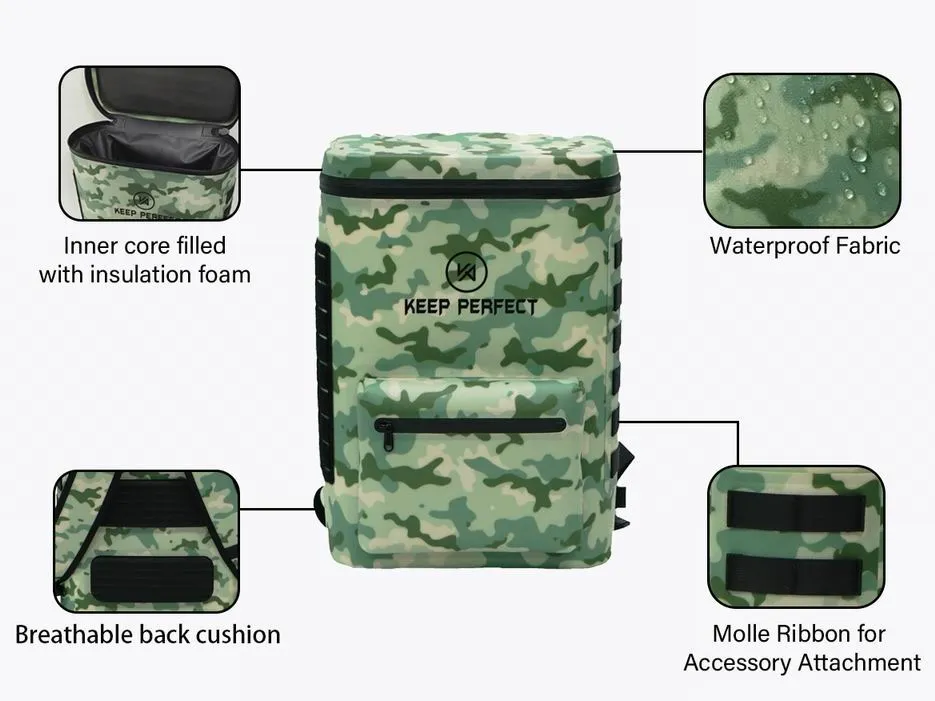
Where the range includes an insulated compartment — for catch, for bait, or both — the insulation layer interacts with all of this. Closed-cell foam does not absorb and is the right choice; open-cell foam and textile batting in a wet zone are the beginning of the smell problem described earlier. The trade-offs are set out in our guide to insulated waterproof construction.
Hooks, knives and how laminates actually fail
A hook point is a very sharp object with a barb behind it, and that combination is the worst case for a coated fabric. Penetration happens at low force because the point radius is tiny; the real damage occurs on withdrawal, when the barb catches and tears the laminate laterally. A bag that survives a hundred punctures from a needle can be destroyed by one hooked lure pulled out sideways.
Design answers exist at three levels. Containment is the first: hooks belong in a rigid or semi-rigid container, so the specification should include a box or a sheath rather than relying on the liner. Zoning is the second: the lower and outer faces of any bag carried at the hip will be brushed by lures, hooks and knives, so those faces get a heavier denier and, where possible, a film facing rather than a textile one. Sacrificial construction is the third: a replaceable liner or a hook-resistant panel turns a bag-ending event into a fifty-cent part.
Puncture resistance is worth specifying as a number rather than as an adjective. A defined probe test with a stated tip radius and a stated pass force gives a supplier something to engineer against; "tough" gives them nothing. Our article on tear, tensile and burst testing explains how to read these results, and the same equipment covers puncture with a different fixture.
One caution about thicker material: it resists puncture but it also resists being rolled, folded and packed, and in this category a bag that cannot be folded into a kayak hatch or a wader pocket will be left behind. The right answer is usually a moderately heavy film facing on the hook-contact faces only, not a heavy shell throughout.
Tool carry: pliers, line, leaders and what must stay dry
Anglers carry more sharp, dirty, wet tools per litre than almost any other user group: pliers, forceps, knives, line spools, leader material, lures in packets, and often a phone and a camera in the same bag. The organisation system therefore determines whether the bag is usable, and it is the feature customers describe when they recommend a product.
| Item | What it does to a bag | Design response |
|---|---|---|
| Pliers and forceps | Rust, drip, and shear against pocket walls | A moulded or welded sheath with a drain hole, mounted outside the dry compartment |
| Knife | Cuts liners and pockets | A dedicated slip with a stiffener; never loose in a main compartment |
| Lures in packets or boxes | Hook puncture and oil residue | Rigid tray or box with a defined slot count, stored in the lower zone |
| Line and leader spools | Tangle and UV degradation | A covered pocket with elastic loops, away from the sun-facing panel |
| Phone, keys, licence | Must stay dry next to wet gear | A genuinely welded pocket with a waterproof closure, tested separately |
| Landing net and tools | Bulky, wet, outside | External compression straps with quick-release buckles that work with wet hands |
Wet hands are the constraint that shapes all of it. A buckle, a sheath or a pocket that requires dry fingers and fine alignment will be ignored by an angler holding a rod in one hand and a fish in the other. Specify closures that can be operated one-handed, with a cold or wet hand, and that release rather than seize when they have been splashed with salt water.
There is also a safety dimension worth designing for. A loose hook in a fabric pocket is a hook in a finger, and it is also a hook that ends up in the car seat, the dog and the carpet. Containment of hooks is not just product care; it is the difference between a recommendation and a complaint.
The tool-carrying logic overlaps heavily with trades and marine use, which is why the same construction decisions appear in our guides to tool bags for professional trades and waterproof bags for marine and boating use. If a range serves both anglers and boaters, one platform can serve both with different tooling.
Tackle weight, floor construction and carry geometry
Tackle is dense. A standard utility box loaded with lures weighs one to three kilograms, anglers carry three or four of them, and the bag is often carried with one hand while the other holds a rod. That combination dictates a stiff, reinforced floor and a grab handle rated for the real load, not for the empty bag.
- Specify a moulded or double-wall floor panel with a stated deflection limit under the maximum box load.
- Bring the shell material up the sides of the floor by several centimetres so corner seams sit above the wear line.
- Rate the grab handle for the filled bag, and test it by lifting, not by pulling slowly downward.
- Put box storage low and close to the back; a hip pack or sling loaded high and outward pulls the wearer sideways.
- Add feet or a wear strip, because angling bags are set down on wet rock, gravel and boat decks constantly.
Carry geometry decides which body position the product is for. A hip pack with three loaded boxes puts maybe five kilograms on one hip, which most anglers tolerate for a few hours and not for a day. A sling shifts the load across the back but swings when casting. A backpack carries better but has to come off to access tackle, which is why convertible sling-to-back designs sell in this category and why a range should usually include both.
For the brand, this is the section that converts into specification numbers: maximum box count, box dimensions the compartment is cut for, filled weight, and a handle rating. Publishing those four numbers is more persuasive than any photograph, because the customer knows exactly what they intend to put inside.
Cleaning regimes the material has to survive
A fishing bag is cleaned far more often than any other bag, and cleaned badly. Owners will use whatever is under the sink, including chlorine bleach, solvent degreasers and pressure washers, and the specification should anticipate that rather than instruct against it. Choose materials that survive the realistic abuse, then state what is actually safe.
Chlorine bleach is the common mistake. It oxidises polyurethane coatings and attacks polyamide fibres, so a bag that is bleached monthly will craze and stiffen even if it never sees sunlight. Enzymatic cleaners work on protein without touching the coating and are the right recommendation, with a mild acetic acid rinse for mineral deposits and a bicarbonate paste for stubborn odour. Warm water up to about forty degrees is fine; hot water accelerates coating hydrolysis and can delaminate a bonded seam.
Drying matters as much as washing. A bag put away damp develops the bacterial film that produces the smell in the first place, so the design should let it be dried open: a stiff mouth that stays open, a liner that can be inverted, and feet that let air under the base. Antimicrobial treatment helps here, but a design that dries in an hour helps more.
Pressure washing deserves a specific instruction. It is the fastest way to clean a welded compartment and also the fastest way to force water through a zip or a seam that would otherwise be fine. Recommend it for the interior of welded compartments and warn against it on closures, which is the same distinction we make for wet and dry separation design.
From a sourcing perspective, the cleaning regime belongs in the material selection meeting. If the intended user will soak the bag in a bucket for a weekend, the coating has to be hydrolysis-resistant and the hardware has to be polymer or 316 stainless, because a plated buckle will not survive a soak no matter what the fabric does.
A capacity matrix for an angling range
Angling ranges fail commercially when they are designed around species rather than around how an angler fishes. The useful segmentation is by session: a few hours from the bank, a full day walking water, a boat day with heavy tackle, and a saltwater trip where everything must be rinsed. Those four sessions map cleanly onto capacity bands and onto how much hardware specification each product can justify.
| Product | Capacity band | Session it serves | Sourcing note |
|---|---|---|---|
| Hip pack or waist pack | 4 to 10 L | Short bank sessions, fly fishing | Entry price point; ideal for logo and colourway experiments |
| Sling or convertible sling | 10 to 20 L | Full day walking water | Highest growth category; needs both carry modes engineered |
| Tackle backpack | 25 to 45 L | Boat days, heavy box loads | Floor panel and handle rating are the specification |
| Bait and cooler combination | 15 to 30 L | Bait fishing, catch retention | Welded wet compartment plus closed-cell insulation |
| Wader and boot bag | 30 to 60 L | Water entry, change at the car | Drainable floor; pairs with the wader category |
| Rod and tube carrier | Variable | Travel and transport | Protection and strap geometry rather than waterproofing |
| Dry insert and liner set | 2 to 20 L | Cross-sell into any bag | Lowest risk SKU; shares tooling with other categories |
Two of those deserve strategic comment. The dry insert set is the most underrated product in angling, because it sells to customers who already own a bag and it shares tooling with dry bags sold into paddling and motorcycling. The wader and boot bag is the highest-margin accessory in the category, because it solves a problem anglers complain about constantly — wet, muddy gear in a vehicle — and it can be built from the same welded platform as the bait compartment.
Sequencing a launch should follow return risk rather than volume. Inserts and hip packs first, because they are hard to get wrong and generate cash; slings next, because they carry the highest satisfaction when they work and the highest return rate when they do not; tackle backpacks and bait systems last, because they need the most testing and the most documentation.
Tests worth writing into an angling specification
Standard waterproof and strength tests are necessary but say nothing about this environment. The five tests below are cheap, and each one maps to a complaint that generates returns in this category. Write all of them into the specification with a pass criterion, not with an intention.
| Test | Method in plain terms | Pass criterion worth specifying | Complaint it prevents |
|---|---|---|---|
| Odour retention | Expose the wet-zone material to a protein and fish oil analogue for 24 hours, rinse per instructions, dry, then assess by panel after a further 24 hours | Below a defined sensory score after one standard clean | The bag that permanently smells |
| Salt spray on hardware | Expose all metal components to neutral salt spray for a defined duration, typically 48 to 96 hours | No red rust; pitting below a stated density; buckles still function | Rusty buckles after one season |
| Coating adhesion after immersion | Immerse laminate samples in saltwater for a defined period, then cross-hatch adhesion test | No delamination; adhesion loss below a stated percentage | Coating that peels after a charter trip |
| Puncture and tear | Defined probe puncture plus a tear test on the hook-contact faces | Pass force and tear resistance above stated minima | Hooks punching through pockets |
| Closure after salt and grit | Contaminate the closure with salt solution and fine abrasive, cycle it, then re-test water resistance | No measurable loss of water resistance | Zips that stop sealing |
| Stain resistance | Expose interior surfaces to blood and fish oil, clean per instructions, assess | Staining below a defined grade on the visual scale | Interiors that look ruined within weeks |
Where a claim appears on packaging — saltwater resistant, antimicrobial, easy clean — the corresponding test has to exist in the file with a number in it. This is also the point at which third-party verification becomes commercially useful rather than decorative, and our overview of third-party testing laboratories explains what a competent report should contain.
One practical note on sampling: run these tests on pre-production samples made with production tooling and production settings. A prototype built by hand from the same material will often pass a salt spray test that the production component fails, because plating thickness, weld parameters and coating cure all vary with the process, not with the design.
Colour, staining and what customers forgive
Colour decisions in angling are unusual because the product is designed to get dirty and the customer still expects it to look acceptable. Dark interiors hide staining and should be specified in every wet compartment regardless of the exterior colourway. Exteriors are more forgiving in earth tones and in mid-tones than in white or in very light grey, and a lightly textured surface hides abrasion haze better than a glossy one.
There is a functional side to colour as well. In bright conditions on water, a highly reflective or very light exterior creates glare for the angler and, in some fishing, spooks fish; several fly fishing traditions favour muted exteriors for exactly that reason. Where visibility matters — bank fishing at dusk, boat ramps, wading in low light — the answer is a reflective trim placed where it does not glare into the water rather than a bright shell.
UV exposure is the last piece. Angling bags spend long hours in direct sun on open water, where ultraviolet intensity is higher than on a shaded trail because of reflection from the surface. Coatings chalk, printed logos fade and webbing loses strength, so the specification should carry a UV exposure requirement and a colour fastness grade, particularly for any product sold into tropical or high-altitude markets. Our guide to UV resistance in outdoor bag materials covers the mechanism.
Sourcing decisions: liner, hardware and logo
Turning this into a brief means deciding four things before the first sample. The liner material and its wet-zone construction, the hardware alloy family, the closure types per compartment, and the logo process that survives protein, salt and ultraviolet exposure. Each is cheaper to decide early than to change after tooling.
The liner decision usually comes down to welded TPU film against coated woven fabric. Welded film cleans, does not hold odour and costs more per unit area, and it welds consistently; coated fabric is cheaper, tougher against puncture and easier to zone, but it holds smell and needs more careful seam design. For a wet compartment there is really only one answer; for a dry compartment either works, which is why most good ranges are hybrid.
Logo durability is where brands lose money in this category. A print sitting on a panel that is regularly wiped with a fish-oil-contaminated cloth must resist both solvent action and abrasion; screen print can soften and lift, heat transfer can edge-lift when the coating carries oil residue, and embroidery perforates a waterproof shell and needs a welded backing patch. Silicone badges and welded-on patches survive best on wipe-clean panels, and embroidery belongs on dry-zone panels only. The full comparison is in our guide to logo printing and embroidery options, and the hardware choices are treated in hardware, buckles and strap selection.
Volume planning follows the same discipline as any range: one liner platform, one hardware family in two finishes, one closure set shared across products, and colourways used to create differentiation rather than new tooling. That is what keeps each style at a workable minimum order quantity and keeps the range serviceable — a customer who can buy a replacement buckle in the same finish three years later is a customer who buys the next bag from you.
From a sample to a production angling line
The sequence that works here is short. State the environment first: freshwater or saltwater, how often the bag will be rinsed, what goes in the wet compartment and what filled weight it must carry. Then approve a material set rather than a single bag, because the liner, the hardware and the closure are the three decisions that determine the outcome and they should be validated together.
Next, build the wet compartment as a separate test article before the whole bag exists. Fill it, carry it, contaminate it, clean it, and smell it a week later. If that test article is still acceptable, the bag around it will probably work; if it is not, no amount of shell design will save the product.
Then run the full bag through the test table above on pre-production samples, approve the cleaning instructions at the same time as the product, and only then commit to bulk. Documentation is part of the deliverable: what can go in the wet compartment, what filled weight is rated, how to rinse the hardware, and which cleaners are safe.
If you want these decisions turned into real numbers, send us your environment, capacity plan and volume targets. Minimum order quantity is 500 pieces per style, samples take 6–10 working days, bulk production runs 35–50 days, and quotations are issued FOB Xiamen.
Frequently Asked Questions
Q1. What makes a fishing bag different from an ordinary waterproof bag?
It is designed around contamination and corrosion rather than around rain: wipe-clean welded wet compartments, salt-resistant hardware, hook containment and a floor rated for dense tackle boxes.
Q2. Why does my fishing bag smell even after washing it?
Because protein from blood and slime has bonded into a porous liner or foam. Smooth welded film rinses clean; textile and open-cell foam hold odour permanently. Replace absorbent materials in the wet zone.
Q3. Is 316 stainless really necessary, or is 304 enough?
For saltwater, 316 is worth it because its molybdenum content resists chloride pitting far better than 304. For freshwater-only products, 304 or a good polymer component is usually sufficient.
Q4. Should I choose a metal or a plastic zip for sea fishing?
A moulded plastic zip. It is immune to corrosion and much more tolerant of the salt crystals and grit that grind coated metal teeth until they stop sealing.
Q5. How do I stop hooks punching holes in my bag?
Contain them. Use rigid lure boxes rather than loose pockets, put a heavier film facing on hook-contact panels, and choose a design with a replaceable liner so a puncture is a part replacement rather than a bag replacement.
Q6. What filled weight should a bait compartment be rated for?
Rate it for water: one kilogram per litre, so a ten-litre compartment is a ten-kilogram load. Handles and floors must be tested at that weight, not at the dry weight of the bag.
Q7. Can I use bleach to clean a fishing bag?
Avoid it. Chlorine oxidises polyurethane coatings and attacks polyamide fibres, causing crazing and stiffening. Use an enzymatic cleaner, a mild acid rinse for scale, and warm water below about forty degrees.
Q8. How often should a saltwater bag be rinsed?
After every trip, and the hardware matters more than the fabric. Fresh water over buckles, zips and D-rings removes the chloride that causes pitting, and drying open prevents the bacterial film that causes smell.
Q9. Is an antimicrobial treatment worth specifying?
It helps, but it is an addition rather than a solution. It slows odour development without removing protein, and it wears off. State the test organism, the reduction and the number of washes the claim survives.
Q10. What interior colour is best for an angling bag?
Dark. Blood, oil and scale staining are unavoidable, and a dark welded interior looks acceptable after a season while a light one looks ruined after a week.
Q11. Should an angling range include a sling or only backpacks?
Both, because they serve different sessions. A sling gives fast access while wading but must be engineered in both carry modes; a backpack carries heavy box loads better but has to come off to reach tackle.
Q12. What is the most underrated product in an angling range?
The dry insert set. It sells to anglers who already own a bag, shares tooling with paddling and motorcycle categories, and carries the lowest return risk of anything in the range.
Q13. How do I test whether a bag will hold its smell?
Use a defined odour retention test: contaminate the wet-zone material with a protein and oil analogue, clean it per the instructions, and assess by panel after a further day. Write the sensory threshold into the specification.
Q14. Do wader and boot bags need drainage?
Yes. They carry wet, muddy gear to a vehicle, so a drainable welded floor and a stiff mouth that stays open to dry are the features that make the product worth its price.
Q15. What logo process survives fish oil and salt?
Silicone badges and welded-on patches on wipe-clean panels. Screen print can soften and lift, and embroidery perforates a waterproof shell, so keep it to dry-zone panels with a welded backing.
Q16. Can one platform serve both freshwater and saltwater products?
Yes, if you change the hardware rather than the fabric. The same welded shell and liner works in both; the saltwater version needs polymer or 316 stainless hardware and a plastic closure.
Q17. How should a brand sequence an angling launch?
Inserts and hip packs first for cash and low risk, slings next once carry geometry is validated, and tackle backpacks and bait systems last because they need the most testing and documentation.
People Also Ask
What should I look for in a waterproof fishing bag?
A welded wipe-clean wet compartment, salt-resistant hardware, a plastic or covered closure, hook containment and a floor rated for filled tackle weight.
How do I get the fish smell out of a bag?
Use an enzymatic cleaner on a smooth welded liner, rinse with warm water below forty degrees and dry open. Porous liners and foam often cannot be fully recovered.
Is stainless steel hardware necessary for sea fishing?
Specify 316 stainless or polymer. Plated steel pits at scratches and edges and usually fails within a season in chloride service.
Can a fishing bag hold live bait?
Yes if the compartment is a continuous welded volume with sealed corners and a closeable spout. Rate handles and floor for the filled weight.
Why did my bag zip stop sealing?
Salt crystals and grit grind the teeth and coating with every operation. Rinse with fresh water or move to a moulded plastic closure.
Are insulated fishing bags worth it?
Yes for bait and catch, provided the insulation is closed-cell and the wet compartment is welded. Open-cell foam in a wet zone creates a permanent odour reservoir.