A hunting bag fails in three ways that have nothing to do with rain: it is heard, it is smelled, or it is stained. Water protection is table stakes in a category where the user sits in wet cover for hours at a time; what separates a good hunting pack from a hiking pack with a camo print is that the closure opens without a sound, the fabric does not rustle when brushed against a jacket, the compartments keep scent away from the items that must stay clean, and the interior can be washed out after a messy day. Specify those four things and the waterproof rating takes care of itself.
This guide works through the decisions in the order a hunter experiences them: why noise, scent and staining are the real failure modes, how silence can be specified as a measurable property, which fabrics talk and which do not, why hardware is the loudest part of most packs, how camouflage printing should be specified for durability and for the ultraviolet-brightener trap, how firearms and ammunition should be separated and secured for lawful transport, how blood and game residue are cleaned out of a bag, what sealed compartments can and cannot do for scent, what a cold stationary wait demands of a pack, how optics and electronics are protected, how tree stands and blinds change the carrying problem, and how a brand should build a hunting range. QUANZHOU JUNYUAN BAGS: custom waterproof bag production since 2014, 4,950 m² SGS-verified facility, MOQ 500 pieces per style, sampling in 6–10 working days and bulk in 35–50 days, FOB Xiamen.
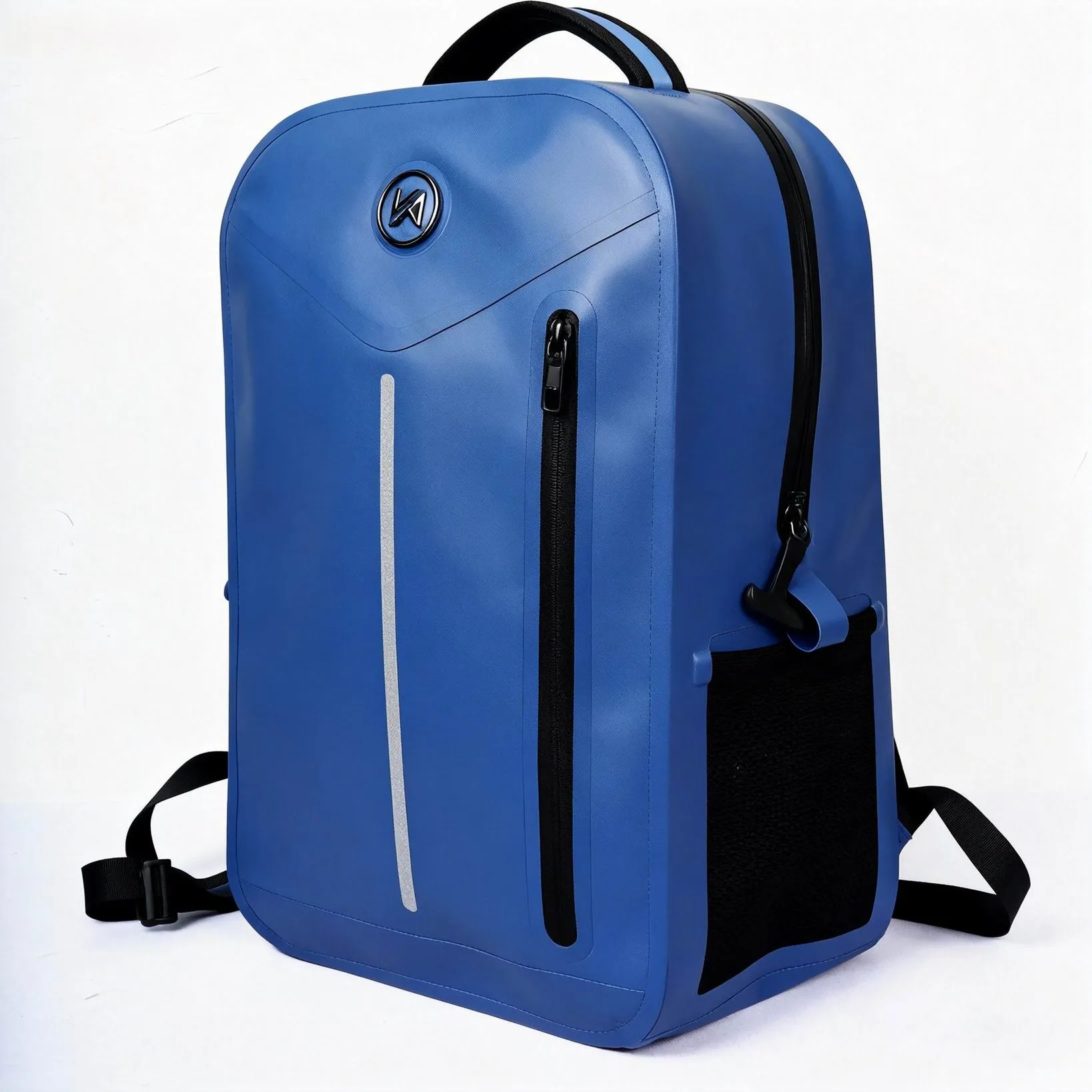
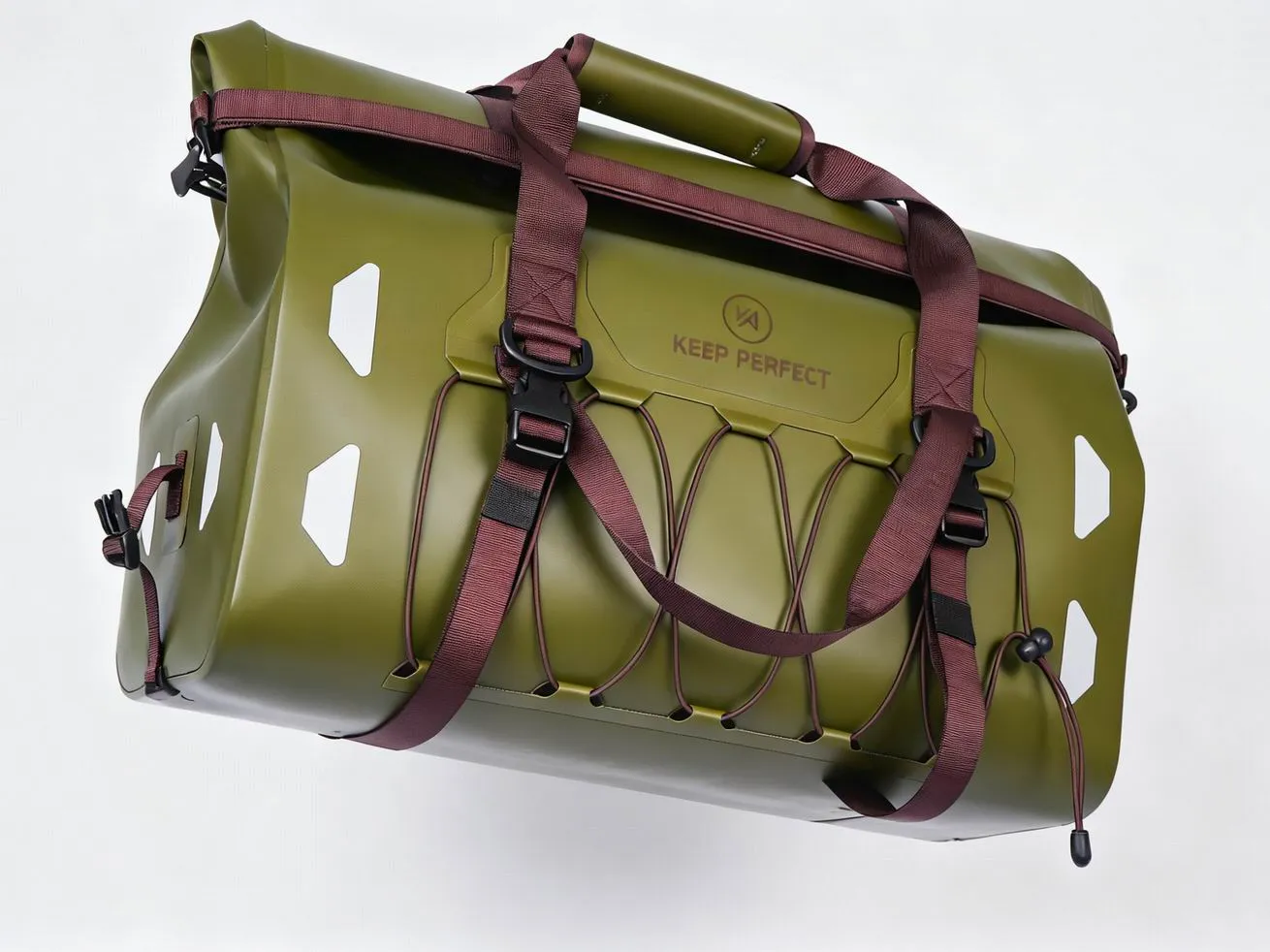
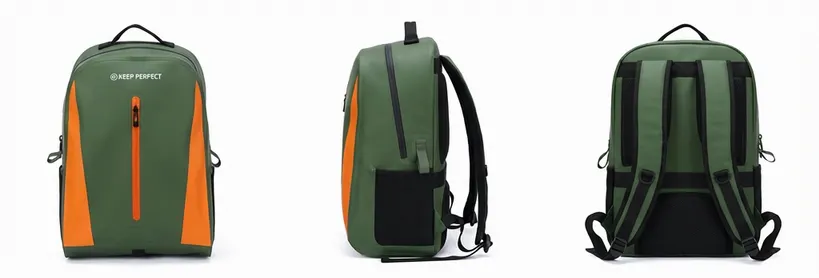
The three failures that end a hunt: noise, scent and stain
A hunting day is decided by things a hiker never has to think about. A buckle that clicks when a hunter shifts position, a sleeve that whispers against a shell jacket when the arm comes up, or a pack that still carries last season’s smell will each end a sit that took two hours of walking in the dark to reach. Hunting waterproof bags are therefore specified against a different failure hierarchy from every other outdoor category, and silent closure systems sit near the top of it because they are the part the user touches most often at the worst moment.
Put the three failures in order of how much they cost. Noise is immediate and absolute: a sound at the wrong moment ends the opportunity and cannot be recovered. Scent is probabilistic and cumulative: it does not always spoil a sit, but it reduces the odds every time and it persists in a bag indefinitely if the bag cannot be cleaned. Stain is slow and commercial: it does not cost the hunt, but it ruins the product and produces the review that says the bag was thrown away after one season.
| Failure | When it happens | Cost | Primary design lever |
|---|---|---|---|
| Noise from fabric | Any movement, especially in cold stiff fabric | Immediate loss of the opportunity | Face fabric choice and panel geometry |
| Noise from hardware | Opening a pocket or adjusting a strap | Immediate, and repeated all season | Polymer hardware, rubber-damped contact, magnetic assists |
| Scent carry-over | Every trip; accumulates over seasons | Reduced odds, permanently | Non-absorbent linings and sealed, washable compartments |
| Blood and residue staining | One bad day | Product replacement and a bad review | Smooth film interior, drainable floor, welded seams |
| Water ingress | Sustained rain or wet cover | Discomfort, and rust on metal | Correct waterproof level for the use, not the maximum |
The commercial version of this hierarchy is worth stating because it explains the category’s return profile. Hunting customers do not return bags because they leaked. They return them because a buckle broke in the cold, because the camo faded in a season, or because the interior could not be cleaned. Each of those is a specification decision that was made late, and each is cheap to fix on paper.
There is also a legal dimension that shapes the whole category, and it is the reason the firearm and ammunition section below is written as it is. Transport rules vary by jurisdiction and by mode of travel, and a product sold into hunting channels has to be designed so that lawful transport is the easy option rather than the awkward one. Organisations such as the National Shooting Sports Foundation publish safety and transport guidance that is worth reading before a range is specified.
Silence is a specifiable property
Silence is usually treated as a feeling and then argued about in forums. It can be measured well enough to specify. Two simple tests predict most of it: a rustle test, in which a panel is flexed and brushed against a standard shell fabric at a fixed speed and the sound pressure level recorded at a fixed distance; and a handling test, in which an operator performs a defined sequence of movements — shoulder the pack, open a pocket, close it, set the pack down — while the peak levels are logged.
The numbers that matter are not the absolute decibels but the character of the sound. A soft broadband rustle at a low level is far less detectable than a sharp transient: a click, a snap or a crinkle. Animals react to transients, and so does anyone who has sat in a blind and heard a neighbouring hunter open a zip. The design goal is therefore not silence in the abstract; it is the elimination of transients.
- Specify a rustle test for the face fabric at the design temperature, because cold fabric is louder than warm fabric.
- Eliminate metal-to-metal contact points on every closure and adjuster that will be touched while seated.
- Replace hard plastic-on-plastic contact with an elastomer-damped contact wherever a part snaps together.
- Avoid stiffened panels in the areas that flex with the body, because a stiff panel crinkles rather than moving quietly.
- Avoid hook-and-loop on the outside of any garment-adjacent pocket. It is the loudest closure in the category and hunters know it.
A practical field test is more convincing than a laboratory number and costs nothing. Load the pack, sit in a quiet room, and perform the sequence a hunter would perform: reach for a call, a rangefinder, a snack, a licence. Anything that produces a sharp sound is a defect. Do it again at the coldest temperature the product will see, because the ranking of materials changes when they stiffen.
Fabrics that talk and fabrics that do not
Not all waterproof fabrics are equally loud, and the differences are large enough to be the deciding factor in a product. A tightly woven, highly calendered nylon shell is crisp and makes a distinct crinkling sound when flexed, and it gets louder as it cools. A polyester with a softer hand and a brushable face is quieter. A laminated tricot or a fleece-backed laminate is quieter still, because the soft face absorbs the movement rather than transmitting it as a sound.
| Face fabric | Rustle character | Cold behaviour | Suitability for hunting |
|---|---|---|---|
| Calendered nylon shell | Sharp crinkle, louder when cold | Stiffens and gets louder | Poor for close-contact panels, acceptable on external pockets |
| Softer-hand polyester | Lower level, less transient | Modest stiffening | Good general choice |
| Brushed tricot laminate | Very quiet, soft broadband | Retains softness | Best for shoulder and body-contact panels |
| Fleece-backed laminate | Very quiet | Retains softness, adds bulk | Best for blinds, seats and quiet panels |
| TPU-coated woven with a matte finish | Moderate, depends on the coating weight | Cold-flexible films stay quieter | Good compromise where abrasion matters |
The trade-off is durability. The softest face fabrics are generally the least abrasion resistant, and a hunting pack is dragged through brush, over fence wire and across rock. The resolution is zoning: quiet fabric on the panels that contact the body or brush against clothing, and a tougher, louder fabric on the base, the lower back and the outer faces where noise does not matter and abrasion does.
Finish matters as much as the base cloth. A high-gloss coating is louder and reflects light, and reflectivity is a problem in its own right: a glossy pack catches the sun and moves with the hunter. A matte, low-sheen finish is quieter, less reflective and reads as a quality difference to a customer who has handled both. Our note on coatings and finishes covers what each finish actually delivers.
There is a procurement consequence. Quiet face fabrics are a narrower supply than general outdoor fabrics, and they should be locked into the specification early rather than substituted during a cost-down. A substitution that saves a small amount per unit and adds a crinkle is the kind of change that gets noticed in the field and in reviews, and hunting customers are unusually vocal.
Hardware and closures: the clatter problem
If a pack makes one sound, it is almost always hardware. A metal triglide sliding on webbing, a buckle body snapping shut, a zip pull tapping against a stop, a magnetic closure clicking home: each is a discrete transient produced by a hard contact, and each is produced at exactly the moment the hunter is doing something deliberate, which is the moment anything moving nearby is most alert.
- Choose polymer hardware over metal wherever the part can contact another hard part. Polymer-on-polymer is quieter and does not conduct cold to the hand.
- Where metal is required for strength, isolate it: a rubber sleeve, an elastomer washer or a fabric cover removes the contact transient.
- Specify magnetic closures with a damped seat. A magnet that snaps is loud; one that seats against an elastomer is not.
- Use zip garages and cord pulls rather than metal pulls, and make sure the pull cannot tap against the stop when the pack moves.
- Cover adjustable webbing tails. A loose tail with a metal triglide is the most common accidental noise source in the field.
The second hardware issue in this category is cold. A hunter sits for hours at temperatures near or below freezing and then handles metal with bare or thinly gloved fingers. Aluminium and steel conduct heat away rapidly and can adhere to damp skin, which is both unpleasant and, in extreme cold, a genuine hazard. Polymer hardware with a large contact area is the better answer for anything the hand touches deliberately.
The third is corrosion, because hunting happens in wet cover, in salt marshes and on damp ground, and because firearm-related items and cleaning solvents can carry aggressive residues. A stated salt spray expectation for any metal component and a coating chosen for chemical as well as water resistance are cheap specifications that prevent the rust-stained hardware that makes a pack look tired after one season. Our guides to hardware, buckles and strap accessories and chemical resistance of waterproof materials cover both.
Camouflage printing: pattern scale, fastness and the brightener trap
Camouflage is the one place in the bag industry where the print is a functional specification rather than a decoration, and it has three measurable dimensions: pattern scale relative to the viewing distance, colour fidelity to the intended environment, and durability in ultraviolet and abrasion. Get any of them wrong and the print either does not work or does not last.
Scale is the one most often got wrong in production. A pattern that reads correctly at two metres is wrong for a pack seen at forty metres, where large-scale disruptive shapes are what break up the outline, and a pattern drawn for a large panel becomes unreadable when it is wrapped around a small pocket. The practical rule is to specify a pattern scale per panel size and to check a printed sample at the actual distances, on the actual shape, rather than on a flat swatch.
| Print decision | What to specify | Failure if ignored | Test worth requiring |
|---|---|---|---|
| Pattern scale by panel size | Larger disruptive shapes on big panels, tighter repeats on small ones | A pattern that reads as a flat colour at distance | Visual assessment at 5 m, 20 m and 40 m on the finished shape |
| Colour fidelity | A reference print approved under defined lighting, with a stated colour difference tolerance | A green that reads blue in the field | Instrumental colour measurement against the approved reference |
| Light fastness | A stated grade against a recognised scale on the production material | Fading within one season | Accelerated light exposure with a stated delta |
| Optical brighteners | Explicitly excluded from the fabric and the print system | A pack that glows under ultraviolet and is visible to game | Inspection under an ultraviolet source |
| Abrasion of the print | A cycle count on the printed, production-representative material | A pattern rubbed off on shoulders and base | Abrasion test on the printed face, not the plain face |
The ultraviolet-brightener trap deserves emphasis because it is invisible in a showroom and decisive in the field. Many detergents and some fabric finishes contain optical brightening agents that fluoresce under ultraviolet light, and many animals see into the ultraviolet range. A pack that looks correctly camouflaged to a human under shop lighting can be conspicuous to game in daylight. Specifying brightener-free fabric and print chemistry, and verifying it under an ultraviolet lamp, is a genuine specification difference that very few brands make.
Print durability is the other half, and it is a well-understood problem with standard tests. Our articles on colour fastness testing and ultraviolet resistance set out what to ask for. For hunting, add the abrasion dimension: a camo print on a shoulder strap or a base panel is being abraded every hour of every trip, and the print should be tested on the printed face rather than on the base fabric.
Firearm and ammunition: separation, securing and lawful transport
Bag design for hunting has one hard constraint that no other outdoor category has: the load may include a firearm and ammunition, and the way those are carried is regulated. The design response is not to solve the legal question — that varies by jurisdiction, by species and by mode of travel — but to make the lawful arrangement the natural one. Practically, that means a dedicated compartment that keeps the firearm separate from ammunition and from the rest of the kit, holds it securely so it cannot shift when the pack is set down or carried over rough ground, and allows it to be accessed only deliberately.
- Give the firearm its own dedicated compartment with a securing strap or sleeve, so it cannot move when the pack is set down hard or carried at an angle.
- Separate ammunition into a closed, rigid-sided container within the pack, mechanically separated from the firearm.
- Make the compartment lockable or at least closable with a positive latch, because transport rules in many places turn on whether the item is secured and inaccessible.
- Design so the compartment can be presented for inspection without unpacking the whole bag, which is what a lawful stop actually requires.
- Keep muzzle and action areas away from food, scent items and anything that could obstruct them; this is a safety requirement as much as an organisational one.
- Publish a clear statement in the documentation that the user is responsible for complying with local transport law, and keep the design compatible with the common lawful arrangements.
There is a materials angle that is easy to miss. A firearm carried inside a pack brings oil, solvent and metal edges with it, and those attack coatings and abrade linings. The compartment that holds it wants a chemically resistant, smooth, wipeable film that can be cleaned, and it wants reinforcement at any point where a hard edge rests. A coated woven lining in that position will stain, hold solvent and eventually perforate.
Weight distribution matters more with this load than with any other, because it is dense and it is long. A dense, awkwardly shaped item carried high and away from the spine makes a pack unstable on side slopes, which is where hunters walk. The right answer is a compartment that places it low, close to the back and along the vertical axis, with the weight balanced left to right. That is also the arrangement that keeps it secure when the wearer slips.
The adjacent category worth reading for the structural side of this problem is our guide to bags for professional and tactical applications, which covers securing systems and compartment discipline in more depth, though the hunting version should be quieter and less hardware-heavy than that one.
Blood, game residue and cleanability
One messy day is enough to destroy a bag that was not designed to be cleaned, and this is the most common reason a hunting pack gets thrown away. Blood and game residue penetrate fabric, set within hours, smell within a day, and cannot be fully removed from a textile lining. The material and construction decisions that make a bag cleanable are made at the specification stage and cannot be added later.
| Design element | Cleanable choice | Choice that cannot be cleaned | Why it matters |
|---|---|---|---|
| Interior surface | Smooth welded film, wipeable, minimal texture | Textile or brushed tricot lining | Blood wicks into textile and sets; film wipes off |
| Seams | Welded, so there is no thread to hold residue | Stitched and taped, where thread absorbs | Stitch holes and tape edges trap organic matter |
| Floor of the compartment | One-piece, with a drain at the lowest point | A folded and stitched corner | A folded corner holds liquid permanently |
| Closure | Roll-top that can be inverted and rinsed | Zip with fabric tape | Zip tape holds residue and cannot be cleaned out |
| Removable liner | A separate washable liner in the game compartment | Integrated padding | A removable liner can actually be hosed down |
A drainable game compartment is the single most valuable feature in this category and it is rare. A compartment with a smooth welded floor, a drain plug at the lowest point and no absorbent lining can be hosed out at the end of the day, which is what a hunter will actually do. Without it, the hunter improvises with a plastic bag, and the pack is one season old by the end of it.
Odour and bacteria follow the same logic. Residual organic matter supports bacterial growth, and a bag that cannot be dried will smell regardless of any treatment. Smooth film interiors, drains and the ability to dry the compartment fully are the primary answers; antimicrobial finishes are a supplement, not a substitute, and they need the right compliance documentation for the market. Our note on antimicrobial treatments is explicit about what they do and do not achieve.
There is a documentation opportunity here that no brand uses well. A one-card instruction on how to clean a game compartment — rinse cold, do not use hot water, dry fully open — prevents the majority of the complaints in this category, because most of them are really about a bag that was put away wet.
Scent control: what sealed compartments actually achieve
Scent control products are sold on claims that are hard to verify, and a bag brand should be careful about what it promises. What a bag can genuinely deliver is containment: keeping scented items — food, toiletries, fuel, scent attractants, worn clothing — in a sealed, non-absorbing volume so that the scent does not transfer to everything else and does not linger in the bag between seasons. What a bag cannot deliver by itself is the elimination of human scent from the hunter or their clothing.
The containment claim is still worth specifying properly, because ordinary bags fail it badly. A coated woven fabric absorbs and slowly releases odour; a zip tape holds it; a padded liner holds it and cannot be cleaned. A welded film compartment with a roll-top closure, no absorbent lining and a wipeable interior genuinely contains odour, and it can be reset between seasons, which is what the customer actually wants.
- Make the scent compartment welded film, not coated fabric, and give it a roll-top rather than a zip.
- Keep scent items out of the main compartment entirely, and never in the compartment that holds food or the one that holds clothing.
- Avoid activated carbon as a structural claim unless the compartment is genuinely sealed, because carbon saturates and then contributes nothing.
- Give the bag a way to be aired: a compartment that opens fully and dries is more useful than one that seals perfectly and never dries.
- Be honest in the documentation. Containment is a real claim; scent elimination is not, and overclaiming in this category is punished in reviews.
The commercial logic is that scent compartments sell as a set. A hunter who buys a sealed scent bag tends to buy a second one for clothing and a third for food, and they are cheap products with high margins. That makes them the right entry point for a hunting range and the right product to lead marketing with, because the claim is demonstrable.
Cold stationary waiting: what a sit demands of a pack
Much of hunting is not walking; it is sitting still for two to six hours, often before dawn, often below freezing, on damp ground or in a stand. That usage is unlike any other outdoor activity and it loads the bag in an unusual way: the pack is not carried, it is hung or placed beside the hunter, and its contents have to be reachable without standing up or making a sound.
| Requirement during a sit | Design response | Consequence if missed |
|---|---|---|
| Reach everything while seated | A pocket layout that faces the hunter, not the back of the pack | The hunter stands up and is seen |
| Keep hands warm | Insulated or fleece-lined pockets, and no bare metal to touch | Cold hands cannot operate a call or a release |
| Stay dry underneath | A waterproof base and a hanging point that keeps it off the ground | A wet pack, then a cold hunter |
| Avoid condensation inside | No sealed warm items in a cold pack; ventilate electronics | Fogged optics and a wet interior |
| Operate closures silently | Magnetic or damped closures, no hook-and-loop outside | A click at the wrong moment |
| Carry a sit pad | An external strap or sleeve, not inside the main volume | A damp pad sharing volume with dry clothing |
Cold changes the pack itself. Coatings stiffen, roll-tops resist rolling, and buckles become hard to release with a gloved hand. Specifying a cold-flexible film and glove-operable closures is the same decision we describe for alpine use, and the underlying polymer behaviour is set out in our article on thermal properties of waterproof materials. For hunting the design temperature is usually milder than for alpinism, but the duration of exposure is far longer.
There is a comfort feature that pays for itself: a quiet, waterproof sit pad integrated into the pack’s exterior, or a sleeve that holds one. It costs little, it solves a genuine problem, and it is the sort of detail that gets mentioned in the reviews that sell the next hundred units.
Optics, rangefinders and electronics in the field
Optics are the most expensive items most hunters carry and the most sensitive to two things: impact and condensation. A rangefinder or a spotting scope that takes a knock against a hard part of the pack is expensive to replace, and one that fogs internally at dawn is useless at exactly the moment it is needed. Both are preventable with compartment design rather than with padding alone.
- Give optics a dedicated padded compartment with a smooth lining, placed where the pack is least likely to be struck: high and close to the back.
- Keep optics out of the same compartment as anything hard, metal or sharp. The most common damage is contact damage, not a fall.
- Allow the compartment to breathe. A warm optic sealed into a small volume will fog when the temperature drops.
- Use a closure that can be opened with one hand and silently, because the other hand is often occupied.
- Protect screens and lenses with a soft, non-abrasive facing; a hard film facing will scratch a lens coating over a season.
Electronics add a battery problem. Cold reduces battery capacity sharply, and a device kept in an outside pocket at near freezing will underperform exactly when it is needed. The practical answer is an inside pocket close to the body, which is warmer, plus a spare battery in a sealed case kept in the same place. That is a small piece of documentation that customers remember.
Our guide to phone pouches and small electronics cases covers the material choices. For hunting, add two requirements: the pouch must be silent to open, and it must not reflect light, which rules out glossy films and bright trim on any item used at close range.
Tree stands, blinds and ground: the carrying problem
Where a hunter sits changes what they need to carry and how. A tree-stand hunter climbs with the pack, needs it to hang silently and securely at height, and needs a haul line for anything heavy. A blind hunter carries more, moves less, and wants a bag that becomes a shelf. A spot-and-stalk hunter carries everything all day and wants a pack that behaves like a good hiking pack with no noise penalty.
| Hunting style | Dominant requirement | Design response | What to avoid |
|---|---|---|---|
| Tree stand | Secure, silent hanging at height | A reinforced hang loop rated for the loaded weight, and silent external attachment | Metal carabiners that clink against the stand |
| Ground blind | Organisation at a fixed position | A bag that opens flat and stands up, with internal anchor points | A soft sack that collapses into a heap |
| Spot and stalk | Load carriage and silence while moving | A harness-compatible belt, quiet face fabric, low profile | Wide packs that catch brush and shift the load |
| Waterfowl and marsh | Immersion and cleanability | Submersion rating, drainable compartments, salt-resistant hardware | Absorbent linings and zips in a silt-heavy environment |
| Upland and rough shoot | Abrasion and brush resistance | Heavier face fabric on the outer panels, quiet fabric next to the body | A uniform fabric that is either loud or fragile |
The haul line is the tree-stand specific item that is most often overlooked. A hunter at height needs to raise a pack or a piece of equipment without climbing down, and a pack with a rated haul point and a loop for the line is safer and quieter than improvising with a strap. A rated haul point is a cheap reinforcement and a genuine safety feature.
Waterfowl deserves a separate note because it is the one hunting context where submersion matters. Decoys, waders and marsh travel put bags in water, silt and salt, and the closures that survive it are roll-tops rather than zips. The adjacent reading is our guide to bags for fishing and angling, which covers the silt and salt failure set in detail.
Load carriage on long approaches and long drag-outs
Hunting loads are unusual in shape and in timing. The approach is often in the dark, over rough and unseen ground, with a load of fifteen to twenty-five kilograms. The return can be heavier, awkwardly balanced, and carried after several hours of sitting still in the cold, which is when people injure themselves. A pack designed for hunting should be designed for the return as much as for the approach.
- Keep the load close to the spine and low, because side slopes and unseen footing punish a high or wide load.
- Provide a real hip belt and load lifters. Hunting loads are heavy enough that a shoulder-only carry is a back injury waiting to happen.
- Make external attachment symmetrical and quiet, and cover every webbing tail that could catch on brush.
- Ensure the pack can be set down and picked up repeatedly without the load shifting, because a hunter does that constantly.
- Rate the handles and haul points for the loaded weight, tested wet, because they are grabbed at the worst moment.
- Consider a frame or a load shelf for game-carrying products, because that is the heaviest and least balanced load of all.
The game-carrying case deserves its own product decision, because it is the one item in the category with no equivalent elsewhere. It needs a smooth welded floor, a drain, no absorbent lining, external straps that secure an awkward load, and the ability to be hosed out. It is also the product most likely to be bought as a replacement, because it is the one that gets ruined. Our overview of load testing for straps and handles applies directly to the haul points.
Building a hunting range: materials, compliance and order planning
A hunting range is unusually good commercially because hunters buy in sets, buy before a season, and replace on a predictable cycle. It is also unusually demanding technically, because the quiet fabrics, the brightener-free print chemistry and the cleanable film interiors are all narrower specifications than a general outdoor range needs. The discipline is to decide all of them before the first sample, because each constrains the others.
| Product | Role in the range | Key specification | Sourcing note |
|---|---|---|---|
| Quiet approach pack | The defining product | Zoned quiet fabric, polymer hardware, harness-compatible belt | Highest validation burden; lock the face fabric early |
| Scent containment sack | Entry product, sold in multiples | Welded film, roll-top, no absorbent lining | Cheap, high margin, easy to absorb a production minimum |
| Game or meat compartment bag | Replacement product | Welded floor, drain, wipeable film | Highest repeat purchase rate in the category |
| Optics and electronics pouch | Attachment product | Padded, silent closure, non-reflective facing | Shares tooling with camera and electronics lines |
| Waterfowl and marsh bag | Seasonal product | Submersion rated, silt-tolerant closures, salt-resistant hardware | Crosses over into fishing and paddling channels |
| Accessory pouch set | Basket builder | Quiet closures, camo-matched print scale | Low risk, high attachment, sells with the pack |
Logo durability has a specific constraint here that does not exist elsewhere: the logo must not compromise the camouflage. A large, high-contrast brand mark on the outside of a hunting pack is a functional problem as well as a taste problem, and the brands that sell well in this channel use small, tonal marks. Silicone prints and welded badges in a tonal colour are the right choice; they also survive the abrasion and cleaning that hunting gear receives. Embroidery perforates a waterproof shell and needs a welded backing, and it is conspicuous. The full comparison is in our guide to logo printing and embroidery options.
Compliance documentation matters more in this channel than in general outdoor retail, because hunting products are sold alongside items with their own regulatory frameworks, and because retailers in this channel ask for it. Having chemical compliance documentation for coatings and prints, and a clear statement of what the product is and is not intended to do, is a commercial asset rather than a cost. Our guides to chemical compliance testing and regulatory compliance for custom bags set out what to prepare.
Order planning follows the season. Hunting ranges are bought in a narrow window before the season opens, which means the sampling round has to finish well before it, and it means inventory risk is concentrated. The disciplined answer is a small number of styles with strong commonality — one quiet face fabric, one hardware family, one camo print system in two or three pattern scales — rather than many styles with separate tooling. Colour and pattern should be the variables; the platform should not be. Independent verification of any durability claim is covered in third-party laboratory testing, and published methods are catalogued by the International Organization for Standardization.
If you want these decisions turned into real numbers rather than estimates, send us your pattern requirements, hardware preferences and target volumes. Minimum order quantity is 500 pieces per style, samples take 6–10 working days, bulk production runs 35–50 days, and quotations are issued FOB Xiamen.
Frequently Asked Questions
Q1. What matters more in a hunting bag, waterproofing or silence?
Silence. Water protection is table stakes in a category where users sit in wet cover for hours. A noisy closure or a rustling panel ends the opportunity immediately and cannot be recovered.
Q2. Which fabric is quietest for a hunting pack?
A brushed tricot or fleece-backed laminate on the panels that contact the body or brush against clothing, with a tougher fabric on the base and lower back. Zoning beats a uniform quiet fabric that wears out.
Q3. How do I stop buckles and zips clicking in the field?
Use polymer hardware, isolate any metal with an elastomer sleeve or washer, replace metal pulls with cord, and cover webbing tails. The goal is to remove sharp transients, not all sound.
Q4. Why does camouflage sometimes look visible to game but fine to me?
Optical brighteners in fabric or print chemistry fluoresce under ultraviolet, which many animals can see. Specify brightener-free materials and check under an ultraviolet lamp.
Q5. Can a bag actually control human scent?
No. What a bag can do is contain scented items in a sealed, non-absorbing compartment. A welded film sack with a roll-top genuinely contains odour and can be reset between seasons.
Q6. How should a firearm and ammunition be organised in a pack?
In separate compartments, with the firearm secured against movement and the ammunition in a closed rigid container, and arranged so it can be presented for inspection without unpacking. Local transport law governs the detail.
Q7. How do I clean blood out of a hunting pack?
Rinse cold, never hot, and dry fully open. Prevention is the real answer: a welded film compartment with a drain and no absorbent lining can be hosed out; a textile lining cannot be cleaned.
Q8. What makes a good game-carrying bag?
A smooth welded floor, a drain at the lowest point, no absorbent lining, external straps for an awkward load and rated haul points. It is the most frequently replaced item in the category.
Q9. Should hunting hardware be metal or polymer?
Polymer, wherever the hand touches it or two parts can contact. Polymer is quieter, does not conduct cold to bare fingers, and does not rust in wet cover.
Q10. Why do coatings get louder in cold weather?
Polymers stiffen as temperature falls, so a panel that is quiet at room temperature crinkles near freezing. Specify a cold-flexible film and test the rustle at the design temperature.
Q11. How should optics be carried?
In a dedicated padded compartment high and close to the back, away from hard items, and allowed to breathe so it does not fog. Keep spare batteries in an inside pocket near the body.
Q12. What is different about a tree-stand pack?
It needs a rated hang point that is silent, a haul line attachment, and a layout that lets the hunter reach everything while seated. Metal carabiners that clink against a stand are the usual mistake.
Q13. Do I need a submersion rating for a hunting bag?
For waterfowl and marsh hunting, yes, along with silt-tolerant closures and salt-resistant hardware. For upland and big-game hunting, resistance to wet cover and ground moisture is the relevant specification.
Q14. Should the brand logo be large on a hunting pack?
No. A large high-contrast mark compromises the camouflage. Tonal silicone prints or welded badges are both discreet and durable enough for abrasion and cleaning.
Q15. How much weight does a hunting pack need to carry?
Fifteen to twenty-five kilograms on the approach, and more on the return. That requires a real hip belt and load lifters, and the pack should be designed for the return as much as for the approach.
Q16. How many products should a hunting range include?
About five or six, built on one quiet fabric, one hardware family and one print system. Hunters buy in sets before a season, so commonality matters more than variety.
Q17. What documentation reduces returns in this category?
A cleaning instruction, a cold-temperature statement, an honest description of what scent containment does, and a note that the user is responsible for local transport compliance.
People Also Ask
What makes a bag suitable for hunting?
Quiet fabrics and closures, a cleanable welded interior, sealed scent containment, secure firearm separation and cold-tolerant hardware, more than a high waterproof rating.
Why are hunting bags designed to be silent?
Because any sharp sound at close range ends the opportunity immediately. Fabric rustle and hardware clicks are detected far more readily than movement.
Can a bag really control scent?
It can contain it. Welded film compartments with roll-tops and no absorbent lining stop odour transfer and can be reset between seasons.
How do you clean blood out of a bag?
Rinse with cold water and dry fully open. A welded film interior with a drain can be hosed out; a textile lining cannot be fully cleaned.
Should hunting packs use metal hardware?
Generally no. Polymer is quieter, warmer to touch in cold weather and does not corrode in wet or salty conditions.
Do camo prints fade on bags?
They can, especially on abraded panels. Specify a light-fastness grade and test abrasion on the printed face, not on the plain fabric.