Dropshipping waterproof bags works when the business is honestly understood as a demand-generation and service operation that buys stock risk removal at a known price. It fails when it is sold internally as a way to build a waterproof brand without owning inventory, quality evidence or delivery control. The model has a real and stable use case: ready-made, non-custom product sold into a market where fulfilment speed is acceptable and the waterproof claim is modest. Its economics are thin, with contribution margins commonly landing between roughly fifteen and thirty per cent after goods, payment fees, shipping and returns, and they are highly sensitive to delivery surprises, oversell incidents and return rates.
This guide works through that structure numerically. It separates the costs that quietly determine profit, models a twelve-month contribution margin, explains why waterproof claims create a distinct evidence and returns burden, sets rules for marketplace and legal accountability, compares dropshipping against genuine custom and private-label routes, and gives a phased migration path for brands that start with ready stock and later commit to specification control. MOQ 500 pieces per style, sampling in 6–10 working days, bulk in 35–50 days, FOB Xiamen: these are the working terms at QUANZHOU JUNYUAN BAGS, custom waterproof bag production since 2014 in a 4,950 m² SGS-verified facility.
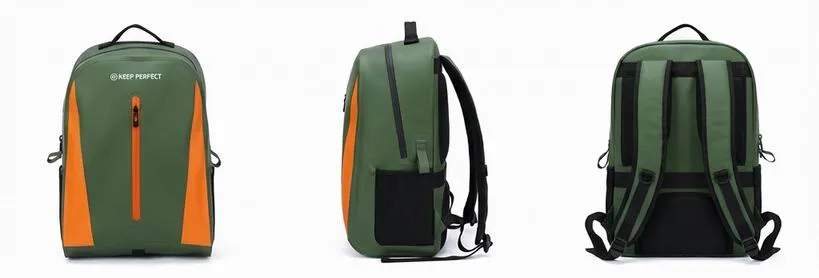
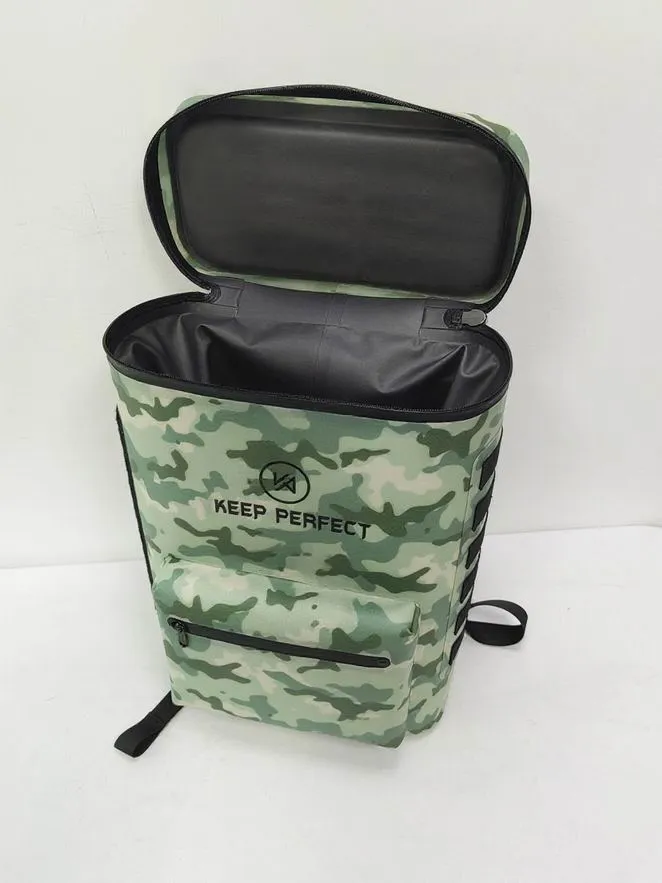
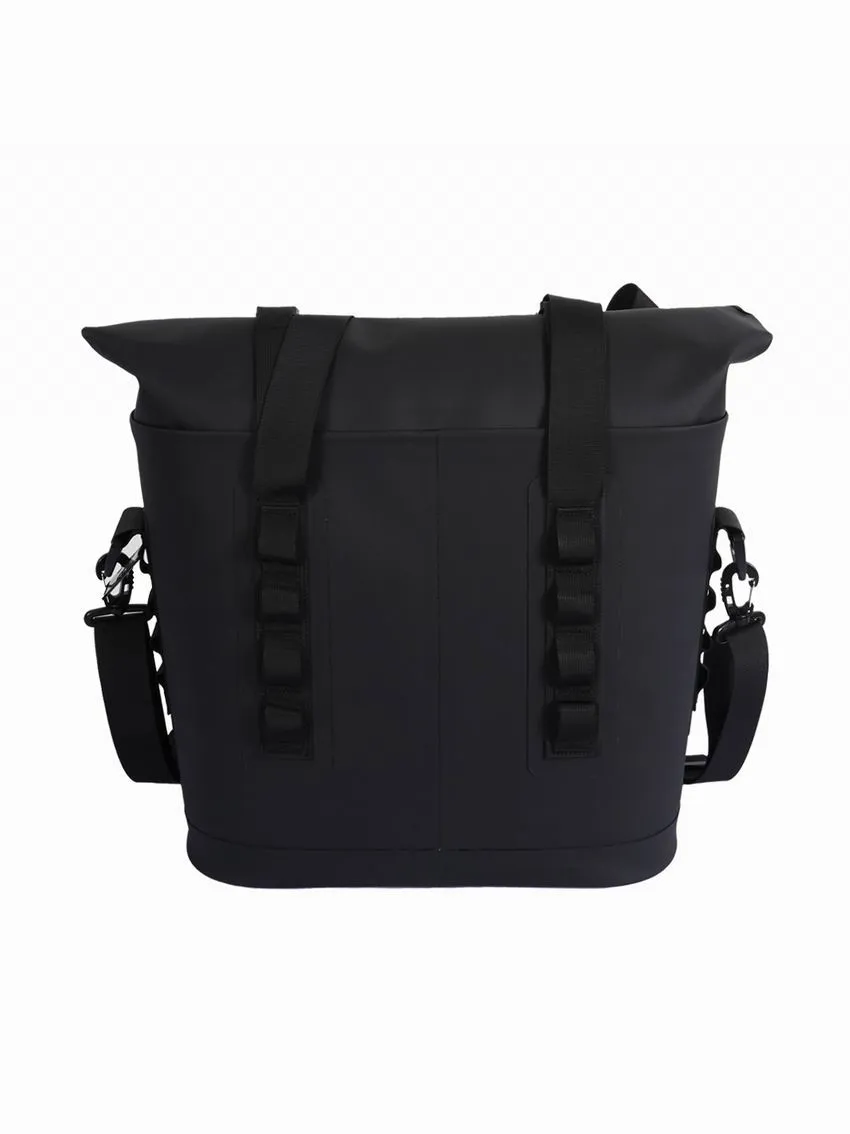
What is actually being bought when inventory risk is removed
The cleanest way to think about waterproof bag dropshipping is as a priced service contract. The seller pays a per-unit fulfilment premium to avoid holding stock, and in exchange accepts reduced control over packaging, inspection, dispatch timing and delivery reliability. That trade is often rational for validating demand, because it converts a capital commitment into a variable cost. It is only rational while the premium stays below the cost of the risk being avoided, and that boundary moves as volume grows.
The decision is therefore not “dropshipping versus owning inventory” in the abstract. It is a comparison of three numbers: the fulfilment premium per unit, the expected cost of stock risk released, and the expected cost of control lost. Stock risk includes cash tied up, obsolescence, size and colour splits and demand error. Control cost includes late deliveries, wrong items, unbranded packaging, weaker inspection, slower exchanges and damage to review scores. Most failed operations priced only the first two and discovered the third through refunds.
| Cost of control released | Cost of control lost | How to estimate | Typical early-stage impact |
|---|---|---|---|
| Working capital in stock | Late or split deliveries | Compare cash cycle cost against observed transit variance | Refund requests and support contacts |
| Storage and handling | No pre-dispatch inspection | Warehouse fees versus internal inspection labour | Higher defect arrival and review damage |
| Obsolescence and dead sizes | Oversell when stock is unsynchronised | Markdown history versus platform penalty rates | Cancellations and account health warnings |
| Demand forecasting error | Unbranded or inconsistent packaging | Forecast error cost per season versus brand conversion loss | Weak repeat purchase and low perceived value |
| Minimum order commitment | Slow exchanges for size or colour issues | Commitment value versus return handling cost | Longer resolution time and lower trust |
In practice the crossover usually appears somewhere between a few hundred and a few thousand units per month, depending on product bulk and value density. Below that, holding stock can cost more than the fulfilment premium. Above it, the premium often exceeds the real cost of a small warehouse and a part-time packer. The point is to run the comparison with your own numbers rather than assume the model scales linearly with revenue.
One structural caveat applies to this category specifically. Waterproof bags are bulky relative to their weight, so parcel freight is charged on volumetric weight and storage is expensive per unit of value. A model built on small lightweight accessories does not translate directly to dry bags and backpacks, because both the shipping line and the storage line behave differently at larger cube.
Build the contribution margin from the bottom, not from a margin percentage
Advertising dashboards report gross margin, which for this model is close to meaningless because it is calculated before the costs that decide survival: payment processing, shipping subsidy, returns, platform fees, support time and app or integration subscriptions. Contribution per order after all variable costs is the only figure that determines whether growth is profitable. Calculate it per SKU, because a large duffel and a small pouch do not share freight or return economics.
| Line item | Illustrative range | Why it varies | Control lever |
|---|---|---|---|
| Goods cost including handling fee | 45 to 60 per cent of retail | Product size, supplier terms, packaging standard | Negotiate tiers or move to owned inventory |
| Parcel shipping | 10 to 25 per cent of retail | Volumetric weight and destination mix | Assortment design and regional warehouse choice |
| Payment processing | 2 to 4 per cent of transaction value | Method mix and chargeback rate | Method mix and fraud screening |
| Marketplace or platform commission | 6 to 15 per cent of retail | Channel rules and category | Channel mix and own-store share |
| Returns and exchanges | 3 to 10 per cent of revenue | Expectation accuracy and waterproof claim clarity | Better product content and fit guidance |
| Customer support time | 1 to 3 per cent of revenue | Delivery variance and claim complexity | Proactive tracking and honest lead times |
| Advertising | 10 to 30 per cent of retail | Keyword competition and conversion quality | Evidence content and repeat purchase rate |
Put those ranges into a twelve-month model rather than a single order. Assume a retail price, apply conversion and repeat rates, and then add one realistic deterioration: for example, a transit delay affecting one in six orders during a seasonal peak. Contribution margin frequently falls by five to eight percentage points under that single change, because support contacts, refunds and advertising efficiency all move together. A model that only works under ideal delivery is not a model; it is a forecast of best-case weeks.
Two ratios deserve monthly review. Contribution per order should exceed a defined floor, commonly targeted at eight to twelve currency units after all variable costs, because thinner orders cannot absorb a bad week. Contribution per advertising unit should exceed a target multiple of acquisition cost within three months; if a product cannot reach that after content and pricing iteration, it belongs in a clearance plan rather than in a larger budget.
Treat cash conversion as part of the model. If the platform releases funds after delivery confirmation, a long transit window extends the cash cycle while advertising is paid immediately. A profitable-looking funnel can still create a working-capital gap, so plan the advertising budget against released cash rather than booked revenue.
Delivery variance is a marketing input, not a logistics footnote
Ready-stock fulfilment from a domestic warehouse can reach customers in a few days, while cross-border dispatch commonly ranges from roughly eight to twenty-five days depending on service and destination. That difference is not a footnote; it changes the advertising promise, review sentiment, cancellation rate and cash timing. Sellers who advertise fast delivery on a slow supply chain create the worst outcome in e-commerce: the product arrives acceptable but later than the promise.
Quote a delivery window you can defend at the ninetieth percentile, not the median. If most orders arrive in twelve days but one in six takes twenty-two, advertise fifteen to twenty and bank the positive surprise. Under-promising is cheap; over-promising costs refunds, support hours and review scores that later raise acquisition cost. Display the same window on the product page, checkout and confirmation email, because inconsistency creates more contacts than slowness does.
Split the promise by destination and service level. One blanket worldwide window is either uncompetitive for nearby markets or dishonest for distant ones. Maintain a simple matrix of destination, service and expected window, update it when carrier performance changes, and pause advertising to any lane where performance degrades. A paused campaign costs less than the account-health damage from sustained late delivery.
Communicate proactively when an order passes its expected window. A short message with a tracking event and a new estimate prevents most “where is my order” contacts and converts a proportion of would-be disputes into ordinary deliveries. This is also where the model shows its weakness: the seller owns the customer relationship and the promise, while the dispatch decision belongs to someone else.
Inventory synchronisation and the real cost of overselling
Overselling is the failure mode unique to this model, and its cost is larger than the refund. Stock data that updates hourly can be several hundred units wrong during a promotion, and marketplaces treat cancellation rate and late dispatch rate as account-health signals. Sustained breach can remove buy-box eligibility or advertising access, which is a revenue consequence far exceeding the margin on the affected orders.
Defend it in layers. First, never advertise stock you do not control; keep a safety buffer by holding back a percentage of reported available quantity for high-velocity SKUs. Second, refresh stock more frequently than your sales velocity requires: if a promoted SKU can sell fifty units in an hour, daily synchronisation is inadequate. Third, run a reconciliation job that compares platform listings against supplier feed at least twice daily and flags mismatch rather than silently updating.
- Keep a buffer quantity proportional to recent hourly sales velocity, not a fixed number of units.
- Pause advertising automatically when available stock falls below a defined days-of-cover threshold.
- Reconcile platform listings against the supplier feed at least twice daily and log every mismatch.
- Keep a documented manual override path with an owner, because feeds fail during the highest-volume days.
- Define in advance who pays for an oversold order: replacement, upgrade, refund or partial ship.
Promotions deserve special discipline. A flash sale multiplies order rate while stock data lags, so either raise the buffer before the event or cap the number of units sold. The cheapest oversell to fix is the one prevented by a quantity cap; the most expensive is the one discovered after two hundred customers have been told their order shipped.
After-sales responsibility stays with the seller
The most dangerous misunderstanding in this model is believing the supplier carries complaints. Commercially and in most jurisdictions legally, the party that advertised the product, took payment and set the delivery promise is responsible for delivery, conformity and redress. The seller then has a separate contractual claim against the supplier, which is slower, partial and irrelevant to the customer waiting for an answer. Build the business on the assumption that every complaint is yours first.
Consumer protection frameworks generally hold the trader, not the distant fulfilment party, accountable for misleading claims and non-conforming goods. In the European Union, for example, the European Commission sets out consumer rights on delivery and conformity, and similar trader-facing obligations exist in most major markets. The practical rule is simple: state what the product does, keep evidence for the claim, and honour the remedy you advertised.
Operationally, that means a written policy with four decisions made before launch. What is the no-questions return window? Who pays return shipping for change of mind versus defect? What is the replacement threshold below which you ship first and investigate later? And what evidence is retained for a defect claim? A policy created during the first dispute is usually generous in the wrong places and slow everywhere.
Price the policy into the model. If a fifteen per cent return rate is plausible for a fitted product, contribution must survive it. Track returns by reason code: not as described, damaged in transit, wrong item, changed mind, or performance disappointment. The first and last codes are content problems rather than product problems, and they are usually the cheapest to fix because they are solved on the product page rather than in the supply chain.
Where waterproof claims break the standard dropshipping model
This is the honest boundary. Dropshipping works best when the product is understood by the customer without technical explanation. Waterproof product is rarely that simple. A buyer needs to know whether the item resists rain or survives immersion, whether the closure or the fabric is the limiting component, and what the rating actually means. If the listing cannot answer those questions with evidence, disappointment returns follow even when the goods are sound.
Performance claims also need a defined method. Ratings such as IPX7 are meaningful only with the test method, duration, depth and condition stated, and the language matters commercially. Our explainer on the IPX rating system and the comparison of IPX7 and IPX8 submersion ratings exist because the difference between splash resistance and temporary submersion is exactly the difference between a satisfied customer and a return.
| Adaptation factor | Strongly suited to dropshipping | Poorly suited | Reason |
|---|---|---|---|
| Product type | Simple dry bags, pouches, rain covers | Technical backpacks with fit and load expectations | Fit and load drive returns that content cannot fully prevent |
| Waterproof claim | Splash resistant or shower proof | Immersion or submersion claims | Immersion requires method, evidence and consistent construction control |
| Customisation | None, or supplier-applied standard branding | Custom colour, hardware, dimensions or artwork | Custom work requires sampling and a minimum order commitment |
| Compliance | General consumer goods | Children’s product or regulated electrical claims | Requires documented testing and responsible-party documentation |
| Delivery expectation | Ten days or more acceptable | Next-day promise | Cross-border dispatch rarely supports express promises economically |
There is also a market-honesty argument. A category where performance claims drive both conversion and returns rewards sellers who can prove claims and punishes those who merely repeat them. Dropshipping a waterproof bag described as “fully waterproof” without a method, a rating or a test report is not a marketing shortcut. It is a deferred refund with a worse review attached to it.
A reasonable compromise exists for early-stage brands: sell ready-made product through dropshipping to learn which use cases customers actually buy, then convert the two or three proven winners into controlled private-label or custom production. Demand discovery and product differentiation are different jobs, and this model is genuinely good at the first one.
Comparing routes: ready-stock, private label and true custom
Three routes are frequently confused because all three can be described as selling someone else’s product. Ready-stock resale means selling existing items unchanged. Private label usually applies your brand and packaging to an existing or lightly modified construction, often with a minimum commitment. True custom means the construction, materials, hardware, dimensions and artwork are specified and validated for you, with sampling before bulk. Only the third creates defensible product differentiation.
The choice is mainly about which risk you want to own. Ready-stock dropshipping owns demand risk and service risk but almost no inventory risk. Private label adds inventory and branding risk in exchange for margin and repeat purchase. Custom adds engineering, sampling and compliance risk, plus a minimum order commitment, in exchange for a product competitors cannot simply list. A useful sequence is to use the first to find demand, the second to build a brand, and the third to protect it.
Comparing private label and white label clarifies an intermediate step many sellers skip. A white-label item with your logo may still be listed by competitors in another colourway, so differentiation can be superficial. Where genuine differentiation is the goal, the private label programme route and eventually custom development with our 500-piece-per-style minimum order quantity, 6–10-working-day sampling and 35–50-day bulk schedule provide the control that marketing cannot substitute for.
Be explicit about the minimum commitment when comparing routes. Custom development requires 500 pieces per style, which is a real inventory position and a real cash decision. That is not a disadvantage of the custom route; it is the price of controlling construction, materials and testing. Sellers who need that control but cannot fund the commitment should stay with ready stock until volume justifies the step rather than seeking a supplier willing to pretend otherwise.
Selecting and governing a fulfilment partner
Partner selection should be a measurement exercise, not a catalogue review. Ask for observed dispatch time distribution rather than an average, stock refresh frequency and mechanism, packaging standard including whether branding is possible, inspection practice before dispatch, return address and processing time, and how oversell incidents are handled commercially. Request a sample order to your own address in the destination market you intend to advertise, because the delivered condition and timing are the actual product your customer buys.
Run the sample order three times across several weeks. One good delivery proves little; three deliveries show variance and packaging consistency. Inspect what arrives: carton condition, product protection, presence of paperwork, accuracy of the item, and whether the waterproof claim documentation matches the listing. Photograph everything, because those images become the standard for later dispute resolution with the partner.
Contract terms should cover the failure modes, not only the price. Define dispatch cut-off times, stock-accuracy expectations and remedy, inspection standard, packaging specification, who funds replacement for partner error, data-format obligations for feeds, and exit terms including how remaining customer service cases are handled. A partner unwilling to state a stock-accuracy remedy is telling you that oversell cost belongs to you.
Maintain a second source for the top two or three SKUs once volume justifies it. Dual sourcing is not disloyalty; it is how you discover whether pricing and service are still competitive, and it limits the damage of a sudden feed or dispatch failure. Rotate a small share of volume to the alternative so the fallback is operational rather than theoretical.
Assortment and pricing discipline for thin margins
With thin contribution, breadth is expensive. Each additional SKU adds content work, stock-synchronisation complexity, return variance and support surface, while only a minority of listings generate meaningful volume. Start with a narrow assortment of perhaps eight to fifteen SKUs covering distinct use cases rather than colours, and expand only when a product has proven contribution for a full quarter. Colour and size variants should wait until the base style has demonstrated repeatable demand.
Price for contribution, not for comparison. Matching the lowest marketplace price usually produces an order that costs more to service than it earns once returns and support are included. Instead, price to a target contribution after all variable costs and improve conversion with better evidence: clearer use-case boundaries, honest waterproof level, real photographs, size context and a visible delivery window. Evidence reduces returns, and reduced returns is the most reliable margin lever available in this model.
Use bundles deliberately. A dry bag paired with a phone pouch can raise average order value while sharing one parcel, which improves freight economics on bulky goods. However, bundles multiply synchronisation risk because two stock positions must both be available. Only bundle items with similar availability and supplier, and cap bundle quantity at the lower available stock.
Watch the advertising-to-repeat ratio. If contribution disappears when advertising stops, the operation is renting demand rather than building a brand. Repeat purchase, email list growth and branded search volume are the signals that justify moving from ready stock toward private label. Without them, scaling spend simply scales a fragile arbitrage.
Legal, tax and data obligations that arrive with scale
Operating across borders brings obligations that are easy to postpone and expensive to discover late. Determine where you are the trader of record, whether import taxes are collected at checkout or on delivery, and who is the responsible party for product compliance in each market. Value-added tax and marketplace facilitator rules differ by jurisdiction, and treating them as an afterthought can convert a profitable quarter into a liability.
Product compliance deserves specific attention for this category. If goods are sold to children, or if a claim implies protection of electrical devices, additional documentation and responsible-party obligations may apply. General guidance from bodies such as the US Federal Trade Commission on advertising and marketing reinforces a principle that applies everywhere: claims must be substantiated before they are made, not after a dispute.
Customer data creates a second set of duties. Order information, addresses and payment references are usually processed under a privacy framework with defined retention and access rules. Keep only what fulfilment requires, restrict internal access, use processors with appropriate terms, and publish a plain policy. A data incident during peak season is both a legal and an operational event.
Finally, align insurance and terms with reality. Product liability cover, a published returns policy consistent with platform rules, and terms that name the correct legal entity are unglamorous items that determine whether a single incident is an inconvenience or a business-ending event. Set them before the first seasonal peak, when volume and scrutiny arrive together.
Metrics that warn before profit disappears
A dashboard built around revenue hides this model’s failure modes. Track a short list that leads outcome rather than reporting it: contribution per order after all variable costs, contribution per advertising unit, dispatch-time distribution, stock mismatch count, cancellation and late-dispatch rates, return rate by reason code, support contacts per hundred orders, and repeat purchase rate within ninety days. Each has a threshold that triggers a defined action, so the dashboard changes behaviour rather than describing it.
| Metric | Healthy early target | Warning zone | First action |
|---|---|---|---|
| Contribution per order | Positive and above the internal floor | Below floor for two consecutive weeks | Raise price or reduce advertising; do not add SKUs |
| Dispatch time, 90th percentile | Within the advertised window | Beyond window on any major lane | Pause advertising to that lane and re-quote the promise |
| Stock mismatch count | Near zero on advertised SKUs | Any oversell on a promoted SKU | Raise buffer, cap quantity and slow the feed refresh interval |
| Cancellation rate | Well below platform thresholds | Approaching account-health limits | Restrict promotions until synchronisation is fixed |
| Return rate | Under roughly eight to ten per cent | Above the modelled assumption | Fix content and expectations before changing suppliers |
| Support contacts per 100 orders | Single digits | Double digits | Add proactive tracking and clearer size guidance |
Review weekly during peak season and monthly otherwise, with a written note on each breach and the action taken. The value of the log is pattern recognition: the same lane failing every quarter, the same SKU driving returns, the same partner feed degrading during promotions. Those patterns justify structural changes such as regional warehousing, dual sourcing or migration to owned inventory.
Set explicit kill criteria too. If a SKU cannot reach target contribution after a defined period of content, pricing and channel iteration, remove it. Carrying a structurally unprofitable listing consumes support capacity and advertising budget that a proven product could use, and thin margins leave no room for sentiment.
When to graduate from dropshipping to controlled supply
The right time to move is when the model’s benefits have been extracted and its costs have become the binding constraint. Typical signals: two or more SKUs with stable demand across two seasons, a return rate dominated by “not as described” rather than quality failure, contribution limited mainly by goods cost rather than demand, and repeat purchase strong enough to justify branding. At that point the fulfilment premium is buying little risk reduction while capping margin and control.
Do not attempt a single leap from pure dropshipping to full custom development. Move in steps. Step one: consolidate the assortment to proven winners and standardise packaging and inserts. Step two: commit to a private-label run on the highest-volume style, which introduces inventory, branding and a minimum commitment while keeping an existing construction. Step three: develop a genuinely custom specification on the style where differentiation matters most, using sampling to validate before bulk.
Budget the transition honestly. Owned inventory converts a variable cost into working capital, adds storage and handling, and requires a demand forecast you are now accountable for. It also delivers what this model cannot: inspection before dispatch, branded packaging, faster delivery, material control and testable waterproof claims. Treat the change as a financing decision supported by data, not as a response to frustration with a partner.
For the custom step, plan around real parameters rather than optimistic ones: 500 pieces per style, 6–10 working days for sampling, 35–50 days for bulk, FOB Xiamen, and a sampling round that answers defined questions. Buyers ready to make that transition can send a specification with target volume and delivery window. The route from validation to a defensible waterproof brand is a sequence, and each stage earns the next.
Frequently Asked Questions
Q1. Is dropshipping waterproof bags actually profitable?
It can be viable on ready-made product with honest expectations, but contribution margins are commonly thin, often roughly fifteen to thirty per cent after goods, shipping, fees and returns. Profitability depends more on delivery reliability, return rate and stock accuracy than on negotiating a lower unit price.
Q2. Why is waterproof product harder to dropship than general accessories?
Because performance is a claim rather than a visible feature. Customers need the waterproof level, test method and use boundary explained with evidence. Without that, disappointment returns occur even when the goods are sound, and returns are the line item that erases thin margins fastest.
Q3. What is a realistic contribution margin for a dropshipped waterproof bag?
Model it per SKU after every variable cost: goods, handling, parcel shipping with volumetric weight, payment fees, platform commission, returns, support time and advertising. Many sellers discover margins below twenty per cent once returns and support are included rather than excluded as overhead.
Q4. How long should I tell customers delivery will take?
Quote a window you can defend at roughly the ninetieth percentile rather than the median. Cross-border dispatch can range from about eight to twenty-five days depending on service and destination, and under-promising is far cheaper than refunds, disputes and review damage.
Q5. What causes the most damage in a dropshipping operation?
Overselling caused by stale stock data. Beyond refunds, cancellations and late dispatch affect marketplace account health, which can remove buy-box eligibility or advertising access and cost far more than the margin on the affected orders.
Q6. How often should stock levels be synchronised?
More frequently than your sales velocity requires. If a promoted SKU can sell fifty units in an hour, daily updates are inadequate. Reconcile platform listings against the supplier feed at least twice daily, hold a velocity-based buffer, and pause advertising below a defined days-of-cover threshold.
Q7. Who is legally responsible when a dropshipped product disappoints the customer?
Generally the seller who advertised it, took payment and set the delivery promise. Consumer protection rules in most markets hold the trader accountable for conformity and claims, while any recourse against the supplier is a separate, slower commercial matter.
Q8. Can I dropship custom waterproof bags with my own design?
Not in the usual sense. Custom work requires specification, sampling, material decisions and a minimum order commitment of 500 pieces per style. Dropshipping fits ready-made product; custom development is a supply-chain programme, not a fulfilment method.
Q9. What is the difference between private label and dropshipping here?
Dropshipping sells existing product with no inventory commitment and limited control. Private label applies your brand and packaging, usually with a minimum quantity, giving better margin and repeat purchase. Custom development changes the product itself and is the only route to real differentiation.
Q10. How do I reduce returns on waterproof bags sold online?
Fix expectations before fixing suppliers. State the waterproof level with its method, show the closure and seam construction, give size context against familiar objects, and set an honest delivery window. Most “not as described” returns are content failures rather than manufacturing defects.
Q11. Should I use one supplier or several?
Start with one to keep operations simple, then add a second source for the top two or three SKUs once volume justifies it. Rotating a small share of volume keeps the alternative operational and reveals whether pricing and service remain competitive.
Q12. What should I test before committing to a fulfilment partner?
Order to your own address in the destination market three times across several weeks. Inspect dispatch timing variance, packaging condition, item accuracy, documentation and whether the waterproof claim evidence matches your listing. Photograph everything as a future dispute standard.
Q13. How many SKUs should a new dropshipping catalogue contain?
Roughly eight to fifteen covering distinct use cases rather than colours. Each additional SKU adds synchronisation complexity, content work and return variance. Expand after a style has produced stable contribution for a full quarter.
Q14. When does holding inventory become cheaper than dropshipping?
Commonly somewhere between a few hundred and a few thousand units per month, depending on product bulk and value density. Compare the fulfilment premium against the real cost of storage, handling and stock risk released, using your own volumes rather than a rule of thumb.
Q15. What taxes and compliance issues should I plan for?
Determine where you are the trader of record, whether import taxes are collected at checkout or on delivery, and who is the responsible party for product compliance in each market. Children’s products or claims involving device protection can add documentation duties.
Q16. What is the safest way to move from dropshipping to a real brand?
Progress in stages: consolidate proven winners and standardise packaging, commit to a private-label run on the highest-volume style, then develop a custom specification on the style where differentiation matters. Each stage converts marketing learning into controlled supply.
People Also Ask
Is dropshipping waterproof bags profitable?
Only with thin but positive contribution after every variable cost. Delivery reliability, return rate and stock accuracy usually matter more than unit price negotiation.
What is a good contribution margin for dropshipping?
Model per SKU after goods, shipping, fees, returns, support and advertising. Many waterproof sellers land below twenty per cent once returns are counted properly.
Can you dropship custom waterproof bags?
Not really. Custom development needs specification, sampling and a 500-piece-per-style minimum. Dropshipping suits ready-made product; custom work is a supply programme.
Who handles returns in dropshipping?
The seller advertises and takes payment, so the seller handles the customer. Recourse against the supplier is a separate commercial claim, usually slower and partial.
How do I avoid overselling stock?
Sync more frequently than sales velocity requires, keep a velocity-based buffer, reconcile listings twice daily, cap promotion quantities and pause advertising below a days-of-cover threshold.
When should I switch from dropshipping to private label?
When two or more SKUs show stable seasonal demand, returns are expectation-driven rather than quality-driven, and contribution is limited by goods cost rather than demand.