Repairability is not a feature added to a waterproof bag, it is a property fixed by the material and the assembly method, and once those two are chosen it cannot be recovered. Thermoplastic shells — TPU, PVC, PE and PP films and coatings — can be thermally welded or solvent welded in the field, which means a tear or a pinhole can be made permanently watertight with a patch and a few minutes. Silicone-coated nylon cannot. Silicone is a crosslinked elastomer; it does not melt, it does not dissolve in any solvent a user will carry, and its surface energy is so low that ordinary repair tape will not wet out and stay stuck. A premium ultralight shell is therefore one of the least repairable products on the market, and that is a specification fact rather than a defect.
This guide covers why repairability is decided at the design stage, the material verdict that separates repairable shells from unrepairable ones and the surface energy numbers behind it, why silicone-coated nylon resists every field method, what solvent and heat repair can actually achieve on TPU and PVC, which classes of damage are repairable at all and which are terminal, every field repair method ranked by substrate, what an ultrasonic or hot-air repair pen really does and where it fails, why tape works on some coatings and not others, when sewing is correct and why it perforates the barrier, what belongs in a field repair kit and what is dead weight, how design choices such as access and standardised hardware determine whether repair is possible at all, how repairability changes warranty cost and brand reputation, and the block to write into a specification. Production reference for this guide — QUANZHOU JUNYUAN BAGS, custom waterproof bags since 2014, 4,950 m² SGS-verified facility, MOQ 500 pieces per style, sampling in 6–10 working days, bulk in 35–50 days, FOB Xiamen.
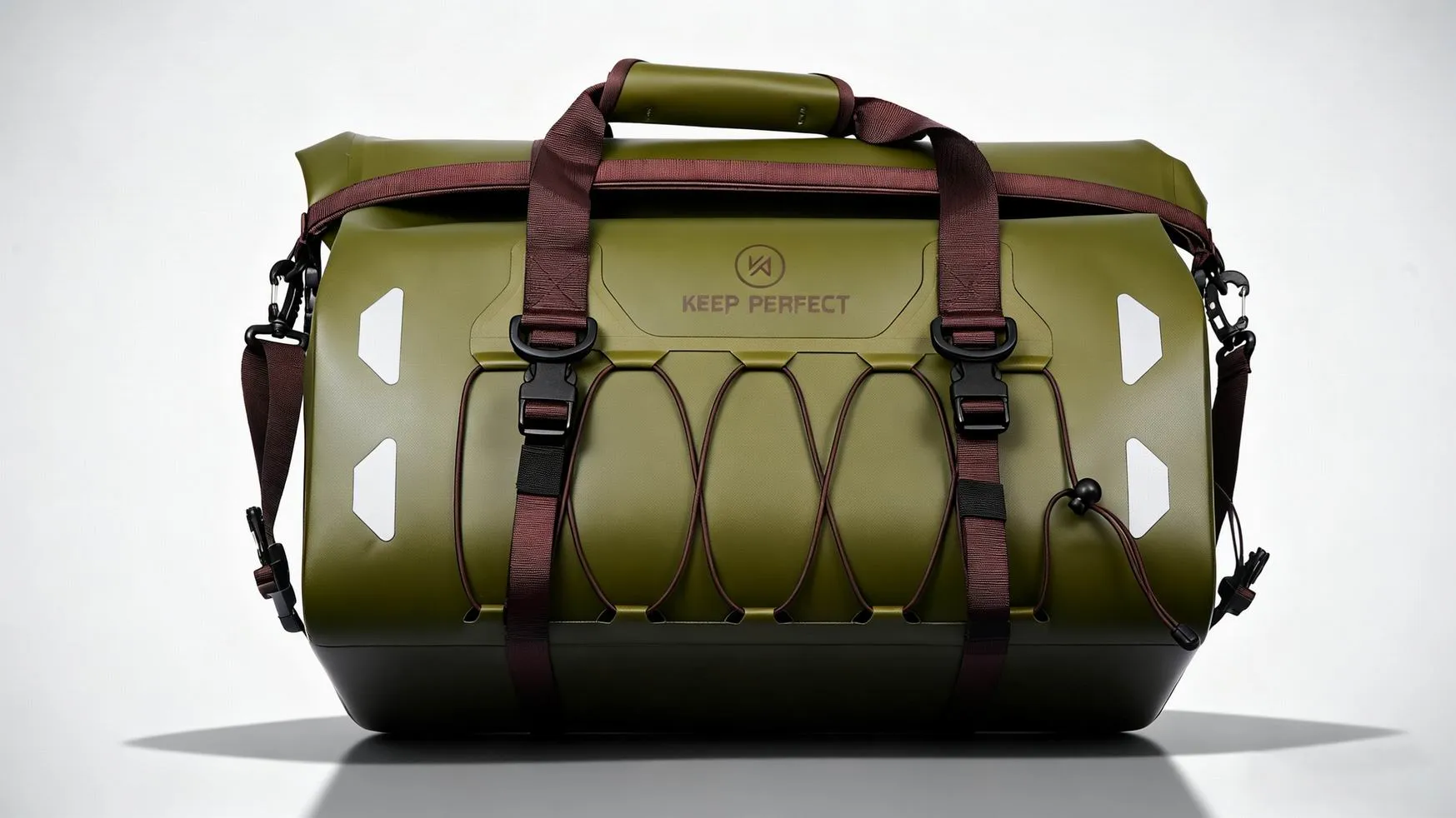
Repairability is fixed before the first sample is cut
Every decision that determines whether a bag can be repaired is made during specification, and none of them can be revisited later. The shell polymer decides whether a patch can be welded or stuck. The assembly method decides whether the damaged area can be reached. The hardware choice decides whether a spare part exists that will fit. Standardisation across a range decides whether a user can buy that spare at all. By the time a bag is in the field, the only question left is whether the person holding it can execute a repair the design has already permitted or forbidden.
The commercial reason to care is that waterproof bag repairability converts an expensive outcome into a cheap one. A bag that cannot be repaired generates a replacement: a product cost, a shipping cost, a handling cost and a customer who has been without the bag for a week. A bag that can be repaired in ten minutes generates a good review, a photograph of the repair and a customer who keeps using the product. The difference between those outcomes is worth far more than the material cost difference between substrates, which is why field repair kit waterproof bags programmes are appearing in categories where they were previously considered unnecessary.
There is also a measurement problem that keeps repairability off specification sheets: it is not tested, so it is not specified. Waterproofness, abrasion and tear strength all have methods and numbers; repairability has no standard test, so nobody writes a requirement for it and nobody discovers the problem until returns arrive. The fix is to specify the proxies instead — the shell polymer, the availability of a compatible patch material, the access to the inside of the shell, and the hardware standardisation — because those can be written down even though repairability itself cannot.
| Design choice | Effect on repairability | Specified by | Typical cost of the repairable option |
|---|---|---|---|
| Shell polymer thermoplastic versus crosslinked | Decides whether welding or solvent repair is possible at all | Material specification | Usually zero; TPU and PVC are not more expensive than silicone |
| Welded monolithic assembly versus mechanically assembled | Decides whether the damaged area can be reached from inside | Construction method | Small; mechanical assembly is often cheaper to make |
| Standard hardware across the range | Decides whether a spare part exists and fits | Hardware block | Zero; it is a discipline, not a purchase |
| Spare parts sold or supplied | Decides whether repair is possible without a return | Commercial decision | Low; a spare buckle costs cents and is high margin |
| Patch material matched to the shell | Decides whether a field patch bonds | BOM and kit contents | Low; offcut film from the same roll |
The material verdict: thermoplastic versus crosslinked
The single fact that governs this whole subject is whether the coating or film is thermoplastic or crosslinked. A thermoplastic softens and flows when heated and dissolves in an appropriate solvent, which means two surfaces of it can be fused into one by heat or by solvent, or joined by an adhesive that partly dissolves and re-forms the surface. A crosslinked elastomer does neither: heating it degrades it rather than melting it, and no safe solvent dissolves it. Repair methods that rely on fusion therefore work on the first group and are impossible on the second.
| Shell material | Thermal repair | Solvent repair | Adhesive tape | Field verdict |
|---|---|---|---|---|
| TPU film or coating | Yes, with hot air or ultrasonic at moderate temperature | Yes, with a suitable solvent or a solvent-based adhesive | Good, once cleaned and dried | The most repairable substrate available |
| PVC film or coating | Yes, at a lower temperature than TPU | Yes; PVC cement is effective and widely available | Good | Highly repairable, with a compliance caveat on solvents |
| PU-coated woven fabric | Difficult; the coating is thin and the weave wicks | Limited | Moderate; tape holds but edge-lifts on the texture | Repairable with tape and seam sealer, not by welding |
| PE and PP film | Yes, by heat; no solvent works at room temperature | No | Poor without surface treatment | Only heat-weldable; poor for tape |
| Silicone-coated nylon | No; it degrades rather than melting | No | Poor; low surface energy prevents wetting | Effectively unrepairable in the field |
| Laminated membrane constructions | Depends on the outer face material | Usually no | Moderate on the outer face | Outer face repairable; membrane repair is not |
The mechanism behind the tape column deserves explanation because it is the one users experience directly and the one with a number attached. An adhesive bonds by wetting the surface, which requires the adhesive to have a lower surface tension than the substrate has surface energy. Polyurethane and PVC sit around forty millinewtons per metre; polyethylene and polypropylene sit near thirty; silicone sits near twenty to twenty-four. Most pressure-sensitive adhesives are formulated to wet surfaces above roughly thirty-five, which is why tape sticks acceptably to TPU and PVC, marginally to polyolefins, and essentially not at all to silicone.
That number explains a complaint pattern that otherwise looks like a bad product. A user applies a well-known repair tape to a silicone-coated shell, it appears to stick, and it lifts within a day or within the first wetting. The tape is not defective and the user did nothing wrong; the substrate has too little surface energy for that adhesive to wet. The only field options on silicone are a silicone-specific room-temperature adhesive, which needs a clean dry surface and many hours to cure, or a mechanical repair. Both are impractical on a wet trail.
Why silicone-coated nylon resists every field method
Silicone-coated ripstop is an excellent material and it deserves the praise it gets: it is light, it packs small, it sheds water superbly, it is more hydrolysis-resistant than polyester-based polyurethane coatings, and it is more thermally stable. It also cannot be welded in the field, cannot be solvent welded, and cannot be taped reliably. Its advantages and its unrepairability come from the same chemistry, which means the trade-off cannot be engineered away.
- Crosslinked structure: the coating is cured, not dried. Heat above its limit degrades the polymer instead of melting it, so a hot-air tool or an iron damages the shell rather than fusing it.
- No practical solvent: nothing a user would carry dissolves cured silicone, so solvent welding is unavailable.
- Very low surface energy: around twenty to twenty-four millinewtons per metre, below the wetting threshold of common adhesives.
- Low friction surface by design: the property that makes it shed water and dirt also makes it shed adhesive.
- Thin coating on a woven base: even where an adhesive grips, the failure moves to the interface between coating and cloth, so the patch peels with the coating attached.
The honest guidance for a brand using this material is to plan around the limitation rather than deny it. Two approaches work. The first is a factory-level repair path: accept returns and repair them with the correct silicone system under controlled conditions, which is genuinely possible in a workshop and impossible on a trail. The second, and better, is to design the product so that the high-risk areas are not made of the fragile material: use a heavier or a thermoplastic material at the base, at the strap attachments and at high-abrasion corners, where damage actually occurs, and keep the ultralight fabric for the panels.
It is also worth being direct with the customer. A hangtag line stating that the shell cannot be taped and should be returned for factory repair sets an expectation, and an expectation met is worth more than a vague claim of durability. Our review of silicone-coated nylon as a premium material sets out where it performs best, and the conclusion there is the same: it is a superb shell for weight-critical products and a poor choice where field repairability matters.
Solvent and heat repair on TPU and PVC: what is achievable
On a thermoplastic shell, a well-executed field repair is not a stopgap. A correctly welded patch of matching material fuses into the shell, produces a joint that is continuous with the panel rather than sitting on it, and can approach the strength of the original material. The word “approach” matters: a field repair is done without jigs, without controlled pressure and usually on a dirty surface, so a realistic expectation is a repair that is waterproof and durable rather than one that matches factory strength.
| Method | Substrates | What it produces | Practical limits in the field |
|---|---|---|---|
| Hot air welding with a matching patch | TPU, PVC, PE, PP | A fused joint continuous with the panel | Needs a steady hand and a clean, dry surface; easy to overheat and thin the film |
| Ultrasonic or thermal repair pen | TPU, PVC and similar thermoplastics | A localised weld along a tear or around a patch | Requires skill; the tip temperature and dwell decide whether it welds or burns |
| Solvent welding or solvent cement | TPU and PVC | Dissolved and re-formed surface; very strong when done correctly | Solvents are regulated for carriage and are unpleasant; not a consumer kit item |
| Heat-activated adhesive patch | TPU, PVC, PU-coated fabrics | A bonded patch applied with a warm iron or a hot tool | Very forgiving; the best compromise between strength and usability |
| Liquid seam sealer or coating | Any, as a top coat | Closes pinholes and seam weep | Thin liquids do not bridge a tear; they close holes, not gaps |
Surface preparation is the variable that decides success and it is the one users skip. A patch applied to a surface carrying sunscreen, salt residue or plasticiser bloom will fail, regardless of method, because the adhesive or the weld is bonding to contamination rather than to the polymer. The effective routine is short: rinse with fresh water, wipe with alcohol, dry thoroughly, then repair. A repair kit that includes an alcohol wipe and says so on its instruction card has a far higher success rate than one that does not, and that is the cheapest improvement available to any kit.
There is one limitation worth stating plainly because it is the most common disappointment. Heat and solvent repair work on film and on coating, and a tear through a coated woven fabric is a different problem: the load-bearing yarns are severed and no patch restores them, so the repair is watertight but not structural. The patch will hold water out and the tear will then extend from its end under load. The correct field treatment for a structural tear is a patch to keep water out plus a stitched or laced closure to carry load, in that order.
Which damage is repairable at all
Not every failure can or should be repaired, and sorting them is part of the design guidance rather than an afterthought. The distinction that matters is between damage to the barrier and damage to the structure: the first is usually repairable, the second usually is not, and a repair that restores waterproofness while leaving the structure compromised creates a worse product than an honest retirement.
- Pinholes and abrasion thinning: fully repairable. A patch or a seam sealer restores the barrier and the area was not carrying load.
- A clean tear in a film panel: repairable to watertight, and close to full strength if welded with matching material.
- A tear in a coated woven panel: watertight but not structural. Patch for water, stitch or lace for load, and treat the bag as reduced-duty.
- Seam creep where weld or tape has lifted at a corner: repairable if the area can be reached and cleaned; recurring if the cause was a weld parameter problem.
- Delamination of a coating from its base fabric: not field repairable. It progresses regardless of what is stuck on top, and it is a material end-of-life signal.
- Hardware failure: fully repairable, and the most common repair of all. A spare buckle, cord lock or slider restores the bag completely.
- Widespread hydrolysis or plasticiser migration: not repairable. The material has aged, and a patch on aged material fails at the edge within days.
The last two entries are the ones a kit cannot address and they are worth naming in customer guidance, because a user who tries to patch a bag with widespread coating failure will conclude that the repair product is useless. Our analysis of delamination causes and prevention and of plasticiser migration in aging PVC describe how to recognise those end-of-life signals, and the recognition is more useful to a customer than another patch.
The hardware entry deserves emphasis because it reframes the whole subject. Across a product population, hardware failure outnumbers shell failure, which means the highest-value item in a field repair programme is not a fabric patch at all. This is the conclusion of our work on buckle fatigue and lifecycle testing, where the dominant field failure is a cracked buckle tongue rather than a torn panel. A kit built around that reality fixes far more bags than one built around adhesive.
Field repair methods ranked by substrate
The following ranking is the practical answer to the question users actually ask, which is what to do with the specific bag in front of them. It is ordered by outcome rather than by convenience, and it assumes the surface has been cleaned and dried, because without that step nothing below works.
| Substrate | Best field method | Acceptable fallback | Do not bother with |
|---|---|---|---|
| TPU film | Hot air or thermal pen weld with a matching TPU patch | Heat-activated adhesive patch | Solvent, unless the user is trained and equipped |
| PVC film | PVC cement or a heat weld with a matching patch | Heat-activated adhesive patch | High-temperature tools; PVC degrades and discolours when overheated |
| PU-coated woven | Heat-activated adhesive patch, then seam sealer at the edges | Repair tape, replaced at intervals | Welding; the coating is too thin and the weave wicks |
| PE or PE-coated | Hot air weld with a matching polyethylene patch | Nothing reliable | Tape without flame or corona treatment |
| Silicone-coated nylon | Factory return for a silicone-system repair | A temporary mechanical closure to get home | Tape, solvent and heat; all fail |
| Hardware | Replace the component from a spare | Cord, a cable tie or a lashing as a temporary substitute | Attempting to re-weld or glue a cracked moulding |
Two entries carry warnings. PVC degrades when overheated, releasing hydrogen chloride and discolouring, so a hot-air tool on PVC needs a lower temperature and a shorter dwell than on TPU, and a repair that smells sharp has been overheated. And a cracked moulding cannot be glued back to useful strength: the fracture surface is small, the material is often a stiff polymer that resists adhesives, and the part is loaded in the direction that peels the bond. Replace it.
The fallback column is where most users end up, which is why it deserves design attention. A heat-activated adhesive patch is the most forgiving method available: it requires only warmth and pressure, it works on nearly every thermoplastic and coated woven substrate, and it produces a repair that survives months rather than hours. Specifying patches cut from the same roll as the shell, pre-cut to two or three useful shapes, converts that fallback into a reliable outcome for very little cost.
What an ultrasonic or thermal repair pen actually does
Handheld repair tools for thermoplastics work by delivering heat and pressure to a small area, softening both the patch and the shell so their polymer chains interdiffuse across the interface and form a single piece on cooling. That is genuine welding rather than gluing, which is why it produces the strongest field repair available. It also has a narrow process window: too little heat and the surfaces do not fuse, too much and the film thins, holes through or degrades.
- Tip temperature and dwell time are the two variables, and the correct combination depends on the polymer and on the film thickness. Thin film needs far less of both.
- Pressure has to be maintained while the joint cools. Lifting early produces a joint that looks welded and peels apart.
- The tool works best on a flat, supported surface. Repairing a corner or a fold without a backing block usually produces a burn-through.
- Overheating is irreversible and visible: thinning, discolouration, and in PVC a sharp odour that indicates degradation.
- The tool is a skill. Expect a first attempt to fail, which is why a kit should include more patches than the anticipated number of repairs.
The honest assessment for a brand is that these tools suit a guided or workshop repair programme more than an unsupervised field kit. They are excellent in the hands of a retailer, a guide operation or a rental fleet, where the same person repairs many bags and learns the window. They are unreliable in the hands of a customer repairing one bag once, on a cold morning, with wet gloves. Our comparison of heat sealing and ultrasonic welding explains the process physics that the tool is reproducing, and the reason it is harder to do by hand than it looks.
Where a brand wants the outcome without the skill, the right answer is to supply pre-cut patches of matching material and a heat-activated adhesive, and to instruct the user to apply heat with something they already have — a warm dry pan, a hot water bottle, a hairdryer on a low setting — rather than a specialist tool. The joint is bonded rather than welded, so it is somewhat weaker, but the success rate is far higher, and a repair that succeeds matters more than a stronger repair that fails.
Tape: why it holds on some coatings and lifts on others
Repair tape is the default field method and its behaviour is entirely predictable from the surface energy figures given earlier, which is worth restating because it lets a brand set expectations accurately. On TPU and PVC, a good tape cleaned and applied to a dry surface holds for weeks to months. On polyethylene it holds marginally and creeps. On silicone it does not wet out and lifts almost immediately, and no amount of pressure or warming changes that.
- Clean and dry first. Adhesion to a contaminated surface fails regardless of the tape, and this is the single largest cause of failed repairs.
- Round the corners of a tape patch. Square corners lift first; a patch cut with rounded corners lasts several times longer.
- Size the patch generously. A patch extending at least twenty-five millimetres beyond the damage in every direction distributes peel load far better.
- Apply firm pressure and, where possible, warmth. Pressure-sensitive adhesives continue to build bond strength over hours.
- Treat tape as a season-scale repair, not a permanent one, and say so on the kit.
- On low-surface-energy substrates, specify a tape with an adhesive formulated for them, or accept that tape is not the answer.
One subtlety is worth including because it produces confusing results. Tape adhesion is measured on a clean, smooth, flat specimen, and a bag panel in the field is curved, creased and textured. Adhesion on a creased area is much lower because the tape is trying to bridge a fold and peel load concentrates at the fold line. The practical instruction is to place the patch on the flattest available area rather than exactly over the damage, bridging the hole from a flat region on each side, which is not what instinct suggests.
For brands building a kit, the specification to write is not “repair tape” but the adhesive family, the peel adhesion figure on the actual shell material, and the expected service interval. Peel adhesion and the conditioning that precedes it are standardised, and the methods are published by ASTM International and in the corresponding ISO series, so a figure quoted with a method number means something and a figure quoted without one does not. Testing three candidate tapes on the production shell, cleaned and uncleaned, wet and dry, takes an afternoon and produces the only number that predicts the customer experience.
Sewing: when thread is right and why it perforates
Sewing is the only field method that restores structural strength across a tear, and it is also the only one that makes the waterproofness worse, because every needle passage is a hole. That trade is often correct and it should be made deliberately: stitch to carry load, then seal to keep water out, in that order, and accept that the result is a repaired bag rather than a restored one.
- Stitch first to close the tear and carry load, using a strong thread and a simple running or overcast stitch through both faces of the tear.
- Seal afterwards with seam sealer or an adhesive patch over the stitch line; the stitches carry the load and the seal carries the water.
- Use a curved needle or work from the inside where the geometry allows, so the repair is accessible and the thread is protected.
- Expect the seal to need renewing. A stitched-and-sealed repair flexes, and flexing lifts a bonded seal eventually.
- Do not sew a thin film. Needle holes in a film tear out under load; film tears should be patched, not sewn.
The distinction in the last point is the useful one. Sewing works on a woven substrate because the yarns hold the thread; sewing a film fails because the film tears at the needle holes, converting one tear into a line of perforations. A user who tries to sew a TPU film panel will make it worse, and the kit instructions should say so.
Thread choice matters more than most users expect and is worth specifying in a kit. A bonded polyester or nylon thread of a reasonable size, waxed, survives abrasion and retains strength when wet; cotton thread rots and a very fine thread saws through the substrate. Our notes on thread selection for stitched waterproof seams cover the reasoning, and on seam taping and sealing methods for how the stitch line is then made watertight.
What belongs in a field repair kit
A kit should be built around the failure distribution rather than around the idea of repair, and the failure distribution says hardware first, punctures second, tears third. The list below reflects that ordering and carries a weight budget, because a kit that is too heavy is left at home and a kit left at home has no value at all.
| Item | Quantity | Weight | Why it earns its place |
|---|---|---|---|
| Spare buckle, matched to the closures | One per closure type in the bag | 10 to 25 grams | The most common failure by a wide margin; a spare restores the bag completely |
| Spare cord lock and a length of cord | One, and one to two metres of cord | 10 to 20 grams | Solves a large share of closure failures without any adhesive |
| Pre-cut patches of the shell material | Three to four, rounded corners, two sizes | 10 to 20 grams | Matching material is the difference between a repair that holds and one that lifts |
| Heat-activated adhesive patches | Two | 5 to 10 grams | The most forgiving method; works on nearly every thermoplastic shell |
| Repair tape, adhesive matched to the shell | One small roll or two strips | 10 to 15 grams | Fast and universal on TPU and PVC; useless on silicone, so check first |
| Alcohol wipes | Two | 5 grams | Surface preparation decides success more than any other single factor |
| Cable ties or a short lashing cord | Two or three | 5 grams | The universal temporary fix for hardware and closures |
| Instruction card, illustrated | One | 2 grams | Converts a kit into a successful repair; the highest-value item per gram |
| Seam sealer, single-use sachet | One | 5 to 10 grams | Closes pinholes and seals a stitched repair afterwards |
That list totals roughly sixty to one hundred grams depending on how much is included, which is acceptable for an expedition product and too much for an ultralight one. The right response for a lightweight product is to split the kit: a minimal in-bag set of a spare buckle, two patches and a wipe, at around twenty-five grams, and a fuller kit sold separately for longer trips. Splitting is better than trimming, because the items that get trimmed first are the ones that fix the most failures.
The instruction card is the item to spend effort on and the one most often omitted. It should state what the shell material is, which method works on it, which does not, and the two-step preparation routine. A card that says “this shell is TPU; clean with the wipe, dry, then apply the heat patch; do not use solvent” prevents most failed repairs. A card that says nothing leaves the user to guess, and the guess is usually tape on a surface that will not take tape.
Designing for repair: access, spares and standardisation
Three design decisions determine whether the kit above can be used at all, and all three are cheap when made early and effectively impossible later. They are access, spares and standardisation, in that order of importance.
- Access: the inside of the shell has to be reachable. A fully bonded liner or a welded monolithic assembly that cannot be opened means a patch applied from outside is the only option, and outside patches peel where inside patches are held by internal pressure.
- Access also means room to work. A compartment opening too small to admit a hand cannot be repaired from inside regardless of intent.
- Spares: a spare part programme requires that the part be identifiable. A named supplier part number, recorded on the tech pack and printed or referenced in the product, is what makes a spare orderable.
- Standardisation across the range: one buckle family, one cord lock, one slider type across as many styles as possible. This is the single cheapest way to make spares viable, and it usually reduces tooling cost as well.
- Modularity at high-risk points: a replaceable base panel or a replaceable wet compartment converts a terminal failure into a parts order.
- Published repair guidance: a page, a card or a video that says what the shell is and how to fix it. This is a design deliverable and it costs almost nothing.
The standardisation point is worth underlining because it is resisted for styling reasons and it pays back twice. A range that uses four buckle families instead of one needs four spare part lines, four stock-keeping units, and it will not have the right one in stock when a customer asks. A range that uses one needs one. The styling loss is smaller than it appears, because the visible differentiation in a bag comes from fabric, colour and trim rather than from the buckle profile.
There is a manufacturing angle to access as well, and it runs the other way, so it should be stated honestly. Welded monolithic construction is cheaper, lighter and more reliably waterproof than mechanically assembled construction, and those are real advantages. The trade is that it cannot be opened for repair. The resolution is not to abandon welding but to choose it deliberately: weld where waterproofness dominates and access is not needed, and use mechanical assembly or a removable component at the points that fail most often. Our comparison of stitched, welded and bonded construction sets out where each belongs.
What repairability does to warranty cost and reputation
The economics are straightforward once the numbers are assembled, and they favour repairability by a wide margin. A warranty replacement carries the product cost, the outbound shipping, the handling labour and the customer service time, and it produces a customer who has been inconvenienced for a week. A field repair carries the cost of a kit, which is a fraction of that, and it produces a customer who solved a problem in ten minutes and told somebody about it. The saving per avoided replacement is usually several times the cost of the kit.
| Scenario | Cost to the brand | Customer experience | Secondary effect |
|---|---|---|---|
| Unrepairable shell, no kit | Full replacement plus shipping and handling | A week without the bag, and a return process | Negative review; the product is remembered as fragile |
| Repairable shell, no kit | Often still a replacement, because the user does not know what to do | A week without the bag | The capability exists and is never used |
| Repairable shell with a supplied kit | Kit cost only, typically a small fraction of product cost | Ten minutes and the bag is back in service | Positive review; the repair is photographed and shared |
| Hardware failure with a spare supplied | Cents | Minutes | The brand is remembered as having thought about it |
| Factory repair programme for unrepairable shells | Repair labour and two-way shipping | Two to three weeks | Acceptable for premium product; poor for expedition use |
The third and fourth rows are the ones worth engineering towards, and they are achieved mostly by specification discipline rather than by spending. The fifth row is the honest fallback for a silicone-shelled premium range, and it is a legitimate position provided the brand can actually execute it: a repair path has to exist with a defined turnaround, or offering it makes things worse.
There is a reputational dimension beyond the arithmetic. A brand whose products are visibly repairable is a brand that customers believe will last, and that belief is worth more than any durability claim in the copy. It also aligns with the direction of travel on product longevity and circularity, where repairability is increasingly treated as a design requirement rather than a nicety. The circular-economy framing of this is set out by organisations such as the Ellen MacArthur Foundation, and our own notes on end-of-life solutions for waterproof bags place repair in the wider product-life picture. Our analysis of warranty and return rate analysis shows how these outcomes appear in the numbers a brand already tracks.
The repairability block on the tech pack
Everything above compresses into a short block that belongs beside the material and hardware specifications. Repairability has no standard test, so this block specifies the proxies that make repair possible, and writing it is the only way the subject survives contact with a cost-down exercise.
- Shell material identified as thermoplastic or crosslinked, with the surface energy class stated, because it decides every repair method.
- Patch material: the same polymer as the shell, with the supplier, the grade and the gauge, and confirmation that offcuts are retained for patch production.
- Repair method by substrate: which of welding, solvent, heat-activated patch, tape or stitching is approved, and which is prohibited.
- Surface preparation routine: the cleaning agent, the drying requirement, and the statement that appears on the instruction card.
- Hardware identification: supplier part numbers for every replaceable component, and the standardisation rule across the range.
- Spare parts: what is supplied with the product, what is sold separately, and the part numbers for both.
- Access: whether the shell interior is reachable, the minimum opening dimension, and whether high-risk areas are mechanically assembled rather than welded.
- Kit contents and weight budget, with the split between the in-bag minimum and the sold-separately full kit.
- Customer guidance: what the product says about repair, including an explicit statement where a shell cannot be taped.
- End-of-life signals: how to recognise delamination and hydrolysis, and what the customer should do when they appear.
The first line does most of the work, because once the polymer class is written down the rest follows mechanically. A specification that says “TPU film, weldable, patch of the same grade” has made the product repairable. One that says “silicone-coated nylon, 30 denier” has made it unrepairable, whether or not anybody intended that, and the difference should be a decision rather than an accident.
If you want a repairability scheme proposed for a specific product, send the shell material, the construction method and the duty environment, and let the kit and the spare-parts plan be specified against them. You can see how a programme moves from first enquiry through sampling into bulk production; every style starts at 500 pieces minimum, with samples in 6–10 working days and bulk in 35–50 days, quoted FOB Xiamen.
Frequently Asked Questions
Q1. Why can silicone-coated nylon not be repaired in the field?
It is a crosslinked elastomer. It does not melt when heated, no safe solvent dissolves it, and its surface energy of around twenty millinewtons per metre is below the wetting threshold of ordinary repair tape.
Q2. Can TPU and PVC bags be permanently repaired?
Yes. Both are thermoplastic, so a patch of matching material can be heat welded or solvent welded into the shell, producing a joint that is continuous with the panel rather than stuck onto it.
Q3. What is surface energy and why does it decide whether tape sticks?
An adhesive bonds by wetting the surface, which requires the adhesive to have lower surface tension than the substrate has surface energy. TPU sits near forty millinewtons per metre and silicone near twenty, which is why tape holds on one and lifts on the other.
Q4. Does repair tape work on polyethylene shells?
Marginally. Polyethylene sits near thirty millinewtons per metre, so ordinary tape creeps and lifts. Heat welding with a matching patch is the correct method for polyolefins.
Q5. What is the most common field repair on a waterproof bag?
Replacing hardware, not patching fabric. A cracked buckle or a lost cord lock outnumbers shell damage by a wide margin, which is why a spare buckle belongs in every kit.
Q6. Can I glue a cracked plastic buckle back together?
No. The fracture surface is small, the polymer resists adhesives, and the part is loaded in the direction that peels the bond. Replace the component instead.
Q7. Should a tear in a coated fabric be sewn or patched?
Both, in order. Stitch to carry the load, since a patch does not restore severed yarns, then seal over the stitch line to keep water out.
Q8. Why should I not sew a tear in a thin film?
Needle holes in a film tear out under load, converting one tear into a line of perforations. Film tears should be patched, not sewn.
Q9. What makes a field repair fail most often?
Contaminated surfaces. Sunscreen, salt residue and plasticiser bloom prevent bonding regardless of method. Rinse, wipe with alcohol, dry, then repair.
Q10. Are handheld ultrasonic or thermal repair pens worth carrying?
For a guide operation or a rental fleet, yes, because the same person learns the process window. For a customer repairing one bag once, a heat-activated patch has a far higher success rate.
Q11. What should a field repair kit weigh?
Around sixty to one hundred grams for a full kit and about twenty-five for an ultralight minimum. Splitting the kit beats trimming it, because the items trimmed first fix the most failures.
Q12. What is the highest-value item in a repair kit?
The illustrated instruction card, per gram. It states what the shell is, which method works, which does not, and the preparation routine, and it prevents most failed repairs.
Q13. How should patch corners be cut?
Rounded. Square corners lift first, and a patch with rounded corners lasts several times longer under peel load.
Q14. When should a bag be retired rather than repaired?
When the coating is delaminating or the material shows widespread hydrolysis or plasticiser migration. The material has aged, and a patch on aged material fails at its edge within days.
Q15. How does welded construction affect repairability?
It reduces it. A welded monolithic shell cannot be opened, so a patch applied from outside is the only option and outside patches peel where inside patches are held by pressure.
Q16. Why standardise hardware across a product range?
Because spare parts become viable. One buckle family across the range means one spare line, in stock, that fits; four families means four lines and the wrong one in stock.
Q17. Does repairability actually reduce warranty cost?
Substantially. A replacement carries product cost, shipping, handling and service time, while a successful field repair costs a fraction of that and produces a customer who solved the problem in minutes.
People Also Ask
Can waterproof bags be repaired?
Yes if the shell is thermoplastic such as TPU or PVC, which can be welded or stuck. Silicone-coated nylon cannot be repaired in the field.
Why does tape not stick to silicone-coated nylon?
Its surface energy is around twenty millinewtons per metre, below what ordinary adhesives need to wet the surface. It lifts almost immediately.
What fixes a waterproof bag in the field?
Most often a spare buckle or cord lock. Hardware failure outnumbers shell damage, so carry spares before carrying patches.
Can you sew a tear in a waterproof bag?
Only on a woven fabric, and then seal over it. Sewing a thin film tears it further, so patch film instead.
What should be in a field repair kit?
A spare buckle, cord, patches of matching material, heat-activated patches, tape, alcohol wipes and an illustrated instruction card.
When is a waterproof bag beyond repair?
When the coating is delaminating or the material shows hydrolysis or plasticiser migration. A patch on aged material fails within days.