Nano coating technology changes waterproofing at the scale of billionths of a meter: nano coating technology — surface treatments built from structures measured in nanometers, from fluorine-free superhydrophobic finishes to sol-gel ceramic layers and plasma-deposited films — represents the next generation of waterproof protection precisely because it works on a different principle than the coatings and membranes the industry has laminated for forty years: instead of building a wall, it builds a landscape, texturing and energizing the fabric surface so water cannot wet it, oil cannot grip it and dirt cannot stick. For bag programs the technology answers three standing frustrations: DWR that washes away, membranes that add weight and stiffness, and PFAS chemistry that regulators are banning. This guide maps nano coating technology from the buyer’s chair: the physics of nanoscale water repellency, the four technology families actually on the market, what nano layers add beyond DWR and membranes, the durability ledger that decides whether the treatment survives real use, the application routes at factory level, and the specification lines that put nano protection on a purchase order with its test basis attached.
The manufacturer reference is QUANZHOU JUNYUAN BAGS, producing custom waterproof bags since 2014 across a 4,950 m² SGS-verified facility: 7 lines, 149 machines, 137 staff, 200,000 pieces monthly. Standard terms — MOQ 500 per design, samples 6–10 working days, bulk 35–50 days, AQL 2.5 inspection, 30/70 T/T, FOB Xiamen — with shipping to 100+ countries.
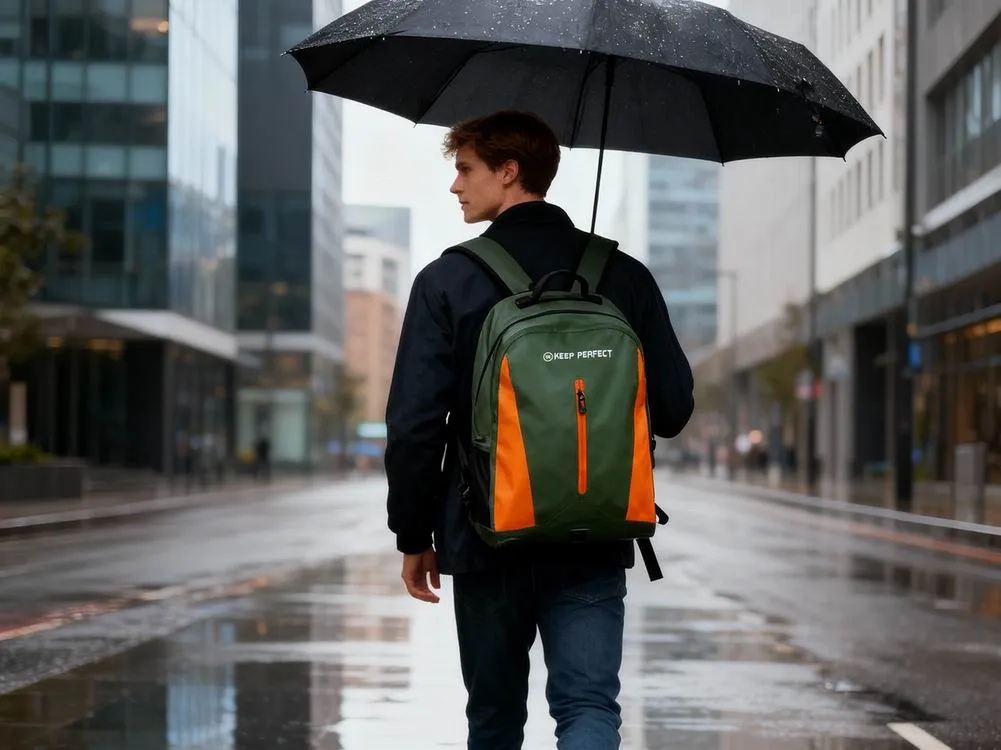
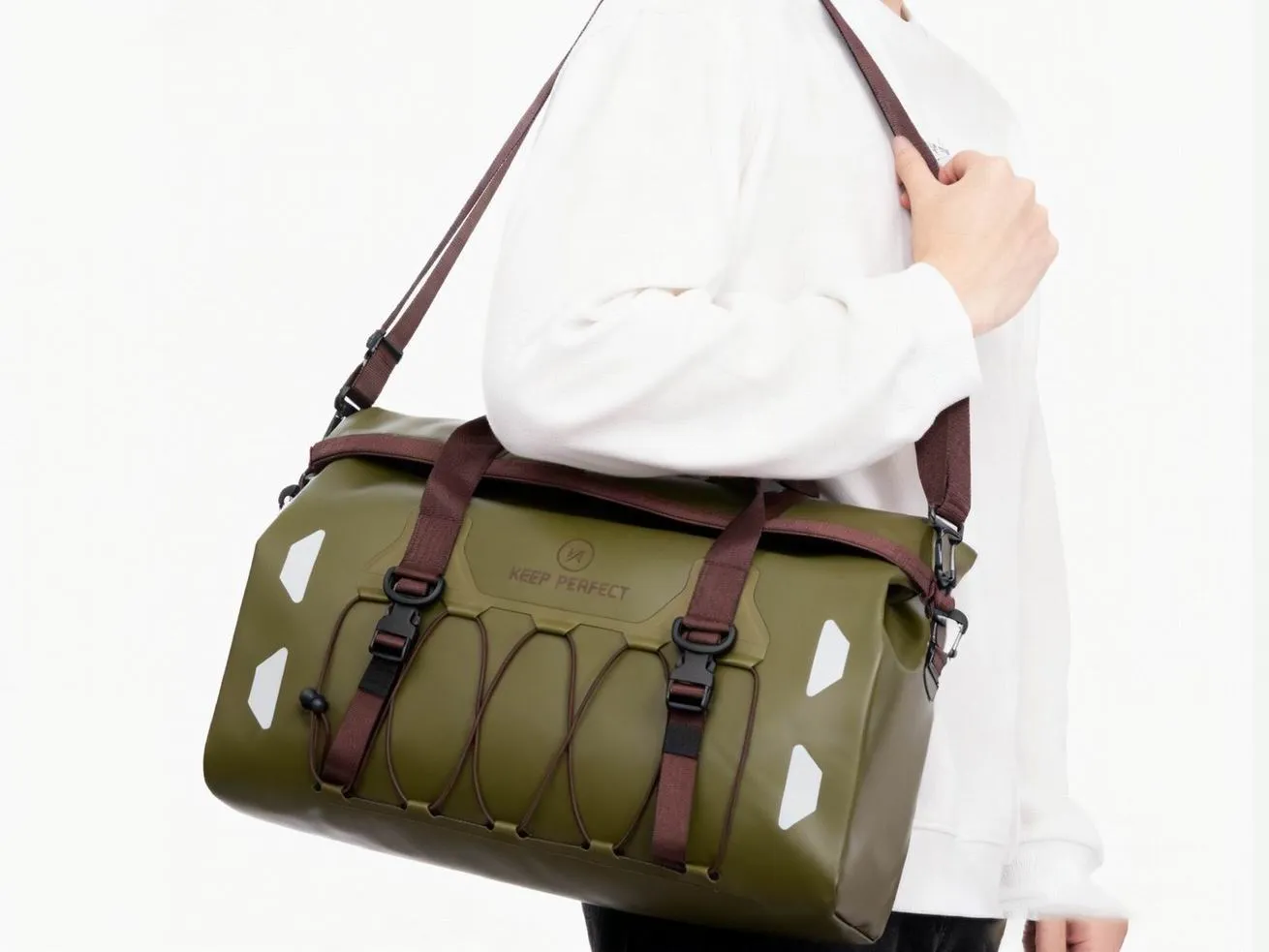
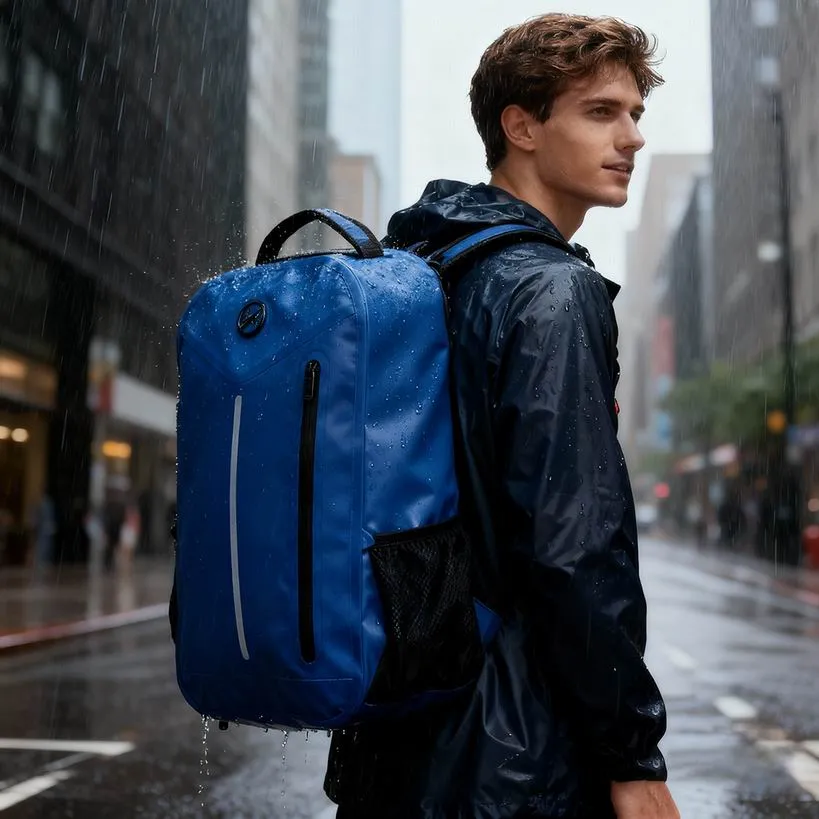
The nanoscale principle: why texture beats thickness
Conventional waterproofing is a wall: a PU coating or TPU film thick enough that water cannot pass, measured in microns and felt as weight and stiffness. Nano coating technology works one thousand times thinner — structures of 10 to 500 nanometers that change the surface itself rather than adding a layer on top of it. The physics is the lotus effect: a surface patterned with nanoscale roughness and tuned to low surface energy forces water into near-spherical beads that roll off at shallow tilt angles, carrying dirt with them — the self-cleaning property that made the lotus leaf the industry’s mascot. Two variables do the work: surface energy, which decides whether water spreads or beads, and roughness geometry, which decides how completely the bead lifts off the surface. A well-built nano finish pushes water contact angles past 150 degrees — superhydrophobic territory — where conventional DWR chemistry plateaus around 110 to 120. The distinction that matters for bag buyers: nano treatments are surface functions, not barriers — they make the fabric face shed water, oil and stains, but they do not replace the hydrostatic barrier underneath, which the hydrostatic head guide rates. The correct mental model is a two-layer defense that our coatings guide frames: the nano surface keeps the face fabric dry and breathable-looking, and the membrane or coating behind it guarantees the waterproof rating — nano technology upgrades the first layer, it does not abolish the second.
The four technology families on the market
The label "nano coating" covers four distinct chemistry families, and buyers should know which one a supplier is actually offering. Fluorine-free superhydrophobic finishes: dendritic polymers and hydrocarbon or silicone chemistries that replace the banned C8 and retiring C6 fluorocarbons — the compliance-driven family, evolving fast under PFAS regulation, with water repellency now matching fluorocarbons but oil repellency still behind, the regulatory driver our bluesign guide tracks through the input-stream lists. Sol-gel ceramic coatings: silica-based networks cured onto the fiber, adding hardness, UV stability and stain release alongside repellency — the durability family, thinner and tougher than polymer finishes but less flexible. Plasma-deposited nanofilms: vacuum or atmospheric plasma polymerizes a film a few nanometers thick directly onto the fabric — the premium family, uniform and nearly weightless, with equipment cost that restricts it to high-value programs. Nanoparticle-boosted finishes: conventional DWR formulations loaded with silica or other nanoparticles to build the roughness the lotus effect needs — the pragmatic family, applied on standard pad-cure lines, currently the most common route in bag production. The buyer’s summary: "nano" is a geometry claim, not a chemistry brand — the specification must name which family, which chemistry and which test, or the word is marketing.
| Family | Core chemistry | Standout property | Main limitation | Bag-program fit |
|---|---|---|---|---|
| Fluorine-free superhydrophobic | Dendritic polymers, silicones | PFAS-free compliance + top water beading | Oil repellency still catching up | The compliance default going forward |
| Sol-gel ceramic | Silica networks | Hardness, UV and stain durability | Flex fatigue on soft fabrics | High-wear faces, premium shells |
| Plasma nanofilms | Plasma-polymerized layers | Nanometer-thin, uniform, weightless | Equipment cost, throughput | High-value technical programs |
| Nanoparticle-boosted DWR | DWR + silica nanoparticles | Runs on existing pad-cure lines | Particle retention over washes | The volume route today |
What nano adds beyond DWR and membranes
The honest value proposition of nano coating technology is a bundle of surface functions no single conventional finish delivers together. Water beading beyond standard DWR: higher contact angles mean faster shedding and slower face-fabric wetting — the bag looks dry longer in rain, and the membrane underneath breathes better because the face never floods. Stain and soil release: the same low-energy texture that rejects water rejects mud, sunscreen and coffee — a commuter or travel bag stays presentable, a property conventional DWR offers weakly. Oil repellency where the chemistry supports it: the fluorine-free families still trail fluorocarbons here, but nanoparticle-structured versions narrow the gap — relevant for the chemical front our chemical resistance guide maps. Weight and hand: nano layers add essentially nothing — no stiffness, no grams — against coatings measured in tens of grams per square meter. What nano does not add: hydrostatic head. A nano-treated fabric still wets through under pressure — knees on wet ground, a bag pressed against pooling water — because repellency resists wetting, not penetration. The barrier function stays with the membrane or coating, per the layer logic our lamination guide details. The architecture that results: nano surface for the daily skirmish — rain, splashes, stains, scuffs — and the rated barrier for the battle — submersion, pressure, sustained storms. Programs that ask nano to do both jobs discover the distinction in the first warranty claim.
The durability ledger: what wears out and when
Every nano finish has a wear-out budget, and the buyer’s job is to price it honestly rather than believe "permanent" marketing. The abrasion axis: nanoscale texture is physically delicate — the asperities that build the lotus effect are the first thing rubbing destroys, which is why nano-treated faces lose beading first at strap lines, base panels and pocket edges — the wear-map geometry our abrasion standards guide measures; sol-gel ceramics resist this axis best, boosted DWR least. The wash axis: detergent and mechanical washing strip or contaminate the low-energy surface — spray ratings typically drop one to two grades over ten home washes for boosted-DWR families, less for ceramics, with reactivation by tumble heat recovering part of the loss. The contamination axis: surfactant films, sunscreen and body oils mask the low-energy surface without destroying it — beading dies, then revives after proper washing, a failure that looks permanent but is not. The UV axis: the polymer backbones of some finishes photo-oxidize on the UV timeline — silica-based ceramics are essentially immune, polymer finishes are not. The honest ledger by family: boosted DWR holds strong beading for one to two seasons of regular use before re-treatment; ceramics hold function for the fabric’s life at reduced repellency; plasma films sit between. The specification consequence: durability must be specified as performance-after-treatment — spray rating after twenty washes, after Martindale cycles — never as the day-one number on the lab report.
| Wear axis | Boosted DWR nano | Sol-gel ceramic | Plasma nanofilm | Specification handle |
|---|---|---|---|---|
| Abrasion | Weak — texture rubs off | Strongest | Moderate | Spray rating post-Martindale |
| Washing (20 cycles) | Drops 1–2 spray grades | Drops ~1 grade | Drops ~1 grade | Spray rating post-wash |
| Contamination | Masks, revives on wash | Masks, revives on wash | Masks, revives on wash | Care-instruction protocol |
| UV exposure | Polymer-dependent | Essentially immune | Good | Post-UV spray rating |
| Service expectation | 1–2 seasons, re-treatable | Fabric life, reduced | Multi-season | End-of-life criterion named |
Factory application routes: what production actually looks like
Nano finishes reach bag fabric through three production routes, and the route decides consistency, cost and what the factory must control. Pad-dry-cure on the textile line: the fabric runs through a finish bath, through squeeze rollers, then through a curing oven — the volume route for boosted-DWR families, inherited from conventional DWR processing, with the same control points: bath concentration, pickup percentage, cure temperature and time, all logged per run. Exhaust or spray application for smaller lots: finishes applied in garment-equivalent equipment or spray booths — the sampling-stage route, with uniformity risk on dense constructions. Plasma deposition: the fabric passes through a plasma chamber where the nanofilm polymerizes in place — a capital-equipment route available at specialist finishers, quoted per meter with setup charges that only amortize at program scale. What the bag factory controls downstream: the cut-and-sew handling that abrasion-tests the finish before the customer does — sewing friction, turning operations, pressing — and the care-instruction engineering that keeps the finish alive in service: wash temperature, detergent type, tumble reactivation, the user-protocol leverage our coatings guide prices. At our facility the process is qualified per fabric lot: spray rating and beading photos on the greige, the finished fabric and the sewn first article, with the finishing certificate filed per batch — because a nano finish applied at the mill and destroyed at the sewing line is a cost without a benefit.
The compliance dimension: PFAS exits, nano enters
The strongest current driver of nano coating adoption is regulation, not performance. The PFAS retreat: C8 fluorocarbon DWRs are banned in major markets, C6 short-chains are being regulated out — the EU’s restriction process and US state laws are on converging timelines, tracked through the substance lists our REACH and CPSIA guide maintains — and every outdoor brand’s RSL now reads "PFAS-free by 2026" or already past tense. Fluorine-free nano finishes are the industry’s answer: dendritic and silicone chemistries with nanoparticle roughness that reach C6-level water repellency without the fluorine — with the honest gap at oil repellency, which matters for food-adjacent and cosmetic-adjacent bags and must be spec’d knowingly. The documentation consequence: a nano finish on the BOM needs its chemistry declared — the finish supplier’s compliance letter, the PFAS-free position, and bluesign or OEKO-TEX listings where they exist, per the claims-evidence discipline our certification map structures. The marketing discipline: "PFC-free" and "eco DWR" are claims with legal exposure under green-claims enforcement — the finish must be what the hangtag says, and the file must prove it. For buyers, the practical sequence: specify fluorine-free now rather than be forced mid-season; qualify the nano finish’s spray rating and durability before committing the fabric platform; and keep the chemistry letter in the master file, because the retailer’s questionnaire will ask for it before the first reorder.
The specification lines: nano protection on a purchase order
The guide compresses to six specification lines. One: the family and chemistry are named — fluorine-free superhydrophobic, sol-gel ceramic, plasma film or boosted DWR — with the finish supplier’s identity and compliance letters in the file. Two: day-one performance is rated — spray rating per AATCC 22 or ISO 4920, contact angle where the lab offers it — on the finished fabric, not the data sheet. Three: durability is specified as performance-after-treatment — spray rating after twenty washes and after the program’s Martindale cycle count, with the reactivation protocol named. Four: the barrier boundary is declared — the nano finish is the surface function; the hydrostatic rating behind it is specified separately and tested per the construction battery. Five: the chemistry position is documented — PFAS-free declaration, RSL alignment, bluesign or OEKO-TEX listings where carried — filed against the green-claims enforcement the hangtag invites. Six: the care protocol is engineered — wash temperature, detergent class, tumble reactivation, re-treatment interval — printed where the user meets it. Six lines turn "nano coating" from a marketing word into a purchase order with a test basis — and the chain that applies finishes at 200,000 pieces monthly, samples in 6–10 working days, bulk 35–50 days, FOB Xiamen, SGS-verified, is documented end to end for buyers who want the factory side of the finish before the first meter is treated.
Frequently Asked Questions
Q1. What is nano coating technology for waterproof bags?
Surface treatments built from nanometer-scale structures — superhydrophobic finishes, sol-gel ceramics, plasma films — that texture the fabric surface so water beads and rolls off instead of wetting it, working on the lotus-effect principle rather than building a thick barrier wall.
Q2. Is nano coating the same as DWR?
DWR is the category; nano coatings are its advanced branch. Conventional DWR lowers surface energy chemically; nano treatments add engineered roughness at the nanometer scale, pushing contact angles past 150 degrees where conventional DWR plateaus near 110–120.
Q3. Does nano coating make a bag waterproof?
No — it makes the surface water-repellent. Repellency resists wetting, not penetration under pressure: the waterproof rating still comes from the membrane or coating behind the face fabric, rated by hydrostatic head. Nano upgrades the first line of defense, not the last.
Q4. How long does a nano coating last?
By family: nanoparticle-boosted DWR holds strong beading one to two seasons of regular use and can be re-treated; sol-gel ceramics function for the fabric’s life at gradually reduced repellency; plasma films sit between. Specification should be performance-after-washes, never the day-one number.
Q5. Are nano coatings PFAS-free?
The leading families are — dendritic polymers and silicone chemistries with nanoparticle roughness, developed specifically to replace banned C8 and retiring C6 fluorocarbons. The honest gap: oil repellency still trails fluorocarbons. Always file the finish supplier’s PFAS-free declaration.
Q6. What is a superhydrophobic coating?
A surface pushing water contact angles past 150 degrees through combined nanoscale roughness and low surface energy — water forms near-spherical beads that roll off at shallow angles, carrying dirt with them: the self-cleaning lotus effect.
Q7. Can nano coatings survive abrasion on a bag?
Abrasion is their weak axis — the nanoscale texture that creates the effect rubs off first at strap lines, base panels and pocket edges. Sol-gel ceramics resist best. Specify spray rating after the program’s Martindale cycle count to price the wear honestly.
Q8. Do nano coatings wash off?
Progressively: boosted-DWR families typically drop one to two spray grades over ten home washes, with tumble heat reactivating part of the loss. Contamination by sunscreen or detergent films masks the effect without destroying it — beading often revives after proper washing.
Q9. What is sol-gel ceramic coating?
A silica-based nanoscale network cured onto fibers — harder, more UV-stable and more stain-resistant than polymer finishes, thinner than any conventional coating, with flex fatigue on very soft fabrics as its main limitation. The durability-led family of nano treatments.
Q10. How are nano coatings applied at factory level?
Three routes: pad-dry-cure on the textile line for volume runs, exhaust or spray application for smaller lots, and plasma deposition at specialist finishers for premium programs. The bag factory then controls sewing-line handling and care-instruction engineering.
Q11. Why is the industry switching to nano finishes now?
Regulation first, performance second: PFAS bans are retiring fluorocarbon DWRs on converging EU and US timelines, and fluorine-free nano finishes are the replacement that matches C6 water repellency. Brands specifying fluorine-free now avoid a forced mid-season reformulation.
Q12. Does nano coating add weight or stiffness?
Essentially none — the layers are nanometers thick, against conventional coatings adding tens of grams per square meter plus stiffness. That weightless profile is a core advantage for packable and ultralight bag programs.
Q13. What tests verify a nano coating?
Spray rating per AATCC 22 or ISO 4920 for beading, contact-angle measurement where labs offer it, and durability verification: spray rating re-measured after specified wash cycles and abrasion cycles. The day-one lab number alone is not a specification.
Q14. Can nano coating be re-applied by the end user?
Consumer spray-on re-treatments restore boosted-DWR-type finishes partially — wash-in and spray products rebuild the low-energy surface though not the original nanoscale texture. The care protocol should name the re-treatment interval and product class.
Q15. Is nano coating worth the cost for a bag program?
Where the surface functions pay: commuter and travel bags needing stain release and a dry look in rain, premium programs where hand and weight rule out heavier coatings, and any program that must exit PFAS chemistry. The cost premium is modest per bag at volume.
Q16. What goes on a nano coating specification?
Six lines: family and chemistry named with the supplier’s compliance letters, day-one spray rating on finished fabric, durability as performance-after-wash-and-abrasion, the barrier boundary declared separately, the PFAS-free position documented, and the care protocol engineered.
People Also Ask
What is nanotechnology in waterproof fabrics?
Engineering the fabric surface at the nanometer scale — structures a thousand times thinner than conventional coatings — so water cannot wet it: superhydrophobic finishes, sol-gel ceramics and plasma films that deliver repellency without weight or stiffness.
Are nano coatings safe for clothing and bags?
The current families are chemistry-screened like any textile finish: fluorine-free nano finishes carry PFAS-free declarations, and bluesign or OEKO-TEX listings where they exist. The compliance file should hold the finish supplier’s chemistry letters against green-claims enforcement.
How do you make fabric superhydrophobic?
Combine low surface energy with nanoscale roughness: the chemistry makes water dislike the surface, the texture keeps droplets balanced on asperity tips, and contact angles climb past 150 degrees — the lotus effect, engineered.
Does nano coating wear off?
Yes, on three timelines: abrasion rubs the texture off high-wear zones first, washing strips or masks the low-energy surface over cycles, and contamination hides it until proper cleaning. Durable families — ceramics, plasma films — slow all three clocks.
What is the difference between waterproof and water-repellent?
Repellency resists surface wetting — water beads and rolls off; waterproof resists penetration under pressure — rated by hydrostatic head in millimeters. Nano coatings deliver the first; membranes and coatings deliver the second; honest programs specify both.
How long does nano waterproofing last on a backpack?
One to two seasons of regular use for boosted-DWR families before re-treatment, longer at reduced performance for ceramics and plasma films — with strap lines and base panels wearing first. Specification by performance-after-wash keeps the expectation honest.