Webbing is bought by the metre and specified by width, and both habits cause failures that a proper specification would have prevented. A bag strap that lets go in service has almost never broken in the middle: it has abraded through where it passes over a buckle bar, pulled out from under a bar tack, or embrittled after two seasons of sun. The buckle is usually fine, and so is the middle of the strap. That asymmetry is the whole subject. Specifying webbing properly means specifying the fibre, the construction, a minimum breaking strength with a named test method, the thickness that determines whether it fits the hardware, and the ultraviolet requirement that decides how long any of it lasts.
This guide explains why the strap wears out before the hardware does, sets out the five numbers that belong on a webbing specification, gives realistic breaking strength ranges by width and by fibre, compares plain, twill and herringbone weaves on hand feel and abrasion, sets out the thickness tolerance that decides whether a strap fits its buckle or slips through it, covers edge finishing and why the cut end is a failure site, describes where straps actually fail and how to recognise each mode, converts catalogue figures into working loads with a stated safety factor, gives a pull test and an abrasion check that can be run without a laboratory, deals with attachment as the real weak link, covers cost, minimums and recycled availability, and finishes with the specification block. MOQ 500 pieces per style, sampling in 6–10 working days, bulk in 35–50 days, FOB Xiamen: these are the working terms at QUANZHOU JUNYUAN BAGS, custom waterproof bag production since 2014 in a 4,950 m² SGS-verified facility.
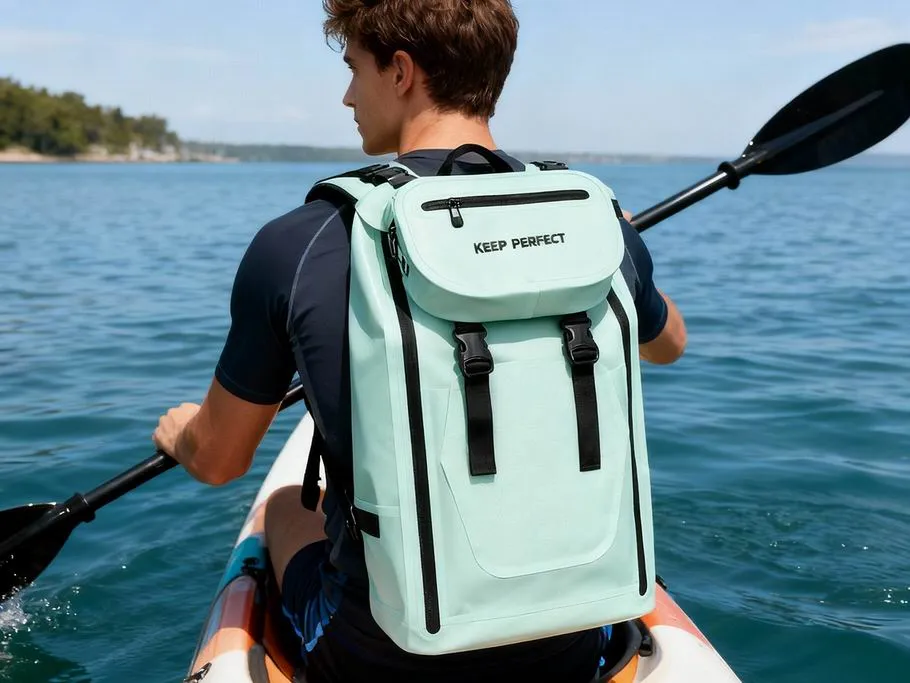
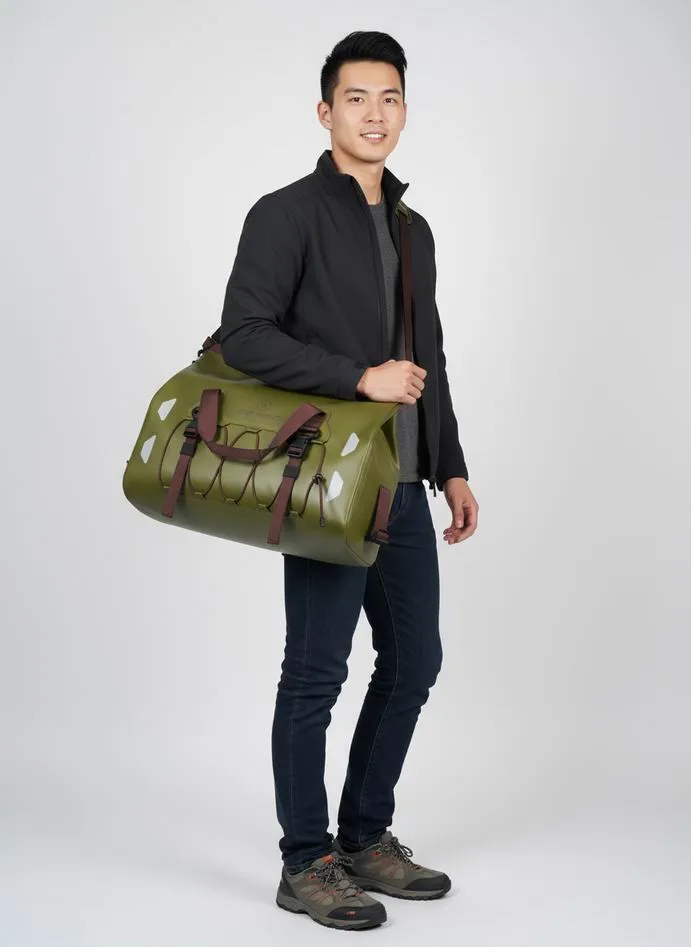
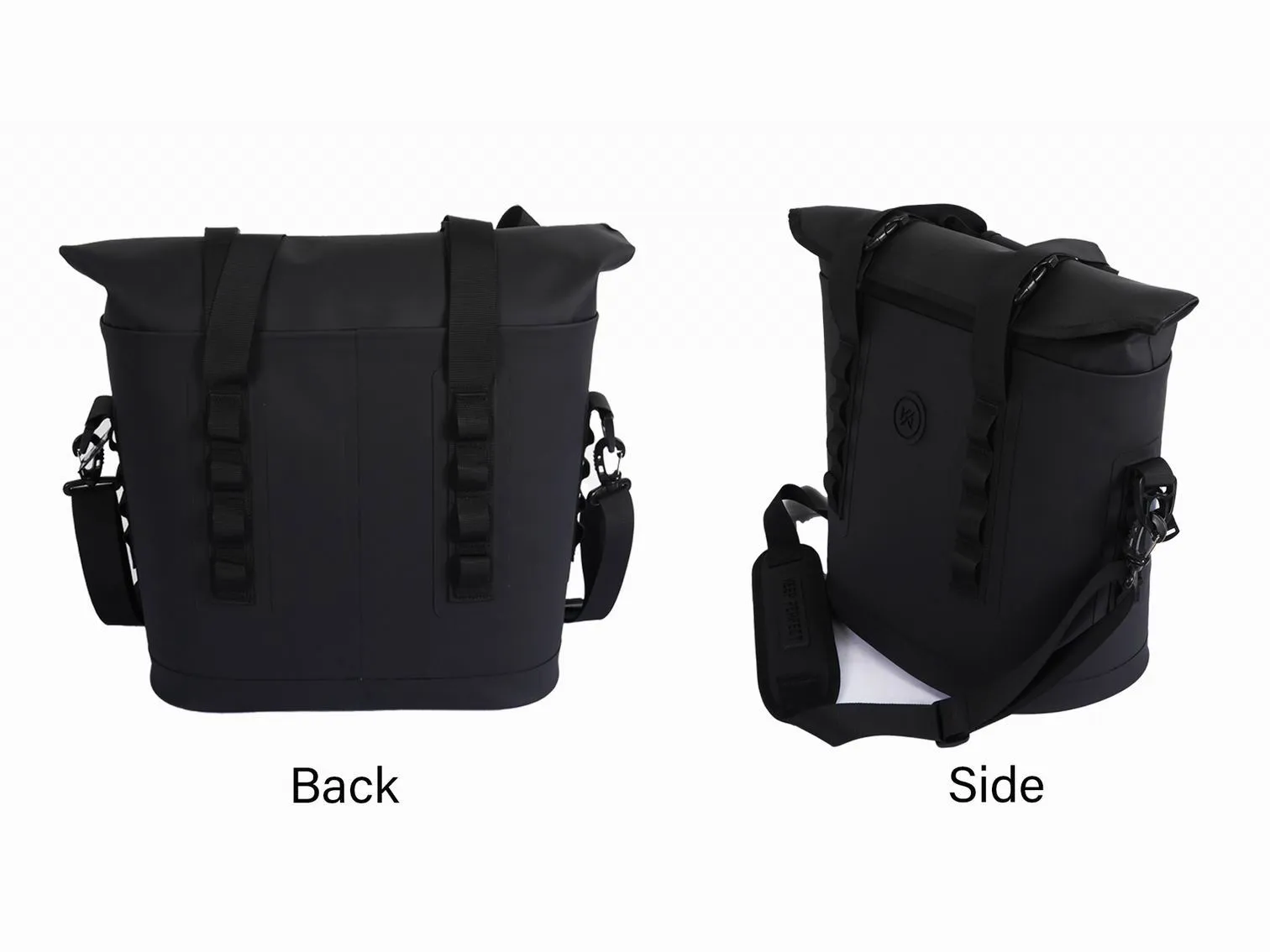
The strap wears out before the buckle does
Ask any repair operation what fails on a bag and the answer is consistent: the strap, at a contact point. The buckle is a moulded engineering polymer with generous section, no flexing and no abrasion, and it is very rarely the culprit. Webbing specification matters because the strap is the wear item in a load path that also contains a component engineered not to wear, and webbing load rating figures describe a condition — a straight, new, dry pull — that almost never resembles service.
The reason is geometric. Where webbing passes over a buckle bar, a ladderlock tooth or a D-ring, the load is carried by the outer yarns of the weave while those yarns are rubbed against metal or polymer under tension. Abrasion and load act together, which is far more damaging than either alone. Add grit, which turns into an abrasive paste inside the weave, and the wear rate at that contact point can be an order of magnitude higher than anywhere else on the strap.
This is why the specification question is not "how strong is this webbing" but "how does this webbing behave where it is loaded and rubbed at the same time". Strength is the easy number, it is printed on every catalogue, and it is the least predictive of the three properties that decide service life. The other two are abrasion behaviour at hardware contact and ultraviolet resistance, and neither appears in the headline figure.
The five numbers that belong on a webbing specification
A webbing line on a bill of materials usually says fibre, width and colour. That is three of the six things that matter and none of the three that determine service life. The complete specification is short and it fits on one line.
- Fibre: polyester, nylon or high-tenacity polyester, named rather than implied by price.
- Width and thickness: width in millimetres, plus thickness, because thickness is what decides hardware fit.
- Construction: weave type and, where it matters, the yarn linear density and ends per centimetre.
- Minimum breaking strength with the test method named, including the speed and the gauge length.
- Ultraviolet requirement: retained breaking strength after a defined exposure, expressed as a percentage with the method named.
- Colour fastness to rubbing and to light, where the webbing is a visible design element rather than hidden under a panel.
The fourth item is where most specifications quietly fail. A breaking strength without a method is not a requirement, it is a marketing figure: two laboratories using different gauge lengths, different grips and different speeds will report different numbers for the same webbing, and neither is wrong. Naming the method removes the ambiguity at no cost.
The fifth item is the cheapest insurance available anywhere in a bag specification. Ultraviolet exposure degrades all three common webbing fibres, at very different rates, and a strap that has lost a third of its strength is invisible until it breaks. Specifying retained strength after exposure costs nothing per metre and converts the most common strap failure from a surprise into a controlled variable. The same exposure logic is treated at the fabric level in our guide to ultraviolet resistance in outdoor materials.
Breaking strength by width and fibre: the ranges you can actually buy
The numbers below are realistic commercial ranges for standard webbing constructions, expressed both in kilograms force and in newtons. They vary with weave, yarn quality and finish, which is precisely why a specification should state a minimum rather than assuming a typical figure. One kilogram force is about 9.8 newtons, so a 900 kilogram strap is roughly 8,800 newtons.
| Width | Polyester, standard | Polyester, high tenacity | Nylon 6.6 | Polypropylene |
|---|---|---|---|---|
| 15 mm | Roughly 200 to 450 kgf, about 2.0 to 4.4 kN | Roughly 350 to 600 kgf, about 3.4 to 5.9 kN | Roughly 300 to 550 kgf | Roughly 150 to 300 kgf |
| 20 mm | Roughly 300 to 650 kgf, about 2.9 to 6.4 kN | Roughly 500 to 900 kgf, about 4.9 to 8.8 kN | Roughly 450 to 800 kgf | Roughly 200 to 400 kgf |
| 25 mm | Roughly 500 to 1,200 kgf, about 4.9 to 11.8 kN | Roughly 800 to 1,600 kgf, about 7.8 to 15.7 kN | Roughly 700 to 1,400 kgf | Roughly 300 to 600 kgf |
| 38 mm | Roughly 800 to 1,700 kgf, about 7.8 to 16.7 kN | Roughly 1,300 to 2,400 kgf, about 12.7 to 23.5 kN | Roughly 1,100 to 2,000 kgf | Roughly 500 to 900 kgf |
| 50 mm | Roughly 1,200 to 2,500 kgf, about 11.8 to 24.5 kN | Roughly 1,800 to 3,500 kgf, about 17.7 to 34.3 kN | Roughly 1,600 to 3,000 kgf | Roughly 700 to 1,300 kgf |
Two things stand out from the table. The first is how wide the ranges are: a 25 mm polyester strap can be bought at roughly two and a half times the strength of another 25 mm polyester strap, and they look identical in a photograph. The second is that strength is never the binding constraint on a bag. A shoulder strap carrying a loaded pack sees tens of kilograms, against a component rated in hundreds or thousands. Every webbing failure that is not abrasion or ultraviolet related is therefore an attachment failure wearing a strap failure’s clothes.
This is the point at which buyers should stop optimising. Upgrading from a standard to a high-tenacity polyester webbing to gain strength the application will never use adds cost and often adds stiffness, and it does nothing for abrasion or ultraviolet behaviour, which are the properties that actually end service life. Spend the money on the ultraviolet package and on the hardware contact geometry instead.
Weave: plain, twill and herringbone, and what each changes
Weave is the most under-specified and most consequential webbing property after fibre. It determines hand feel, thickness, how the strap sits against the body, how it grips in a buckle, and how it wears.
| Weave | Hand and appearance | Abrasion and wear behaviour | Hardware interaction | Typical use |
|---|---|---|---|---|
| Plain weave | Flat, dense, firm; holds its shape and resists rolling | Good abrasion resistance; wear shows as uniform thinning | Grips well in ladderlocks and cam buckles; the safest default | General straps, compression, haul loops |
| Twill weave | Softer, more supple, drapes better; slightly thicker | Very good abrasion resistance; the diagonal floats spread wear | Can slip slightly more in smooth-jawed hardware | Shoulder straps and anything next to the body |
| Herringbone | Decorative, soft, distinctive pattern | Good, though the pattern can hide early wear | Grips well; often chosen for appearance | Lifestyle and heritage styling |
| Needle or double-weave | Denser and stronger for the width; firmer | Excellent dimensional stability under load | May be too thick for some standard hardware | Load-critical and technical applications |
The practical selection logic runs through comfort and grip rather than strength. A shoulder strap benefits from a softer weave because it has to conform to a shoulder and because a stiff strap rolls and digs. A compression strap benefits from a firm plain weave because it has to feed through a ladderlock without twisting. Where a strap does both, the softer weave with a slightly wider width usually wins on comfort and loses nothing on strength.
Weave also sets thickness, and thickness is what the next section is about. A twill of the same nominal width and material can be noticeably thicker than a plain weave, which changes whether it passes through the buckle that was selected for it. Programmes that select hardware first and webbing second discover this at sampling; the correct order is to fix the webbing, measure it, and then select hardware against the measured thickness.
Fibre: polyester, nylon and high-tenacity polyester
Three fibres cover nearly all bag webbing, and the choice is driven by environment rather than by strength, because all three are strong enough for any bag application.
- Polyester: absorbs very little water, resists ultraviolet better than nylon, holds its dimensions when wet and costs least. The default for outdoor bags.
- Nylon: tougher and more extensible, with excellent abrasion resistance, but it absorbs several per cent moisture, loses stiffness when wet, and degrades faster in sun.
- High-tenacity polyester: the same chemistry with higher molecular orientation and better finish, giving roughly 50 to 80 per cent more strength at the same width, at a premium and with a firmer hand.
- Polypropylene: cheap, floats, absorbs no water, and has poor ultraviolet resistance. Suitable only for cost-led or indoor programmes.
- Recycled polyester: widely available with chain-of-custody certification and essentially equivalent performance to virgin polyester.
The wet behaviour of nylon deserves emphasis because it is the one that produces complaints. A nylon strap that has been soaked is measurably less stiff and slightly longer, which means a load-bearing strap that was adjusted dry will sit differently wet, and a cam buckle that held dry can slip wet. For a bag that will be used in and around water, that alone argues for polyester.
Where recycled content is wanted, webbing is the easiest component in the bag to put it in. Recycled polyester webbing performs like virgin, it is mature and widely available, and unlike a load-critical moulded buckle it carries no concern about mechanical consistency from a recycled feedstock. The certification requirement is covered in our guide to the Global Recycled Standard, and the wider argument about where to place recycled claims is made in our piece on hardware selection for waterproof bags.
Fit tolerance: whether the strap works is decided by thickness
A strap and a buckle are a mating pair, and the dimension that decides whether the pair works is thickness against the slot height. This is specified less often than colour, and it causes more assembly problems than any other webbing property.
- Too thick: the strap will not thread, or it threads with effort and then binds, which makes adjustment stiff and wears the yarns at the fold.
- Too thin: the strap slips in the hardware under load, and in a ladderlock or cam buckle that means the adjustment will not hold.
- A useful working rule is that the strap should fill most of the slot height without forcing it; a strap that rattles in the slot is a slip risk.
- Typical 25 mm webbing runs somewhere between about 1.0 and 1.6 mm thick depending on weave and yarn, and the spread is enough to matter on every buckle.
- Stiffness interacts: a thick, stiff strap resists the small radius over a buckle bar and will not sit flat, which concentrates load on the outer yarns.
The check takes thirty seconds and should be a formal part of first article approval. Thread the production webbing through the production buckle, pull it through by hand, and then load the assembly to roughly twice the expected working load and see whether the adjustment holds. If the strap must be forced, the pair is wrong. If it slips, the pair is wrong. If it feeds smoothly and holds, it is right, and that is worth more than any catalogue figure.
There is a sourcing reason to insist on this. Webbing is bought by the roll from whichever mill has stock in the right width and colour, and a substitution within the same nominal width can change thickness and weave. Without a thickness tolerance on the specification and a physical reference sample, an approved bag can be produced with a strap that does not fit its own buckle. The substitution discipline is the same one described in our guide to selecting buckles, straps and accessories.
Edge finishing and the cut end: a small detail with a long tail
Every strap has ends and edges, and both are failure sites. Ends pull out from under stitching, fray, or dig into the user; edges abrade against hardware and against the shell.
- A hot-knife cut seals the end and prevents fraying, and the resulting bead is hard, which can abrade skin and catch on other gear.
- A straight cut leaves a square end that is easiest to trap under a bar tack; a V-cut or angled cut distributes load better across the stitch line.
- Melting the end into a hard lump makes it impossible to trap the end properly and creates a stress concentration at the stitch line.
- A turned or folded end doubles the material under the stitch and roughly doubles pull-out resistance for a few cents of labour.
- Laser or ultrasonic cutting seals the edge cleanly with a smaller bead than a hot knife, and is worth specifying where the edge is visible or touches the user.
The interaction with the shell is worth naming. A hard melted end inside a bag rubs against the coated face, and over time it can abrade through a coating at the contact point. That is a slow failure that appears as a leak rather than as a strap problem, and the diagnosis usually takes weeks because nobody connects the strap end to the hole. A softer end treatment or a backing patch at the contact point prevents it.
Where the strap end is stitched, the thread matters as much as the webbing. Every stitch through a welded or coated shell is a perforation of the barrier, and the strap end is one of the largest stitch groups on a bag. The combined answer is a hydrophobic thread plus a welded patch or a sealant, which is the same problem treated in our guide to thread selection for stitched waterproof seams.
Where straps actually fail: six modes and their evidence
Strap failures are identifiable by inspection, and the mode tells you which specification line was missing. These six account for nearly everything that comes back.
| Failure | Where it happens | Evidence | What was missing in the spec |
|---|---|---|---|
| Abrasion at the hardware contact | Where the strap passes over a buckle bar or through a ladderlock | Yarns thinned and polished on one face only, usually with grit embedded in the weave | No abrasion requirement and no hardware contact geometry review |
| Ultraviolet embrittlement | Anywhere the strap is exposed | Colour faded, yarns brittle, break with little elongation and no abrasion | No ultraviolet retained strength requirement |
| Pull-out at the attachment | The strap is intact; the end came out from under the stitch | The stitch pattern is distorted or the panel tore at the stitch line | Attachment geometry, not webbing strength |
| Slip in the hardware | Ladderlock or cam buckle that will not hold adjustment | No damage; the strap simply will not stay where it was set | Thickness tolerance and hardware pairing |
| Edge fraying and fibrillation | Cut ends and abraded edges | Loose yarns and a fuzzy edge, often after washing | Edge finishing requirement |
| Stitch-hole tearing in the panel | The panel tears where the strap is sewn on | The strap and the stitching are intact; the fabric failed | Webbing strength checked against panel tear strength |
The last row is the one that reveals over-specification. Programmes frequently specify a stronger strap than the panel can resist, so the panel tears while the strap is untouched. The correct comparison is not strap strength against expected load, it is strap strength against the tear strength of the panel it is sewn to, and that comparison is set out in our guides to denier ratings and durability and to tear, tensile and burst testing.
Note also how rarely the middle of the strap fails. A strap that has broken in the middle, away from any hardware, has either been cut, been shock-loaded far beyond any bag use case, or degraded uniformly by ultraviolet exposure. Every other failure is at a contact point, at an end, or in the panel.
From catalogue figure to working load: applying a safety factor
A breaking strength is measured on a new, dry, straight specimen pulled slowly until it breaks. Service involves aged material, wet conditioning, shock loading, off-axis pulls and abrasion all at once, so the catalogue figure has to be reduced deliberately before it is used as a design number.
- For light-duty or decorative straps, a factor of two to three against breaking strength is adequate.
- For anything carrying the weight of a loaded bag, a factor of four to five is the conventional expectation.
- For anything that could injure someone if it failed — a child carrier strap, a rescue handle, a haul loop on a loaded rescue bag — higher still, and the application should be engineered rather than estimated.
- Shock loading matters more than static load: a dropped bag on a strap generates several times the static load for a fraction of a second.
- Abrasion reduces the section that carries load, and the reduction is invisible until it is substantial.
Worked through, a 25 mm polyester strap quoted at 900 kgf is not a 900 kilogram component. At a factor of five it is a working component of roughly 180 kgf, which is still far beyond anything a shoulder strap sees. That is the honest conclusion for bag webbing: strength is almost never the constraint, and the safety factor exists to absorb ageing, shock and abrasion rather than to cover an under-rated component.
The corollary is that a programme should not buy strength it cannot use. It should buy the ultraviolet package, the right weave for comfort and grip, the correct thickness for the hardware, and a good attachment geometry. That is where the service life is. Load rating protocols and conditioning requirements are covered in our guide to load stress testing on straps and handles.
A pull test and an abrasion check you can run without a laboratory
Formal testing is worth paying for on any load-critical strap, but a workshop test catches the majority of problems early and can be run on a sample before a commitment is made. Two tests are enough.
- Tensile: grip the specimen over a sufficient gauge length and wrap it around capstan grips rather than clamping it flat, because jaw breaks are the most common invalid result. Pull at a stated speed and record both the breaking load and the elongation.
- Wet conditioning: repeat after soaking the specimen, because nylon in particular changes behaviour when wet and the catalogue figure will not show it.
- Abrasion under load: run the strap back and forth over a bar of the hardware material under a modest tension for a few hundred cycles, then pull it to destruction and compare against an uncycled specimen.
- Ultraviolet: rather than trying to run an exposure cabinet, ask the mill for retained strength after a defined exposure and check that a method is named.
- Fit: thread the production strap through the production hardware, load it, and confirm that adjustment holds.
The abrasion-under-load test is the one that predicts field behaviour best and is almost never run, because it is slow and because it destroys specimens. It reproduces the actual failure mechanism — abrasion and tension together — and it will separate two webbings that have identical catalogue strengths by a wide margin. A strap that loses a third of its strength after a few hundred loaded cycles over a bar will fail in service long before a strap that loses none.
Formal methods are published and worth citing by number so that a laboratory knows exactly what was meant: tensile testing of textiles comes from ISO and from ASTM International, which also publishes a dedicated method for webbing, tape and braided material, and abrasion and general textile durability work is covered by independent laboratories such as SATRA. Additional abrasion guidance relevant to the whole product is set out in our article on abrasion resistance standards.
Attachment: the joint, not the strap, is the weak link
It is worth stating this explicitly because it resolves most strap failures and because it is cheap to fix. When a strap detaches from a bag, the strap did not break. The end pulled out from under the stitching, the bar tack tore through the panel, or the panel tore at the stress concentration where the stitch line ends.
- Load concentrates at the ends of a stitch line rather than in the middle, so the pattern geometry at the ends matters more than the thread.
- A box-with-cross or a radiused pattern spreads stress better than a plain rectangle with sharp corners.
- Trapping the strap end by folding it back roughly doubles pull-out resistance for a few cents of labour.
- A wider, taller attachment patch spreads load into more yarns of the shell, which is usually the cheapest improvement available.
- On a welded shell, a welded tab of compatible polymer outperforms any stitch and leaves the barrier intact.
The welded-shell case deserves the warning it usually gets. Stitching a strap onto a welded shell perforates the barrier, and then the stitch holes have to be sealed by tape or by a welded patch. If the holes are taped, the tape becomes part of the load path, and tape is not designed to carry sustained peel load. The correct answers are a welded tab or a mechanically attached patch that leaves the barrier alone, and the trade-offs are set out in our comparison of stitched, welded and bonded construction.
One fifteen-minute test settles the whole question: attach the strap to the actual production panel, load it to twice the expected working load, and hold it for a minute. If the panel deforms, the panel is the weak link. If the stitching distorts, the pattern is wrong. If nothing moves, the geometry is right. That result is worth more than any catalogue figure on any component.
Cost, minimums and what webbing really costs to customise
Standard webbing is cheap: a few cents to a few tens of cents per metre at volume, which means the webbing content of a typical bag is a small fraction of the material cost. Customisation is where the money goes, and the same pattern appears here as in hardware.
- Stock widths and stock colours carry no minimum beyond the mill’s normal roll quantity, and they are available in days.
- Custom colour usually carries a dye-lot minimum measured in hundreds to thousands of metres, which is manageable on a bag programme and negligible per unit.
- Custom weave or a jacquard woven logo requires loom set-up and a considerably larger minimum, and it is a tooling decision in the same sense as a mould.
- Printed or heat-transferred branding on webbing is cheaper than woven and wears less well; it is a design choice rather than a performance one.
- Recycled polyester with chain-of-custody certification is now close to stock pricing and is the cheapest genuine sustainability claim available on a bag.
The practical rule is the same one that applies to hardware: customise the branding, not the component. A stock webbing in a stock colour with a woven label or a branded buckle costs a fraction of a bespoke weave and looks deliberate. A bespoke jacquard weave is justified only at volumes where the loom minimum and the set-up cost amortise to something small per unit.
Lead time behaves similarly. Stock webbing is available immediately and never appears on the critical path; custom colour adds the dye-lot lead time, which can be several weeks; custom weave adds longer. On a programme with a launch date, the webbing decision belongs early for exactly this reason, and the scheduling consequences are covered in our guide to lead times for custom orders.
The webbing block on the tech pack
Everything above compresses into a specification block that sits with the fabric and hardware specifications. Written this way, webbing stops being a commodity bought from stock and becomes a set of requirements a factory can quote against and be held to.
- Fibre and construction: named, with the weave type and the yarn specification where it matters.
- Dimensions: width plus thickness, with a tolerance, because thickness decides hardware fit.
- Performance: minimum breaking strength with the method, speed and gauge length named.
- Ultraviolet: retained breaking strength after a defined exposure, with the method named.
- Hardware pairing: the buckle or ring it must fit, and a requirement that fit be verified on the production pairing.
- Edge finishing: cut type, sealing method, and how ends are treated before stitching.
- Attachment: stitch pattern, whether the end is trapped, and the panel tear strength it was checked against.
- Substitution: no change of webbing without a re-submitted test report and a renewed approved sample.
The second line is the one most often missing and most often decisive. Width is always specified; thickness almost never is; thickness is what decides whether the strap works with the buckle that was chosen for it. Adding it costs nothing and prevents a problem that is otherwise discovered at assembly.
If you want this worked through on a specific style, send the load cases, the hardware you intend to use and the duty environment, and let the webbing be specified against those rather than chosen from a colour card. You can review how a programme runs from first enquiry through sampling to bulk production; every style starts at 500 pieces minimum, with samples in 6–10 working days and bulk in 35–50 days, quoted FOB Xiamen.
Frequently Asked Questions
Q1. Why does webbing wear out before the buckle?
Because the strap is loaded and rubbed at the same time where it passes over hardware, while the buckle is a rigid moulding with generous section. Add grit inside the weave and the contact point wears an order of magnitude faster.
Q2. What breaking strength should I expect from 25 mm webbing?
Roughly 500 to 1,200 kgf for standard polyester, 800 to 1,600 kgf for high-tenacity polyester, and 700 to 1,400 kgf for nylon. The range within one fibre is wide, which is why a minimum should be specified.
Q3. Is polyester or nylon webbing better for outdoor bags?
Polyester. It absorbs very little water, resists ultraviolet better and holds its dimensions when wet. Nylon is tougher and more abrasion resistant but degrades faster in sun and loses stiffness when saturated.
Q4. What safety factor should I apply to a webbing breaking strength?
Two to three for decorative straps, four to five for anything carrying the weight of a loaded bag, and higher for anything that could injure someone if it failed. The factor covers ageing and shock, not an under-rated component.
Q5. Why does my strap slip in its buckle?
Usually a thickness mismatch: the strap is too thin for the slot, so the hardware cannot grip it. Specify thickness with a tolerance and verify the pairing on production parts before approval.
Q6. Why is my strap hard to thread through the buckle?
It is too thick or too stiff for the slot, which makes adjustment stiff and wears the yarns at the fold. Fix the webbing and hardware as a pair rather than choosing the buckle first.
Q7. Does weave type affect strength?
Less than it affects comfort, thickness and grip. Plain weave is firm and grips well in hardware; twill is softer and better next to the body; both are far stronger than any bag application requires.
Q8. How does ultraviolet exposure affect webbing?
It embrittles the yarns, so a strap loses strength without visible damage until it breaks. Specify retained breaking strength after a defined exposure, with the method named, and match the fibre to the duty.
Q9. Should I use high-tenacity polyester webbing?
Only if the width is constrained. It gives roughly 50 to 80 per cent more strength at the same width for a premium, but strength is rarely the constraint on a bag and it does nothing for abrasion or ultraviolet life.
Q10. How do I test webbing without a laboratory?
Pull a specimen to destruction using wrapped grips rather than flat jaws to avoid jaw breaks, repeat after wet conditioning, and run an abrasion-under-load check over a hardware bar before pulling to destruction.
Q11. Why does the panel tear where the strap is sewn on?
Because the strap is stronger than the panel. Compare webbing strength against panel tear strength rather than against expected load, and widen the attachment patch to spread the load.
Q12. How should strap ends be finished?
Cut so the end can be trapped under the stitch, seal it to prevent fraying without creating a hard lump, and fold it back to roughly double pull-out resistance. Avoid a melted bead that cannot be trapped.
Q13. Can webbing be welded onto a waterproof shell?
Yes, and it is usually better than stitching. A welded tab of compatible polymer distributes load across the whole bond area and leaves the barrier intact, whereas stitching perforates it and puts peel load onto tape.
Q14. Is recycled webbing available?
Yes. Recycled polyester webbing is mature, widely available with chain-of-custody certification, and performs essentially like virgin. It is the easiest place on a bag to put a genuine recycled claim.
Q15. How much does custom webbing cost?
Stock webbing costs cents per metre. Custom colour adds a dye-lot minimum measured in hundreds to thousands of metres, and a custom weave or jacquard adds loom set-up and a much larger minimum.
Q16. Does custom webbing affect lead time?
Stock does not. Custom colour adds the dye-lot lead time of several weeks, and custom weave adds longer, so the webbing decision belongs early on any programme with a launch date.
Q17. What is the cheapest way to prevent webbing substitution?
Keep a signed and dated reference sample of the approved webbing, specify thickness as well as width, and require a re-submitted test report before any change. Substitution is detected by comparison.
People Also Ask
Why does webbing fail before the buckle?
Because it is loaded and abraded at the same time where it passes over hardware. The buckle is rigid and barely wears.
How strong is 25 mm webbing?
Roughly 500 to 1,200 kgf for standard polyester and up to about 1,600 kgf for high-tenacity grades, which is far more than any bag needs.
Which webbing is best outdoors?
Polyester. It absorbs little water and resists ultraviolet better than nylon, which degrades faster in sun and softens when wet.
Why does my strap slip in the buckle?
A thickness mismatch. Specify thickness with a tolerance and verify the strap and hardware as a mating pair.
What safety factor applies to webbing?
Four to five for straps carrying the weight of a loaded bag, and more where failure could cause injury. The factor covers ageing and shock.
How do I test webbing at home?
Pull to destruction using wrapped grips, repeat wet, and abrade the strap under load over a hardware bar before pulling it again.