Modular attachment is bought for one reason: a single purchase that serves several scenarios. A daypack that takes a camera pod, a tool roll, a wet compartment and a helmet carrier is a more useful product than four separate bags, and that is a genuine and saleable advantage. The cost is equally real and almost never priced: every interface adds weight, adds bulk, adds a failure point, adds an assembly operation, and creates a commitment that the next product in the range will still fit this one. The most common way modular systems fail is not that an interface breaks. It is that the brand ships a new accessory two years later and it does not fit the bag the customer already owns, which converts the entire selling proposition into a complaint.
This guide covers the honest ledger of modularity and how to price it, the interface families from webbing loops through to rails and magnets with their real load and reliability characteristics, what each interface costs in weight and bulk, why tolerance and batch consistency determine whether interchangeability exists at all, the brand-incompatibility failure and the five mechanisms that cause it, mixed-material interface problems, the field failure modes specific to attachments, which products genuinely benefit from modularity and which do not, how to test an interface, how a brand governs an interface so it stays stable for years, and the clauses a procurement team should require in the technical package. QUANZHOU JUNYUAN BAGS — custom waterproof bag production since 2014, 4,950 m² SGS-verified facility — works to MOQ 500 pieces per style, with sampling in 6–10 working days and bulk in 35–50 days, FOB Xiamen.


The modular ledger: what you buy and what you pay
The argument for waterproof bag interchangeable mounting is straightforward and correct: one shell, many configurations, no duplicate purchases. A customer who buys a bag and then buys two accessories over three years has spent more with the brand and has a product that adapts to a wider range of uses. For a brand, accessories carry higher margin than bags, they deepen the relationship, and they generate repeat purchase without a new main-line development. None of that is illusory.
The cost side is where programmes get into trouble, and it has four entries that are individually small and collectively decisive. Weight: interfaces add mass whether or not anything is attached, and a bag carrying unused attachment points is carrying dead weight every day. Bulk: an interface that protrudes catches, snags and looks technical on a product that may need to look clean. Failure points: every interface is a joint that can break, and a modular bag has more of them. Commitment: once an interface is published, every future product is constrained by it, and that constraint is the one nobody budgets for.
The reason modular attachment systems deserve a written evaluation rather than an enthusiastic one is that the costs are certain and the benefits are contingent. The weight is added on day one; the benefit arrives only if the customer buys accessories, and only if those accessories exist. A programme that adds a full interface grid to a bag and launches with one accessory has paid the cost and deferred most of the benefit. The discipline is to launch the interface with the accessories, or to scale the interface down to match what is actually available.
| Entry | Certain or contingent | When it is incurred | How to price it |
|---|---|---|---|
| Interface hardware added to the shell | Certain | At launch, whether or not used | Grams and assembly minutes per unit |
| Additional assembly operations | Certain | Every unit produced | Seconds per station, multiplied by volume and labour rate |
| Added failure points and warranty exposure | Certain but delayed | Across the service life | As an increment to the expected return rate |
| Constraint on future product design | Certain and cumulative | Every subsequent development cycle | As a design restriction, hardest to price and easiest to underestimate |
| Accessory revenue | Contingent | Only if accessories are developed and bought | Attach rate multiplied by margin; be conservative |
| Customer reuse across scenarios | Contingent | Only if the system stays compatible | The whole proposition; worth nothing if compatibility breaks |
Interface taxonomy: six families and what each is for
Interfaces are often chosen by appearance and should be chosen by load path, by frequency of use and by whether they must work one-handed. The six families below cover nearly everything in the category, and they differ far more in behaviour than in looks. The load figures are working loads rather than catalogue breaking strengths, applying the safety factors set out in our hardware guidance, because a modular accessory hanging off the outside of a bag is shock-loaded every time the bag is set down.
| Interface | Realistic working load | Weight per point | Best use | Weakness |
|---|---|---|---|---|
| Webbing loop or daisy chain | Five to fifteen kilograms, limited by the anchorage rather than the webbing | Three to eight grams | Light accessories, compression, lash points | Load is limited by the stitch or weld anchoring it, not by the loop |
| D-ring, polymer or metal | Ten to twenty-five kilograms, again anchorage-limited | Five to fifteen grams | Strap routing, shoulder carry, moderate loads | Can deform open under side load; metal corrodes and stains |
| Snap hook or clip | Two to ten kilograms for a non-locking gate; more with a locking gate | Ten to twenty-five grams | Frequently removed accessories | A non-locking gate opens when snagged; this is the dominant failure |
| Ladderlock or strap-through channel | Fifteen to thirty kilograms | Five to fifteen grams with the strap | Heavier pods and pouches held close to the shell | Slow to attach; requires access to both strap ends |
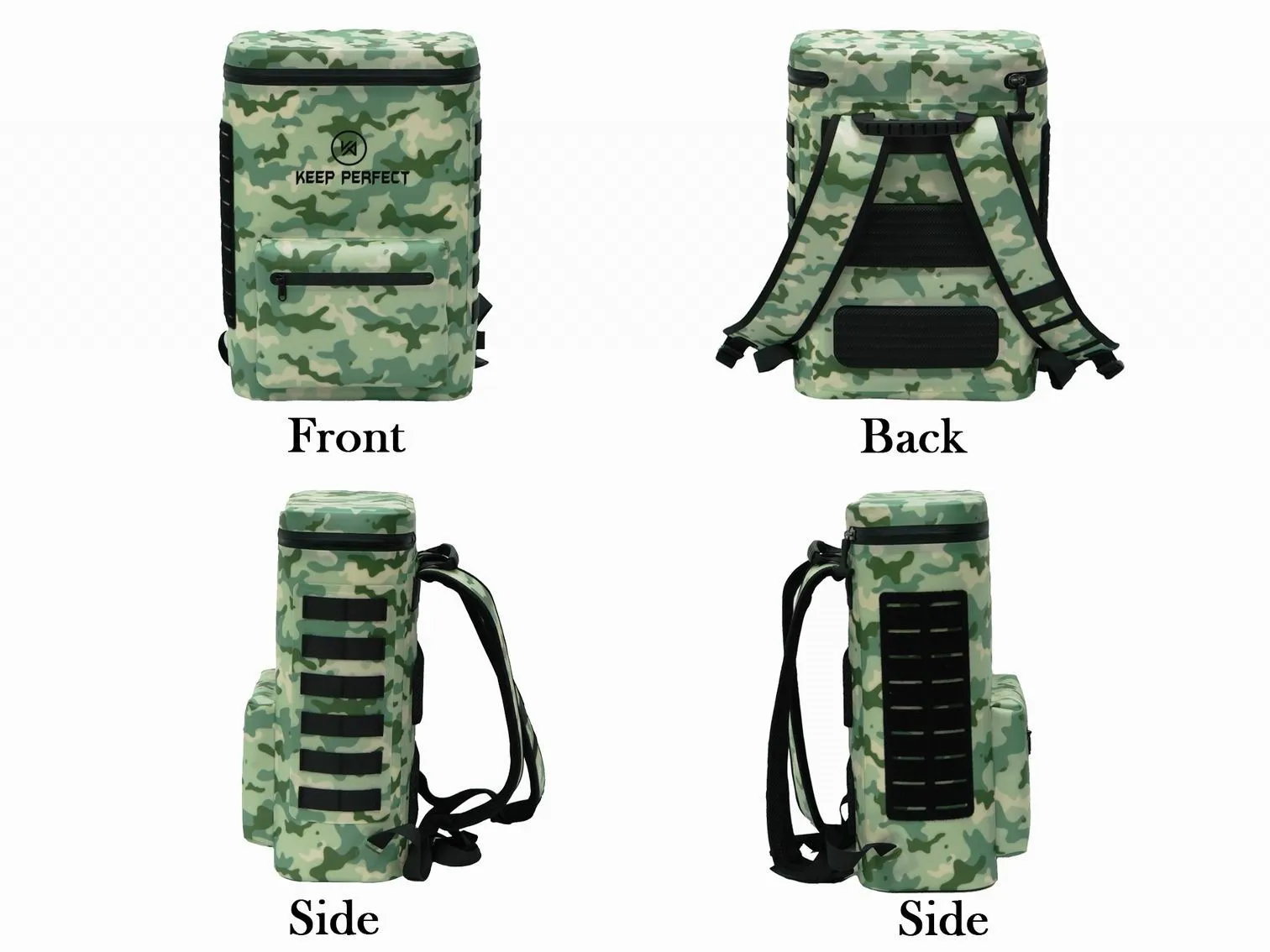
| Slot or rail system | Ten to thirty kilograms depending on the rail | Sixty to one hundred and fifty grams for a run | Systems needing sliding adjustment and precise position | Heavy, expensive, and the rail is a permanent styling commitment |
| Magnetic mount | Under one kilogram against peel, more against pure shear | Fifteen to forty grams | Very light accessories, positioning, tool retention | Poor in peel and in shear under shock; the lowest load capacity by far |
The row that surprises people is the anchorage limit, and it is the one that decides real-world performance. A webbing loop rated at fifteen kilograms is not the limit; the limit is what holds the loop to the bag, which is a stitch line, a weld, or a rivet through a coated panel. In practice the anchorage fails before the loop does in the great majority of cases, which is why the specification should be written for the assembly rather than for the component. Our guidance on webbing tape specification and load ratings and on load stress testing on straps and handles both make the same point: test the joint, not the part.
The magnetic row deserves a pointer, because the numbers are low enough to be disqualifying for anything but positioning. A magnet mount that holds half a kilogram perpendicular may hold several times that in pure shear, and it will release under a shock load in either direction. Where a magnet is used for accessory mounting it should be paired with a mechanical secondary retention, and the reasoning is set out in our analysis of magnetic closures and their feasibility on waterproof bags, where the same force-versus-gap relationship governs the outcome.
Load rating is an assembly property, not a component property
This point is important enough to give it its own section, because it is where most modular programmes are quietly under-specified. A supplier quotes a hook rated at twenty kilograms and a buyer records twenty kilograms, but the hook will be attached to a loop, the loop to a webbing tab, and the tab to a coated panel, and each of those joints is weaker than the hook. The system carries the lowest of the four, and in soft goods that is almost always the panel.
- Specify the load for the assembled path: hook, loop, tab, panel. Name the weakest link explicitly rather than leaving it to be discovered.
- Test in the worst direction. A hook loaded axially holds far more than the same hook loaded across its gate, and across-gate is what happens when a bag is dragged.
- Test with shock. An accessory that holds a static load will not necessarily survive the bag being dropped on the corner where the accessory is mounted.
- Test after cycling. Attachment points are engaged and disengaged constantly, and wear at the contact reduces capacity well before anything is visible.
- Test wet. Coated panels lose tear strength when saturated, and a mounting tab that is dry-tested will overstate the wet capacity.
The design response is to spread load rather than to specify a stronger component. A mounting tab that is wider and taller, welded rather than stitched where the shell permits, and positioned over a seam or a reinforced panel rather than in the middle of a flat area, will outperform a stronger hook on a poor anchorage by a wide margin. This is the same conclusion reached in our review of custom hardware selection, where attachment geometry beats component strength in almost every case.
There is a useful rule of thumb for anchorage area that prevents most pull-out failures: the bonded or stitched footprint of a mounting tab should be at least four times the cross-sectional area of the webbing it carries, and it should extend beyond the load line in every direction rather than sitting flush with it. In practice that means a twenty-five millimetre strap needs a tab of roughly fifty by fifty millimetres or more, which is larger than most pattern makers draw by default.
What modularity costs in weight and bulk
Weight is the most reliably underestimated cost of modularity, and it is worth putting numbers on it because the totals are larger than intuition suggests. An interface that is never used still weighs what it weighs, every day, for the life of the product, and it is the most common reason a modular bag is heavier than its non-modular competitor by a margin the customer notices.
| Configuration | Hardware weight added | Typical number of points | Total added weight | Comment |
|---|---|---|---|---|
| Four webbing loops plus a daisy chain | Roughly 30 grams | Four to eight | 30 to 60 grams | Acceptable on almost any product |
| D-rings at four positions, polymer | Roughly 50 grams | Four | Around 50 grams | Acceptable; the anchorage reinforcement adds more |
| D-rings at six positions, metal | Roughly 120 grams | Six | Around 120 grams | Noticeable; justified only on technical product |
| Snap hooks supplied with two accessories | Roughly 40 grams | Two | Around 40 grams | Carried only when the accessory is fitted |
| Laser-cut laminate attachment panel | Roughly 80 grams | One panel | Around 80 grams | Efficient per point if the panel is actually used |
| Full rail run with two sliding inserts | Roughly 150 grams | One run | Around 150 grams | Significant; only for systems that genuinely need adjustment |
| Magnetic mounts at four positions plus backing plates | Roughly 120 grams | Four | Around 120 grams | The most weight for the least load capacity |
Two of those rows deserve comment. The metal D-ring and the rail run both add weight in the range of a hundred to a hundred and fifty grams, which on a daypack is roughly five to ten per cent of the total product weight. That is a real cost and it should be justified by actual accessory use rather than by the appearance of capability. The magnetic row adds comparable weight for a fraction of the load capacity, which is the clearest example of an interface chosen for feel rather than for function.
Bulk and snag are the costs that do not appear in a weight budget and that generate field complaints. A protruding hook catches on clothing, on car door frames and on vegetation; a rail catches on everything and is uncomfortable where it contacts the back. The design mitigations are cheap: recess the interface where possible, specify a low-profile hook with a guarded gate, and place rails on side or front panels rather than on any surface that touches the wearer.
Tolerance and interchangeability: where modularity actually lives or dies
Interchangeability is not a design intention, it is a dimensional fact, and it is decided by tolerances that are rarely written down. A hook fits a loop because the gate opening is larger than the loop material thickness with a margin, and because both are within tolerance. That margin is typically well under a millimetre, and the processes that consume it — mould wear, plating thickness, anodising thickness, coating thickness on the webbing, and shrinkage variation between material lots — are all routine and all invisible.
| Dimension | Typical manufacturing variation | What consumes the margin | Specification response |
|---|---|---|---|
| Webbing width | Plus or minus half a millimetre | Weave tension, coating thickness, lot variation | State width with tolerance and test with gauge, not by eye |
| Webbing thickness | Plus or minus 0.1 to 0.2 millimetre | Coating weight variation | Matters for any hook or slot; state it |
| Hook gate opening | Plus or minus 0.3 to 0.5 millimetre | Mould wear over the tool life | Measure at the start and end of a tool life, not only at sampling |
| D-ring wire diameter | Plus or minus 0.1 millimetre | Die wear and plating build-up | State whether the dimension is before or after plating |
| Moulded insert body | Plus or minus 0.2 to 0.4 millimetre | Shrinkage varies with material lot and with the moulding parameters | Require parts from the production tool, not from a prototype |
| Grid spacing on a webbing panel | Plus or minus one millimetre over a run | Pattern cutting and sewing accumulation | State spacing over a defined length, not per interval |
The dimensional question that is almost never asked and most often causes the problem is whether a stated dimension is before or after finishing. A metal D-ring specified at four millimetres wire diameter is a different part before and after a plating build-up of fifty micrometres, and a hook from a tool that has worn for three years has a measurably different gate. Both are within the nominal specification and both can fail to mate with an accessory made to the earlier condition.
The practical control is a go/no-go gauge kept with the tech pack, built from parts at the extremes of the tolerance band rather than at the nominal. Every production lot of an interface component is checked against it, and so is every accessory. This costs a few hundred dollars to make and it is the only reliable way to detect drift before customers do. Tolerance principles and the drawing conventions for expressing them are maintained by ISO in its geometrical product specification series, and naming the convention removes the ambiguity that causes most of these disputes.
The most common failure: your own next product does not fit
It is worth stating the central failure of this category plainly, because it is more damaging than any interface breaking. A brand launches a bag with an interface, sells accessories for it, and then launches a new bag or a new accessory that does not mate with the existing system. Customers who bought into the system discover that their accessories are orphaned, and the proposition that sold the first bag becomes the reason they do not buy the second. Nothing has broken; the promise has simply not been kept.
| Mechanism | How it happens | Why nobody noticed | Control |
|---|---|---|---|
| Redesign for styling | A new model changes the interface for a cleaner look | The drawing changed legitimately; nobody checked compatibility | Freeze the interface dimensions separate from the styling drawing |
| Supplier change | A new hardware supplier produces a nominally identical part | The part number is the same; the tool is different | Require mating tests against retained reference parts before approval |
| Tool revision or new tool | A worn tool is replaced and the new cavity differs | The new part is closer to nominal than the old one | Measure both and check the worst-case combination, not the nominal |
| Material or process change | A different polymer shrinks differently; a different coating is thicker | The change was made for cost or compliance | Require a compatibility test as part of any material change approval |
| No owner | Nobody is responsible for the interface across programmes | Each project team optimises its own product | Name an interface owner and version the drawing |
The last row is the root cause behind the other four. In most organisations an interface belongs to whichever project created it, and when that project ends, ownership ends. The next project is measured on its own product, has no instruction to maintain compatibility, and frequently improves something in a way that breaks it. The fix is organisational rather than technical: a named owner, a versioned interface drawing, and a mandatory compatibility check on every new part that claims to fit.
There is a commercial dimension as well, and it is worth being honest about. Compatibility across generations reduces accessory churn, and some organisations deliberately break it to force replacement. That is a legitimate strategy and it is also the fastest way to lose the customers who bought most enthusiastically into the system. Brands that publish a compatibility commitment — a stated number of years, or a stated generation — tend to keep those customers, and the cost of honouring it is usually just the discipline described above.
Mixed materials at an interface: corrosion, abrasion and noise
An interface puts a hard component in contact with a coated shell and, usually, in contact with another metal. Three problems follow, all of them slow, all of them visible at month six rather than at approval, and all of them cheap to prevent at specification.
- Galvanic corrosion: a stainless hook on an aluminium D-ring in salt water corrodes the aluminium. Isolate dissimilar metals with a polymer washer, or standardise on one metal family.
- Abrasion of the shell: a hard interface that can move abrades the coating it is mounted on, and movement is what modular systems provide by design. Back every contact point with an abrasion-resistant patch.
- Plating wear and staining: plated metal wears at the contact, exposes the base alloy, and stains adjacent light-coloured panels permanently.
- Grit as an abrasive paste: an interface that traps sand between two hard parts polishes through a coating far faster than clean contact would. Design so the joint can be rinsed.
- Rattle and noise: a loose metal interface on a moving bag is audible, and it is one of the most common reasons customers remove accessories and stop using the system.
The rattle point is easy to dismiss and it is a genuine usage barrier. A hook that rattles against a D-ring with every step is annoying enough that customers stop carrying the accessory, which ends the modular behaviour the system was built to encourage. The fixes are a polymer sleeve on the hook, a slight interference fit at the mating surfaces, or a quiet material such as a moulded polymer hook instead of metal.
Standardising on one metal family across an interface is the cheapest single decision here, because it removes the galvanic question entirely and it simplifies the corrosion testing. Where a stainless component is genuinely required for strength, anodised aluminium elsewhere in the same assembly needs isolation, and the isolation is a part that must appear on the bill of materials rather than being left to the assembly line.
Field failure modes specific to attachments
Modular systems fail in a recognisable set of ways, and each has a design fix that is cheaper at the specification stage than in the field. The list below is the recurring set, ordered by how often it appears in returned product.
| Symptom | Mechanism | Where it originated | Fix |
|---|---|---|---|
| Accessory falls off without warning | A non-locking gate opened when snagged | Hook specification | Specify a locking gate, or a guarded gate, for anything carried on the outside |
| Mounting tab pulled out of the panel | Anchorage weaker than the component | Attachment geometry | Increase the footprint to at least four times the strap cross-section; weld where the shell permits |
| Interface rattles and is removed by the user | Loose metal-to-metal contact | Clearance and material choice | Polymer sleeve, slight interference, or a polymer hook |
| Coating worn through around a D-ring | Movement plus hardness differential | Contact design | Abrasion-resistant backing patch; restrict movement with a keeper |
| Rust staining around a metal interface | Plating worn, base alloy exposed, or a galvanic couple | Material specification | Standardise the metal family; isolate dissimilar metals; specify salt spray hours |
| Accessory sits crooked or slides | Tolerance stack between hook, loop and strap | Dimensional control | Go/no-go gauge at the tolerance extremes; measure over a run, not per point |
| New accessory does not fit an old bag | Interface drifted between generations | Governance | Frozen versioned interface drawing and a mandatory mating test |
The first entry accounts for the largest share and it is a specification choice rather than a quality problem. A non-locking snap hook is cheaper and easier to operate, and it opens when the gate is pressed against something, which is what a bag dragged through an airport or a doorway does repeatedly. For anything mounted on the exterior of a bag that will be carried through tight spaces, a locking gate or a screw-gate is the correct specification, and the small increase in cost is trivial against the accessory it protects.
The sixth entry is the one that reveals a tolerance problem rather than a strength problem, and it is worth noting that it often appears as a cosmetic complaint rather than a functional one. An accessory that sits visibly crooked generates more dissatisfaction than one that is slightly weak, because the customer sees it every time they use the bag.
When modularity pays, and when it does not
The decision should be made on the duty cycle rather than on the product category. Modularity pays when the same shell genuinely serves several different loads and fails when the product does one thing well and the interface exists to look capable.
- It pays on expedition and technical product, where the load genuinely changes between trips and where users already own accessories.
- It pays on professional and trade product, where a tool configuration changes per job and where the accessories are bought expensed rather than personally.
- It pays where accessories are launched with the bag, so the benefit is available immediately rather than promised.
- It pays where the accessory is heavy enough or specific enough that integrating it would compromise the bag.
- It fails on ultralight product, where the interface weight is a larger fraction of the total than on anything else.
- It fails on fashion-led product, where a protruding interface conflicts with the appearance the customer is buying.
- It fails when the range has no accessory roadmap, because the cost is certain and the benefit never arrives.
- It fails on submersion-critical product, where every added penetration and attachment is a risk to the rating.
The last point deserves expansion because it is specific to waterproof construction. Every attachment point on a waterproof shell is either a penetration or a bonded patch, and both are risks to the barrier. A welded tab preserves the barrier; a stitched and taped one does not, at least not permanently. Where a genuinely submersible product needs attachment points, they should be welded tabs of compatible polymer, positioned on panels that are not load-critical, and the assembly should be leak tested after the tabs are fitted rather than before.
For the tactical and pouch-based end of the category, the grid systems have their own standards and their own failure modes, and our notes on tactical pouch and modular systems cover the spacing, the weaving pattern and the load expectations in detail. The relevant carry-over to general product is the spacing discipline: a grid specified per interval drifts badly over a long run, and it should be specified cumulatively over a defined length instead.
Testing an attachment interface
An interface needs a test programme that covers load, cycling, environment and compatibility, because each of those produces a different failure and none of them predicts the others. The set below is proportionate for a modular range and can be run on a single tensile machine with simple fixtures.
| Test | Procedure | Pass criterion | What it catches |
|---|---|---|---|
| Assembly pull to failure | Pull the mounted accessory in the worst realistic direction | Failure above a stated load, and preferably in the component rather than the panel | Anchorage weakness, which is the most common real limit |
| Across-gate loading | Load the hook perpendicular to its intended axis | No gate opening below a stated load | The snag-release failure |
| Shock or drop test | Drop the loaded assembly onto the corner where the accessory is mounted | No release and no damage | Failures that a static test never reveals |
| Engagement cycling | Attach and detach several hundred times | No measurable wear that reduces retention; no visible damage | Wear at the contact and loss of retention over time |
| Wet and cold conditioning, then load | Soak and condition, then pull | Retention above a stated fraction of the dry value | The wet-panel and cold-polymer cases |
| Corrosion exposure | Salt spray for a defined duration, then function | No base metal exposure; still functions | Plating quality and galvanic couples |
| Mating check against retained references | Fit a new production part to reference parts at the tolerance extremes | Engages and releases without interference | The drift that causes incompatibility between generations |
The mating check is the one that protects the commercial proposition and the one most often omitted, because it requires keeping reference parts. Retaining a set of interface components from the first production lot, at the measured extremes of the tolerance band, costs almost nothing and provides the gauge against which every later lot is judged. Without it, compatibility is a matter of memory, and memory is what fails.
The cycling test is also worth running with contamination, because it is the realistic condition and because grit changes the wear rate substantially. Cycling a hook in clean conditions and then in a light dusting of sand gives two very different results, and the second is the one that corresponds to a bag used outdoors. Test methods for corrosion and for mechanical cycling are published by ASTM International and by the corresponding ISO committees, and citing the method number is what makes a result comparable between laboratories.
Governing an interface so it survives its own success
The mechanics of keeping an interface stable are unglamorous and they are the entire difference between a modular system that compounds value and one that decays. Four practices cover it, and none of them requires anything more than discipline.
- Freeze the interface drawing separately from the product drawing, with its own version number, so a styling change cannot silently alter it.
- Name an owner for the interface who is not the owner of the product that first used it, and who signs off every part claiming compatibility.
- Maintain a reference set of interface parts from the first production lot, measured and retained, and test every new lot against it.
- Publish the compatibility commitment: which generation fits which, and for how long the commitment holds.
- Where a change is unavoidable, design an adapter rather than an orphan, and supply it at cost. An adapter is a far cheaper outcome than a broken promise.
- Record the interface on the bill of materials as a controlled line, not as a generic description, so substitution triggers review.
The adapter point is worth dwelling on because it is the safety net that makes the whole system forgiving. Interfaces do have to change occasionally, for a compliance reason, a supplier failure, or a genuine improvement. In every such case, an inexpensive moulded adapter that lets old accessories fit new shells converts a broken promise into a minor inconvenience, and it costs a fraction of the goodwill it preserves.
There is a documentation habit that supports all of this and costs nothing: record the interface as a named system with a version, and print that version on the product or on the accessory packaging. A customer who can see that a pouch is interface version two and a bag is interface version two knows whether they fit. That single piece of transparency prevents the majority of compatibility complaints, and it also signals that the brand intends to keep the promise.
What a buyer should require in the technical package
For a procurement team specifying a modular range, the requirements below are the ones that convert a modular intention into a modular reality. They are written as clauses because clauses are what can be quoted against and enforced, and because most of the failures described above are failures of specification rather than of manufacture.
- Interface identification: a named system and a version number, with a drawing reference that is separate from the product drawing.
- Dimensions with tolerances, stating whether each is before or after finishing, and the gauge method used to verify it.
- Assembly load rating: the working load for the complete path, stated in the worst realistic direction, with the safety factor named.
- Anchorage specification: the footprint area, the attachment method, and the reinforcement material, tested as an assembly.
- Component materials: the metal family or polymer for every interface part, with a rule against mixing dissimilar metals without isolation.
- Corrosion and weathering: salt spray hours and ultraviolet hours, each with a written pass criterion.
- Cycling: engagement cycles with and without load, with a retention requirement afterwards.
- Compatibility: a mating test against retained reference parts at the tolerance extremes, on every production lot.
- Compatibility commitment: the stated period or generation for which the interface will remain stable.
- Substitution rule: no change of supplier, tool or material without a mating test, a renewed reference part and written approval.
- Spares: the part numbers for every interface component, and the commitment to supply them.
The substitution clause is the one that protects everything else. Interface components are substituted more often than any other part, because they go out of stock, because a supplier changes, and because a visually identical part is available sooner. Without the clause, an approved system becomes an incompatible one without anyone deciding anything. With it, the decision has to be made consciously, and that is usually enough to prevent it.
Two commercial notes close the subject. Interface tooling is a cost with an ownership question, and our notes on tooling and mould costs and who owns them set out why the interface tool should be treated as a brand asset rather than a supplier asset, since it is the thing that guarantees future compatibility. And the interface is a line on the bill of materials that deserves the same scrutiny as the shell fabric, for the reasons set out in our breakdown of the waterproof bag bill of materials. If you want a modular scheme proposed for a specific range, send the accessory roadmap and the duty cases. You can see how a programme moves from first enquiry through sampling into bulk production; every style starts at 500 pieces minimum, with samples in 6–10 working days and bulk in 35–50 days, quoted FOB Xiamen.
Frequently Asked Questions
Q1. Is modular attachment worth the added weight on a waterproof bag?
It depends on whether accessories exist and are bought. The weight is certain from day one and the benefit is contingent, so launch the interface with the accessories or scale it down to match what is available.
Q2. What is the realistic working load of a snap hook?
Roughly two to ten kilograms for a non-locking gate and more with a locking gate, loaded axially. Loaded across the gate, which is what snagging does, the capacity is far lower.
Q3. Why does the mounting tab fail before the hook does?
Because the anchorage is the weakest link in the path. Specify and test the complete assembly, and give the tab a footprint at least four times the strap cross-section.
Q4. How much weight does a modular interface add?
Around thirty to sixty grams for webbing loops, around fifty for polymer D-rings, around a hundred and twenty for metal D-rings, and around a hundred and fifty for a full rail run.
Q5. What tolerance should I specify on webbing width?
Plus or minus half a millimetre, verified with a gauge rather than by eye. Thickness matters too, at plus or minus 0.1 to 0.2 millimetres, because it decides whether a hook or slot mates.
Q6. Should dimensions be stated before or after plating?
Always state which. A plating build-up of tens of micrometres changes a wire diameter measurably, and parts made to the pre-plating figure may not mate with earlier accessories.
Q7. What is the most common cause of modular system failure?
The brand shipping a new product or accessory that does not fit the old one. It is a governance failure: no interface owner, no frozen drawing, no mandatory mating test.
Q8. How do I keep an interface compatible across product generations?
Freeze the interface drawing separately from the product drawing, name an owner, retain reference parts from the first lot at the tolerance extremes, and require a mating test on every lot.
Q9. Do I need a locking gate on accessory hooks?
Yes for anything mounted on the exterior of a bag carried through tight spaces. A non-locking gate opens when pressed against something, which snagging does repeatedly.
Q10. What is the best way to detect tolerance drift before customers do?
A go/no-go gauge built from parts at the extremes of the tolerance band, kept with the tech pack, used on every production lot and on every accessory.
Q11. Can magnetic mounts carry accessories on a bag?
Only very light ones. Under a kilogram against peel and somewhat more in pure shear, releasing under shock in either direction. Add mechanical secondary retention.
Q12. Why does my accessory rattle and why does it matter?
Loose metal-to-metal contact. It matters more than it sounds, because customers remove a rattling accessory and then stop using the modular system entirely.
Q13. Should I mix stainless and aluminium in one interface?
Not without isolation. They form a galvanic couple in an electrolyte such as salt water and the aluminium corrodes. Standardising on one metal family is cheaper.
Q14. Does modular attachment compromise a waterproof rating?
It can. Every attachment point is a penetration or a bonded patch. Use welded tabs of compatible polymer on non-critical panels and leak test the assembly after fitting.
Q15. When should I avoid modularity altogether?
On ultralight product, where interface weight is a large fraction of the total; on fashion-led product, where it conflicts with appearance; and when there is no accessory roadmap.
Q16. What should be done when an interface has to change?
Design and supply an adapter rather than orphaning old accessories. An adapter costs a fraction of the goodwill a broken compatibility promise destroys.
Q17. What is the single most important clause in an interface specification?
The substitution rule: no change of supplier, tool or material without a mating test, a renewed reference part and written approval. Substitution is how approved systems quietly become incompatible.
People Also Ask
What is a modular attachment system on a bag?
A standardised interface that lets accessories be added, removed and moved between bags. It buys reuse and costs weight, bulk and failure points.
How much weight does modular attachment add?
Around thirty to sixty grams for loops and daisy chains, and a hundred to a hundred and fifty grams for metal rings or a rail run.
Will accessories from one bag fit another?
Only if the interface is governed. Frozen drawings, a named owner and mating tests against retained reference parts keep it compatible.
How strong is a bag attachment point?
Usually limited by the anchorage rather than the hardware. Test the complete path in the worst direction, not the hook in isolation.
Do I need locking hooks on accessories?
Yes for exterior carry. A non-locking gate opens when it is pressed against something, which is exactly what snagging does.
Should I avoid modularity on ultralight bags?
Usually yes. Interface weight is a much larger fraction of total weight, and the cost outweighs the benefit unless accessories are genuinely used.