Outdoor creator partnerships fail in the waterproof category for a specific reason: brands select on audience size and the category requires evidence capability. A creator with two hundred thousand followers who photographs a dry bag on a beach has produced an image every competitor can produce, and it resolves nothing for the viewer. A paddling creator with nine thousand followers who submerges the bag for thirty minutes, opens it on camera and shows a dry paper towel has produced the single most persuasive asset the brand owns, and it can be licensed, edited and reused across every channel for a year. Reach and proof are different purchases, and in this category proof is the one that converts.
This guide covers the whole partnership cycle. It sets out how to identify creators with genuine evidence capability and what signals to look for, where to find them, why verification content outperforms lifestyle content and which formats to commission, how the gifting, paid and affiliate models differ in cost and in what they actually buy, why the most common failure is sending free product without agreeing a deliverable, the contract terms that matter including usage rights, term and exclusivity, what disclosure obligations fall on the creator and on the brand, how to brief conditions rather than scripts, how to measure a partnership honestly, how to turn creator output into owned channel assets, how to build a roster rather than a series of one-offs, how to budget against the outdoor season, and what a ninety-day programme looks like. Production reference for this guide — QUANZHOU JUNYUAN BAGS, custom waterproof bags since 2014, 4,950 m² SGS-verified facility, MOQ 500 pieces per style, sampling in 6–10 working days, bulk in 35–50 days, FOB Xiamen.


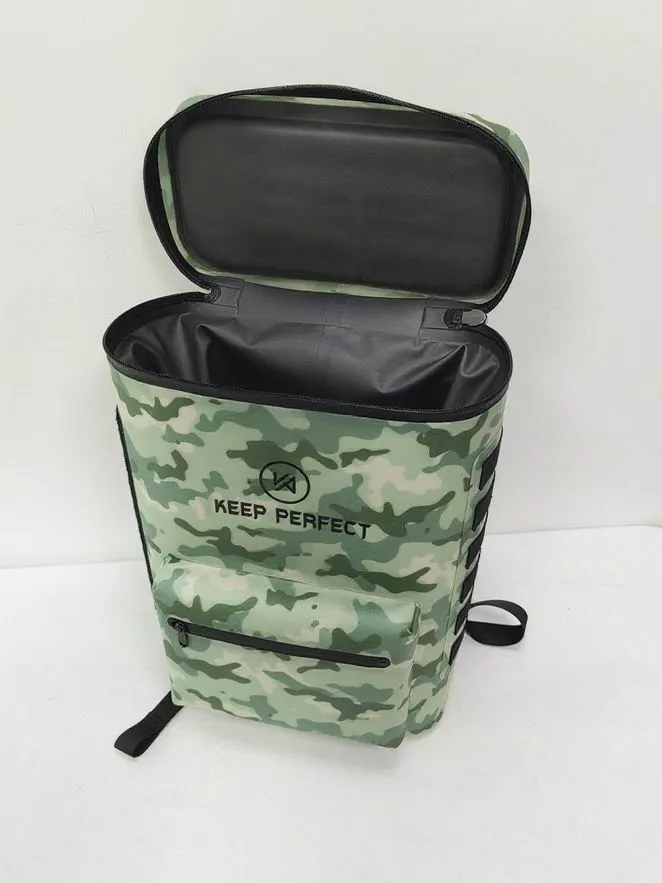
Select on evidence capability, not follower count
The selection decision determines everything downstream, and most outdoor creator partnerships are lost at this step. The standard filter is reach, with engagement rate as a secondary check, and neither measures the thing that matters in influencer marketing for a waterproof product: whether this person will put the product into water and show the result. A creator who has never shown a product failing, who never states conditions, and whose comments are compliments rather than questions will produce a post that looks good and converts at roughly the rate of the brand’s own lifestyle photography.
Evidence capability is observable before you contact anyone. Scroll twelve months of a creator’s output and look for four signals: whether they have ever shown something not working, whether they state conditions and durations when they test, whether their audience asks technical questions, and whether their content is shot in the environment your product is used in rather than staged for the camera. A creator with all four and nine thousand followers will outperform one with none of them and ninety thousand.
| Signal | What to look for | Why it predicts value | Weight |
|---|---|---|---|
| Has shown a product failing | A past post naming something that did not work and why | Audiences trust a creator who has said no before | Highest |
| States conditions and durations | Depth, time, temperature, load mentioned without prompting | Their content can carry a real performance claim | Highest |
| Audience asks technical questions | Comments contain fit, material, and use-case questions | The audience is buying, not browsing | High |
| Shoots in the real environment | Content filmed on water, in rain, or on trail rather than staged | The evidence will look credible rather than produced | High |
| Uses the product category already | Existing familiarity with dry bags, packs or technical gear | Lower briefing cost and a believable recommendation | Medium |
| Comments contain use cases | Followers describing their own trips and conditions | Content will generate qualified demand | Medium |
| Engagement rate and reach | Standard metrics | Needed for scale, meaningless without the above | Lowest of these |
Engagement rate is worth one line because it is over-weighted. Typical rates run from roughly one to three per cent on image platforms and higher for small accounts, but a three per cent rate composed of emoji comments has no commercial value. Read thirty comments rather than calculating one ratio. If the comments contain questions about whether something fits, whether it survives a specific activity, or how it compares, the account is commercially alive; if they contain praise, it is not.
Reach still matters, just later in the sequence. Use evidence capability to qualify, then use reach to scale: commission the most credible creators first regardless of size, and once a format is proven to convert, buy additional reach on the same format from larger accounts. That order converts the budget from a guess into a repeatable model, and it is the sequencing principle behind the asset library approach in the digital marketing guide for waterproof bag brands.
Where the credible outdoor creators actually are
Sourcing is where programmes stall, because the obvious tools optimise for reach and the useful creators are not the ones those tools surface. The people who run paddling clubs, guide trips, delivery rounds, dive boats and trail crews have genuine evidence capability and small audiences. They are found through the activity, not through a creator marketplace.
- Activity communities: paddling, sailing, angling, bikepacking, trail running and overlanding groups where members post real trip reports.
- Guide and instructor networks: people who lead trips and therefore test equipment constantly and publicly.
- Your own customer list: customers who have already posted photographs of your product in use are pre-qualified and already believe in it.
- Review and forum contributors: people who write long, specific gear assessments are the natural authors of verification content.
- Specialist micro-communities: a marine electronics group or a whitewater group converts better per impression than a general outdoor audience.
- Creator platforms as a second pass, filtered by evidence capability signals rather than by follower count.
Your own customers deserve priority. Someone who bought the product, used it in a real trip and posted about it unprompted has already demonstrated evidence capability and affinity, and the cost of formalising that relationship is one email and one agreement. Brands frequently spend thousands sourcing strangers while ignoring a list of people who have already done the work for free.
Qualify before you brief. Send a short message asking what they would want to test and in what conditions, and read the answer. A creator who proposes a specific, testable scenario is ready; one who asks what you want them to say is not. That single exchange filters more effectively than any metric, and it takes one round of email rather than a sourcing budget.
Keep a living roster rather than a campaign list. Record every creator contacted, their activity, their evidence signals, what you sent, what they delivered, how it performed, and what the arrangement cost. A roster built over four quarters is a genuine asset; a list assembled per campaign is a recurring expense. The commercial context for that is set out in the market analysis for waterproof bags.
Commission verification, not lifestyle
In a category where the promise is invisible, the content type that converts is the one that makes the promise visible. That is verification content: a defined condition, a real test, and an observable result. Lifestyle content has a role — it builds recall and it fills social calendars — but it rarely resolves the doubt that blocks a waterproof purchase, and commissioning it as the primary deliverable is the second most common waste in this category after mis-selection.
| Content format | What it proves | Production burden on the creator | Conversion value |
|---|---|---|---|
| Submersion or dunk test with a dry proof object | The core promise under stated conditions | Low: one session, one tank or body of water | Highest |
| Spray or storm test in real weather | Rain protection for commuter and trail products | Low, but weather-dependent and slow to schedule | High |
| Long-term durability update after a season | That the product lasts, which no new brand can claim | Low effort, but requires a delay of months | Very high, and unique to creator content |
| Honest comparison against a competitor or a previous bag | Where the product stands on specific attributes | Moderate: needs both products and a fair framing | High, and builds credibility disproportionately |
| Teardown or construction explanation | Why the price is what it is | Moderate: needs access and some technical comfort | High for premium positioning |
| Packing and fit walkthrough | Whether the buyer’s kit actually fits | Low | High, because it prevents size returns |
| Lifestyle or scenic content | Nothing measurable | Low | Low on its own; useful only alongside the above |
Two formats deserve particular emphasis. The long-term update is the one asset a brand cannot produce for itself, because a new brand has no history and a customer will not trust a self-reported durability claim. A creator holding up a bag after a full season of use, showing the wear and saying what still works, answers the objection that no amount of launch marketing touches. And the honest comparison, in which the creator names something the competitor does better, buys credibility for everything else in the video.
Give conditions, not scripts, and never require an outcome. The brief should specify the test conditions — depth, duration, load, closure method — and explicitly state that the creator must report what happens, including if it fails. A creator who knows they are free to report a failure produces content whose positive result is worth something; a creator who senses the brand needs a win produces content that reads as advertising and converts accordingly.
Plan the content against the production calendar so the creator has a real unit in time for a real season. Sampling takes 6–10 working days and bulk 35–50 days, so product for a spring paddling season must be decided in the preceding autumn. Content commissioned in the peak week arrives after the demand has passed. The broader calendar logic is covered in the seasonal planning guide, and the brand-building sequence in building a waterproof bag ecommerce brand.
Gifting, paid and affiliate: three different purchases
The three commercial models are often presented as a ladder, and they are better understood as three different purchases. Gifting buys content and a relationship at the cost of goods, but buys no control over timing, format or whether anything appears at all. Paid buys control and predictability at a known cost, and is the only model that reliably produces assets on a deadline. Affiliate buys ongoing distribution with variable cost, and works best where a creator already has durable search or evergreen content.
| Model | Typical cost | What you control | What it is best for |
|---|---|---|---|
| Product gifting | Unit cost plus shipping, often USD 20 to 80 per creator | Almost nothing without a written agreement | Discovery, relationship building, and finding unexpected credible voices |
| Gifting plus affiliate commission | Unit cost plus 8 to 15 per cent of attributed sales | Nothing on delivery; commission aligns incentives | Scaling a roster of small creators with minimal fixed cost |
| Paid single post or video | Roughly USD 150 to 600 micro, 600 to 3,000 mid-tier, 3,000 to 15,000 plus macro | Format, timing, usage rights and disclosure | Producing specific assets on a deadline for a launch or season |
| Paid plus usage licence | The above plus typically 20 to 50 per cent for defined paid usage rights | Everything above plus the right to reuse in advertising | The highest-value structure for this category |
| Ongoing ambassador programme | Monthly retainer, often USD 300 to 2,000, plus product | Relationship, continuity and recurring content | Building durable credibility with a defined activity community |
| Affiliate only | Commission only, no fixed cost | Nothing on content; cost follows results | Evergreen review content and search-driven creators |
The most efficient structure for a waterproof brand is paid content plus a usage licence, because the licence is frequently worth more than the post. A single creator video used on the product page, in paid social, in email and in a marketplace listing can outperform the original post by a wide margin, and it keeps working after the post has scrolled out of view. Negotiating that licence at the outset is far cheaper than returning to ask for it later.
Affiliate deserves one caution: it attracts creators who optimise for search and discount rather than for evidence, which can put your product alongside coupon content and price comparisons. Pair affiliate with a content standard — a minimum format, a requirement to state conditions, or a prohibition on discount-only promotions — or accept that the channel will trade on price rather than on performance.
Budget the mix by stage. Early on, allocate most of the creator budget to a small number of paid verification pieces with licences, because those become the asset library. Once the library exists, shift toward gifting plus affiliate to widen the roster at low fixed cost, and toward ambassadors in the one or two activity communities that convert best. The review-generation mechanics that sit behind gifting programmes are treated in the review generation guide, and the compliance boundary there applies equally here.
The most common failure: free product, no deliverable
Every brand that runs a gifting programme eventually learns this lesson, usually expensively. Product is sent to a list of creators with a friendly email and no written agreement, and a meaningful share of it never produces anything. Not because the creators acted in bad faith, but because nothing was specified: no format, no deadline, no definition of what counts as delivery, and no consequence for silence. The brand has spent hundreds or thousands of dollars on goods and received nothing it can use.
- Put every gifting arrangement in writing, even a short email that is explicitly confirmed as agreed.
- Specify the deliverable: format, platform, minimum length or number of frames, and the required conditions to be shown.
- Specify the deadline, and a fallback if the season or weather prevents the planned test.
- Specify what happens if nothing is delivered: a conversation, a return of the product, or removal from the roster.
- Specify the disclosure requirement, because it is the brand’s obligation as well as the creator’s.
- Specify whether the brand may reuse the content, and in what channels, even at no additional cost.
The fix is cheap and unglamorous: a one-page gifting agreement. It does not need to read like a contract, but it must state what is being sent, what will be produced, by when, with what disclosure, and what rights the brand has in the result. Creators who are serious accept this without friction, and the ones who object were unlikely to deliver anyway. The agreement is therefore a filter as well as a protection.
Track delivery rate per creator and treat it as a selection input. A creator who delivered well is worth a paid engagement next season; one who took product and delivered nothing is not, regardless of their audience. This is the single most useful piece of data a gifting programme produces, and it is almost never recorded.
Set expectations about product condition too. A creator who tests properly will return a wet, possibly muddy bag, and that is evidence the arrangement worked. Agree in advance that the unit is theirs to keep after testing, that it should not be returned to stock, and that the brand may ask for specific photographs of wear. Those photographs are often the most persuasive durable asset the whole programme produces.
Contract terms that decide the value of the deal
A creator agreement is not a formality; it is where the commercial value is set. The post itself is a single publication with a short life, and the licence is what turns it into a reusable asset. Four clauses carry most of the weight: usage rights, term, exclusivity, and deliverables with remedies.
| Clause | What to specify | Common default and its cost | Reasonable position |
|---|---|---|---|
| Usage rights | Which channels, organic or paid, and for how long | Organic repost only, which blocks paid use | Organic plus defined paid usage for a stated term, priced as an uplift |
| Term of licence | Six to twelve months, or perpetual with attribution | Undefined, which later becomes a renegotiation | Twelve months renewable, or perpetual for a higher fee |
| Exclusivity | Category scope and duration, and whether competing brands are barred | Broad category exclusivity requested by the brand at no extra cost | Narrow: one product category, three to six months, paid for explicitly |
| Deliverables | Number, format, platform, deadline, and required conditions shown | Vague, which makes non-delivery unenforceable | Itemised, with dates and a definition of completion |
| Approval rights | What the brand may review, and how quickly | Full script approval, which kills authenticity | Factual accuracy review only, within a stated turnaround |
| Disclosure | How the relationship must be disclosed, in the content itself | Left to the creator, which exposes the brand | Specified placement and wording, required by contract |
| Remedies | What happens on non-delivery or on a disclosure failure | Nothing, so there is no consequence | A cure period, then a fee adjustment or termination |
| Attribution | Links, codes or landing pages to be used | No tracking, so performance is unknown | One tracked link or code per creator and per placement |
Approval rights deserve emphasis because they are where brands quietly destroy the value they paid for. Full script approval produces content that reads as an advertisement, and the audience detects it immediately. The defensible position is factual review: the brand may correct a specification, a rating or a claim, within a short turnaround, and may not change the creator’s opinion or edit out a criticism. That is both more effective and more honest.
Exclusivity should be narrow and paid for. A creator who paddles cannot plausibly avoid all bag brands for a year, and asking for that either gets refused or gets agreed and then quietly breached. One product category, three to six months, with a fee attached, is enforceable and proportionate, and it protects the specific commercial interest without making the arrangement uncomfortable.
Pay on delivery, not on posting, where possible, and keep the payment schedule simple. A deposit and a balance on approved delivery is standard and protects both sides. Complicated milestone structures cost more in administration than they recover in control, particularly at the micro-creator scale where the fees are small.
Disclosure is the brand’s obligation too
A common misunderstanding is that disclosure is the creator’s problem. It is not. Regulators in major markets treat the brand as responsible for ensuring that material connections are disclosed clearly and conspicuously, and a brand that pays for content and takes no steps to ensure disclosure is exposed regardless of what the creator did. The practical requirement is that the disclosure must be in the content itself, not buried, not only in a caption that requires expansion, and not dependent on a platform’s own tool alone.
- Require disclosure in the contract, with specified placement and wording, not a general reference to following the rules.
- Disclosure must appear where the audience will see it: in the video as well as the description, in the first lines of a caption.
- A free product is a material connection and requires disclosure even with no payment and no obligation to post.
- Platform disclosure tools help but do not substitute for a clear statement in the content.
- Do not ask a creator to remove or soften a disclosure, and do not approve content that lacks one.
- Keep records of what was agreed and what was delivered, including disclosure, for each engagement.
Two related obligations follow. First, the creator must have actually used the product; endorsing something untested is precisely what the rules prohibit, and this is why gifting without conditions is risky. Second, any performance claim made in creator content must be one the brand can substantiate, because it becomes the brand’s claim the moment the brand approves, amplifies or republishes it. A creator saying “it survived two metres for an hour” on a product rated for one metre is now the brand’s problem.
Guidance is published and consistent across major markets. The US Federal Trade Commission guidance on endorsements and testimonials sets out the material connection principle, and the UK Advertising Standards Authority publishes equivalent rules and rulings on influencer disclosure. The European Commission consumer protection framework covers the same ground on misleading commercial practices. One clause in the contract and one check before payment satisfies all three.
Brief conditions, never outcomes
The brief is the difference between content that converts and content that looks like an advertisement, and the failure is nearly always over-specification. A brand that hands a creator a shot list, a script and a list of required phrases will receive exactly what it asked for, and it will perform at roughly the level of the brand’s own advertising. Authenticity is not a stylistic preference; it is the mechanism by which creator content borrows the trust the creator has already earned.
- State the product, the rating and the boundary, so the creator cannot accidentally overclaim.
- State the conditions you want shown: depth, duration, load, closure method, environment.
- State explicitly that an honest negative result is acceptable and will not affect payment or the relationship.
- State the one question the content should answer, and let the creator decide how.
- Do not supply a script, required phrases, or a mandatory product shot list.
- Do not require approval of opinions; limit review to factual accuracy and disclosure.
Provide technical support rather than creative direction. Send the test data, the rating documentation and a note on how the closure should be operated, because a creator who rolls a top incorrectly will report a failure that is not the product’s fault. That single piece of briefing prevents the most damaging possible outcome: a credible creator publishing a genuine-looking test that failed for a procedural reason.
Ask for the raw footage. Most creators are willing to supply unedited or lightly edited material, and the raw file is what makes the content reusable across channels. A thirty-minute uncut take of a submersion test can become a hero clip, three stills, a marketplace image and an email block. The finished post cannot. Negotiate this in the agreement, because asking afterwards is a second negotiation with less leverage.
The photography standard that applies to your own studio work applies here too: continuous takes, stated conditions, scale references and honest colour. Sharing that standard with creators raises the usability of everything they produce, and it is set out in the waterproof product photography guide. Where a creator’s footage meets the standard, it can go straight into the asset library.
Measure the partnership honestly
Creator partnerships are usually reported on impressions and engagement, which are the two metrics least connected to commercial outcome. The useful chain runs from content to qualified visit, to conversion, to contribution after returns, and to whether the asset keeps producing after the campaign ends. Reporting the second chain requires one tracked link or code per creator and per placement, and a landing page that matches what the content promised.
| Metric | How to capture it | What it tells you | Why the common metric misleads |
|---|---|---|---|
| Attributed sessions | One tracked link or code per creator | Whether the audience visited at all | Reach does not measure intent |
| Conversion rate on that traffic | Sessions to orders on the tracked landing page | Whether the audience is a buying audience | Engagement counts likes, not purchases |
| Contribution after returns | Revenue less cost of goods, fees, returns and the creator fee | Whether the partnership made money | Revenue attribution ignores returns and fees |
| Assisted conversions | Multi-touch or view-through reporting over a defined window | The effect of content that informed a later purchase | Last-click undervalues creator content systematically |
| Asset value | Performance of the licensed content on your own channels | The part that keeps working after the post | Ignored entirely in most reporting |
| Repeat and roster effect | Whether the same creator’s audience buys again | Whether to renew the relationship | One-off reporting hides compounding |
Attribution has a known bias worth naming: creator content is disproportionately an upper-funnel influence, so last-click reporting systematically undervalues it and overvalues the retargeting impression that closed the sale. Judge creator work over a defined window rather than a single session, and hold one channel constant occasionally to see what happens. Without that discipline, brands cut the content that created demand and increase spend on the ad that harvested it.
Separate the two values in the reporting: the value of the publication and the value of the asset. A post that performed modestly but produced footage that converts on the product page for a year may be the best value in the whole programme, and a post with impressive reach that produced nothing reusable may be the worst. Report them as two lines and the renewal decision becomes obvious.
Set a threshold before the campaign. If contribution after returns and fees does not exceed the cost within a defined window, the partnership does not renew on the same terms. Pre-agreed thresholds prevent the most common budgeting error in creator work, which is renewing relationships because the content was pleasant rather than because it produced contribution.
Convert creator output into owned channel assets
This is the step that turns a marketing expense into a balance-sheet asset, and it is the step most often skipped. A creator post has a life measured in days. The same footage, licensed and edited, can serve the product page, paid social, email, the marketplace listing, retail sell sheets and wholesale presentations for a year or more. The licence negotiated at the outset is what makes that possible, and the cost of the licence is usually a fraction of the value it unlocks.
- Negotiate organic and paid usage rights at the outset, with a defined term, rather than returning later.
- Request raw or lightly edited footage, not only the finished cut.
- Edit channel-specific derivatives: vertical for social, stills for listings, a short proof clip for the product page.
- Keep creator attribution wherever the content is used; it is usually a licence condition and it also aids credibility.
- Store assets in the same library as brand-produced content, with the same naming convention and rights register.
- Record the licence expiry and set a renewal reminder before the term ends.
Attribution matters commercially as well as legally. Content presented with the creator’s name and handle retains the trust it earned, and content stripped of attribution loses a meaningful share of that effect while often breaching the licence. Where a platform allows it, use the official partnership or branded content mechanism so both parties are credited and the disclosure travels with the asset.
Customer-generated and creator-generated content also feeds the review ecosystem, which is where the language buyers search actually comes from. Where a creator also leaves a review or answers questions, that content is both evidence and search material. The rules about incentivising reviews apply here with full force: a gifted product must be disclosed, and nothing may be conditioned on a positive rating. The mechanics are set out in the review generation guide.
Finally, feed the creator’s findings back into the product. A paddling creator who reports that the roll-top is awkward with cold hands has given you a specification input that no survey would have produced. Record it in the same defect taxonomy used for returns and reviews, and it becomes a change in the next production run rather than an interesting conversation.
Build a roster, not a series of one-offs
One-off creator engagements produce content; a roster produces a compounding position inside an activity community. The difference is that a roster of paddling creators who all use and test your product creates a presumption among that community that the product is what paddlers use, and no single post can buy that. Building it takes three or four quarters and a deliberate structure.
- Pick one or two activity communities first rather than spreading thinly across five.
- Anchor the roster with two or three credible, evidence-capable creators regardless of size.
- Add a wider tier of smaller creators through gifting plus affiliate to broaden presence at low fixed cost.
- Renew the creators who delivered and converted; drop those who did not, politely and without drama.
- Give the roster something to test each season, so there is a reason for recurring content.
- Bring the roster into product development: ask what they would change, and tell them what changed as a result.
Renewal economics favour the roster heavily. A second engagement with a creator who already knows the product, has an established relationship with the audience, and has proven they deliver costs less to brief, produces better content, and converts better because the audience has seen the product before. The first engagement is an experiment; the third is a channel.
Concentration in one community has a strategic payoff that reach-based programmes miss. A brand that is visibly the dry bag used by the whitewater community in one region can expand to adjacent activities from a position of credibility, whereas a brand with scattered posts across ten activities is nowhere in particular. Depth first, then adjacency.
Where the brand also sells wholesale or into institutions, creator evidence has a second use that is frequently overlooked: a buyer evaluating a range responds to field proof from people who actually use the product professionally. Creator footage belongs in the same sell-in material as your own testing, and the B2B mechanics are covered in the B2B sales conversion guide, with event and face-to-face context in the trade show strategies guide.
Budget against the season, and test before scaling
Outdoor creator work is seasonal in a way that catches brands out, because the content has to be produced before the season and consumed during it. A paddling video commissioned in June arrives after the buying decision has been made. The production calendar runs backwards from the season: select and contract roughly ten to fourteen weeks ahead, ship product early enough for a real test, allow four to six weeks for the creator to actually use the product in genuine conditions, then publish as the season opens.
| Weeks before the season | Workstream | Deliverable | Why the timing is fixed |
|---|---|---|---|
| 16 to 14 | Selection and contracting | Signed agreements with usage rights | Good creators book up; late outreach gets refusals |
| 12 to 10 | Product allocation and shipping | Production units in the creator’s hands | Sampling takes 6–10 working days, bulk 35–50 days |
| 8 to 4 | Field use and testing | Real trips, real conditions, raw footage | Creators need genuine conditions, which cannot be scheduled |
| 4 to 2 | Editing, factual review, disclosure check | Approved content with disclosure in place | Factual corrections are cheap before publication |
| Season opening | Publication and paid amplification | Live content plus licensed derivatives | Demand peaks; assets must exist before it does |
| After season | Measurement and roster decision | Contribution per creator and renewal list | Renewal decisions need data, not impressions |
Budget structure should follow the season rather than being spread evenly. A common allocation is to spend the majority of the annual creator budget in the two quarters preceding the main season, with a smaller always-on layer of gifting and affiliate activity maintaining presence year-round. Even spreading produces content that is neither early enough nor sustained enough.
Test before scaling, and keep the test honest. Commission three to five creators across different sizes and formats in one season, measure contribution after returns and fees, and only then scale the winner. Five small tests produce more usable knowledge than one large bet, and the cost of being wrong at five-creator scale is survivable in a way that a single macro bet is not.
One mechanism is worth building into the test design: holdout comparison. Publish creator content for one region or one product line and not another for a defined window, and compare. Without a comparison, every result can be explained by seasonality, and creator budgets get defended or cut on anecdote rather than on evidence.
The evidence that creator content produces should be verifiable in the same way your own claims are. Where a creator reports a performance result, confirm it against your own testing so that amplifying the content does not publish a claim you cannot support. The relationship between laboratory testing and field validation is set out in the guide to laboratory and real-world validation, and claim substantiation in the testing standards guide. Once the content engine works, the remaining constraint is the product itself, and changing it runs from specification through sampling into bulk. Review the process from first enquiry through sampling into bulk production; minimum order quantity is 500 pieces per style, sampling takes 6–10 working days, bulk takes 35–50 days, quoted FOB Xiamen.
Frequently Asked Questions
Q1. Should I choose outdoor creators by follower count?
No. Choose by evidence capability: whether they have shown a product failing, whether they state conditions and durations, whether their audience asks technical questions, and whether they shoot in the real environment. Reach scales a proven format; it does not create one.
Q2. What signals show a creator will produce useful waterproof content?
Past content naming something that did not work, specific conditions and durations stated unprompted, comments containing fit and use-case questions, and footage shot on water or in rain rather than staged.
Q3. Why does lifestyle content underperform for waterproof products?
Because the promise is invisible. A scenic post resolves no doubt, while a submersion test with a dry proof object does. Lifestyle content has a supporting role but should rarely be the primary deliverable.
Q4. What is the most valuable content format to commission?
A submersion or storm test under stated conditions, and a long-term update after a full season of use. The second is the one asset a brand cannot produce for itself, because no new brand has a history.
Q5. What does gifting cost versus a paid post?
Gifting costs the unit plus shipping, often USD 20 to 80, but buys almost no control. Paid content typically runs USD 150 to 600 for a micro creator and USD 600 to 3,000 for mid-tier, and buys format, timing, usage rights and enforceable disclosure.
Q6. What is the most common failure in creator programmes?
Sending free product with no written agreement specifying a deliverable, a deadline and a disclosure requirement. A large share of gifted product produces nothing, and the fix is a one-page agreement sent before the product ships.
Q7. Should the brand get rights to reuse creator content?
Yes, and negotiate at the outset. Organic plus defined paid usage for a stated term is usually worth more than the post itself, because the footage can serve the product page, paid social, email and listings for a year.
Q8. How much should usage rights cost?
Commonly an uplift of roughly 20 to 50 per cent on the content fee for defined paid usage over a stated term. Negotiating it later is a second negotiation with less leverage, so agree it in the first contract.
Q9. Who is responsible for disclosure?
Both, but the brand cannot delegate it. Regulators treat the brand as responsible for ensuring material connections are disclosed in the content itself, so the requirement must be in the contract and checked before payment.
Q10. Is a free product enough to require disclosure?
Yes. A gifted product is a material connection even with no payment and no obligation to post. The disclosure must appear in the content, not only in a caption that requires expansion.
Q11. Should I approve creator scripts before publication?
No. Limit review to factual accuracy and disclosure within a short turnaround. Full script approval produces content that reads as advertising and destroys the trust you were paying to borrow.
Q12. What exclusivity should I ask for?
Narrow and paid for: one product category for three to six months. A broad request to avoid all competing brands is either refused or quietly breached, and it makes the arrangement uncomfortable.
Q13. How should creator partnerships be measured?
Attributed sessions, conversion on that traffic, contribution after returns and fees, assisted conversions over a window, and the ongoing value of the licensed asset. Impressions and engagement measure attention, not outcome.
Q14. Why does last-click attribution undervalue creator work?
Because creator content is usually upper-funnel. Last-click credits the retargeting impression that closed the sale and undervalues the content that created the demand, which leads brands to cut what actually worked.
Q15. How far ahead should outdoor creator content be planned?
Roughly ten to fourteen weeks before the season for selection and contracting, product in hand eight to twelve weeks ahead, four to eight weeks for genuine field use, and publication as the season opens.
Q16. Should I build a roster or run one-off campaigns?
A roster. Repeated work with the same credible creators in one activity community builds a presumption that the product is what that community uses, and each renewal costs less to brief and converts better than the last.
Q17. How should I test before scaling creator spend?
Commission three to five creators across different sizes and formats in one season, measure contribution after returns and fees, then scale the winner. Use a regional or product-line holdout so seasonality does not explain the result away.
People Also Ask
How do I choose an outdoor influencer for a waterproof bag?
Choose evidence capability over reach: look for creators who have shown products failing, state test conditions, and shoot in real conditions.
What content works best for waterproof products?
Verification: a submersion or storm test with a dry proof object under stated conditions, plus a durability update after a season of use.
Should I pay creators or just send free product?
Gifting costs little but buys no control. Paid content buys format, timing, usage rights and enforceable disclosure, which is usually worth the fee.
Do I need rights to reuse influencer content?
Yes. Negotiate organic and paid usage rights at the outset; the licensed footage is often worth more than the original post.
Who must disclose a paid partnership?
The creator must disclose, and the brand must ensure it happens. Regulators hold the brand responsible for disclosure in the content itself.
How far ahead should I plan outdoor creator campaigns?
Ten to fourteen weeks for contracting, product in hand eight to twelve weeks ahead, and four to eight weeks of genuine field use before the season opens.